International Guild of Realism continues to provide collectors access to among the best in contemporary realism artwork through its exhibitions and events. Its second Spring Salon Online Exhibition will feature more than 230 new works of art by some of the organization’s esteemed artists through online platforms where purchasers will be able to communicate directly with IGOR to buy artwork. The show will be online from March 20 through May 20.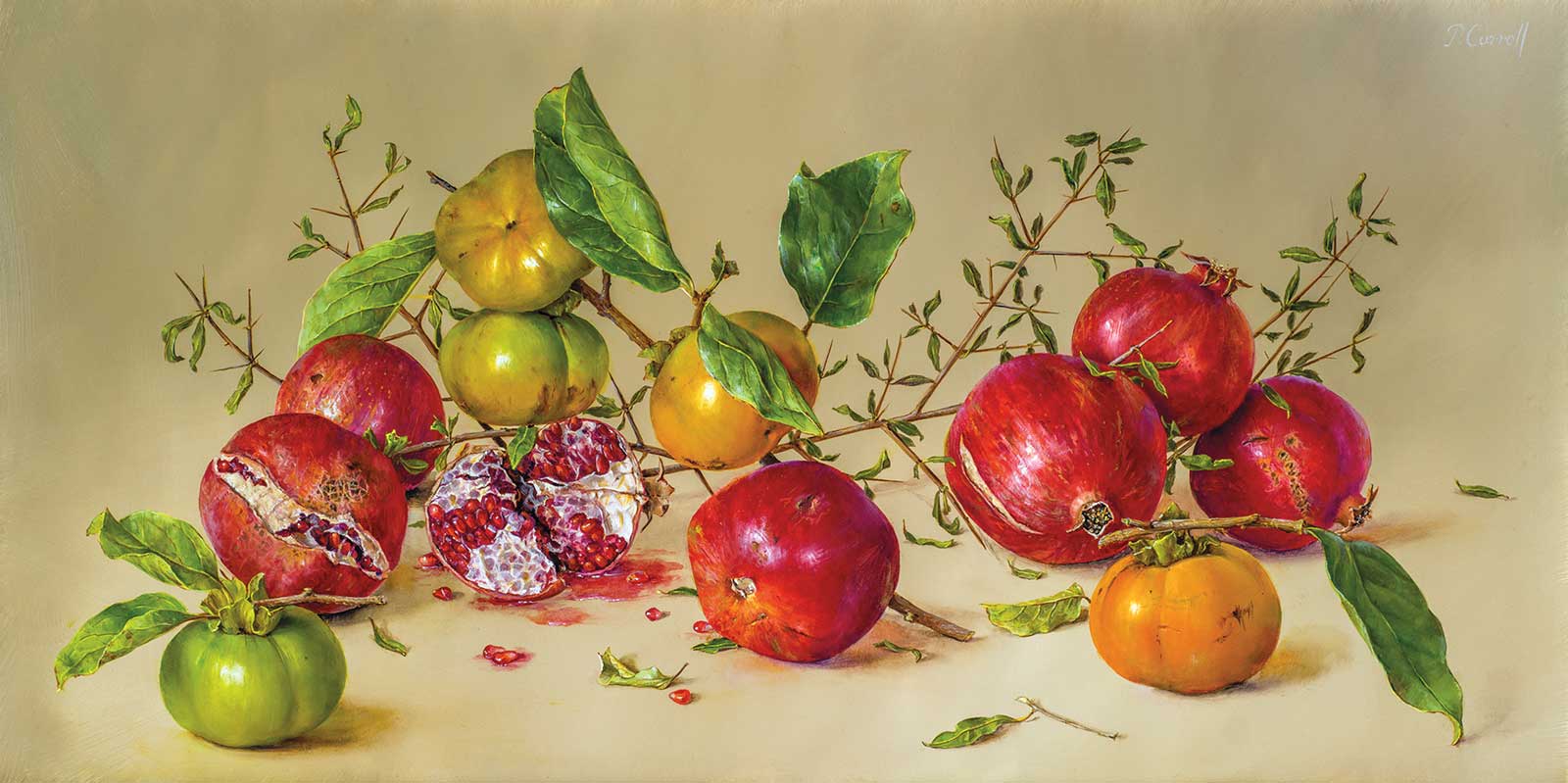 Pamela Carroll, Pomegranates and Persimmons, oil, 12 x 24"“As an original charter member of the International Guild of Realism, I am thrilled to see the amazing growth within IGOR over the past 16 years,” says Donald Clapper, artist and founding charter member. “IGOR is definitely a major player in the resurgence of academic realism in fine art. Our juried membership represents some of the very best realists in the world, and this year’s 2021 Spring Salon Online Exhibition is one of our best shows to date in terms of quality and number of paintings with 234 artworks from over 200 IGOR artists. Our juried membership hails not only from North America but from over 35 countries around the world. We are honored to have this year’s online exhibition showcased on three major websites: IGOR’s website, American Art Collector and QC Fine Art.”
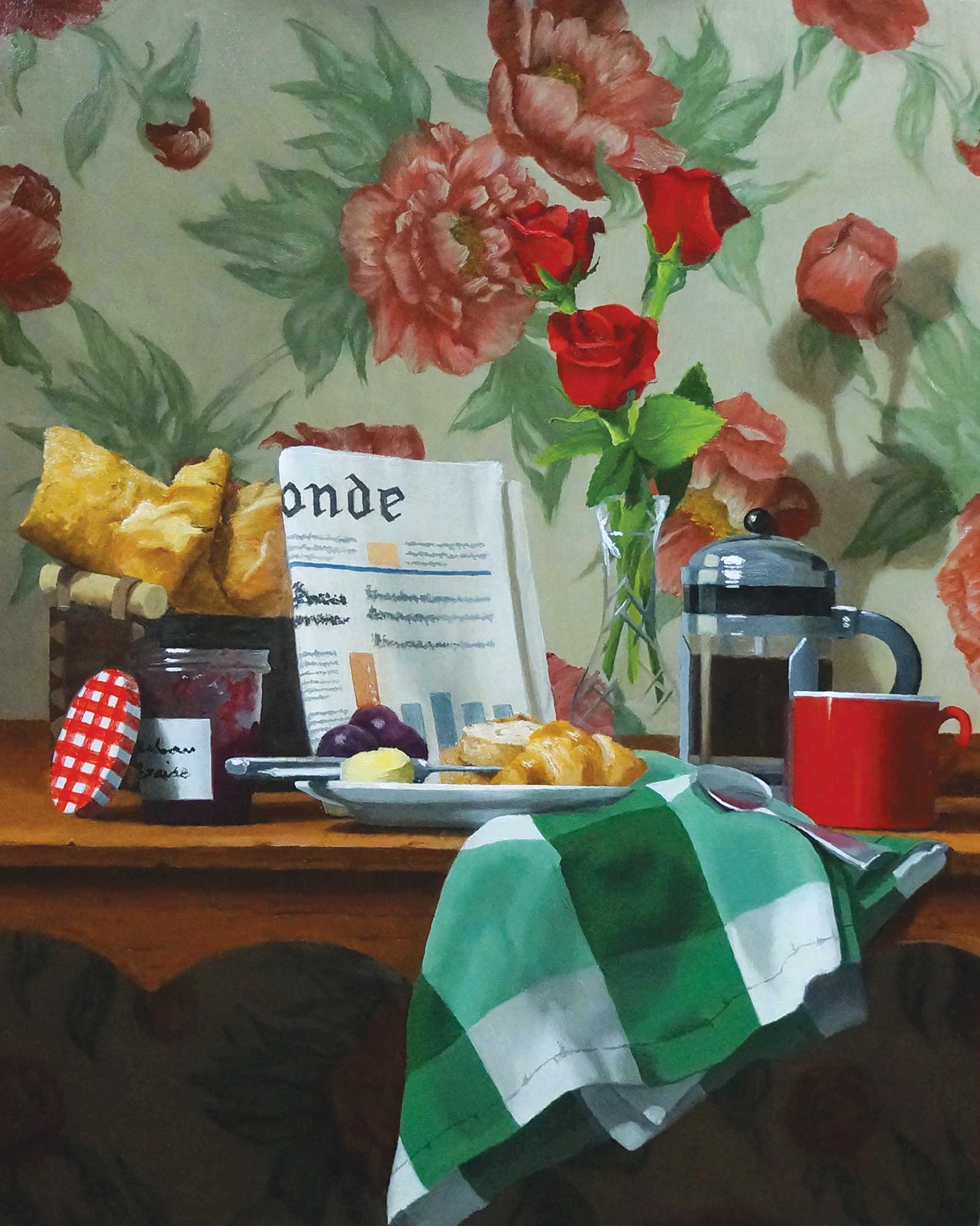 Claudia Seymour, French Press, oil on linen/panel, 20 x 16"
Included in the exhibition is artwork from Aki Kano, Allan Gorman, Barbara Nuss, Bonnie Hamlin, Carol Stratman, Debbie Shirley, Deborah Flood, Deborah LaFogg Docherty, Francois Chartier, Irene Georgopoulou, Maria Villioti, Marianna Foster, Nancy Jacey, Pamela Carroll, Rebecca Luncan, Susan Helen Strok, Trisha Lambi and Will B. Reyes. The artwork will be in a variety of styles and mediums, as well as diverse subject matter including still life, figures and landscapes, to name a few.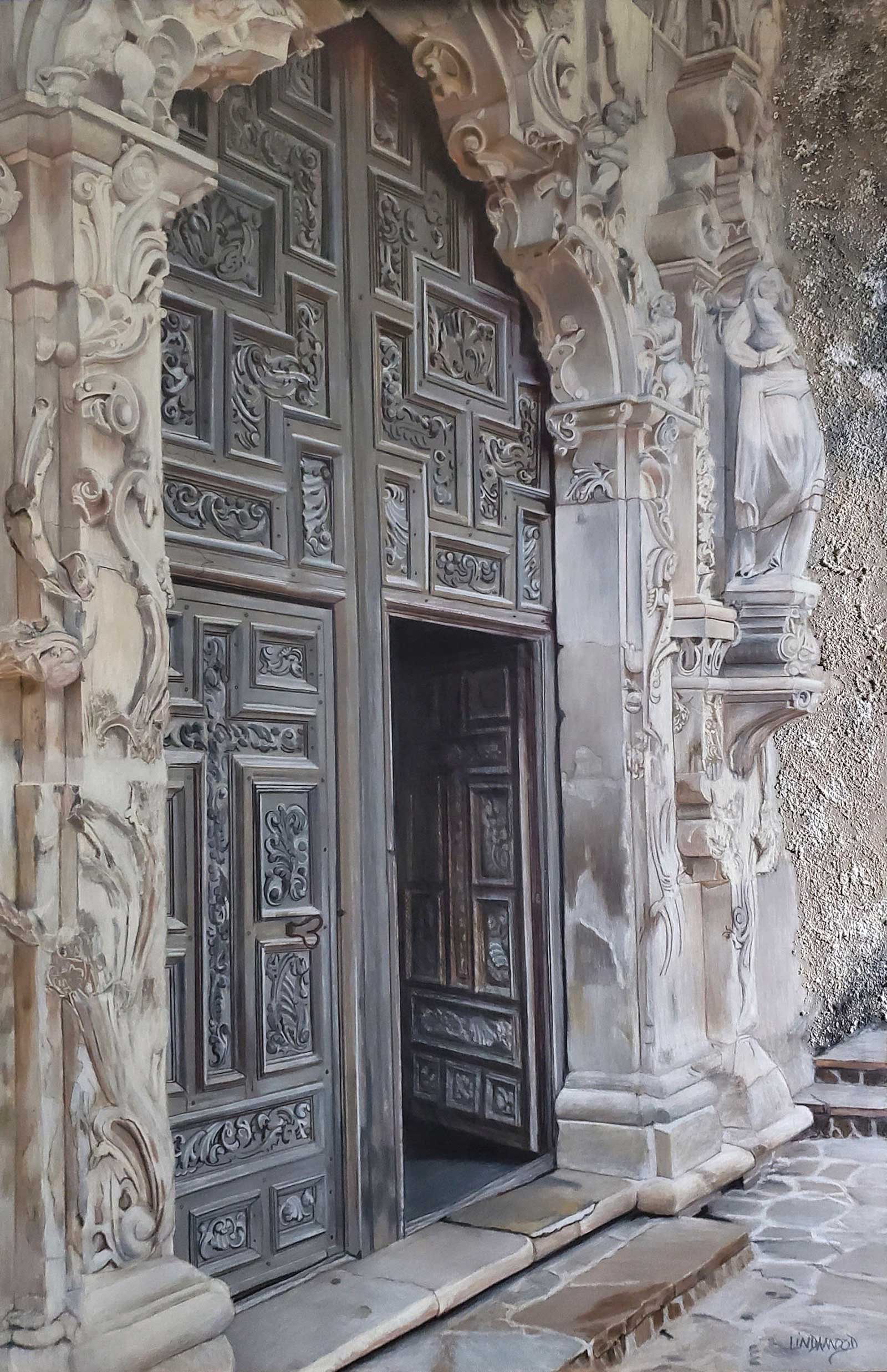 Patsy Lindamood, Through This Door, watercolor pencil on Ampersand Pastelbord with pastel ground, 36 x 24"
Artist Nathan Miller believes that nature and humanity need to become more intimately connected. His painting Forest Dream is one example of that intimate connection. “We have become so separate from nature, and I think we need to find a way to understand, respect and connect with the natural world,” he explains. “This piece depicts a beautiful young woman, hair flowing, clothed only in a warm blanket, sleeping peacefully on a bed of fall leaves.”
Diego Glazer’s figurative painting Silence is from a series titled Hemispheres that was inspired by the album from the rock band Rush. “Silence depicts the time when humanity had lost the inspiration to find their path through knowledge,” he says, “abandoning their cities in search of a life that was guided by love and emotion.”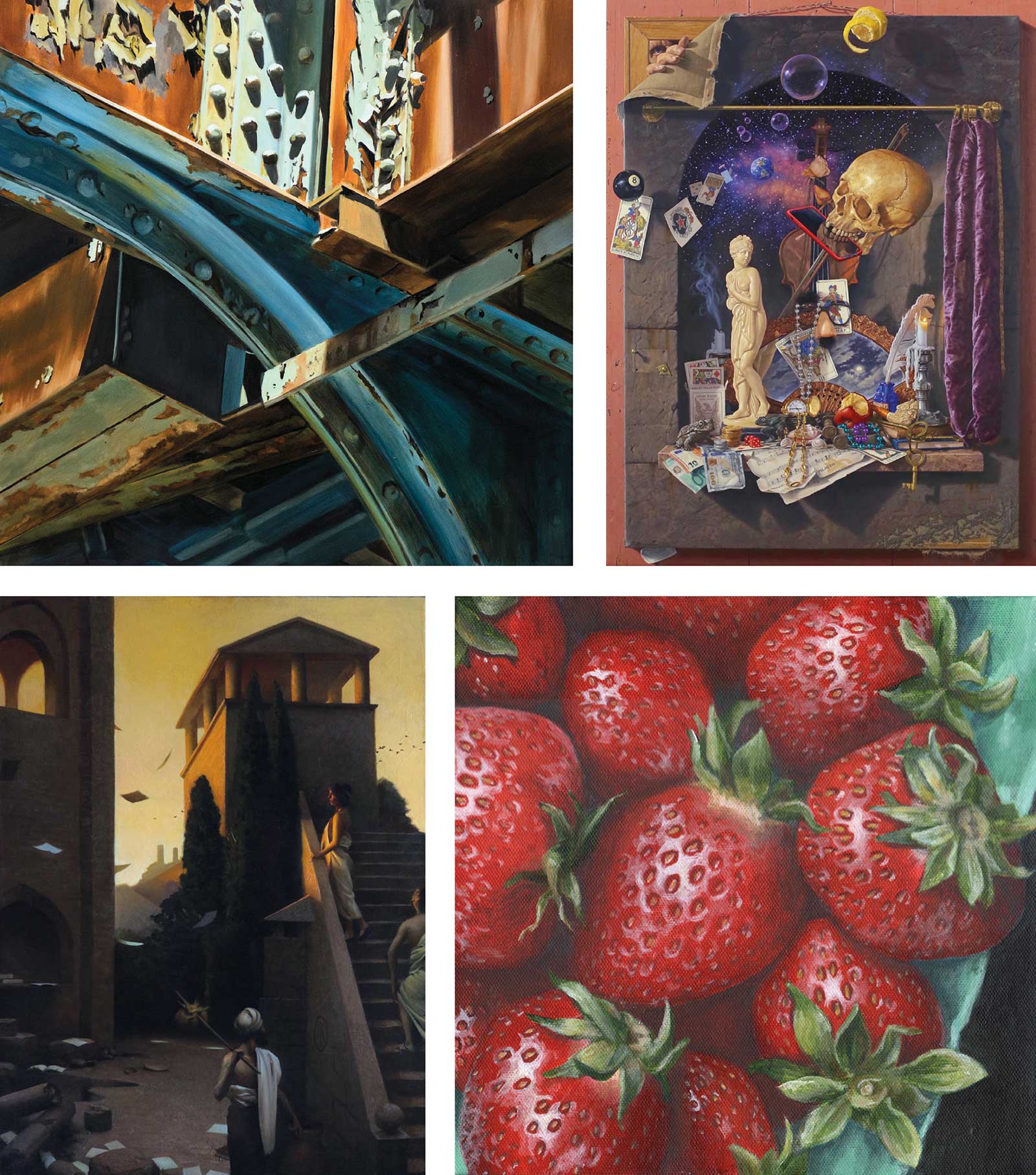 Clockwise from top left: Allan Gorman, Culver Line Rust, oil on panel, 30 x 30"; John C. Moffitt, All Is Vanity, oil on linen canvas, 40 x 30"; Debbie Shirley, Ruby Red, acrylic on canvas, 10 x 10"; Diego Glazer, Silence, oil on canvas, 27½ x 19½"Survivor 2020 is a portrait by Edi Matsumoto of a nonagenarian friend who is a retired psychologist. “She is a Holocaust survivor who fled Vienna as a young girl under the occupation of the Nazis. She came to the U.S. via Shanghai and became a psychologist to help others who suffer,” Matsumoto says. “Decades later, she fears and laments the country’s political divide while trying to survive the deadly pandemic and the loss of her beloved husband.”
Another portrait in the exhibition is Memento, by Ivan Pazlamatchev. “I started this painting with memories of being in renaissance buildings, where light filters inside in a beautiful way,” he shares. “It illuminates not only the art and interiors, but the people as well. It makes everyone and everything a work of art.”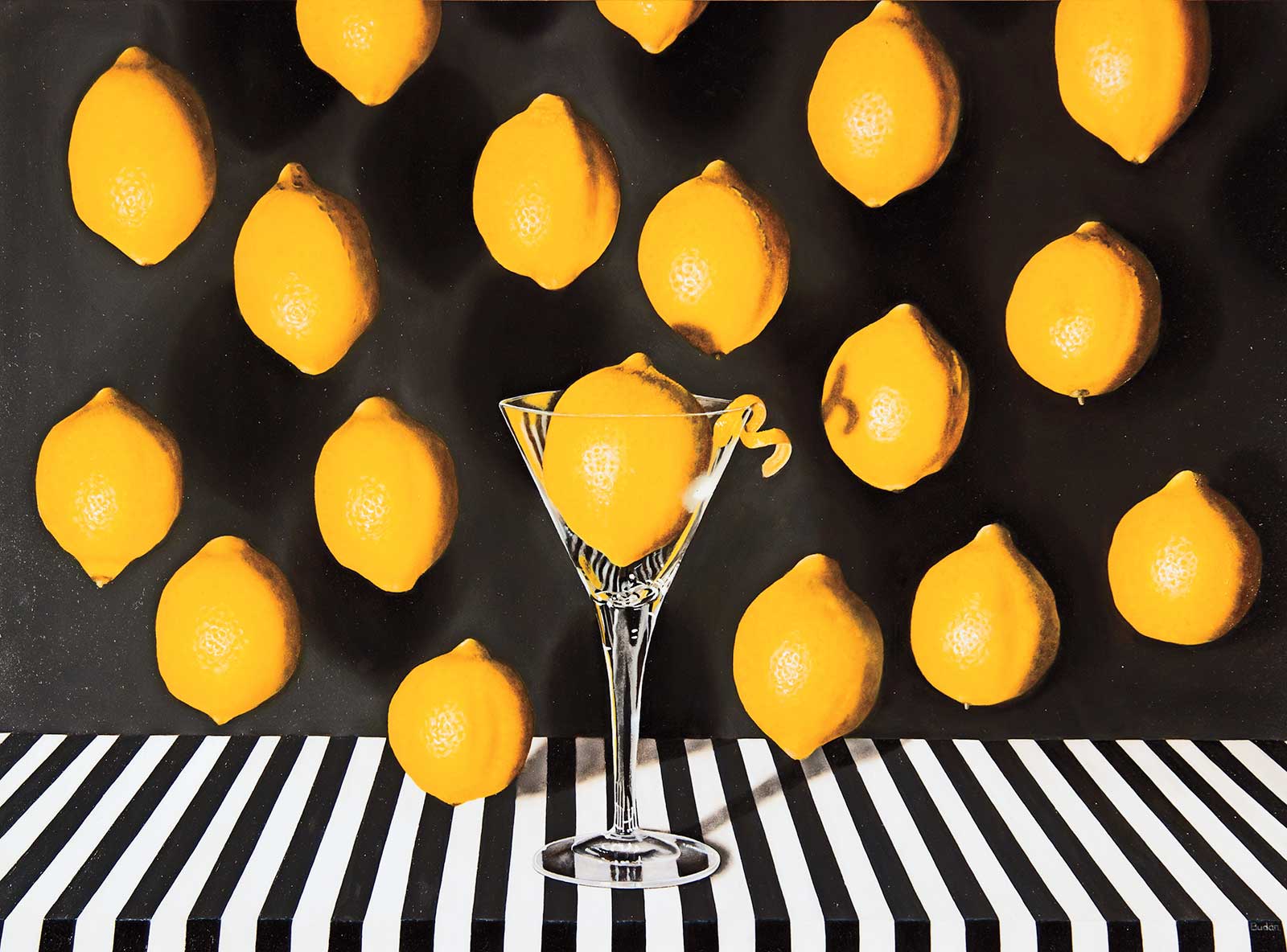 Karen Budan, Lemondrop Martini, oil on panel, 18 x 24"
Callisto is from a new series of allegorical paintings by artist Lisa Rickard. Of the work, she says, “Callisto is named after one of the most intriguing moons orbiting Jupiter. She allegorically represents the adventurous adolescent. Her bold, engaging yet pensive gesture is reminiscent of a young adult’s inexperience and exploratory nature.”
Stephen Mangum’s juried painting Illusions of My Childhood No. 6 is from his recent series of artworks highlighting social injustice. The work, he says, “is a current day portrait of my granddaughter painted with a background appropriated from an iconic photo taken by the late Bill Hudson documenting violence in Montgomery, Alabama, in 1963. Representing my DNA then and now, the portrait is painted with the background bleeding through, to show that the racial violence that occurred in the background of my life permeates the present day.”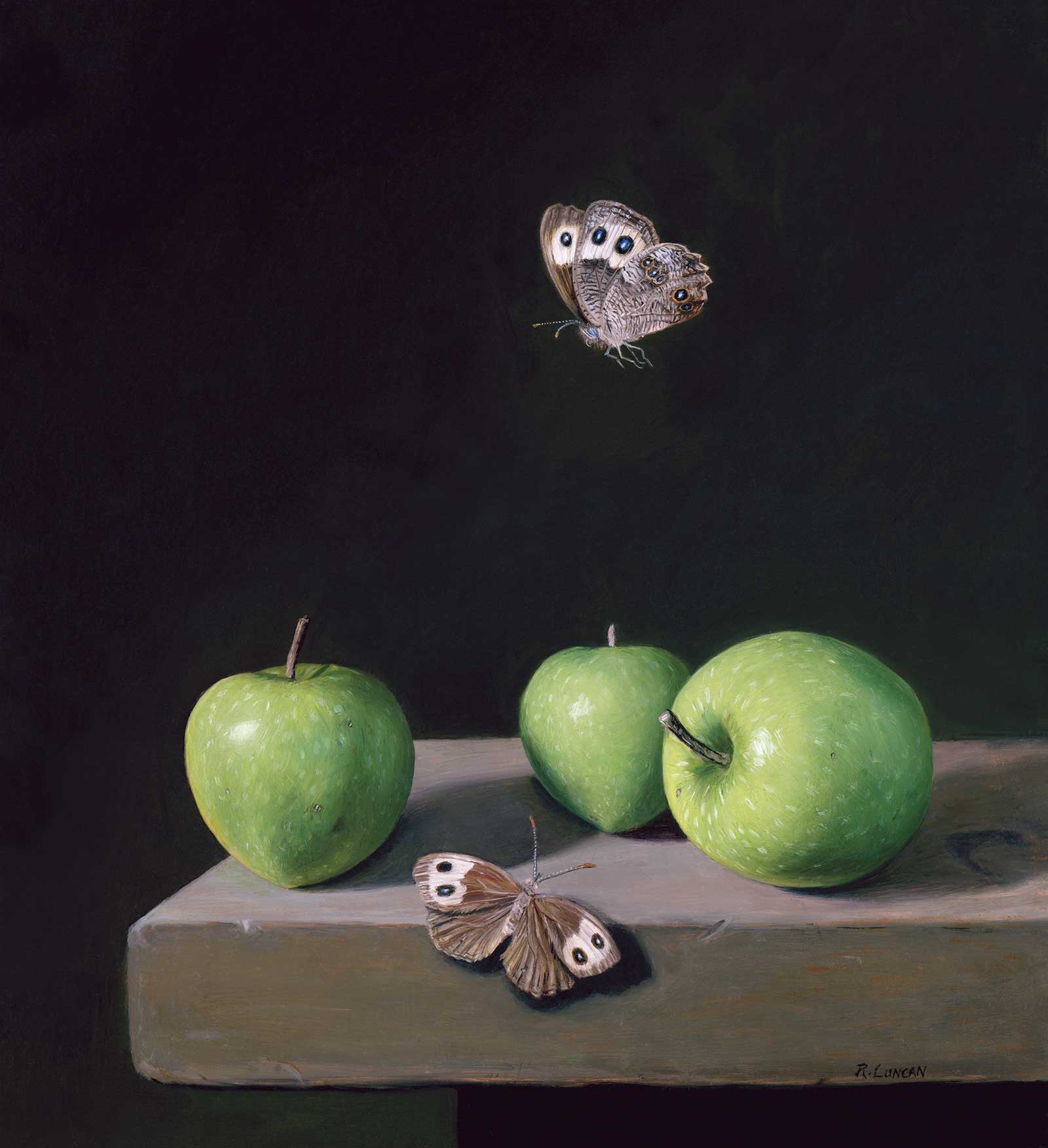 Rebecca Luncan, Wood Nymphs and Green Apples, oil on copper, 10 x 9"
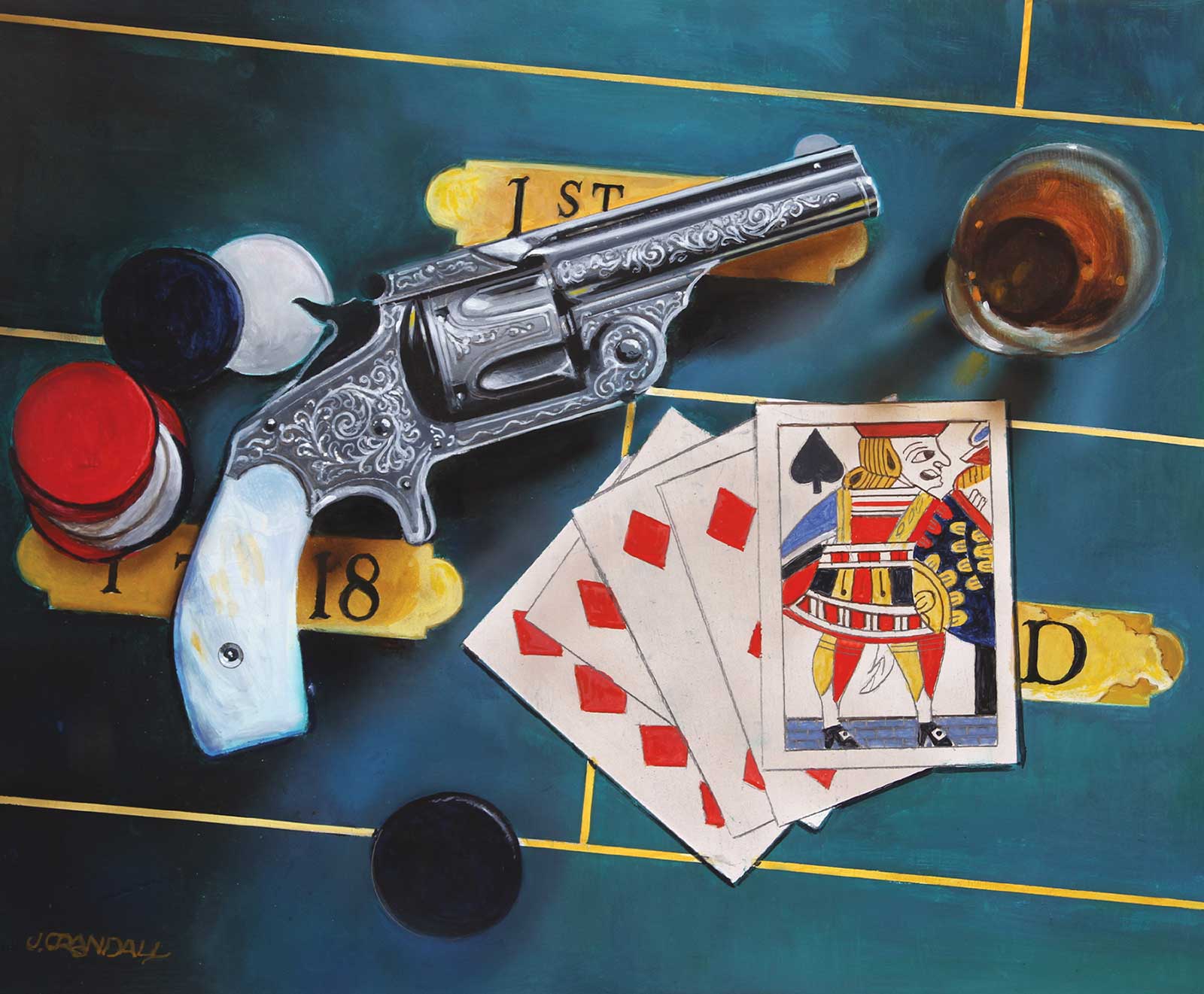 Jerry Crandall, One Eyed Jack, oil, 16 x 20"
The colored pencil drawing Picture of My Dreams, by Tracy Frein, is a beautifully rendered work that has a larger meaning. The artist says, “This drawing favors the world of dreams over the more painful reality of the waking world. We are fed into a vision of a life lived best in the protective arms of dreams, rather than the toxic horrors of reality.”
Cindy Valek Mottl’s landscape paintings, including Manitowish River Rocks, are “inspired by the beauty of the outdoors in northern Wisconsin, especially the quality of light on water as well as glowing through treetops deep in forests. The viewer should feel, smell and hear the energy of moving water, and the peace of quiet woods and calm pools.”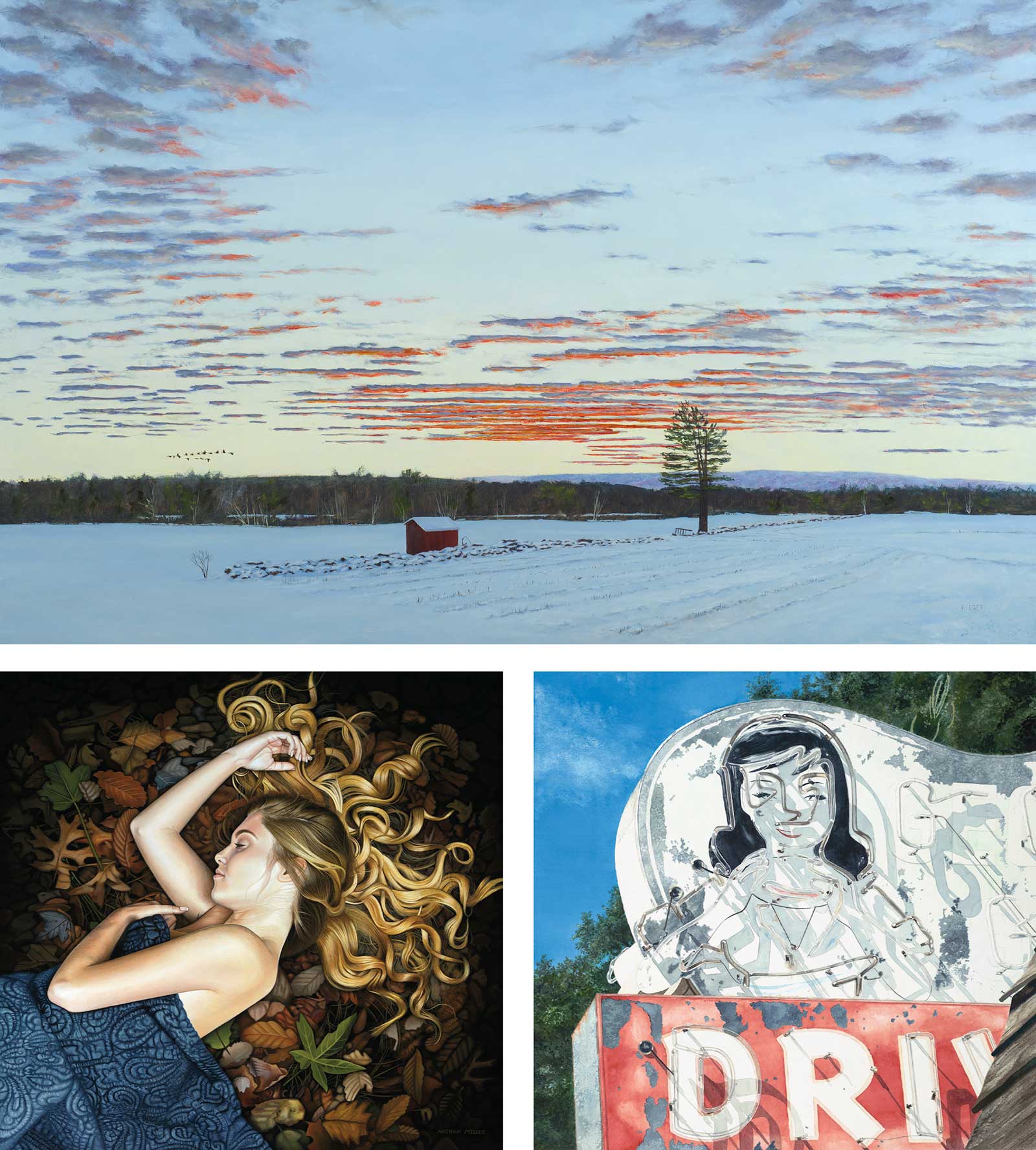 Top: Victor Leger, Cascading Stillness #2, oil on panel, 35 x 52"; Bottom Left: Nathan Miller, Forest Dream, acrylic on canvas, 36 x 36"; Bottom right: Tony Craig, Georgia Girl Drive In, watercolor, 24 x 24"
For his colored pencil drawing Moss Point, David Kizziar used a color effect that has been repeated in many of his past paintings. “The striking beauty of the secluded Laguna Beach cove inspired me to capture it in a drawing which would convey the essence of its natural allure,” he says. “This drawing is part of my sepia brown collection in which I use six colored pencils on toned paper to create [works], each of which take more than 300 hours to complete.”
In The Front Gate, Robbie Fitzpatrick depicts a view down the road from her home to her front gate. “We have always felt blessed that we can live in such a lovely place at the edge of the East Texas Piney Woods, but on this occasion, as the sun just started to lower, the light and shadows demanded my attention,” she says. “I simply had to paint this incredible sight.”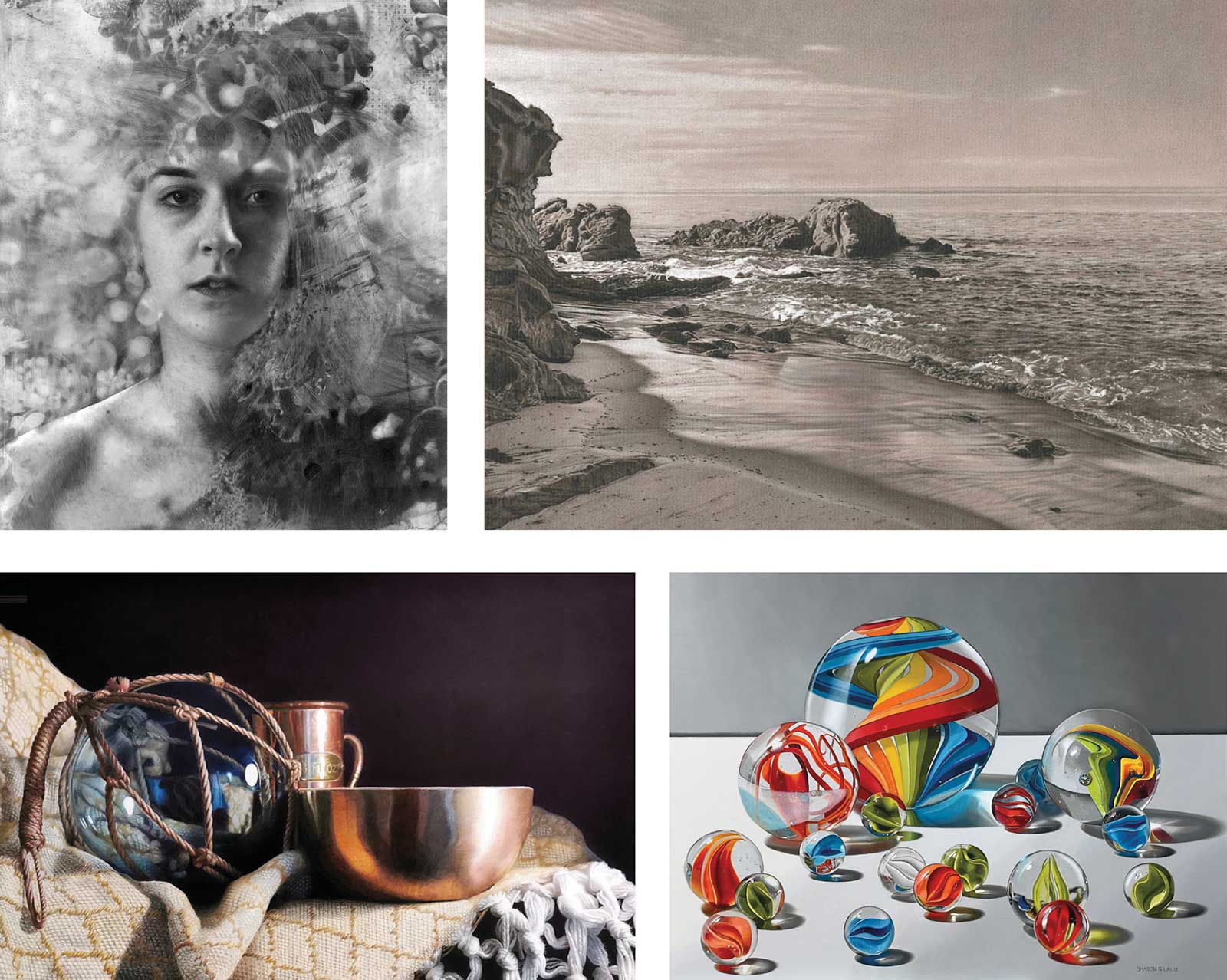 Clockwise form top left: Tracy Frein, Picture of My Dreams, colored pencil, 25 x 20"; David Kizziar, Moss Point, colored pencil, 15 x 19"; Sharon Guyton Lalik, Glass Marbles II, oil on canvas, 34 x 44"; Tom Strutton, The Singing Bowl, colored pencil, 14 x 20"
Another artist with a work in the exhibition featuring a place close to home is Victor Leger. His painting Cascading Stillness #2 is a wide-open landscape blanketed in snow that also has bold colors in the skies as the day beings to wane. Leger says, “This painting is inspired by some of the beautiful wintery sunsets that I am fortunate to experience near my home.”
Robert Steiner’s painting Point Lobos captures the movement of the waves as they chop against the rocky alcove. “I love Point Lobos because of the shapes of the rocks as they meet and are eroded by the sea are outstanding,” he says. “For this painting I chose a spot that was not overly dramatic but with a subtle arch, which epitomized for me the experience of this transcendent piece of God’s handiwork.”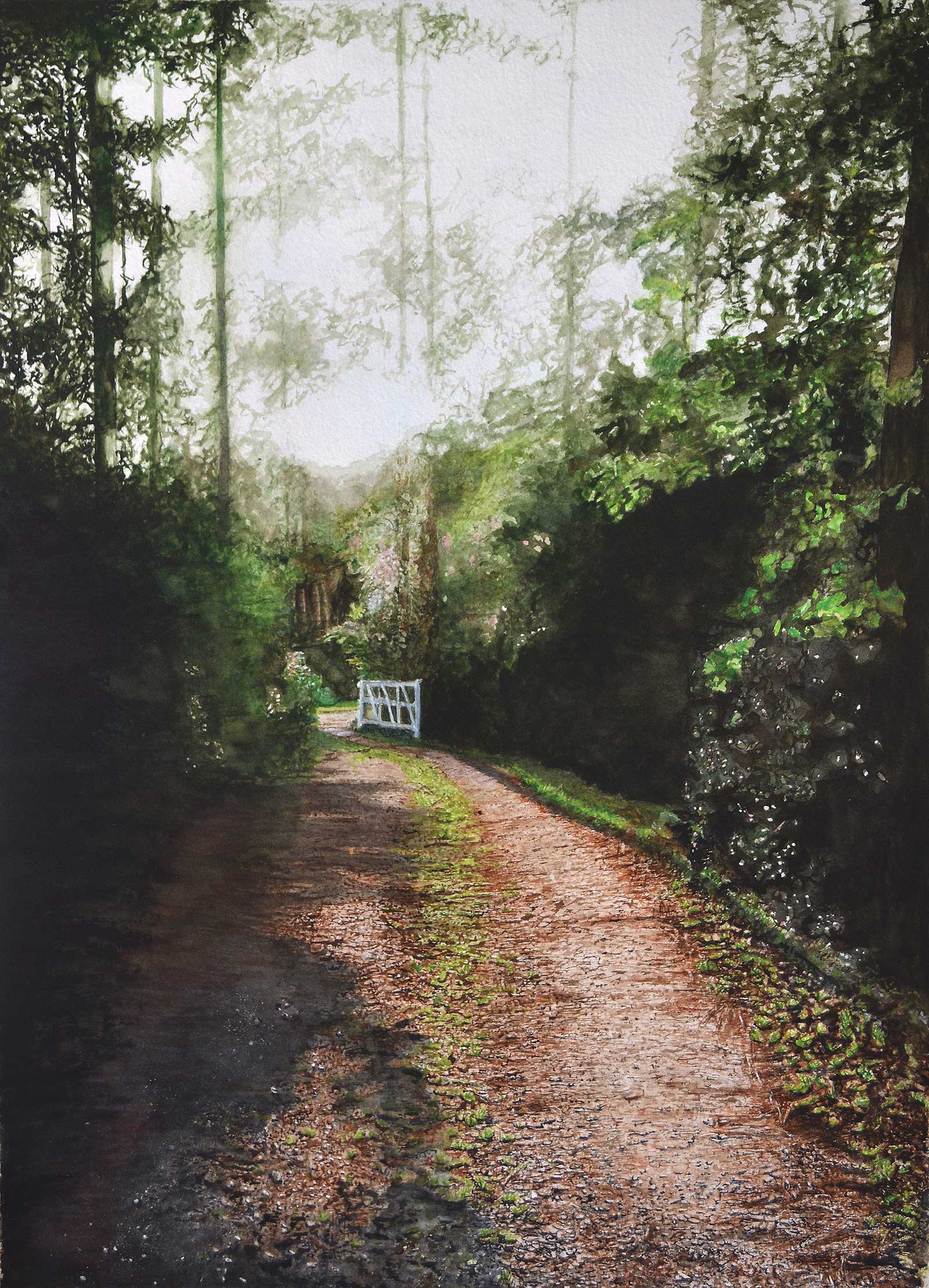 Robbie Fitzpatrick, The Front Gate, watercolor, 26 x 19"
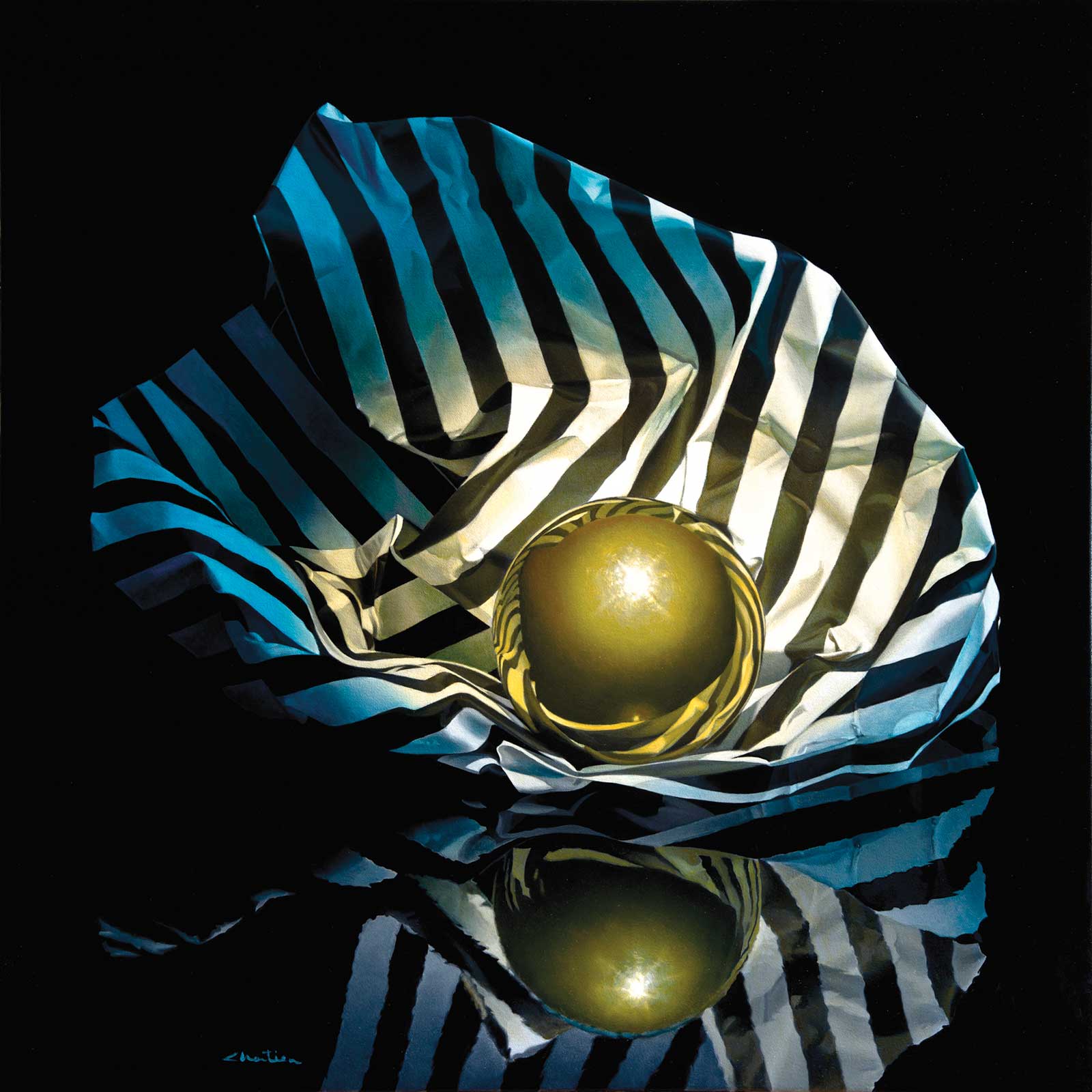 Francois Chartier, Golden Pearl, oil on canvas, 24 x 24"
Georgia Girl Drive In, by Tony Craig, evokes a bit of nostalgia for its viewers. “I photographed this sign in southern Georgia and was instantly attracted to the challenge of painting the broken neon, shadows and weathered image,” Craig shares. “I’m glad I was able to eke a bit more life out of the Georgia Girl.”
An extraordinary perspective takes center stage in Johnny Guthrie’s painting Round and Round. The work depicts a view looking down onto a spiraling staircase and highlights the intricacies of its patterning, shape and more. Explaining the idea for the work, Guthrie says, “I saw a challenge in the texture, shadows and depth of this lighthouse staircase.”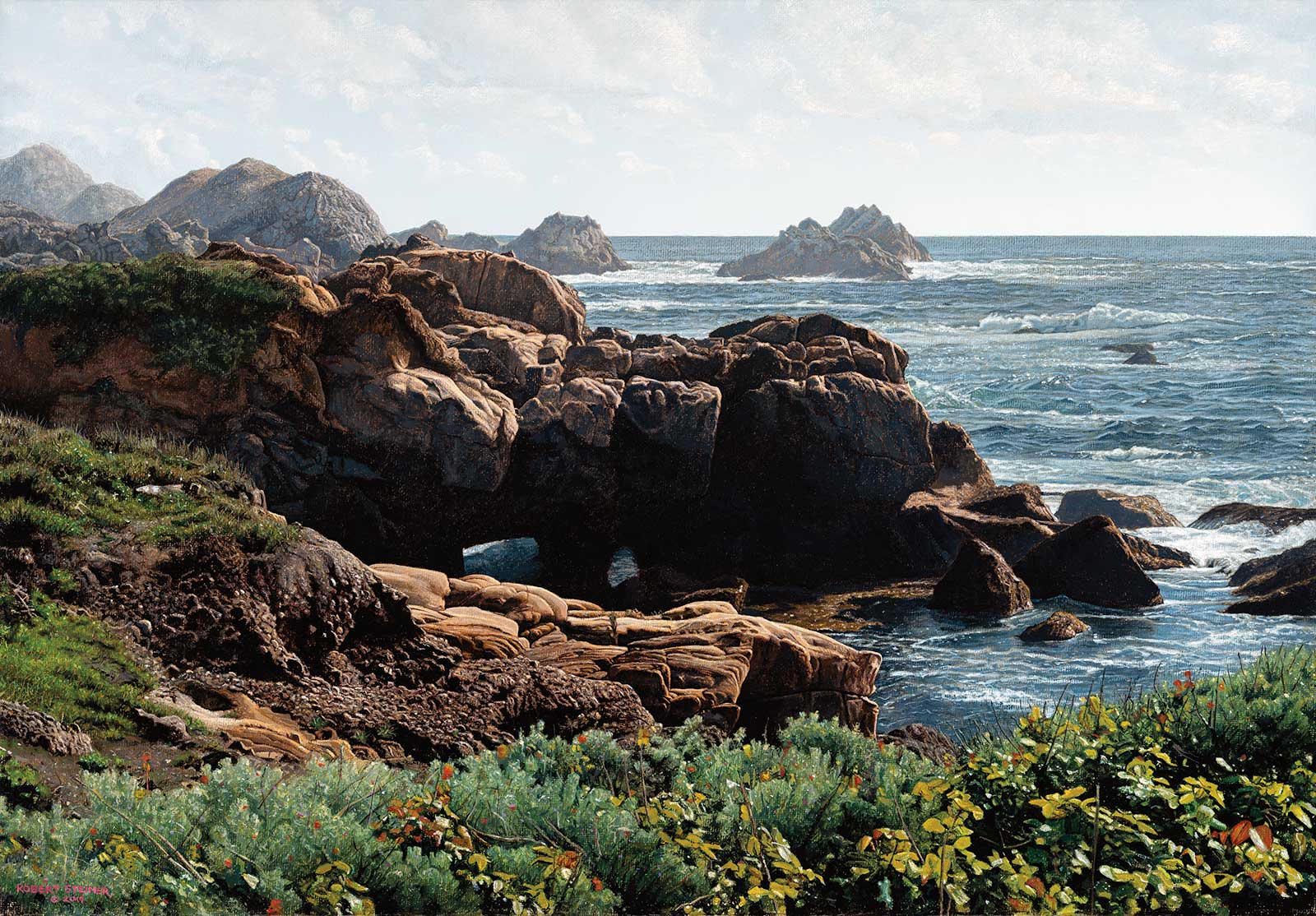 Robert Steiner, Point Lobos, acrylic on canvas, 16 x 24"
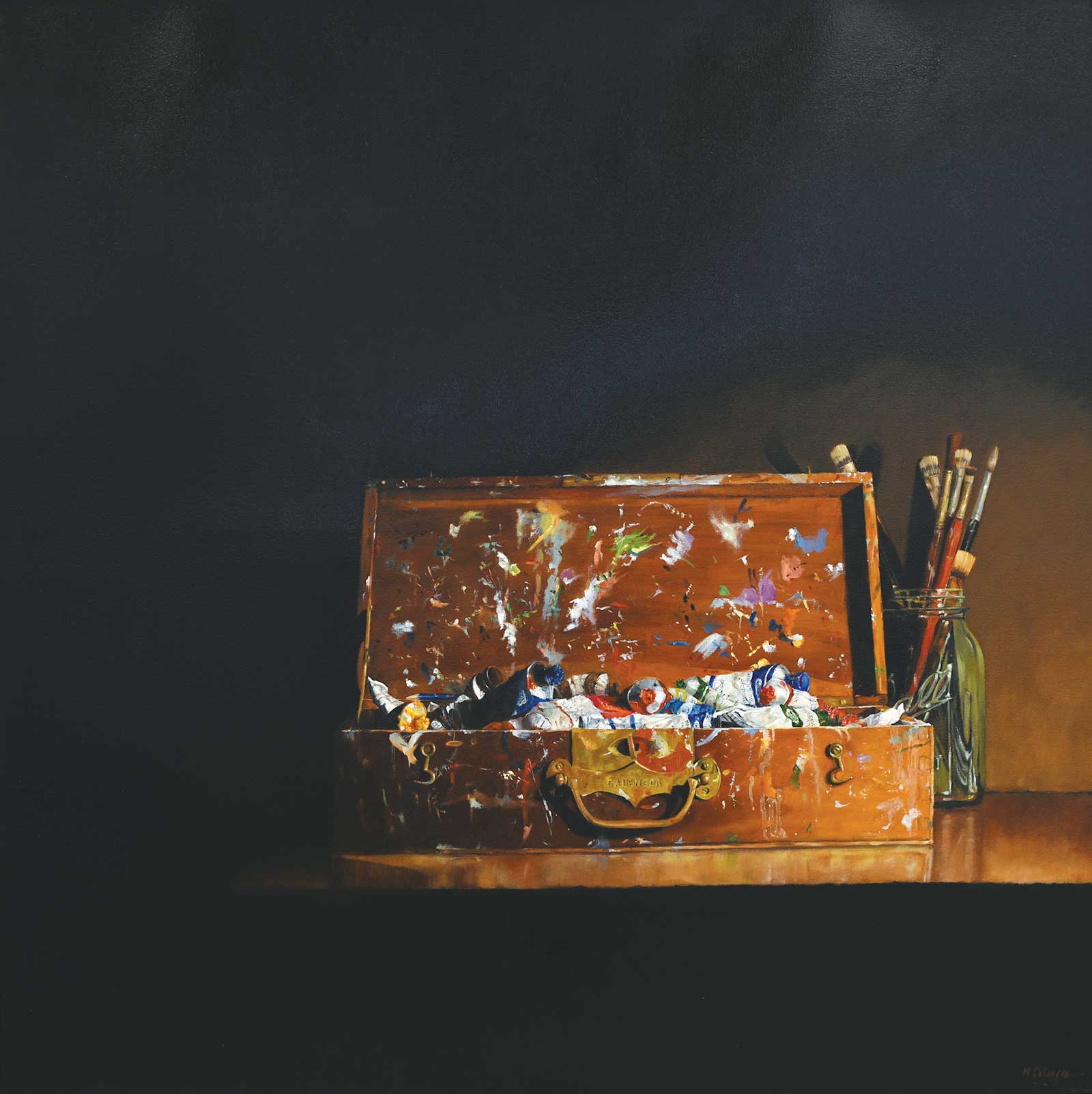 Mary Calengor, Tale of Two Artists, oil on canvas, 48 x 48"
Another architectural work in the show is Patsy Lindamood’s Through This Door, which is a departure from her typical wildlife subjects but reflects her travels to collect reference materials. She says, “On a trip to San Antonio, Texas, I discovered a new affinity for architecture as a subject while exploring one of Texas’ historic mission sites. I shot hundreds of views that day, but I was particularly drawn to several which featured textural detail, repetitive geometric patterns and unusual angles. In Through This Door, I have incorporated a high degree of textural detail, repetitive geometric and organic patterns, an unusual angle and a sense of mystery. The monochromatic palette of the piece accentuates the repeating patterns and textures, and the darkness beyond the opening of the door creates subtle mystery. The viewer enters the painting from an angle, sees the door partially open, has not even a glimpse of what lies within, yet is lured to cross that threshold to discover what lies ‘through this door.’” 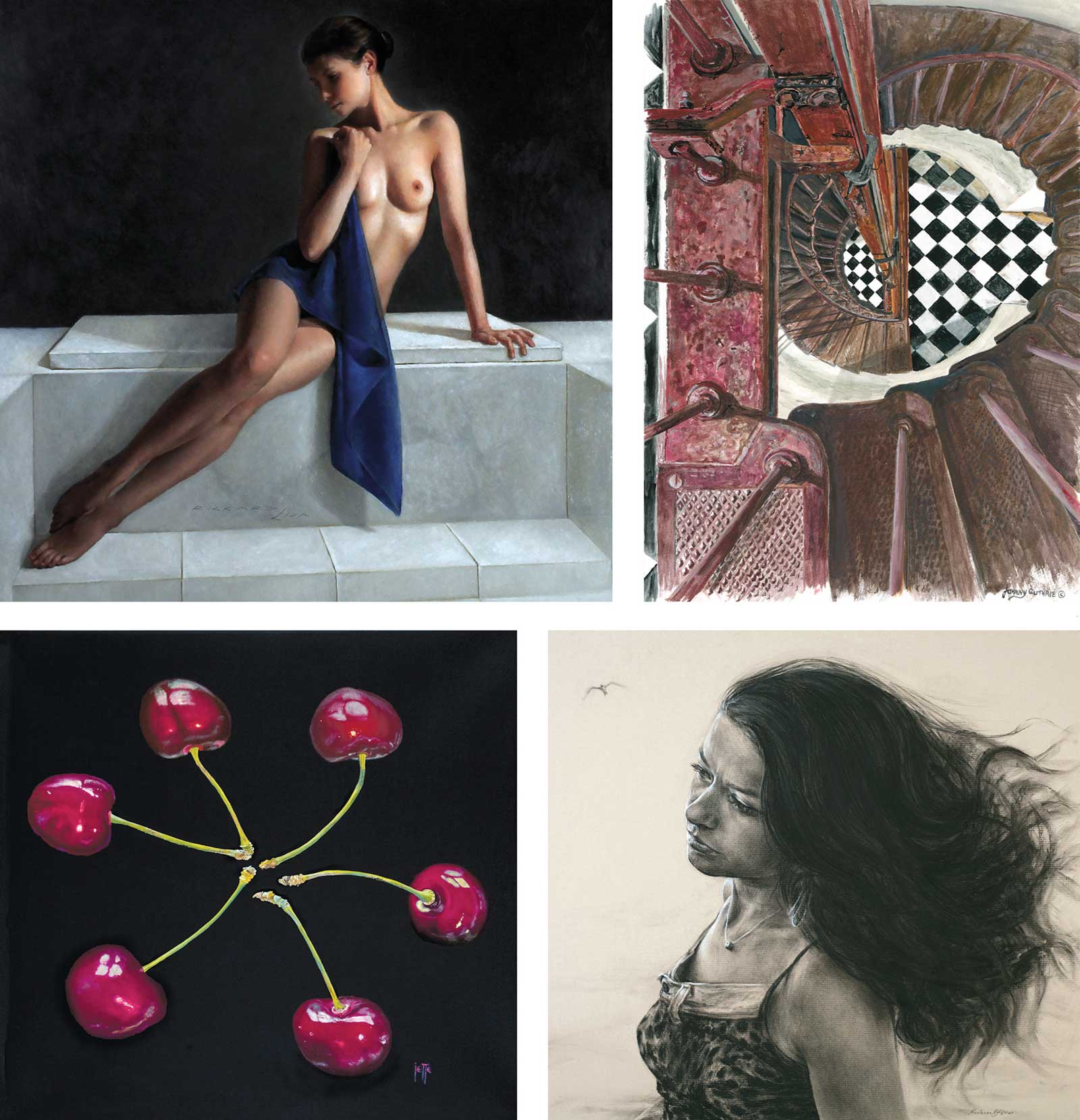 Clockwise from top left: Lisa Rickard, Callisto, oil on mylar, 14 x 14"; Johnny Guthrie, Round and Round, gouache, 22½ x 15"; Marianna Foster, The Wind, charcoal and chalk on toned paper, 18 x 18"; Jette van der Lende, Cycle of Life, oil on linen, 27 3/5 x 27 3/5"
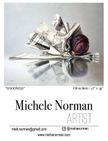
In her still life French Press, artist Claudia Seymour infused a bit of wit when constructing the work.
“I thought combining a French cafetière (French press) with a French newspaper (Le Monde) could make for a wonderful play on words, and that’s the genesis for the work,” she says. “The title came long before the painting, and the starting point for the actual work was finding the fabric for the background—it gave me a perfect palette of red and green to work with. Having been years since I had done a ‘food’ painting, this was very satisfying and fun to create.”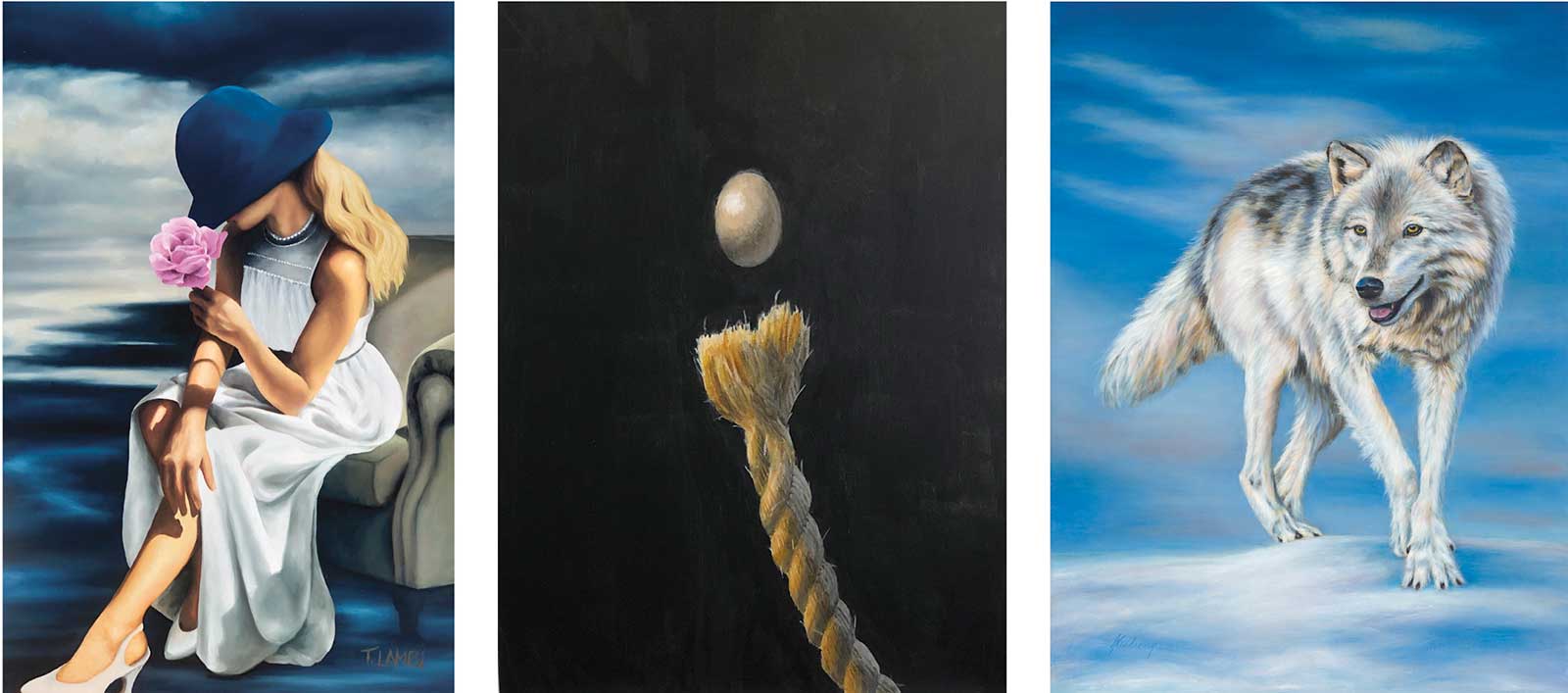 Left to right: Trisha Lambi, After The Storm, oil on linen, 36 x 24"; Peter Swift, Egg and Rope, acrylic on canvas, 24 x 18"; Nancy Andresen, Wolf Moon, oil on canvas, 24 x 18"
Sharon Guyton Lalik’s still life Glass Marbles II is a contemporary set up, focusing on the reflections and colors of the glass objects. The painting “came to life after seeing light radiating through a glass marble sitting on my white table. Its shadow, full of color, was captivating. At that very moment, I knew I had to share this vision,” the artist explains. “As I set up this still life, every marble I added interpreted the light differently, creating splashes of color on each other and the surface beneath them. Each marble became eye candy!”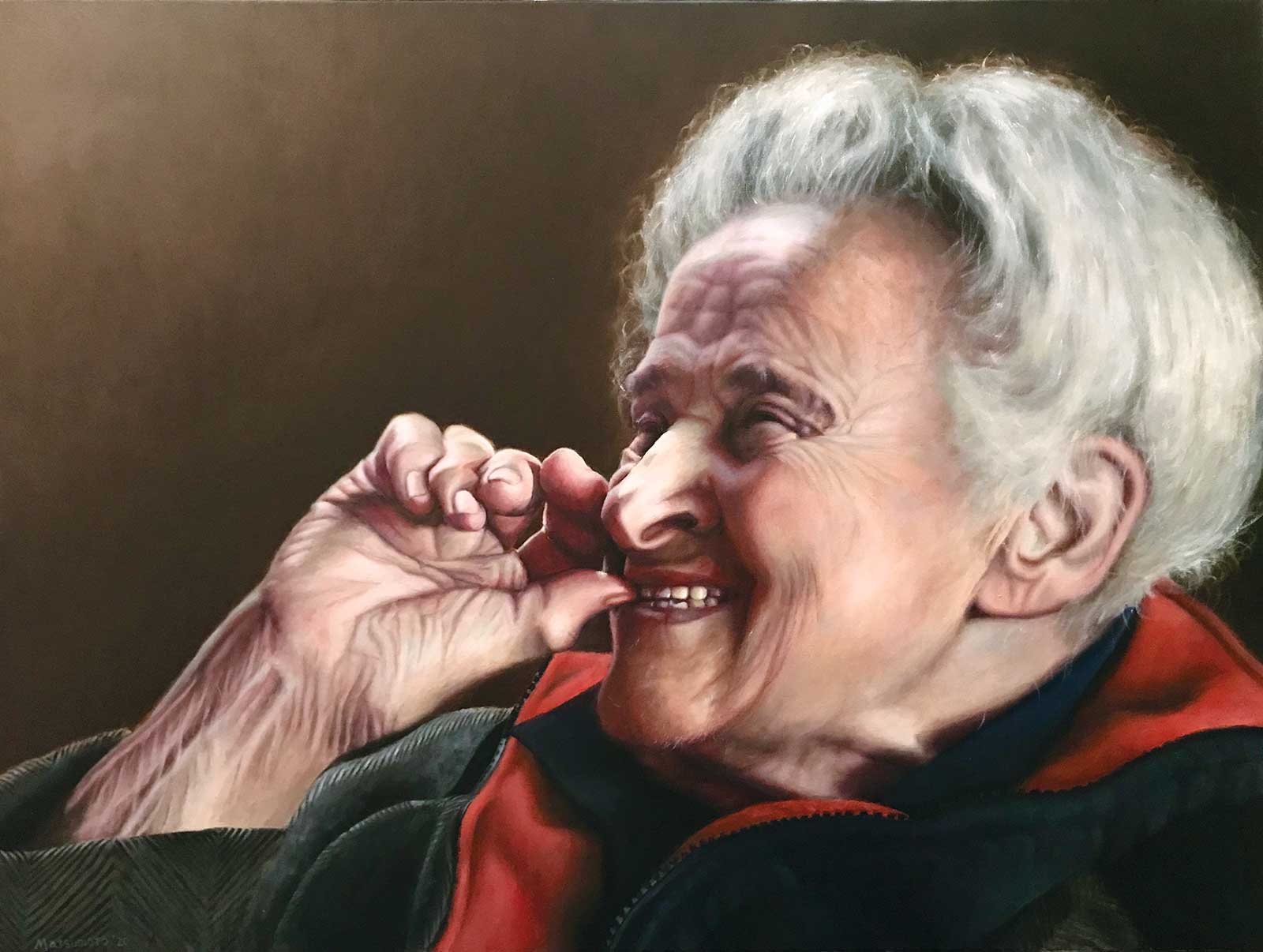 Edi Matsumoto, Survivor 2020, oil on canvas, 30 x 40"
In the Trompe l’Oeil painting One Eyed Jack, artist Jerry Crandall shows off his technical skills as well as some of his favorite subjects. He says, “As a collector of Western artifacts, I like to group items together that are a challenge to paint due to the different textures, shapes and colors as well as lighting.”
Jette van der Lende blends the style of surrealism and still life in the painting Cycle of Life. “Cherries symbolize the cycle of life, death and rebirth, as well as reproduction,” says the artist of the subject matter. “Since I put the cherries in a circle, it amplifies the symbol, since a circle symbolizes eternity. Like people, no cherries are alike. Put people in a circle, and they will interact and make the circle stronger, so the symbolism will be stronger.”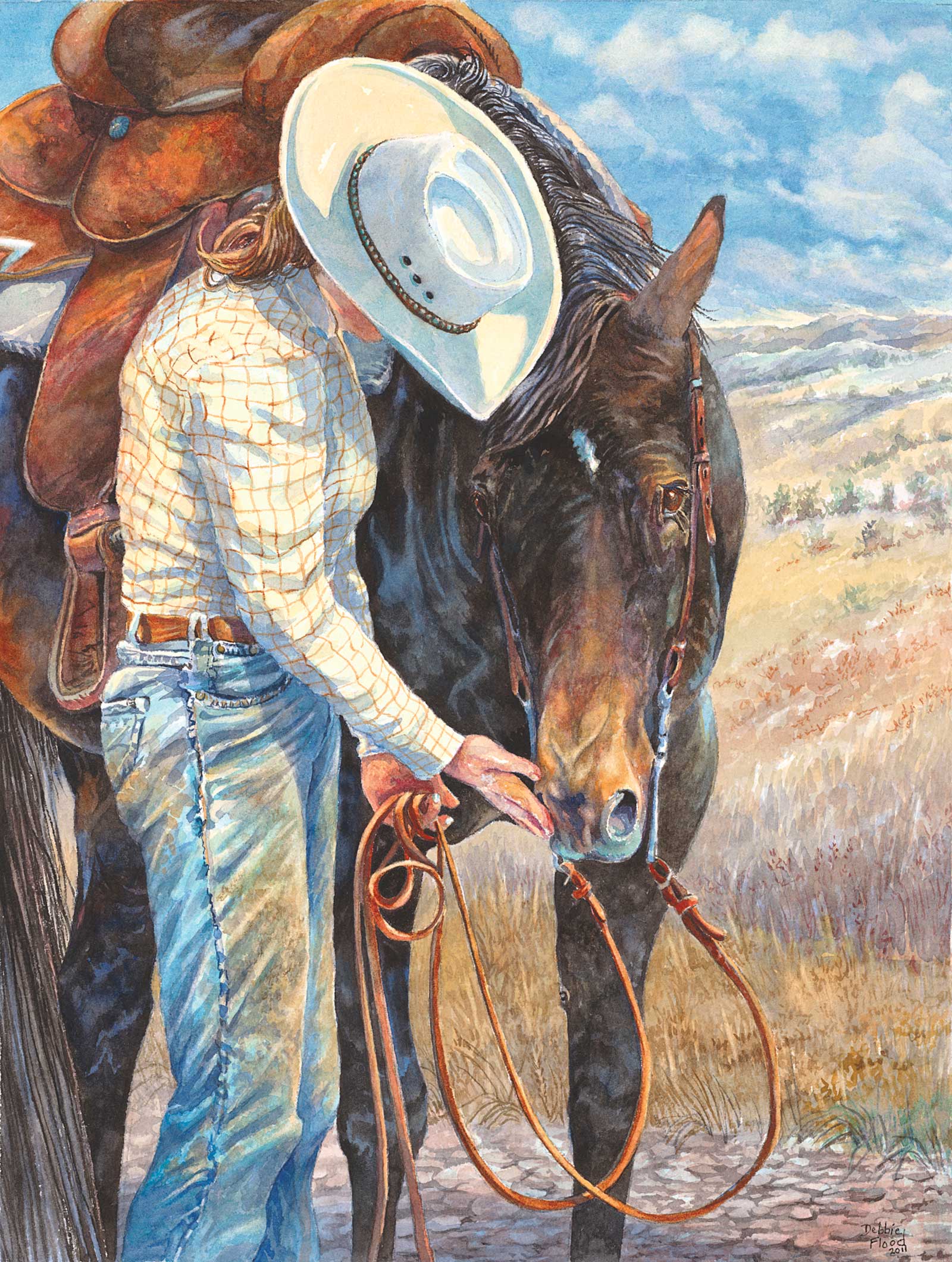 Deborah Flood, Tell Me it’s OK, watercolor, 14½ x 11"
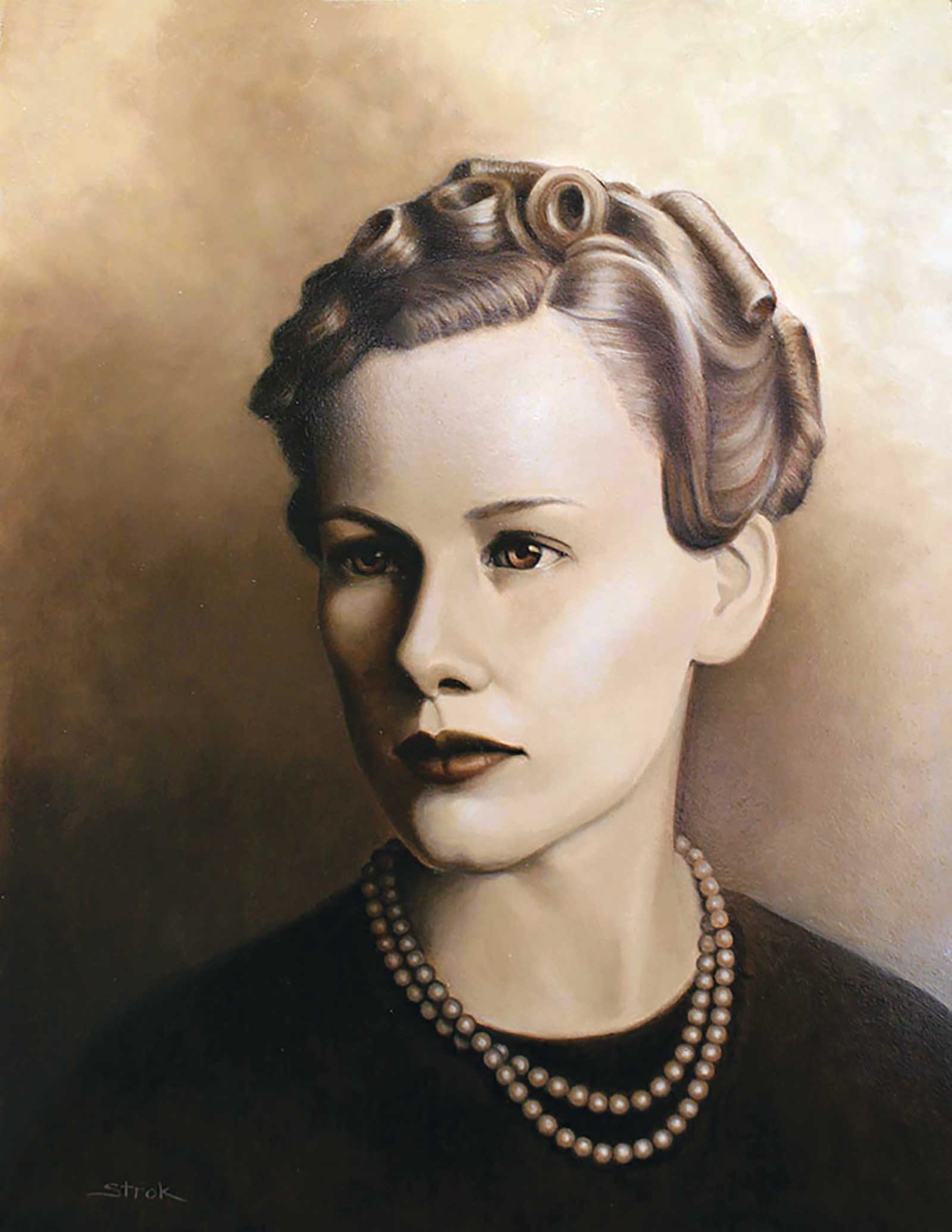 Susan Helen Strok, Helen’s Curls, oil on panel, 18 x 14"
All Is Vanity, by John C. Moffitt, is a “somewhat modern take on the traditional symbolism laden vanitas still life paintings common in northern European art during the 16th and 17th centuries,” he says. “Although I held primarily to objects with traditional symbolic meaning, I did add some contemporary twists for the viewer to consider.”
While discussing her martini series of still life paintings with another artist, Karen Budan was talking about how much fun they have been to paint. The pieces are vibrant and colorful, as well as capture the essence of the drink. In this show will be her work Lemondrop Martini. “We started throwing out names of types of martinis I have not painted yet,” she says. “When lemondrop martini was named I instantly envisioned a martini glass surrounded by lemons dropping around it.”
The shimmering interior surface of a seashell is the featured object in Luba Stolper’s still life Abalone. She shares, “In this uncertain time, I would find peace and quiet while painting still life. I am inspired by nature around me to create a visual language to communicate with the world.”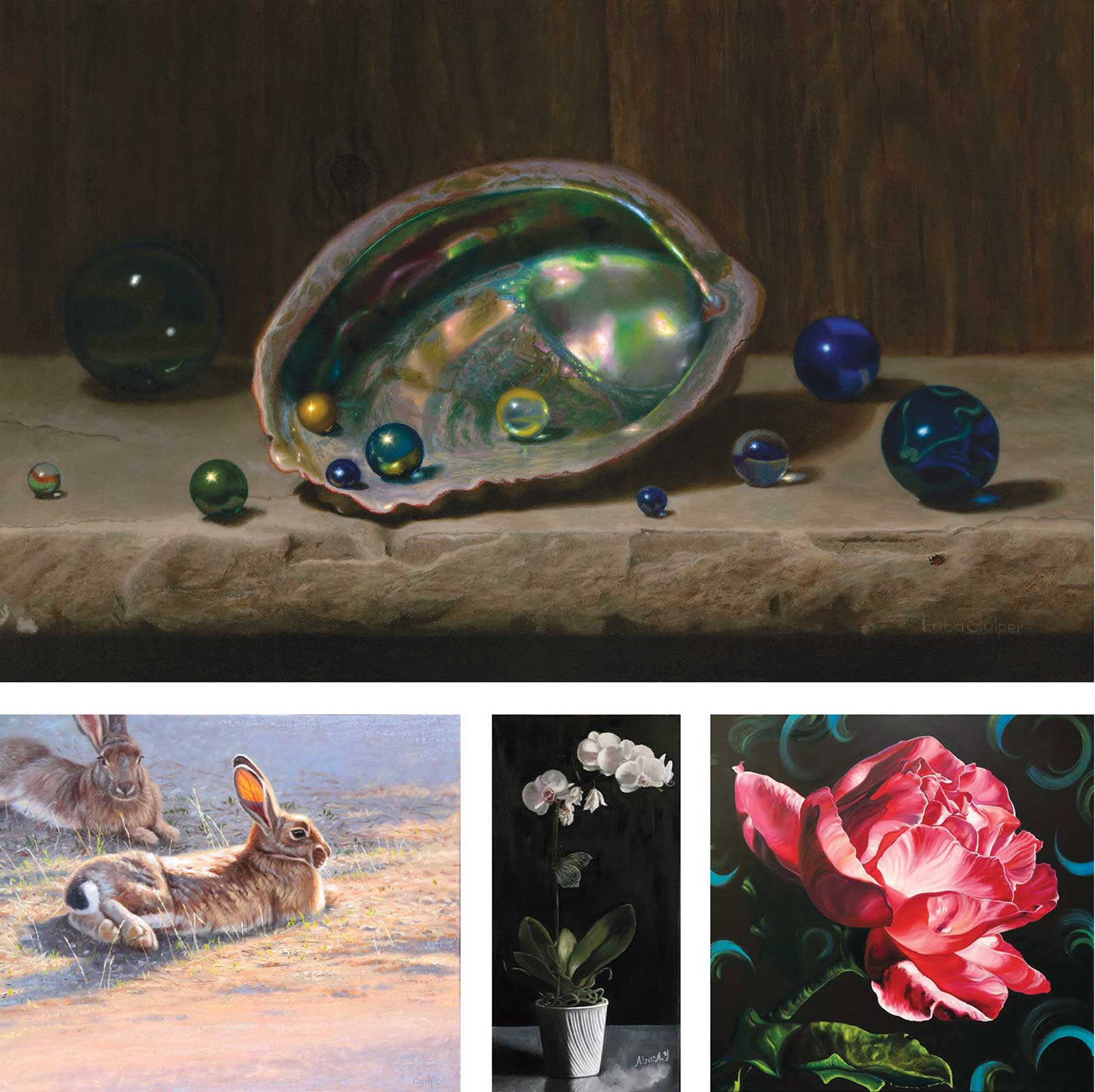 Top: Luba Stolper, Abalone, oil on canvas, 12 x 19"; Bottom row, left to right: Cynthie Fisher, Sunny Bunny, oil on canvas, 16 x 20"; Abir Yousef, Simplicity, oil, 24 x 12"; Nancy Jacey, A Moment to Celebrate, acrylic, 48 x 48"
Tale of Two Artists, by Mary Calengor, is a still life featuring a treasured art box that is a tribute to her father and another artist. “In the ’50s my father was working for the military as a cryptographer. He was dispatched to France to work at the Château de Fontainebleau, the NATO headquarters at the time. He and my mother rented a room in a house owned by Madame Brassard at 40 Rue de la Haute Bercelle in Fontainebleau just next to the chateau. Monsieur Brassard had passed away, but he was an artist and had a studio in the home with large windows overlooking the chateau gardens. My father is an artist, and it is in that studio that he painted while working in France,” says Calengor. “This art box belonged to Monsieur Brassard, and Madame gave it to my father who had it engraved with his name and has kept it in his studio for 60 years. The box itself is at least 100 years old.”
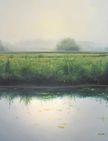
Peter Swift’s painting Egg and Rope shows how everyday objects can be rearranged into innovative designs. “I like to juxtapose opposites,” Swift says. “Here we have something that is round, smooth and fragile, placed next to something which is flexible, tough and hairy. Classical still life realism, combined with powerful design.”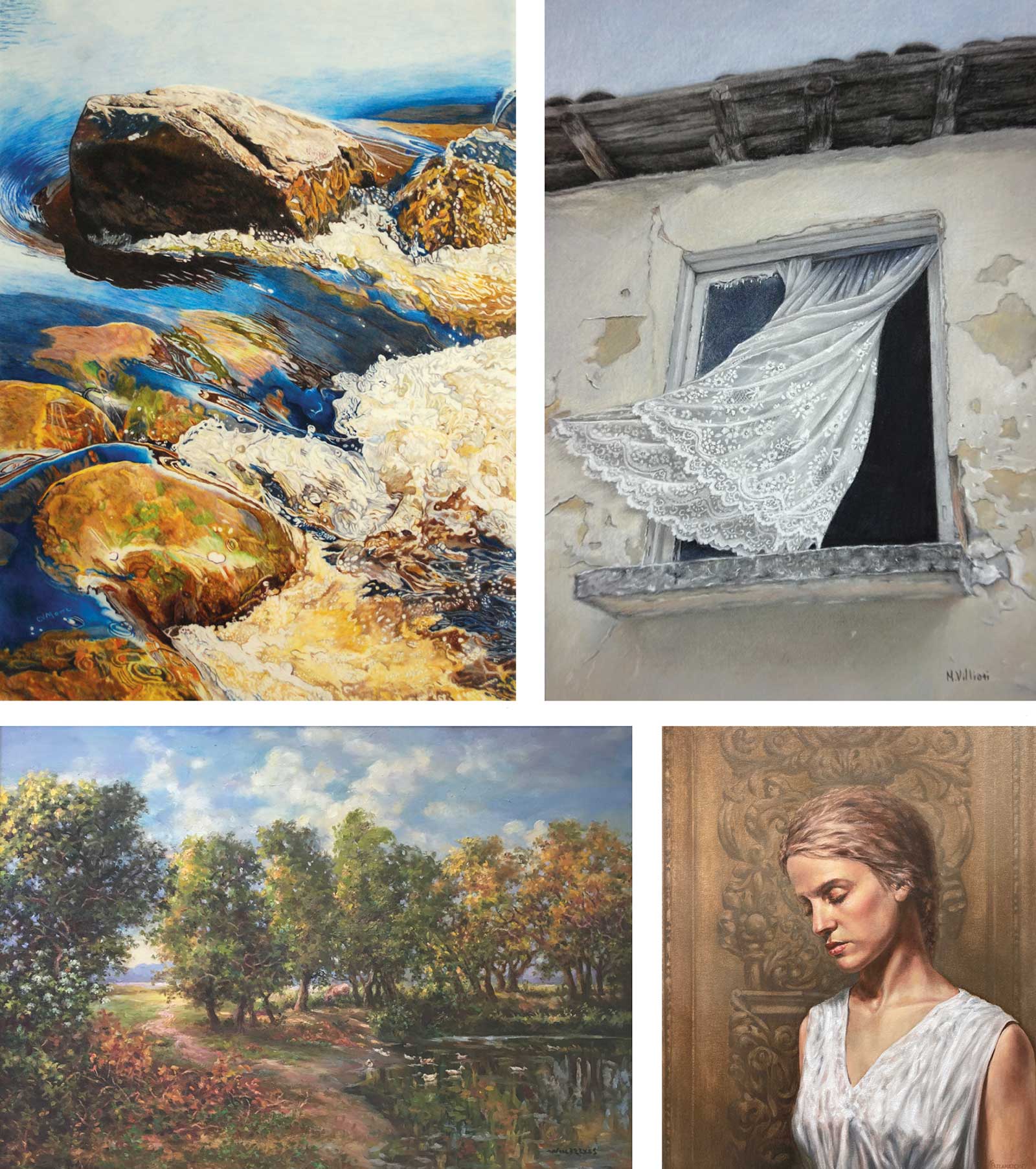 Clockwise from top left: Cindy Valek Mottl, Manitowish River Rocks, colored pencil on drafting film, 16 x 22"; Maria Villioti, If The Lace Could Tell a Story, colored pencil, 20 x 14"; Ivan Pazlamatchev, Memento, oil on canvas, 24 x 20"; Will B. Reyes, March Afternoon at the Pond, oil on canvas, 20½ x 28½"
Sarah Weizhen Xu’s still life I am the True Vine was painted entirely from life. Explaining the inspiration for the piece, the artist says, “Every object in this painting is simply common items that could be found in our common life, yet somehow being put together, they present the symbols of Christ and the Last Supper. The most outstanding object in this painting is the grapes, thus I titled this painting I am the True Vine, which is quoted from the Gospel of John ‘I am the true vine, and my Father is the gardener,’ said by Jesus during his last supper.”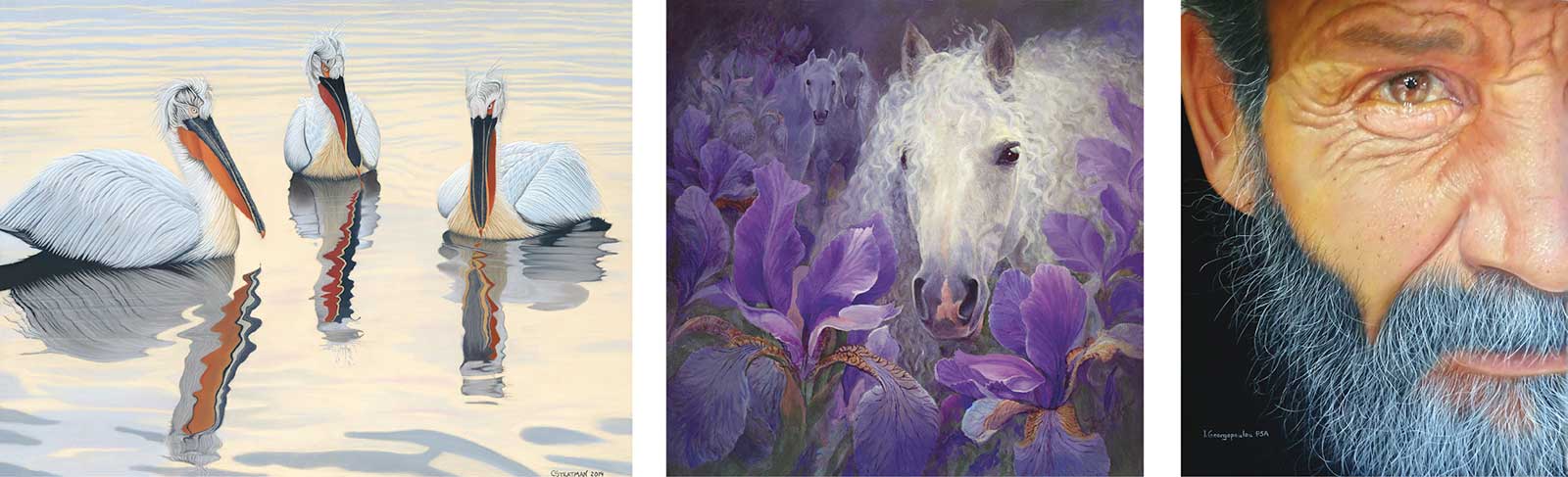 Left to right: Carol Stratman, Tousled Trio, pastel, 19 x 25"; Bonnie Hamlin, Dream Visitors, acrylic, 16 x 16"; Irene Georgopoulou, Refugee, soft pastel, 20 x 16"
Using colored pencils, artist Tom Strutton has created the highly realistic work The Singing Bowl. “The blue glass of the fisherman’s float, with its appealing spherical character and distortion of colors, battles the gleaming singing bowl for space and attention,” he says. “In the background, a third player, less imposing in stature, oversees the ongoing contest.”
In Simplicity, a painting of orchids, Abir Yousef chose to implement traditional symbolism, inspired mainly by Dutch still lifes with a dark background and the flowers bright and accentuated. “The beauty of orchids manifests in its simplicity and its resilience in living a long life even in the absence of nourishment, representing beauty, wealth and strength,” Yousef says. “To complement this, the butterfly symbolizes rebirth. This painting aims to inspire healing, growth and light in the new year.”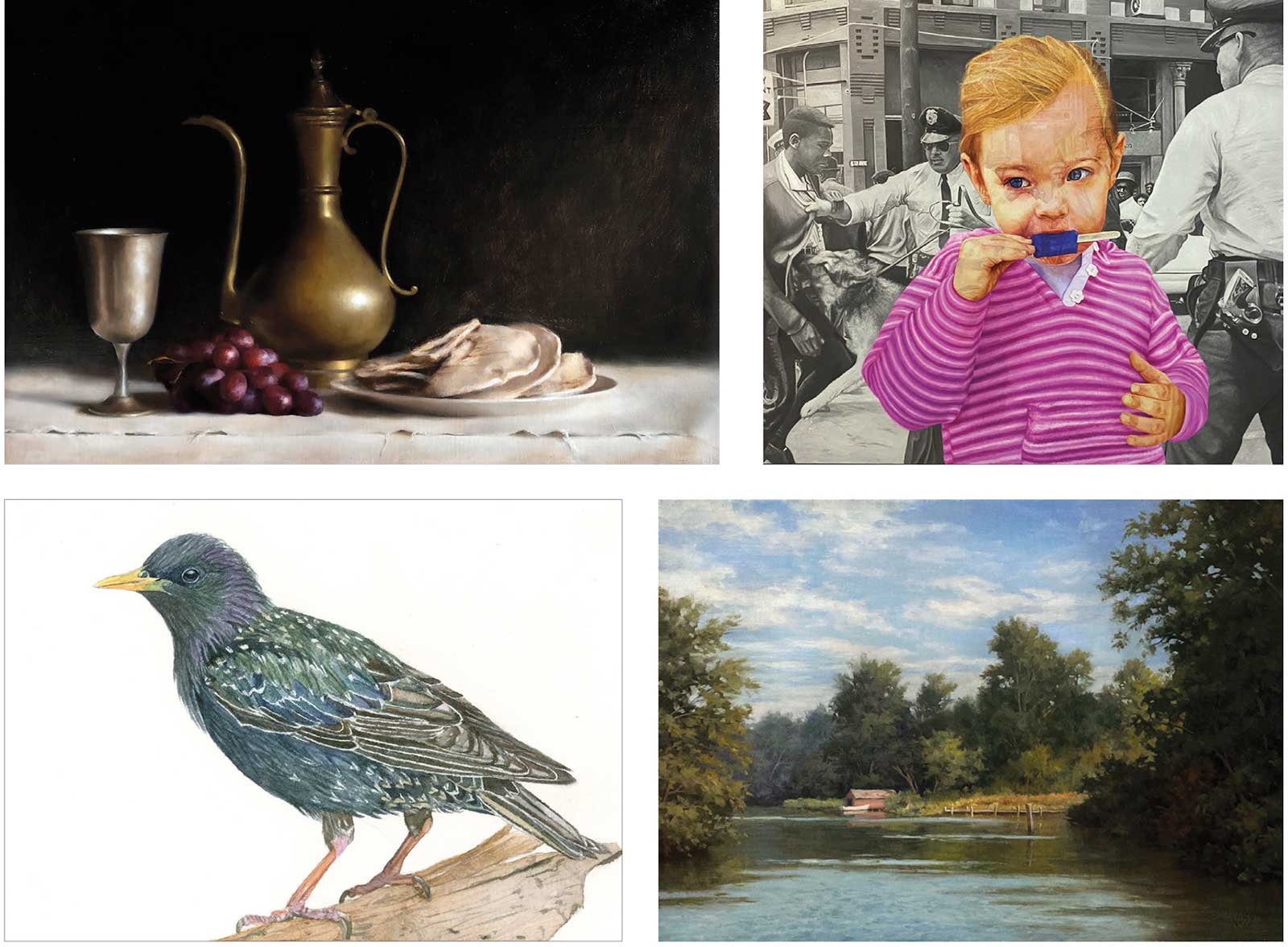 Clockwise from top left: Sarah Weizhen Xu, I am the True Vine, oil on linen, 17 x 28"; Stephen Mangum, Illusions of My Childhood No. 6, oil on linen, 72 x 80"; Barbara Nuss, Winchester Cove, oil on linen, 12 x 16"; Aki Kano, Starling, watercolor, 9 x 12"Wildlife artist Cynthie Fisher was inspired by rabbits in New Zealand for her painting Sunny Bunny. She elaborates, “I observed these rabbits in New Zealand, lounging in the evening light, grooming, relaxing and napping. It felt special to watch them, so calm and mellow; they almost seemed catlike. I enjoy traveling the world and painting things I witness in the animal world.”
Another wildlife image in the show is Nancy Andresen’s painting Wolf Moon, which is based on a blue moon in Alaska. “Blue-colored moons are rare and happen when the Earth’s atmosphere contains dust or smoke particles of a certain size. When these particles are present in our air, and the moon shines through them, the moon may appear blue in color,” says the artist. Explaining the painting, she says, “We become one with the wolf when the blue moon rises across the sky.”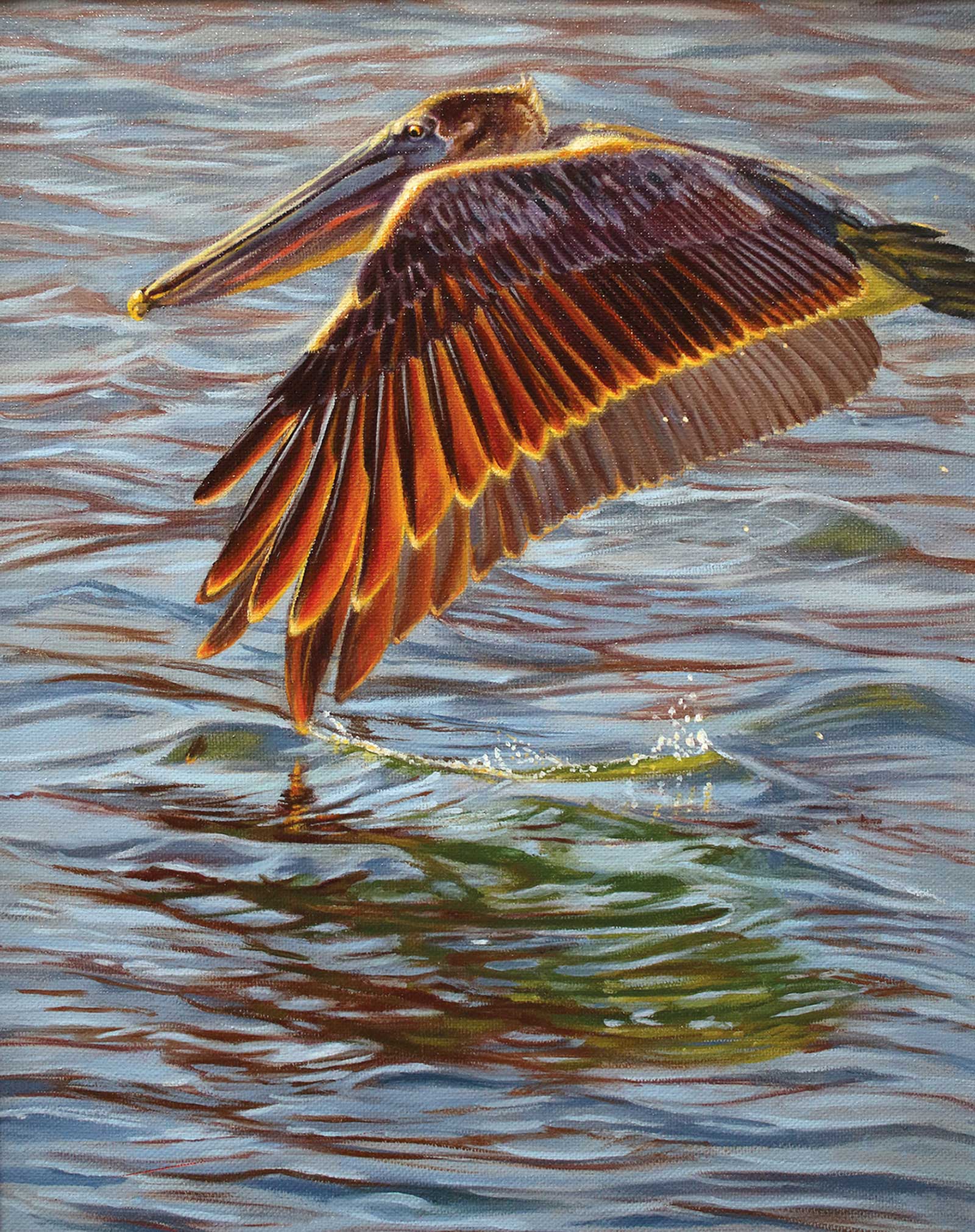 Deborah LaFogg Docherty, Breaking the Surface, oil on canvas, 14 x 11"
The Spring Salon Online Exhibition is also a juried competition, with the award winners indicated on all the websites where the exhibition can be viewed. —
International Guild of Realism’s Spring Salon Online Exhibition
When: March 20-May 20, 2021
Where: View the show online at www.americanartcollector.com, www.qcfinearts.com and www.realismguild.com.
Powered by Froala Editor