Joel Babb, chronicler of the complex architecture of Boston and the natural intricacies of the Maine woods and the sea, began his career as an abstract expressionist. “I had no patience for older art then,” he says. “Over time I got reversed. I became much more interested in earlier art.” He was an avid student of art history at Princeton, however, and was impressed by his seminar with Wen Fong, who illustrated the way Chinese artists revered and emulated the past.
After Princeton, he went to Rome and Florence. He had studied perspective in art history but encountered it in real life in the art and architecture there. “Once you have seen the Sistine Chapel and the Raphaels of the Stanza,” he explains, “your scale is set to a different starting point.” He saw the built realization of Alberti’s and Brunelleschi’s study of the ancient architecture of Rome.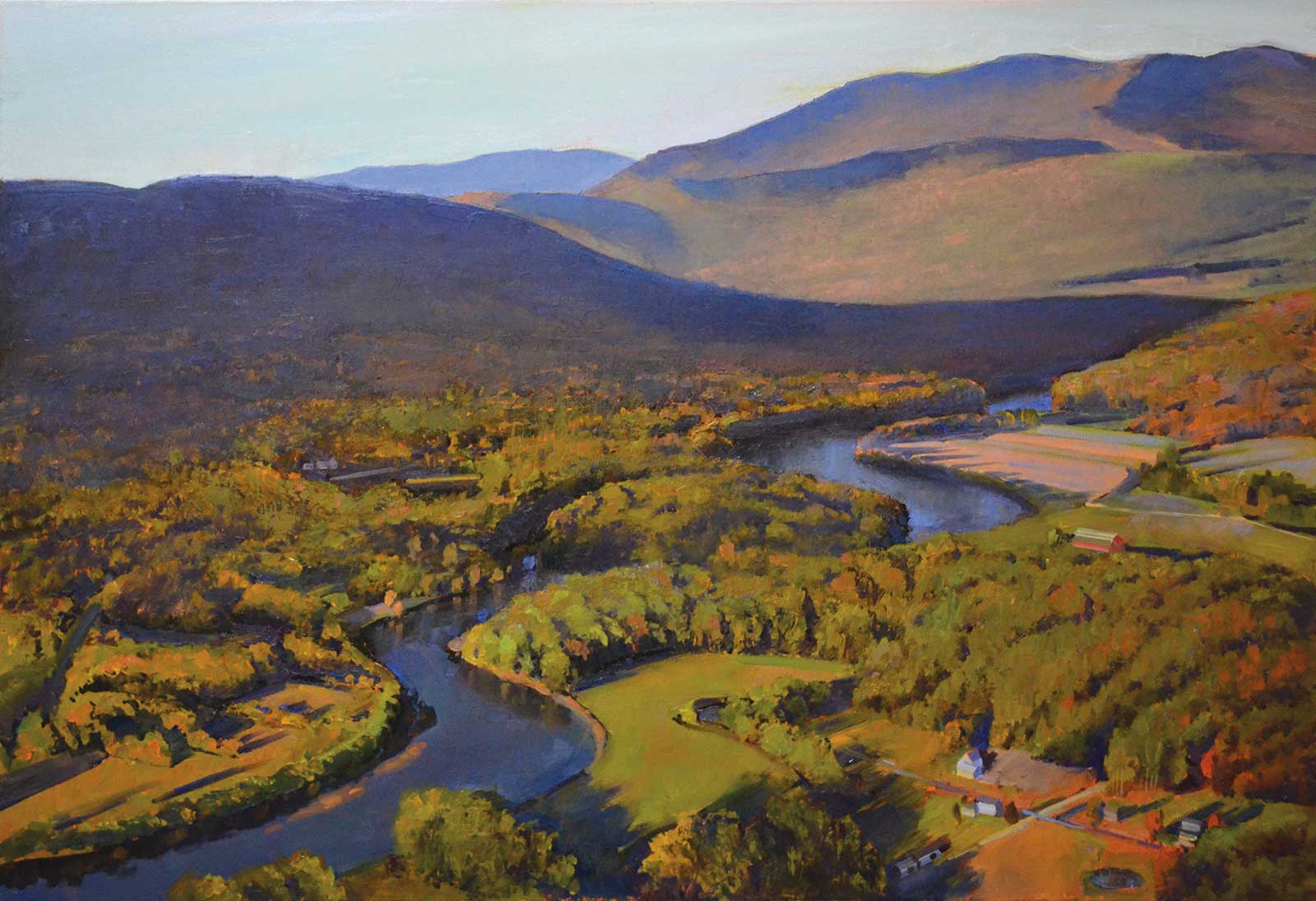 Androscoggin Aerial Serpentine Dark Hills (detail), oil on linen, 22 x 30". Courtesy Greenhut Galleries, Portland, ME.
“It felt as if someone handed me a violin and said ‘Play!’ I didn’t know how to play. I needed to start over,” he says. Babb decided to dedicate himself to painting rather than art history and returned to the U.S. to pursue an MFA at the School of the Museum of Fine Arts in Boston. The museum, in addition to its treasures of Western art, has a fine collection of Chinese art. In addition to the perspective in Renaissance and classical painting, he was intrigued by the Asian use of isometric perspective, “a whole different way of constructing space. I began studying perception, how the mind apprehends what it sees—what is the process of seeing.”
To support himself, he took a job as a night watchman at the museum and roamed the galleries experiencing “discoveries and encounters” as he absorbed the art, filling sketchbook after sketchbook with his drawings.
After receiving his MFA, he taught at Tufts University and for the education department of the museum.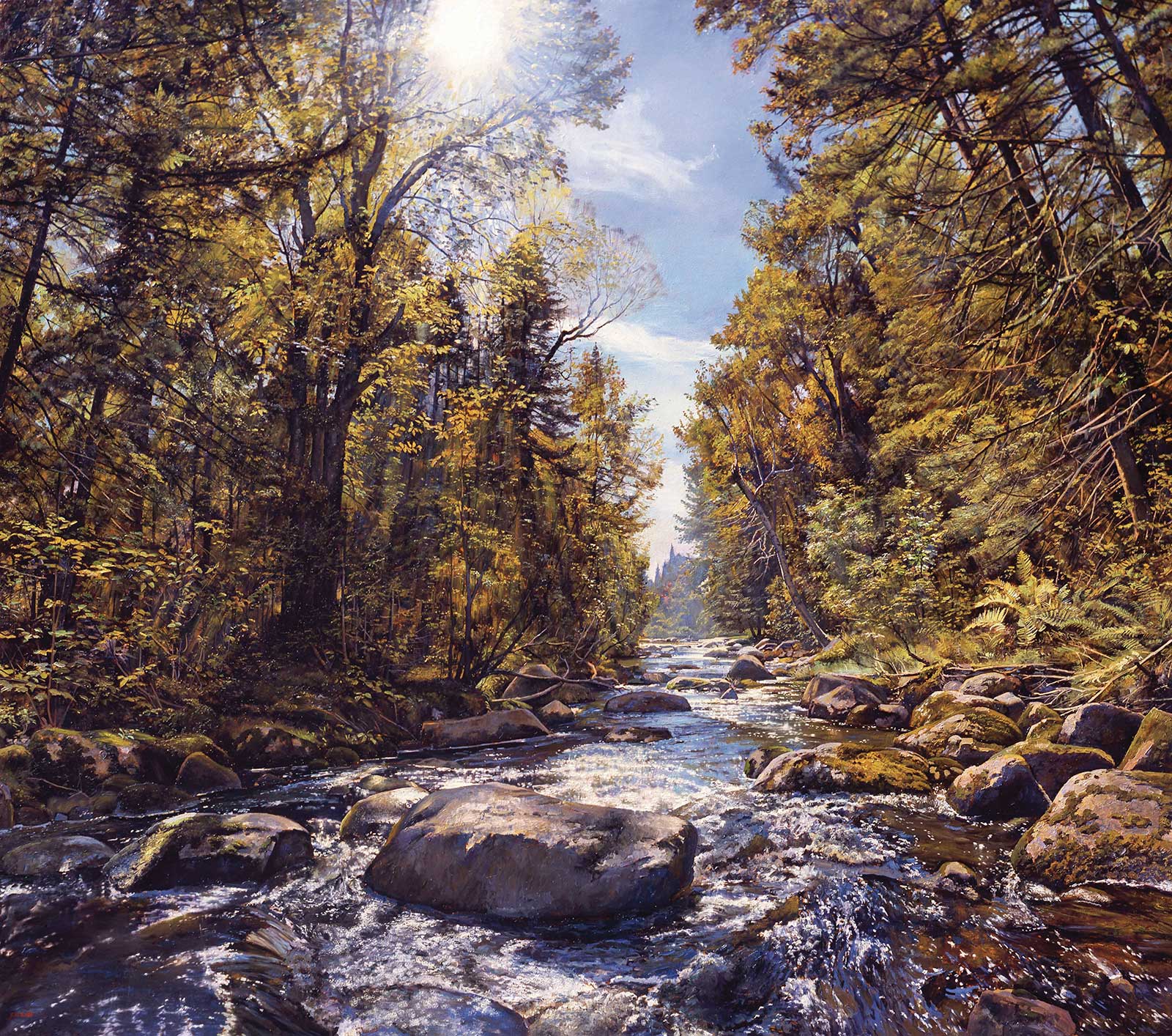 Bernd Heinrich’s Brook in Autumn, oil on linen, 60 x 68". Courtesy Greenhut Galleries, Portland, ME.
He had first visited Maine in 1971 and, several years later, was given a piece of land there. In 1975 he began building a cabin. He would often sit for hours sketching and absorbing the new landscape. He and his wife, Frannie Moser, began to spend summers there and, in 1988, moved to Maine permanently. Meanwhile, his growing mastery of perspective had resulted in two large paintings for a hotel and a bank in Cambridge, Massachusetts.
Commenting on his Boston paintings, many with aerial views, Marcia L. Vose of Vose Galleries in Boston, writes, “I once joked to Joel that he is the modern-day Canaletto—in a helicopter—and we mused together what the great Venice artist (1697-1768) would have done in the contemporary world. But he’s not just a copyist. He has spent years developing the style of the Old Masters but has fused these techniques with modern aids to stretch in new ways. His art is his own—spellbinding, versatile.”
Despite his renown for paintings of Boston, it is his paintings of Maine that attract me. I left Maine the year Babb arrived. The Maine woods, marshes and rocky ocean coast became part of me when I lived there and are alive in me 50 years later.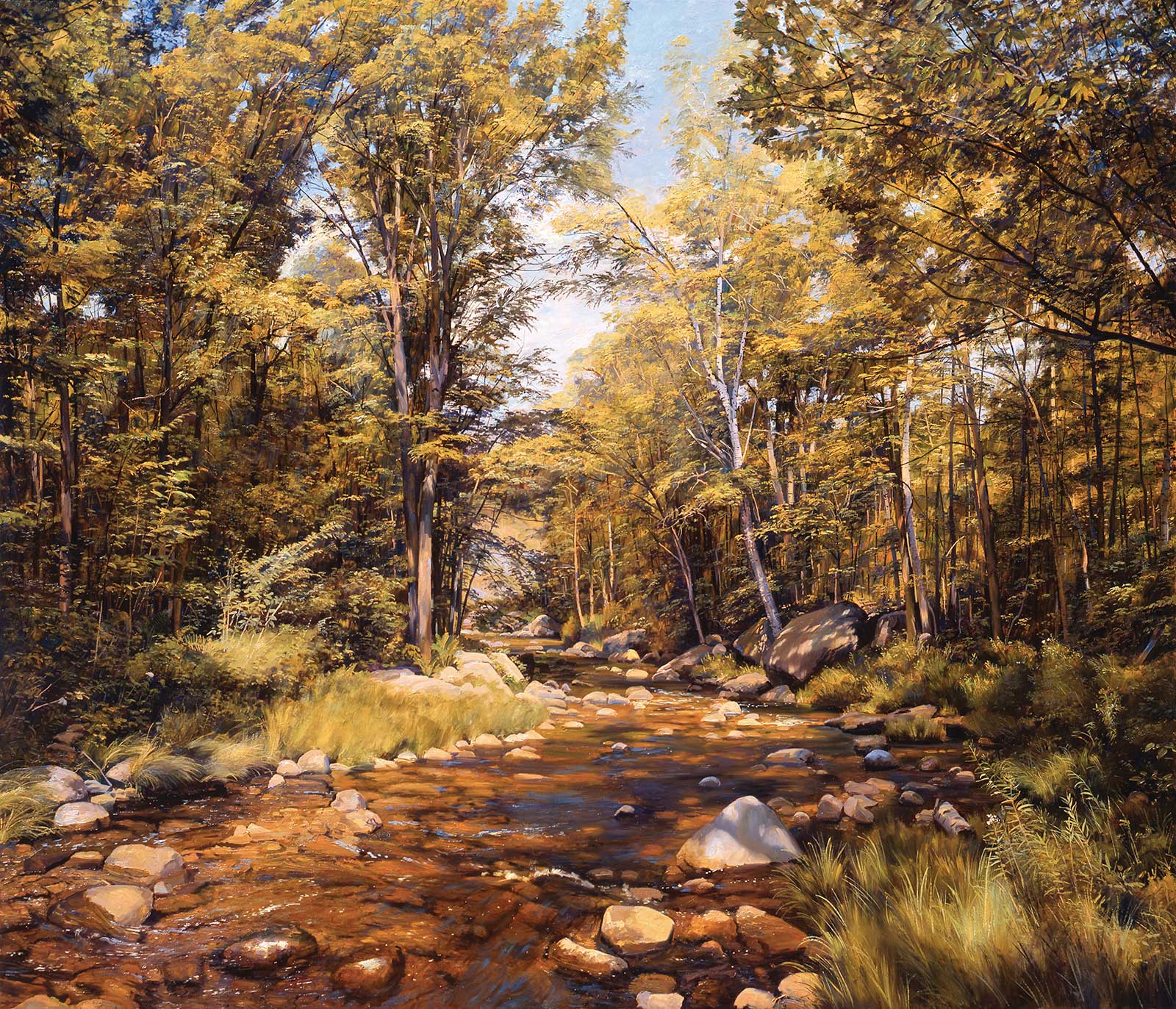 The Pleasant River, oil on linen, 46 x 54". Courtesy Greenhut Galleries, Portland, ME.
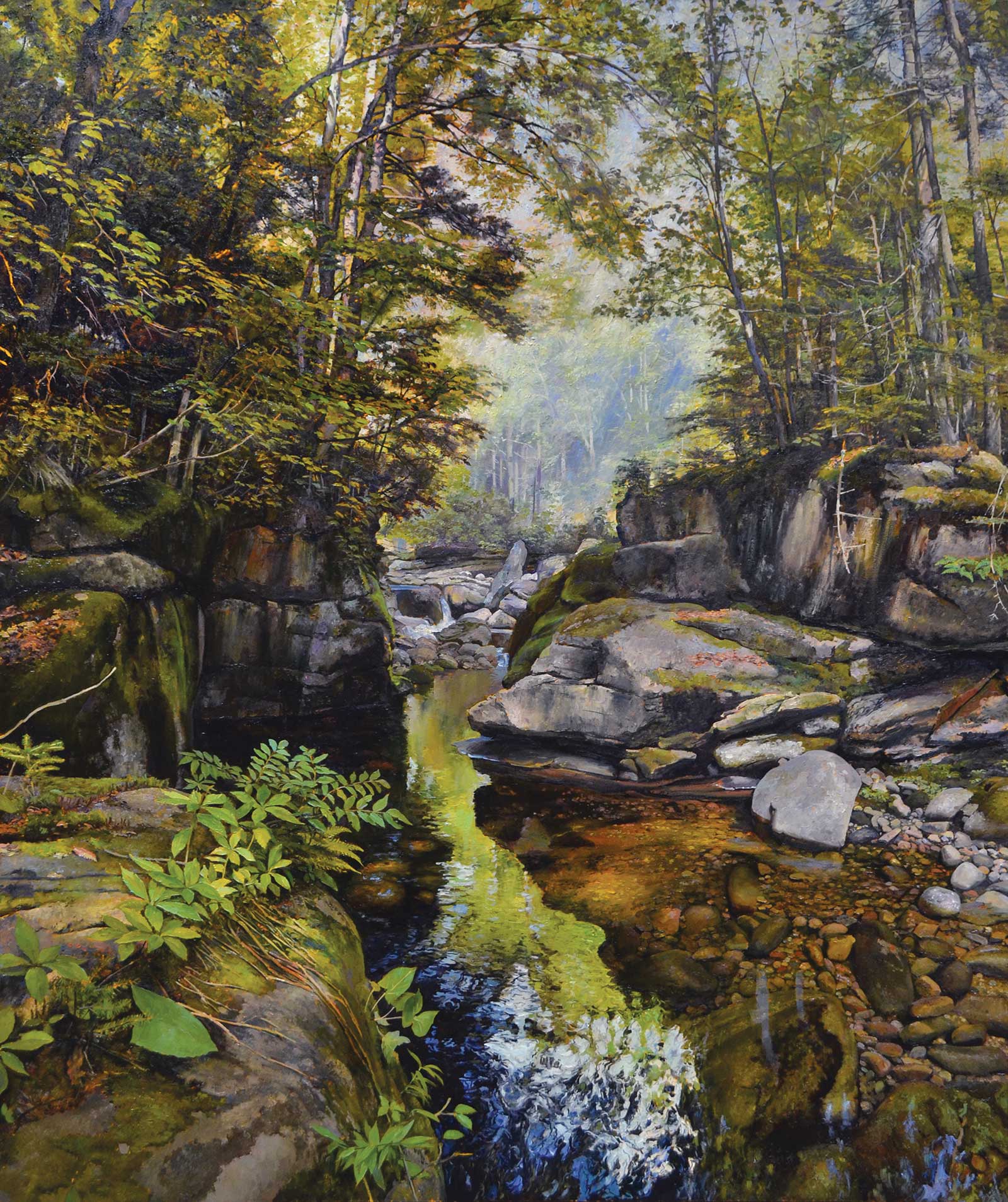 Crystal Pool, oil on linen, 62¾ x 52". Courtesy Greenhut Galleries, Portland, ME.
He says, “I love Boston but live up here in the woods. I derive so much pleasure going out and getting lost in our woods, getting to know the area. It’s something profoundly necessary. I can’t live without the concordance of the relationship with nature. “I had to learn to represent nature. In the beginning I couldn’t do it. It had me totally floored. As I looked at the arrangement of grasses and the whorls in the water I thought of Leonardo and his drawings of those details,” Babb explains. “Nature is a great self-organizing, infinite and mysterious thing. When you look at it closely, it’s microscopically fascinating. It’s infinitely small and so infinitely large it encompasses us.” His study of Leonardo brought him to the details, but Claude Lorraine’s drawings revealed a “very complex and beautiful way of organizing space. Once I began to think and apply it, I invented landscapes based on Claude’s landscapes and his drawings.”
Babb is a fan of John Ruskin and the American Pre-Raphaelites. In his book Modern Painters, Ruskin wrote, “Paint the leaves as they grow! If you can paint one leaf, you can paint the world.” In his Crystal Pool, Babb captures the foreground vegetation with clarity as the space fades into the distant mist.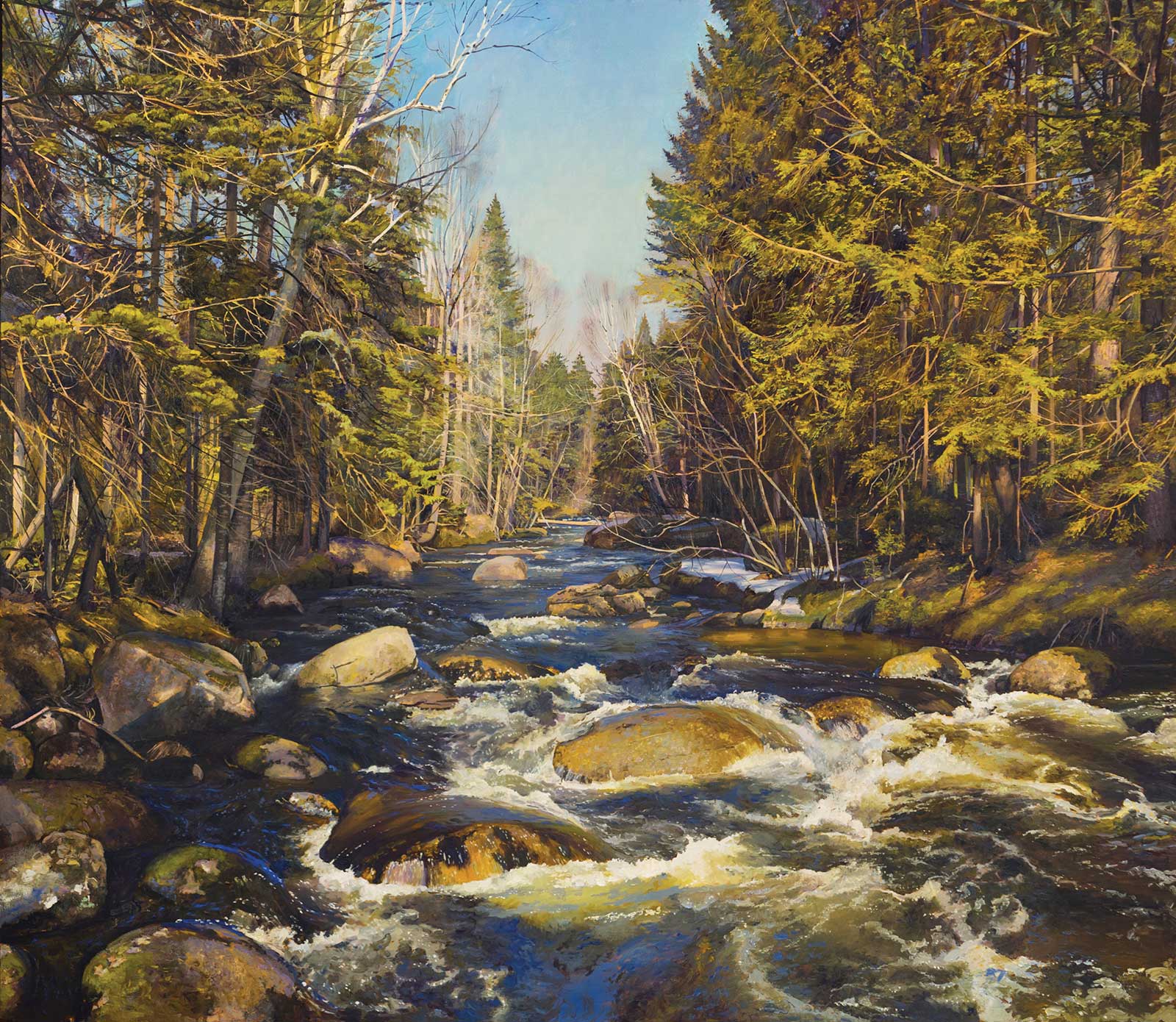 Bernd Heinrich’s Brook in Spring, oil on linen, 45 x 52". Collection of Bernd Heinrich. Courtesy Vose Galleries, Boston, MA.
His observation of the intimate details of the forest and the reflections on the flowing water echoes those of his friend Bernd Heinrich, who lives on 650 acres even deeper in the Maine woods. Heinrich is an ultra-marathoner with a Ph.D. in zoology. I first discovered his book Mind of the Raven after moving to Santa Fe and becoming fascinated with the sounds and antics of the ravens here.
Babb has painted Heinrich’s brook in different seasons and was photographed by Heinrich as he was set up nearly in the brook to paint it. Babb notes that Heinrich makes discoveries in the acres surrounding his home, experiencing nature intimately and writing about it.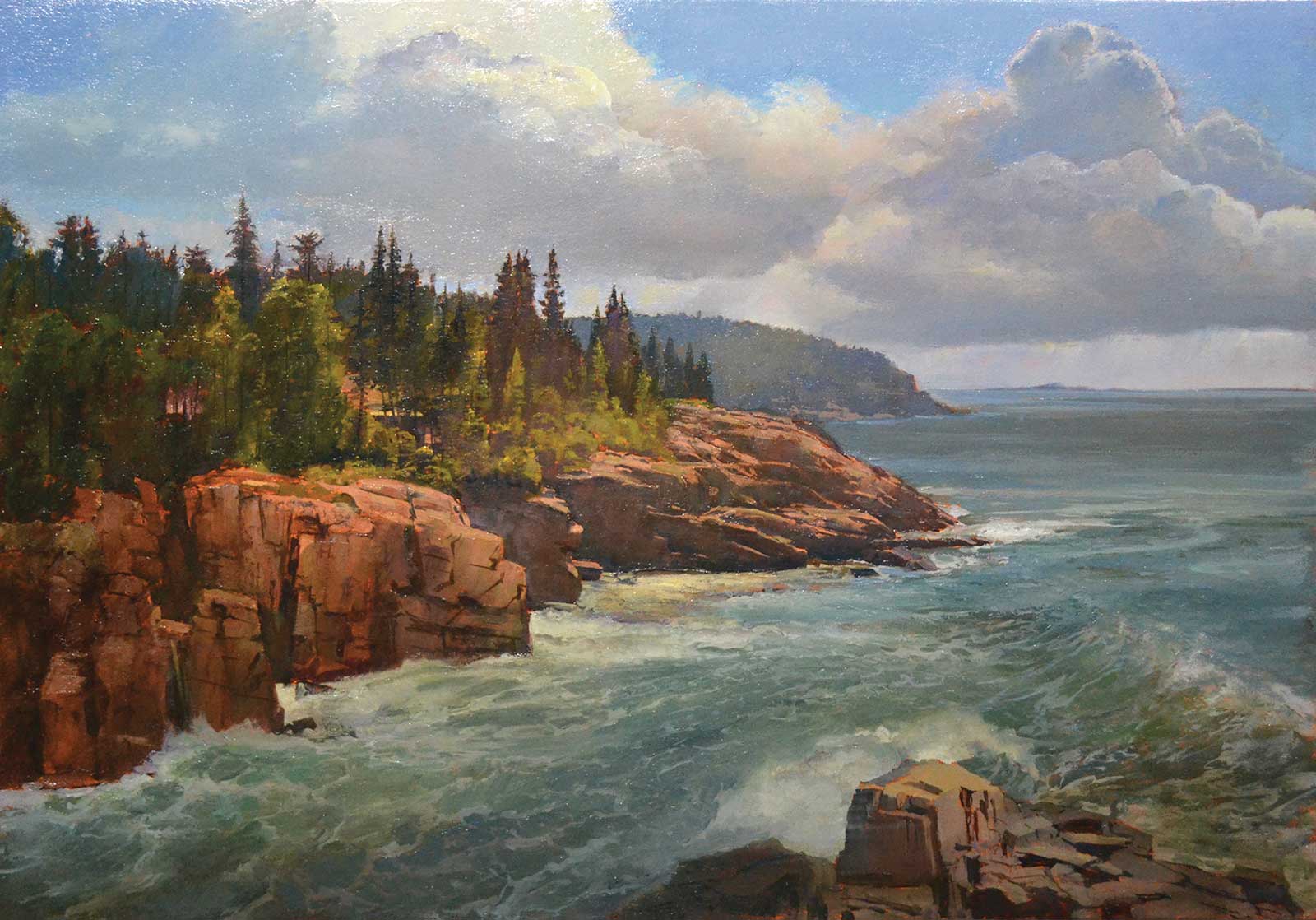 Mount Desert Capriccio, oil on linen, 14 x 20". Courtesy Greenhut Galleries, Portland, ME.
“Bernd is a hardcore scientist,” he observes. “He is an artist, too, with a deep aesthetic. He receives the same aesthetic pleasure from both science and art.”
Babb’s large, highly detailed paintings allow him to portray the feeling of space and place, from minute leaves to the “vast beauty of the space.” He muses not only about what he sees, but how he sees. “In a way we’re not looking at the thing in itself, we’re looking at a changing set of phenomena,” says Babb. “I’m interested in how the mind apprehends things. Lucretius wrote a six-book poem, De Rerum Natura (On the Nature of Things), over 2,000 years ago in which he wrote about atoms in space combining and recombining. I think of Lucretius when I’m at Acadia—the interaction of forces, water wearing away the rocks, eternally changing atoms.”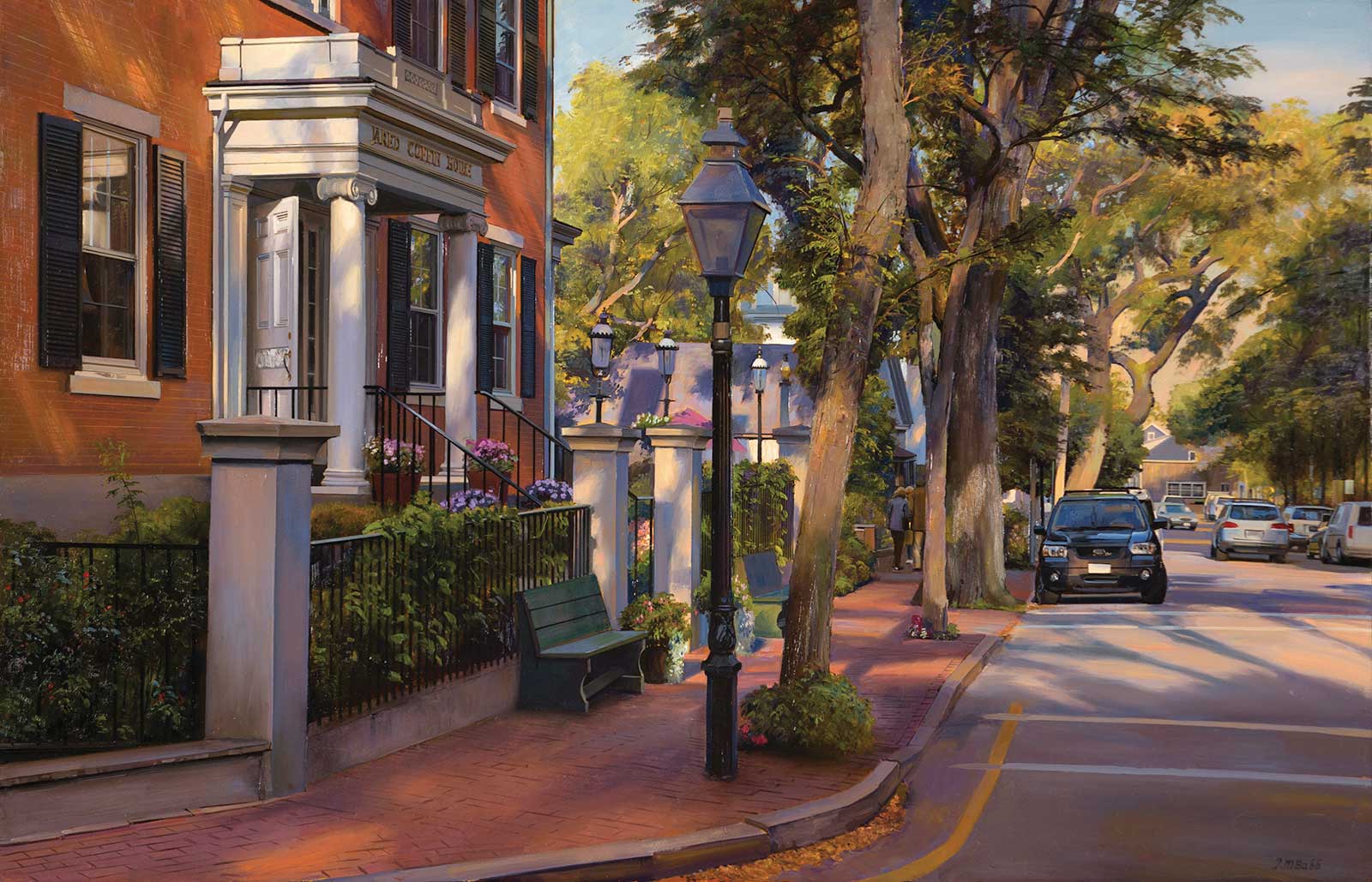 The Jared Coffin House, Nantucket, oil on linen, 22¾ x 36". Courtesy Vose Galleries, Boston, MA.In the book Nature & Culture: The Art of Joel Babb, Bernd writes, “A paining is the product of the eye, mind and hand. The mind has to be transported into the scene, then captivated by certain features of it, for the ‘truth’ of it to shine. Thus, when we see a painting of a brook, we are consciousness-sharing with the artist. We are seeing not only a brook but also what has entered a person’s eyes and has been processed and executed to be reproduced into a recognizable facsimile of the real. The painting also represents a human caring. It shows what the painter values and appreciates. It is the visible proof of that consciousness and caring.”
Babb’s artwork is available through Vose Galleries in Boston and Greenhut Galleries in Portland, Maine. —
Powered by Froala Editor