Painting often captures a singular moment in time. What happens, however, when an artist wants to explore something more abstract? When they want to move beyond a static image to a sequence of events? How do they capture that idea on a two-dimensional surface? In the new exhibition SHIFT at Susquehanna Art Museum, director of exhibitions Lauren Nye pairs the works of Tiffany Calvert and Alex Kanevsky to show how artistic confines can be broken. Alex Kanevsky, Lulu in Madrid (Twice), oil on board, 12 x 72". Courtesy the artist and Hollis Taggart, New York.
As the museum explains, “The visual disturbances created by each artist shift the viewer’s perceptions of classical forms. The human body, nature and architecture are reimagined with a contemporary style that references technology and the persistent passage of time.”
Both artists paint recognizable subjects—including still lifes and the human form—but abstract the images to formulate new ideas. The artists also rely on art history, whether past paintings or the techniques, to elevate classical to contemporary.
Calvert’s artwork integrates traditional and emerging media to investigate changes in human perception. The work also is a conversation on how painting and digital media intersect, because she uses a software program called Processing to “digitally ‘glitch’ some of the source image before printing it on canvas” and painting.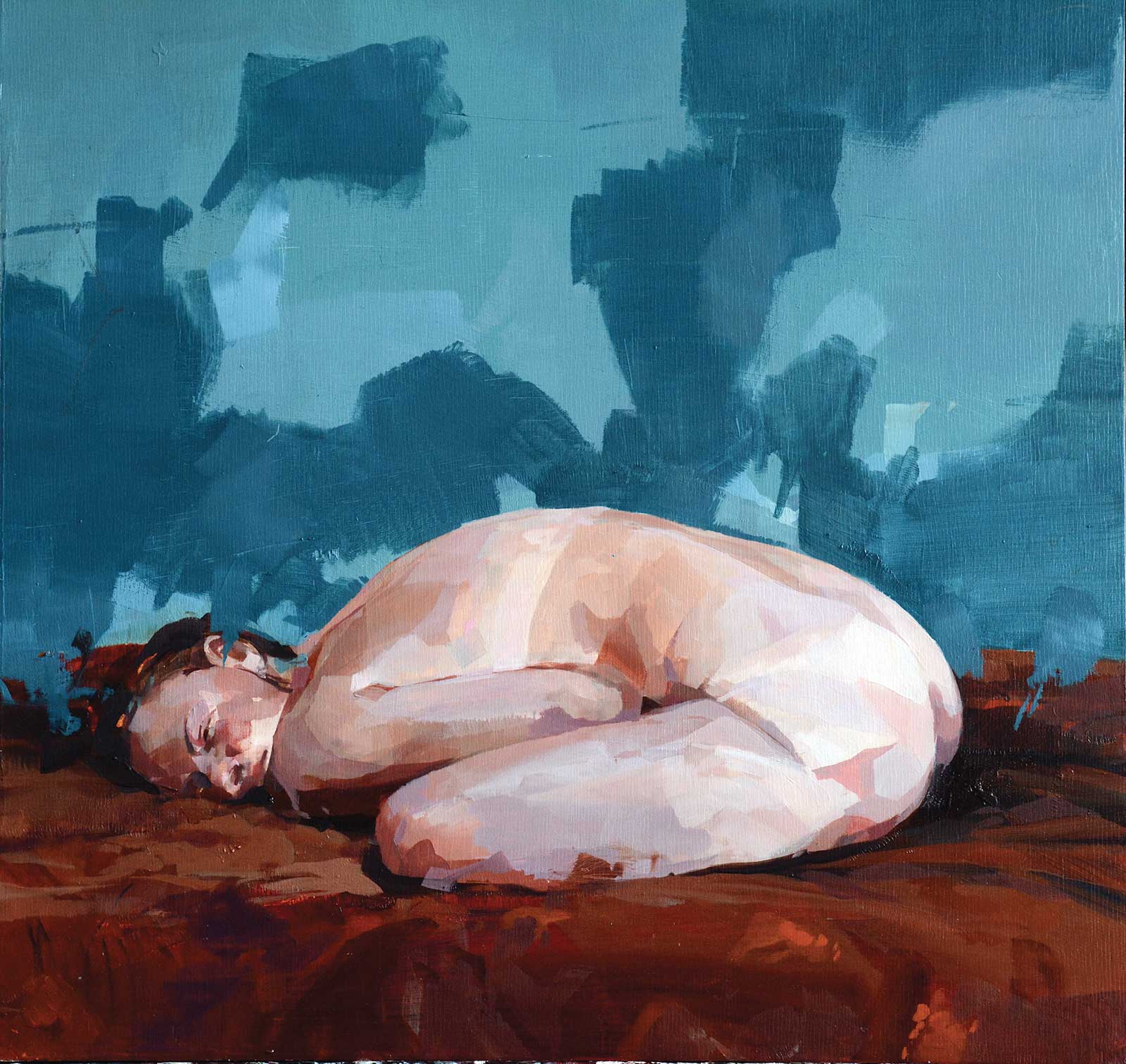 Alex Kanevsky, M.H., oil on board 18 x 18". Courtesy the artist and Hollis Taggart, New York.
She says, “I am especially interested in the evolution of pictorial space. My work takes up the ‘digital shift’ in image production that rather suddenly antiquated late modernism’s various flatnesses (including, in particular, Rauschenberg’s flatbed picture plane). Today we view our screens and the world they occupy as a shallowly layered space of overlapping desktop windows. The picture plane has tilted up again from the flatbed to float in front of our eyes. My paintings in turn depict an intermediate space, where the verticality of the still life paintings cohabitate with these digital panes.”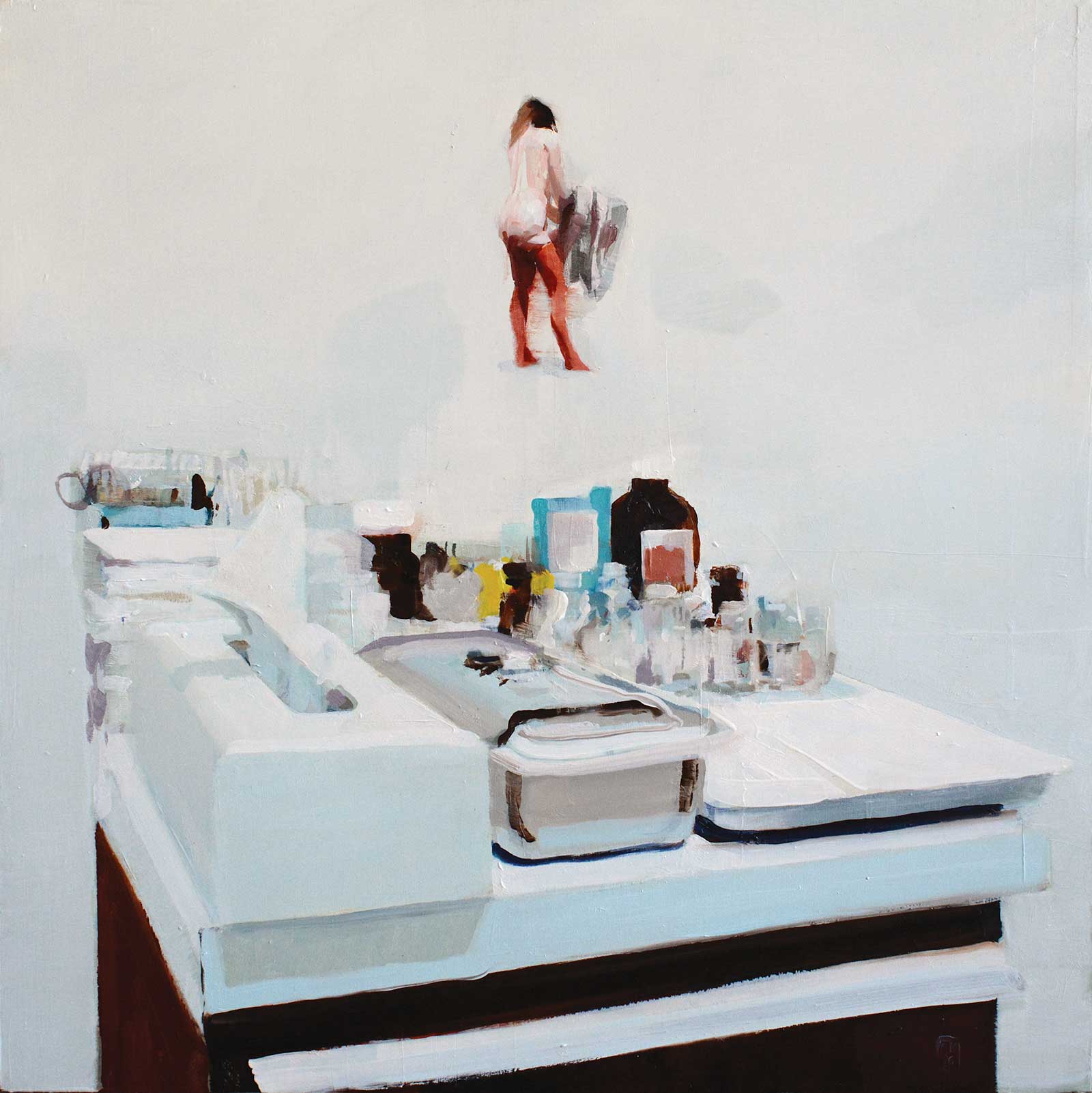 Alex Kanevsky, Doctor’s Table, oil on panel, 18 x 18". Courtesy the artist and Hollis Taggart, New York.
Dutch floral still life paintings have been a vessel for Calvert since they address many of the issues she is attempting to explore. “Their subjects were botanical fantasies, emblems of an economic mirage that has contemporary corollaries. Most important to my pictorial concerns, they depict ephemeral things in shallow and diagrammatic space—they are all foreground,” she explains. “They contain an abundance of visual information in overwhelming density, creating an allover resolution, a visual field that is equivalent to digital noise. By making painterly interventions into reproductions, I attempt to dissolve the layer between the resolution of the source image and abstraction of the painted mark.”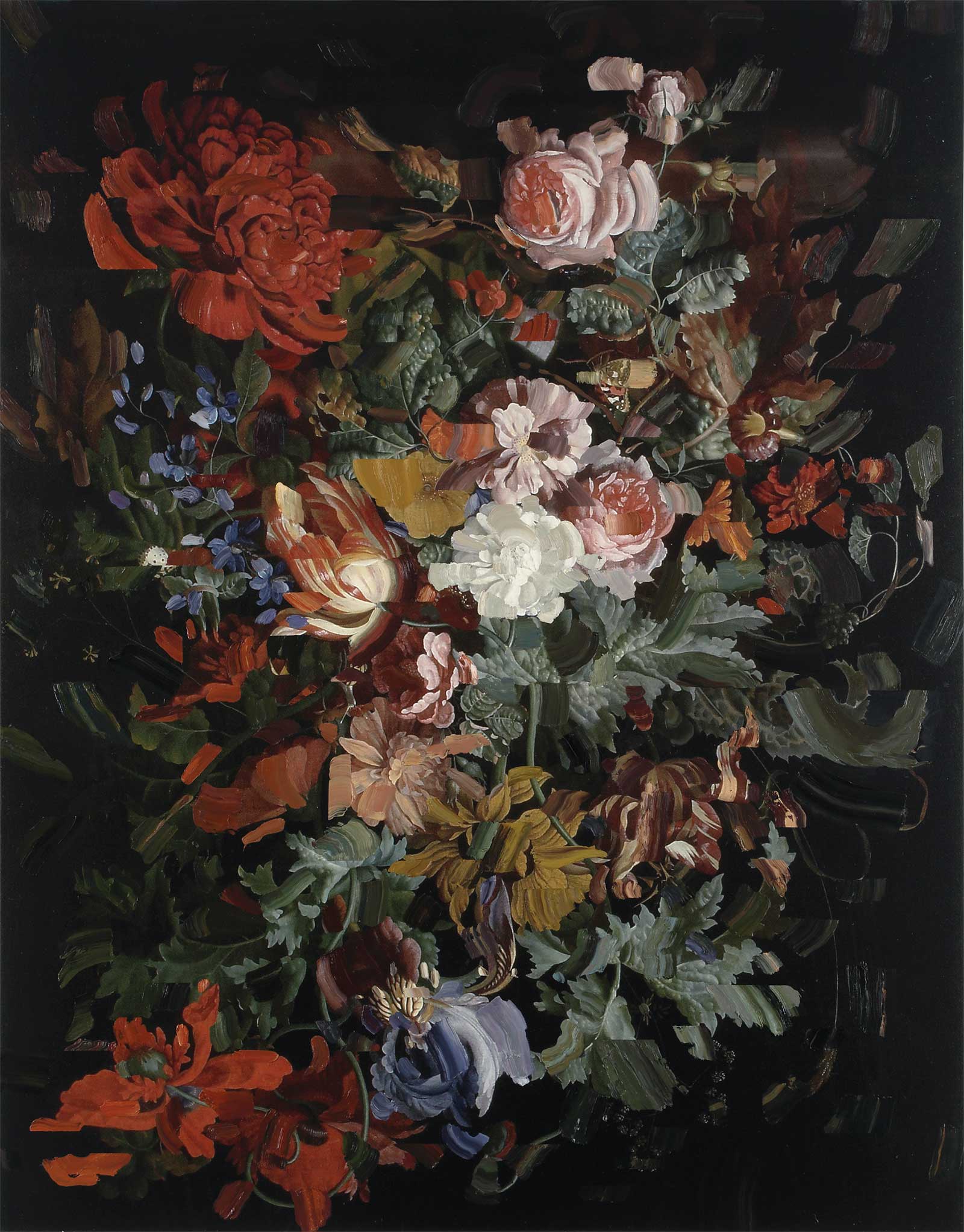 Tiffany Calvert, #296, oil on inkjet print on canvas, 60 x 48"
Her painting #296 was based on Bouquet of Flowers in a Glass Vase by Dutch artist P.W. Windtraken, which she reproduced upside-down. In subsequent versions of the work, including her piece #305, she altered the code of the image using software to produce the digital portion of the multimedia piece. Rachel Ruysch’s 1700 work Vase of Flowers was the inspiration behind #338 and three other paintings. “The painting contains an example of the Dutch tulip most prized during Tulipomania: Semper Augustus. Striping is caused by a virus which infects the bulb,” Calvert explains; she adds, “There is a parallel between a virus infecting the bulb and creating aberrations in its appearance (making it more rare and prized) and the aberrations I create using code altering software to create ‘glitches.’”
Kanevsky is a firm believer that artwork should speak for itself. What the artist puts on canvas is all that is needed for the meaning of the piece to be interpreted. “Everything that I wanted to convey is already in my work,” he elaborates. “Any additional words from me would dilute the impact and confound the meaning. I believe that paintings function where words fall short and prefer it that my paintings have this opportunity.”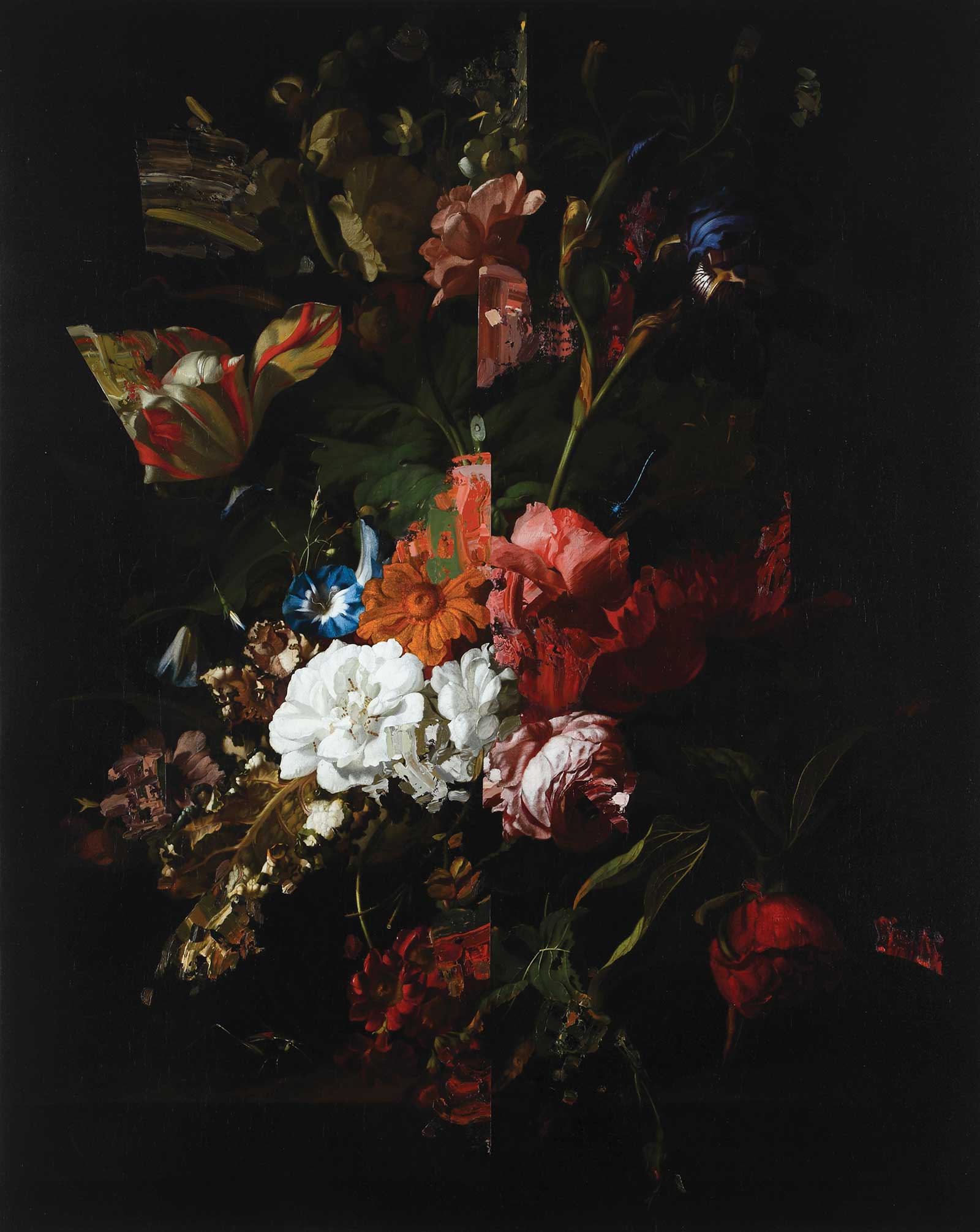 Tiffany Calvert, #327 (detail), oil on inkjet print on canvas, 60 x 48"
According to the museum, his “paintings capture the constant flow of time. Like the unreliable nature of memory and the imprecise atmosphere of poetry, his multilayered works provide more questions than answers. These paintings combine abstraction and figuration in layered compositions in which the artist strives to convey his own personal view of the world.”
Inspiration for Kanevsky can come from anything that he experiences and observes. It can be from something that he read, something that has been said, how a color looked or became a memory to him, or even moments of his life. Rather than identifying his work as having a particular style, Kanevsky says his paintings have developed from how interprets what he sees.
“Like everyone else, I have my own unique view of the world. As an artist I try to arrive at the extreme clarity of that view and then try to find visual means, capable of expressing this clarity,” he says. “So, if my work has any recognizable traits, they are mostly a byproduct of always trying to be very clear and concise about my personal view of the world. You know, if you always trying to climb the same mountain, you will eventually be known as a guy who is always climbing that mountain.”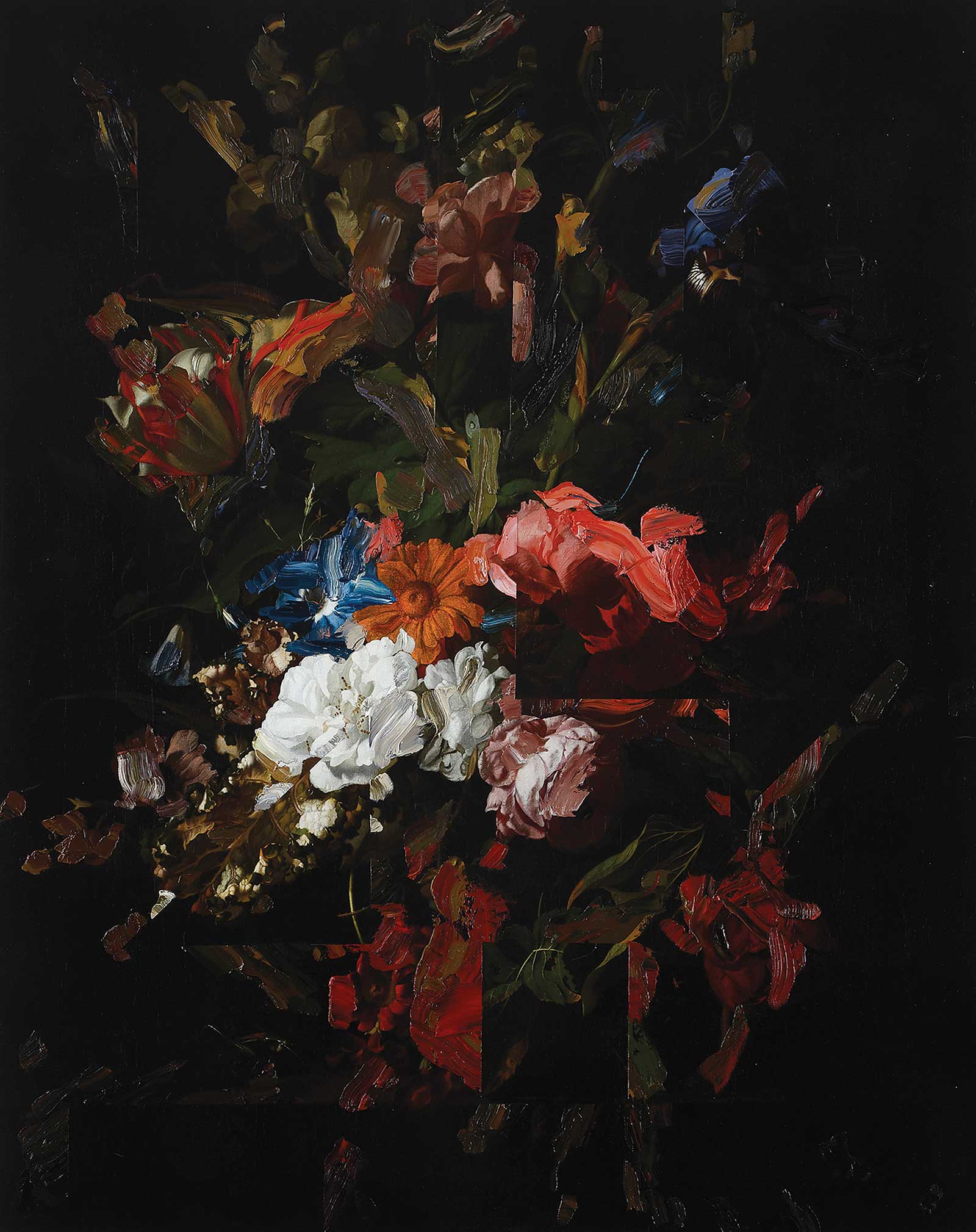 Tiffany Calvert, #328 (detail), oil on inkjet print on canvas, 60 x 48"
Nye’s intent with the exhibition is to educate museum visitors about art history through the contemporary lens. “Our audience is consistently interested in learning more about artistic processes that they are familiar with, like painting the figure or still life, when they can see examples of it that are being created by artists who are new to them,” she says. “Tiffany and Alex both approach paint handling in a way that is tactile and alluring. Their use of rich colors, thick applications and perception-shifting compositions have dazzled our visitors. The visual disturbances created by each artist inspire viewers to inspect what they are seeing on a deeper level.” —
Powered by Froala Editor