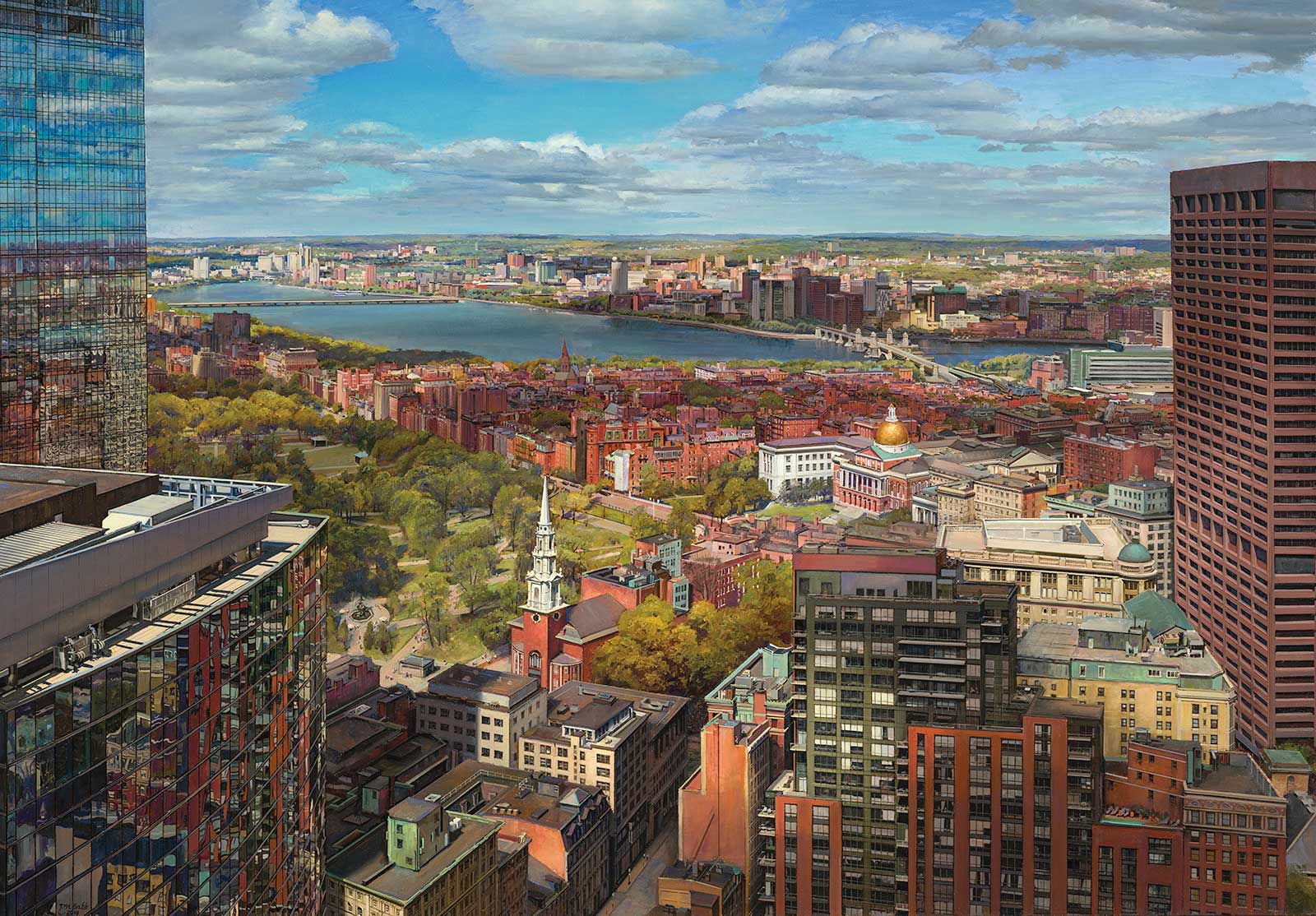
 Vose Galleries, Church and State, Boston from the Harvard Club (detail), oil on linen, 42¼ x 60¼", by Joel Babb.
Of his aerial cityscapes, Joel Babb says, “There is a sense of detachment in a broad view like that—so that one doesn’t think of individuals on the street, or being in the city, but one sees the city as an organism with a life of its own…You think of the passage of time, and from the distance the city and all its inhabitants seem like part of the pattern of nature.”
His views of Boston were originally captured from a helicopter. Most recently he has sketched from the top floors of the city’s tallest buildings. Church and State, Boston from the Harvard Club is a view from the 38th floor of a building in downtown Boston overlooking a large chunk of its history. People may not be visible but their presence is, from herding grazing cattle on Boston Common in colonial times, to the intrepid workers who built its tall buildings.
Babb frames two iconic buildings from the 18th and 19th centuries, the gold-domed State House completed in 1798 and Park Street Church, completed in 1809. For 36 years, the church was the tallest building in the country until it was surpassed by Trinity Church Wall Street in New York City.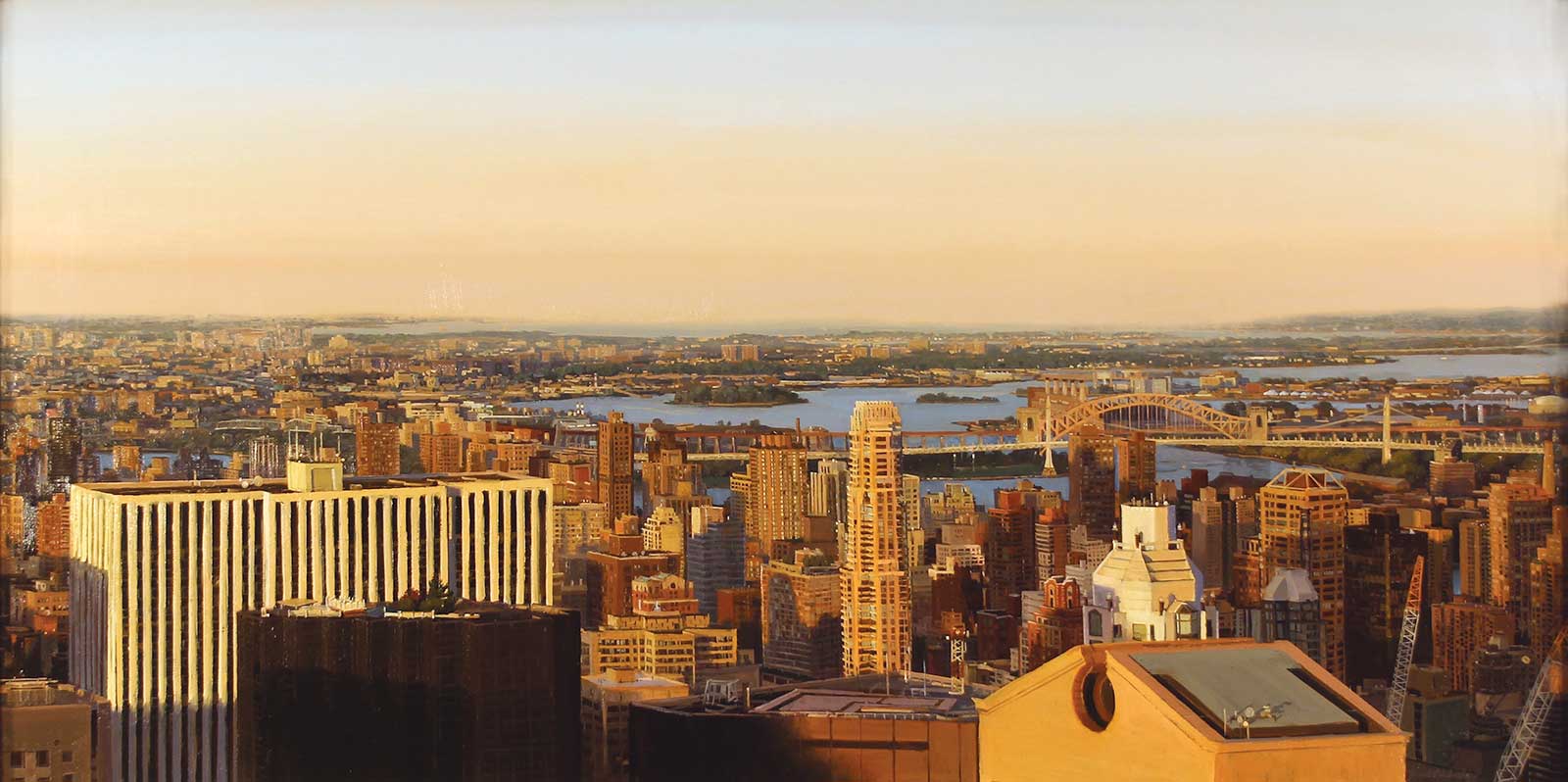 George Billis Gallery, Twilight, East River, oil on panel, 24 x 48", by Brad Aldridge.
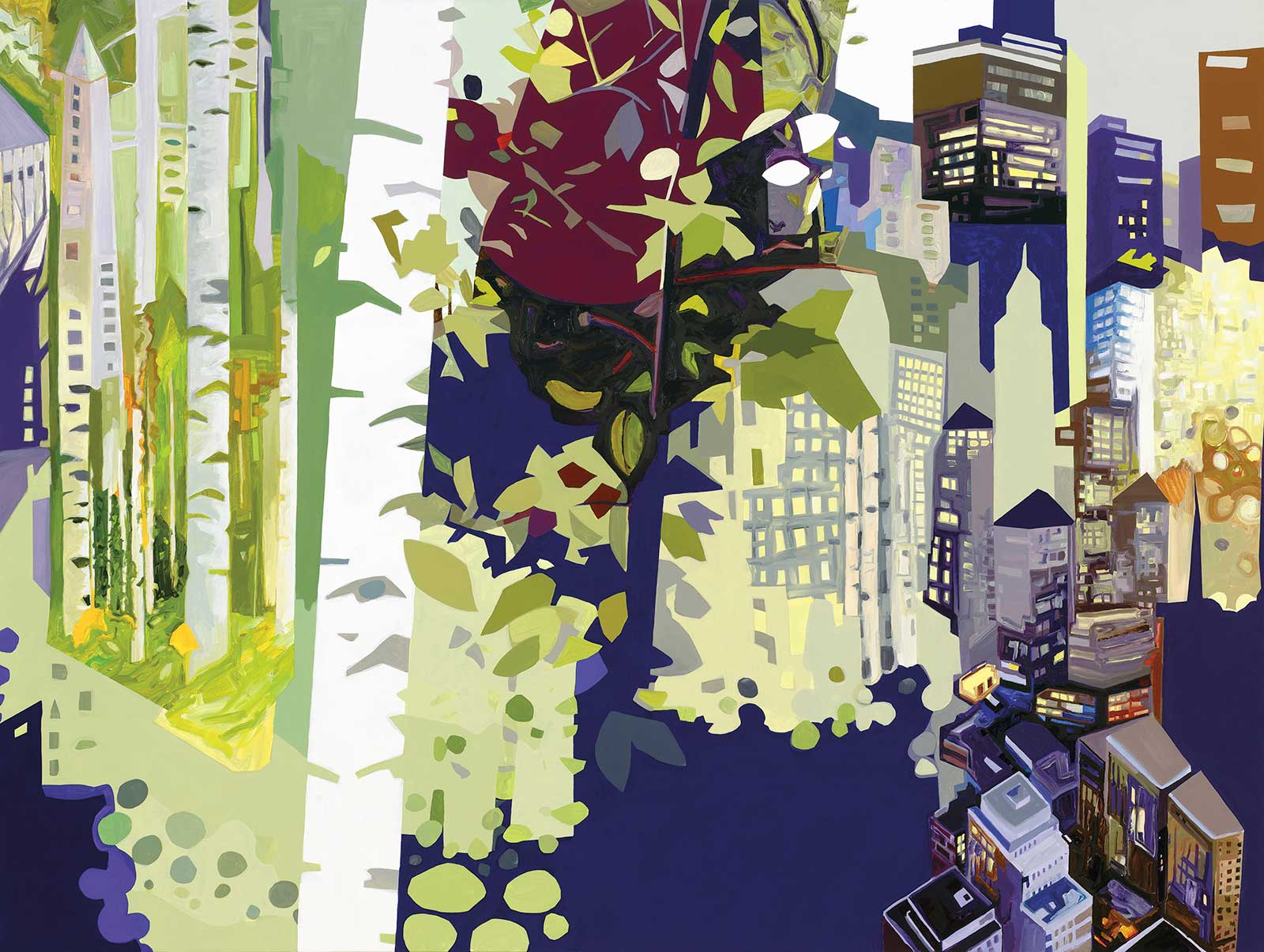 Garvey | Simon, Over and Under Growth, oil and acrylic on canvas, 60 x 72", by Sandy Litchfield.
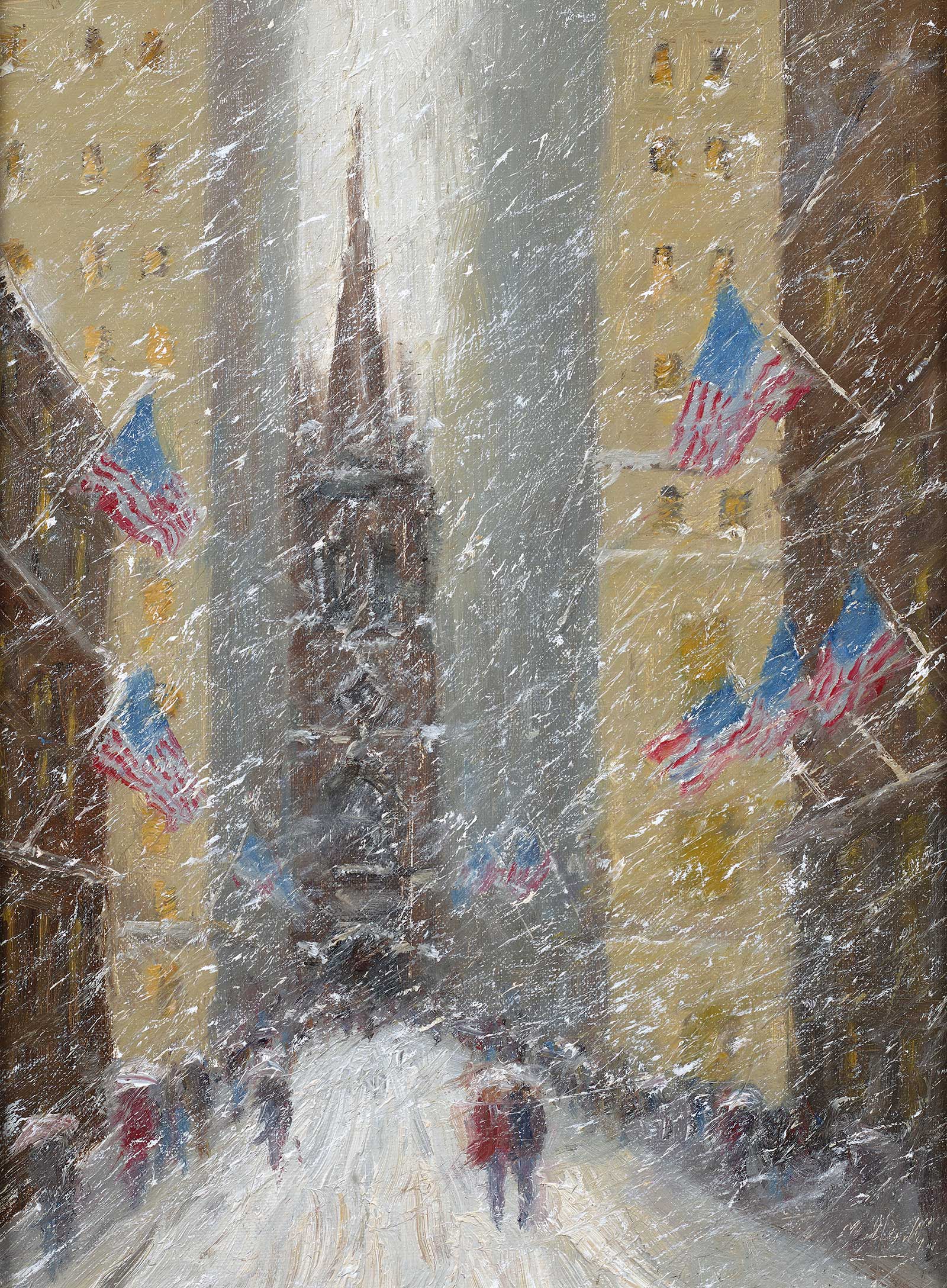 Rehs Contemporary Galleries, Winter Flags, Old Trinity Church, oil on panel, 12 x 9", by Mark Daly.Trinity Church was completed in 1846 and has been the subject of painters throughout its history. The contemporary impressionist Mark Daly painted Winter Flags, Old Trinity Church looking up Wall Street to the church. Daly, with degrees in economics and business administration, has had a side gig as a mandolin player, composing and performing his own music. He had studied painting as a boy but didn’t return to it until 2007.
He says, “For me, every painting is a new adventure—a journey of discovery, growth and creativity. I like to capture the visual joys of life—people walking the streets of the city with patriotic flags flowing, families playing at the beach, peaceful boats reflecting in a calm harbor. A good composition, strong sense of light, honest color, confident brushstrokes, engaging edgework and a connection with the viewer are outcomes I strive for.” Daly’s sense of musical rhythm in a “good composition” is evident in Winter Flags with the perspective leading directly to the church and the dark buildings rising in height from left to right framing two lighter buildings.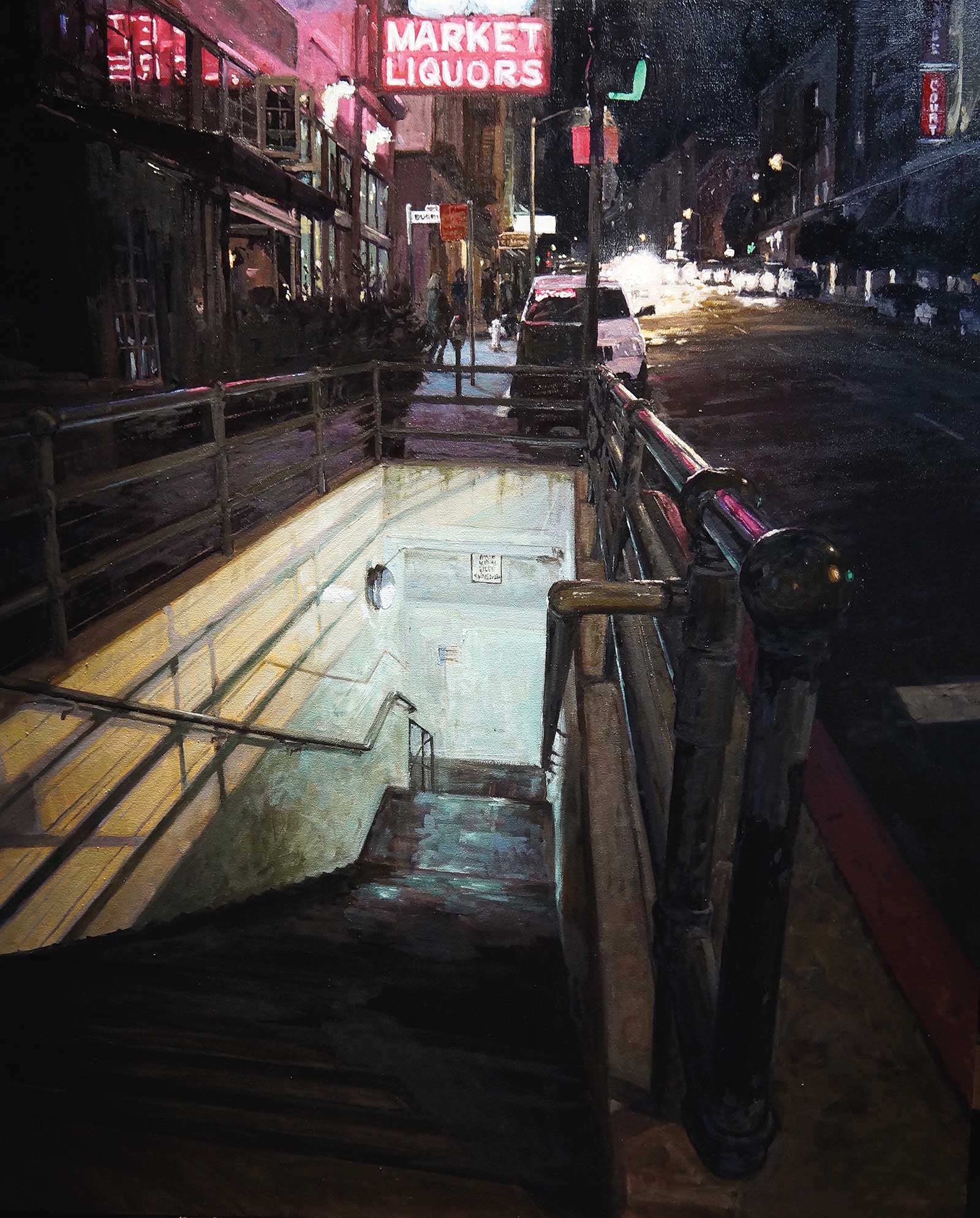 PoetsArtists, Stairs to Stockton Street, oil on canvas, 48 x 40", by Scott W. Prior.
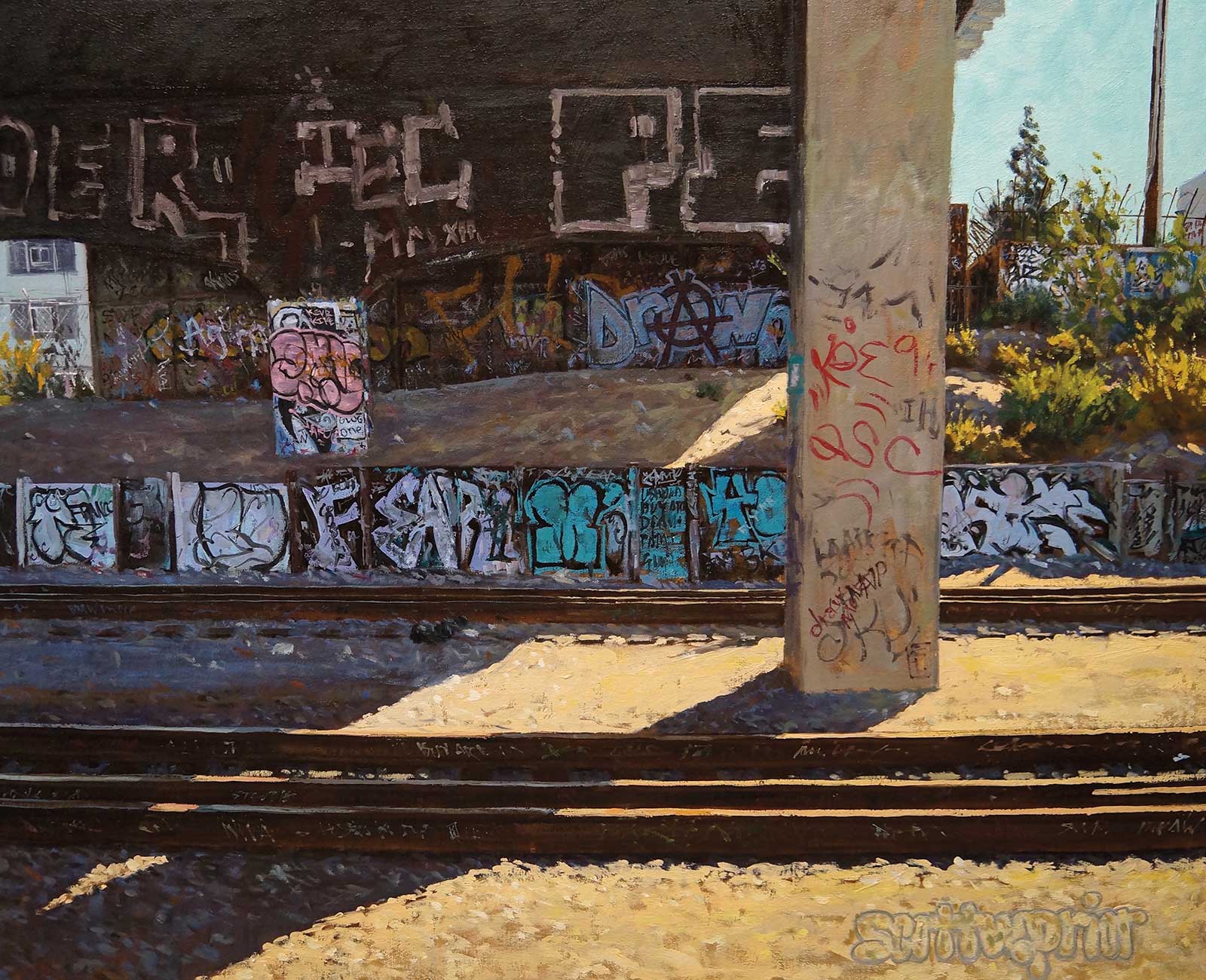 PoetsArtists, Under the 7th St. Bridge, oil on canvas, 32 x 40", by Scott W. Prior.
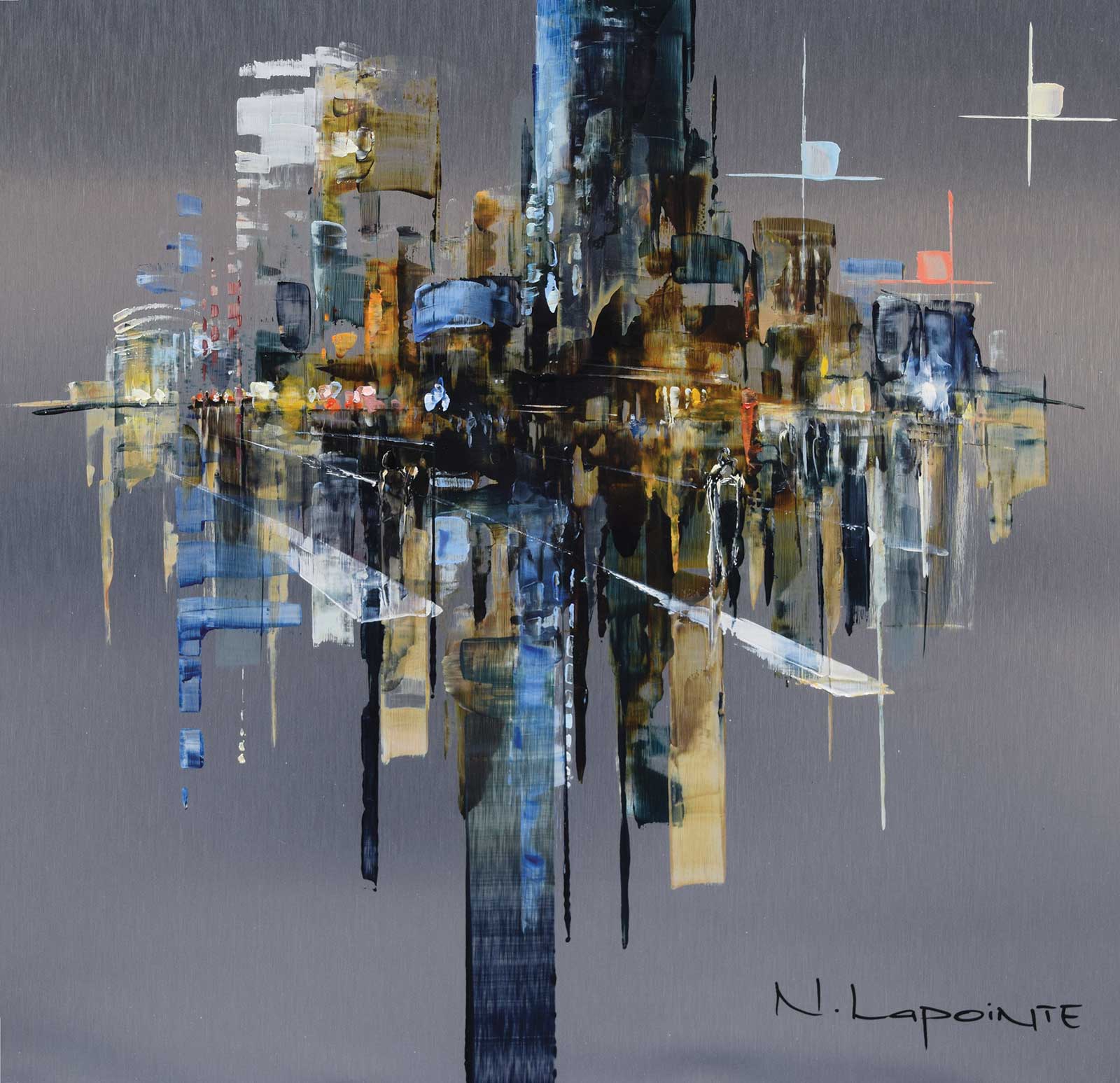 Nathalie Lapointe, Free Luminous, oil, 17½ x 17½"
Brad Aldridge’s Twilight, East River, recalls Babb’s scene of Boston with the complexity of the city lessening across the river as the landscape becomes more bucolic with Long Island in the distance and the Atlantic beyond. The luminous light recalls American scenes of a less frenetic time. In the foreground of Aldridge’s painting is a controversial Manhattan icon, the former AT&T building by Philip Johnson with its furniture-like top. Aldridge remembers wanting to be an artist at age 4. Today, his cityscape paintings recall a feeling more than a sensation of a specific place—the complex giving way to the more simple—both giving way to the spiritual. He says, “The spiritual resonance one senses from nature seems universal to most cultures and is a timeless belief.” 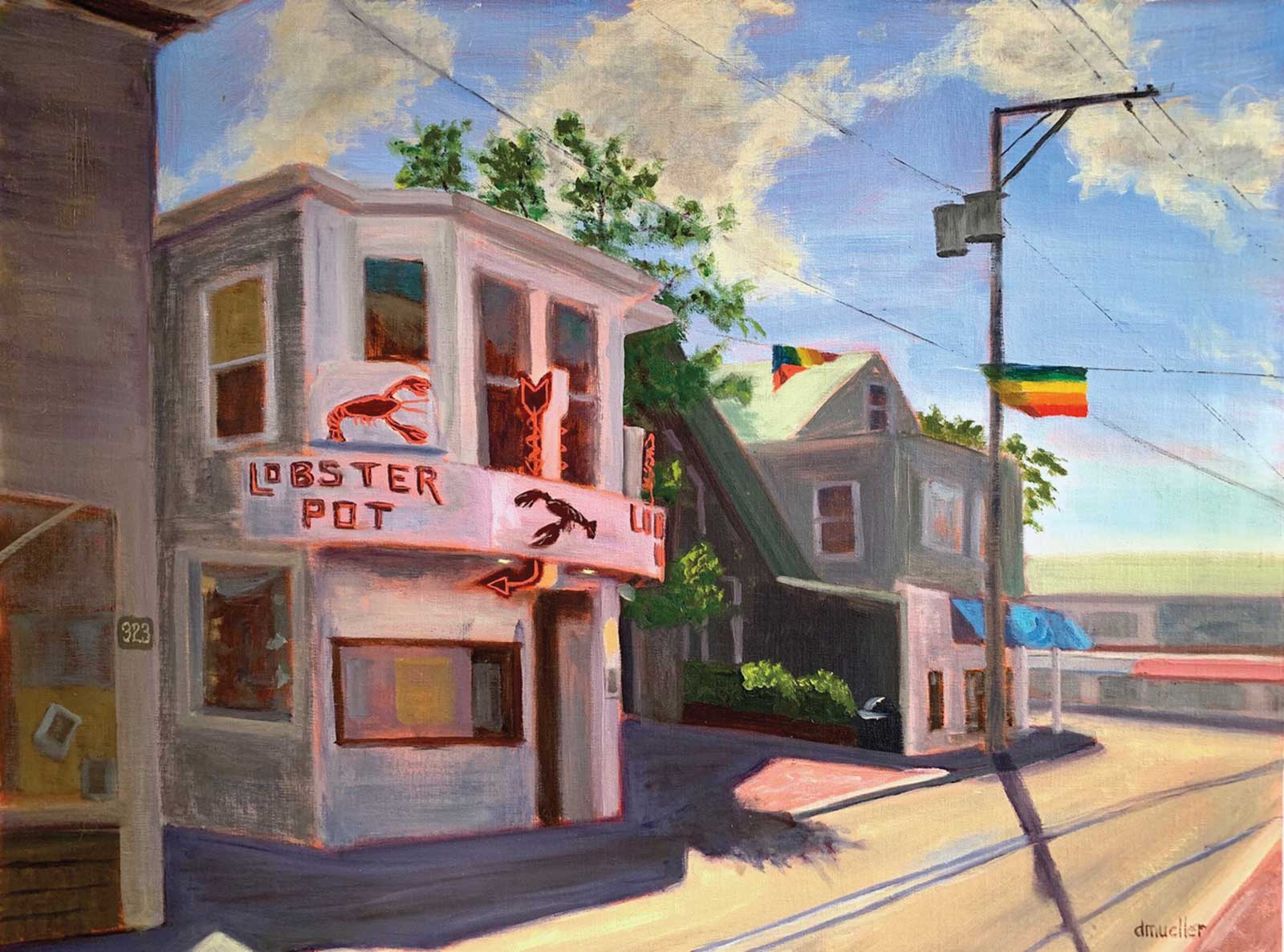 Debbie Mueller, High Noon on Commercial Street, oil on linen panel, 18 x 24"
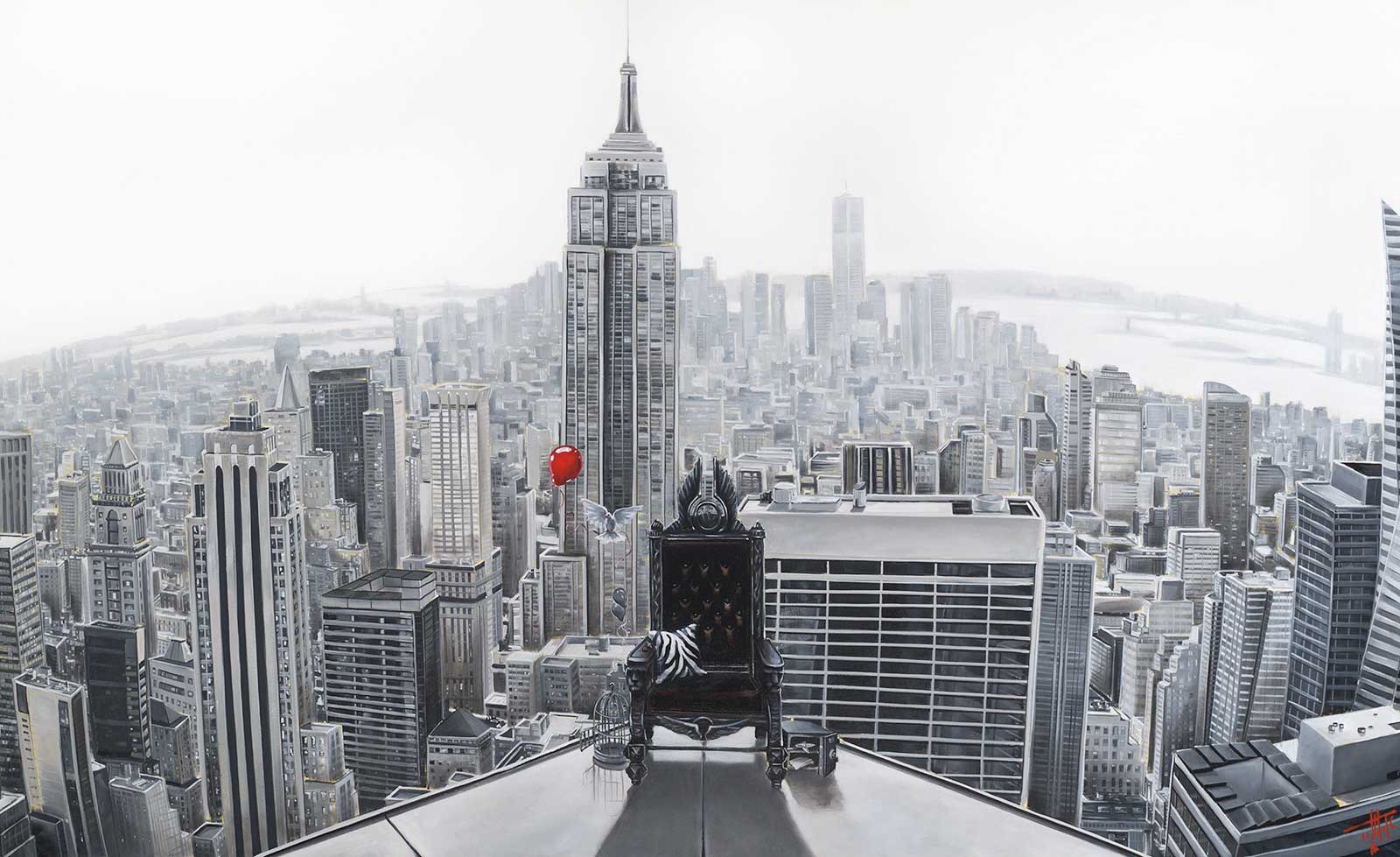 Celebration of Fine Art, Believe, oil on canvas 48 x 60", by Pete Tillack.
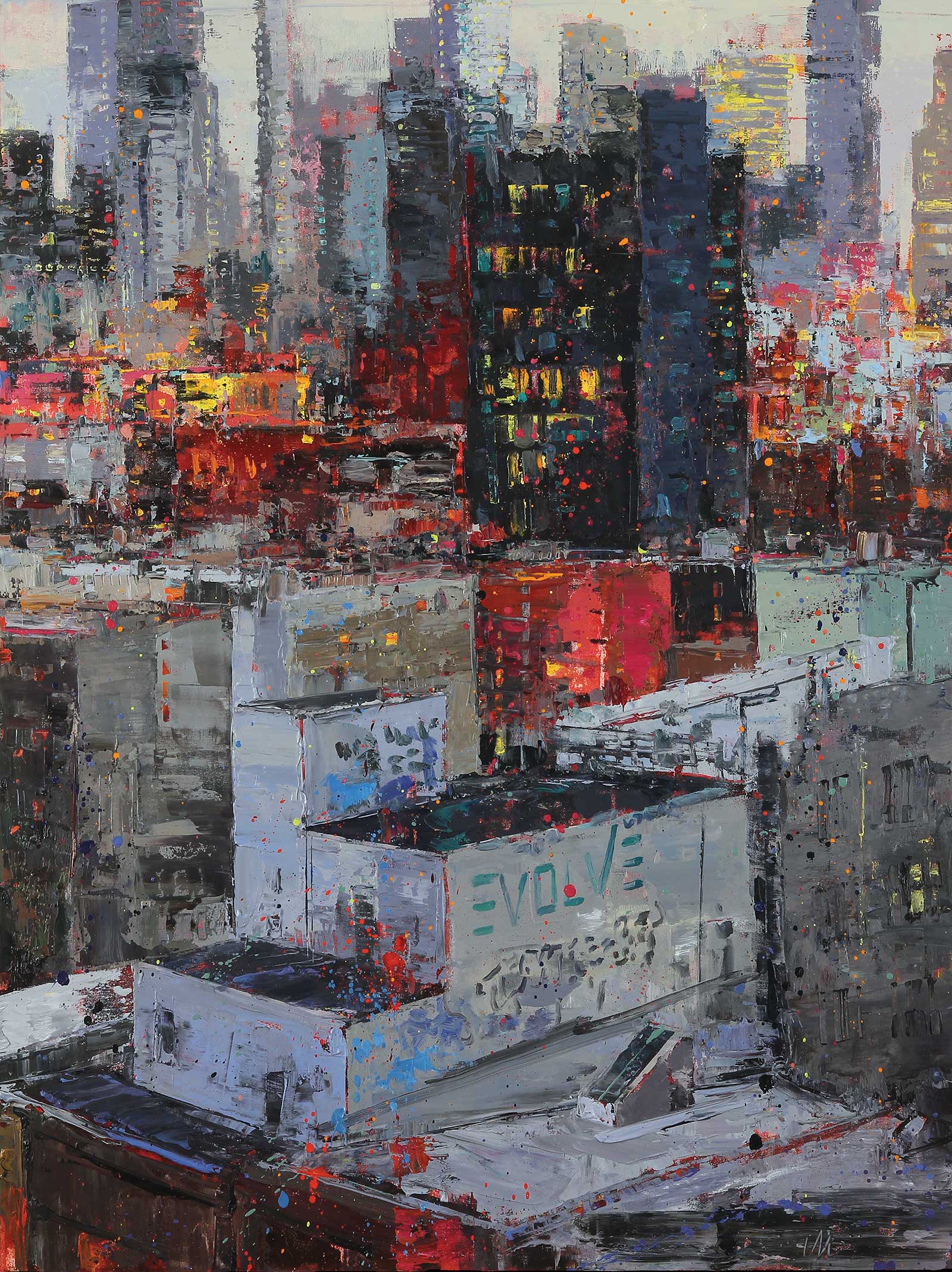 ArtHaus Gallery + Consulting, Evolve, Lower East Side, oil on canvas, 48 x 36", by Carolyn Meyer.
Sandy Litchfield grew up in Manhattan and in the countryside and woods of Westchester County and the Adirondacks. She merges the verticality of both forests and the structures of the city in complex compositions such as Over and Under Growth, each with its own organic nature. Litchfield teaches in the department of architecture at the University of Massachusetts Amherst. She says, “I like to envision place as something fluid rather than solid, flexible as opposed to ridged. It moves around us as much as we move around it. Its changing nature evokes feelings of uncertainty and vulnerability as well as wonder and awe.” In Over and Under Growth, what may at first glance appear to be a collage is a composition of expressively applied paint, a forest of trees on the left—some of which morph into towers—and a cityscape on the right. Its spring-like colors suggest hope for the commingling of the built and the natural environment.
In the pages of this special section are modern metropolises that have continued to captivate artists. The places are often iconic, but the renderings are individual to the hand of the painter and highlight what interested them about the bustling city they depict.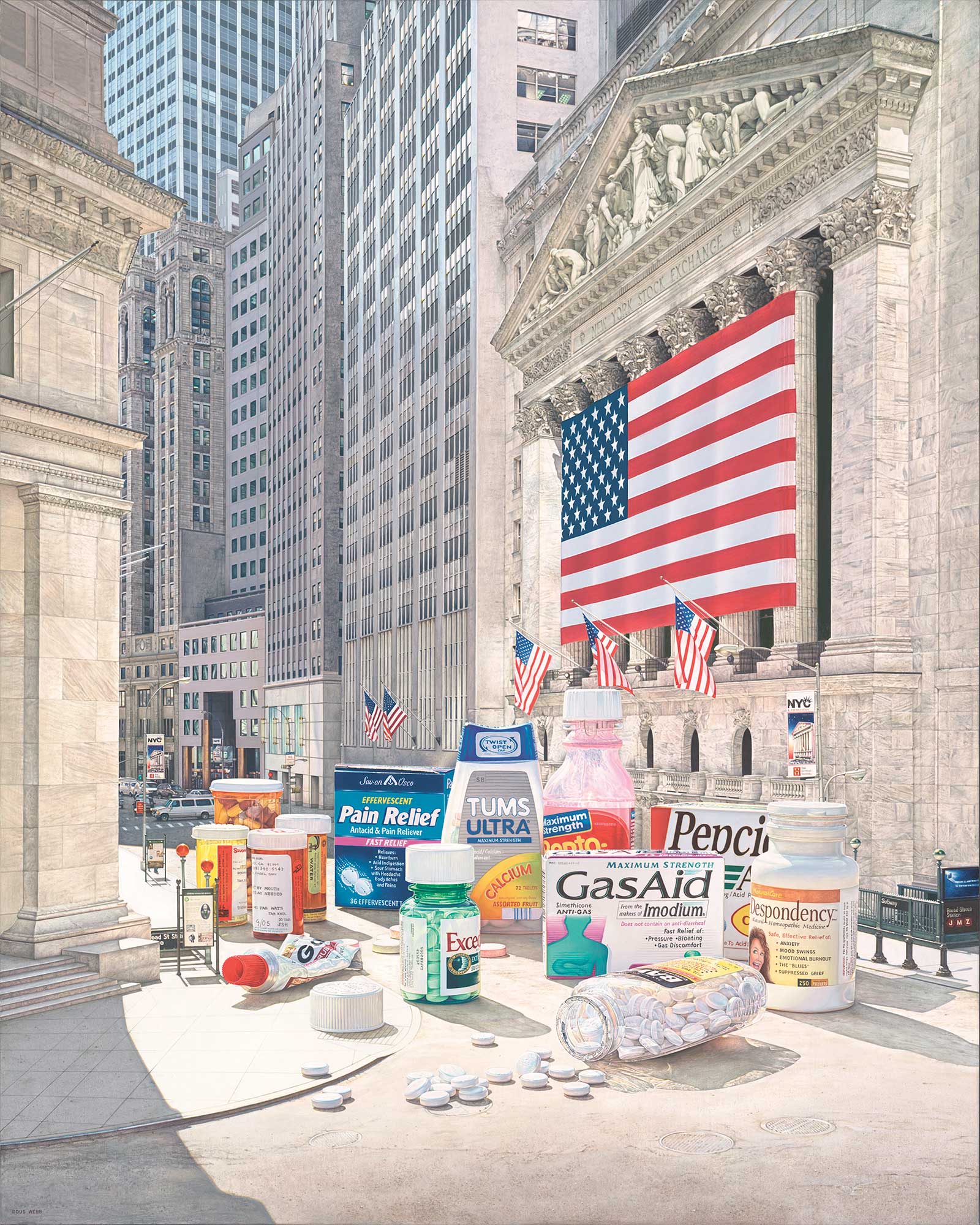 PoetsArtists, Quick Fix, acrylic on linen, 50 x 40", by Doug Webb.
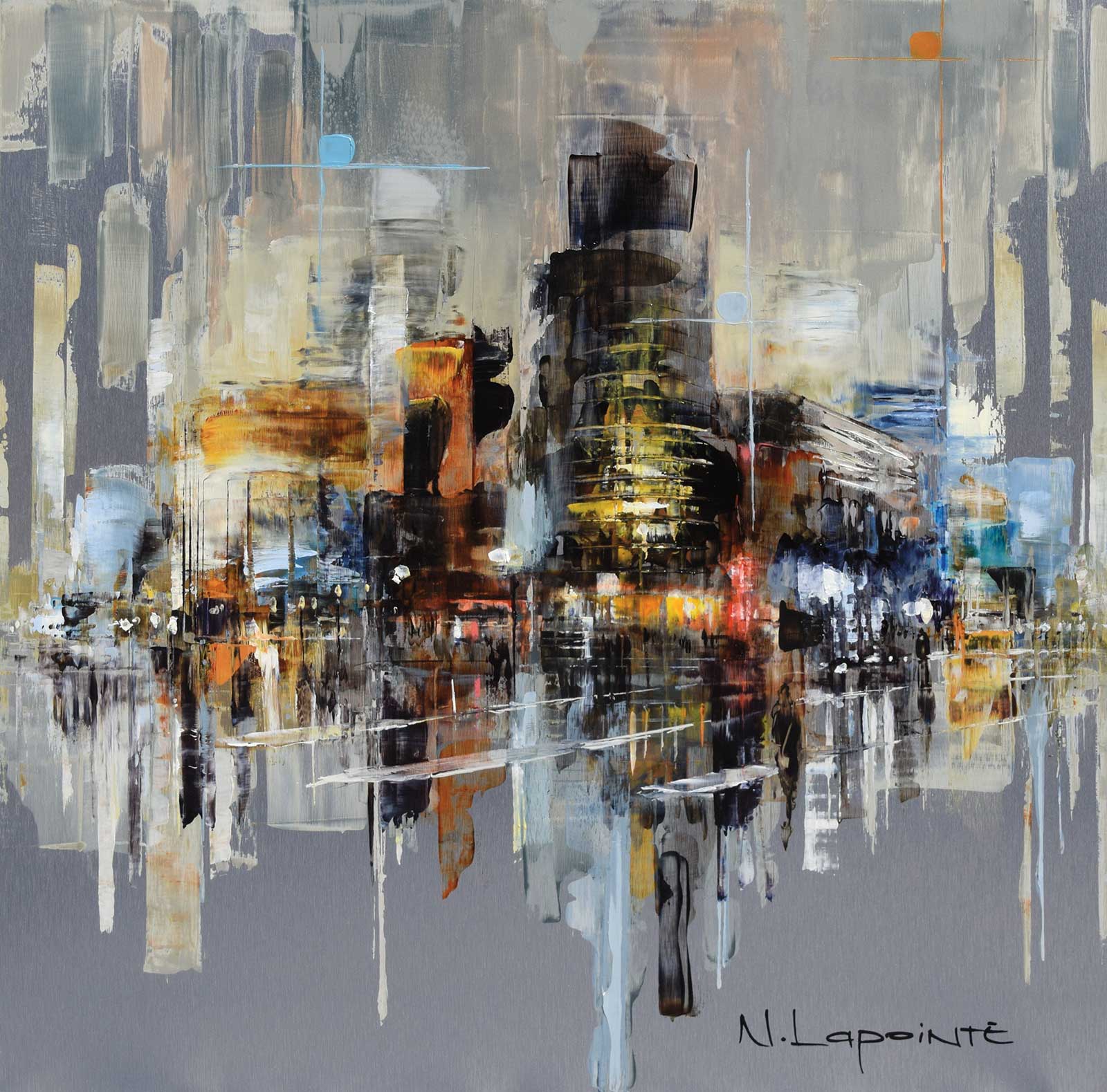 Nathalie Lapointe, Jetlag, oil, 18 x 18"
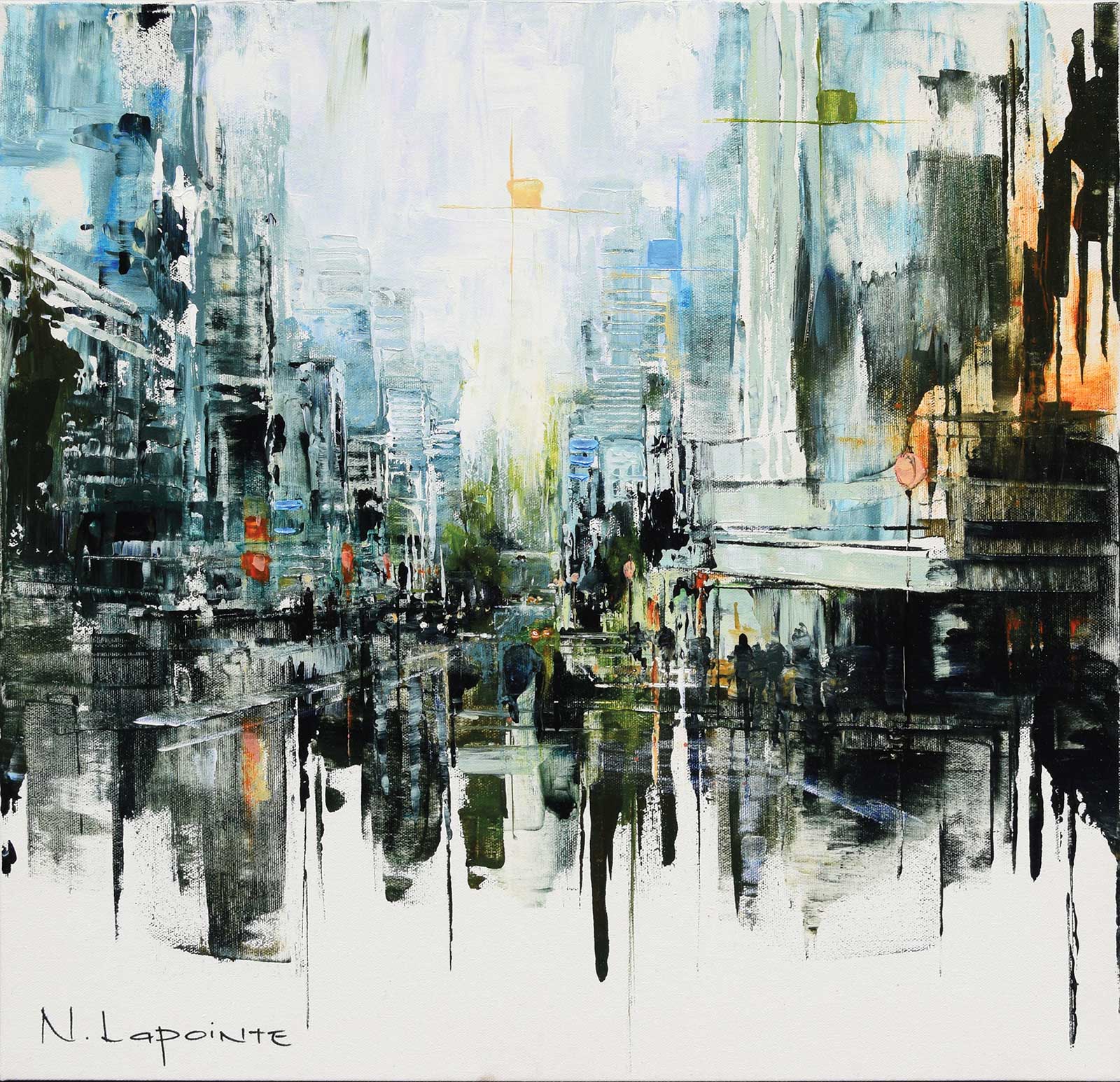 Nathalie Lapointe, Printemps, oil, 20 x 20
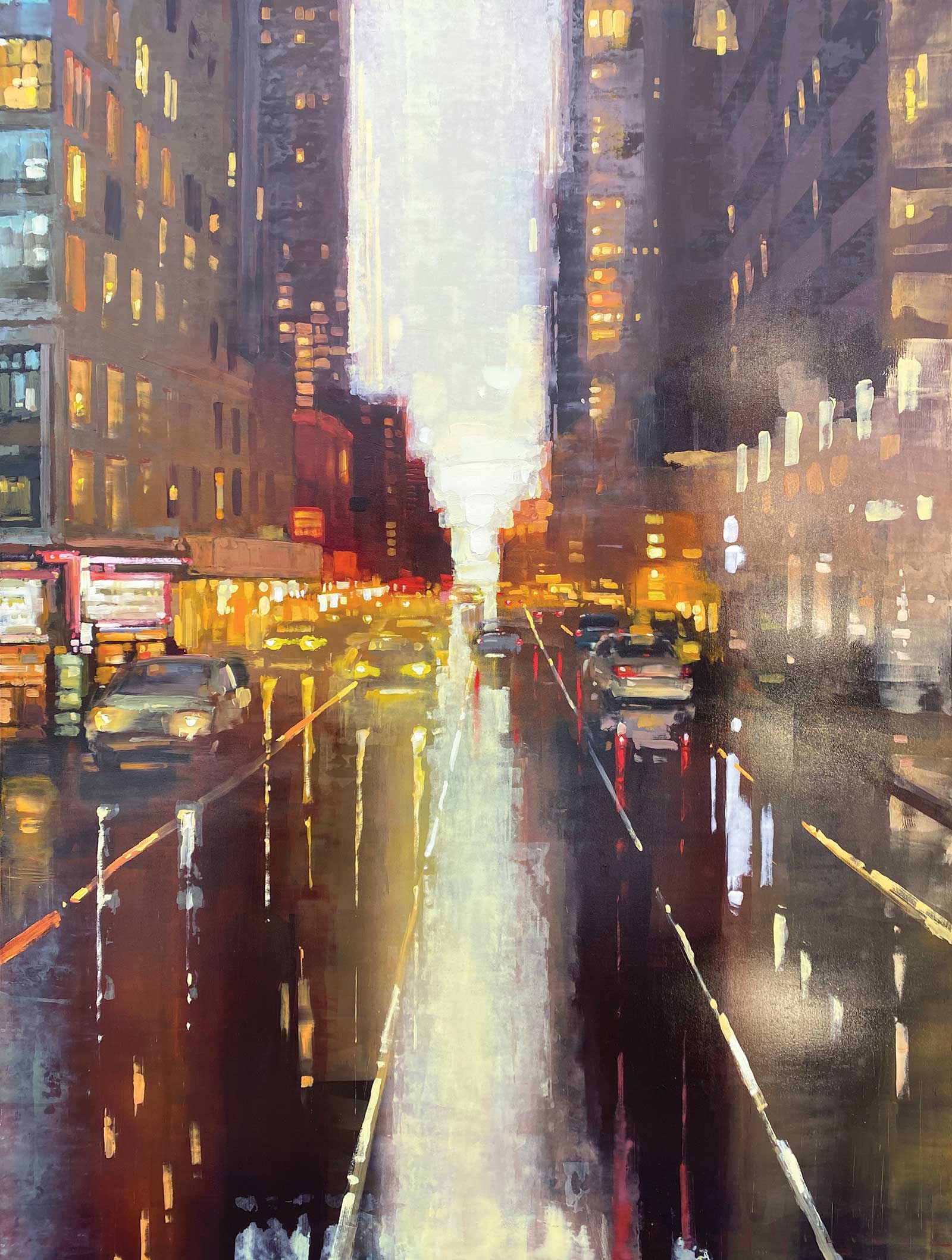 Celebration of Fine Art, Here Comes the Nighttime, oil on panel, 48 x 36", by Matthew Sievers.
Members of the PoetsArtists organization paint in a variety of subjects and styles. Two of their cityscape artists are Scott W. Prior and Doug Webb.
Of his paintings, Prior says, “As an artist, I’m visually attracted to everyday life scenes; things that most people would just walk by and not notice. It can be as simple as an archway with some trashcans lit by the afternoon sun or a complex alley scene that’s all tagged up with graffiti and the reflective light is bouncing off the walls. My goal is for the viewer to feel like they’re there with me; I want them to have a sense of place and belonging, whether it be a hot summer day standing on a street corner in New York or a cool fall evening walking the streets of San Francisco, I want them to feel like they’re right there too.”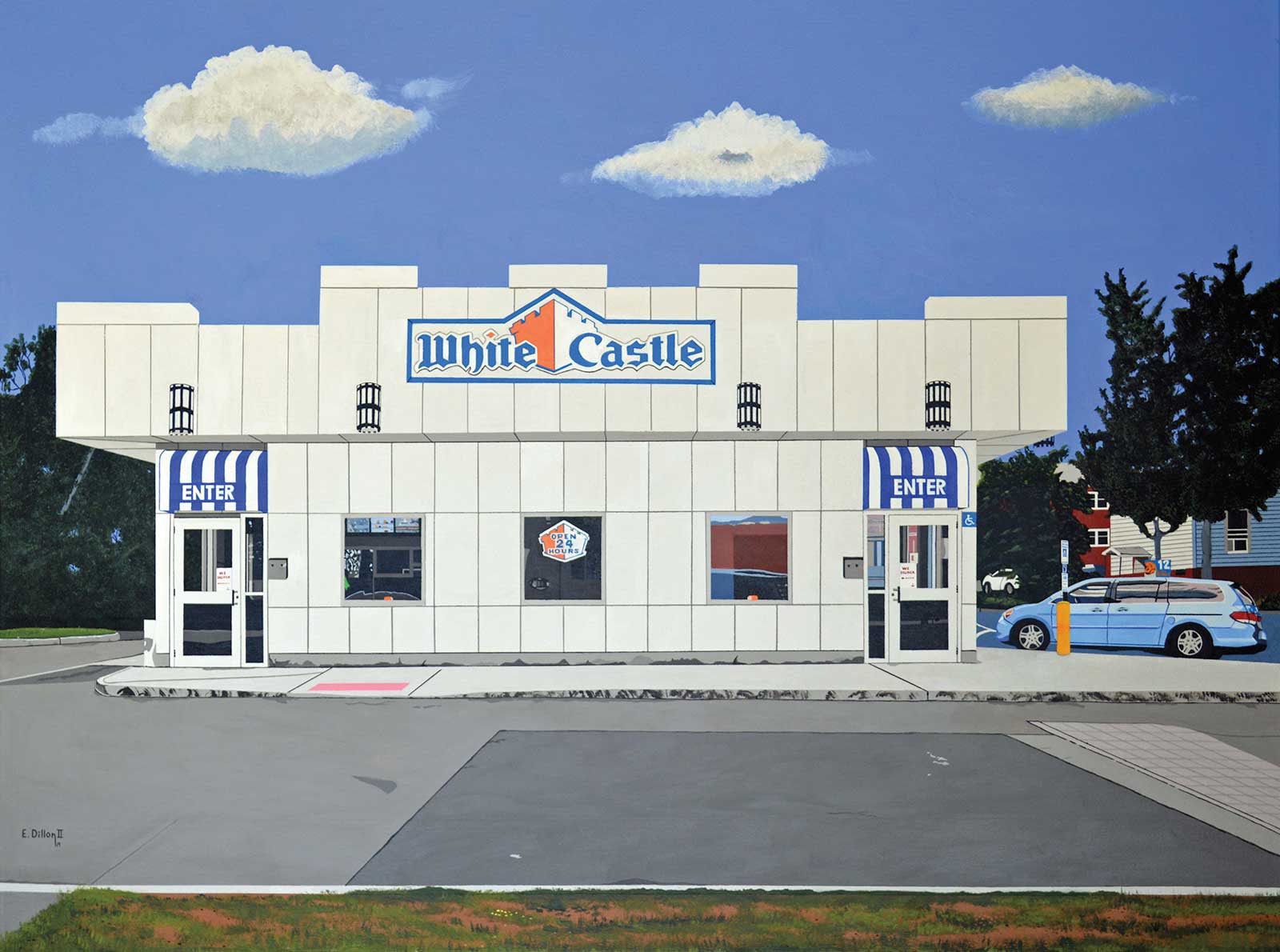 Emile Dillon II, White Castle II, acrylic on canvas, 30 x 40"
Webb, has a similar inspiration, explaining, “My paintings are narrative in nature influenced directly and indirectly by everyday events. With the use of composite imagery and shifts of scale between everyday scenes, situations and common objects,
I weave a tapestry blending threads of satire, irony, conflict and hope.”
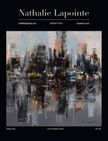
Canadian artist Nathalie Lapointe has always loved the hustle and bustle of cities and the architecture found there. “I work a lot on the interpretation of cities and through them I look for a rendering that is freer, more grubbing, more impressionistic,” she says, adding that the strong contrasts and atmosphere are also important to the work. “Whether it’s the vibe of the city, its calm of the morning, its nightlife or the quiet beauty of the seaside, of the boats, or even all the splendor of the fantasy worlds, imaginary, inspired by video games, I like to go somewhere else and make people travel.”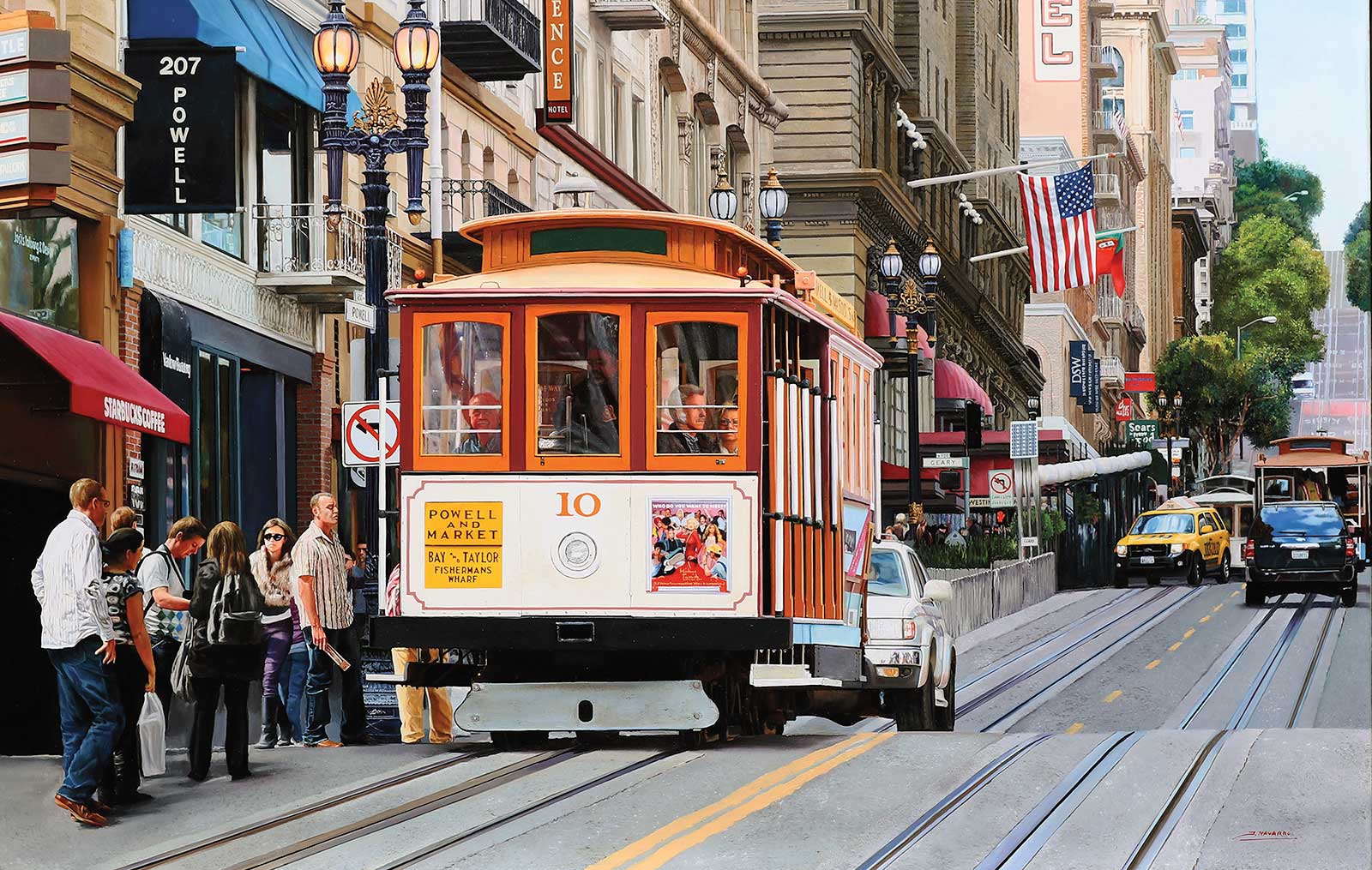 Lotton Gallery, San Francisco, Cable Car, oil on canvas, 24 x 35", by Jesus Navarro.
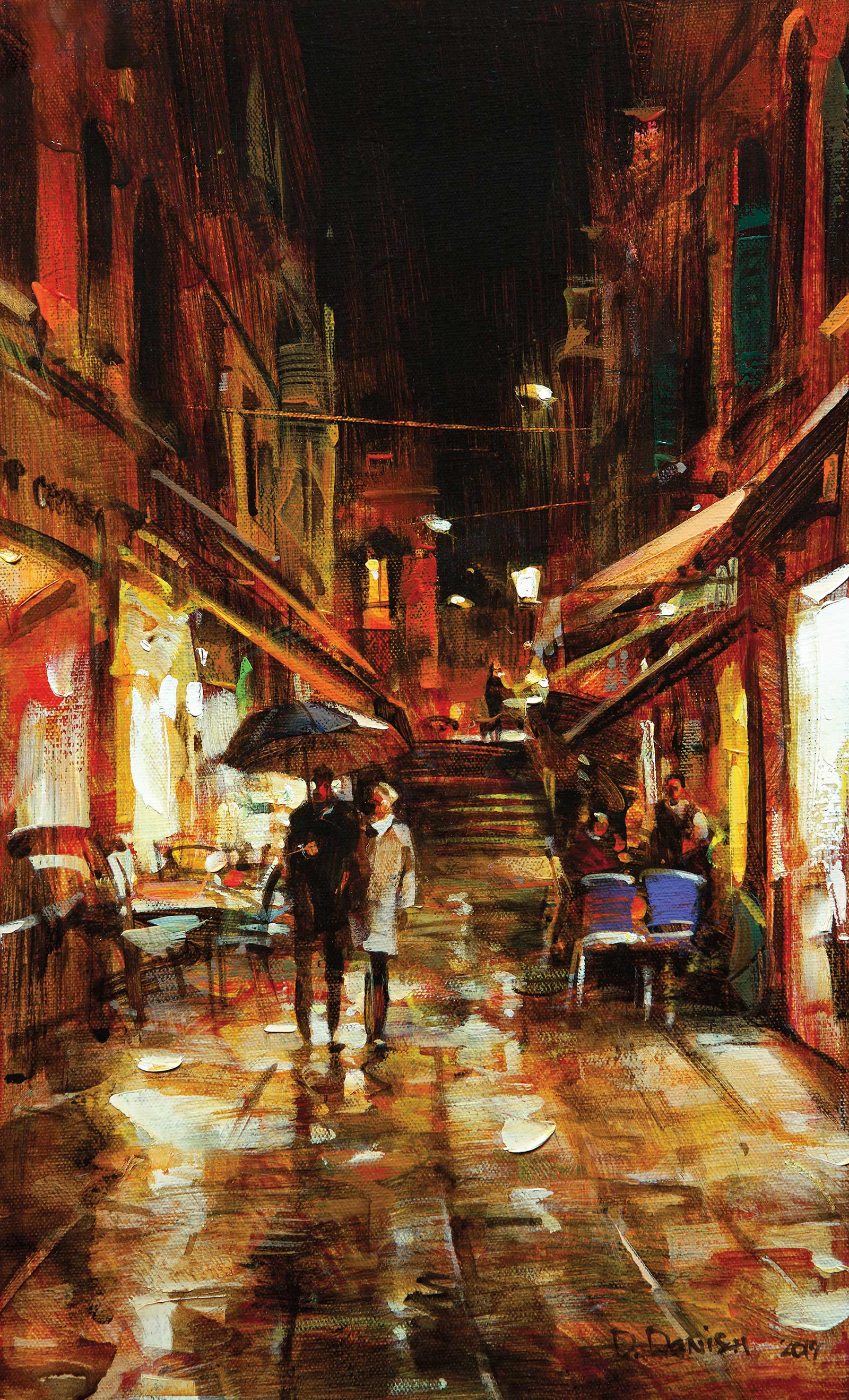 Lotton Gallery, Walking in the Rain, oil on canvas, 16 x 10", by Dmitri Danish.
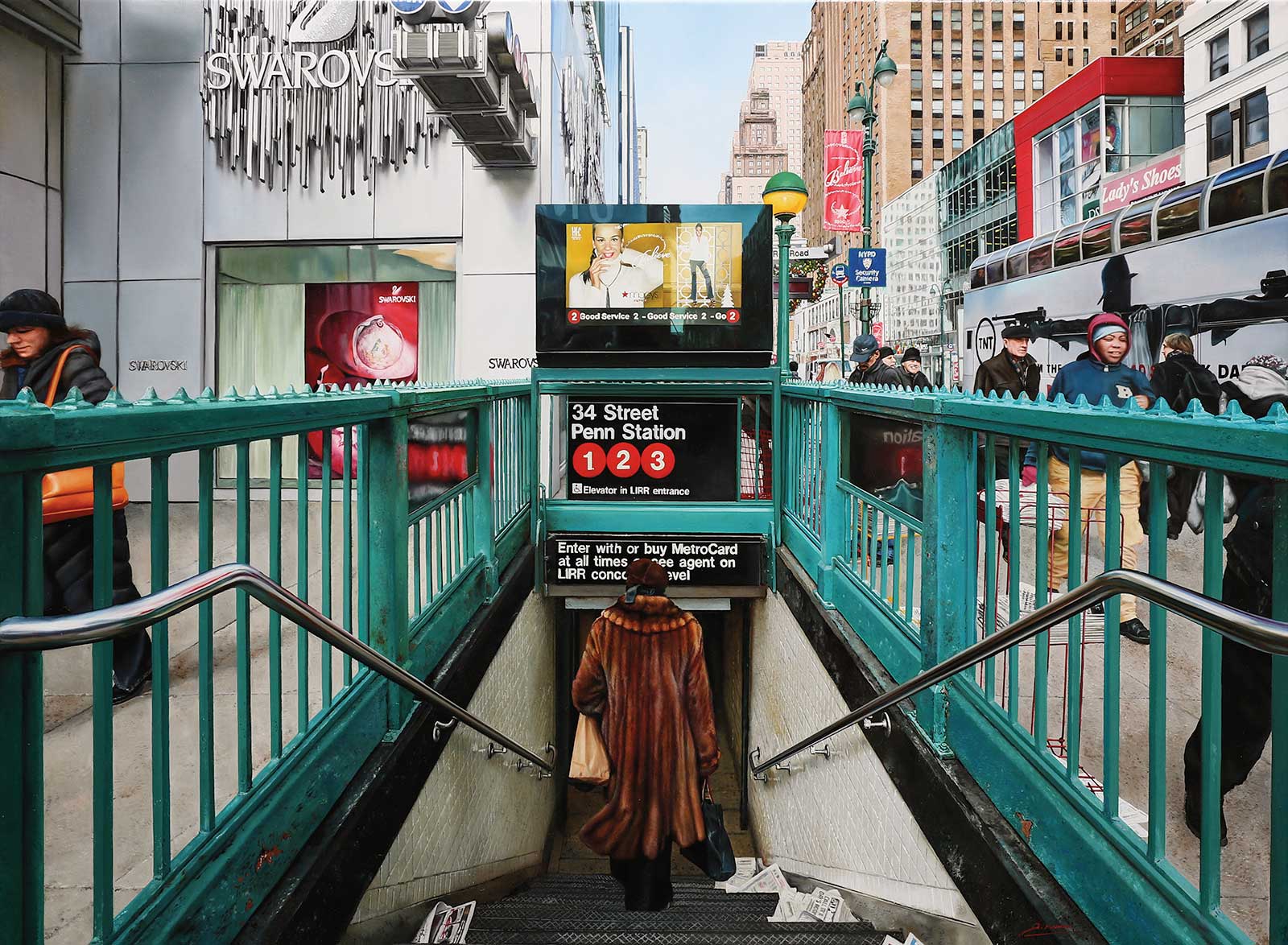 Lotton Gallery, New York Metro, oil on canvas, 24 x 31", by Jesus Navarro.
Drawing from the vanishing urban landscape through his art, hyperrealist artist Emile Dillon II, who is represented by Skidmore Contemporary Art, captures that moment in time revitalizing the memories of our youth. Through signature boldness of color, he makes a familiar and popular place a work of fine art. Dillon’s painting of the well-known image of White Castle, in New Jersey, evokes memories of our youth through its eye-catching colors and details.
Lotton Gallery features cityscape artist Jesus Navarro. His two newest paintings San Francisco, Cable Car and New York Metro are colorful and site-specific. Each piece takes a month or more to paint, and every work is brimming with details including passersby, tourists, street signs and advertisements. He produces a result where a well-traveled person or a native of his many featured cities will know the exact place he is painting in his works, making his cityscapes recognizable and unique.
Dmitri Danish, also represented by the gallery, paints the Italian rain in Walking in the Rain. He creates wet streets and glowing lights that are a mesmerizing signature for Danish.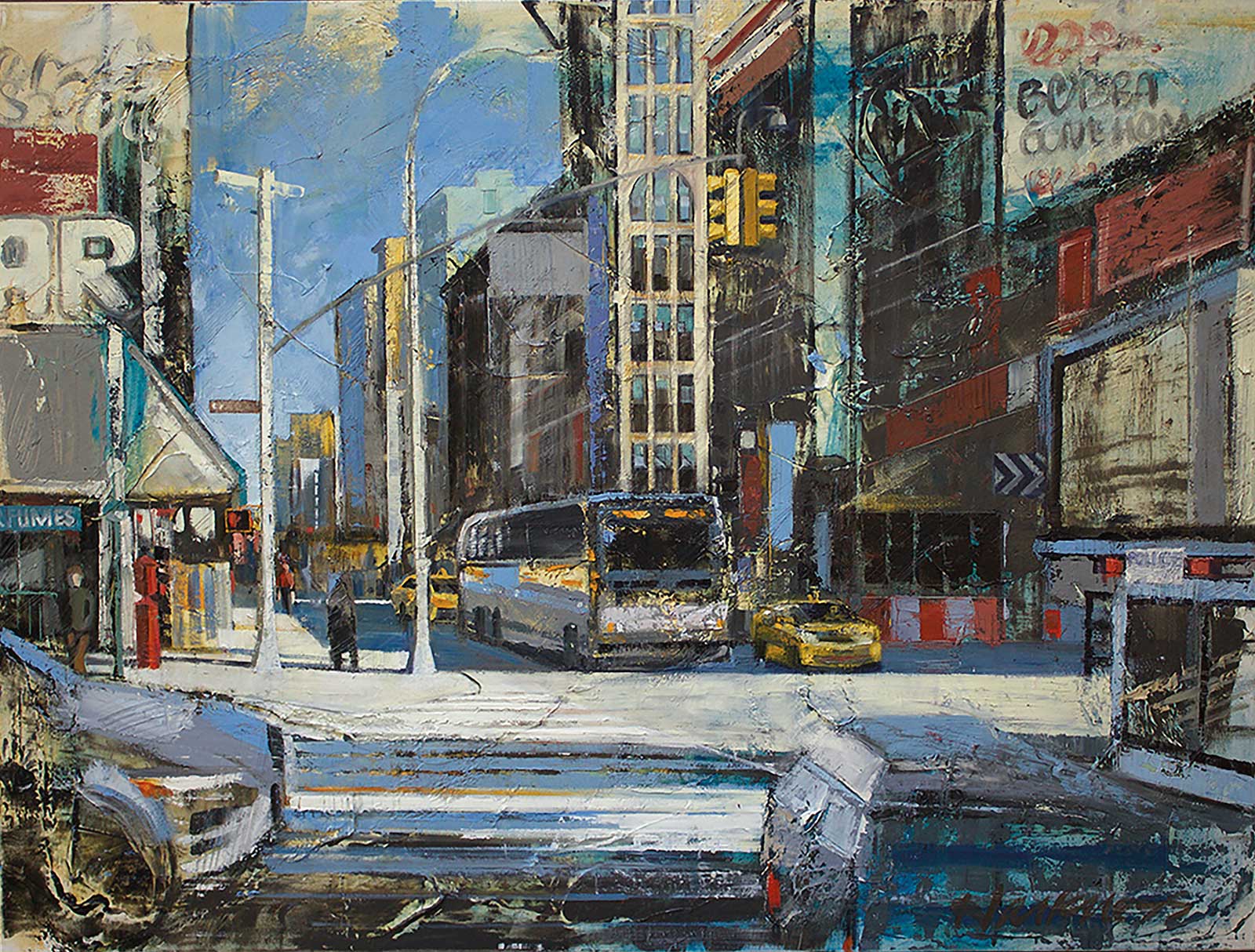 Anne Harkness, Good Morning, Canal Street, oil on canvas, 36 x 48"
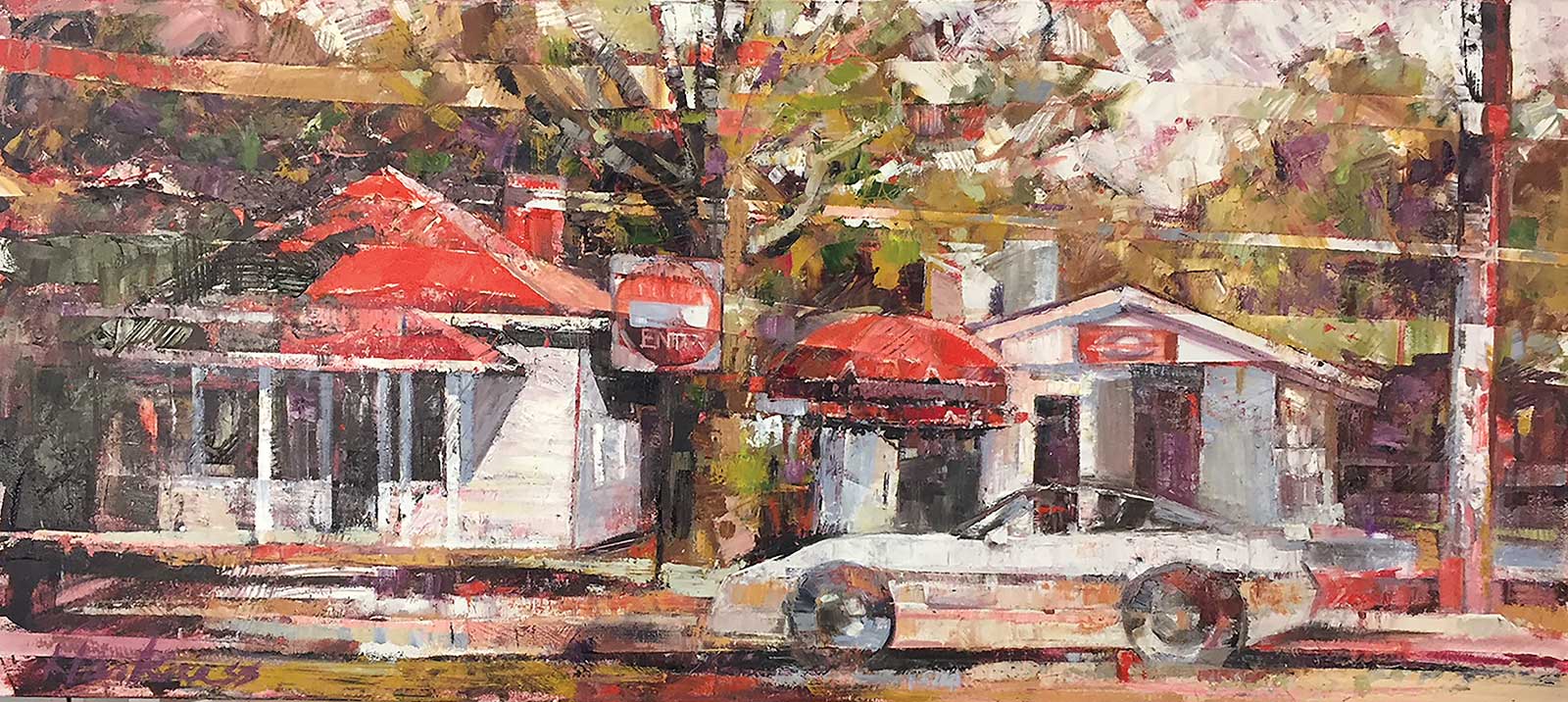 Anne Harkness, Mill Town USA, oil on canvas, 24 x 48"
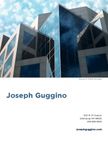
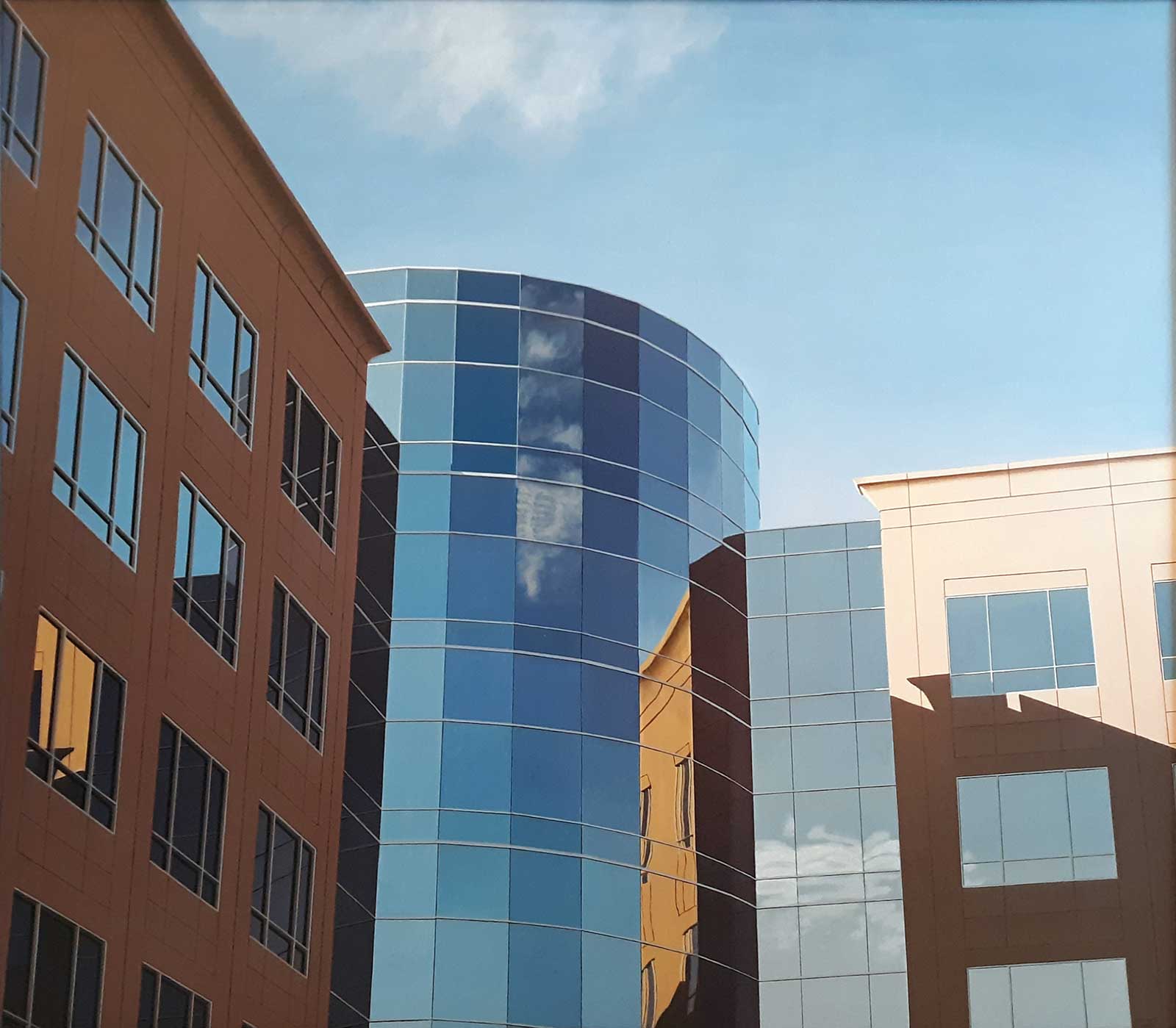 Joseph Guggino, Skycorner #13, oil on linen, 42½ x 48"
Artist Anne Harkness is inspired by everyday beauty as well. “The street corner or road traveled daily sometimes just catches my eye with a new insight or little treasure just for me,” she says. “I photograph then turn it into a live memory, all the while enjoying the action of application and experimentation. My paintings celebrate present-day settings and the beauty they contain.”
Another aspect of that idea comes from Washington state artist Joseph Guggino, who hones in on the forms themselves. He says, “The inspiration behind my work is to reveal beauty in common, everyday structures. Starting with a structure one might pass and hardly notice, I focus on a portion of it to reveal design, reflective light and patterns, seeking to make the ordinary extraordinary.”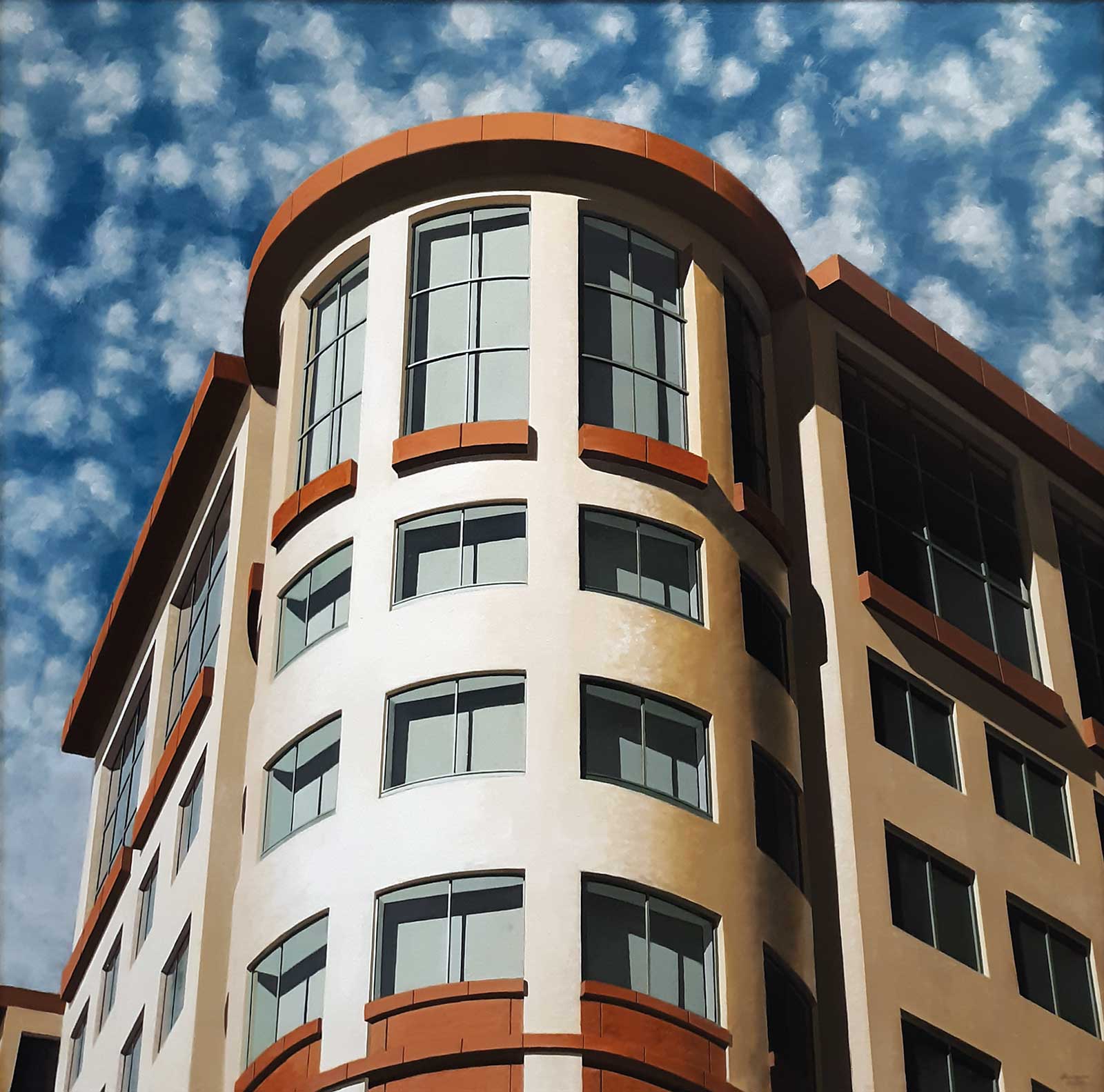 Joseph Guggino, Skycorner #3, oil on linen, 51 x 51"
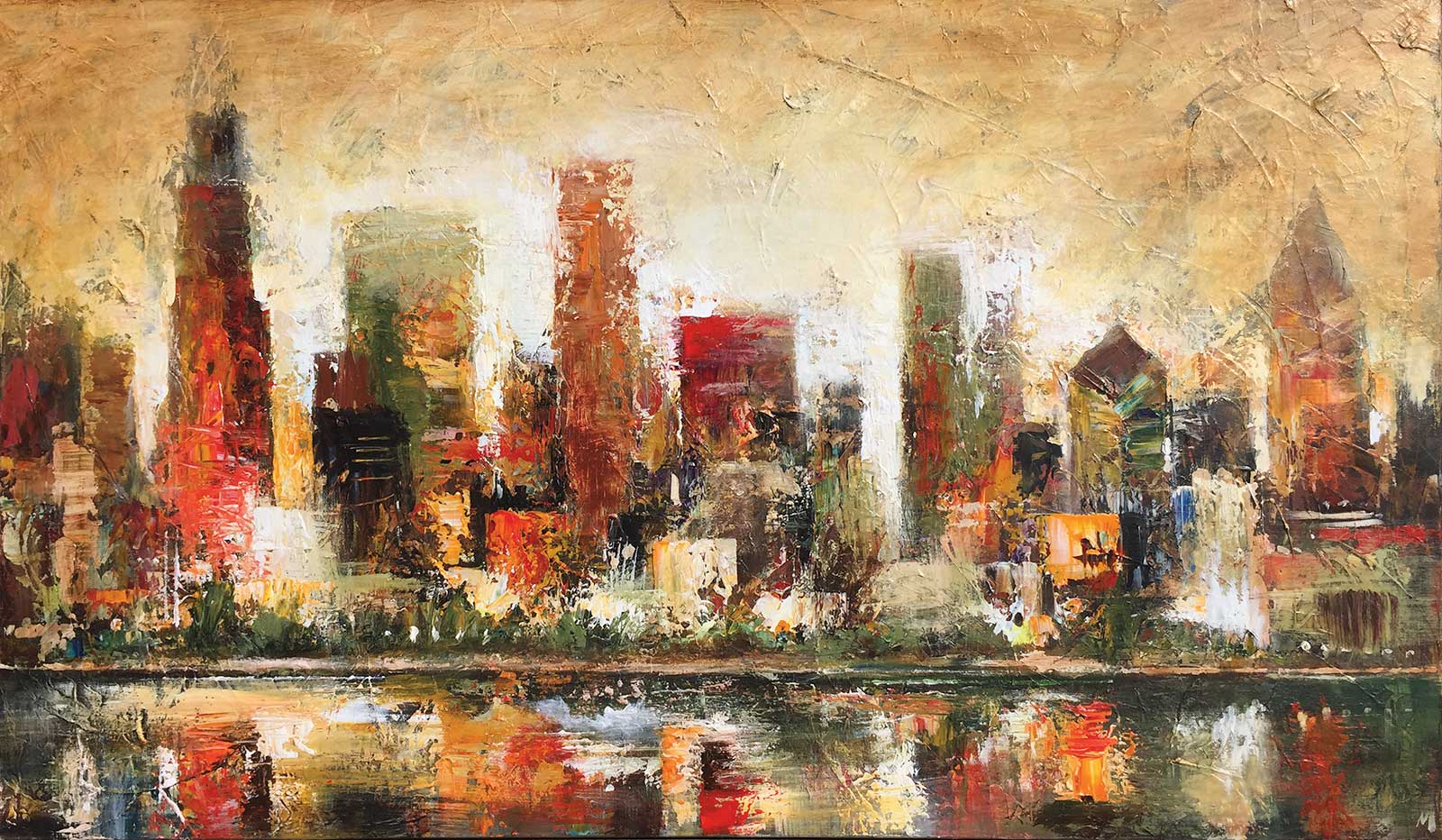 Celebration of Fine Art, My Kind of Town, acrylic on canvas, 36 x 60", by Bruce Marion.
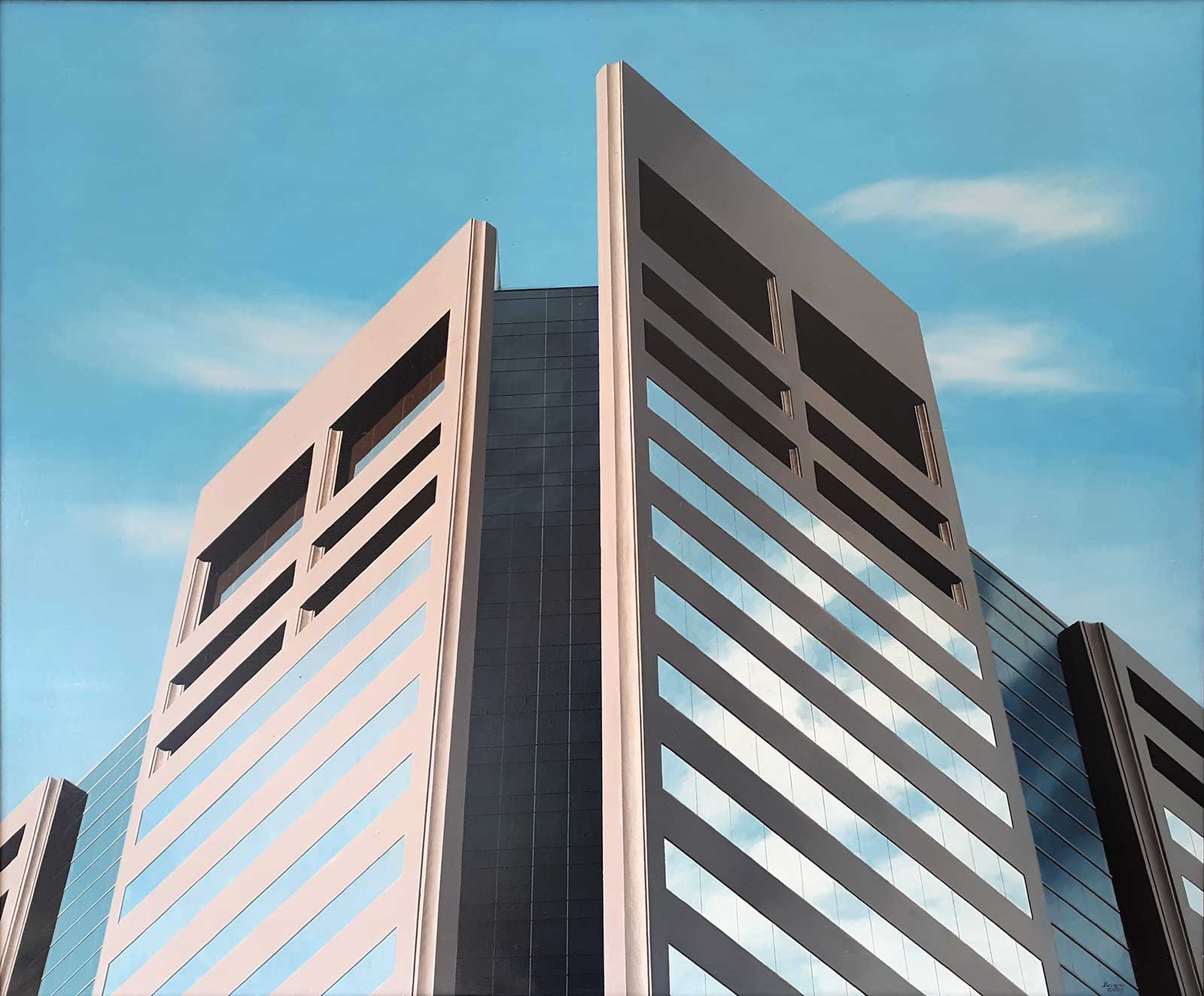 Joseph Guggino, Skycorner #4, oil on linen, 42½ x 51½"
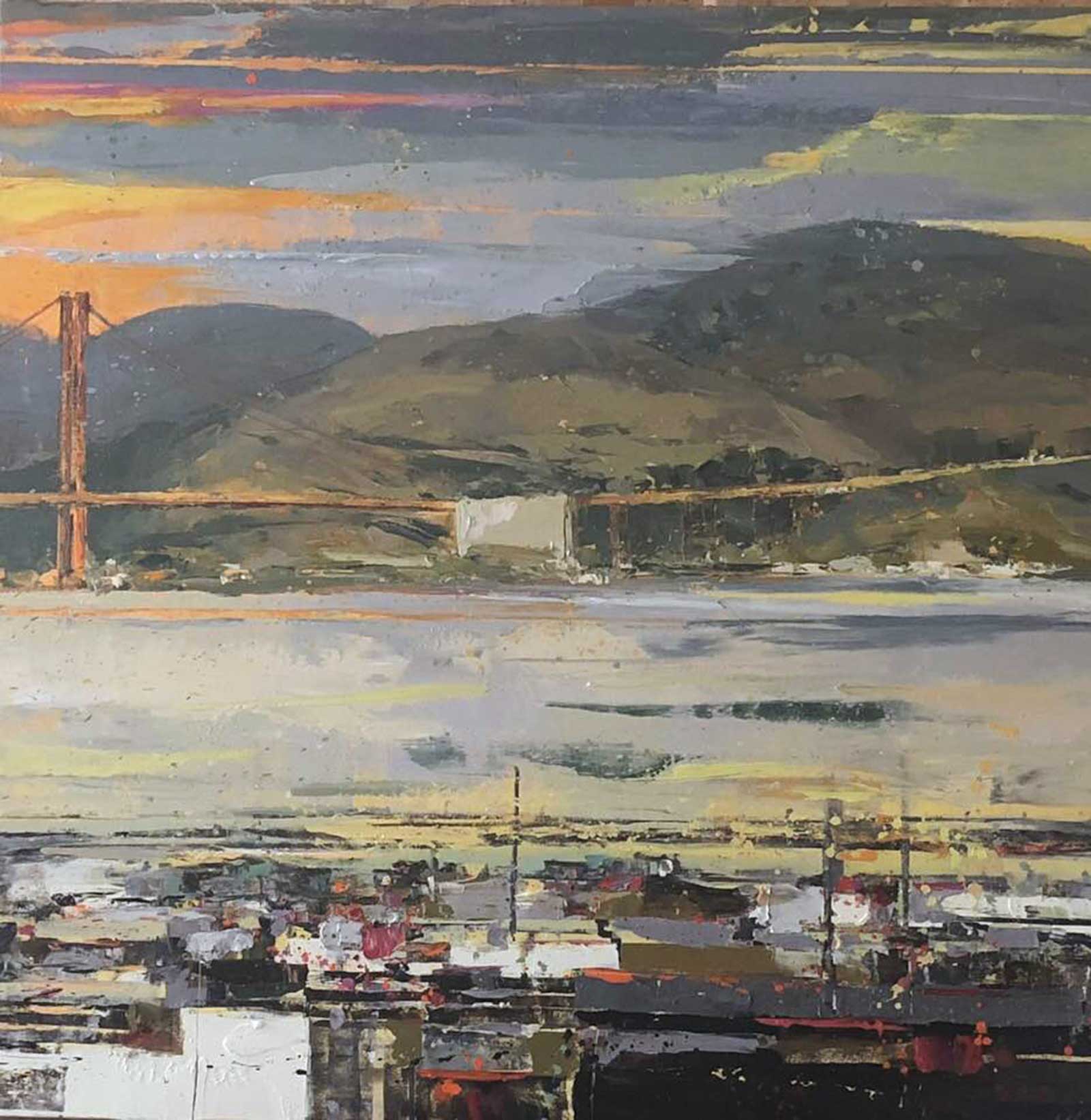 ArtHaus Gallery + Consulting, Smoke, oil on canvas, 48 x 48", by Carolyn Meyer.
In Scottsdale, Arizona, the annual Celebration of Fine Art features 100 working studios of established and emerging artists including several who paint cityscapes. Among them are Matthew Sievers, Bruce Marion and Pete Tillack.
Sievers, of Rigby, Idaho, says, “My cityscape series comes despite, or possibly as a result of, my rural upbringing. I have always been drawn to the city. I love the excitement of a bustling downtown street or a moody neighborhood at night. Whether I’m there to be inspired by an art museum, or to see a favorite band perform live, that rhythm and energy is what I want to portray through my paintings of the city.”
Susan Morrow Potje, who produces the show, adds, “Art has the ability to transform and transport us to a place and a time in our memory. Cityscapes—either definitive or ethereal—deliver us to a place of energy and possibility. They can leave much to the imagination as to what is happening within the bustle and the buildings.”
Powered by Froala Editor