As collectors of figurative realist paintings, and as sponsors of a prize for women figurative painters, we must stay current with the contemporary art market. As one effort to do this, we annually attend Art Week during December in greater Miami. In the first week of December 2019, we saw as much as we could during this frenetic, whirlwind gathering of gallerists, dealers, collectors, artists and beautiful people from all around the world. 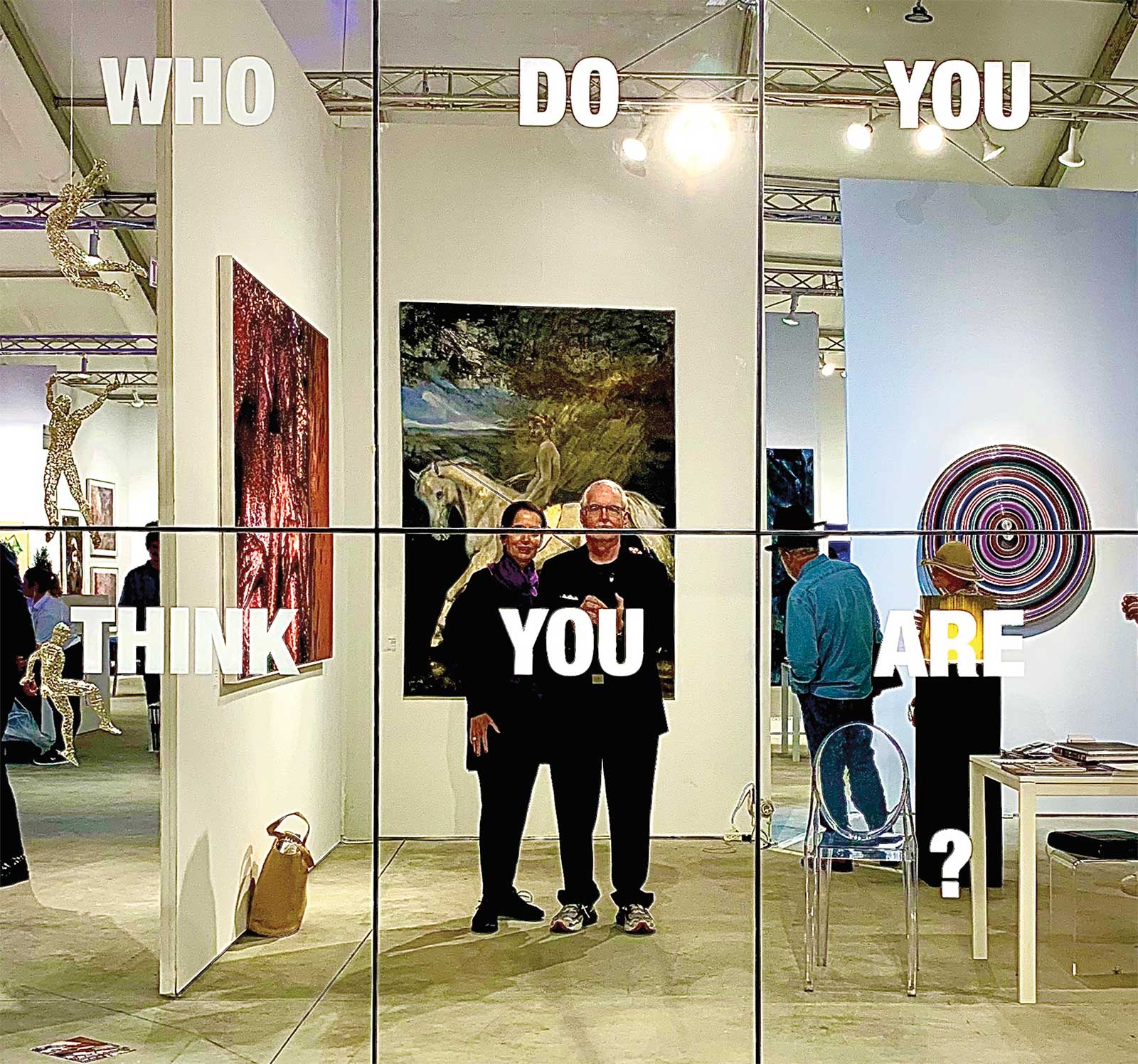 Who Do You Think You Are? on view at Rebecca Hossack Gallery’s booth.
The United States is host to categorically incredible art fairs but, for sheer volume and breadth, Miami Art Week is the place for modern and contemporary art. Anchored by the flagship show, Art Basel Miami Beach, which takes over 500,000 square feet of the cavernous Miami Beach Convention Center, and surrounded by 17 “satellite” shows scattered across Miami and Miami Beach, Art Basel, as the entire complex of shows has come to be informally known, has collectively become the single most important art event in the United States. With offerings ranging from a couple of hundred dollars to millions of dollars and styles as diverse as Giorgio de Chirico and Nan Goldin, there truly is something for everyone.
The centerpiece show, Art Basel Miami, has hundreds of exhibitors from Seoul to Prague, Toronto to Adelaide offering museum-quality work. All the important galleries and dealers are represented (Gagosian, Zwirner, Hirschl & Adler, Landau, Marlborough, Acquavella, etc.) and the work tends to break into two categories: “modern masters,” mostly dead artists from the 20th century who are instantly recognizable—Picasso, Matisse, Diego Rivera, Reginald Marsh, etc., and then newer, living artists making cutting-edge, often conceptual or abstract work. In this category are Tracey Emin, Cindy Sherman, Kehinde Wiley and others, both known and unknown, trying to break into the world of “big art.” This year, the most discussed work was the big joke, aka Comedian, a banana duct taped to the wall for $120,000, which sold, twice, and had to come down early because the throngs were going crazy. 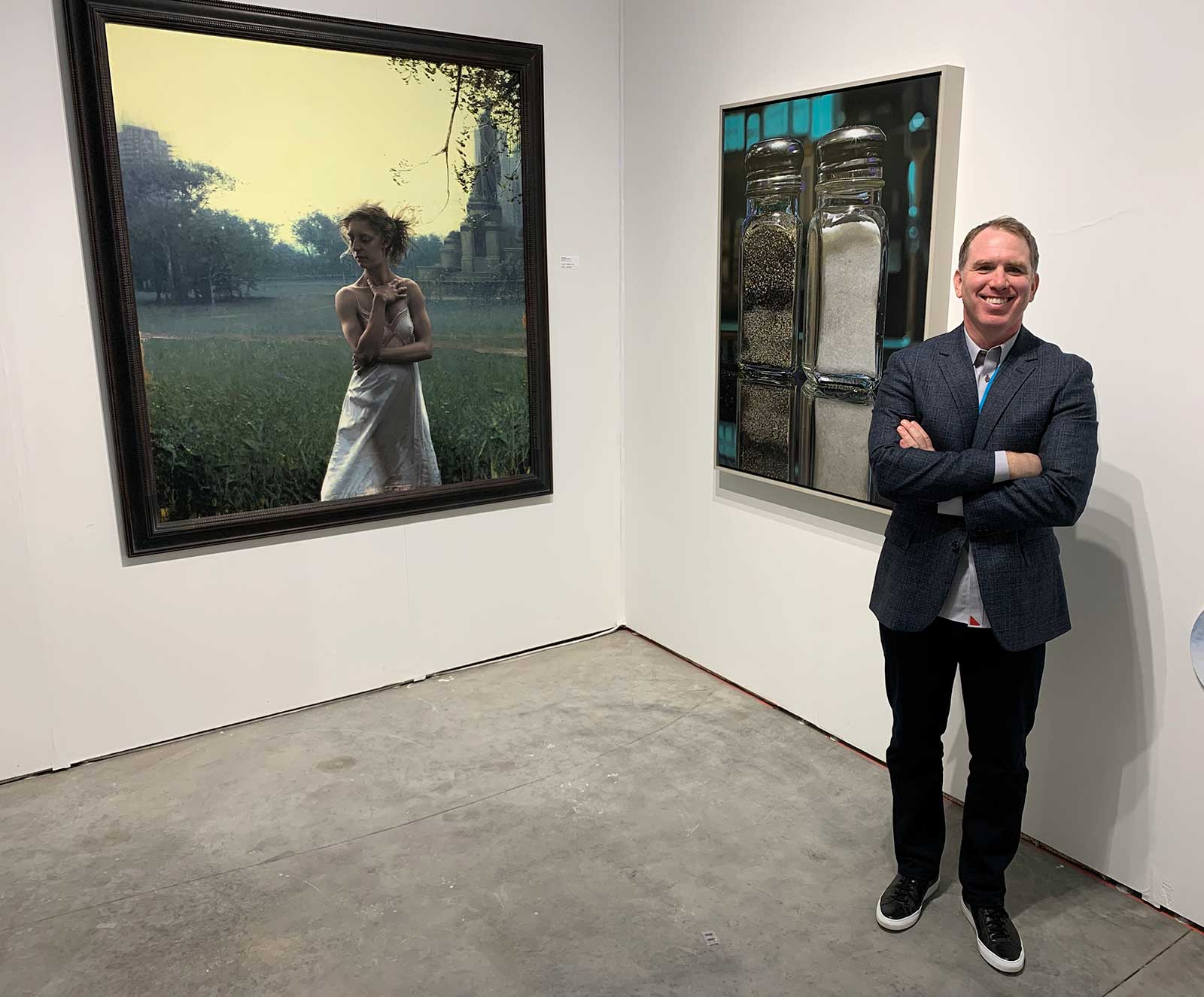 Gallery Henoch’s Andrew Liss with Daniel Sprick’s 2016 painting Wake from Dream.
Who is buying what and how much they are paying is always the buzz among the in crowd, as is which artists have significant work for sale, often a bellwether as to who has peaked or whose collectability is trending higher. In 2019, unlike prior years, Basquiat was largely MIA while work by Mel Ramos, who is perennially for sale, was pretty much everywhere. Similarly, work by Alex Katz seemed to be around every corner.
Although women artists, as usual, tended to be fewer and farther between, the “Ninth Street Women”—Lee Krasner, Grace Hartigan, Helen Frankenthaler, Elaine de Kooning and Joan Mitchell—riding the popularity of the book by the same name, appeared here and there; although we suspect that the smart money is holding back on these women until the market has more fully priced their work. This, of course, was not entirely true, as Mnuchin Gallery of New York reportedly sold Frankenthaler’s 1981 White Joy for $1.65 million.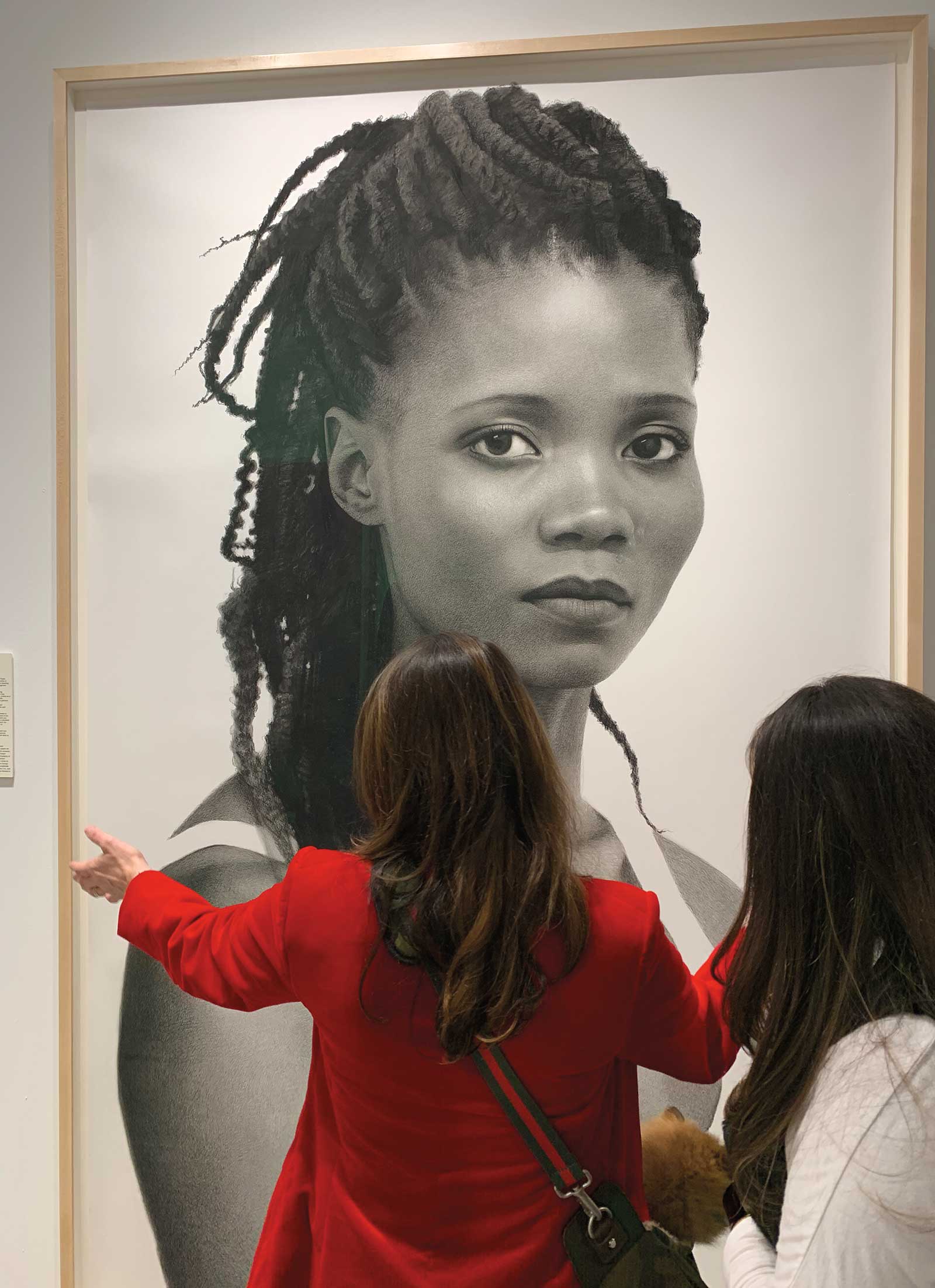 Fairgoers admire Clio Newton’s Amari, 2019, compressed charcoal on paper, 91 by 58 inches.
For collectors for whom a multimillion-dollar work is a dream, much of Art Basel Miami is interesting but academic—nice to know but not of truly practical application. For us, who collect the work of mostly living women figurative realists, we have come to not expect much and, with intentionally dinky expectations, have not been disappointed. Nevertheless, this year we found figurative works at the big show and more so than in prior years.
Wandering the maze of exhibitors, we came across some truly lovely paintings by well-recognized and iconic painters—Rivera, Faith Ringgold and others, a Tamara de Lempicka here, a Tschabalala Self there. In all, the big show was an engaging and eclectic mix of dead modern masters and contemporary abstract and conceptual artists, some selling for big ($1 million-plus) money but, as expected, it was not a bastion of figurative realism. Suffice it to say, however, that Art Basel Miami has hundreds of exhibitors and thousands of works on display and there is great art to see there.
The “satellite shows” that revolve around the big show are scattered geographically all over Miami and Miami Beach. These are significantly smaller versions of the big show but with discernible themes, price ranges and types of work. They often occur in large, temporary, air-conditioned tents on the beach or near it. Each has a given name which the in crowd knows and which carry subtle meanings about the offered styles and price ranges. Discernibly, there is a rank order among these shows in terms of prices, scarcity and collectability. 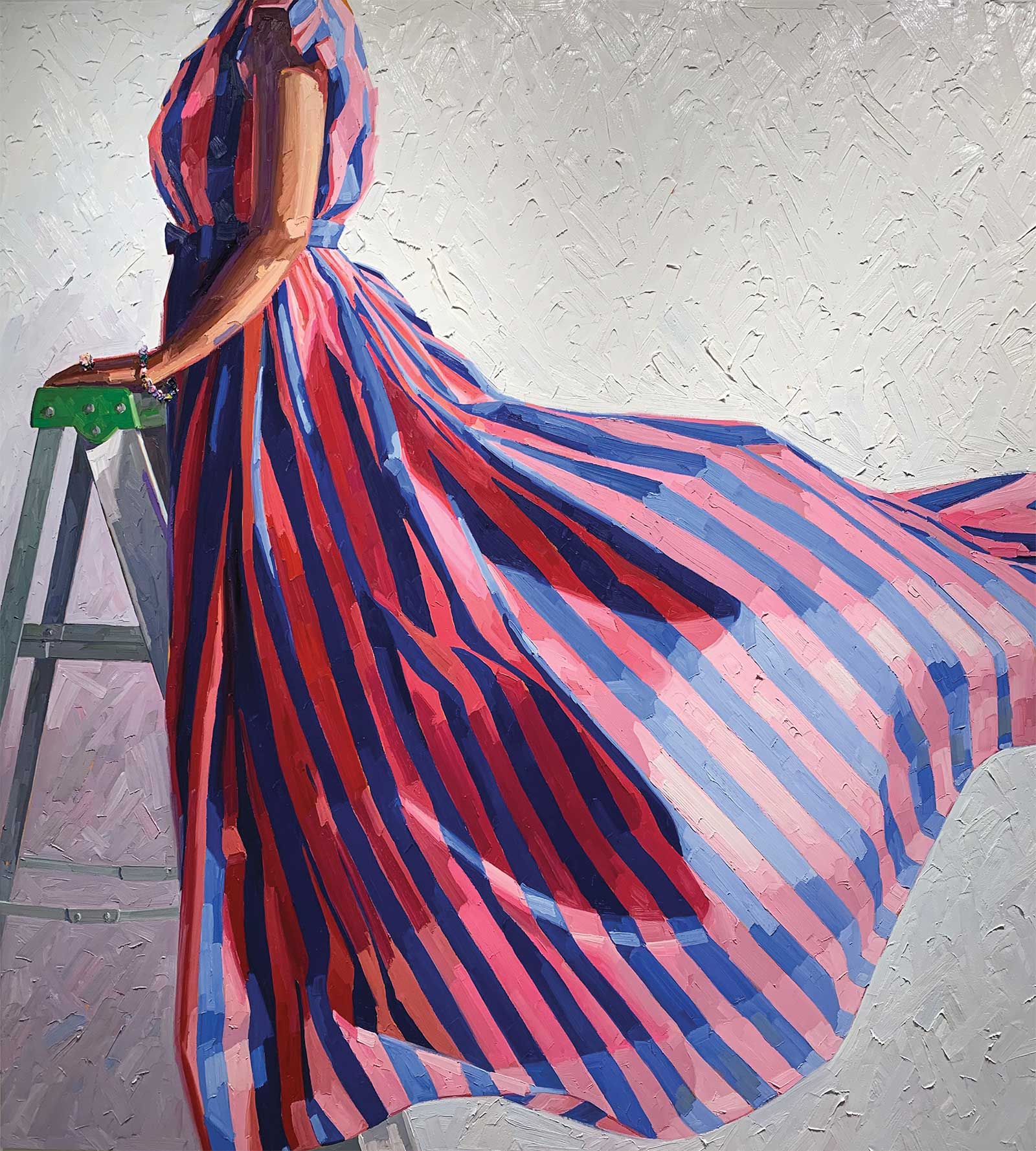 Kelly Reemtsen, Rise Up, oil on panel, 95 x 95"
Immediately following Art Basel Miami are Art Miami and CONTEXT Art Miami. These are basically one show in two connected tents offering varied work that tends to be upscale and collectible ($25 to $100,000 and up). Then, shows like SCOPE and PULSE are an eclectic combination of mid-priced work where one might comfortably buy a painting for $5 to $50,000. Ditto for UNTITLED, which displays more abstract and conceptual work. On par with these are the ethnically themed exhibitions, Pinta for Hispanic art and Prizm for work with an African flavor. At the low end, in terms of price at least, is the Aqua show, which is held in a 1950s-era, two-story Miami Beach motel in which the white-washed walls of each room, sans furniture, become a mini-gallery. There are other shows, too, some with very specific emphases: Design Miami for design, INK Miami for prints, Art Beat Miami for Caribbean art and NADA (the New Art Dealers Association) for new artists, among several others.
For the 2019 satellite shows, there are several observations. First, figurative realism is back and it is back big. In prior years, one could fire off a canon and not hit a single piece of figurative realist art. This year, however, figurative realism was scattered everywhere throughout most of the satellite shows. Not necessarily your grandmother’s figurative realism, but nevertheless work that clearly depicted the human figure in ways that were attractive and, sometimes, hypnotic. In this regard, it should be noted that the great bulk of the available figurative work is of women. While one might argue as to whether this is a function of the male gaze or the female gaze, we say that it is merely driven by the fact that depictions of women sell. Those of men don’t.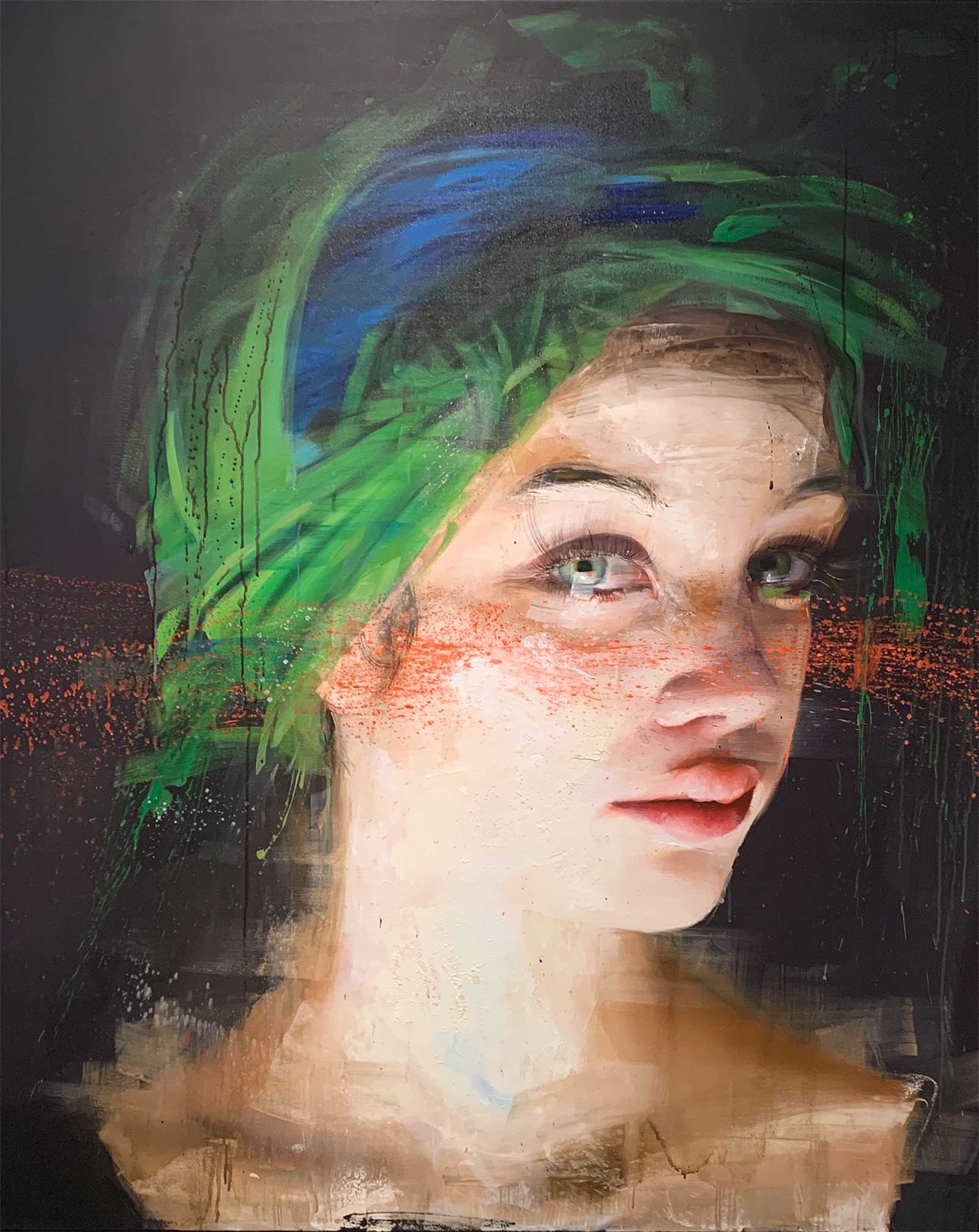 Roberta Coni, Diletta Green 2, oil on canvas, 63 x 51"
As for women artists, they were more in evidence than in prior years, but still not near parity with the men. Despite this, we were pleased to see that women’s work was being included and not with a blushing excuse as to why they were (or weren’t) on the wall. Also, video installations were largely missing from the 2019 edition of Art Week, but photography presented robustly, with the work of women photographers better represented than that of women painters.
At Art Miami/CONTEXT, we were impressed by the breadth and prominence of the figurative realist work on display. At Gallery Henoch, we got a chance to see a terrific figurative work by Daniel Sprick titled Wake from Dream, and took delight in Sprick’s atmospherics and deftness with diaphanous drapery. At the Forum Gallery booth, we marveled at the twice life-size charcoal renderings of Clio Newton, whose subtle attention to detail makes one do a double take. We also admired the “headless women” of Kelly Reemtsen at the booth of the David Klein Gallery of Detroit, all of which have a narrative that leaves the viewer with as many questions as answers. Our last find was at the booth of Galeries Bartoux of New York. Here, the giant, colorful heads of Italian artist Roberta Coni were selling well and with good reason. The eyes of the depicted figures drill a hole through you.
Up the street from Art Miami/CONTEXT was the NADA show, which is held in the Ice Palace Studios complex. Here, “new” artists are featured and their emphasis tends not to be on representational work. Nevertheless, we were impressed by the postage stamp-sized figures and portraits of Jorge Diezma represented by Galeria Alegria of Madrid. These small portraits were numerous and extraordinary, some echoing the work of Rembrandt, Renoir and Matisse. We also liked the simple figural paintings by Jane Corrigan at the Marinaro Gallery of New York, each apparently executed in an “action painting” style. 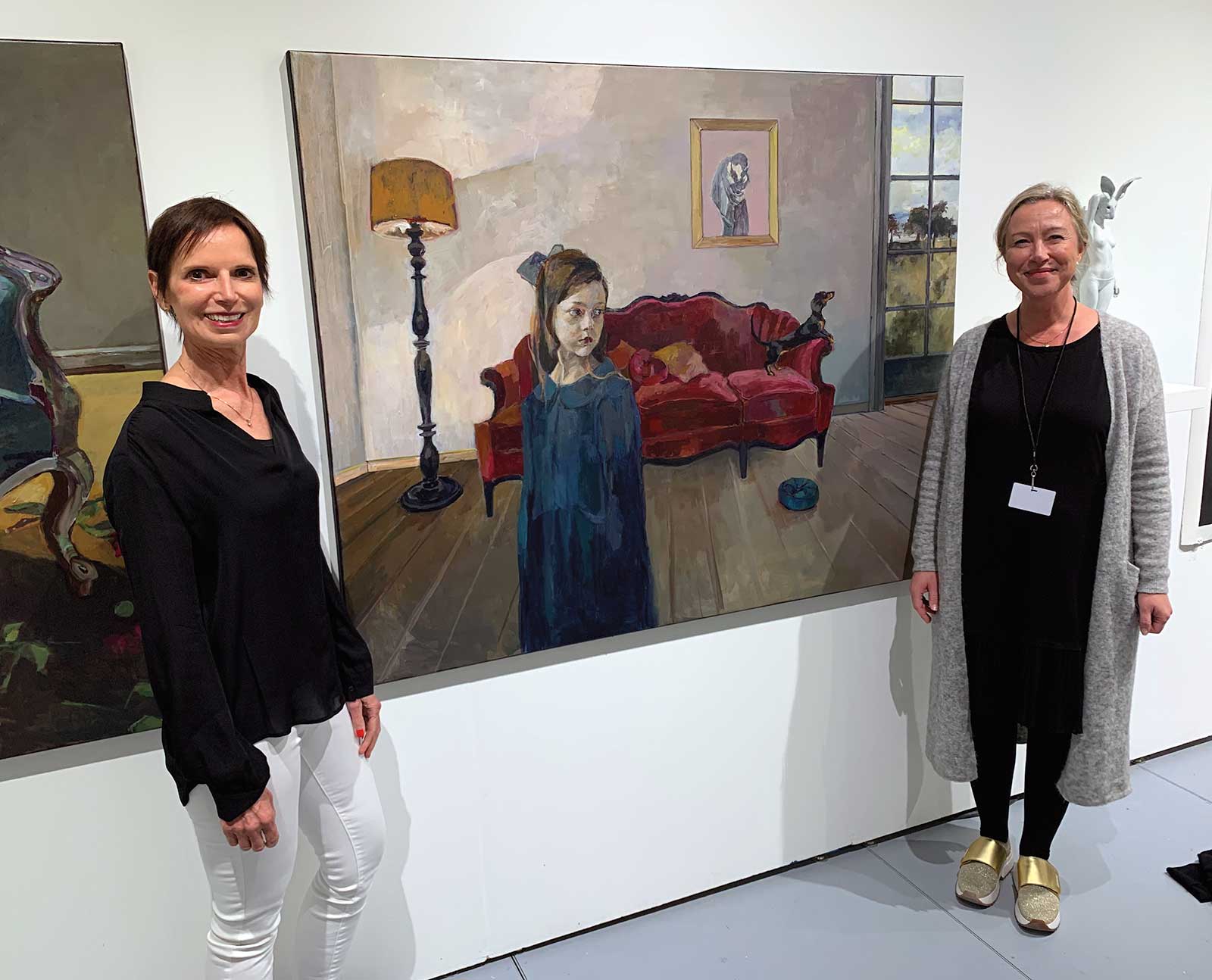 Dr. Elaine Melotti Schmidt, left, with gallerist Elisabeth Ramfjord admiring Ingebjørg Støyva’s Girl in Interior.
Back on the water in Miami Beach, at the SCOPE show, we saw some of the best figurative realist painting on offer during Art Week. After running into our good friend Robert Lange of Robert Lange Studios in Charleston, South Carolina, and having a good laugh with he and painter Nathan Durfee, whose whimsical work was on display at the Abend Gallery booth, we took in some truly captivating portraits by Ron Hicks, an African American painter represented by Vail International Gallery of Colorado. Hicks’ Klimt-like jewels depict beautifully rendered women whose heads sit on fractalized bodies defined with broadly rendered, mixed blocks of vibrant and pastel impasto. Also catching our eye were the works of a Norwegian woman painter, Ingebjørg Støyva, a native of Bergen, Norway, represented by Galleri Ramfjord of Oslo, whose children in eerily rendered and sometimes vacuous interiors captivated us enough to buy one. Also at SCOPE was a vast offering of the acrylic portraits of Tim Okamura at the booth of the Meijler Gallery of Tel Aviv, which continue his incisive observations on the ‘tude and sociopolitical views of millennial women. In the unusual category, we watched “tape artist” Max Zorn make portraits on a light box using layers of translucent tape.
Just up the beach from SCOPE was UNTITLED, a show that has focused on newer artists and mid-priced contemporary abstract and conceptual art and a place that has not traditionally been where one goes to see realist work. Yet again, however, we were surprised by the offerings here. We attempted (and failed, as it was mostly sold at the vernissage) to buy the tantalizing work of South African painter Kate Gottgens, represented by SMAC Gallery of Johannesburg. Gottgens’ interiors and slightly out of focus half-portraits of men and women had an ethereal quality. We also admired the mixture of art deco and portraiture in the monumental work of Juan Miguel Pozo, a Cuban artist from Havana represented by La Sindical Gallery, also of Havana. 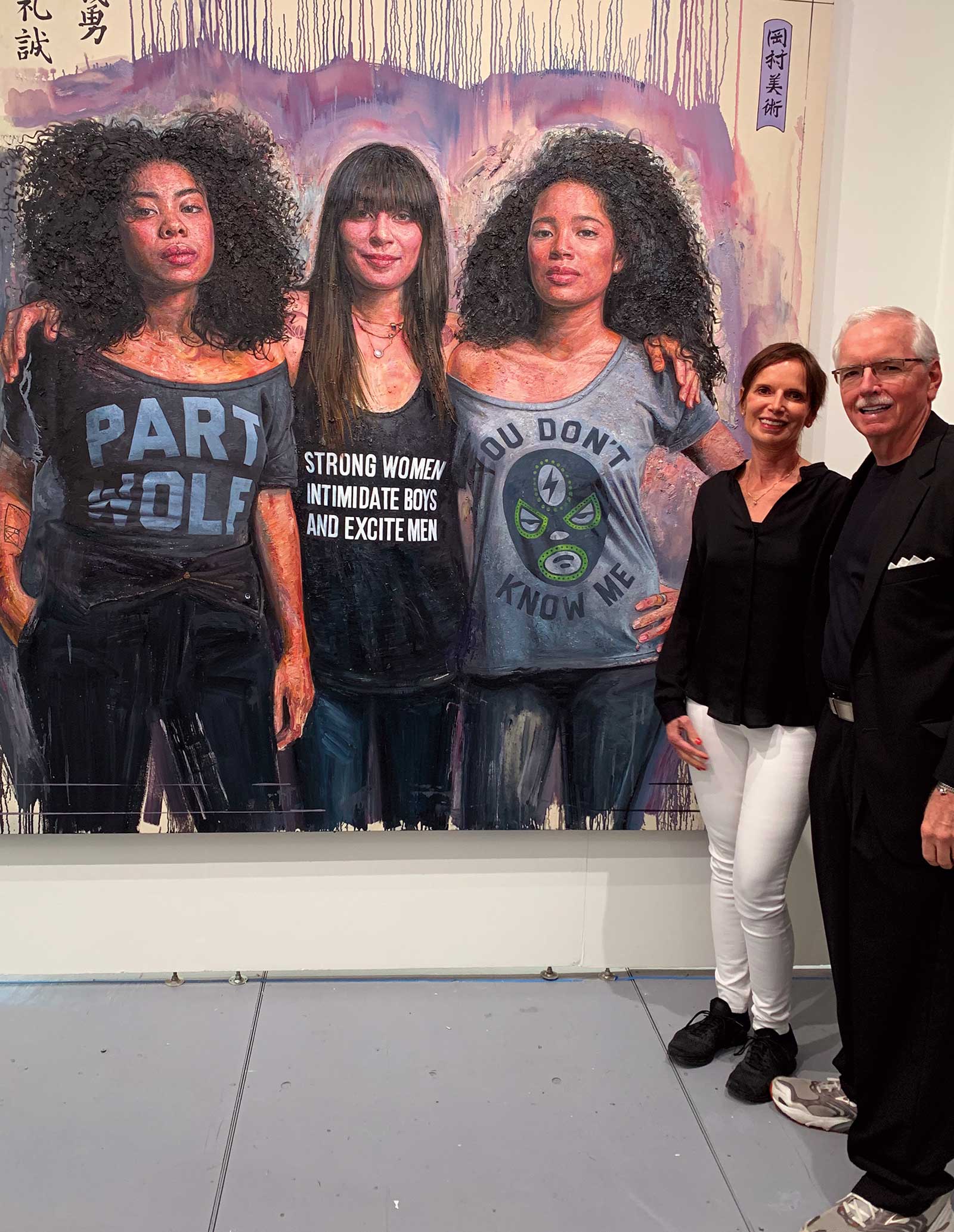 Authors Steven Bennett and Elaine Schmidt with Tim Okamura’s Part Wolf, 2019, oil and acrylic on canvas, 84 by 84 inches.
Back in the Wynwood neighborhood of Miami, at the Pinta show, where Hispanic art is the focus, we struggled to find much realist work but nevertheless admired the mixed media work When You are Gone (en honor a Nipsey Hussle) by Latina artist Flor Bari represented by FutureBrand Hispanoamérica. We also appreciated the very unusual wall “peelings” of Mexican artist Alfredo Romero at the booth of Simard-Bilodeau Contemporary of Los Angeles, who painstakingly removes the signs and postings from the walls of old buildings, thereby creating artifacts that reflect history, culture and advertising of the past.
In Miami, the two big hits of Art Week for us came in shows that traditionally do not attract the throngs and which were not traditional figurative realism. The first was at the Aqua show, held in the Aqua Hotel on Collins Avenue in Miami Beach. Here, we came across the endearing work of an Azerbaijani woman based in Paris and represented by BP Projects of Paris, Maryam Alakbarli. The artist, who has Down syndrome and does not speak, studied in Baku, Moscow and then Paris, and she creates compelling portraits of individuals and figures from both her imagination and experience. We acquired one of these, The Djinn Fairy is Watching You, and believe it to be one of the most sincere and original works to join our collection.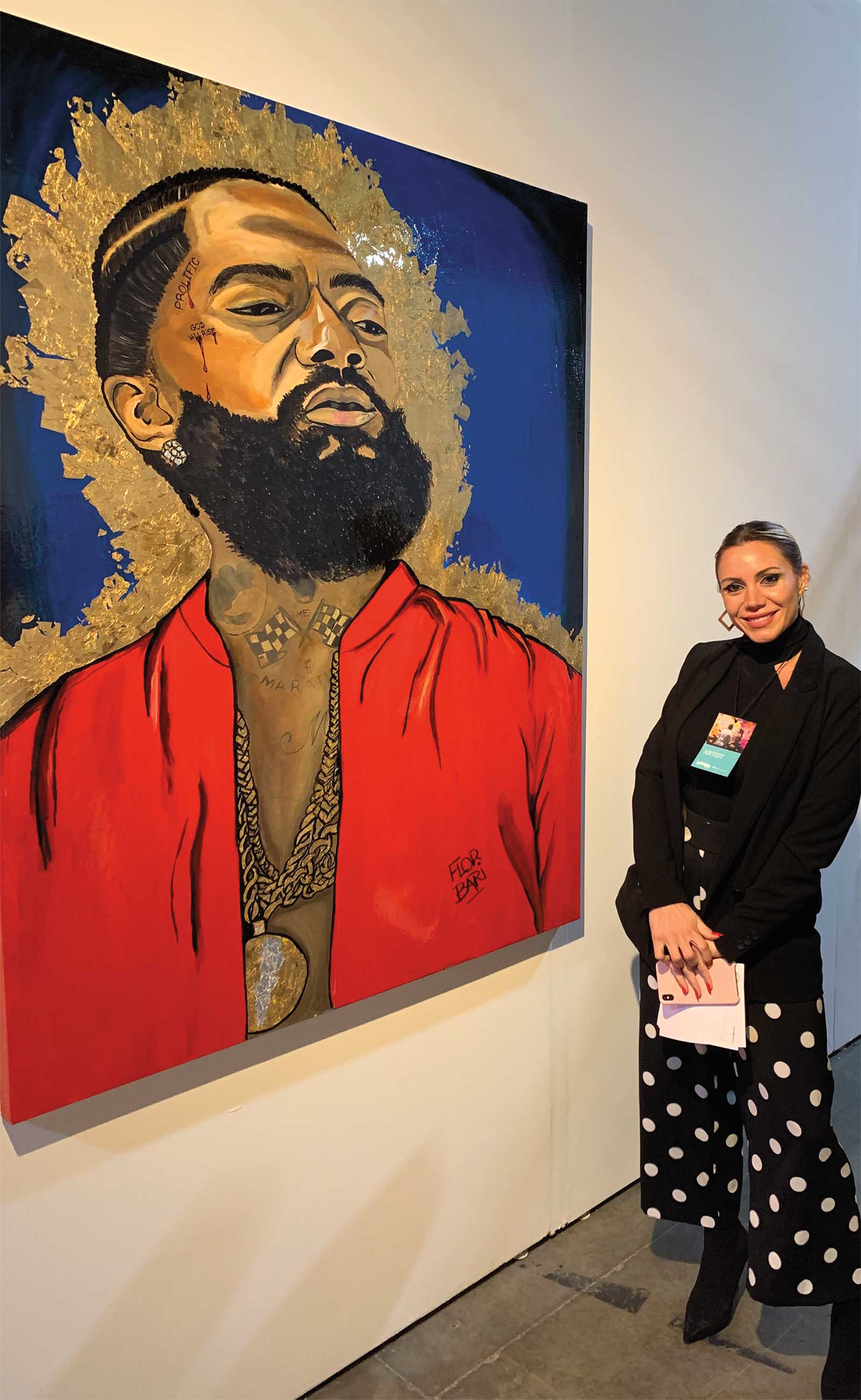 Artist Flor Bari with her mixed media work When You Are Gone (en honor a Nipsey Hussle), 2019.
The second hit from our time in Florida came at the Prizm show, which was held at the Alfred I. duPont building in downtown Miami. This show specializes in the works of artists of the “African diaspora,” and includes works by African Americans, Jamaicans, and artists from the various nations of the African continent. Among these was the work of the Ghanaian sports artist TAFA, who has built his reputation on his semi-abstract knife paintings of soccer games and other sporting events. On display at the booth of Hearne Fine Art of Little Rock, Arkansas, was the oil on canvas Hands Up Don’t Shoot. This mixed media knife painting required significant study, but truly brought home the horror of guns pointed at the unarmed. We found this work and the Alakbarli work to be compelling examples of how art can speak in a way that no other medium can. It was a great punctuation mark to our time in Florida.
Our 2019 Art Week whizzed by and required every ounce of our attention and visual stamina. It showed us that figurative realism is again on the upswing and that women are slowly but inexorably taking their rightful place at the table of big art. It also brought home the point that the art market is a river that ebbs and flows with various styles and types of work. Yet, despite the endless hunt for something new, different and unusual, our time in Miami reaffirmed our belief that these things can be found in the figurative realist work being done today. We invite you to join us next year, but be sure to bring your walking shoes. —
Powered by Froala Editor