Rich storytelling and a classical, but modern aesthetic are two of the integral components in artist Alex Venezia’s paintings. His influences are rooted in not only the Old Masters, beginning with Caravaggio, who he first learned about in his high school art class, but also from wanting to convey human emotions. Throughout his studies—from books of artists such as Solomon J. Solomon and working with Jeff Hein, Daniel Sprick, Michael Klein, Joshua LaRock and Louis Carr—Venezia has learned a multitude of techniques that have helped him refine his artistic voice.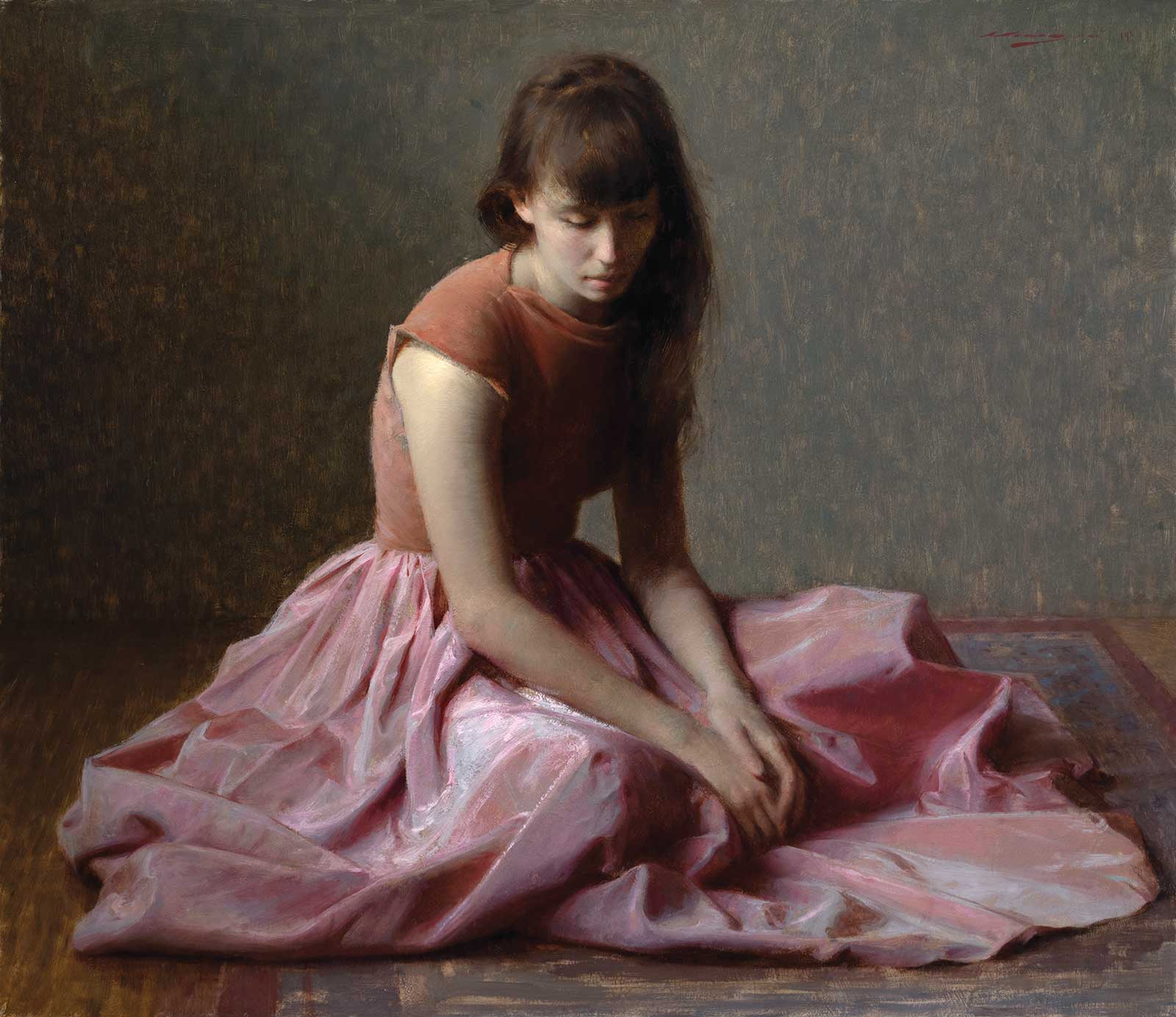 Disillusioned, oil on canvas, 26 x 30"
In particular, Veneiza has found himself comparing art to music or films in that he finds a connection to them. “When I looked into the films, music and other things that I love, I found I was drawn to melancholic works or a deeper feeling, or the storytelling aspect,” he says. Most commonly using the figure as his vessel, he composes moments of life that may not appear in art often but are palpable and universal. People have a connection to them, because at some point in their life they have felt the emotion that is radiating out of the composition. At first glance, it could be hard not to think of these melancholic scenes as anything other than sad, but as one looks deeper into the pieces, they notice the nuances that elevate the painting to another level.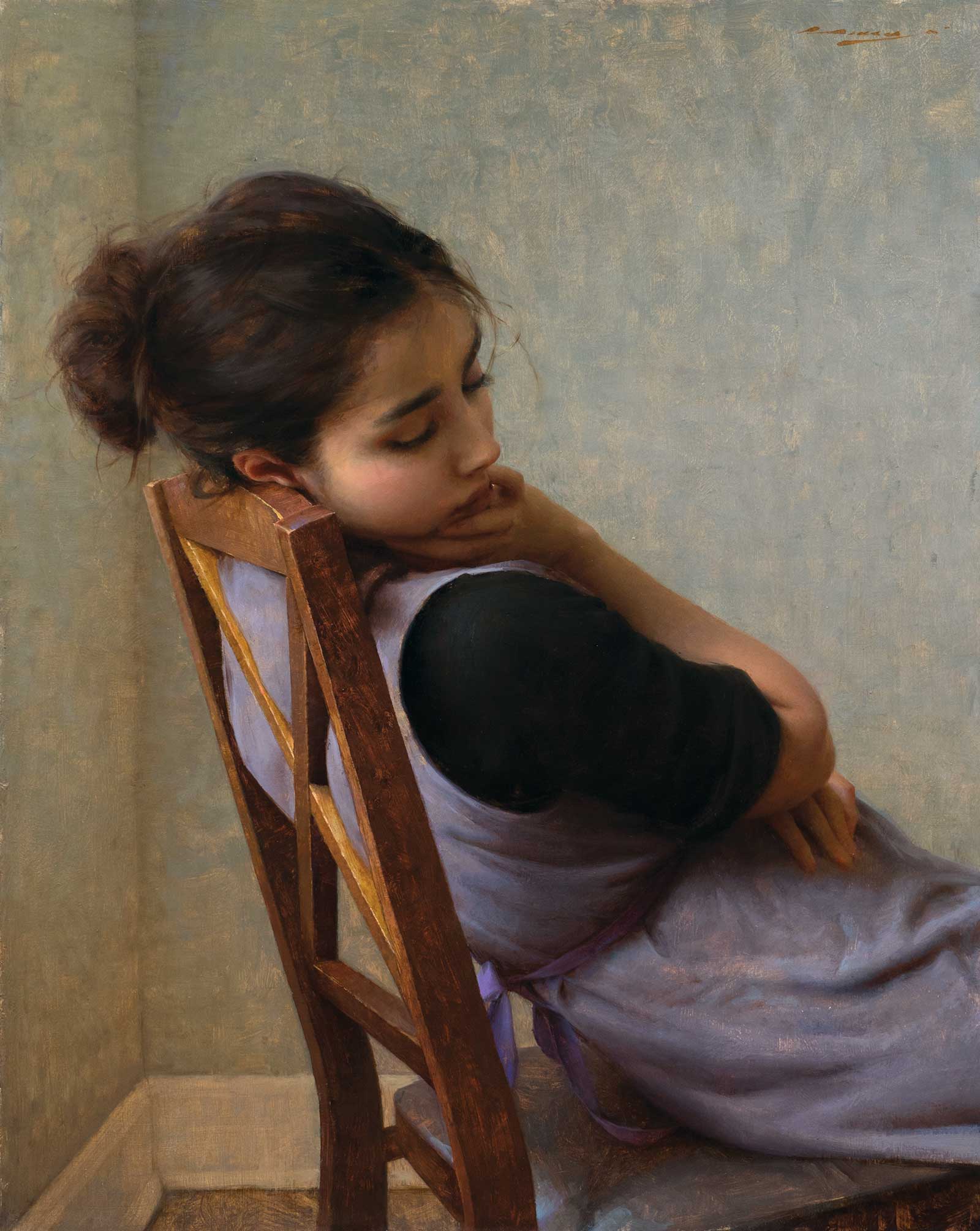 Repose, oil on canvas, 26 x 21"
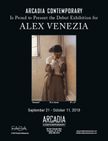
At only 25 years old, the emerging talent has already carved a solid introduction in the art world winning numerous awards and appearing on an array of “best” lists. In April 2019 his painting Haunting received First Place Painting and People’s Choice during the Portrait Society of America’s 21st annual International Portrait Competition. He also has forged a relationship with one of the country’s leading galleries, Arcadia Contemporary, where he will have his debut solo exhibition September 21 through October 11.
About a year-and-a-half ago, Arcadia gallery owner Steven Diamant was scrolling through Instagram when a painting stopped him in his tracks. Usually when this happens, Diamant says, the work ends up being by a deceased artist from a century earlier. “And as much as I love contemporary painting, sometimes an image from a century ago has all of the elements that made me become a gallerist in the first place—an amazing narrative quality, beautifully executed imagery and an elegance that seems to elude so many artists of today. What can I say...that’s my ‘jam,’” he explains. “I appreciate and respect every genre of painting, but give me a timeless and elegant image, whether contemporary or not, and I’m yours.”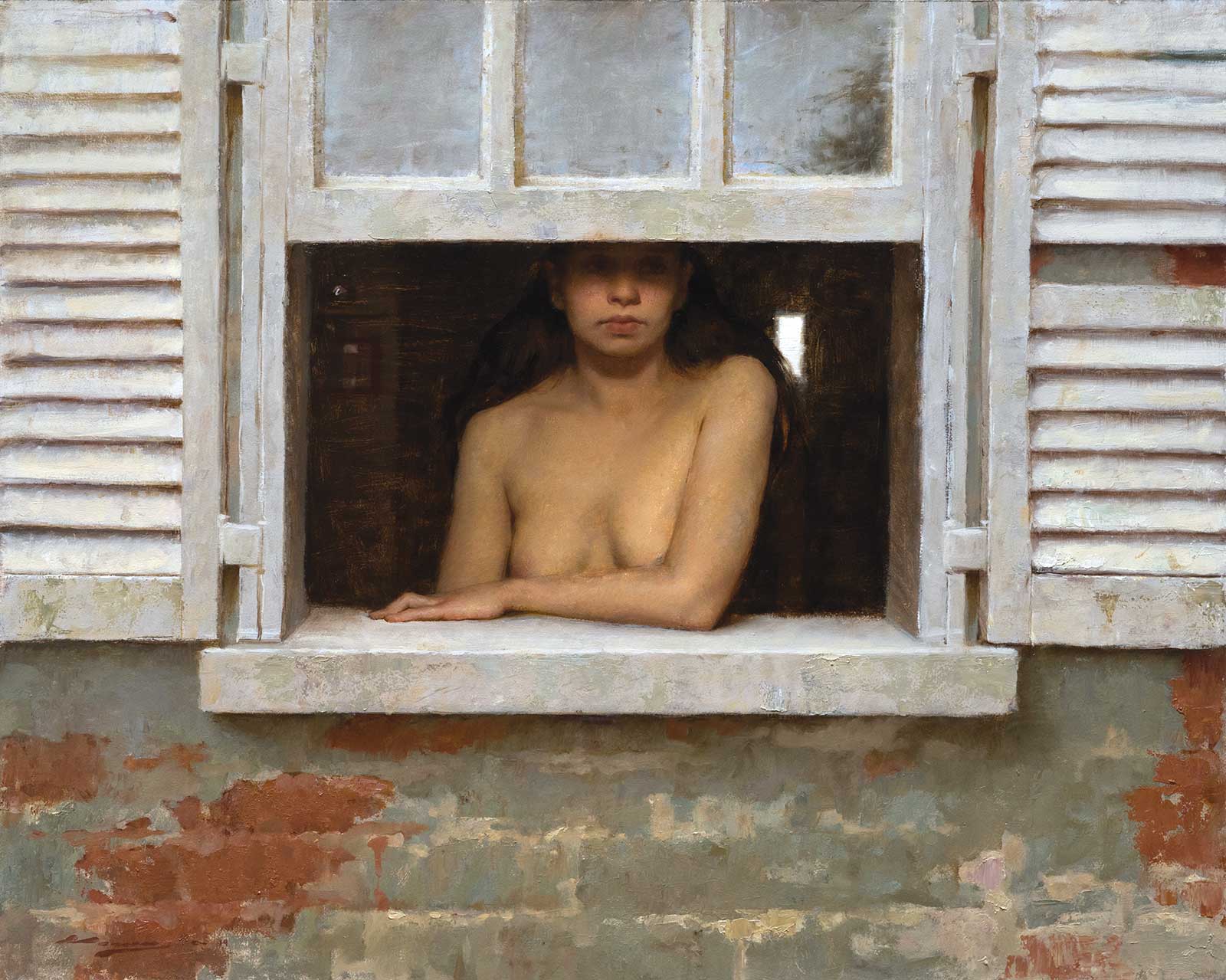 At the Window, oil on canvas, 21 x 26"
This time, the painting in question—Disappearing, a quiet and contemplative image of a woman with her back to the viewer and a basket of fruit in hand—was done by Venezia. Diamant contacted the artist and, to his surprise, it was available. Venezia sent the work to the gallery, and it soon sold, as did subsequent pieces the artist sent over. The interest in his art quickly led to conversations for the exhibition.
“Every once in a while, a painter comes along who ‘has it all’—at least in terms of what this gallery owner looks for—and we are very fortunate to represent a few of those kind of painters but they are few and far between. The ones who have the skills, but more importantly the emotional depth to be able to create works that will be admired and enjoyed for decades, if not centuries to come. These artists are ‘storytellers with paint’ who are able to reach into our collective emotions and make us feel as much as we see when we encounter their works. Alex Venezia is one of those painters.”
With storytelling as his forte, and similar to that of a symphony or the acts of a film, Venezia makes narratives that live and breathe across multiple paintings. Take Sisters and Solace, for instance. “There are two parts to Solace, the emotional aspect and the compositional aspect,” he says. “One thing I knew that I wanted was the composition of these two larger, dark shapes kind of sweeping up the rest with a gray, lighter tone surrounding them. It’s kind of a dark and gray composition with the one piece of light being the one figure’s back and neck. Then, the emotional aspect, was me trying to dive deeper into that melancholic feeling of sadness because that’s something I react to so strongly in music.”
Sisters depicts the same girls in a similar compositional style. “The girl that’s crying in Solace, she’s resting her head on the shoulder of her sister. You can tell that is the start of where she’s feeling something, or there’s trouble going on and she kind of breaks down,” the artist describes. “The older sister is kind of comforting her. It’s not anything specific, but just a story of sadness and comforting.”
Adding another layer to the story is the still life Roses, which Venezia says can be seen as a mirror opposite to Solace. Its dark background and white roses are almost mimicking the sisters—one rose wielding above the other as if to provide comfort and protection to the smaller rose below.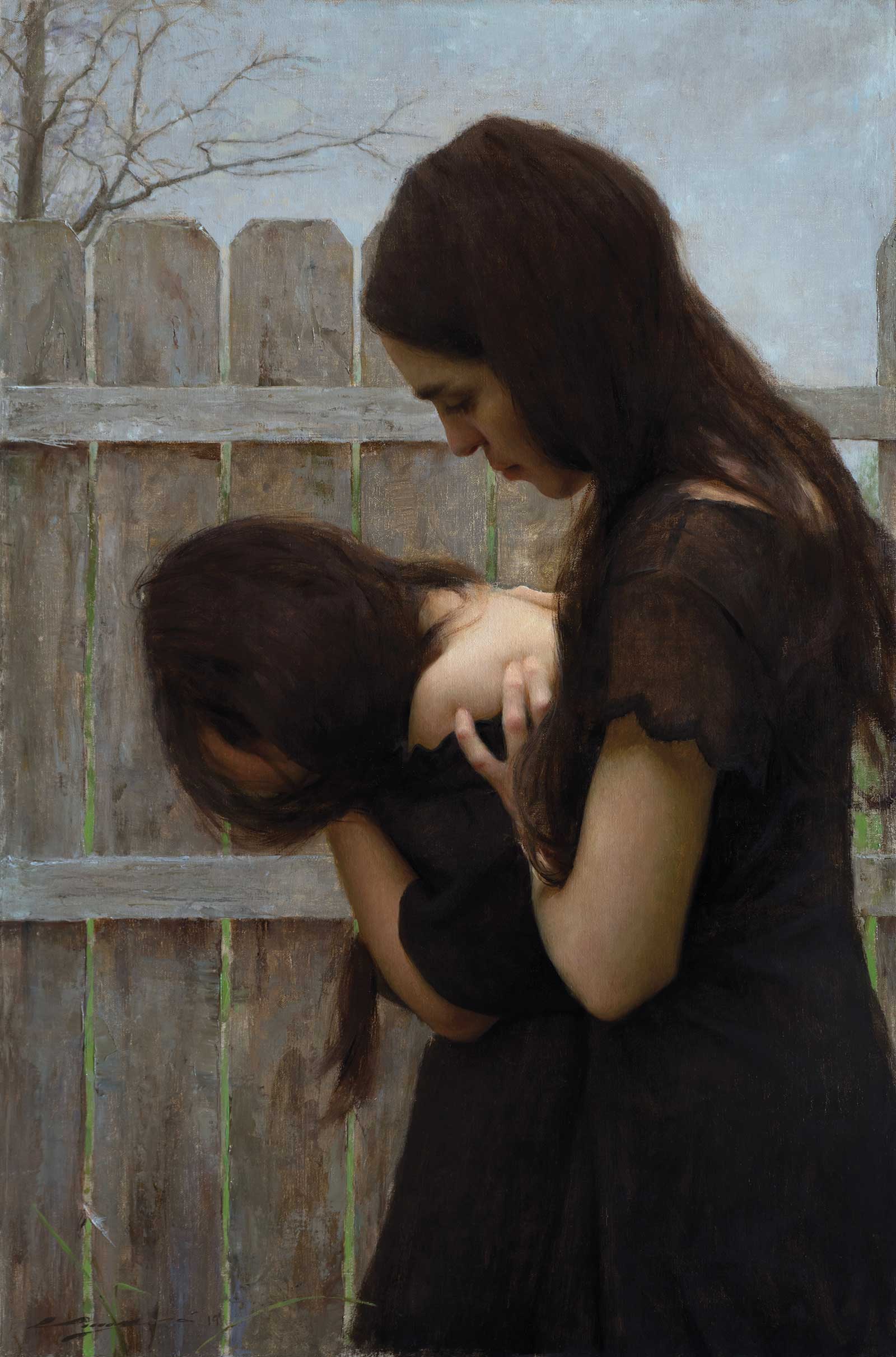 Solace, oil on canvas, 27 x 18"
This idea happens again in his works Repose and Haunting. The woman depicted, the artist’s wife, Divya, is in the same dress and environment. In the latter work, you can clearly see her face as she slouches over a chair, her look—and the open door behind her—hint at recalling memories that cannot be left behind. In Repose, she changes position with her back against the chair, her expression still lingering. When Haunting was completed, Venezia at first hesitated to paint the similar composition, but decided to break the rules and do it anyway because there was more left to say. He explains, “I thought this pose was equally as powerful and beautiful, but just in a different way, with the face being mostly in shadow.”
Along with the figures, sometimes the clothing becomes characters of their own, such as a pink dress that has appeared in three of his paintings. His newest piece featuring the garment is Disillusioned, which derives from his work Disappearing. Venezia was interested in capturing a particular emotion in his paintings featuring the dress, and part of his process was creating new works until he was able to let go. “I had a story in mind about the dress,” he says. “…It’s the morning after a night when this woman went out and now she’s disappointed the next day. All that she was hoping for didn’t happen.”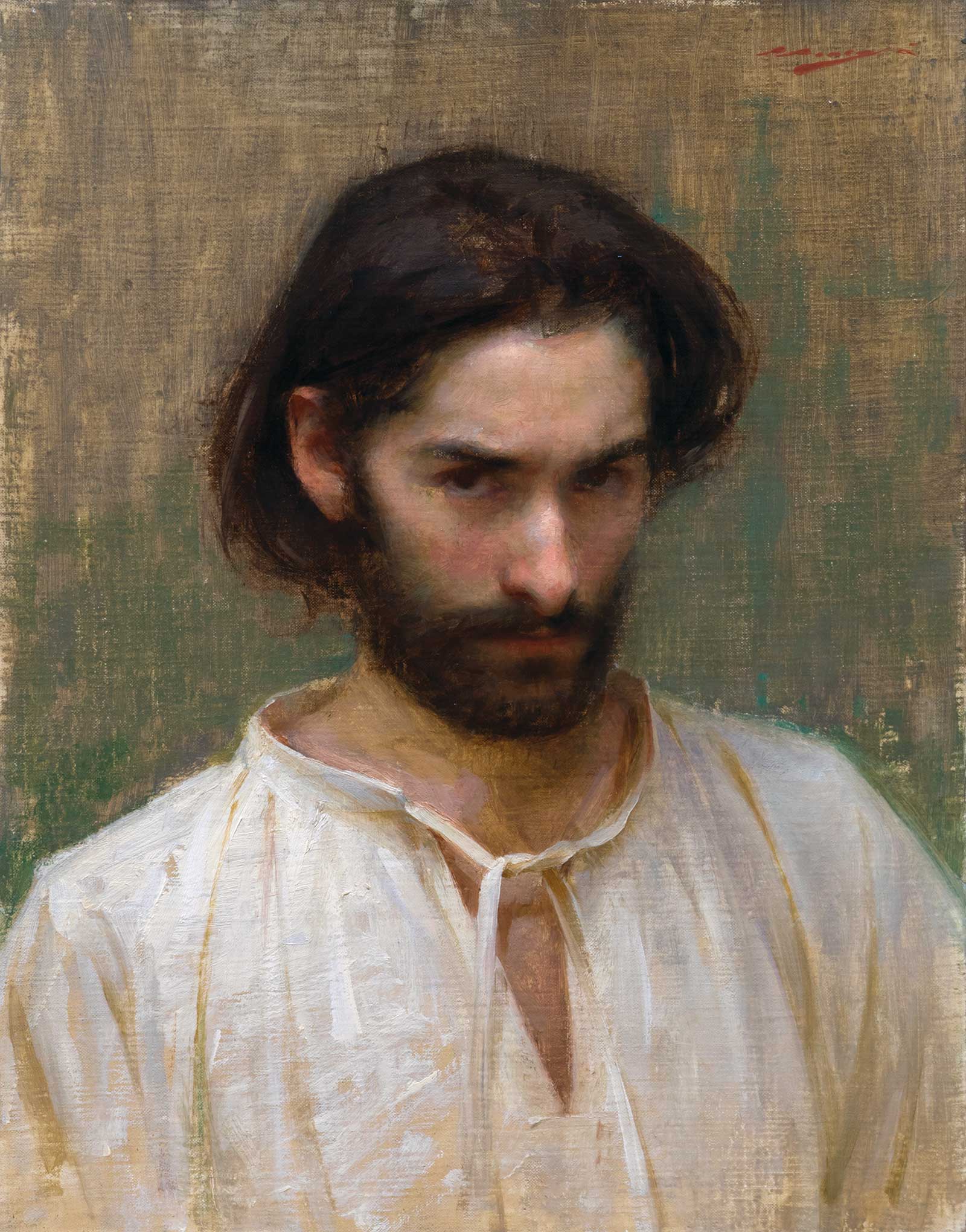 Self-Portrait at 25, oil on canvas, 14 x 11"
Venezia’s paintings are also reminders of the past masters, which was something he discussed with Odd Nerdrum while studying with him for two months in Norway. The pair talked about how artists can gain inspiration from masters’ compositions, because great art is often derivative. In that sense, even if it’s unintentional or unknown, someone may have created something similar before. Venezia’s At the Window is homage to a sketch he found in Andrew Wyeth’s book The Helga Pictures, while Self-Portrait at 25 is based loosely on a self-portrait by Henri Fantin-Latour.
“A common thread throughout the paintings in the art world is there’s this sense of you wanting to be very individual and find your individuality and what makes you different from everyone else. Philosophically, I’m aiming for something else,” Venezia says. “I’m looking for universal commonality. In movies you can connect with the characters, and in songs you connect with the music. The same love story is in every movie, but it’s told in a different way. I like to find this universal commonality that strikes the chord with people.” —
Alex Venezia
When: September 21-October 11, 2019
Where: Arcadia Contemporary, 39 E. Colorado Boulevard, Pasadena, CA 91105
Information: (626) 486-2018, www.arcadiacontemporary.com
Powered by Froala Editor