
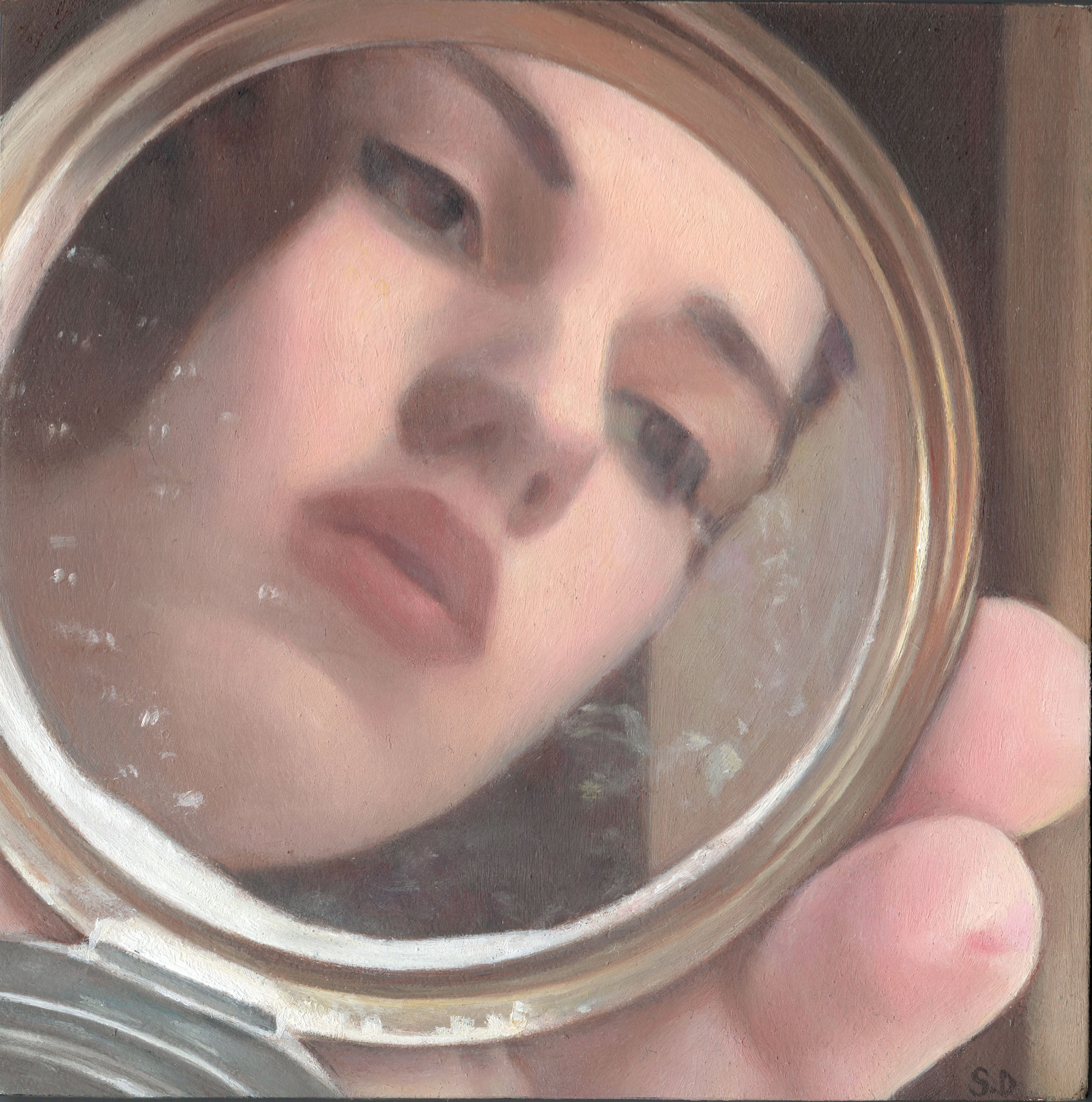
A docent once told me that it’s abundantly clear when a museum guest has found a piece that has deeply moved them. They linger at the work, studying its movements and the lyrical notes therein. They peer at it intently, absorbing it, letting it rinse through their very being. The docent will occasionally meander over to offer an additional thought or brief story about the work, and will invariably ask what inspired them. The answer, the docent said, is almost always the same: people see themselves in the work, or elements of themselves. “You could hang a mirror, but you get better results with the paintings,” the docent said.
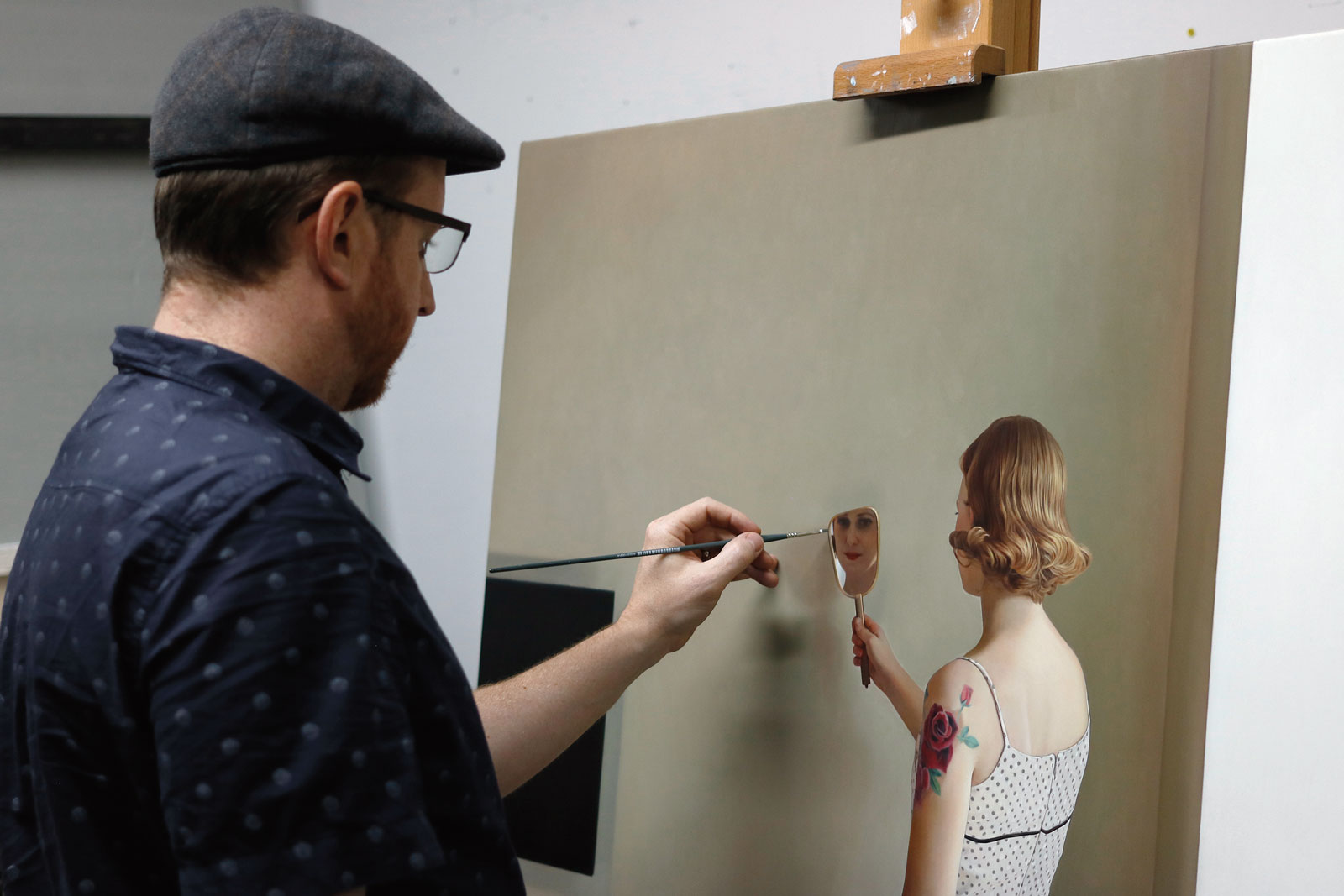
This idea of works of art reflecting back onto the viewer is the central theme of a new Shaun Downey show, Reflection, opening December 8 at Arcadia Contemporary in Pasadena, California. The Toronto-based Downey, who has long painted figures in deep reflection within the confines of minimalist interior spaces, has recently been adding another dimension of reflection in his work.
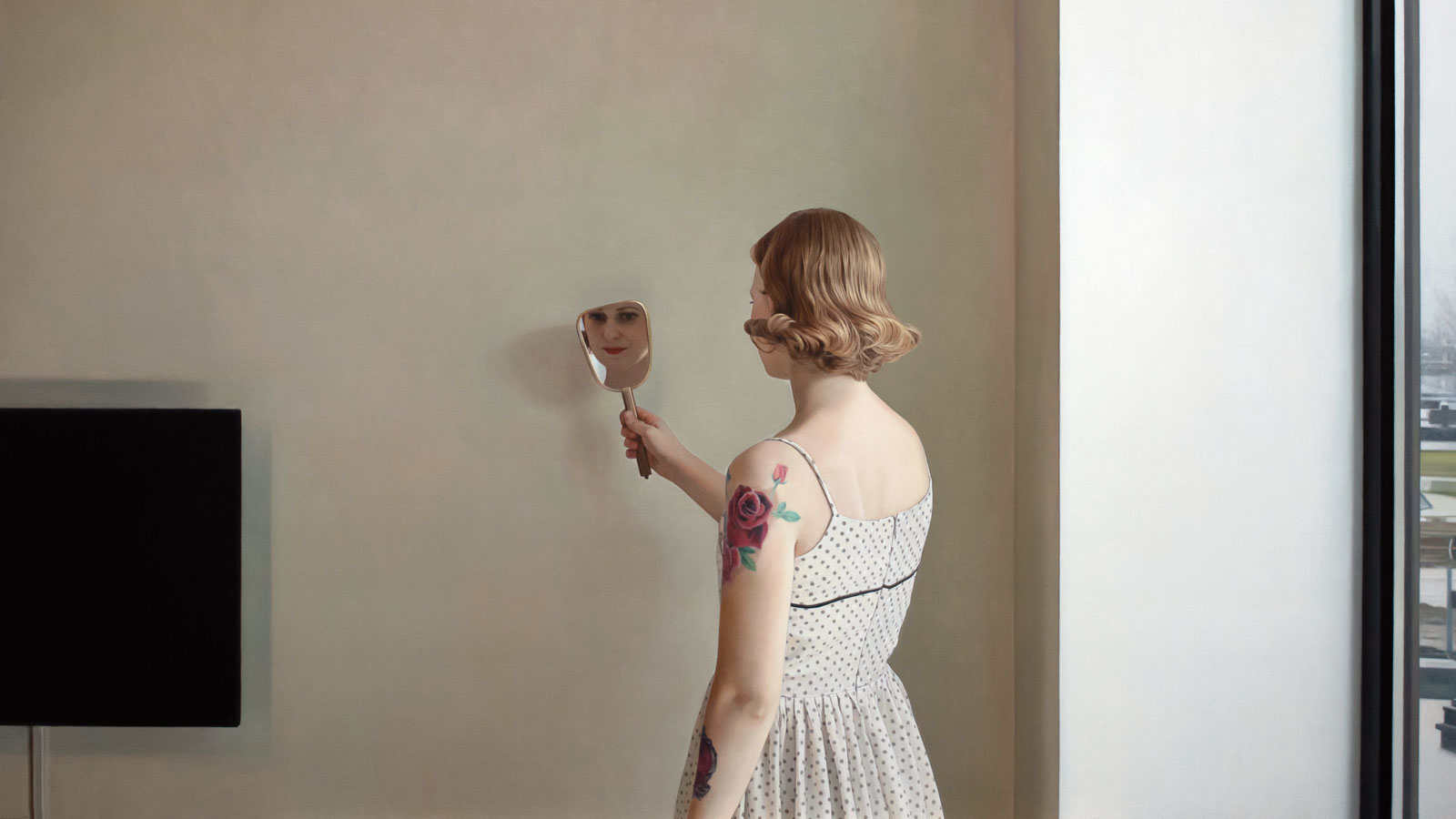
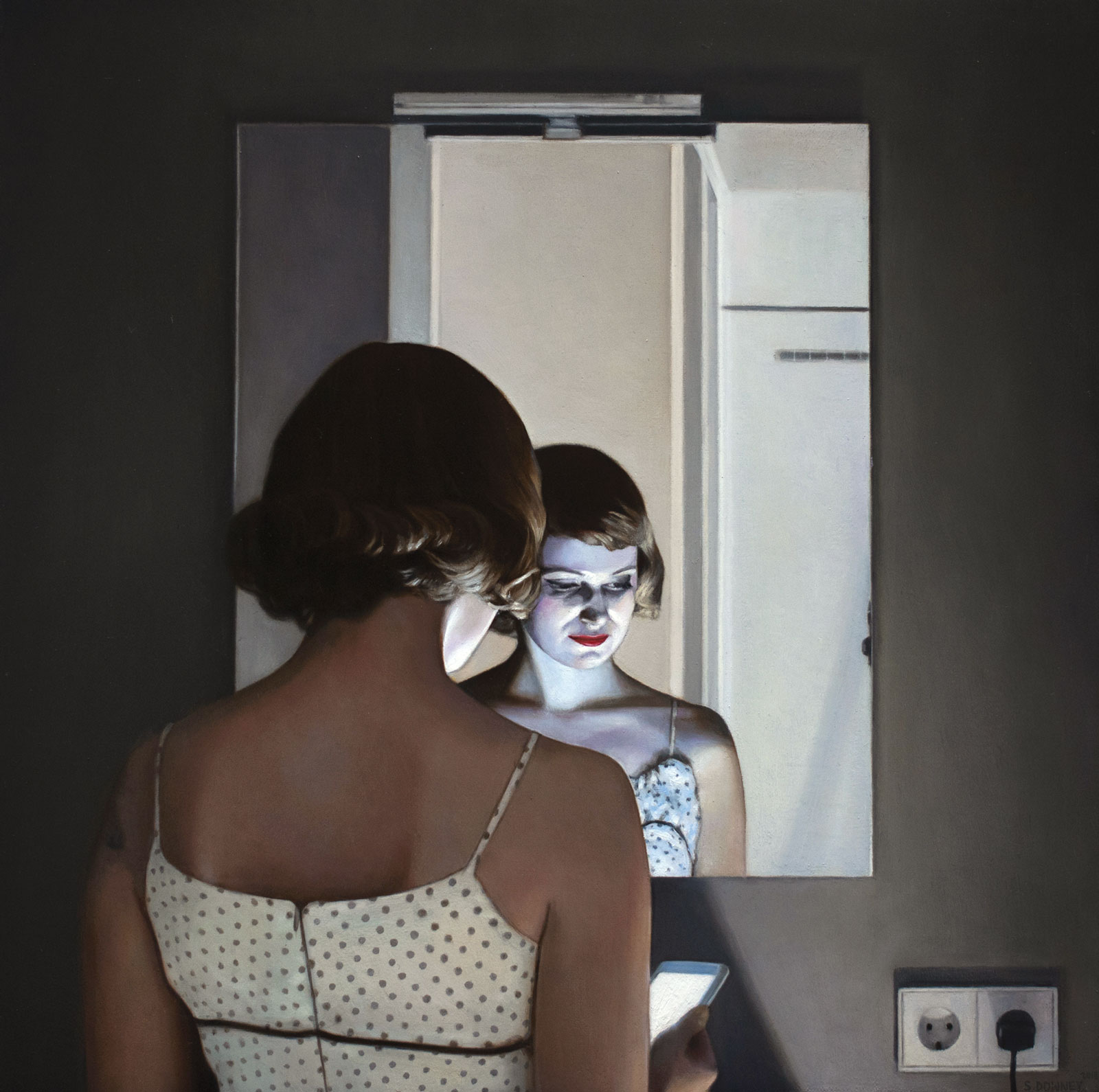
Downey’s compounding thoughts on the nature of the internet, especially the variety that hums silently in our pocket eagerly awaiting its obsessive retrieval, is itself a form of reflection. What we do online, what we share, how we act…these are revelations of the user. I’m reminded of this insightful meme: “That moment in between Netflix episodes when you see your reflection on the black screen and wonder what you are doing with your life.”
Mirrors in our homes, paintings on our walls, dark screens on our smartphones—these are all places where people see themselves. For Downey, they are also interesting ideas for a painting, and in Dutch Light he uses all three: a woman standing in front of a mirror peers down at her phone as light cascades up casting a prominent glow on her exposed shoulder blades, jawline and face. It’s not the first time he’s painted a figure gazing at a phone, and it will likely not be his last as he continues to explore what it means to be truly alone.
“Being a painter is one of the most solitary professions. When I’m working it’s me and the canvas. It’s time to just be by myself and listen to music and re-digest everything,” he says. “And yet there is a duality to that isolation. I love being myself. I’m a jovial person and I think we’re all social creatures, but this work requires solitude sometimes.”
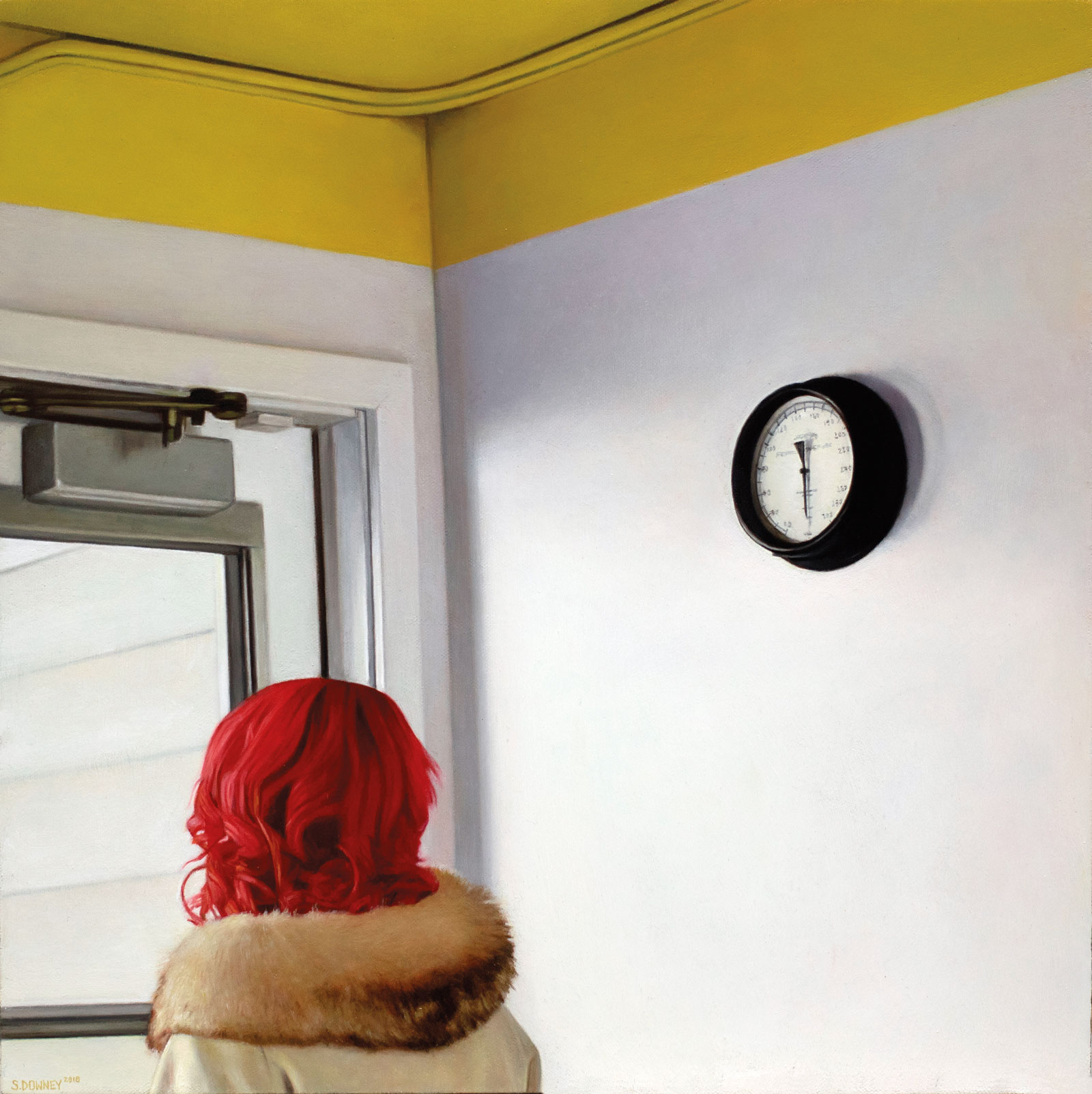
A number of Downey’s new works include his wife, as well as other models that he’s worked with frequently. The model in Dutch Light appears again in In the Mirror No. 2, a 48-inch-wide work showing a female figure looking directly at the view from a mirror held out in front of her face. The figure is relatively small in the painting, dwarfed by two blank walls that divide the painting. In Barometer, a red-headed figure stands next to a door, and immediately to her left is an empty wall, filled partly by the subject in the title. Negative space plays a huge part of both paintings, and it’s not by accident.
“I think immediately of Mondrian or Vermeer—they are great influences on me. I love composing a work with the negative space. Sometimes I compose them into the images right away, and other times I’ll revisit them by coming back to them day after day,” Downey says, adding that he typically begins each painting with a photo session. “I’ll have an idea for light and color, so I’ll choose my model and locations and get w ardrobe together. It feels like a mini film set even though it’s just me and the model. Occasionally my wife will work as a photography assistant. I’ll take 1,000 photos in a day and then chisel them down to what I want. Then I can start playing more with the light, the color, those negative spaces. I want it all to be figured out before I even start painting.”
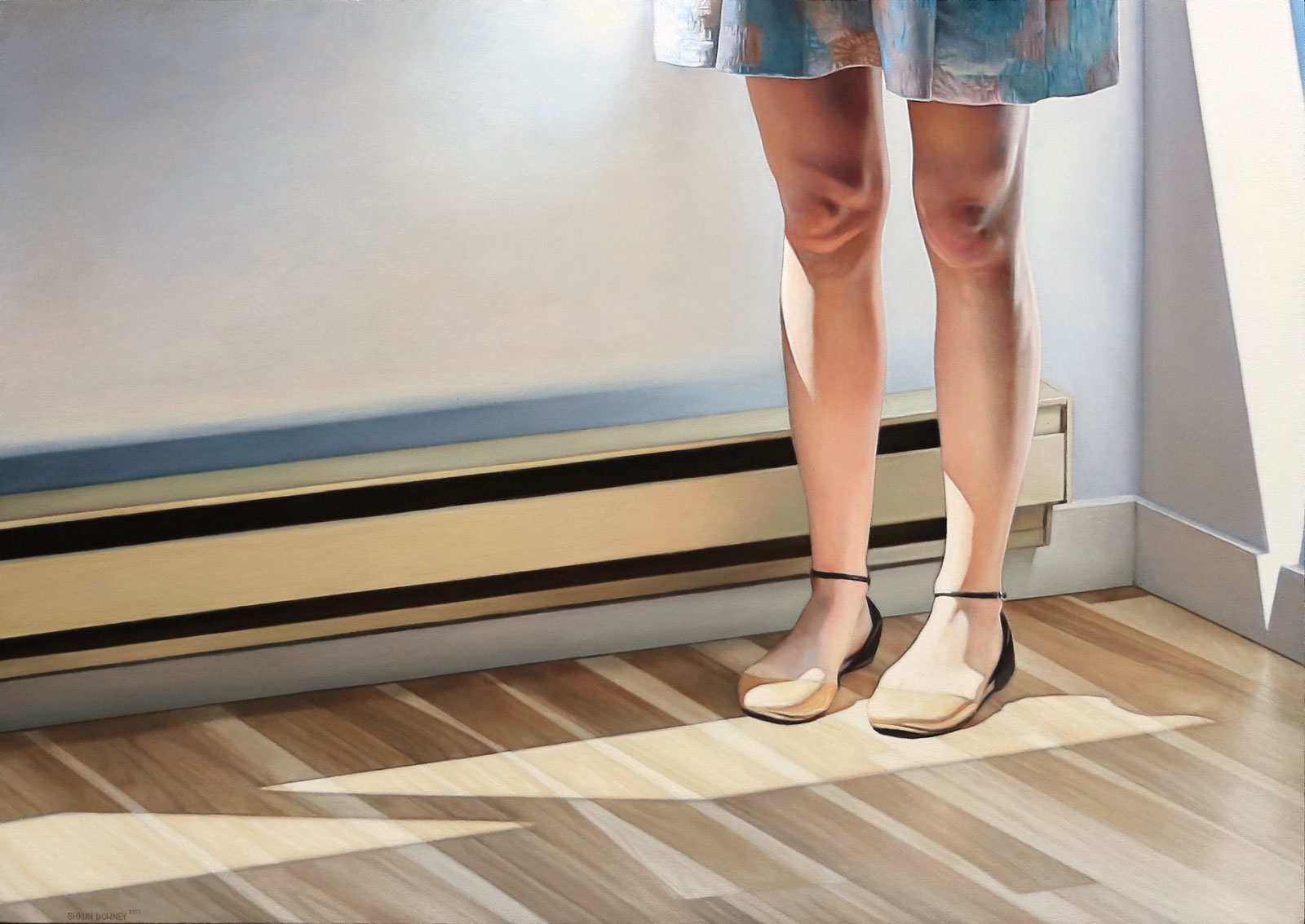
Incoming Sun, which also has interesting areas of negative space, is also a fascinating study of light and line. In it, a figure’s legs are illuminated by sunlight coming in through a window at an extreme angle. At her feet are an arrangement of lines in the wood flooring, in the baseboards and in what appears to a vent system mounted near the floor. “The geometry of that one was fun to put together. It’s very pleasing to the eye,” he says.
The work also reinforces his central themes: reflective isolation. He immediately thinks about Andrew Wyeth’s Helga series, in which Wyeth painted a neighbor secretly for 15 years. “I like to think of those works as more contemplative, but also very haunting. Haunting because we’ve forgot how to be all alone. This is also why mirrors are so interesting to me. Mirrors are windows on another world that is happening in tandem with ours. We are simply the ghostly image passing through it.”
Shaun Downey: Reflection
When: December 8-30, 2018
Where: Aracadia Contemporary, 39 E. Colorado Boulevard, Pasadena, CA 91105
Information: (626) 486-2018, www.arcadiacontemporary.com
Powered by Froala Editor