In Domestic Katabasis, New York painter Martin Wittfooth’s new exhibition, the primal relationship between man and the animal kingdom reaches an anarchic conclusion as the animals are in open revolt of the system, of technology, of the status quo, of nature itself.
“I use the term katabasis, which not a lot of people might know. It’s an old Greek term, one that shows in up hero’s tales—something from Joseph Campbell or about his archetypal hero’s journey. It is the valley into which our hero descends. In many stories the hero descends to never return, but alternatively there are stories where the descent offers challenges and a hope that maybe the hero could rise out of it,” Wittfooth says of his show, now on view at the Corey Helford Gallery in Los Angeles. “As a collective species, we’re in a state of katabasis, which is why I’ve paired these scenes with domesticated animals…dogs, cats, bulls and horses, farm animals as well. We have a human desire to manicure our own experience, even with animals. Even nature itself is brought into our world of human form.”
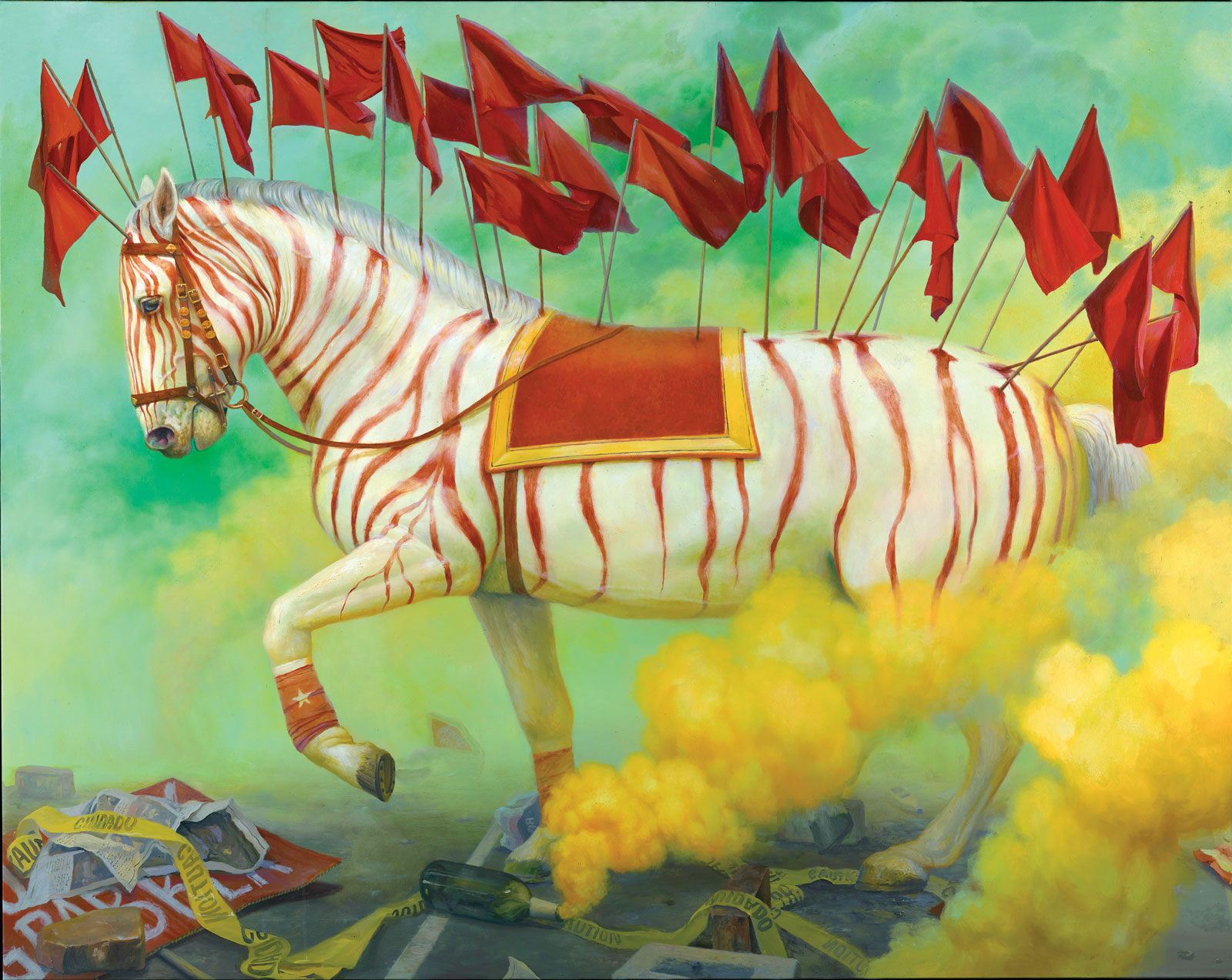
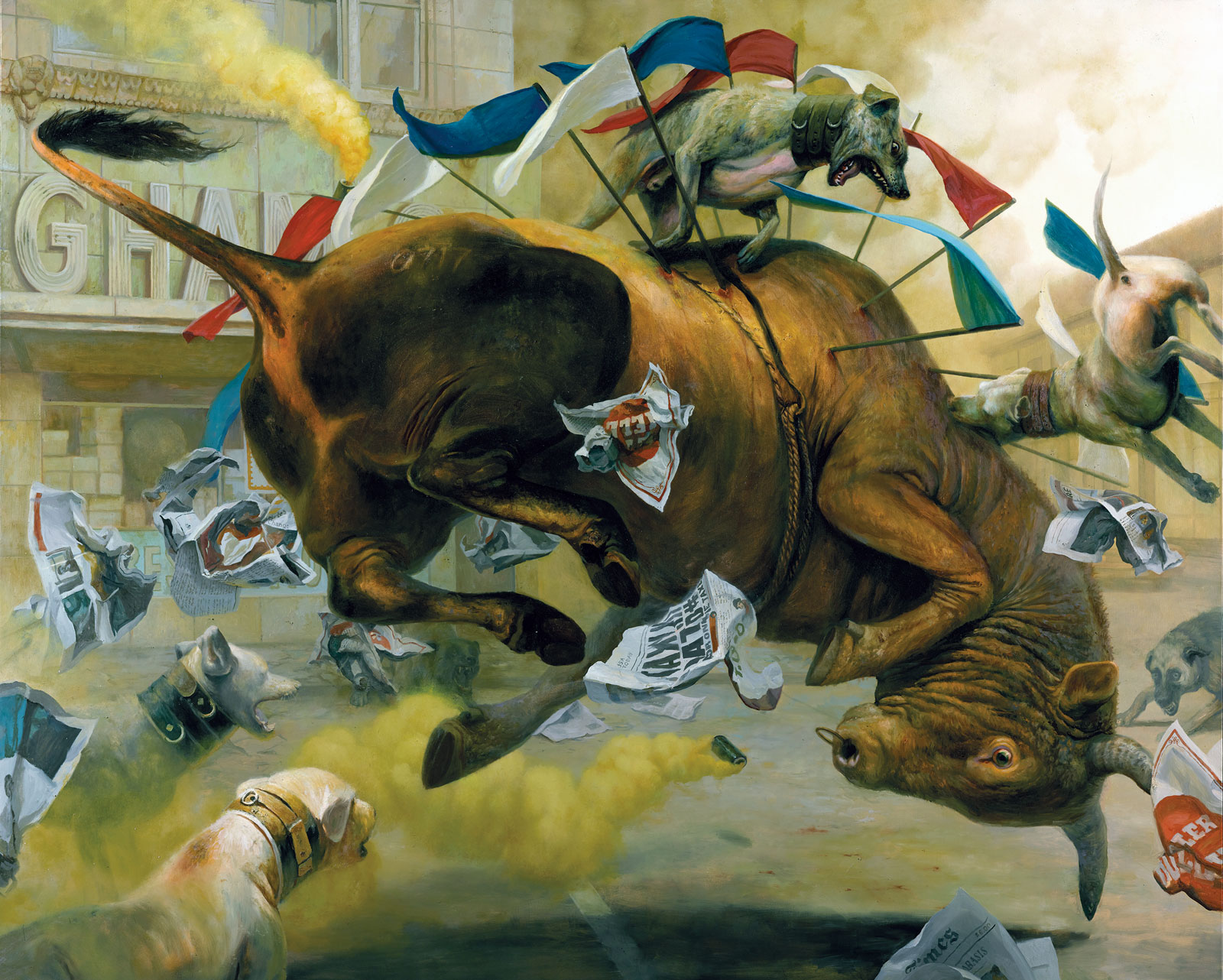
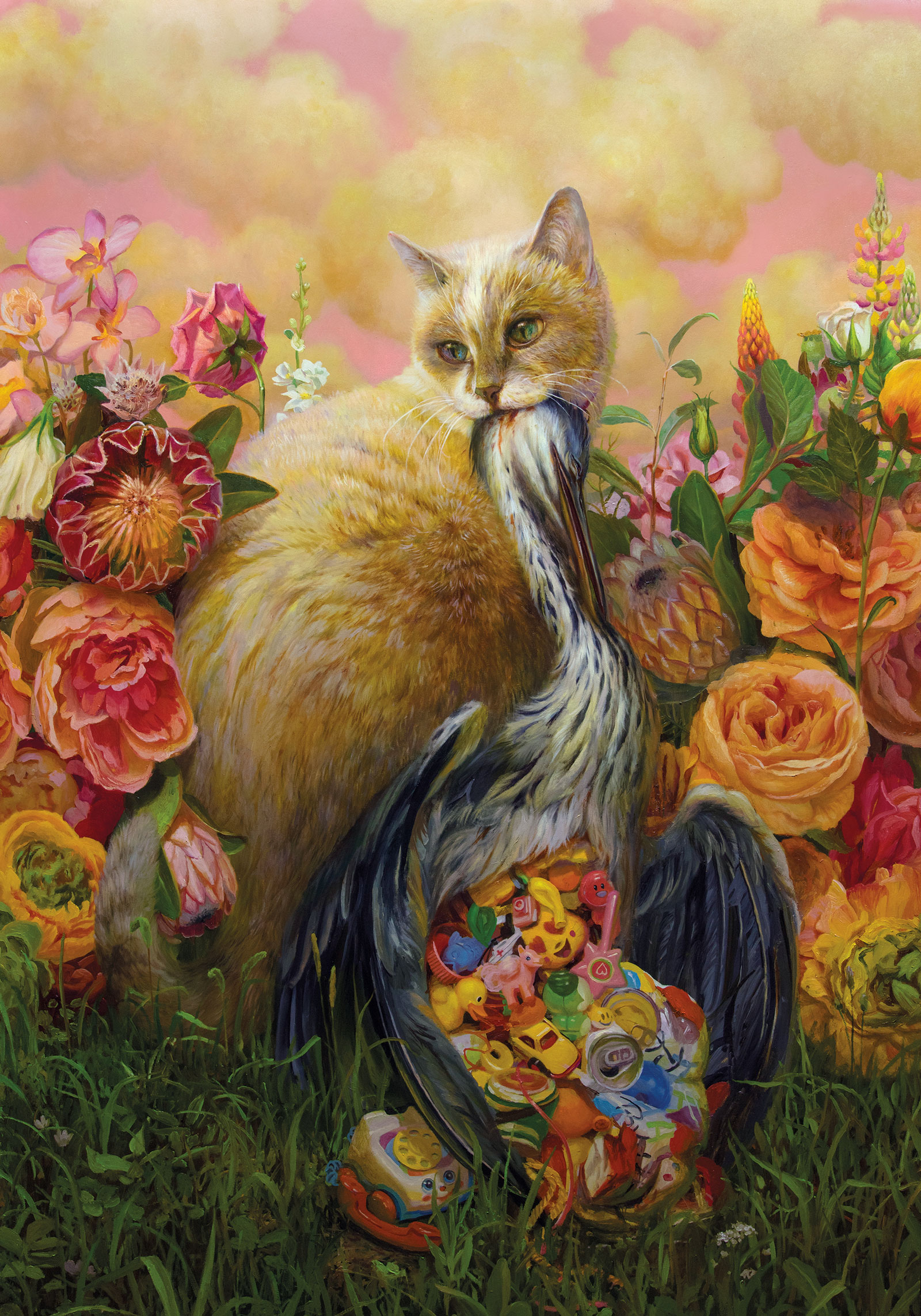
The show is anchored by four works, including the three previously mentioned works, that each measure 105 or 107 inches on their longest side. “Scale was important for these works. It places the action in the room, and that scale was something I really wanted to emphasize as I started to paint,” he says. “They’re essentially lifesize works and they transport the viewing right into the piece.”
Wittfooth’s paintings are often heavy in symbolism and allegory, and it can be daunting for some viewers who feel they must align everything in the work to a real-world meaning, but the painter encourages viewers to experience the works on their own terms and using their own narratives. For example, this new work has a political slant to some of the works—the baboons are draped in an American flag, the bloodied horse has a military-like presence, and Conquest’s bull is often linked to ideas of capitalism—but Wittfooth encourages viewers to take up their own ideas, even if it takes them outside the United States to a more global understanding of human, or animal, nature.
One of the cornerstones of the show is Wildmother, an image of a domesticated dog that is laying in a gorgeously colored landscape of plants, birds and small forest creatures. Milk is leaking from the dog’s belly, feeding the grass and animals in a luscious and peaceful comment on the healing power of nature. “The painting is happening through a dream-like filter,” the painter says, adding that the band Rival Sons are using a version of the painting on the cover of their new album. “I’ve been interested in this theme of nature as mother, hence Mother Nature, for a long time. There’s something beautiful about this living breathing organism that we are all floating around on.”
Domestic Katabasis continues through November 24 in Los Angeles.
Corey Helford Gallery, 571 S. Anderson Street, Los Angeles, CA 90033 • (310) 287-2340 • www.coreyhelfordgallery.com