We begin, beloved, on the outward breath, with the life cycle of bright flowers. Here is Rose Frantzen’s Spectrum, a colored band of rich beauty conspiring to span a bright rectangle of canvas from left to right, a spectrum of transition from the juicy and expanding buds to the dry but seed-filled heads of winter potential, a reflection and observation of transformation. Light is compressed here, within the brisk contrast of the brightness of birth and life to the melancholy of deep darkness. Time is compressed here, where nature’s slow season and process of growth, and the unending cycle of birth and death are revealed. Space is compressed here, too, behind the blooms, where pretty bands and bundled patterns arranged in complex plans of rosettes and tessellations border the thirded strip of bright leaves and blossom and browning seed.
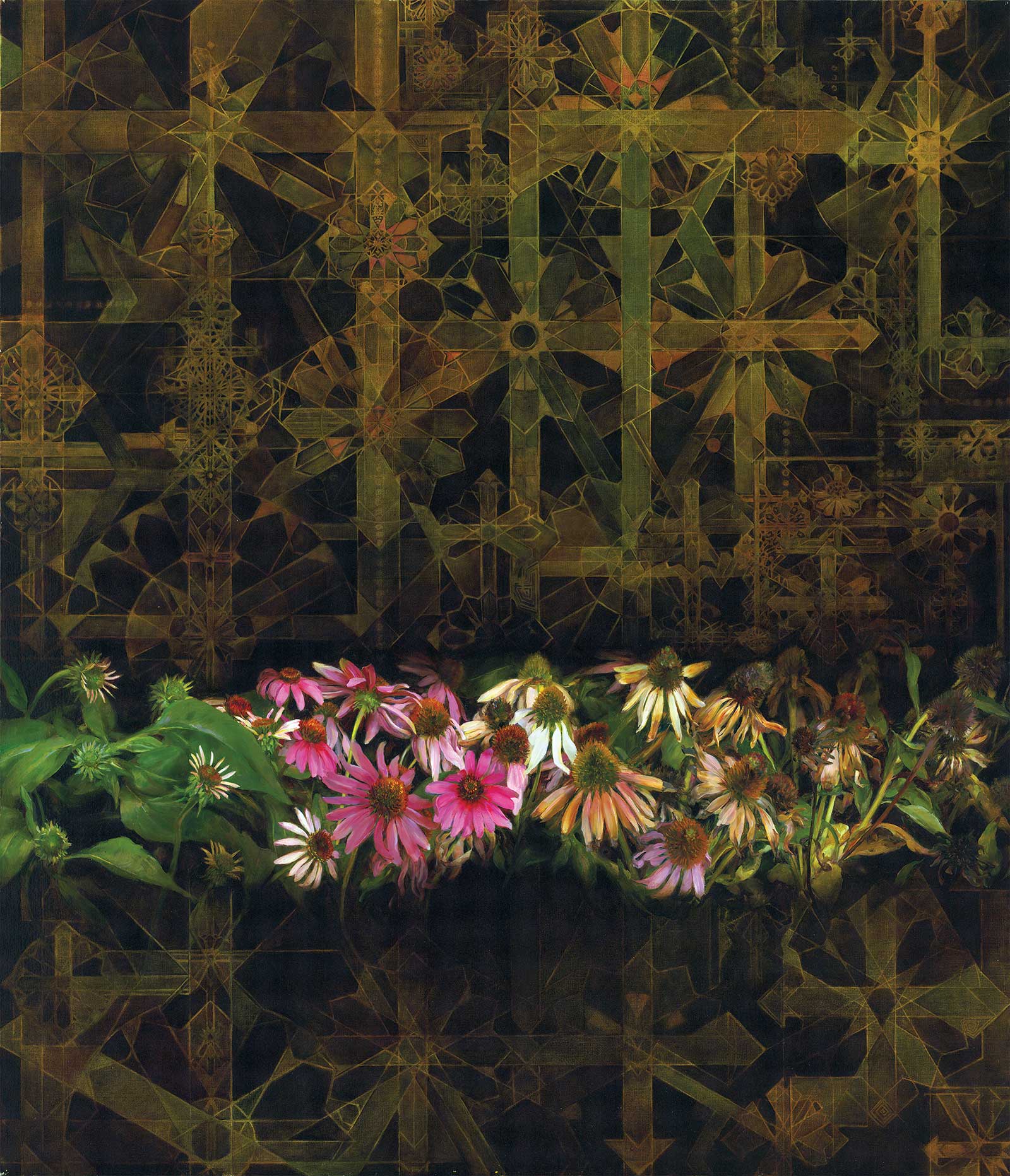
Spectrum, 2008, oil on linen, 42 x 36 in.
These contemplative hints that cosmic order dwells behind reality expand in Frantzen’s Life Within, a cruciform floral wreath of angel’s trumpets and morning glories and blue cornflowers geometrically arranged around an octagon of tight roses, the stems of the living abundance woven into a central radiating pattern like stained and sacred glass. The seasonal wreath rises over a four-squared landscape wrapping each edge of the picture with a filigree and tracery of intricate pattern and inset jeweled squares of floral decoration. It is a crossed blessing upon this green and wooded land, this cardinal tabulation of fertility and lavish plenty. Frantzen recalls, “…the first thing I saw that I resonated with in my work was chaos and order. I kept setting things up that were just chaotic…and yet I’m looking for the order in that. I’m looking for the rhythms that can tie it together.”
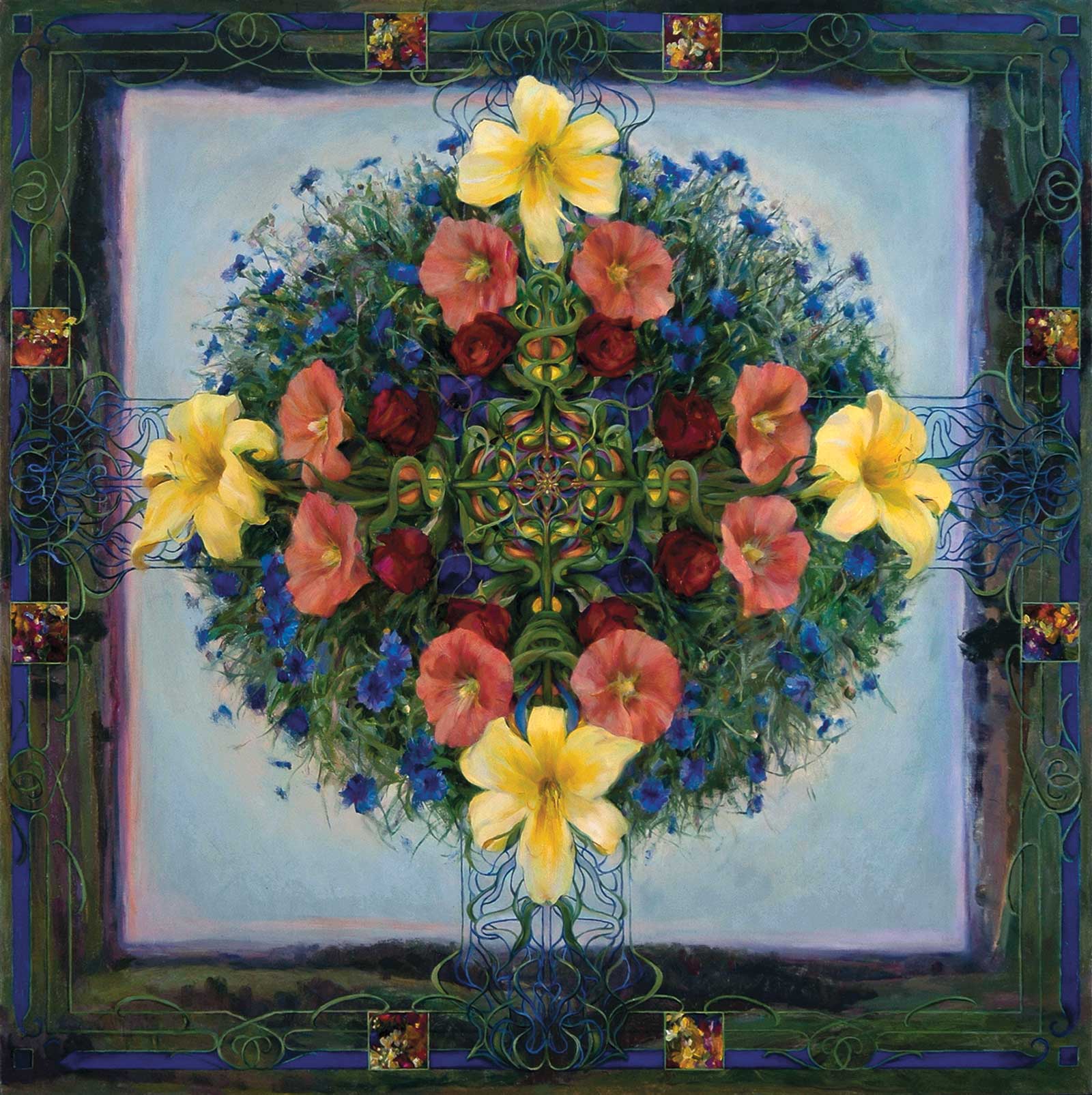
Life Within, 2002, oil on linen, 40 x 40 in. Private collection.
In From and To, the geometric structures and patterns blend in shimmering glazes of Prussian blue and the delicious range of iron oxides over a serene feminine face with the otherworldly appearance of an entity from another place. She is more than a portrait, but less than a person and, as a metaphysical image, inspires more questions than answers.
The Impossibility of Feeling Worthy of a Universe of Infinite Beauty, in which a great floral splash seduces viewers into falling into a fantastic display of Frantzen’s sensitive appreciation of the sacred geometry of the universe that dwells behind the filters of human perception, is another superb piece. Here her expanding mandala has multiplied into configured patterns of carefully composed radiance, glowing in chromatic harmonies, and emerging from the mathematical structures that bind space and time together. All this sensual splendor unfolds behind a beautiful young woman, her back turned to it, unaware and unable to witness the fullness of its presence, but her shoulder tattooed with a flattened image of flowers echoing its power and glory. Frantzen says, “she’s basically scarring herself with this image of this infinite beauty behind her, so she reminds herself of something, right? Or she’s trying to be it, or she’s trying to meet it, and yet she’s moving away from it. She’s turned away—the whole thing is right there, if she were to turn.”
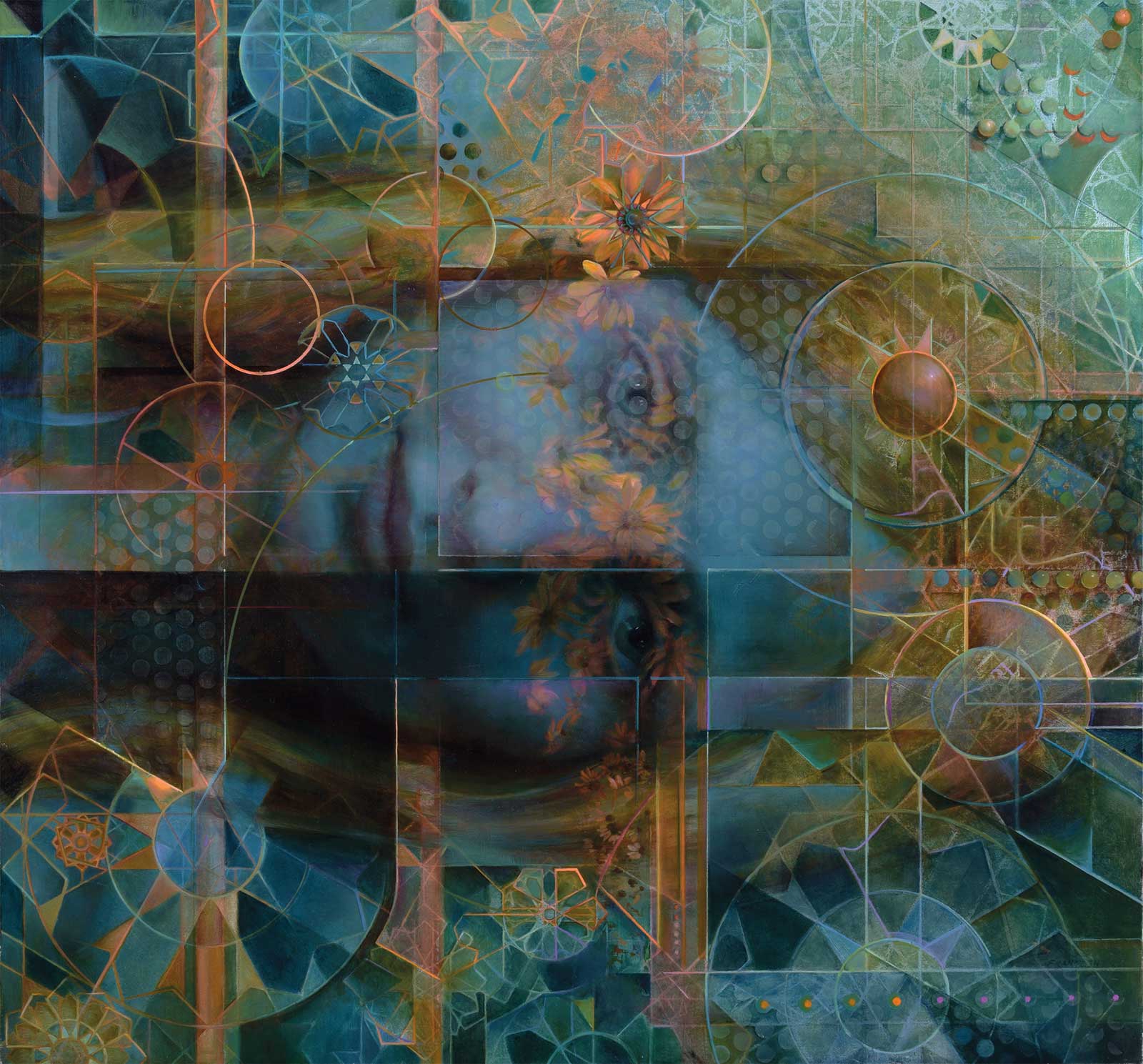
From and To, 2021, oil on linen, 30 x 32 in.
The ordered chaos is unmanageable, but unspeakably beautiful. It is the infinity and moment of inflating creation, the Pythagorean eruption of the rush of becoming from nothingness—always present, yet timeless and eternal. Frantzen explains, “that title comes from me sitting here in my studio designing that painting and telling Chuck that I just don’t feel worthy of this infinite beauty. I just can’t allow it to touch me. And I’m so bothered by the fact that I can’t just be touched by this incredible opportunity.”
The philosopher Plato imagined reality as a performance witnessed by an audience who could only see the shadows of actors on the wall of a cave. Alluding to Plato, the visionary William Blake wrote, “If the doors of perception were cleansed every thing would appear to man as it is, infinite. For man has closed himself up, till he sees all things thro’ narrow chinks of his cavern.” Quantum has revealed that reality is indeed stranger than we are capable of understanding, and much of the structure of the universe is beyond our witness. Imagination seems to be ascendant, in this world of uncertainty, and Blake’s doors are open to a crack, and through that tiny space the beauty that is beyond perception slips blithely into ordinary experience.
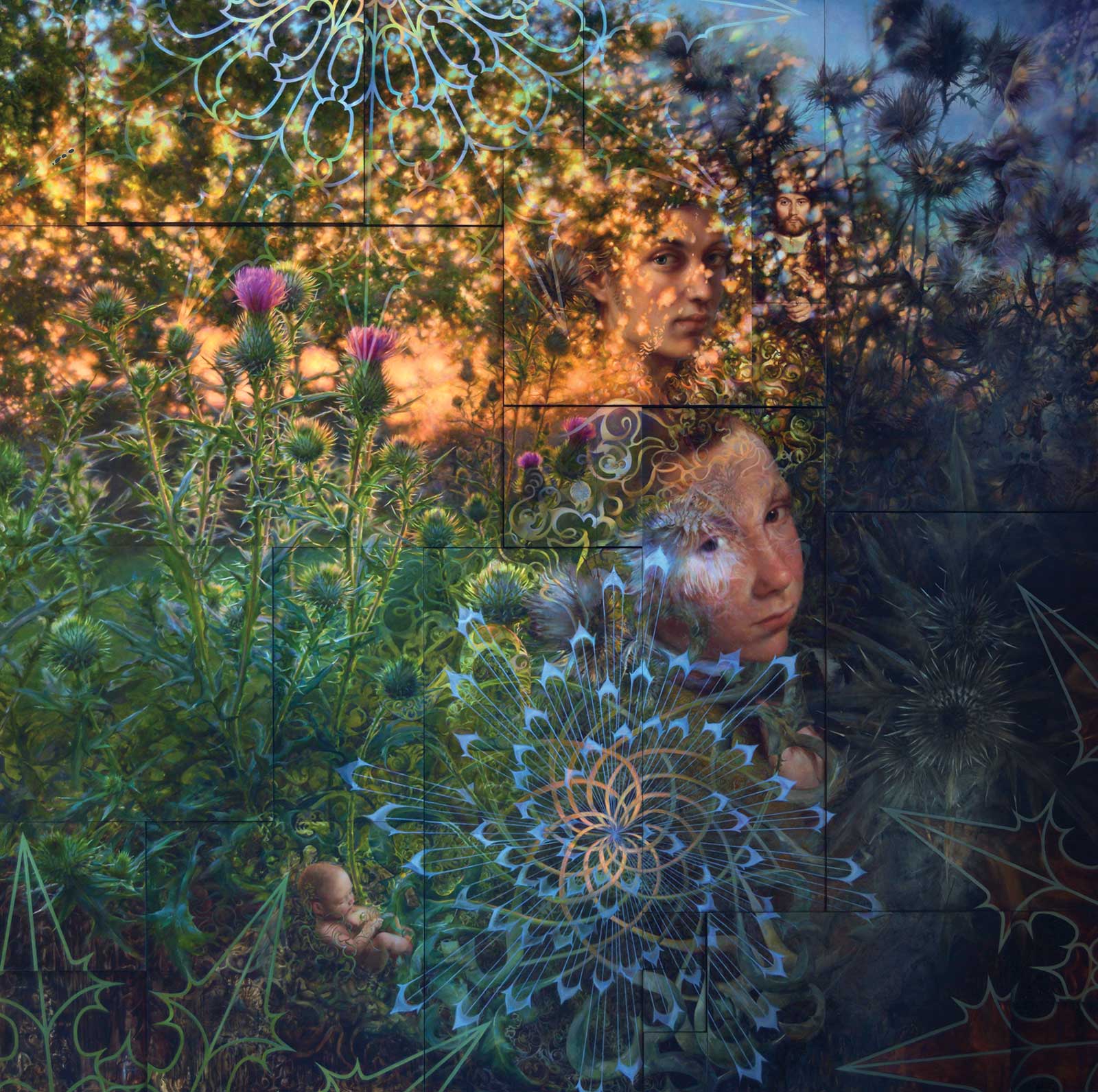
Life Has No Opposite, 2015, oil on 28 panels, 96 x 96 in. (overall). Private collection.
Here is Frantzen’s fantastic painting of a thistle flower, a glorious manifestation of golden light behind a gorgeous spread of abundant thistles in greens, pinks and purples, magically more filled with life in painted form that any plant that ever lived, glowing in a backlit nimbus of the royal sun’s setting light. Frantzen grew the thistles beside her home, nurturing their irresistible but prickly grace. But when an intrusive neighbor reported her thistles as a nuisance, incredibly, cops arrived at Frantzen’s door. She explained, “We have ordinances against noxious weeds in our town. So, the police gave me a summons and I had to remove them.” She explained she was painting the plants, and the officer told her she must finish her work. She was unimpressed. “Weeds, to my mind, are a matter of opinion,” she said.
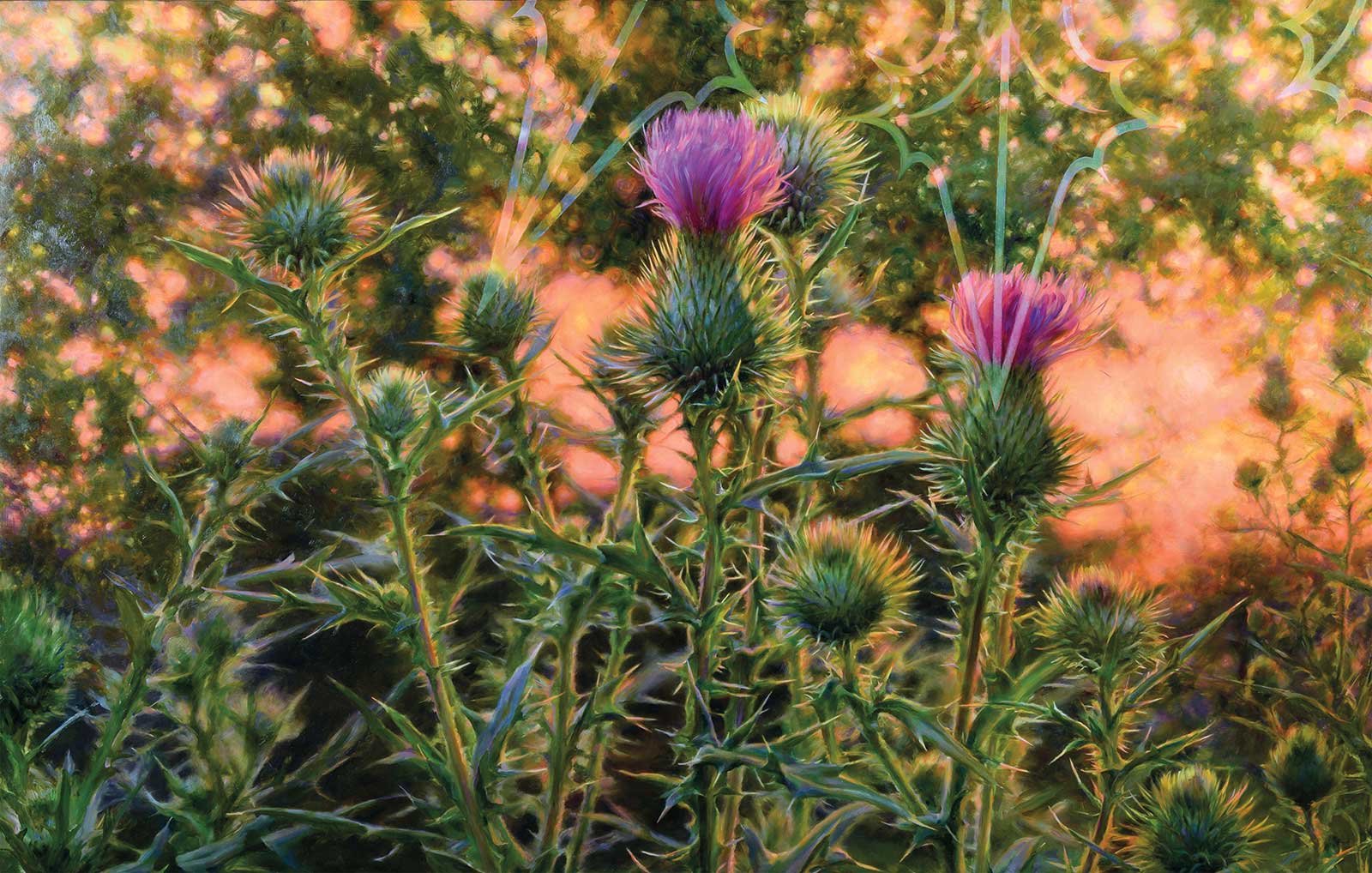
Life Has No Opposite (detail), 2015, oil on 28 panels, 96 x 96 in. (overall). Private collection.
Thus, this radiant painting is an exemplar of the nature of perception—though the mundane events and concerns of daily life are dull necessities, the still moments of perception when humans witness the beauty behind everything may be insights more real than ordinary reality. The threshold between the two is where artists visit, enjoy, and assess the space between reality and imagination. Frantzen looks through the crack in the world that lets in the light.
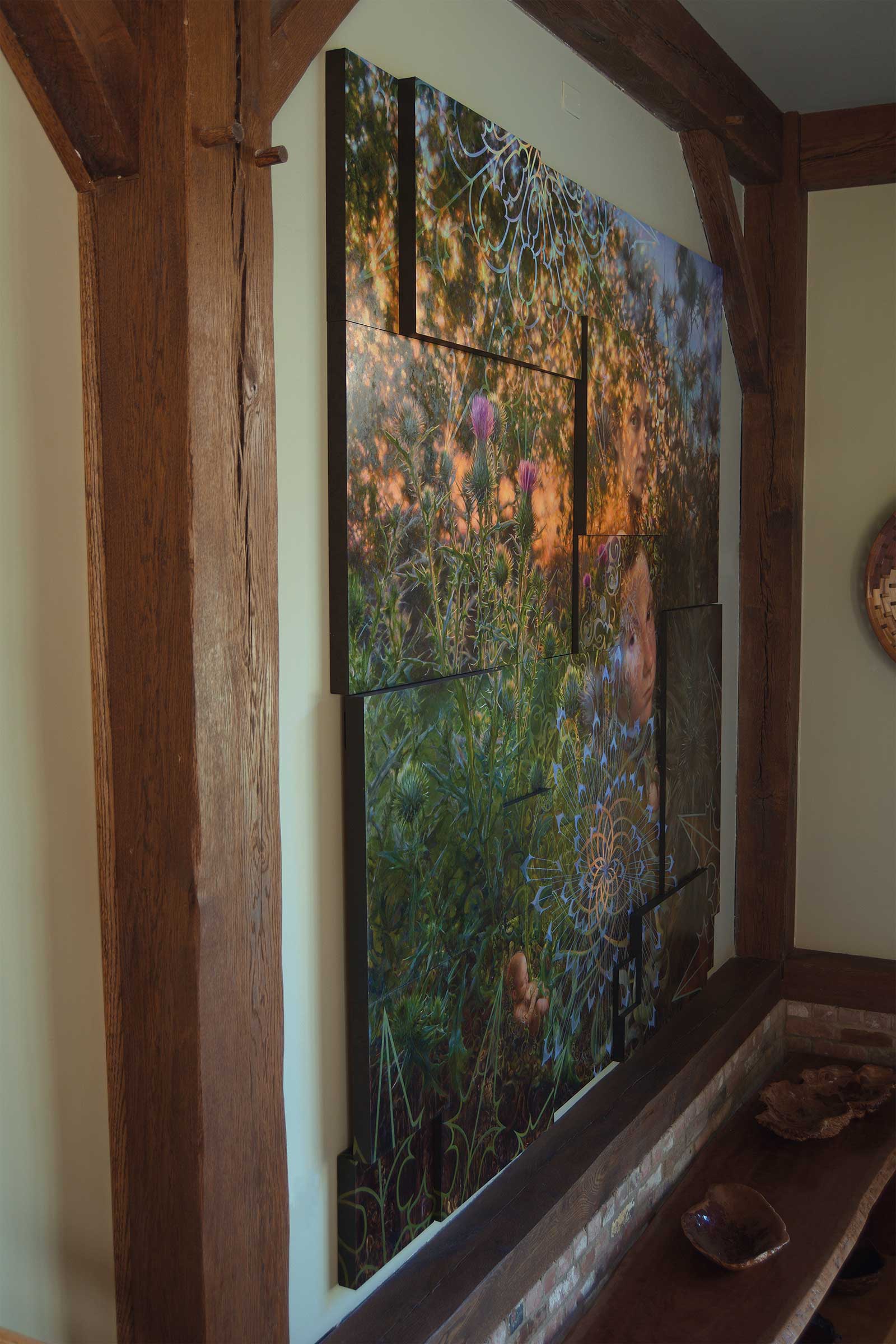
Installation view of Life Has No Opposite
Incredibly, the thistle flower painting is part of a composite image of even greater splendor combining 28 panels into one large picture titled Life Has No Opposite. Each individual piece blends effortlessly into the scenography of the larger composition. The golden backlight spreads across the top of the image, spilling over a translucent portrait of a youth, quoted from Raphael’s sensual Portrait of Bindo Altoviti, who emerges paradoxically from behind the light that is in turn behind the deep background. Altoviti is part of a sequence of the ages of man, beginning with a naked baby tucked into the shelter of the thistle bed; the boy from Gian Paolo Pace’s Alessandro Alberti with a Page; Hans Holbein the Younger’s portrait A Member of the von Wedigh Family; and in the top corner, a ghostly profile view of sculptor Lorenzo Bernini’s bust of Monsignor Francesco Barberini; each portrait a fragment of the whole. Delicate complexities of pattern in blue and gold radiate over the representational imagery, reminders of the Fibonacci series that is integral to thistle heads, and one of the orderly fingerprints of God upon creation.
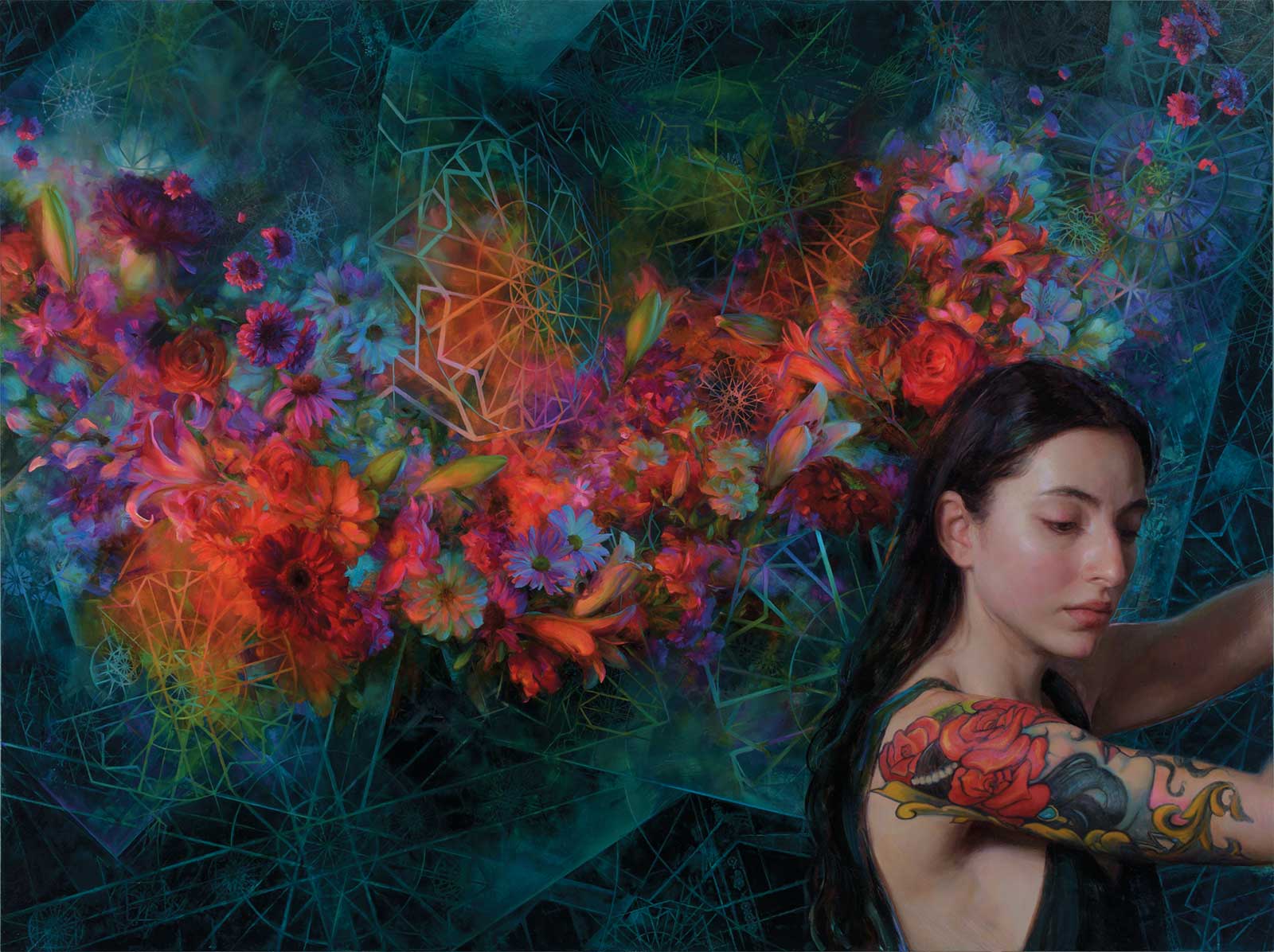
The Impossibility of Feeling Worthy of a Universe of Infinite Beauty, 2025, oil on panel, 36 x 48 in.
Seeking mindfulness, Frantzen meditates. “I’m interested in what attention is,” she says, “What is it to actually be here in the moment that I’m experiencing?” On the path of discovery, she traveled into breath, hoping to find balance, but she struggled with witnessing the commercialization of spirituality. She explains, “it’s almost as if you’re dancing on the grave of something…all of it’s kind of polluted. So, I’d rather try to paint it, and then let the people who it resonates with see it.”
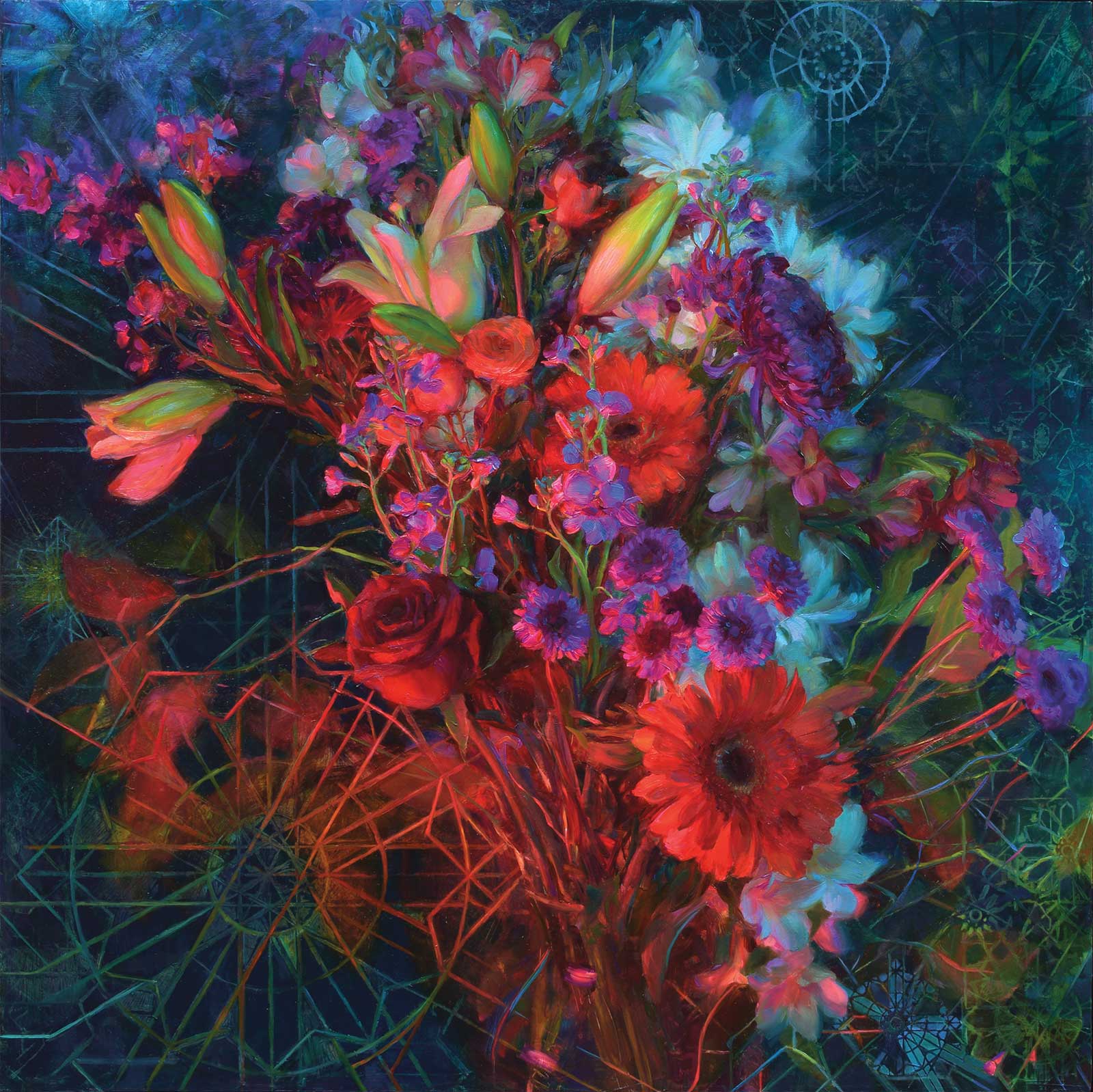
Spectral Burst, 2026, oil on panel, 24 x 24 in.
So, she planted canna lilies, which flourished in the rich earth around her Iowa home, and as the seasons passed the plants grew tall and rich, then, after their full glory finished, and they faded in the fall, Frantzen’s father dug black dirt to reveal the rhizomes, which had proliferated underground. Frantzen helped pull huge clumps of them in handfuls. She wondered at the abundance of that hidden life, grown concealed in darkness, and carried a bundle into her studio, suspending them for examination. She recalls, “I looked at those large plants all summer long, as I’m looking at this surface level of myself and judging it harshly. And I think, ‘What if there’s a part of me underground that knows how to be?’” The epiphany was profound, and she realized she had to paint it. So, she returned to earth, literally, with deep inward breaths of its dark air as she immersed herself in explorations of the rooted underworld in a series of triptychs she titled Dormancy.
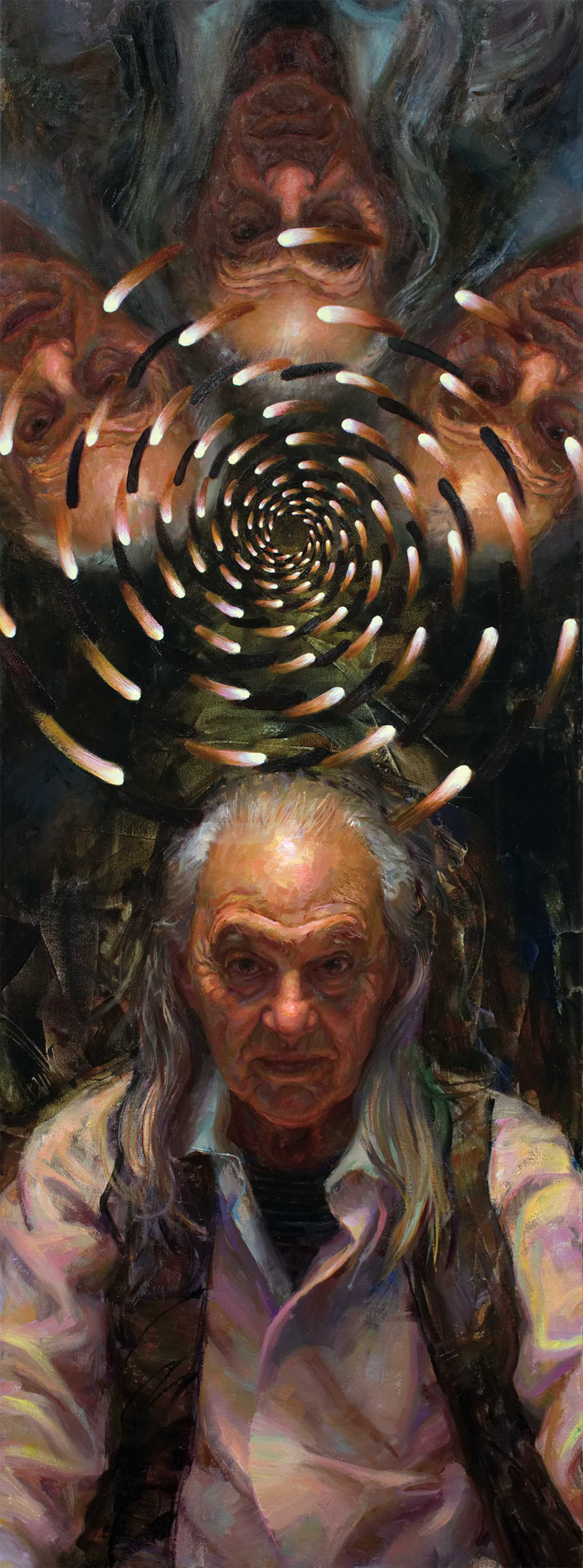
Circles Diminished by Spiraling Selves, 2017, oil on linen, 48 x 18 in. Collection of the artist.
Here are Breach, Lament and Yield, which together form a narrative of a young man in the underworld confronted by a web of roots, the binding threads of restriction. In Breach, he breaks a hole through the net; in Lament he is appalled by the sacrifice he has made, but in Yield his freed head breaks through the surface of the earth into light, resurrected, and liberated by his severance of the ties he had first regretted breaking. Now he breathes clean air. A new lily grows in his cupped hand. “Each one of these paintings moves towards some sort of redemption,” explains Frantzen. She realized she had arrived at equilibrium, at a balance between mindful living and simply being. “The question became, ‘What are the emotions that keep me from allowing this unseen world that knows how to do its duty, that knows how to grow…knows how to be, knows how to take its place, knows where to seek its nutrients, knows all that stuff?’ It makes this glorious pattern, right? If you look, there, the pattern of the underground is part of the metaphor.”
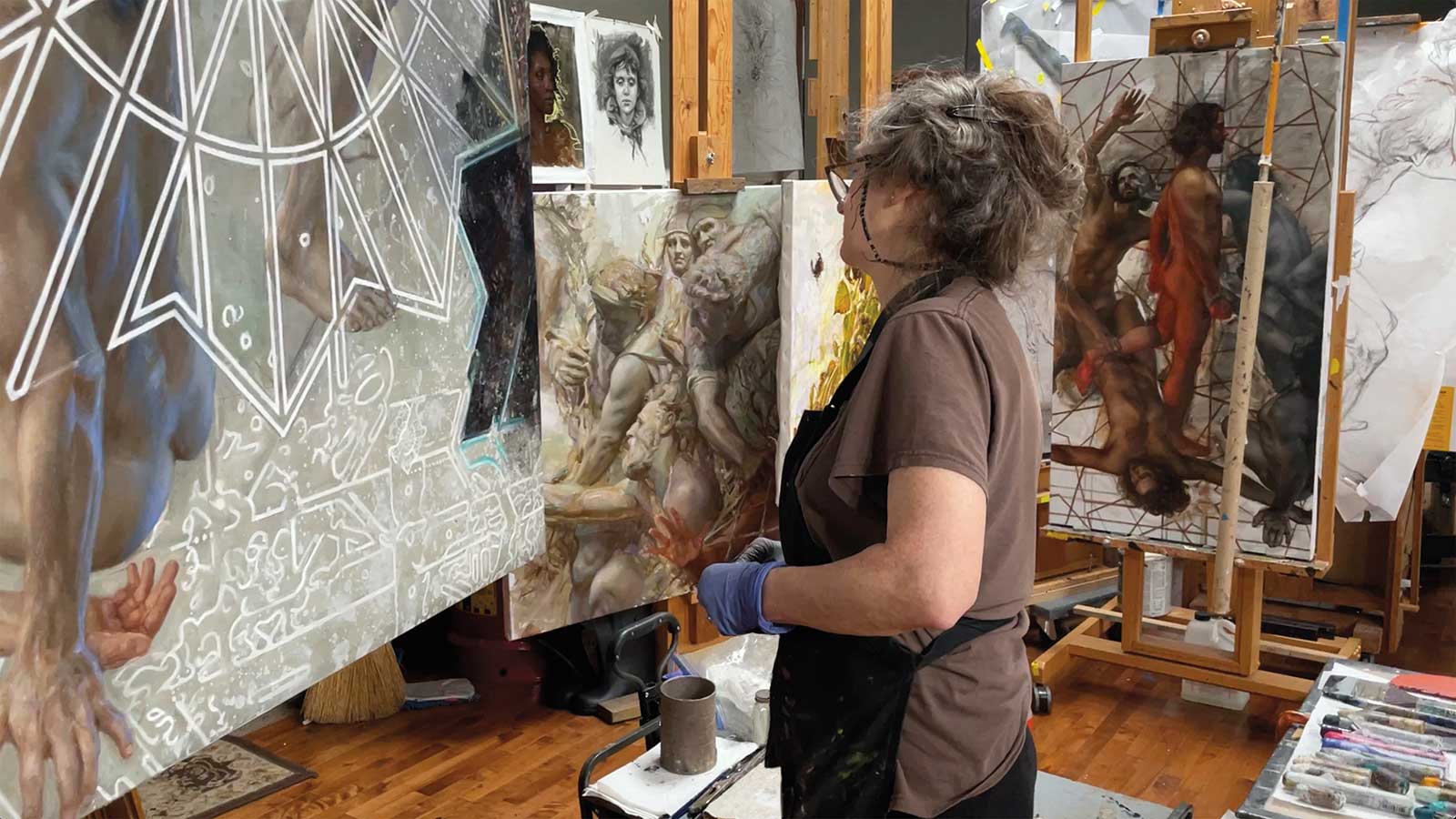
Rose Frantzen working on her unfinished painting, The Infinite Moment in October 2026.
We end, beloved, as engaged participants in the unending and heavenly spectacle, as witnesses to the power and glory that is hidden behind everything, as the spirit and breath of liberty released from the body into a new atmosphere above the earth. Rose Frantzen opens doors. —
Powered by Froala Editor