
There is a time, neither day, nor dark, when the familiar world tips into twilight and the friendly forms of homes and trees transform into ambivalent and untrustworthy shapes of shadow and inversion. In daylight, house windows are opaque, and interiors discrete. Now, as light retreats from night, these private interiors are revealed to outside eyes, alone in shrouded darkness. Artist Linden Frederick paints this threshold time, opening a passage through the fearful nocturnes and shadows of evening and man may glimpse distant lights in the darkness as either threats or as the pinpoints and promises of comfort. Frederick’s America is familiar but psychologically charged, his mindscapes scattered with homes lit from within through warm windows, the fragile glass a protective shield of fragile hope resisting the tidal swell of night. Frederick says twilight is “the hour when the dog becomes the wolf.”
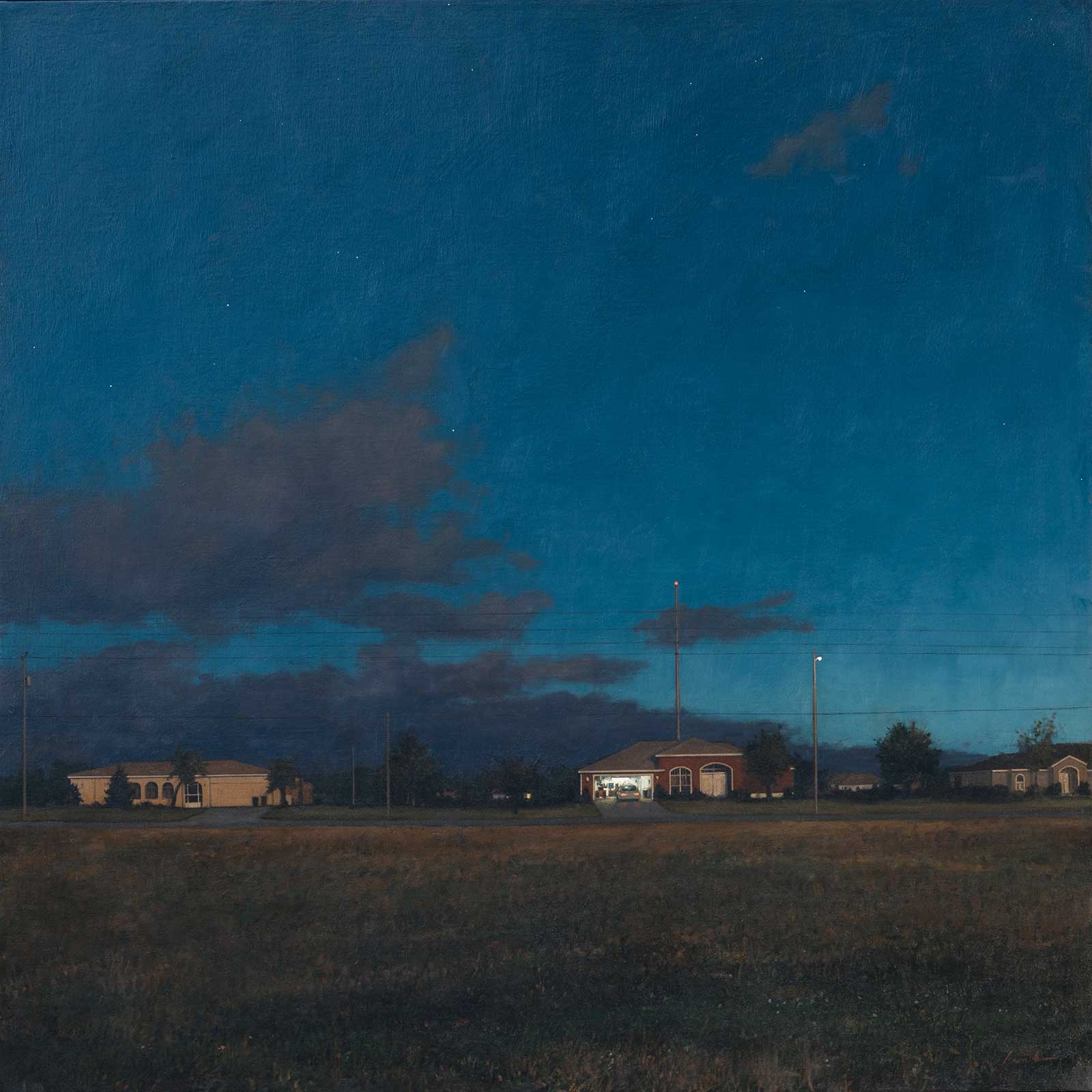
Vacant, 2016, oil on linen, 36 x 36 in.
He paints it with a chromatic clarity that recalls the great luminists while turning from their consolations. Thomas Cole found the god of divine right and Manifest Destiny in the Hudson Valley wilderness. Frederic Church mapped the primitive divine in the Andes. Caspar David Friedrich evoked the wild ways and comforts of the old religion in his Germanic twilight in the spirit of Northern Romanticism. Now, instead of seeking the sublime in spectacular landscapes and tempestuous weather, or in the pagan mood and mirror of ancient megaliths, Frederick mines it in the suburban parking lots of Maine, among the motels and marginal buildings of the American landscape, in the singularities and loneliness of lit windows. When we are alone in his darkness, an inviting light may signal safety, love and hope, but also emphasize the surrounding shadows.
Frederick’s paintings are set in the fading landscapes of post-industrial small-town America. These are scenes from the vernacular landscape, pictures of the fading mill-towns and blue-collar communities of the Northeast, left behind after industry vanished. Frederick’s friend, author Richard Russo, won a Pulitzer Prize for Empire Falls,a novel set in a decaying Maine mill town with an economy hollowed when the factories shuttered. Russo’s protagonist slings burgers at the Empire Grill, which becomes a microcosm of diminished expectations, of lives circumscribed by geography, money and family dysfunction. Frederick says Russo once told him, “Lindon, you paint what I write about.” The two didn’t know each other when they were young, but today they live 10 miles apart, and Frederick says “we paint the same idea… It’s about painting something you know about, people you know about.”
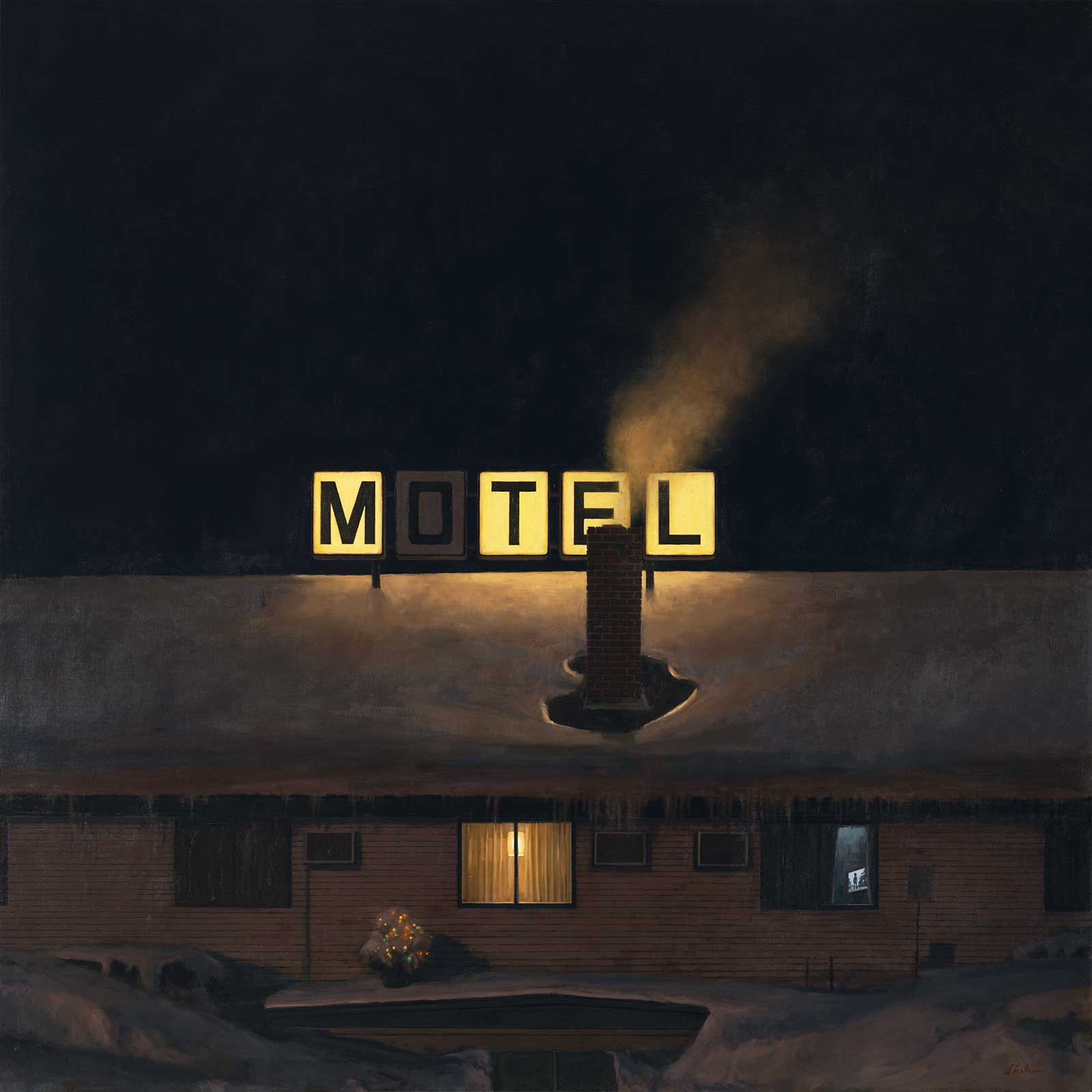
Traveling Salesmen, 2020, oil on linen, 55 x 55 in.
A cheaply boxed motel sign in bold capitals forms yellow rectangles of tired plastic against a blackened sky, partially obscured by a protruding brick chimney, smoke wafting into the empty darkness like traces of lost labor. The ‘O’ is out, telling a story of neglect. This is Frederick’s Traveling Salesmen, a masterpiece of fading Americana. Behind a half-closed curtain, we voyeurs peer inside a bedroom where a television plays out the high drama of a cowboy silhouetted in a duel on a dirt street at noon.
In Frederick’s Night Stand a solitary sandwich shop stands on the edge of a sad expanse of cracked asphalt. The empty ramp behind the building frames a moody sky above the horizon, where high clouds spill in a turbulent dance across a light and lycanthropic moon. The brighter bait of a vending machine leads the eye across the parking lot to the black window of a door, the vanishing point of yellow lines demarking parking spaces and whispering, “Follow me.”
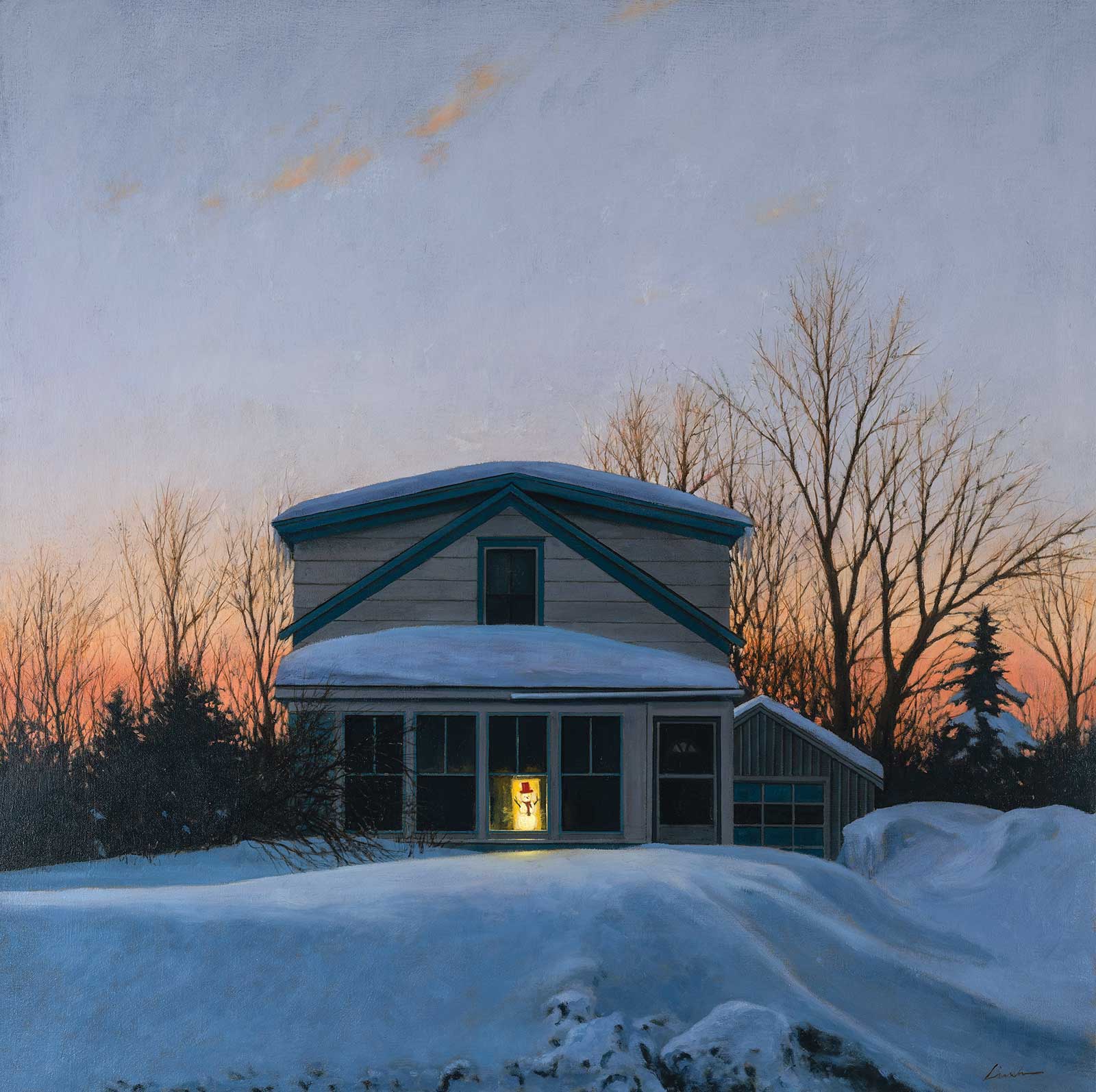
Weight of Winter, 2024, oil on linen, 30 x 30 in.
Reflecting on the origins of his oeuvre, Frederick recalls when he and his wife were renovating their house, making a home from emptied bedrooms and bare walls, cooking in a makeshift kitchen of plywood counters, and sleeping in the front room. They went for a drive, and he was the passenger, watching the lights of homes sliding past in the darkness. “I would look at somebody’s window as we drove by, and all the curtains were open, and it was so tidy, and I thought, ‘Wow, what must it be like to live in a house where everything is in the right place.’” It was a beginning for him, driving through the city at night, looking out through automobile glass. There are no people in his paintings. He explains why. “Because to put a person in a painting, it’s about the person. And it’s better [when it’s] about the place…I imply people by having a light on in the window, or a car. I often use a car with headlights as a surrogate person.”
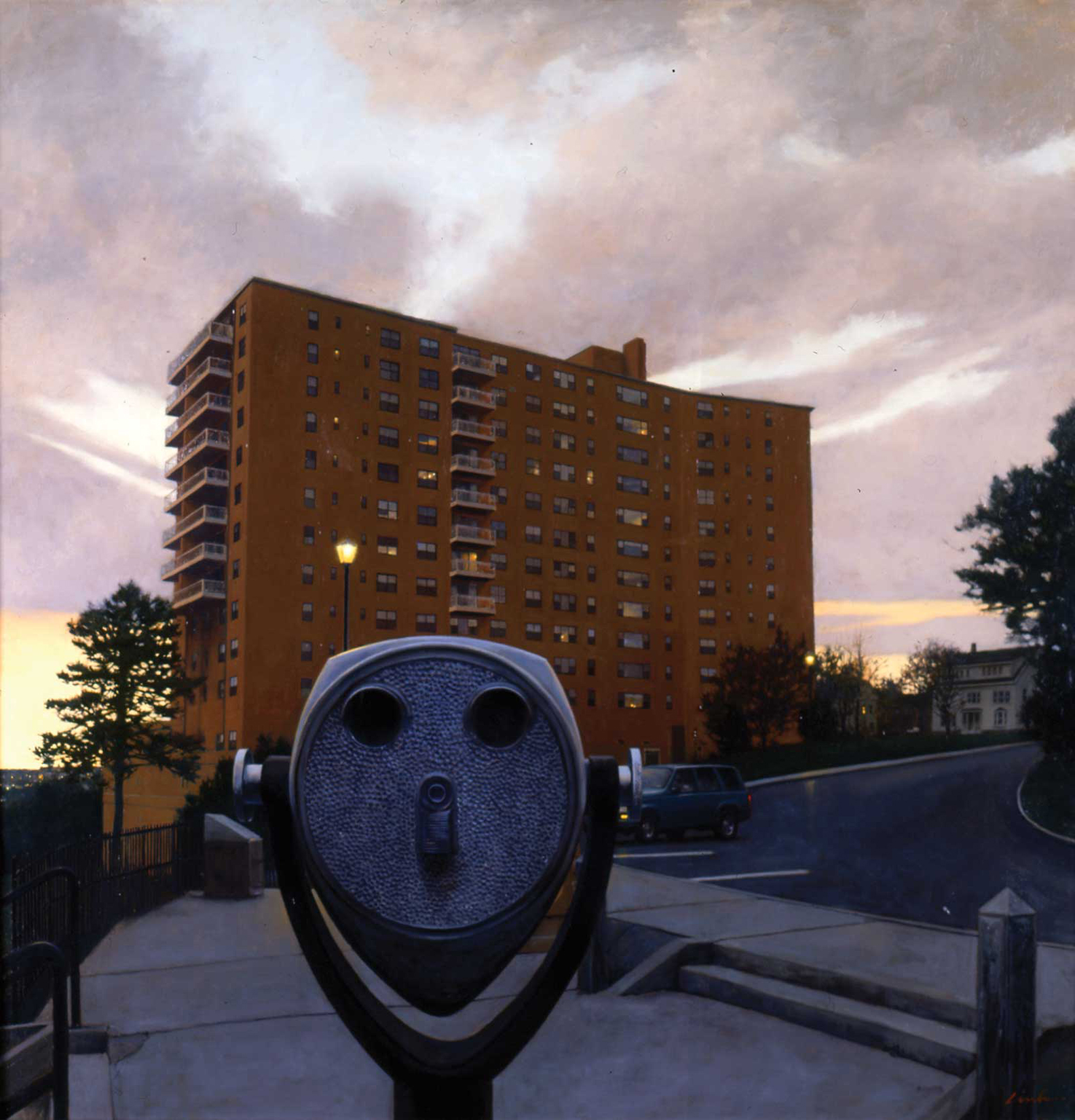
Sentinel, 2006, oil on linen mounted on panel, 45 x 45 in.
In Vacant, a homeowner pulls into the garage in a moment of coming home to refuge as the twilight grows, but we viewers are positioned far from the security and comfort of domestic harmony, seeing the scene from a distance spanning the disused land. In the wild darkness, silence is magnified, and if you look closely at the painting, and attend carefully with lupine senses, perhaps the hum of the rolling motor will echo distantly across the emptiness.
And here is Night Owl, where we would-be wolves may watch the light in a suburban home in dawn darkness, playing witness to the private and interior life of strangers. Listen! Here is the hush and sweep of a shooting star falling far and high from empty space over the gothic roof of the sleeping house. While we wait outside witnessing the silent miracle of the heavens’ cosmic theatre, inside, in silence, a person must be breathing the first breaths of morning, quietly moving into the day, conducting their bathroom rituals, unaware of the distant drama in the inscrutable sky. Their hushed neighbors as ominous as the sentinel towers of the tarot Moon. The hour when the dog becomes the wolf is always when the comforts of home reveal their fragility against the primordial dark.
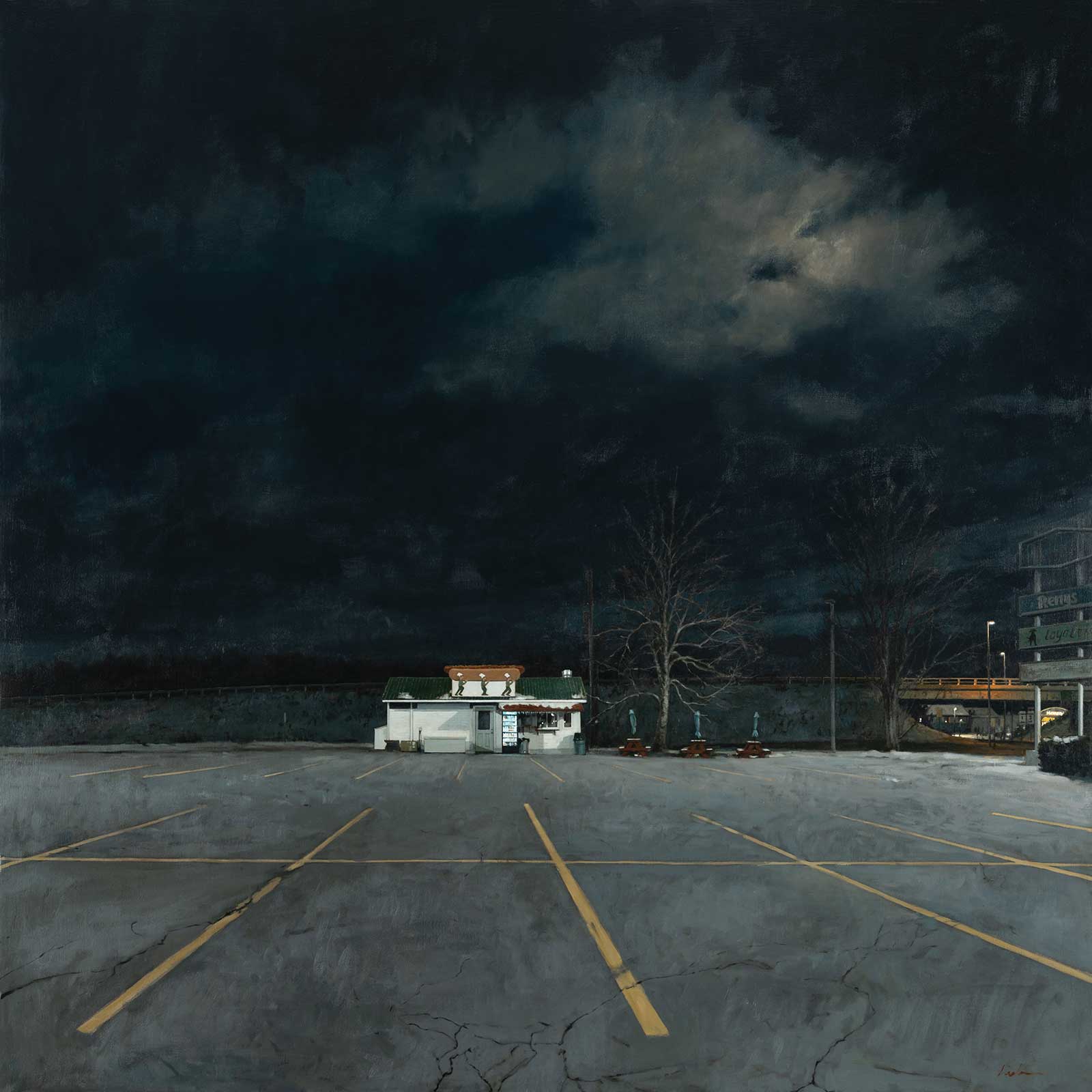
Night Stand, 2021, oil on linen, 55 x 55 in.
Twilight, Frederick says, has “always been something that just hits my buttons—there’s a certain feeling it gives me, and I like to get that in my painting.” Expatriate connoisseurs of subtle sentiment know that sensation as hiraeth, which is a wanderer’s longing to return to home, though that home can never be restored. Hiraeth is not easily described in words, but it can be painted. Frederick says his imagery chants “the mood of long twilights and slow dawns.” They are portraits of time as much as observations of place. Perhaps that is why they feel like scenes from thoughtfully composed movies, like establishing shots framed before narrative declares itself. Ingmar Bergman is no idle reference here. Frederick cites the director’s remark that no art form penetrates consciousness as directly as film, moving “straight to our emotions, deep into the twilight room of the soul,” and his paintings wear the costume of that cinematic quality. He says the twilight hour is when “people gather inside and light the fire. The day is over and the night is approaching. They feel safe.” Yet, his paintings always frame that inner comfort from outside. Watching night unfold, we are always at the end of the lawn, on the hungry margins of the lot, on the side of the frozen field, looking in at framed fragments of a lit room, caught in the hope and appetite of desire like waiting wolves longing for what lies inside. There is an invitation to half-seen horror in these dusky suburban scenes, as if we are waiting for the camera to pan to the shadows in the trees where the sharpened teeth of evil wait.
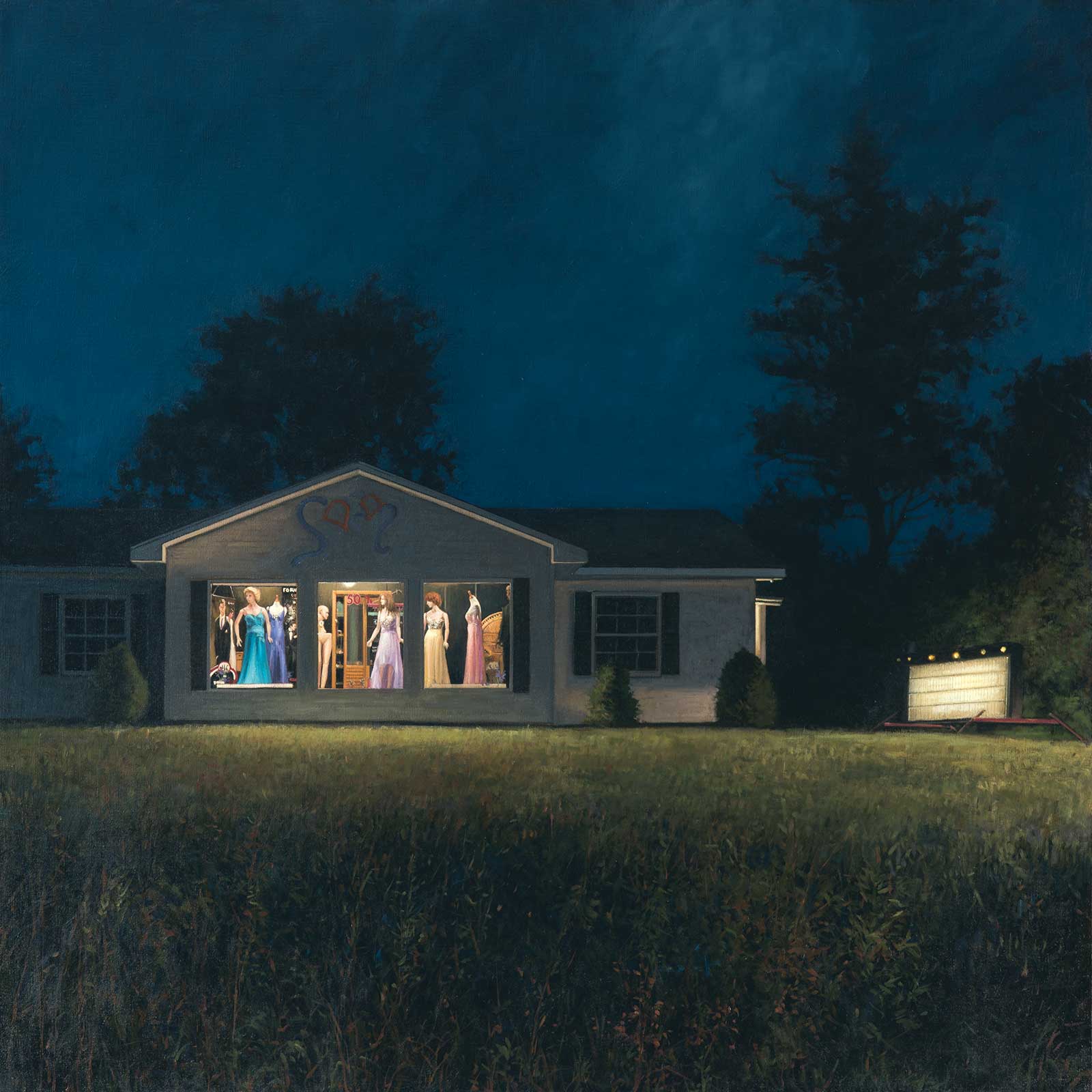
50 Percent, 2016, oil on linen, 36 x 36 in.
Frederick describes the divided response his work generates with characteristic directness. He says, “…there’s a kind of warmth of home, lights on, and windows, but there’s also a little bit of apprehension. I once had a show where one person said, ‘Oh, I’m so comforted by this painting.’ And then the next person said, ‘Oh, this makes me feel creepy.’ So, it’s what you bring to the picture.” He continues, “I think that’s kind of the whole point of the painting…part of it is kind of hard to describe. And that, for me, is a successful painting—when I get across visually what I’m thinking, even subconsciously.”
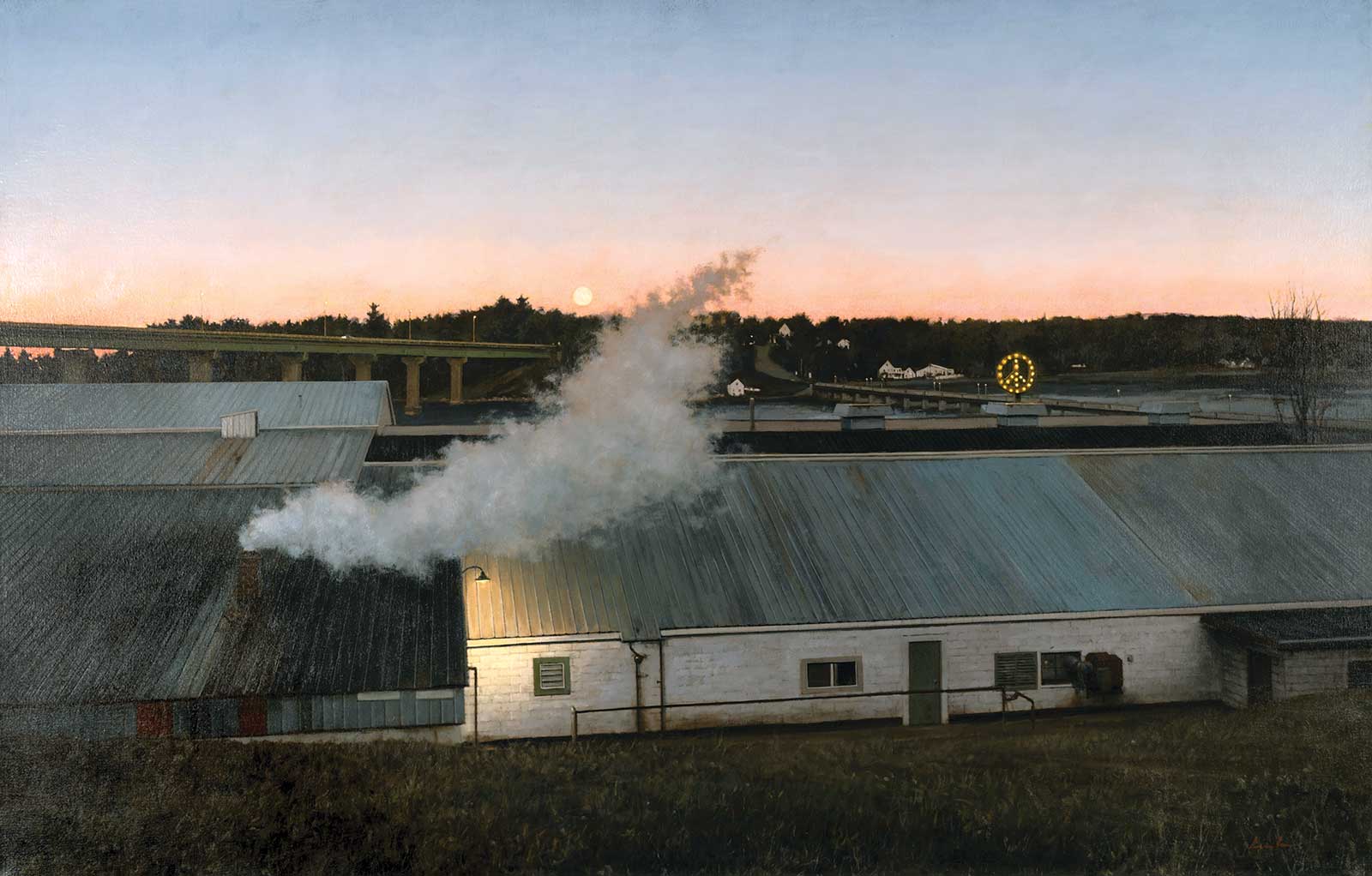
Peace, 2025, oil on linen, 27 x 42 in.
There are bleak omens here, where unfolding meanings must be parsed from the messages of what is seen. In The Weight of Winter the darkened house is sheathed in drifts of trackless snow and trees blown to bare branches by winter winds become silhouettes against a thin and distant sienna sunset. Although light glows in the center of the blackened windows, it radiates from a cheap plastic snowman, a simulacrum of the innocent joy of play set against the sinister darkness of the house behind it. The bright dress shop window in his 50 Percent is a scene from a suburban nightmare on the edge of delivering its horror, the uncanny female mannequins half alive in chromatic dresses, some dismembered. These discounted facsimiles of feminine glamor in a space edged by an ominous half seen and shadowed man cropped by the window’s false shutter.
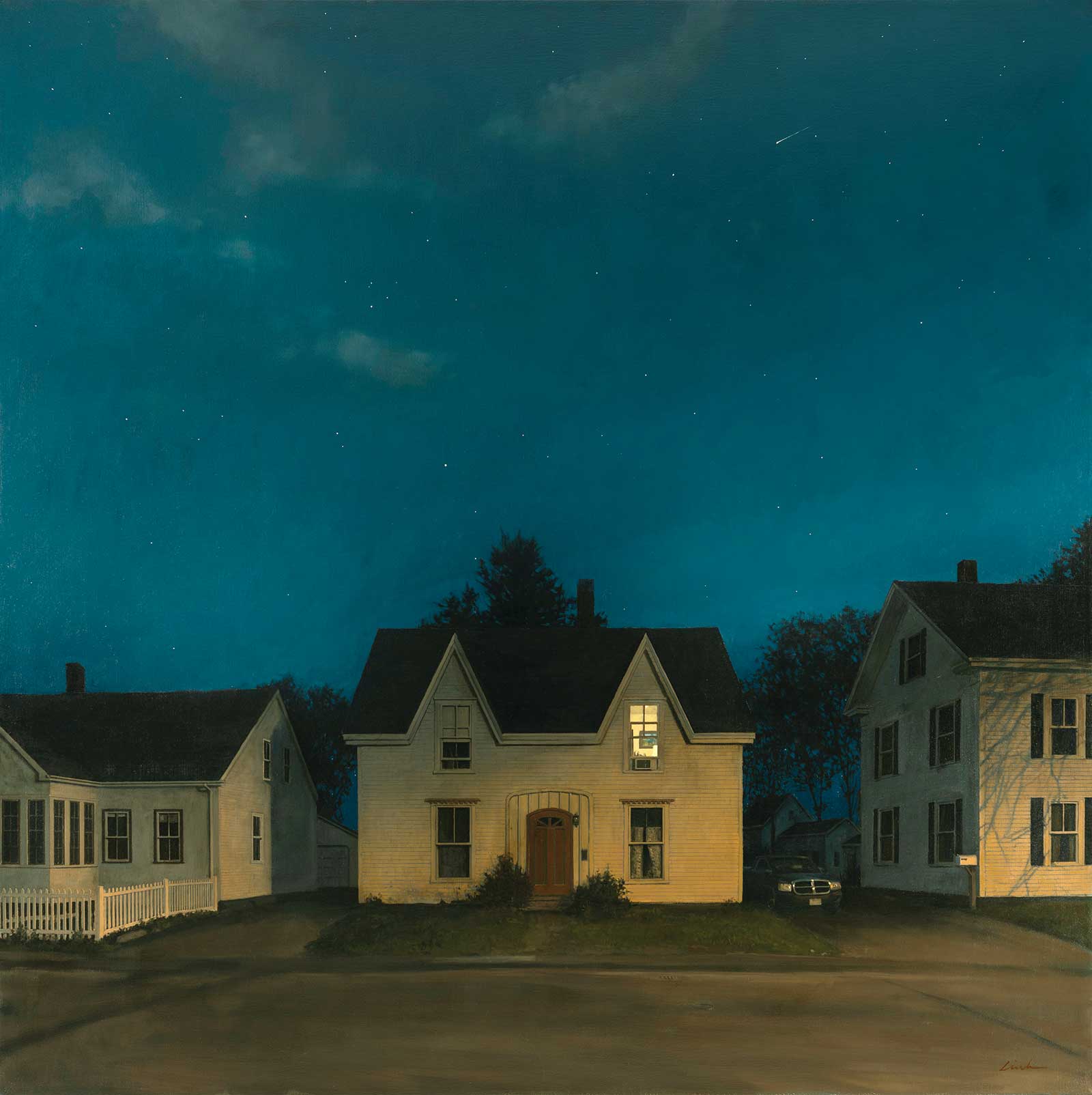
Night Owl, 2021, oil on linen, 55 x 55 in.
Frederick’s Traveling Salesmen feels like an opening shot from a classic thriller whose terrifying protagonist has not yet appeared, a tense homage to Alfred Hitchcock’s Bates Motel. The gothic house in Night Owl, with its singular lighted window and its falling star, feels like an image from the opening sequence of a paranormal tale told with ghostly shades. Frederick creates these narrative possibilities without resolving them, which is the source of their enduring psychological pressure. He understands, as the great compositional filmmakers understood, that anticipation is always more powerful than delivery. —
+++
All images courtesy Forum Gallery, New York, NY
Powered by Froala Editor