Creating art in miniature has its origins in classical antiquity. According to ancient records from Pliny the Elder, Iaia of Cyzicus, a celebrated Greek painter born in the Roman Empire was etching tiny portraits onto ivory in Rome during the 1st century BCE.
A Roman gold glass portrait by an unknown maker, engraved on a sheet of gold leaf pressed between glass, that dates back to 250 AD is housed in the Vatican Museums.
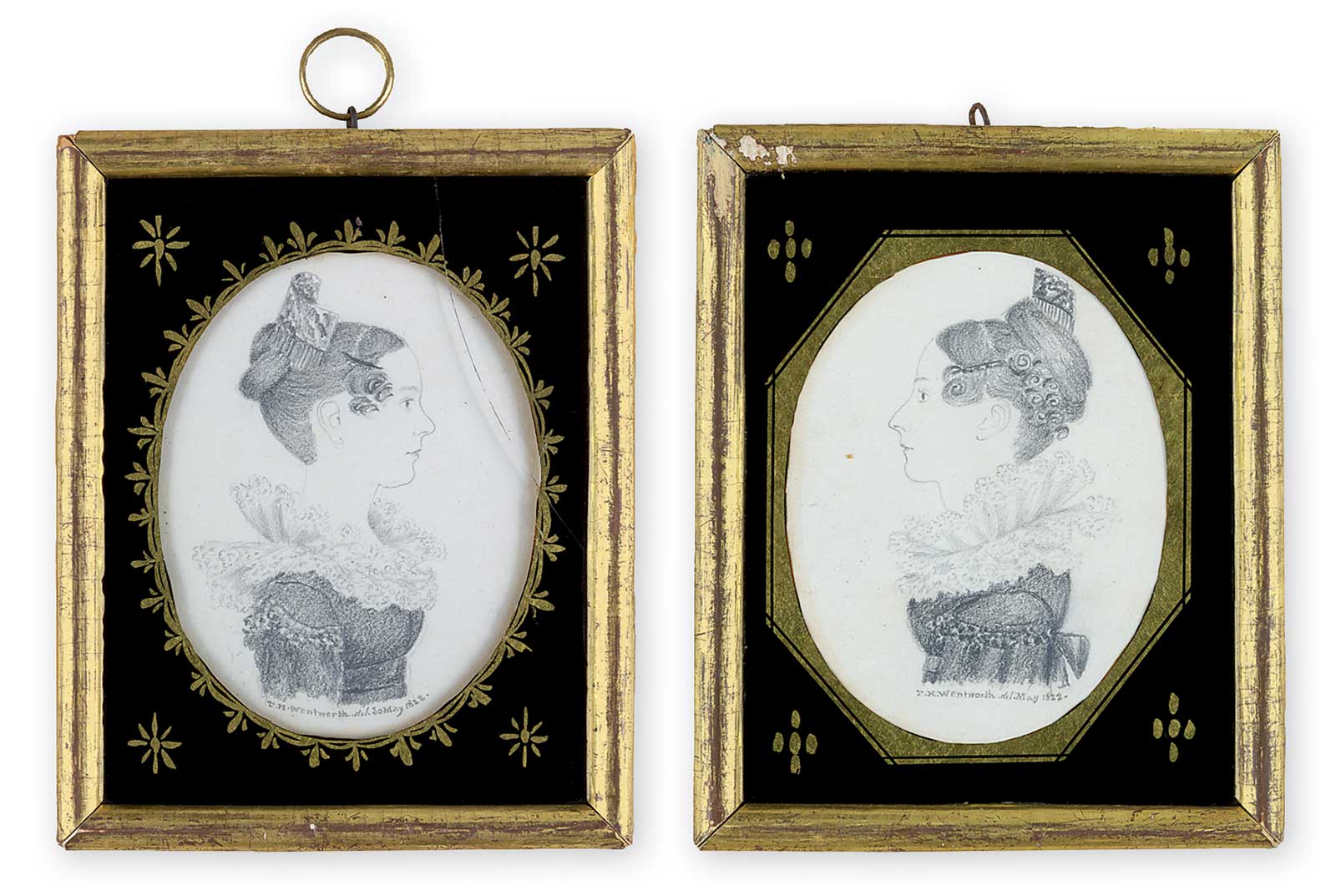 Thomas Hanford Wentworth (1781-1849), Lucretia and Mary Deming, 1822, pencil on paper, 4¾ x 3¾ in. each, signed on front and dated. Collection of the Litchfield Historical Society, Litchfield, Conn.
Throughout the centuries that followed, miniatures remained closely tied to manuscript illustration until the 1520s, when Hans Holbein left Germany and moved to England to become the court painter of King Henry the VIII. Charged with painting diminutive portraits of the king and his wives, Holbein established himself as the first master of miniature painting.
Before photography, miniature portraiture grew out of a desire to carry a likeness of a loved one on one’s person, and when the tradition was brought to America by European settlers, the art form flourished in the newly-formed Colonies. Many of country’s earliest foremost artists, including John Singleton Copley, Charles Willson Peale, Thomas Sully, Samuel F. B. Morse and Emanuel Leutze, were also practicing miniaturists.
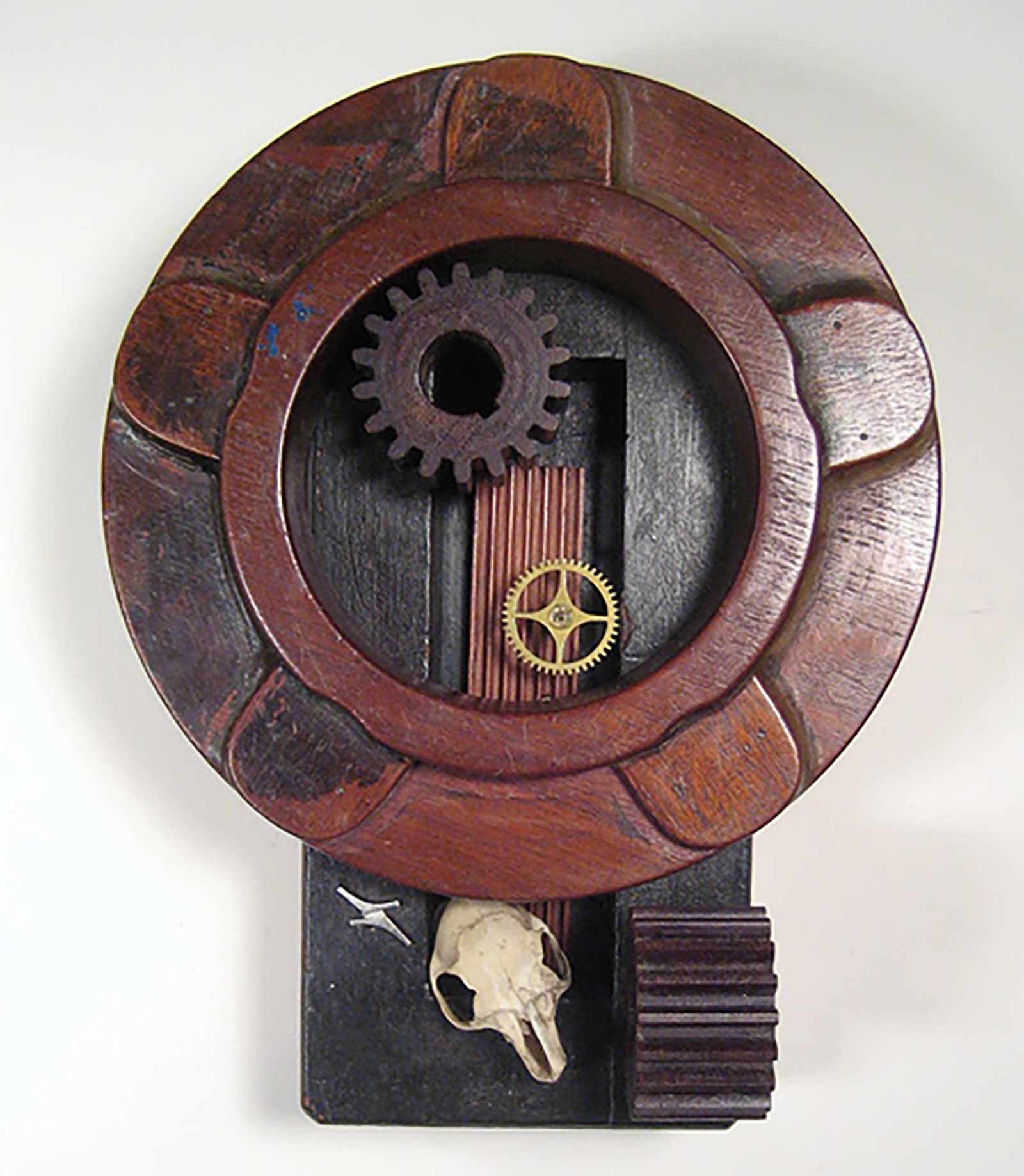
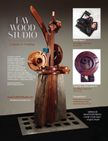
Fay Wood, Time Piece - Abras Mach RF1, found objects, metal, wood and bone, 10 x 8 x 4 in.
“Copley, the 18th century’s leading American portraitist, began painting miniatures around 1758, in addition to his full-scale work,” writes Peter J. Baldaia, former chief curator at the Huntsville Museum of Art, in an essay written in connection to an exhibition at the museum. “His linear and direct style, which utilized strong side lighting and clear modeling, became the prototype for colonial American portraiture,”
When Copley left for London in 1774, Charles Willson Peale replaced him as the leading American portraitist. “Peale showed an early penchant for miniature painting while studying in London with Benjamin West, and supported himself as a miniaturist while in England,” continues Badaia. “Returning home in 1769, Peale continued to paint miniature portraits…Peale trained his brother, James Peale, to paint the tiny portraits. The younger Peale possessed a superb talent, and soon surpassed Charles as one of the country’s finest miniaturists. He assumed the miniature portion of Charles’ business in 1786; and James’ outstanding execution kept him in constant demand.”
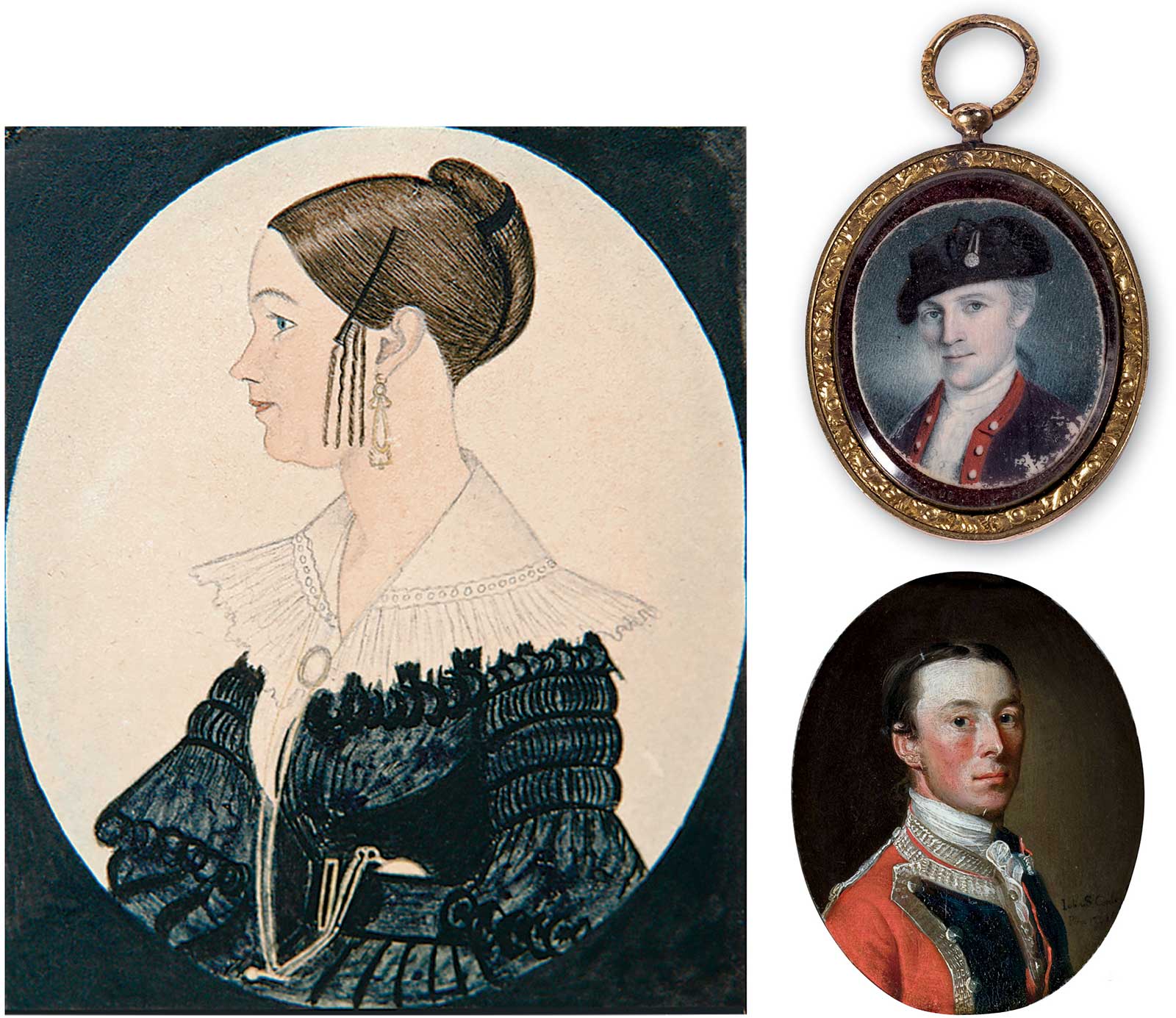
Clockwise from left: Atrributed to Justus DaLee (1793–1878) or Da Lee family, Unknown Woman, ca. 1840, watercolor, ink and pencil, with gum arabic highlights on Bristol board, 3 x 2 ½ in. Photograph courtesy of Peggy McClard Antiques, Houston, TX. • Portrait miniature of a Revolutionary War soldier, ca. 1778 by Charles Willson Peale. Image courtesy of Doyle Auctioneers and Appraisers. • John Singleton Copley (1738-1815), Portrait of an American Military Officer (Captain William Hall), 1761. Oil on copper, copper: 3 ¼ x 2 ½ in; framed: 4¼ x 33/8 in., signed and dated lower right: ‘John S. Copley / pinx 1761.’ Courtesy Sotheby’s.
Concurrently, slightly larger portraits measuring roughly between 3 and 5 inches and not meant to be worn or carried, were appearing in the northeastern United States from approximately 1820 to 1850. Produced in both rural towns and major cities and depicting ordinary Americans, they were an important step toward the democratization of early American art.
Miniatures retained widespread popularity until the 1839 invention of the daguerreotype and, with it, the advent of photographic portraiture. “Miniaturists could not compete with the new technology’s increasing popularity, and consequently, many abandoned their art,” relates Badaia. “The advent of negative-based photography in the late 1850s enabled portrait photographers to easily reproduce multiple prints. Photographs were consequently so cheap and ubiquitous, that miniatures came to be looked upon as undesirably outdated.”
While teeny-tiny portraiture may have fallen out of favor, the art of painting and sculpting on a small-scale is very much alive and well in the contemporary art world, with an expanded sense of size, subject and significance.
In the remainder of this special section, we highlight painters and sculptors who create small-scale works of art, often in addition to full-sized works, and the galleries that represent them. Continue reading to learn about the challenges and joys of creating small works and miniatures, and why they are the perfect addition to every collection.
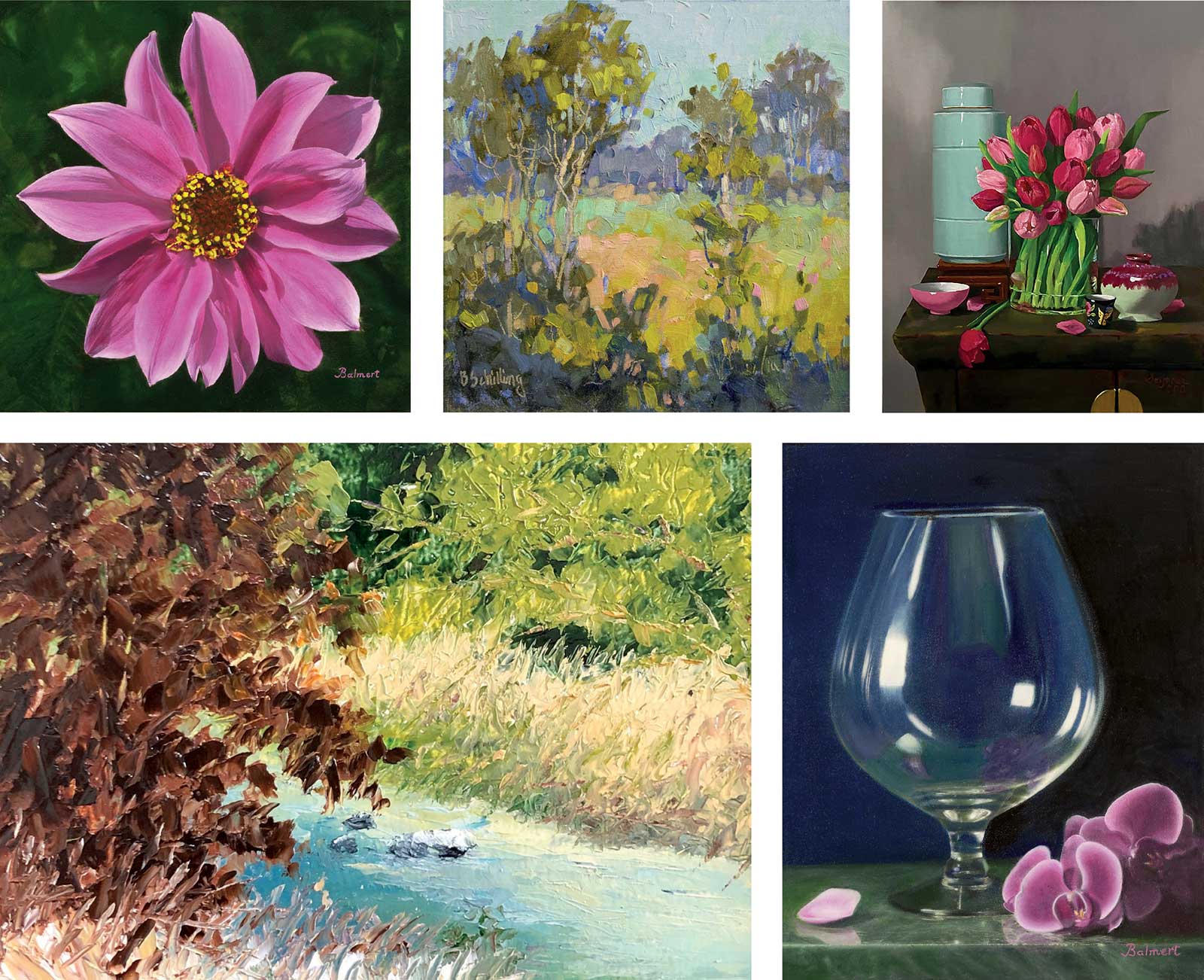
Top: Nancy J. Balmert, Fascination, oil, 14 x 14 in. Barbara Schilling, Cluster of Beech Trees, oil, 12 x 12 in. Claudia Seymour, Twenty-Two Tulips, oil on linen on ACM panel, 14 x 11 in. Bottom: Idaho Art Gallery, Forest Creek, oil on panel, 9 x 12 in., by Bill Garibyan. Nancy J. Balmert, Crystal and Classic Purple, oil, 14 x 11 in.
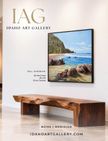
Bill Garibyan’s plein air work is a direct response to the Idaho landscape. “He paints outdoors, in the landscape itself, using oil and a palette knife to work quickly and capture the light, color and atmosphere as they change,” explains Idaho Art Gallery owner and curator Nelli Garibyan. “For collectors, I think that is one of the great appeals of plein air painting. You can look at a painting and know that the artist was physically there, working from that exact view and responding to that particular day.” When considering a plein air piece, Nelli encourages collectors to look closely at the handling of the paint. “The palette knife marks, layers and shifts in color are part of what makes each painting unique,” she says. “Those details are where you really begin to see the artist’s hand.”
Claudia Seymour’s goal as a traditional realist painter is to depict, through the beauty of color, scenes in which the effects of light enhance objects and patterns of intrinsic beauty and timeless appeal. “My paintings are a personal expression of a lifelong fascination with the visual effects of color as revealed by the play of light across a still life tableau or floral arrangement,” explains Seymour. “I attempt to portray the light-filled interaction between objects, their highlights and shadows, and the surroundings in which they are set. Using every day, and rare or antique objects and textiles, as well as flowers and other natural articles, my hope is always to create a lasting impression of serenity.”
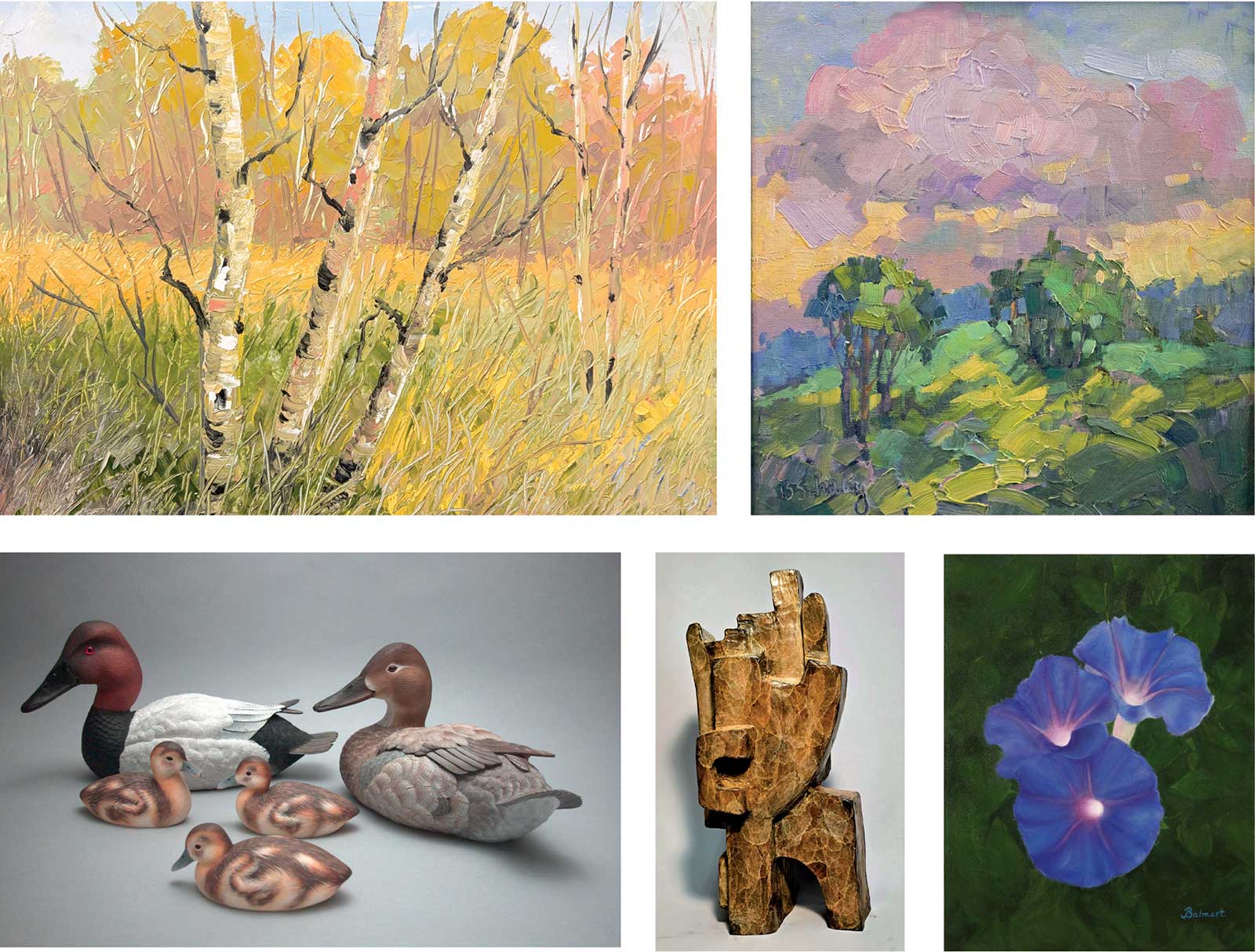
Top: Idaho Art Gallery, Spring Time, oil on panel, 11 x 14 in., by Bill Garibyan. Barbara Schilling, Patterns in the Sky, oil, 12 x 12 in. Bottom: The Waterfowl Festival, Canvasback Family, by waterfowl sculptor William G. Sutter. Larry R. Rankin, Mojave, bronze, 12½ x 5½ x 4½ in. Nancy J. Balmert, Morning Glory, oil, 14 x 11 in.
Among the many things Nancy J. Balmert finds fascinating about painting is the unlimited supply of subjects that are just waiting to be painted. One staple subject of Balmert’s is florals. “I’ve always loved dahlias, something we can’t grow in our yard in Texas,” says Balmert. “But we also have a nice place in Seattle, and when we’re there in the summer, there are dahlias growing everywhere. Their colors, shapes and sizes are incredibly varied, making them a striking subject for a painting, such as Fascination.
Orchids, on the other hand, are abundant around her Houston home and make an appearance in works like Crystal and Classic Purple.“They have such a stately appearance, and when painting, they pair so well with glass objects to create a very classical look to the work,” says Balmert. “While many of my flower paintings are larger than life, small works present their own unique challenge: capturing the important details that bring the subject to life in a small space.”
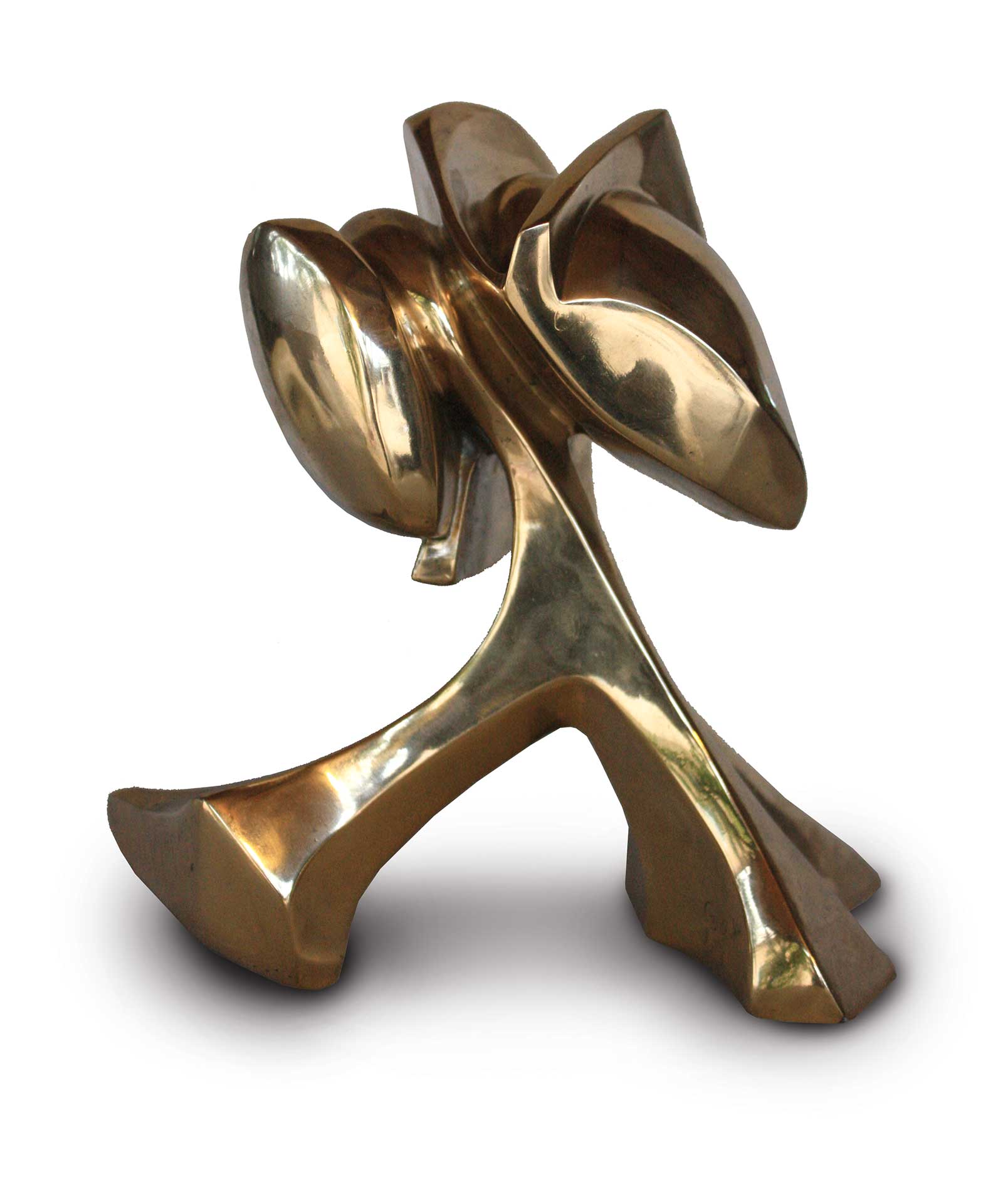
Larry R. Rankin, Golden Moon, bronze, 9 ¼ x 9 ½ x 6 in.
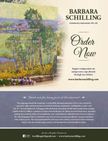
Artist Barbara Schilling has always loved the intimacy and immediacy of working small. “A small painting asks me to make decisions quickly—to simplify, trust the brushstroke and say more with less,” says Schilling. “I’m interested in finding the essential shapes, colors and rhythms that communicate what first drew me to a subject.”
Schilling has found that working on a smaller scale encourages a greater freedom in her handling of paint. “A single brushstroke can describe a tree, a patch of sunlight or the movement of a cloud, and I often allow those marks to remain visible rather than refining away their energy. Although these paintings are small in dimension, I don’t approach them as studies or lesser works. I want each one to feel complete and to carry the same sense of atmosphere, movement and emotional presence that I seek in a much larger painting. For me, the challenge—and the pleasure—of a small work is discovering just how much can be expressed within a limited space.”
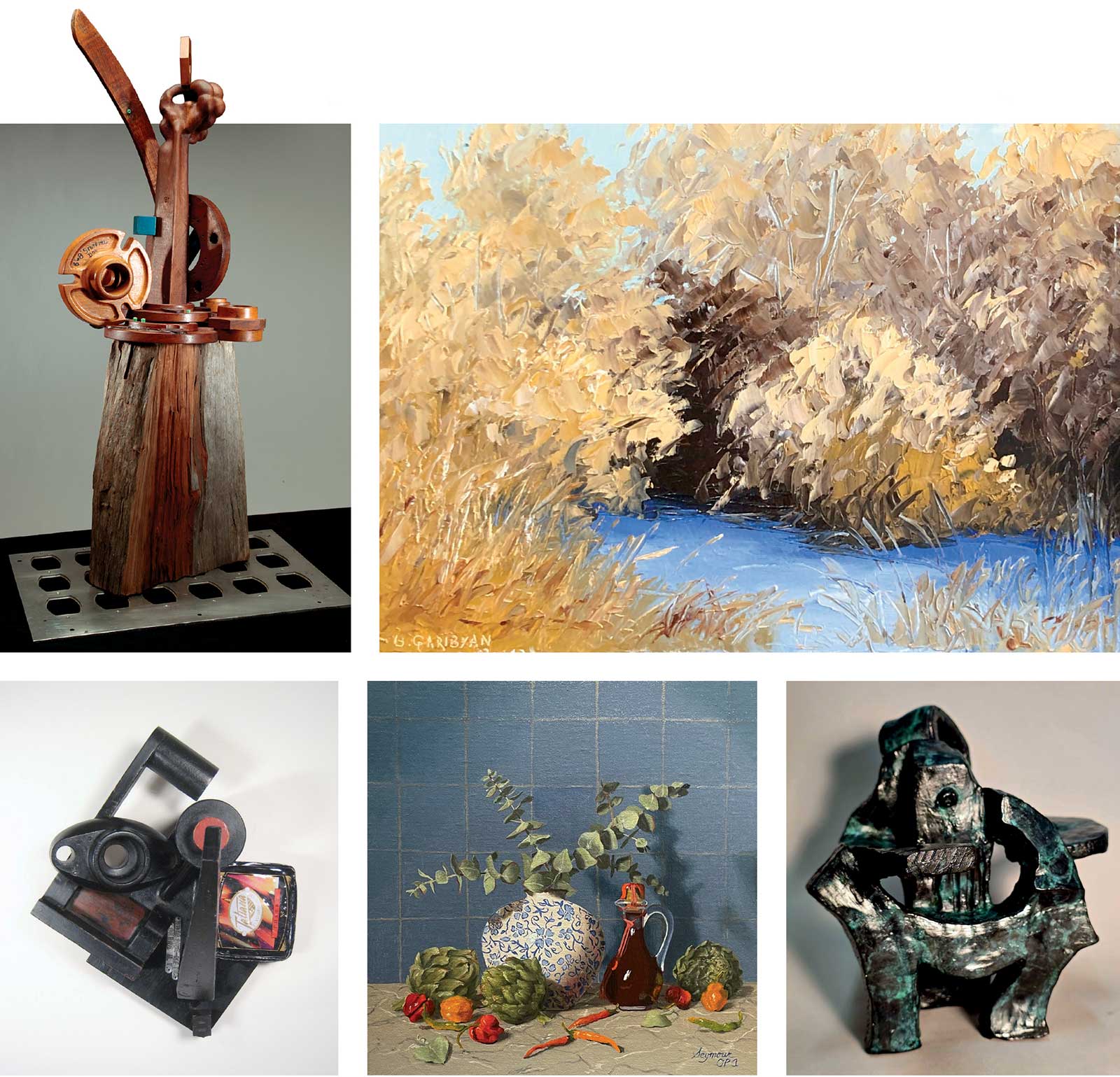
Top: Fay Wood, Overachiever, found wood, carved walnut, cherry wood and found metal, 35½ x 19 x 15 in. Idaho Art Gallery, Rushing Water, oil on panel, 9 x 12 in., by Bill Garibyan. Bottom: Fay Wood, Black Mask 8”, found objects, metal and wood, 14 x 12 x 12 in. Claudia Seymour, Three Artichokes, oil on linen on panel, 12 x 12 in. Larry R. Rankin, Entheos, bronze, 7 x 7 x 5 in.
Among the extensive art offerings at The Waterfowl Festival, taking place this November in Easton, Maryland, is the Cocktail Decoy Auction, a long-standing celebration of contemporary decoy art. For decades, the auction has brought together exceptional works by some of the country’s most respected carvers, offering collectors the opportunity to acquire highly sought-after, one-of-a-kind decoys created specifically for the event. Past carvers include Randy Conner, Chris Wilson, Dick Snyder, Al Jordan and others. More than functional representations of waterfowl, these decoys are miniature works of sculpture—valued for their craftsmanship, artistry, rarity, provenance and the distinctive style of their makers. The auction begins on Thursday, November 12 and concludes on Sunday, November 15 at noon.
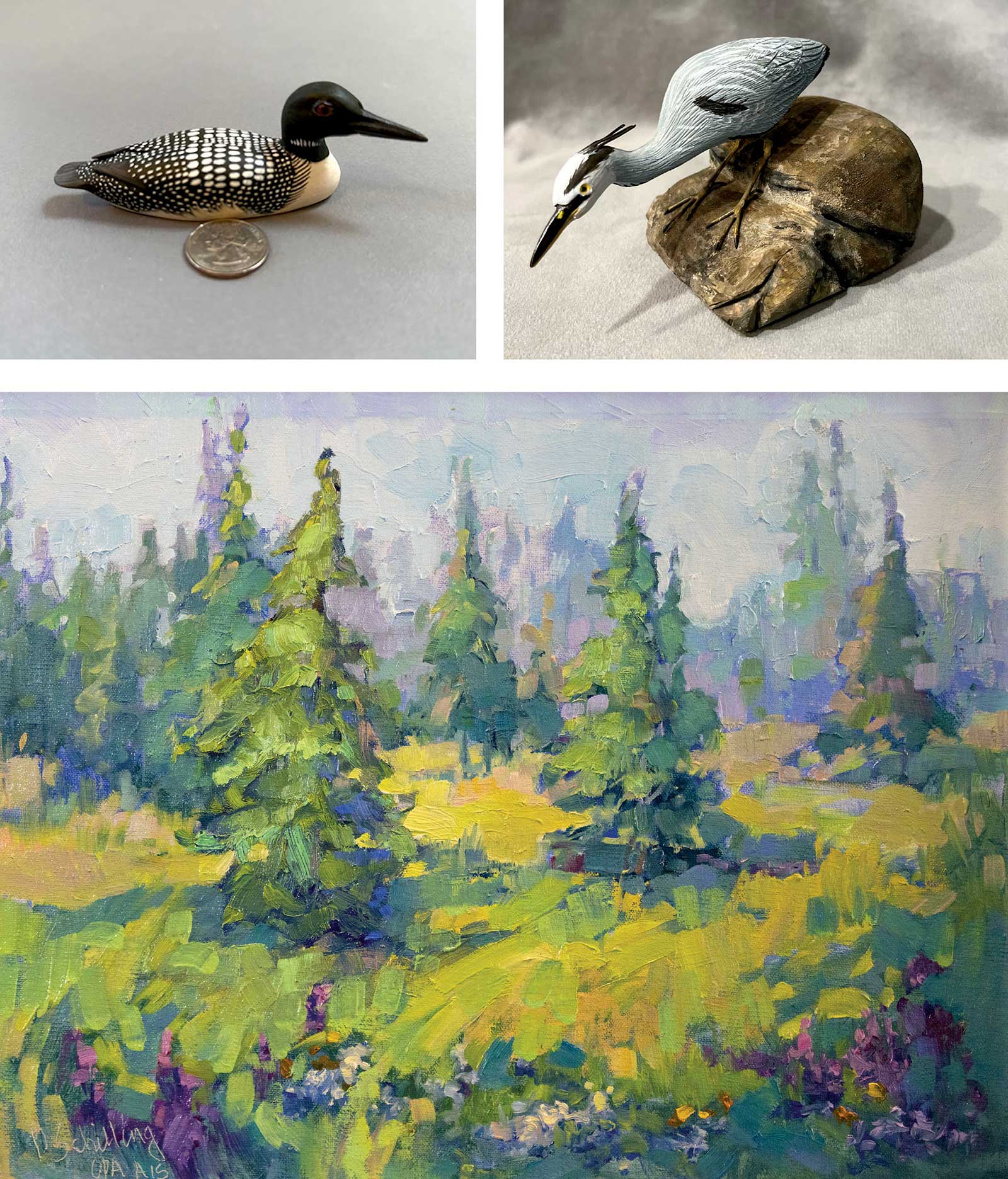
Top: The Waterfowl Festival, Common Loon by Tom Ahern. The Waterfowl Festival, Miniature Great Blue Heron by Richard (Dick) Snyder. Bottom: Barbara Schilling, Pine Grove, oil, 11 x 14 in.
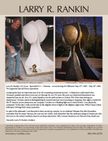
Larry Rankin’s artistic journey is deeply intertwined with his personal history, including his service in the U.S. Army during the Vietnam War. These experiences profoundly influence his work, serving as both a catalyst and a canvas for emotional expression. His sculptures made from stone, wood and bronze, are a therapeutic outlet through which he navigates the complex tapestry of his post-war experiences. The intrinsic motivation and self-expression that drive his art are evident in every piece he creates, offering both artist and viewer a pathway to understanding and emotional connection. His pieces are celebrated for their powerful and unusual designs, reflecting his profound love of family, humor and an intricate understanding of abstract and non-objective forms.
Working across found object sculpture, oil painting on glass and canvas, drawing and collage, Fay Wood is an artist of exceptional range and material intelligence. To paraphrase curator Despina Tunberg, “Her body of work is not unified by a single medium or style, but by the deeply held conviction that discarded, overlooked and accumulated materials carry within them the possibility of art.” —
Featured Artists & Galleries
Barbara Schilling
bschillingart@gmail.com
www.barbaraschilling.com
Claudia Seymour
claudiaseymour@aol.com
claudiaseymourfineart.com
IG: claudia.seymour.art
Fay Wood
info@faywoodstudio.com
www.faywoodstudio.com
Idaho Art Gallery
702 W. Idaho Street, Suite #105 Boise, ID 83702
idahoartgallery@gmail.com
www.idahoartgallery.com
FB, IG: @idahoartgallery
Larry R. Rankin
www.larryrrankin.com
Nancy J. Balmert
nbalmert@comcast.net
www.nancybalmert.com
Waterfowl Festival
Easton, MD, (410) 822-4567
www.waterfowlfestival.org
Powered by Froala Editor