Sedrick Huckaby likes to start with the title. Flowers in the Concrete, the name he gave his recent exhibition at Caravan of Dreams gallery in Fort Worth, Texas, is, in his hands, less a slogan than a working definition of what art is for. “Most art has to do with some type of contrast,” he explains. “It’s usually not one-sided. It’s not just beauty or just struggle.” That tension, he believes, gives a work of art its depth. For Huckaby, it runs through every material he touches: oil paint built up like sediment, chairs and butcher blocks pulled from antique stores, red Solo cups, newspaper pulp and the memory of his grandmother’s kitchen table.
Huckaby spent 18 years as a college professor before leaving academia in 2022 to paint and sculpt full time. In recent exhibitions, he has pushed to make sure his work isn’t read as the output of “a painter” alone—he wants drawing, painting and sculpture treated as equally weighted, since people have long called him a painter when he has always worked across all three.
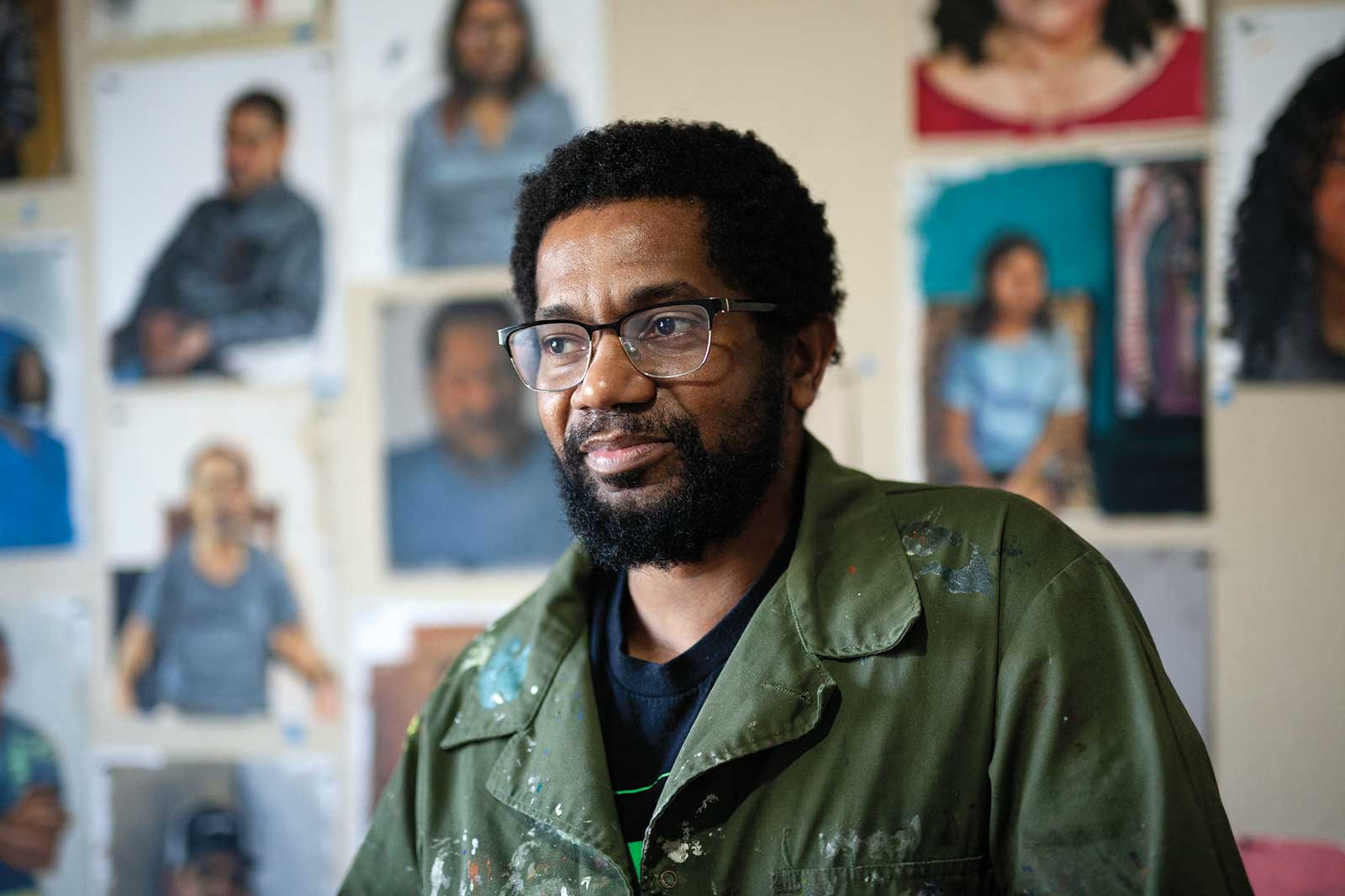
Sedrick Huckaby in his studio, Fort Worth, Texas. Photo courtesy Talley Dunn Gallery, Dallas, TX.
Query Huckaby about what his work means, and he doesn’t reach for an abstraction. Instead, he reaches for the firmness of the ground—of stories. One installation in his recent show finds that ground in a family dinner table draped and cluttered with the debris of ordinary gatherings: newspaper place settings, paper plates and those red cups everyone recognizes from a cookout. “I left those intentionally red,” he says, “both as an identifier, but also as a visual anchor.” The goal isn’t nostalgia, it’s elevation—taking material that “isn’t worth very much at all” and showing that, put together, it holds a kind of quality. “It’s about elevating the ordinary to show its legitimate nature,” he says.
He traces part of that instinct to a piece at the Smithsonian American Art Museum: James Hampton’s The Throne of the Third Heaven of the Nations’ Millennium General Assembly,an installation built from foil, cardboard and furniture scraps by a self-taught artist who worked alone for 14 years. From a distance it looks like gold and silver; walk closer, and it’s revealed to be built from ordinary discarded material. That transformation—humble stuff made to shimmer—became a kind of north star for Huckaby’s own practice.
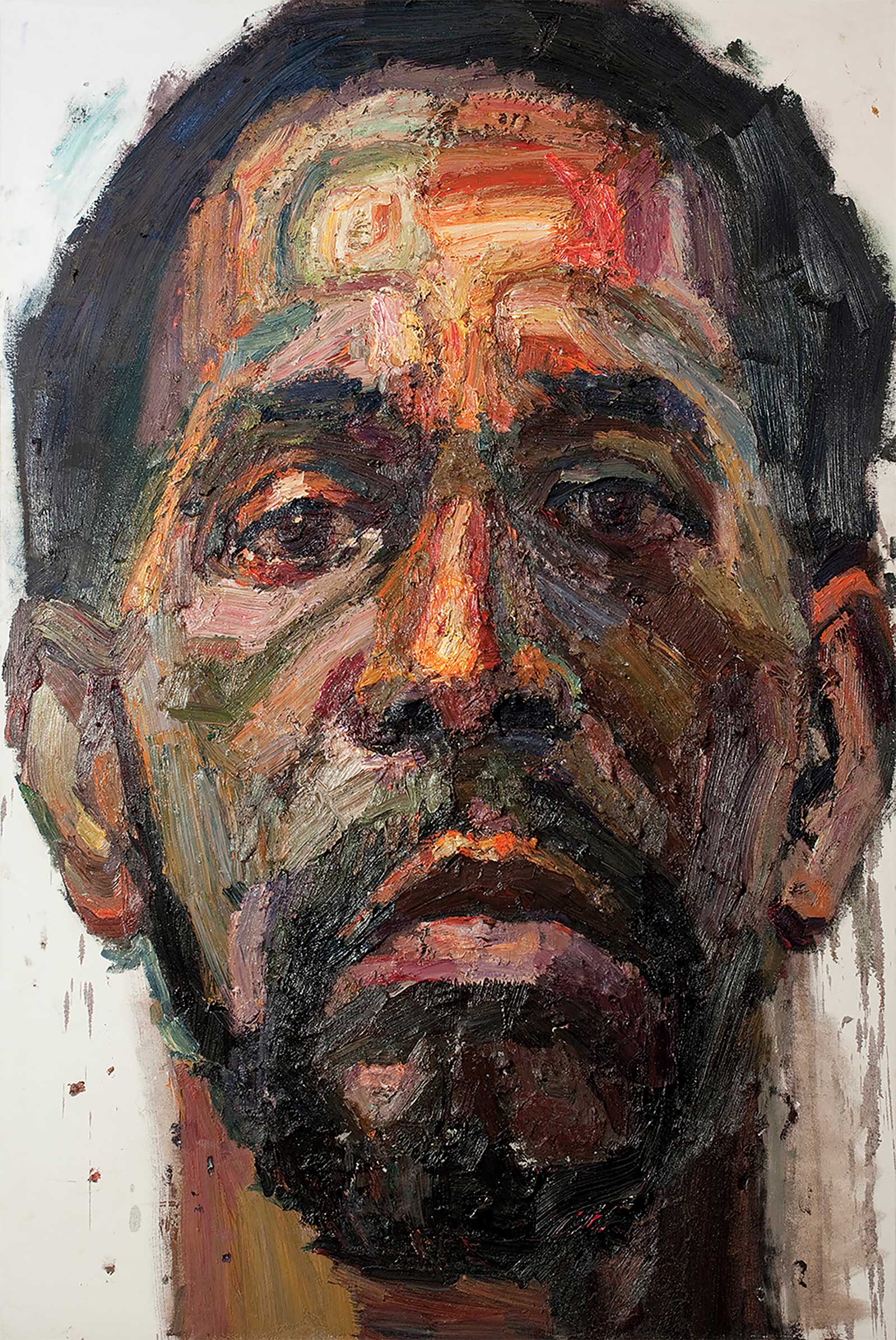
Sedrick, Sed, Daddy, 2016, oil on canvas, 72 x 48 in. Courtesy the artist.
His approach to portraiture follows the same logic, scaled to people instead of objects. “It is not that each person has a story,” he says. “Each person is a story.” The distinction matters to him: a story is a single narrative he could tell you directly, but a person is a whole book, full of “side pathways” and “nuances” that no single canvas can hold. What he’s able to capture, he says, is only ever a fragment—“little bits of their story”—while the rest remains unwritten, or unwritten yet. That worldview extends into faith. Asked whether his Christianity shapes the work, Huckaby doesn’t separate the spiritual from the social. He points to Martin Luther King Jr. as an example of faith and public position being inseparable. “It all really connected back to a spiritual root,” he says. Huckaby describes himself, half-jokingly, as an artist embedded within the Black church itself, a role he grew into rather than set out to claim. For Huckaby, the church has never been separable from social justice; it is both spiritual home and site of struggle.
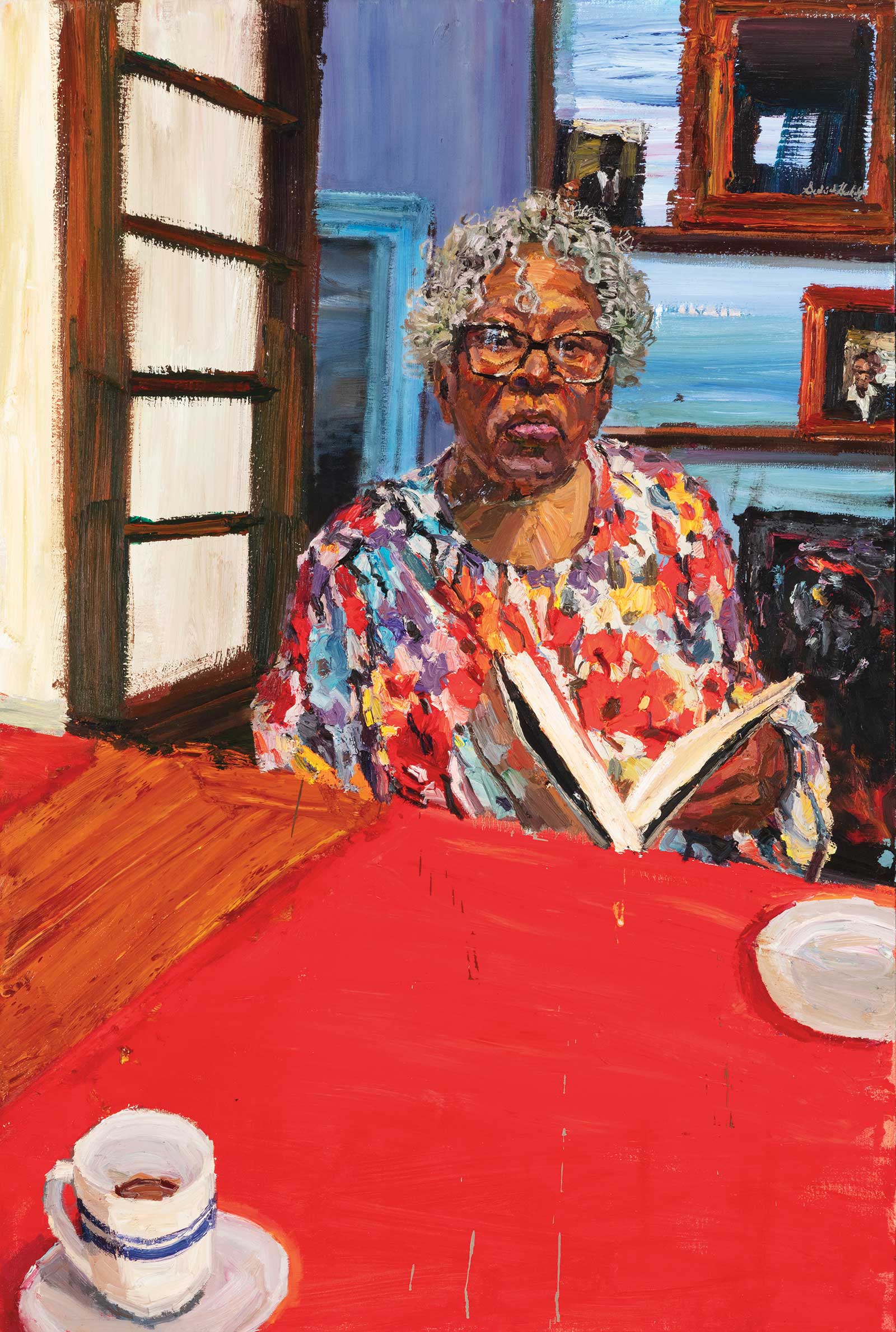
Opal Lee, 2023, oil on canvas, 60 x 40 in. Courtesy Talley Dunn Gallery, Dallas, TX and the National Portrait Gallery, Washington D.C.
Ask Huckaby to describe the arc of his career and he doesn’t begin with an exhibition or an award. He begins as an introverted kid who found that drawing let him communicate without having to talk. Over decades, the subject matter matured alongside him. “If I had to sum it up right now,” he says, “the art is about family, the African American community and issues of faith—life and death, as lived through faith.”
The gravitational center of that arc is his grandmother, known to the family as Big Mamma. Her house was where everyone gathered, no occasion required. When she passed away, the property eventually came to Huckaby, and he and his wife, Letitia, transformed it into Kinfolk House, part gallery, part community space, deliberately built to blur the line between “high” and “low” art. Exhibitions there have paired traditional quiltmakers with contemporary artists, or brought in a filmmaker, a fashion designer, a jazz musician and a potter, collaborators chosen to widen what counts as art. “It’s about a welcoming spirit,” Huckaby says. “It was about sitting down at the table, celebrating together, eating together.”
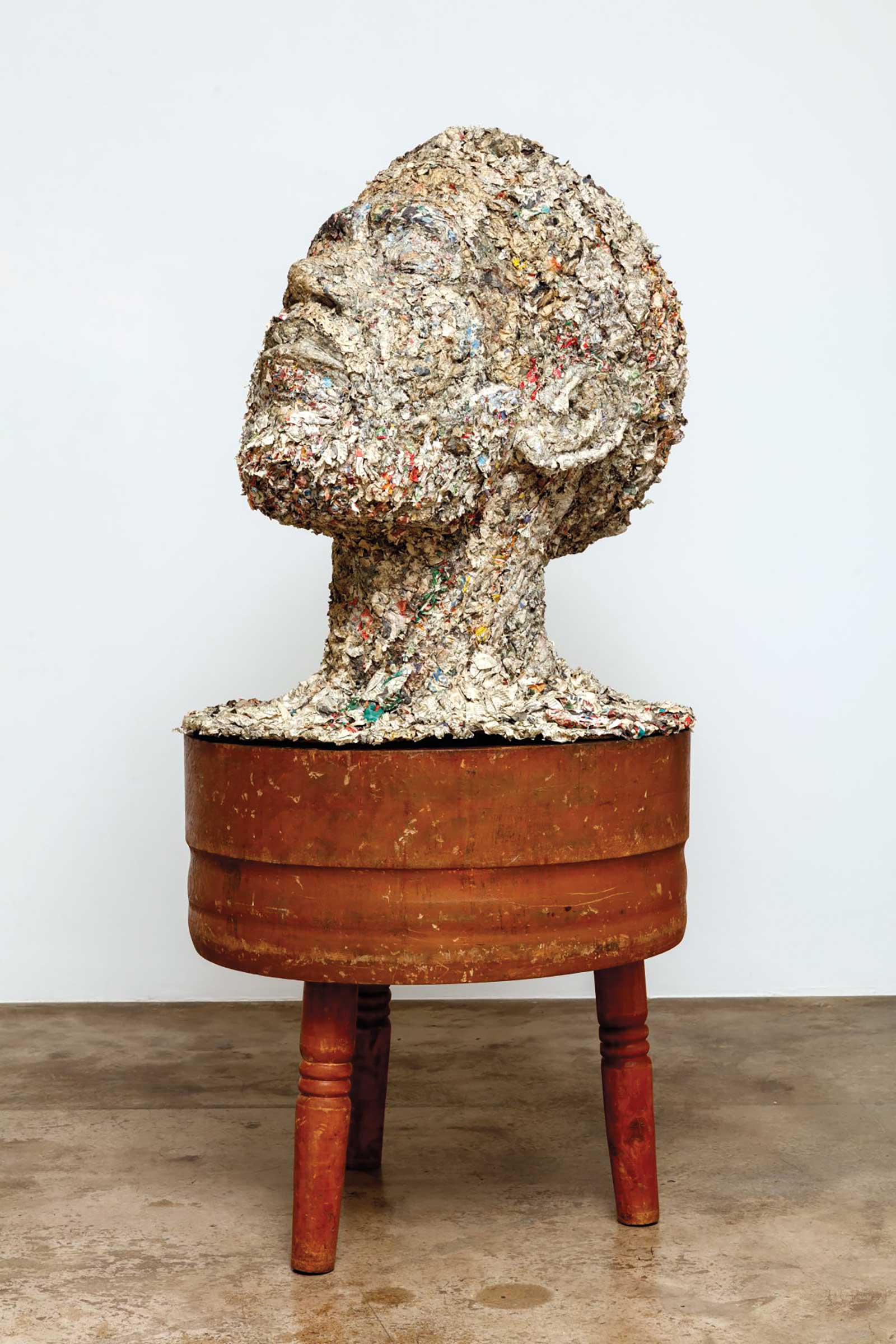
A Living Sacrifice, 2021, newspaper pulp and wood base, 72 x 31 x 38 in. Courtesy Caravan of Dreams Gallery, Fort Worth, TX.
That instinct, starting from the intimate and expanding outward, became a template. His early Big Mamma’s House series focused on a single figure; after her death, he painted the family members who remained. From there came The 99%, roughly a hundred lithographs built from listening to a broader circle of Fort Worth families, some he knew and many he didn’t, “trying to get a voice for a wider group,” the same expanding circle that would eventually lead him to Mexico.
Milestones followed, though Huckaby describes his career as connected moments rather than a single breakthrough. One was seeing a large “quilt painting” hung at the Amon Carter Museum of American Art, the first time his hometown museum gave him that platform, and the first time it drew members of his own church there to see his work. Another was an honorable mention from the National Portrait Gallery, awarded for a self-portrait titled Sedrick, Sed, Daddy. That recognition eventually led the museum to accept his portrait of Miss Opal Lee, the activist and hometown hero behind the push for Juneteenth recognition as a federal holiday, into its permanent collection, placing a Fort Worth figure, and Juneteenth cause, inside a national institution built around portraits of famous Americans.
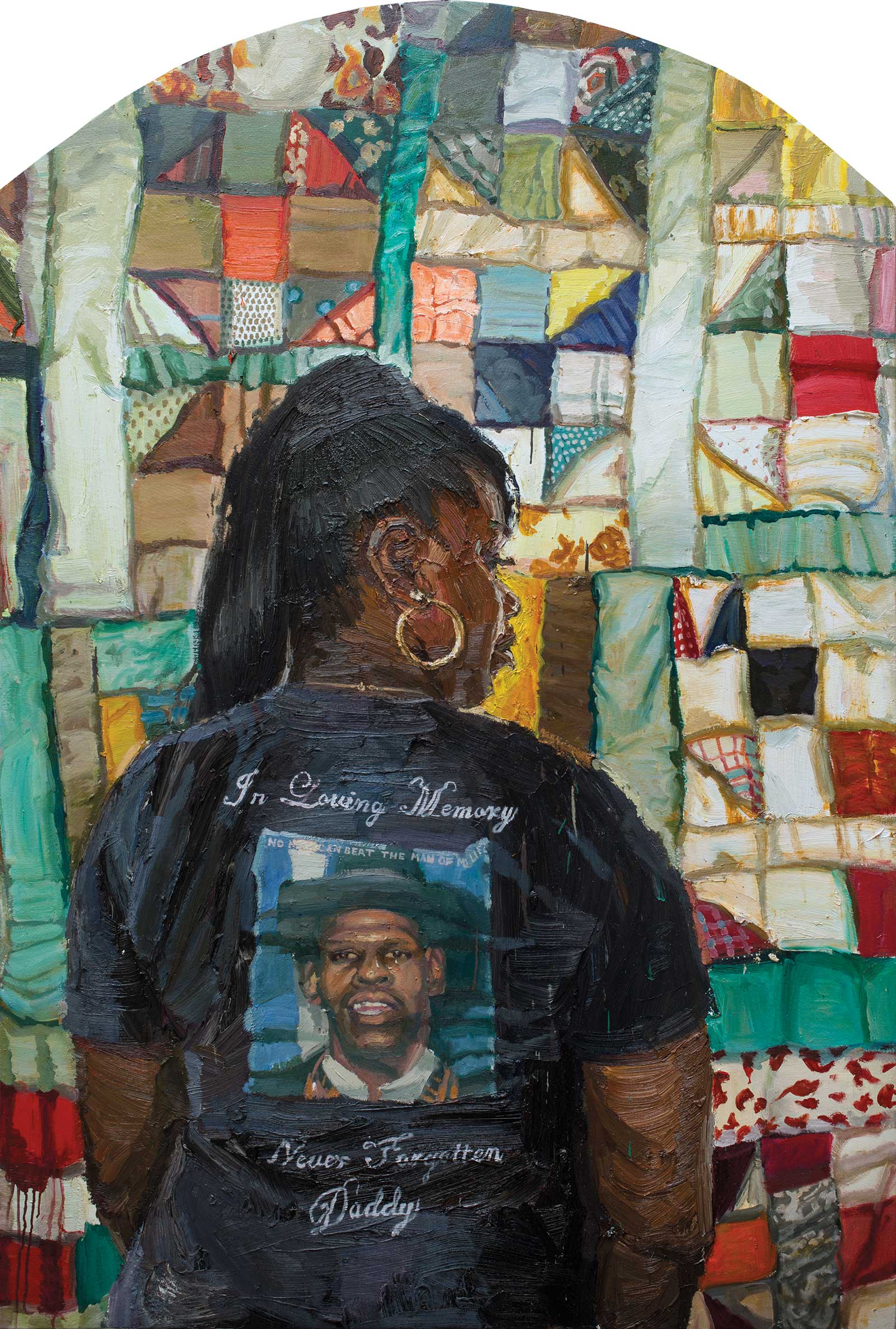
Never Forgotten Daddy, 2018, oil on canvas on panel, 74 x 511/4 in. Courtesy Talley Dunn Gallery, Dallas, TX.
One of Huckaby’s most distinctive formal devices grew out of a tradition he almost didn’t think to examine, because it had always simply been there. In many African American families, including his own, a death is marked by custom-made memorial t-shirts printed with the face and name of the person being mourned and worn to the wake. Huckaby had grown up around the practice without registering it as remarkable; it took his wife Letitia, from a military family with no such tradition, to notice it as something worth documenting. What began as a photography project of hers became a collaborative body of paintings: portraits of people wearing shirts that memorialize someone else, dead loved ones layered inside portraits of the living.
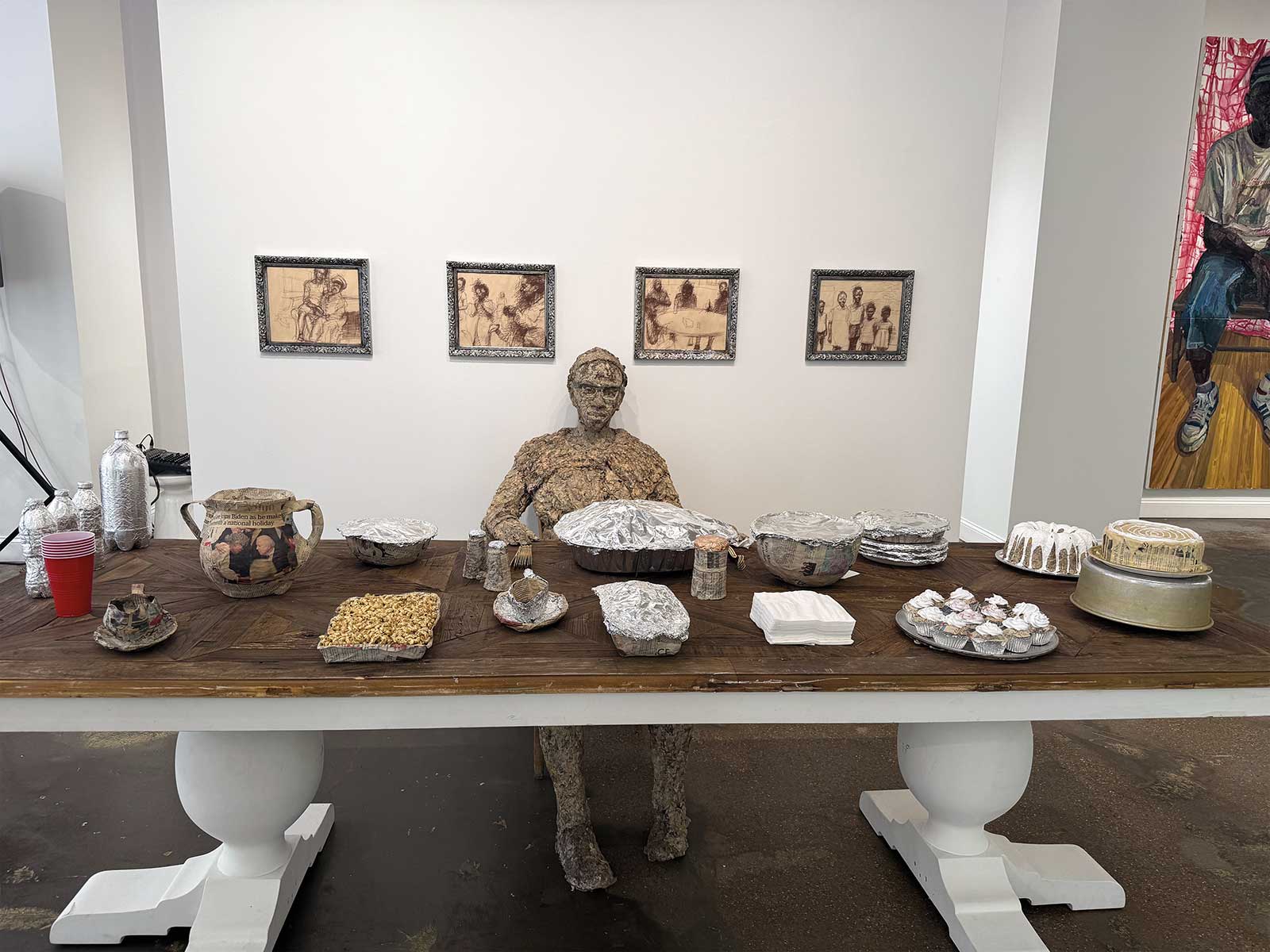
Welcome, 2022/2025, table, paper mache, mixed media works on paper, 52 x 108 x 68 in. Courtesy Talley Dunn Gallery, Dallas, TX.
Formally, the device works like a window within a window. The living subject is framed (Huckaby describes it as looking “through a window at your subject”) and on their chest, framed again, is the face of the person they’ve lost. The effect collapses time: the viewer looks at someone in the present who is, quite literally, wearing the past over their heart. Huckaby has noticed a pattern in who ends up on these shirts, often younger people, “who left too early,” a quiet social dimension alongside the personal one. He resists reducing it to any single meaning. “Part of it is paying homage,” he says, “part of it is about the literal situations that may have caused this death, and then another part of it is thinking about it in a spiritual way.”
The same logic surfaces outside the t-shirt series proper. A large painting of his daughter, Halle, titled Hallie/Hallelujah, shows her holding a tambourine in the same chair where her great-grandmother, Big Mamma, once sat. Halle was born on the day of Big Mamma’s funeral. The painting itself began years earlier as an unfinished portrait of the grandmother and was only completed after her death, its meaning shifting in the interval. Over time, Huckaby bridged the two works further with a papier-mâché sculpture of Halle extending the same figure and the same chair from canvas into three dimensions. The sculpture sitting in Big Momma’s actual chair became the physical link connecting grandmother and great-granddaughter across mediums. Asked whether this kind of memorialization is something he’ll keep returning to, Huckaby doesn’t offer a clean answer. “I like for those discussions to start on earth,” he says, “and end up in heaven.”
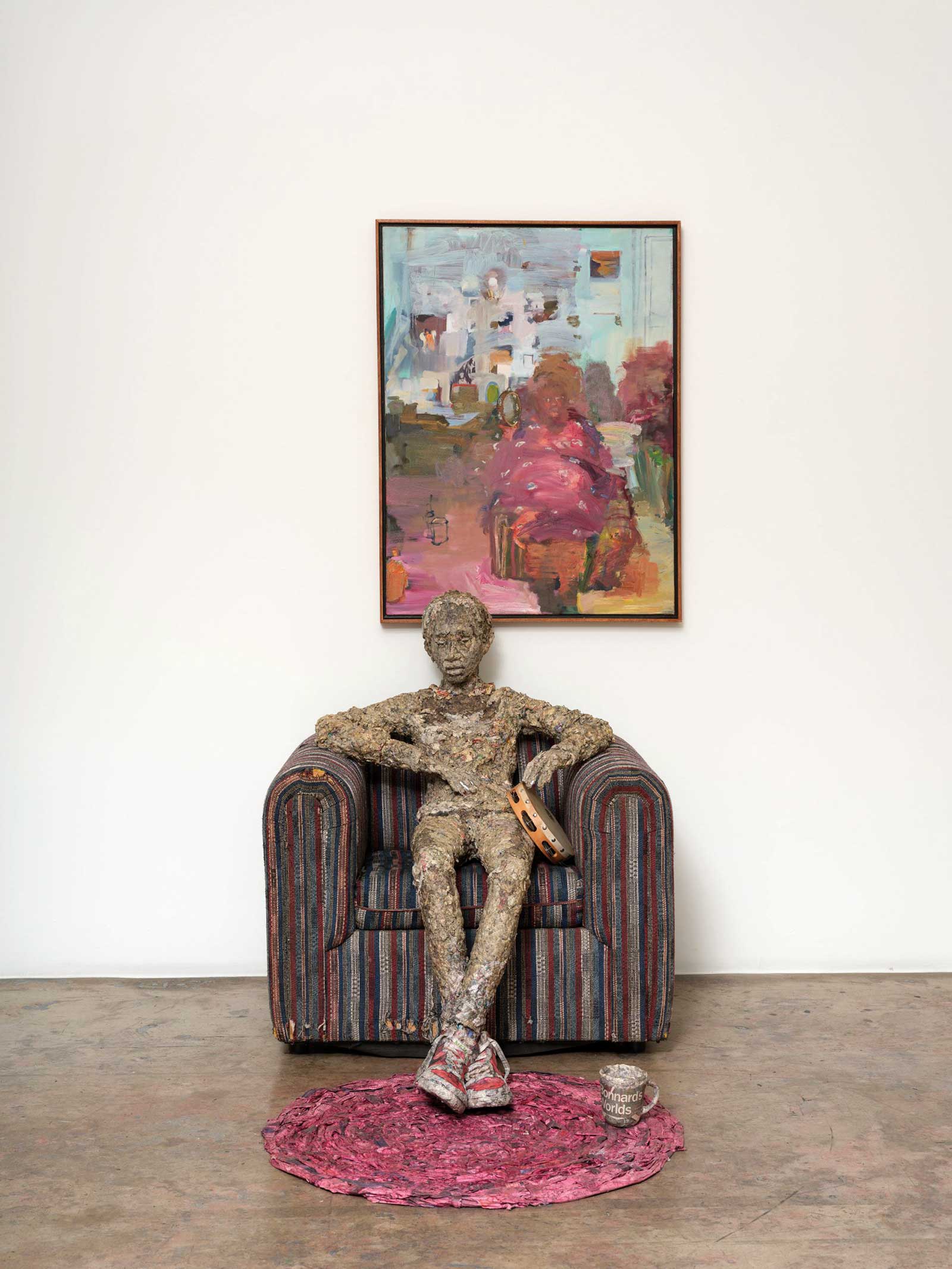
Connection, 2020, oil on canvas, wood, newspaper pulp, painting: 72 x 48 in., sculpture: 43 x 28 x 19 in. Courtesy Caravan of Dreams Gallery, Fort Worth, TX and Talley Dunn Gallery, Dallas, TX.
Huckaby’s sculptural technique has an origin story rooted in thrift. He began making small sculptures out of leftover oil paint: half-dried scrapings from his palette, pressed together into solid, textured forms. It worked, but it didn’t scale; oil paint is heavy and expensive, and a life-sized figure could consume gallons of it.
The solution came as a gift. Dr. Eddie McAnthony, Fort Worth’s first African American art professor and a mentor of Huckaby’s, ran a papier-mâché workshop that Huckaby had organized, and then found himself unable to stay out of joining as a participant. He recognized in McAnthony’s sculptures the same rough, built-up texture he’d been chasing with dried paint, and realized papier-mâché could let him work at a scale oil paint never could. Central to McAnthony’s method was avoiding a rigid internal armature; he built instead forms with rolled paper that stayed adjustable, so a sculpture could be reworked rather than locked into a single pose from the outset.
His own process varies by each papier-mâché piece: sometimes starting with a wire form and wrapping it in wet paper, sometimes building from crumpled, clay-like paper pulp that can be shaped and reworked “in the round,” much like clay. On his large self-portrait, a meditation on the sacrifice of prayer, sections kept collapsing under their own weight as he built them up. His solution was to drive screws into the drying form to hold the weight in place while it cured; when he later saw the screws still visible in the finished head, he chose to leave them, struck by their unplanned resonance with a piece about sacrifice.
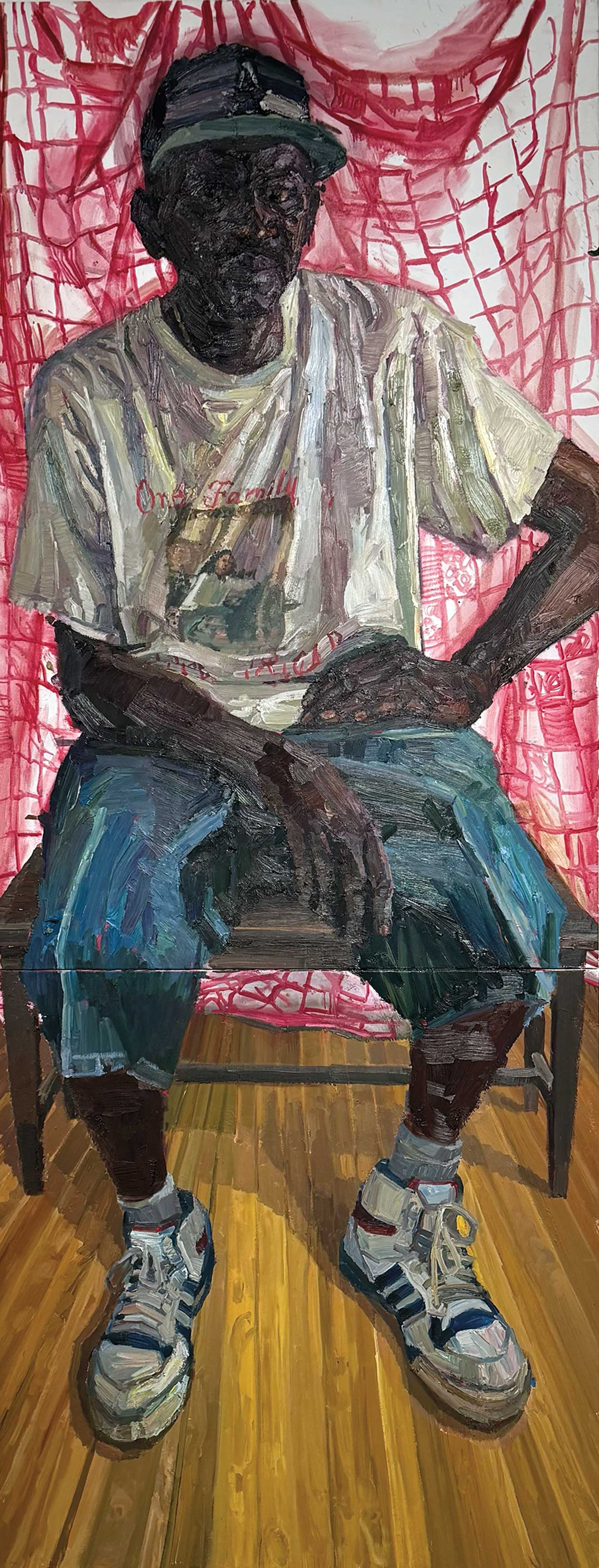
Billy, 2022, oil on canvas on panel, 126 x 48 in. Courtesy Caravan of Dreams Gallery, Fort Worth, TX.
Newspaper is his material of choice, and not just for its texture. Each sheet carries the residue of an ordinary day—grocery ads, local headlines, whatever was happening when the sculpture was made. Built into the work, it becomes a hidden time capsule. “You’re taking the lives of many people over many months,” he says, “and making it into a singular statement.”
Huckaby’s most ambitious extension of this practice took him out of Texas entirely. On a Fulbright fellowship, he spent four and a half months living among the Mascogos of Nacimiento, Coahuila, descendants of Black Seminoles who fled through Oklahoma and Texas into Mexico in the 19th century. Their history includes an inversion many Americans have never heard. Mascogo fighters were enlisted by the Mexican government to help guard the border against Texas Rangers and slave-catchers pursuing escaped people who had crossed south along a lesser-known route of the Underground Railroad.
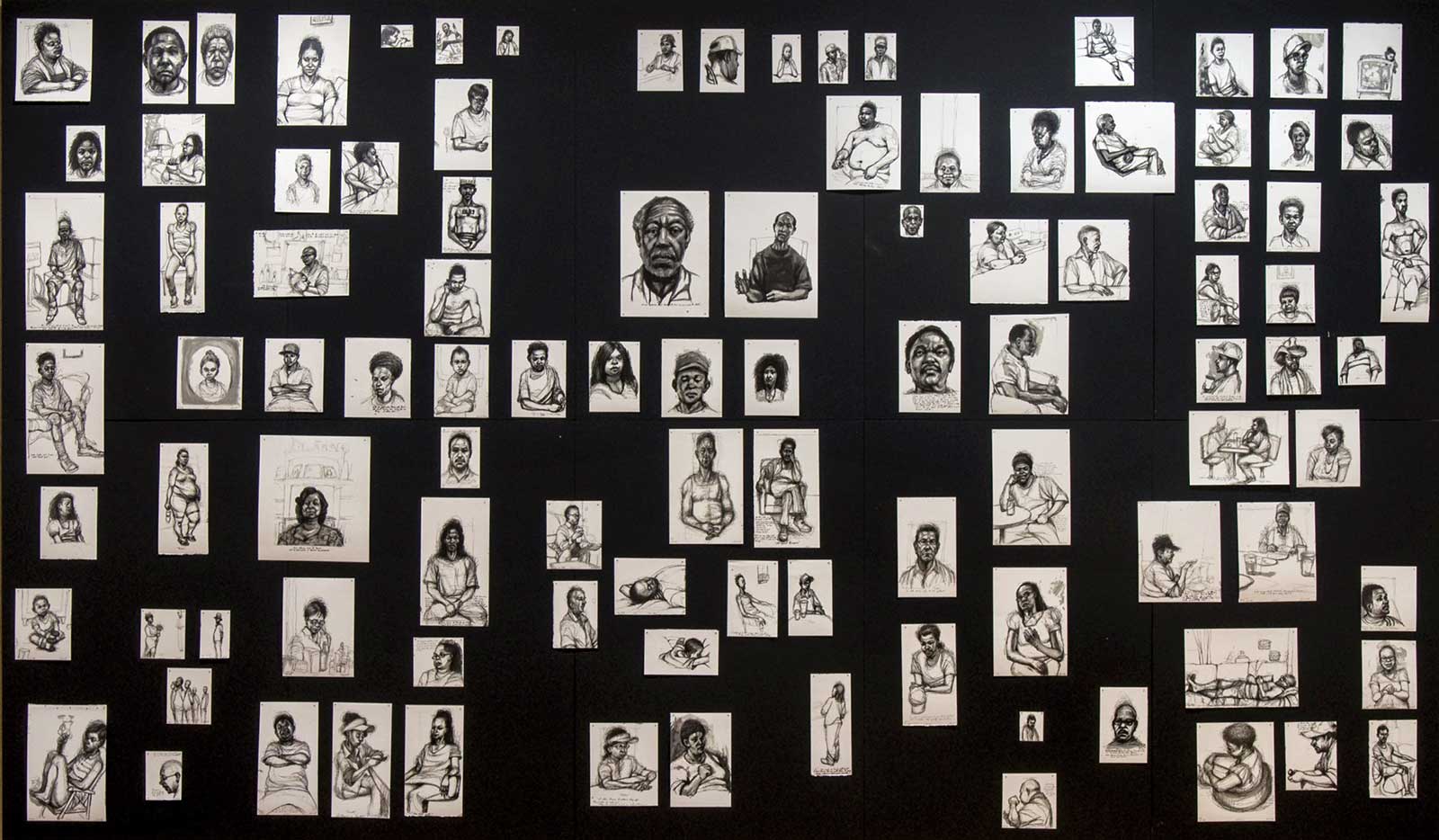
The 99% - Highland Hills, 2012-2013, suite of 101 lithographs. Courtesy Valley House Gallery, Dallas, TX.
What drew Huckaby to the community initially was Juneteenth. The Mascogos have independently celebrated it for generations, a fact he learned before the holiday achieved national recognition. Working the way he prefers, from life, he produced roughly 101 pastel portraits on-site, later developed into paintings in his studio, each embedded with handwritten Spanish snippets drawn from his conversations with sitters. Living in the community surfaced unexpected continuities: shared spirituals of uncertain American origin, still sung in Spanish-inflected form; a possible quilting tradition strikingly similar to the Gee’s Bend tradition in rural Alabama; and a relationship with the neighboring Kickapoo, for whom the Mascogos now perform much of the administrative labor—an echo, Huckaby notes, of an older alliance.
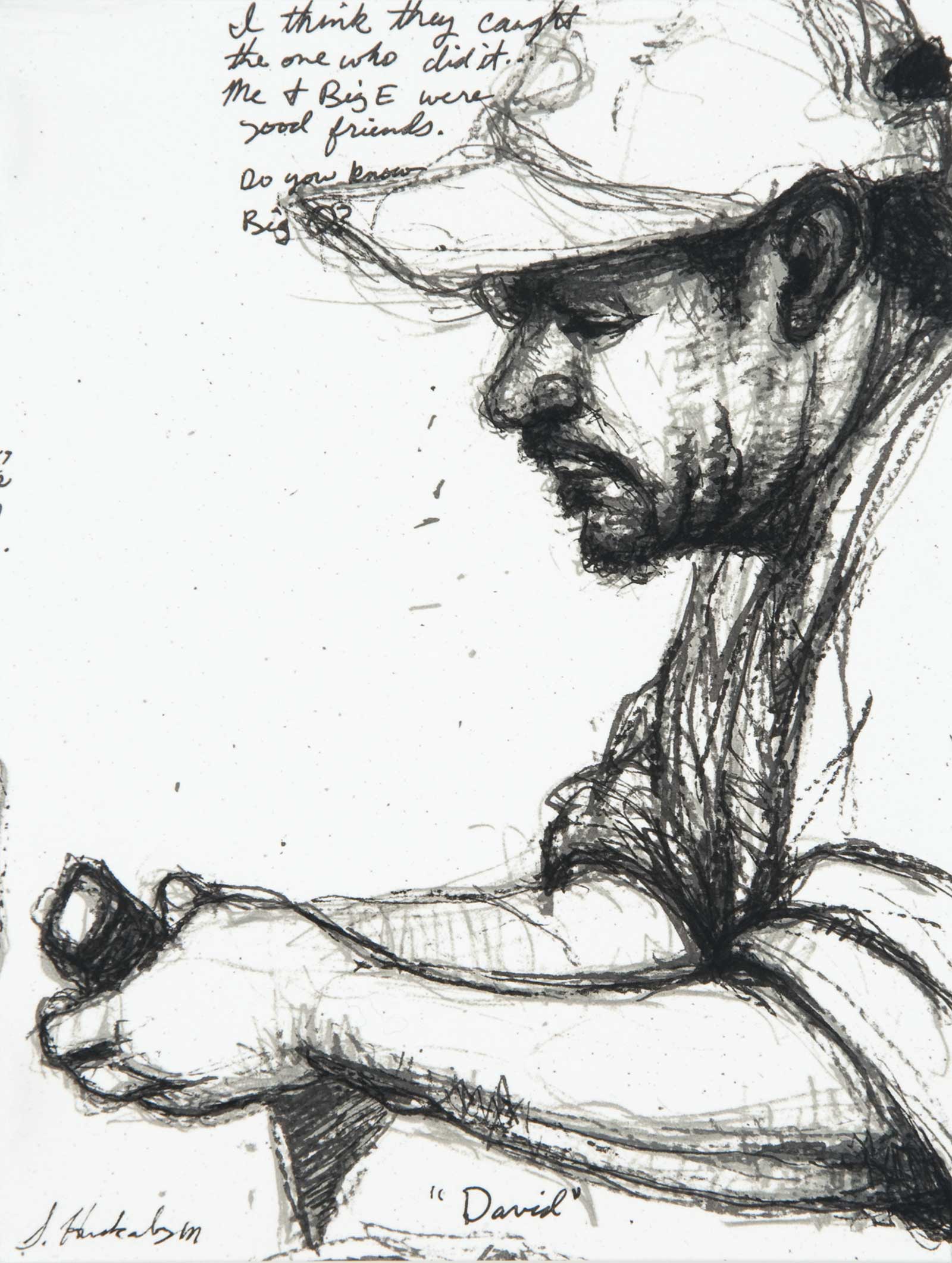
The 99% - Highland Hills: #074 David, 2012, lithograph, 7 x 5¼ in. Courtesy Valley House Gallery, Dallas, TX.
One painting captures a young woman holding a portrait of her late brother, killed in an accident. In Mexico Huckaby discovered the same act of memorialization he had already been documenting in Texas, now appearing independently, unprompted, in a community in a different country. He’s careful not to frame the Nacimiento project as protest art. “I’m not actually particularly painting about that,” he says of the border’s inverted history. “It’s embedded in the lives of all these people.” His larger hope was that socially engaged art, paired with serious studio practice, could do more than document. He believes that it could affect change. He’s candid that the project has only partly realized that ambition so far. “Just a touch of what I envision it can be,” he says.
It’s a fitting way to describe the whole body of work. Family, faith, memory and justice run through Huckaby’s practice not as separate subjects but as one continuous thread—what he calls, describing the connections between Fort Worth and Nacimiento, “a spider web.” Pull on any one strand—a red cup, a memorial t-shirt, a screw left in a sculpted head—and the rest of the story comes with it. —
Andrew Walker, PhD, is an art consultant, curator, and writer based in Fort Worth. For approximately 14 years he served as Executive Director of the Amon Carter Museum of American Art, following earlier positions at the Art Institute of Chicago, the Missouri Historical Society, and the Saint Louis Art Museum. He is currently Chief Curatorial and Strategic Executive at Fort Works Art and principal of Walker Art Consultants, where he advises collectors and foundations on collection placement and stewardship. He also serves as Art Director for the Fort Worth African American Museum and Cultural Center, where he brings his curatorial experience to its exhibition program.
Powered by Froala Editor