Joel Babb’s life has been one of changing perspectives. Studying art history at Princeton, he painted abstract expressionist works. After graduating, he went to Florence and Rome where he experienced the highly sophisticated art and architecture of ancient Rome as well as Leonardo and the artists of the Renaissance who, literally, brought art back to life. He returned to the United States to earn an MFA degree at the School of the Museum of Fine Arts in Boston. To support himself, he worked as a night watchman at the museum, roaming the empty galleries and filling sketchbooks with drawings. Another change came when he and his wife built a cabin and studio in rural Maine where they moved permanently in 1988.
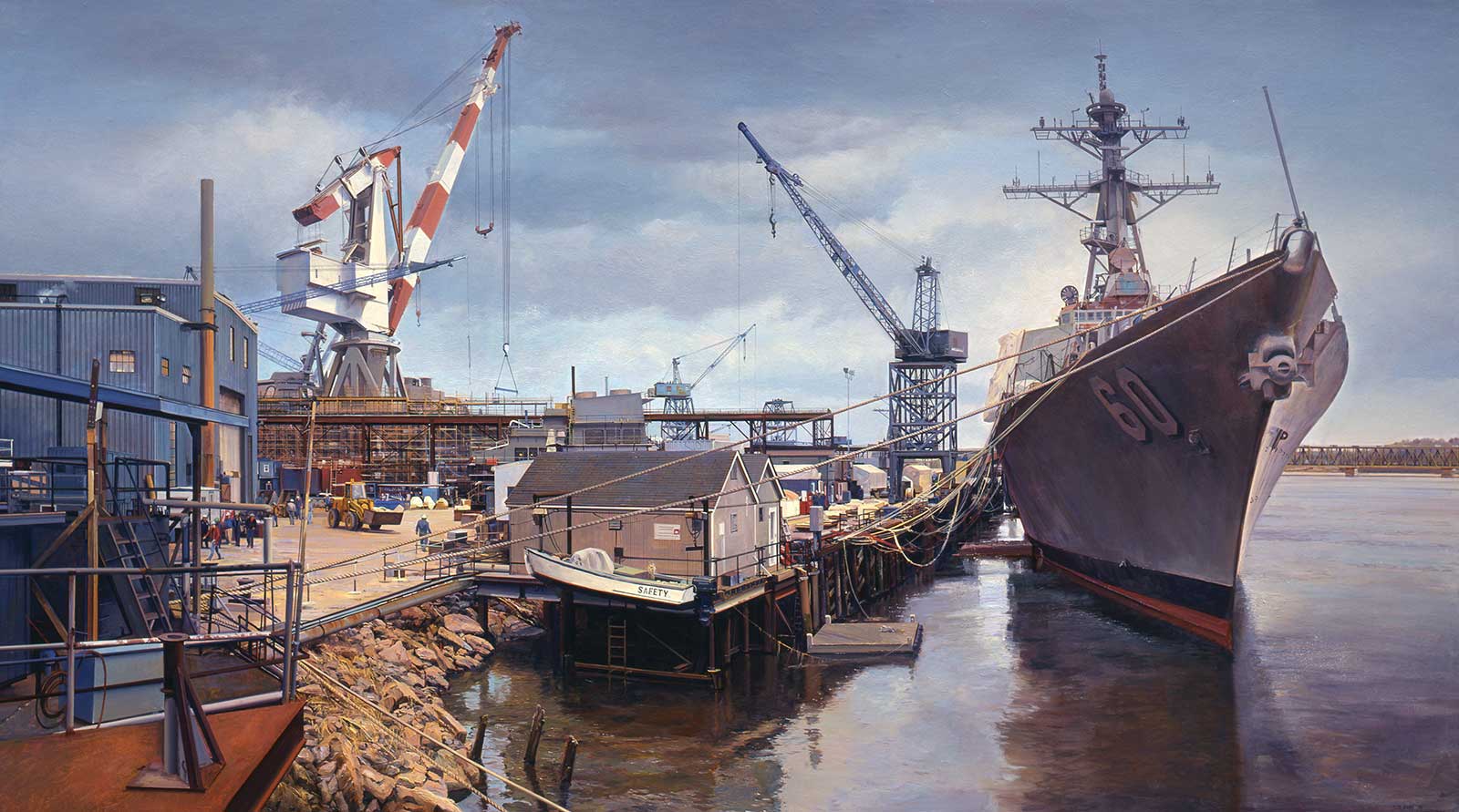
The Bath Iron Works, 1994, oil on canvas, 33 x 66 in. Maine Maritime Academy Collection, Gift of Elizabeth B. Noyce © 2026 Joel Babb / Image courtesy of the artist
Jane Bianco, curator of the Farnsworth Art Museum in Rockland, Maine, has assembled an exhibition of 14 cityscapes and landscapes for the exhibition Shifting Vision: Joel Babb’s Painted Universe, opening October 3 and running through January 2027.
She writes, “The exhibition works from the premise that Joel Babb’s affinity for imagination, balanced by precision, results in imagery that shifts between illusion and reality. His emphasis upon passageways, often defined by light, is the result of shifting vantage points, focus, and detail. These visual shifts offer a hiker’s sense of trek and discovery. His large-scale paintings of the natural wilderness present impressions of deep space and draw viewers into his scenes, moving vicariously over rocks, through waterways, and between trees. He presents a glimpse of the world, where, as he puts it, ‘one could observe in an essentially overlooked corner of the universe, larger forces at play.’”
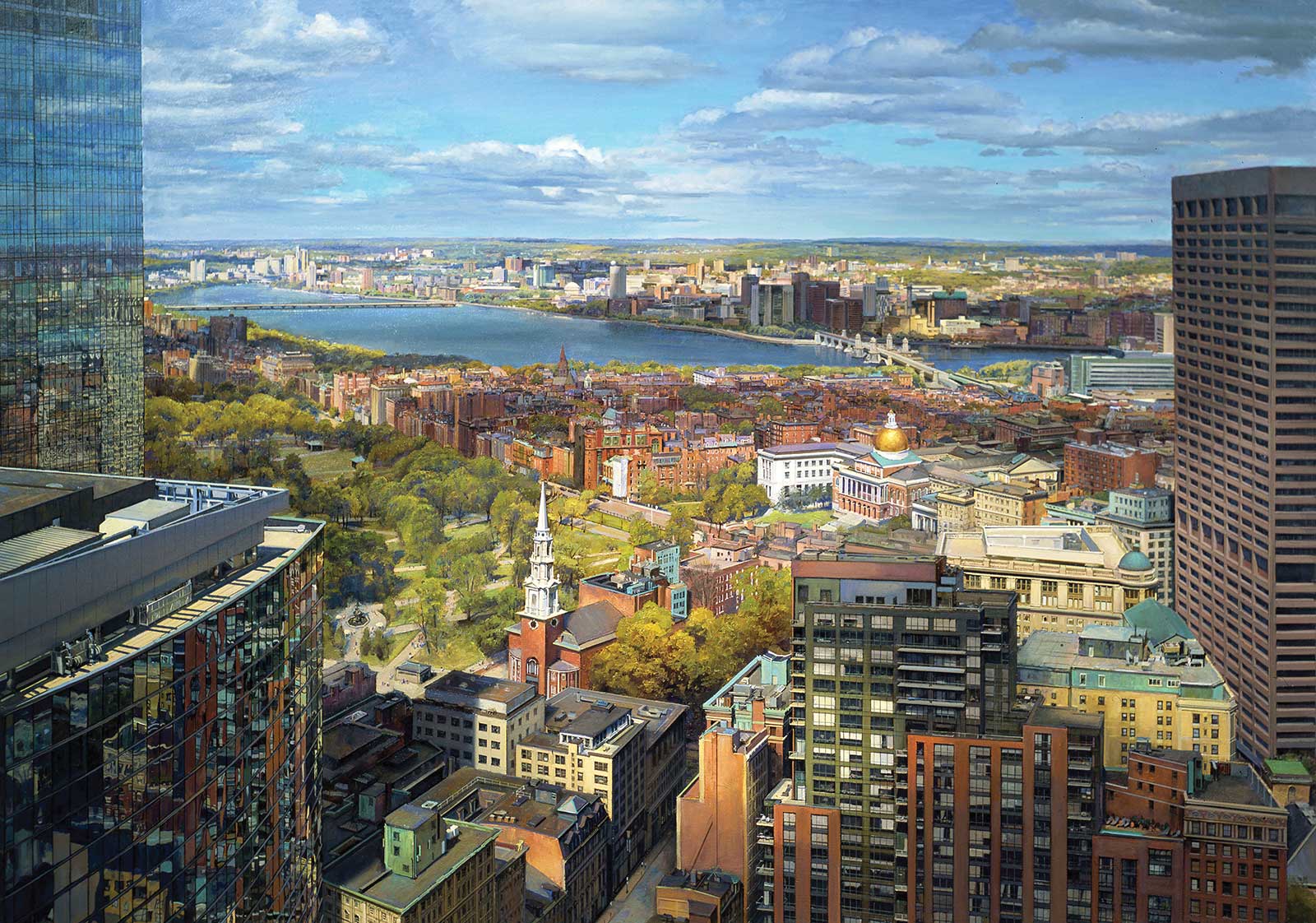
Church and State, Boston, 2018, oil on linen, 42 x 60 in. Private Collection © 2026 Joel Babb / Image courtesy of the artist
His 60-by-68 inch painting, Bernd Heinrich’s Brook in Autumn, 2013, is a favorite of mine for several reasons. It refers to Bernd Heinrich, the biologist who wrote, among many other books, Mind of the Raven. The painting also demonstrates the results of Babb’s many years studying perspective. As we seemingly stand in the brook with the water rushing toward us, our glance is simultaneously drawn back upstream where, using atmospheric perspective, Babb has softened the detail and cooled the palette to create great depth. In between, there are acres of mystery which Heinrich explores and studies.
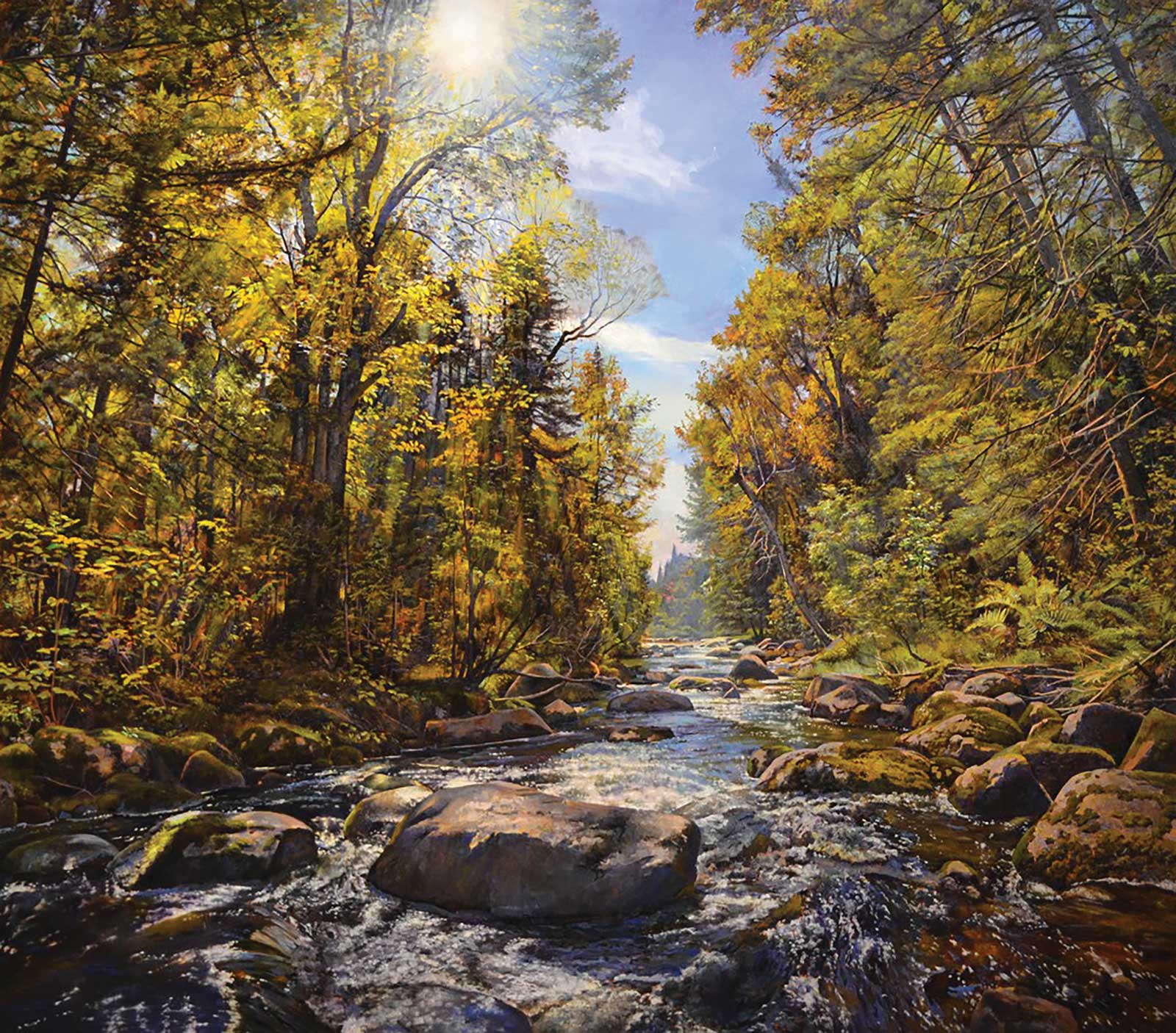
Bernd Heinrich’s Brook in Autumn, 2013, oil on linen, 60 x 68 in. Farnsworth Art Museum, anonymous gift in honor of the Osher family of Maine, 2023.2 © 2026 Joel Babb / Image courtesy of the artist.
Babb says, “I was totally at a loss when I first worked with Maine landscapes.” When we first spoke several years ago, he acknowledged, “I had to learn to represent nature. In the beginning I couldn’t do it. It had me totally floored. As I Iooked at the arrangement of grasses and the whorls in the water I thought of Leonardo and his drawings of those details. Nature is a great self-organizing, infinite and mysterious thing. When you look at it closely, it’s microscopically fascinating. It’s infinitely small and so infinitely large it encompasses us.” His study of Leonardo brought him to the details, but Claude Lorraine’s drawings revealed a “very complex and beautiful way of organizing space. Once I began to think and apply it, I invented landscapes based on Claude’s landscapes and his drawings.”
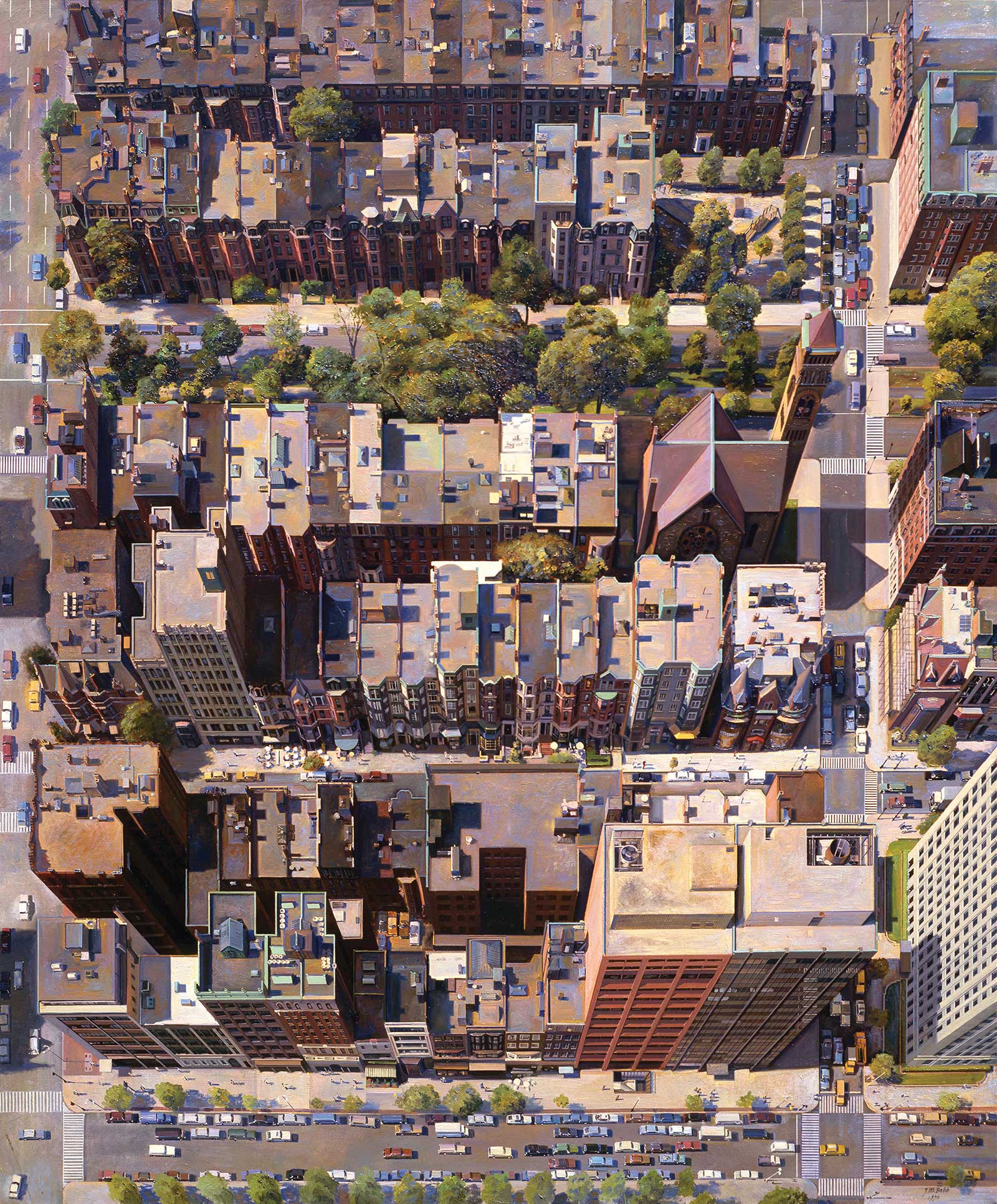
Copley Plunge, 1990, oil on linen, 82 x 65 in. Collection of the Museum of Fine Arts, Boston. Gift of Peter Jacobs in memory of Mimi Jacobs, 2017.4006 © 2026 Joel Babb / Image courtesy of the artist
Babb treks through the Maine woods and along its rocky coast subject to the vagaries of New England weather, especially along the shore. Babb relates his camping after beginning a painting of the shore. “I went back to work on the painting the next day. It was sunny in the campground but fogged-in on the shore. It’s hard to paint the fog convincingly. It’s eerie. You can’t see the ocean, but you can hear it.”
He also walks the streets of Boston, and has experienced the city from a helicopter, taking photographs that he has assembled into simple and complex perspective paintings of the city. Copley Plunge, in one-point perspective, is in the collection of the Museum of Fine Arts, Boston. Church and State, Boston,2018, is a view from the 38th floor of a building in downtown Boston. He frames two historic buildings that border Boston Common where cattle grazed in colonial times—the gold-domed State House, completed in 1798 and Park Street Church, completed in 1809.
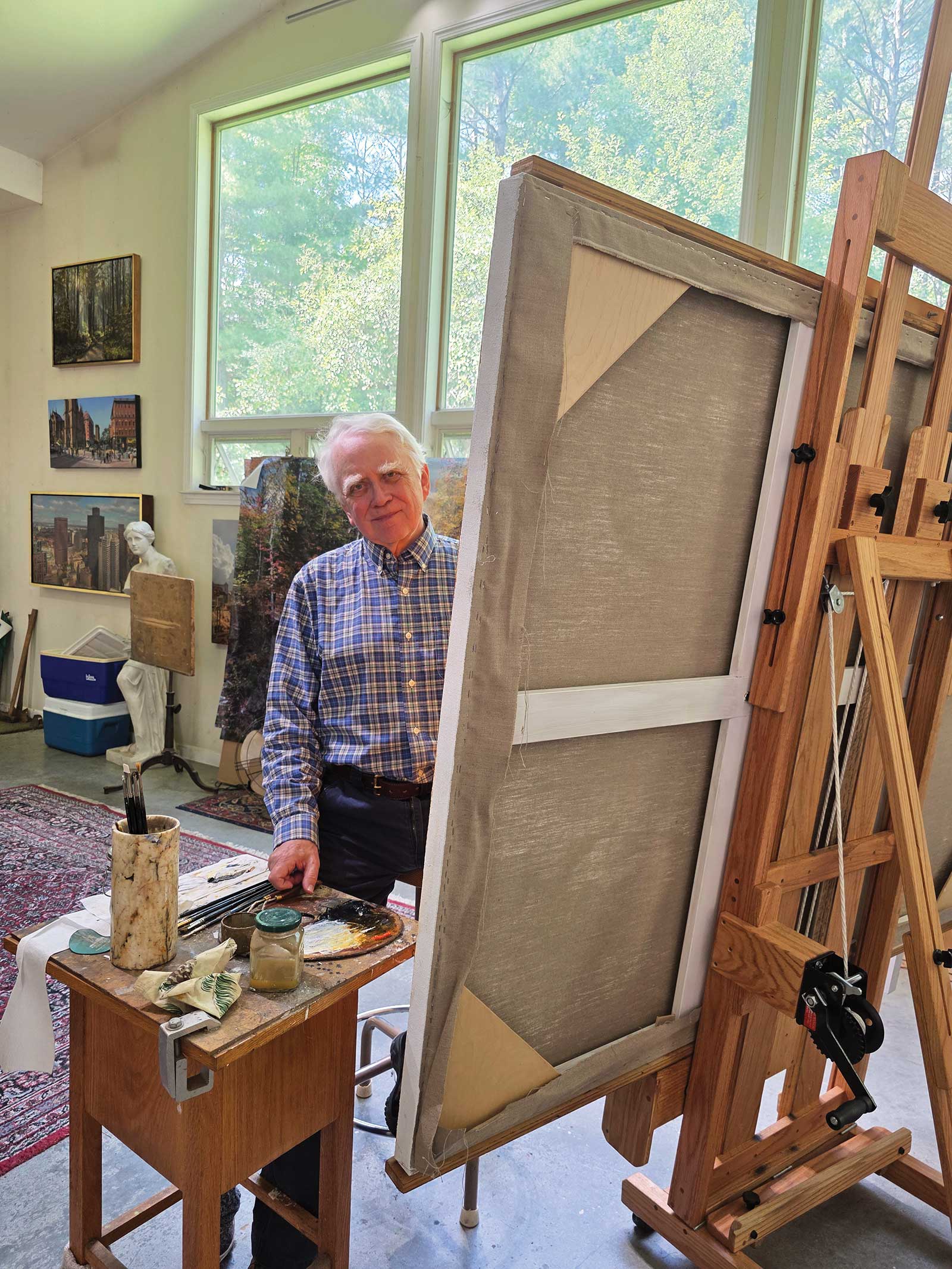
Joel Babb in his studio beginning a new painting.
In a 2020 essay for the Maine Arts Journal, Babb wrote, “there is an aesthetic thrill for me in seeing a familiar place from a different perspective—a sublimity in which people, cars, and buildings in the distance are turned into abstract patterns of rectangular blobs or even dots. The macrocosm engulfs the microcosm.”
Five years ago, I ended an article about the artist with a quote from Bernd Heinrich in the book Nature & Culture: The Art of Joel Babb. It’s worth repeating because it relates to Babb’s sensitivity to his subjects and his ability to share.
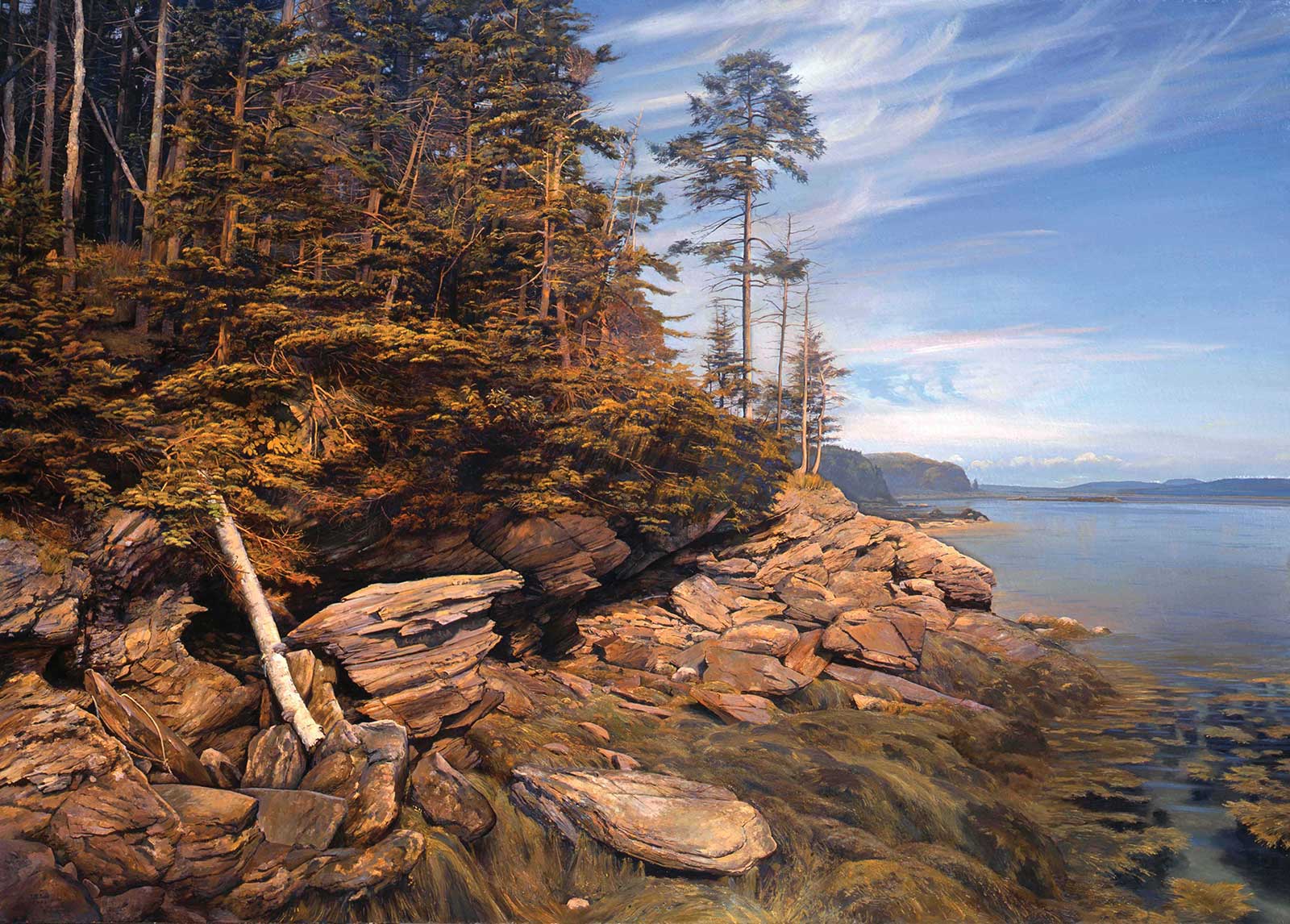
Eggemoggin Reach, 2002, oil on linen, 60 x 84 in. Private Collection © 2026 Joel Babb / Image courtesy of the artist
Heinrich writes, “[W]hen we see a painting of a brook, we are consciousness-sharing with the artist. We are seeing not only a brook but also what has entered a person’s eyes and has been processed and executed to be reproduced into a recognizable facsimile of the real. The painting also represents a human caring. It shows what the painter values and appreciates. It is the visible proof of that consciousness and caring.”
Shifting Vision: Joel Babb’s Painted Universe opens with a reception on October 2 from 4 to 6 p.m.
Shifting Vision: Joel Babb’s Painted Universe
October 3, 2026-January 31, 2027
Farnsworth Art Museum
16 Museum Street, Rockland, ME 04841
(207) 596-6457, www.farnsworthmuseum.org
Powered by Froala Editor