Adrienne Stein is not known as a Western painter. The lush poetry of her past work was born of her Pennsylvania garden, opening an ethereal entrance to the green and evening growth of the fantastic Eden planted around her home, offering connoisseurs a twilight invitation to enjoy her floral visions of the midsummer night reverie of dreamy dryads that dwells in her pleasant land of unearthly delights, these beauties resting among an abundance of foliage and flowers and breathing life into the magic and enchantment of coppices and coverts like fairy Queen Titania among the bowers of her blessed domain. Now, Stein has moved her magic eye to the home of another kind of holy beauty, ruled by the mysteries dwelling in the vast American desert that spans the West. The spirit of this time-shaped place is older than the trees, and the current of her new paintings has a primordial depth stirred by her commune with the elemental land.
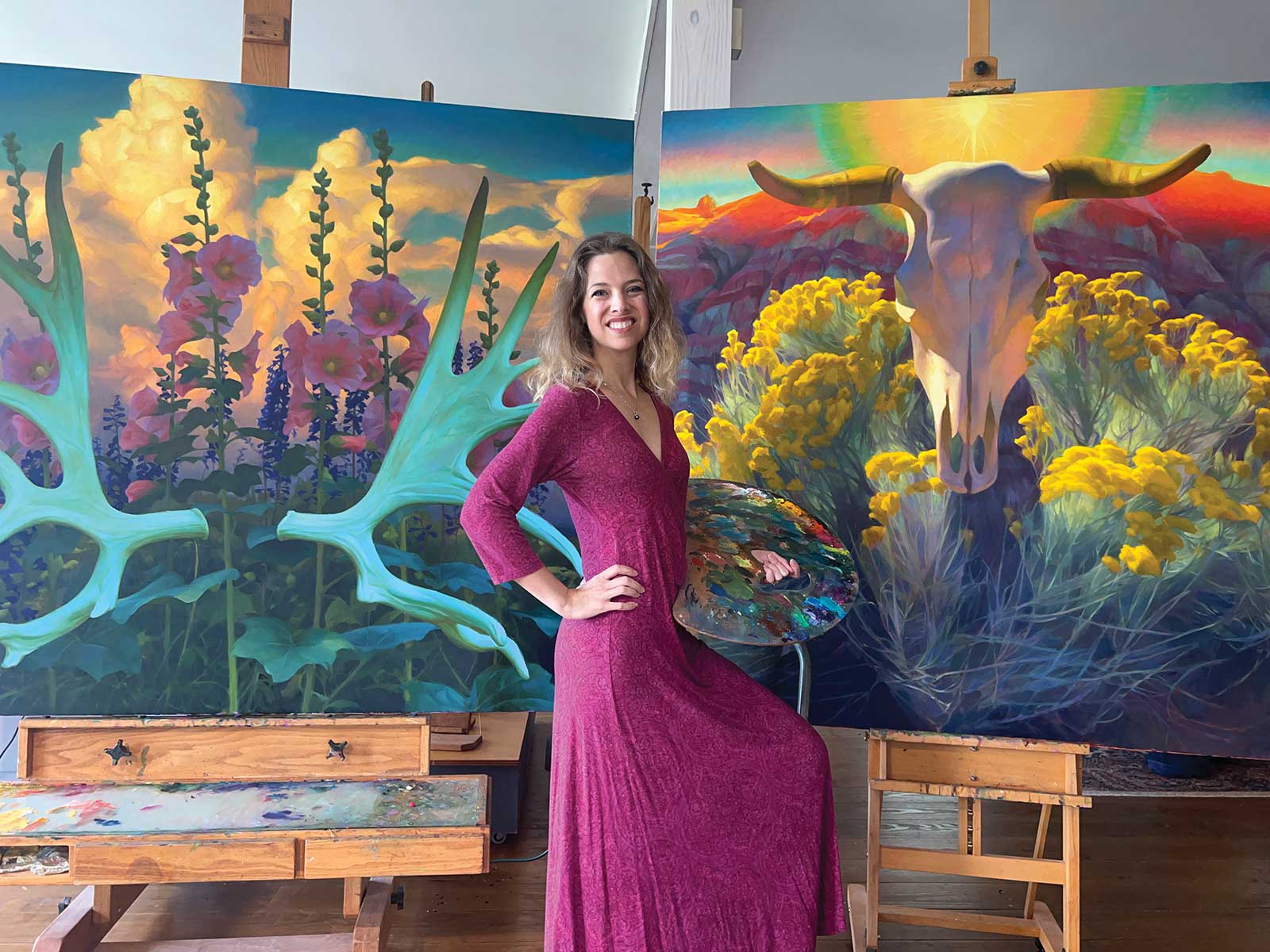 Adrienne Stein in her studio.
 The artist will unveil these new pieces in the exhibition The Enchanted West of Adrienne Stein, opening August 22 at the Museum of Western Art in Kerrville, Texas.
Though Stein’s romantic roots are deeply entangled in the rich ground of green poesy and plays, with her figures enriched by Shakespeare’s poetic heroines and Pre-Raphaelite stunners, and the sidhe of the green mounds, in her new imagery she has attended to experiences of a different kind of spiritual life found in the contrasting landscapes of Pennsylvania and Colorado, where she and her husband Quang Ho own homes, splitting their year between them. She brings a fresh eye to the mythic land of the West. “The whole aesthetic of the American West was completely new to me,” she explains. “It’s incredible just how visually different it is. The obvious things like vistas where you can see hundreds of miles…but then also all the fascinating rock formations, being able to see into geologic time…the forms of the West, the colors of the West. Very specific colors of rocks, very specific colors of skies.”
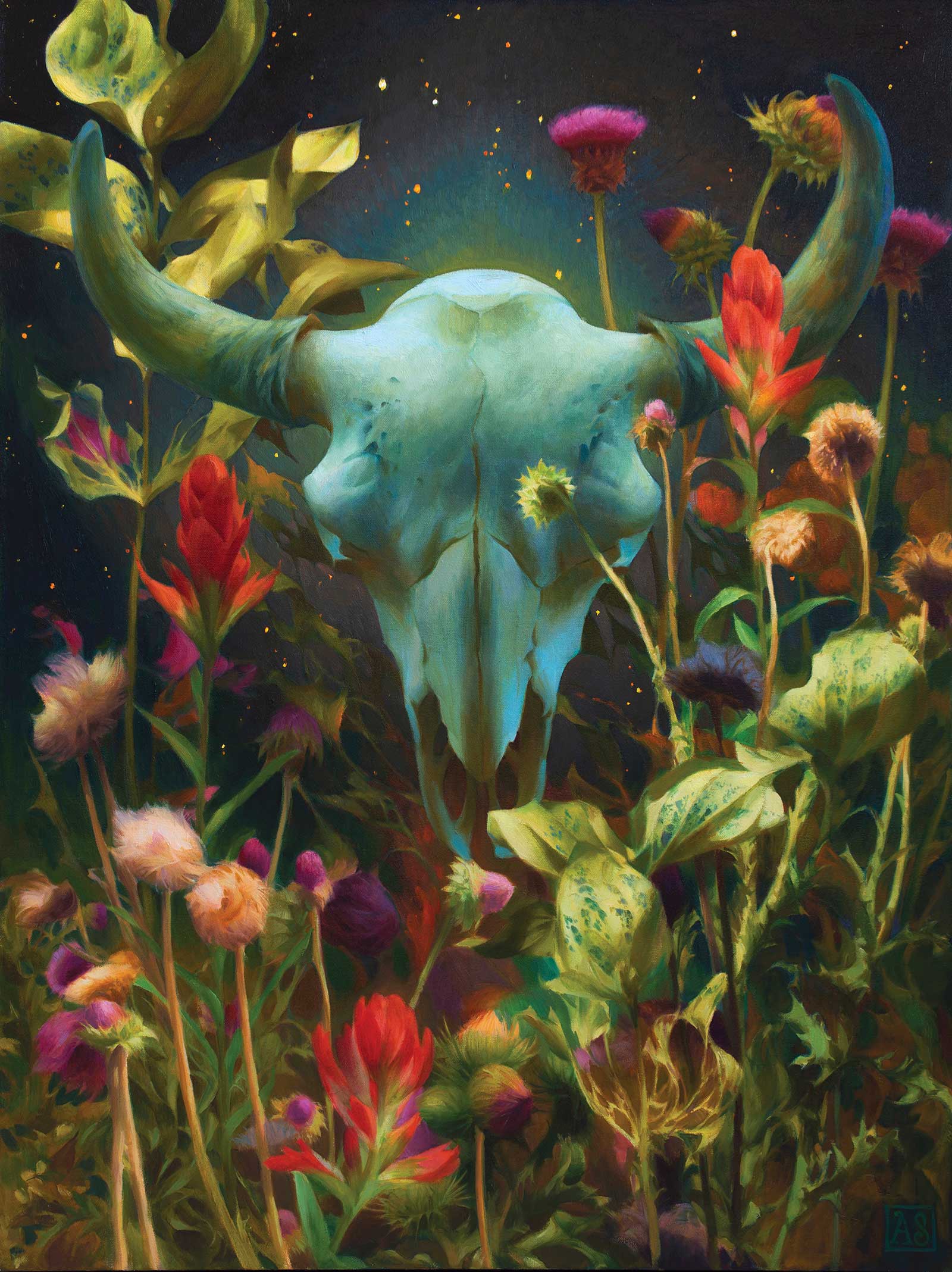
Guardian, oil on canvas, 40 x 30 in.
Helios was inspired by Carbon County, Wyoming, where big, eroded bluffs shaped by wild winds and the flow of ancient floods rise from the desert floor in colored layers; the natural architecture of the earth built over hundreds of millions of years, revealing layers of deep geological time. With pigment and palette Stein bears numinous witness to the oxidized layers of rich red ochres and true sienna hues that shape the land in silence and simplicity—and if these ancient strata are the fathers of a harsh materiality of stone in the open desert, then the insistent life that finds survival within the creak and crack of the preternatural rock is the mother of the magic that balances it—the austerity of raw stone balanced by fertile forms sprung from the slow miracle of the seeds of ghostly grey and bright yellow chamisa germinating in dryness and cooled by the nightly shine of a lazy yellow moon. There is darkness in the desert, too. A skull looms over the bright Indian yellow flowers, lit from above in a radiant nimbus of sunlight, stamping the land with iconic significance. This is the avatar of the sacrificed steer, the symbol of the bone, and blood, and meat that feeds America. In Penumbra, the skull is ominous among flat cacti under a threatening eclipse casting the pale light of the blackened sun over the bone with the sinister mood of apocalypse and the end of time.
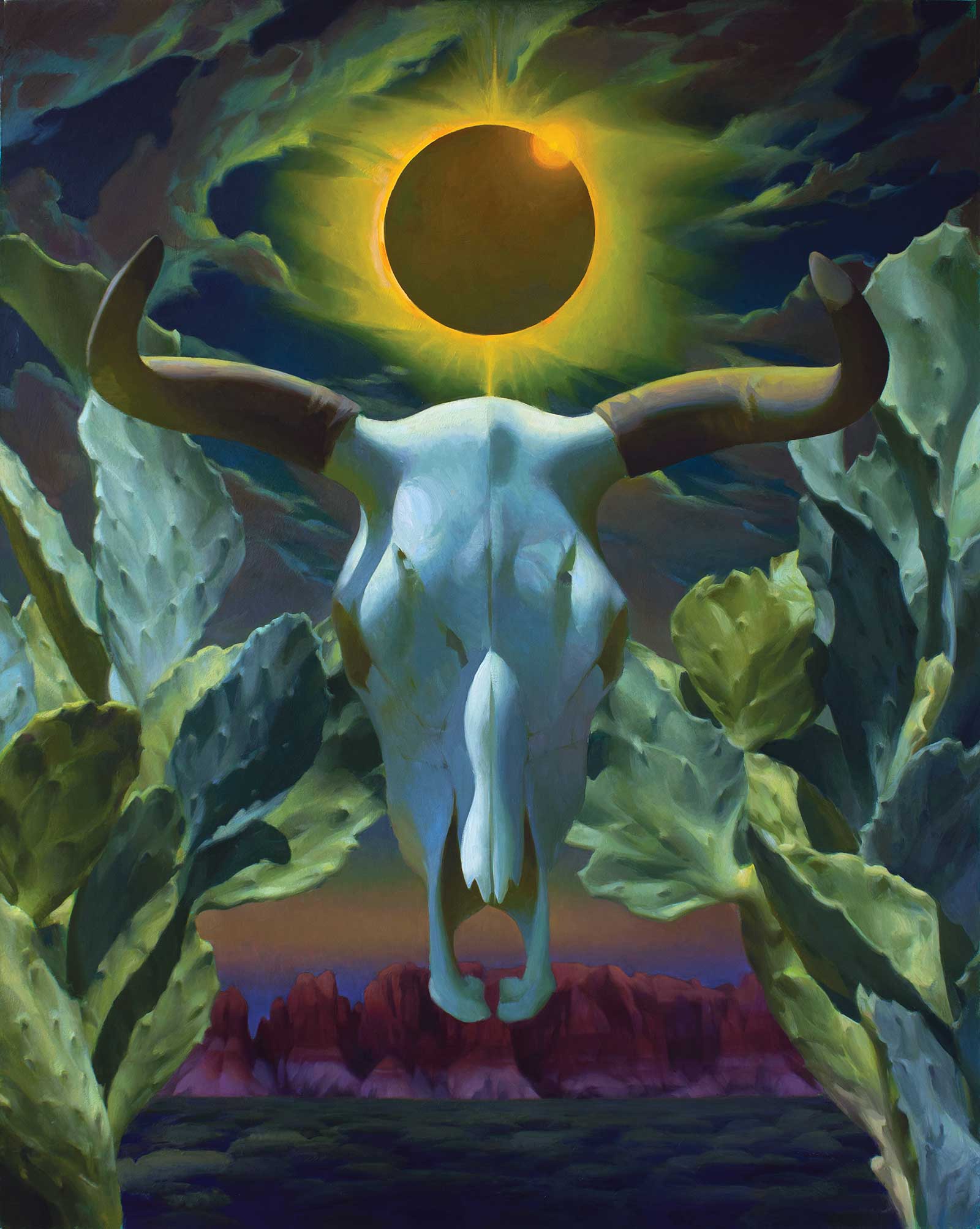
Penumbra, oil on linen, 60 x 48 in.
Stein says the Werner Herzog documentary Cave of Forgotten Dreams was an important influence on her. In the film, which is a brilliant study of the paintings of horses and steers made 30,000 years ago in France’s Chauvet Cave, Herzog shot beautiful pictures of a calcite encrusted cave bear skull positioned on top of a boulder like an offering. “It’s probably one of the earliest altars, one of the earliest forms of religious devotion and prayer,” says Stein, “Whoever it was that they were invoking, whatever it was they were asking for, is a spiritual longing for God in the human heart and a seeking of the divine.”
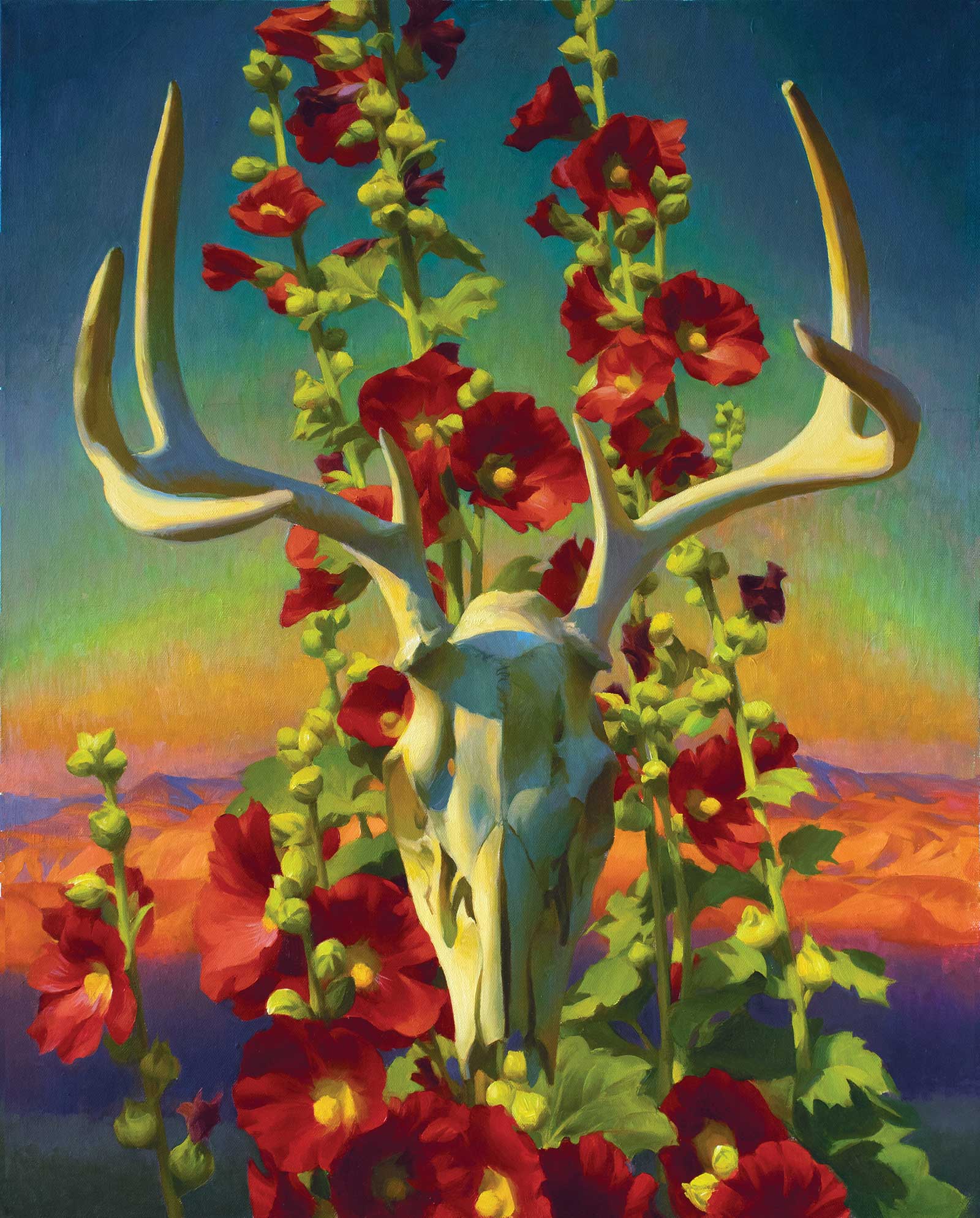
July, oil on canvas, 30 x 24 in.
Like many of the paintings in the show, images like Helios and Penumbra owe a formal debt to religious altarpieces, where the landscape behind Christ and the Virgin was depicted as the beautiful garden of Eden, and Stein’s paintings seek the beauty and life that is hidden in the vast expanse of the desert, making the invisible visible by bringing floral abundance to the foreground and opening the arid landscape behind it as an expanse of eternal space spread between the eye and distance. This is no garden, but a silent land of seclusion where mystics go to find God in meditation and silence, where ancient spirits suspended in dust and air breathe life into the estate of the Almighty.
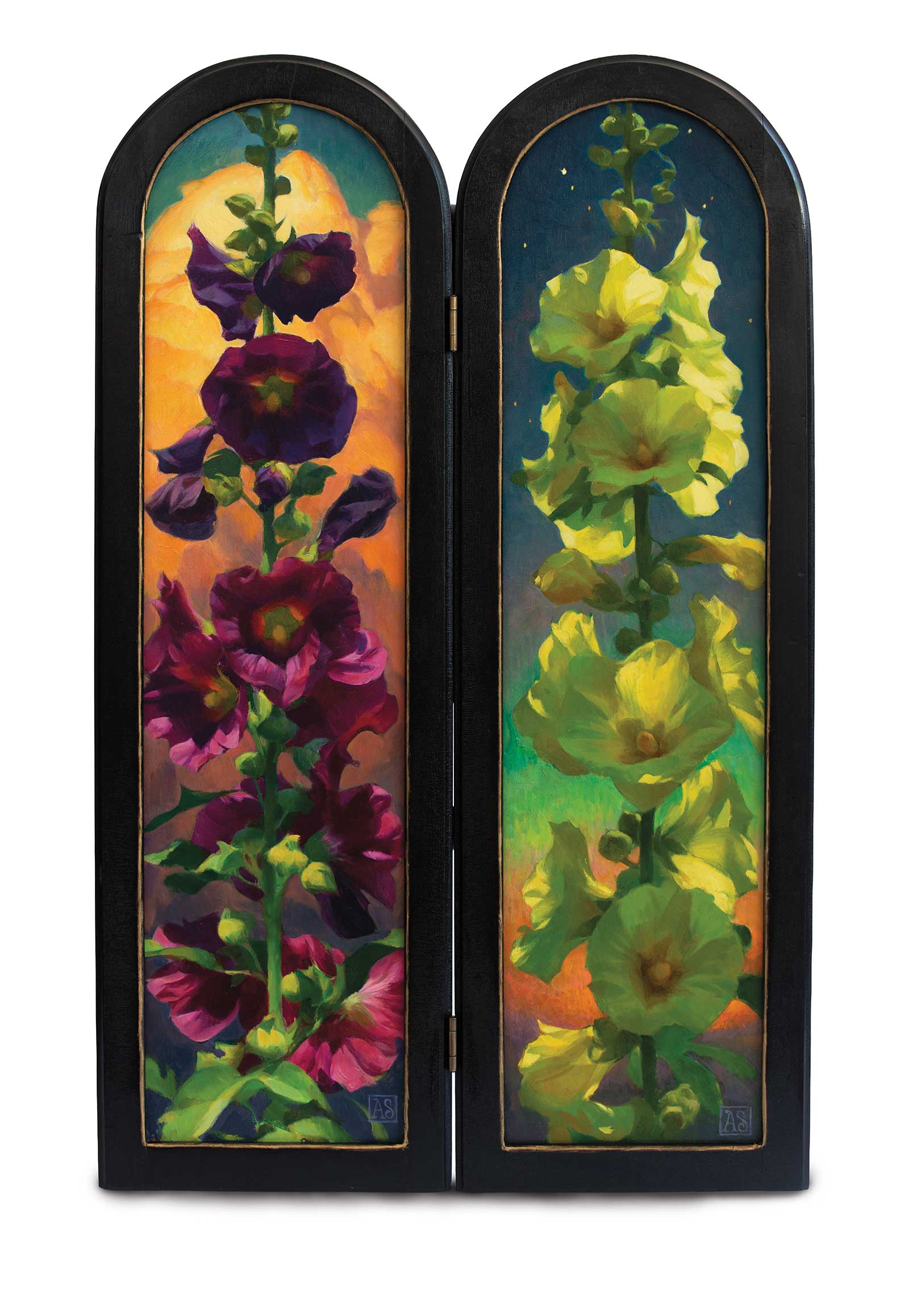
Towers of July, oil on birch panels, 32 x 20 in. Collection of Donna Deerin.
These desert icons are born of love. Stein’s painting August is a memory of her first date with painter Quang Ho. He took her to a concert given by the opera singer Renée Fleming at the Aspen Music Festival. After dinner, the couple were driving down switchback roads to Denver while big thunderheads over the valley filled the sky with drama. Stein recalls, “…an enormous double rainbow and then this beautiful, intense golden light that was just hitting the mountains at the last light of day as we were driving...And I wanted to replicate that. So, it is a romantic painting to me…I have a really corny selfie of us with the double rainbow behind us on our first date. It’s a personal meditation on that time.”
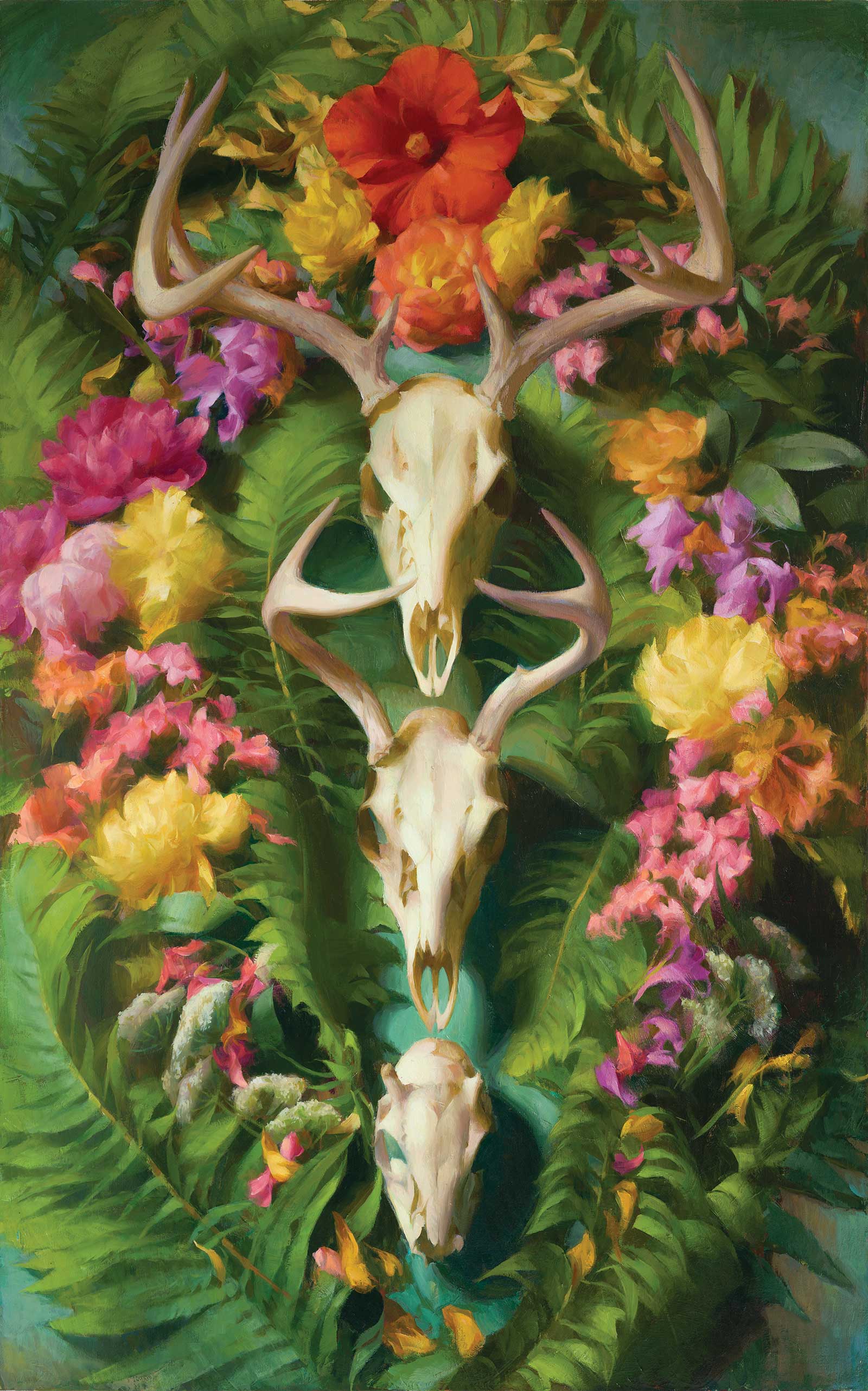
Legacy, oil on linen, 48 x 30 in. Collection of Donna Deerin.
Recalling the romance, she painted August as a synthesis as all her memories gathered round her—the misty mountain landscape she saw on the road from Aspen, the dark and dusty antlers of a deer she found in the woods behind their home in Connecticut painted on the bright and dark drama of the storm-bringing sky, the double promise of the rainbow blessing their union, all framed by her rich signature burgundy hollyhocks. Their love was found in artistic bohemia, and the painting is flavored with a gothic sensibility that meets and fits beautifully with the romance and symbolism of the West, where the skull is an icon of ranch life. She continues, “It is kind of a resurrection painting to me. There’s, again, sort of the same theme that was running through my paintings, a meditation on Western forms but also on death and resurrection.” The bones that appear in many of the paintings are shared by the people who live in these places, where longhorn skulls are an emblem dressing every ranch’s gate as talismans of an American way of life, as motifs of the cycle of death and life that is austerely clear and present in the span of scrabbled hardship and dust.
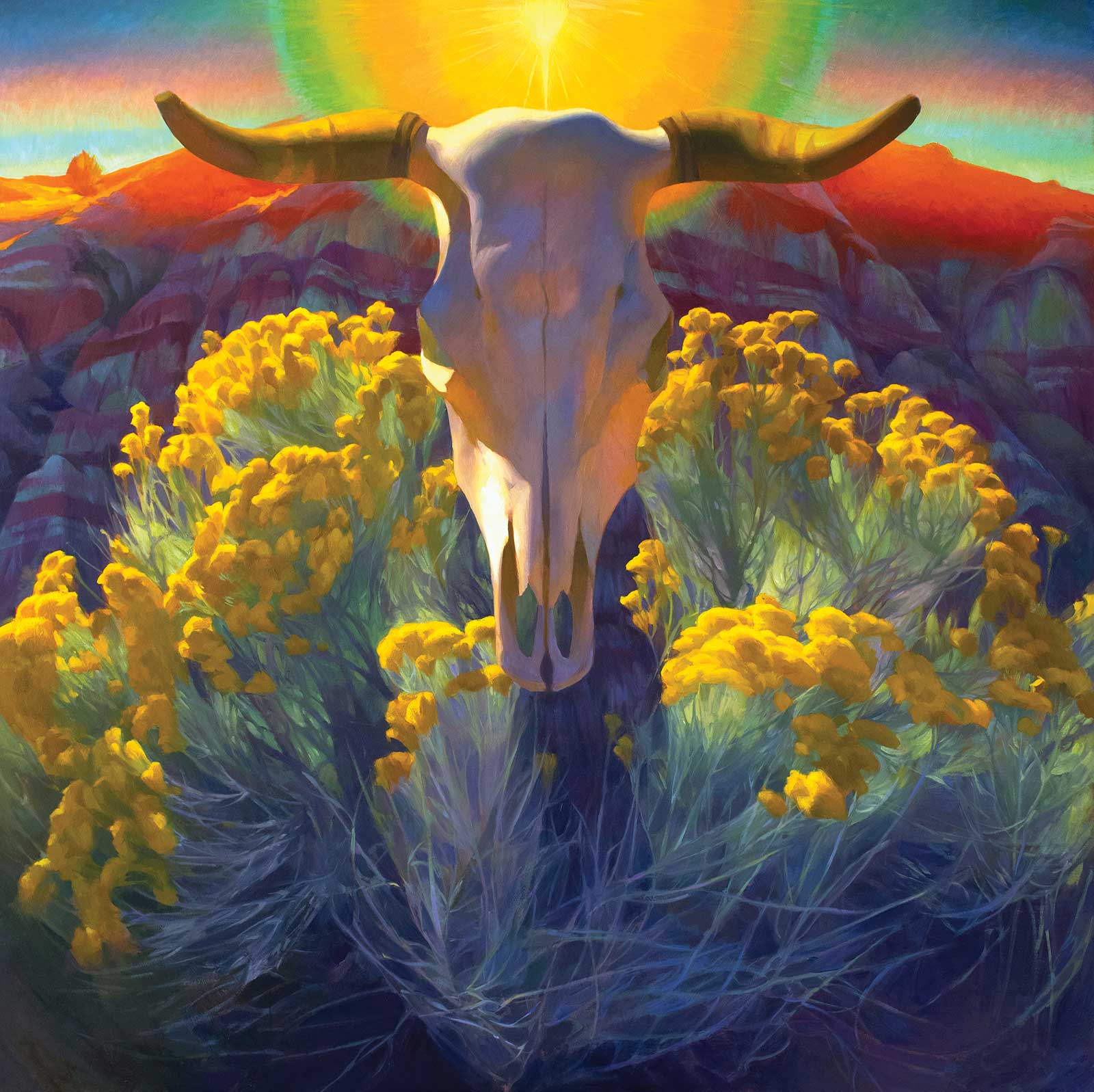
Helios, oil on canvas, 60 x 60 in.
Thus, her lush paintings flourish among the abundant treasures springing from the fertile soil of our postmodern garden of hybrid novelties and wonders. They are personal meditations on hope, romance and transcendence, and as they bring her floral religious iconography to the traditional conventions of Western art, they mark an exciting moment of its evolution. She is a creative agent of synthesis, following the fertile threads of imagination as she builds her painted delights, betrothing the dreamy botanical aesthetics of her fond and fertile forest to the crisp Western inspiration of the dry and distant desert, binding myths, and legends.
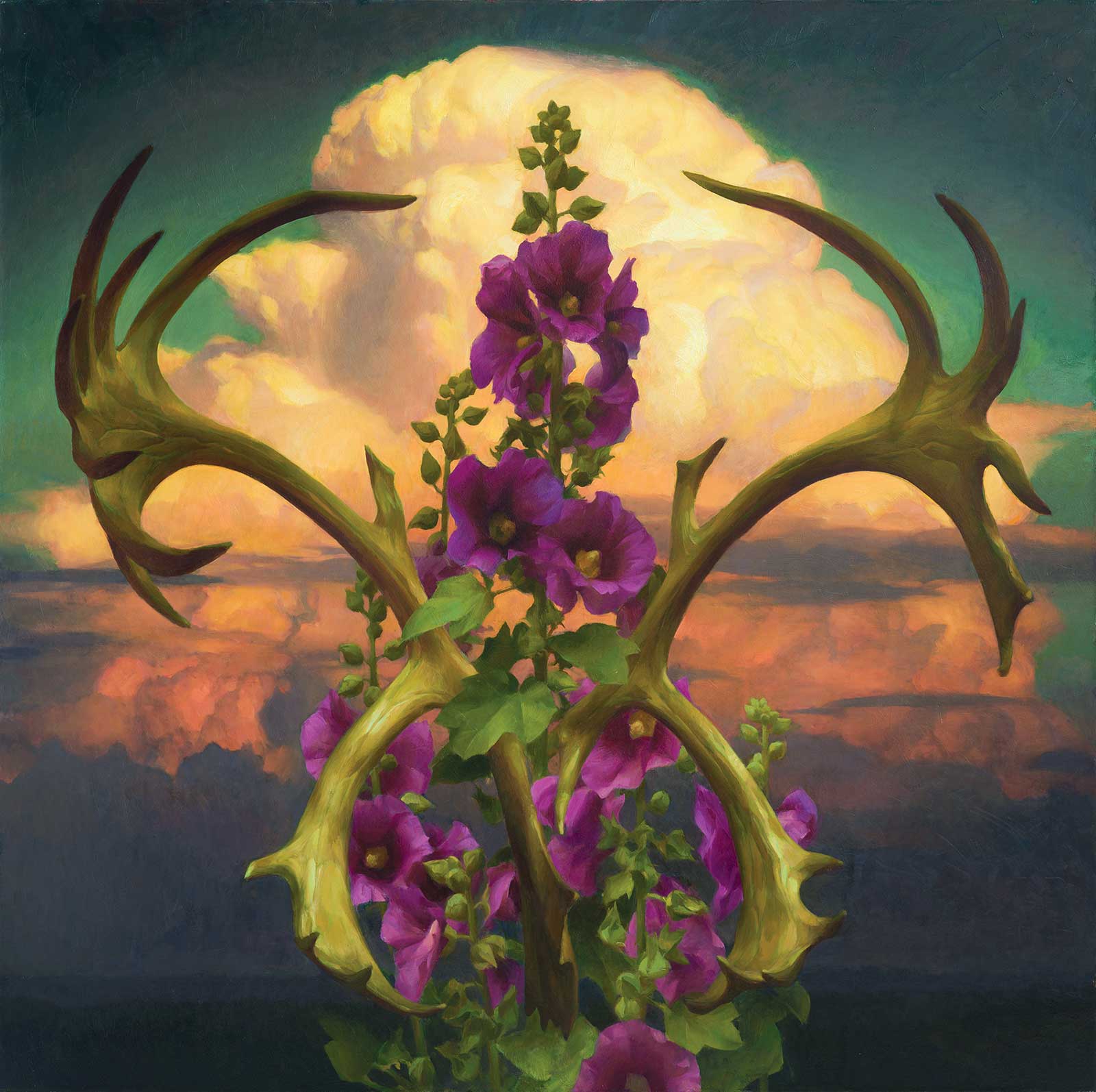
Arc, oil on canvas, 48 x 48 in. Collection of Willy Matthews & Laura Barton
Like pioneers exploring the land, the couple have made many charmed journeys down the country roads that take them from home to home, passing through New Mexico, Utah, Arizona, Wyoming and Idaho, stopping to sink themselves into the blessed places they found. “I got to paint in a lot of these places and spend significant amounts of time there, really getting to drink in that landscape…When I’m looking at the Western landscape, I’m looking at it through the eyes of an alien visitor in a way, you know? And in a certain sense, I kind of wanted some of the paintings of the floating skulls and antlers to feel like alien objects, like a UFO or an angelic being. Because there is something really celestial about certain parts of the West.”
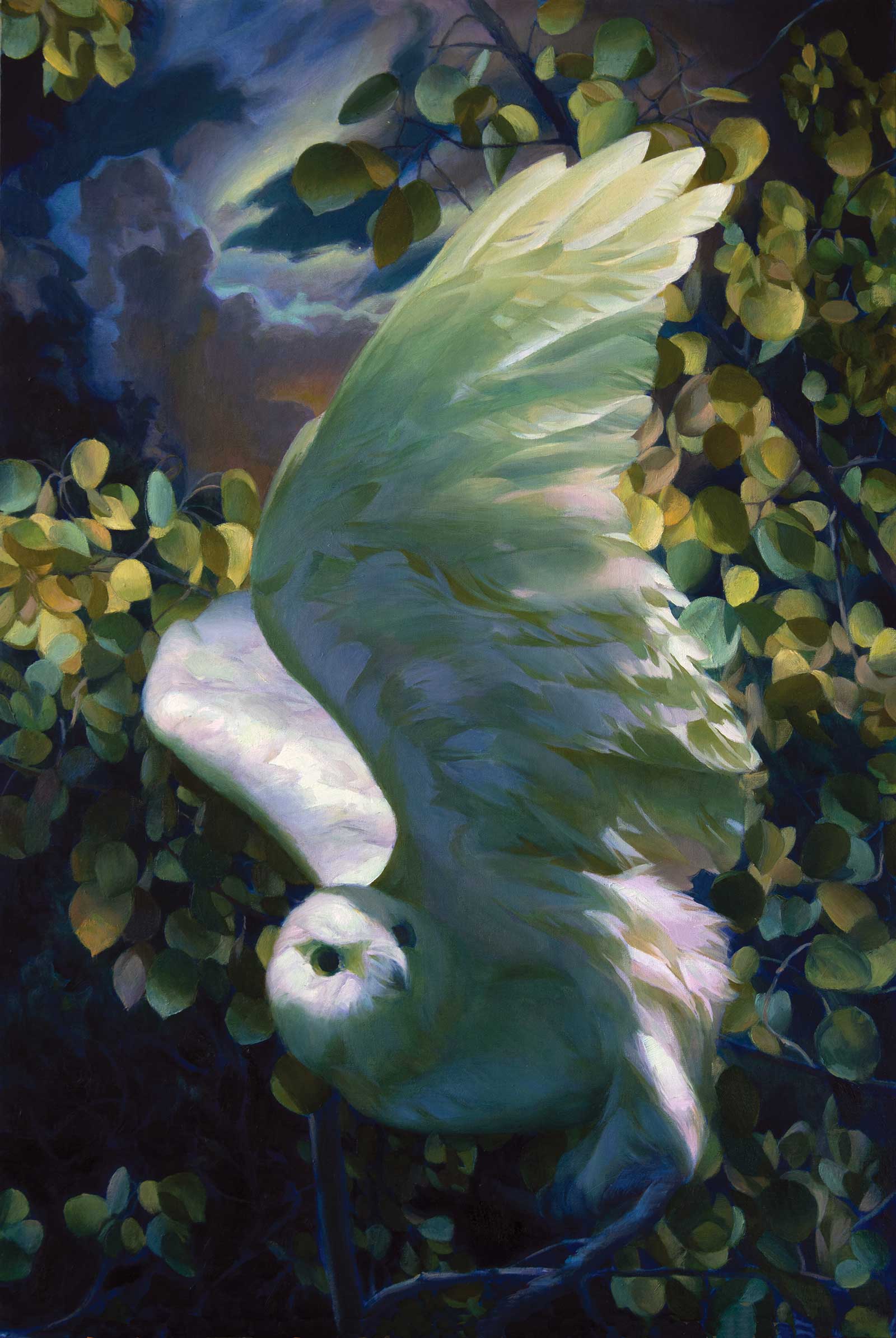
Nyx I, oil on linen, 36 x 24 in.
Her work is founded on brilliant masters of the American desert. Stein points to Georgia O’Keeffe, “…And most importantly for me, Agnes Pelton. She’s been a really big influence on me. She was a transcendentalist painter and spiritualist artist. She claimed that a lot of her paintings were given to her, channeled to her by spirits…a lot of her paintings have a landscape feel and format, but they are abstracted, and she’s filtered the West through her very, very unique and specific spiritual vision.” And if Pelton offers Stein mandala-like symmetry, meditations on form, and a metaphysical precedent, then she has also learned from Maxfield Parrish’s rich color gradients, his personal gardens of spiritual elevation, and his composed dreamscapes.
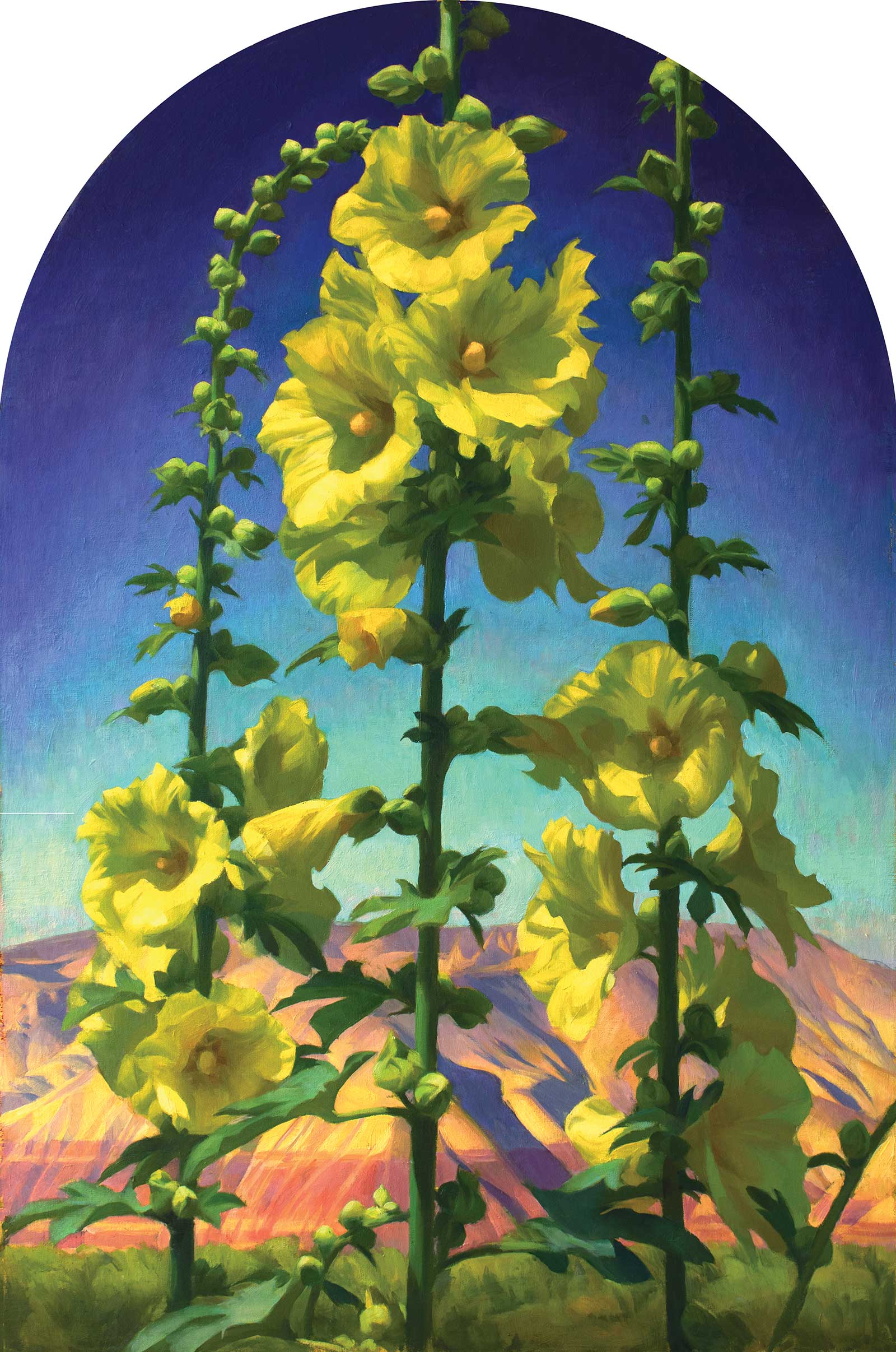
Alcea Rugosa, oil on linen panel, 36 x 24 in.
Stein’s paintings are innovative jewels in the canon of contemporary Western art. They are timely indications of the change that has been brewing, for the collectors of the Millennial and Z generations were not raised with the mythos of the cowboy at the forefront of popular culture. Their West is not the Boomers’ West. The broad cultural differences between the generations, the transition of wealth funding new collectors, and the shift toward bohemian revolt among the young each position the genre for transformation. Darrell Beauchamp of the Kerrville Museum of Western Art says, “…It goes to defining the American West. It’s no longer just cowboys on a horse looking left. Cowboys in a stream looking right. It’s not your grandfather’s American West…we’re looking towards a younger crowd. A crowd that…likes colors, they like vibrant patterns.” The museum’s wise wager on Stein signals an institutional welcome to the evolution of Western art which comes with rich potential for its broader recognition beyond regional confines. As the tastes of generations shift, profound cultural changes alter the art market, and Stein’s hybrid paintings represent a future that is as inevitable as the geology of the timeless strata of Carbon Canyon.
This article also appears in the August 2026 issue of Western Art Collector. —
The Enchanted West of Adrienne Stein
August 22-November 7, 2026
Museum of Western Art
1550 Bandera Highway, Kerrville, TX 78028
(830) 896-2553, www.museumofwesternart.com
Powered by Froala Editor