American artists flocked to Paris and the French countryside after the end of the Civil War in 1865 to absorb European culture, marvel at the proximity of great works of art and learn from the masters.
French Impressionism made its debut at a private exhibition in Paris in 1874, shortly after the influx of eager American artists. The style rejected traditional academic art, focusing instead on light, color and representing the daily lives of the middle class.
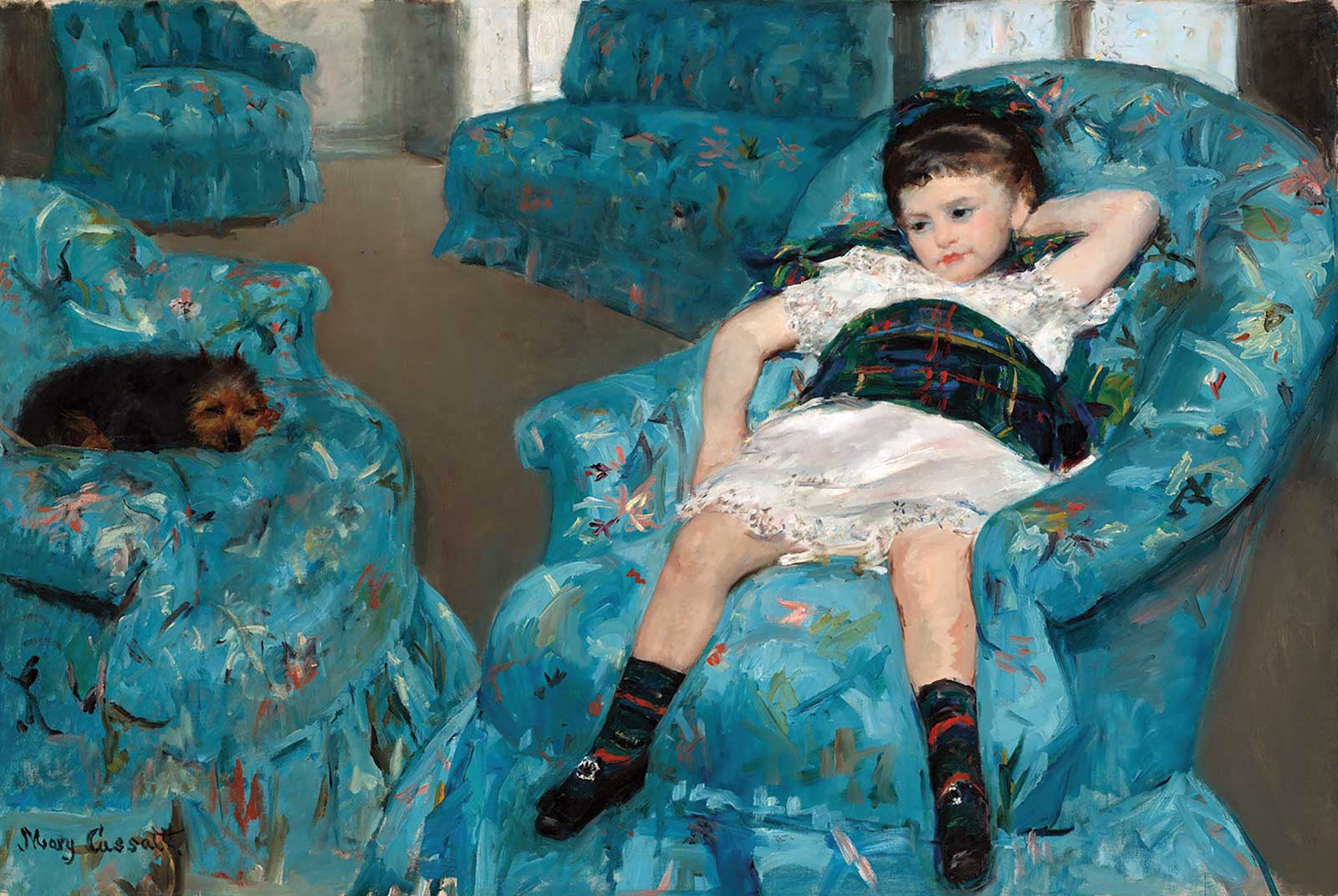
Mary Cassatt (1844-1926), Little Girl in a Blue Armchair, 1878, oil on canvas, 35 1/4 x 51 1/8 in.
“My most quoted statement—The power of the suggestive is much greater than the statement of reality—captures both my philosophy of painting and the essence of impressionism, particularly the work of Claude Monet,” says C.W. Mundy, a modern American impressionist painter.
“To understand American impressionism, one must begin with Monet’s Impression, Sunrise, 1872. In naming the painting, Monet emphasized his interpretation of the scene rather than a literal depiction of it. That concept gave rise to an entirely new movement: Impressionism.”
Most young Americans in Paris in the 1870s were repelled by the style when it made its debut. They ignored it, continuing to focus on traditional academic styles. Mary Cassatt was the exception. She moved to Paris in 1874 and adopted the style, painting scenes focusing primarily on the private, social and maternal lives of women. Her work caught the attention of Edgar Degas, who invited her to exhibit with the French impressionists in 1877.
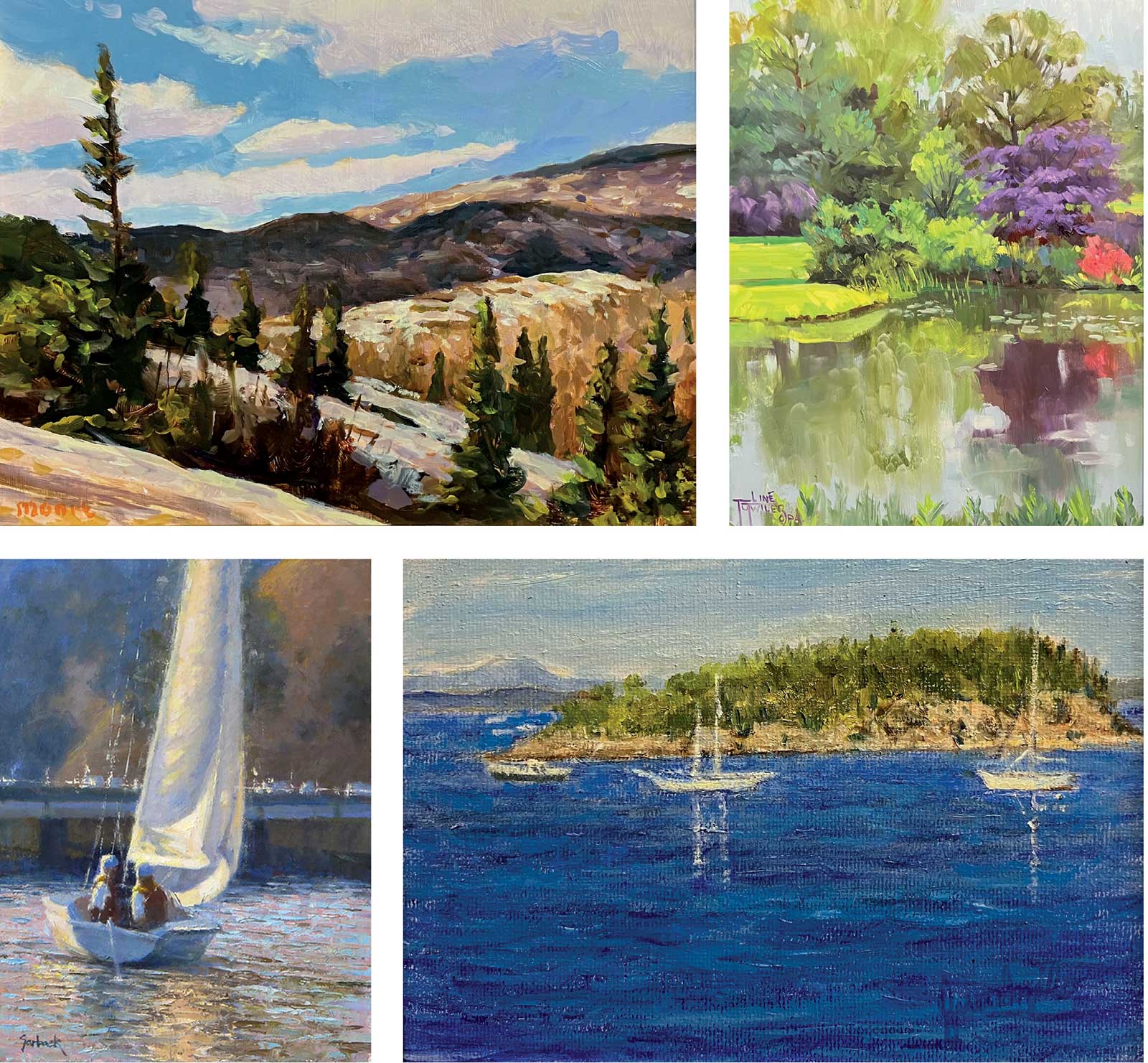
Top: Argosy Gallery, March, Champlain Mountain, oil on panel, 12 x 16 in., by Scott Moore. Argosy Gallery, Garden Delight, Asticou, oil on panel, 16 x 12 in., by Line Tutwiler. Bottom: Susan Sarback, Winds at Dusk, oil on panel, 9 x 12 in. Argosy Gallery, Sheep Porcupine, oil on canvas, 5 x 7 in., by Carolyn Jundzilo.
In the mid-1880s, French Impressionism lost its radical edge, and American collectors began to appreciate the style, and American painters began to adopt its signature pastel palette and loose brushstrokes.
“Many American artists traveled to France to study this innovative approach, returning home with new ideas that would shape the development of American impressionism,” says Mundy. “Their greatest adaptation of the French style was the expanded use of varied brushwork and broken color. For me, Impressionism has always been about the expressive possibilities of paint manipulation and the creative use of diverse tools and techniques.”
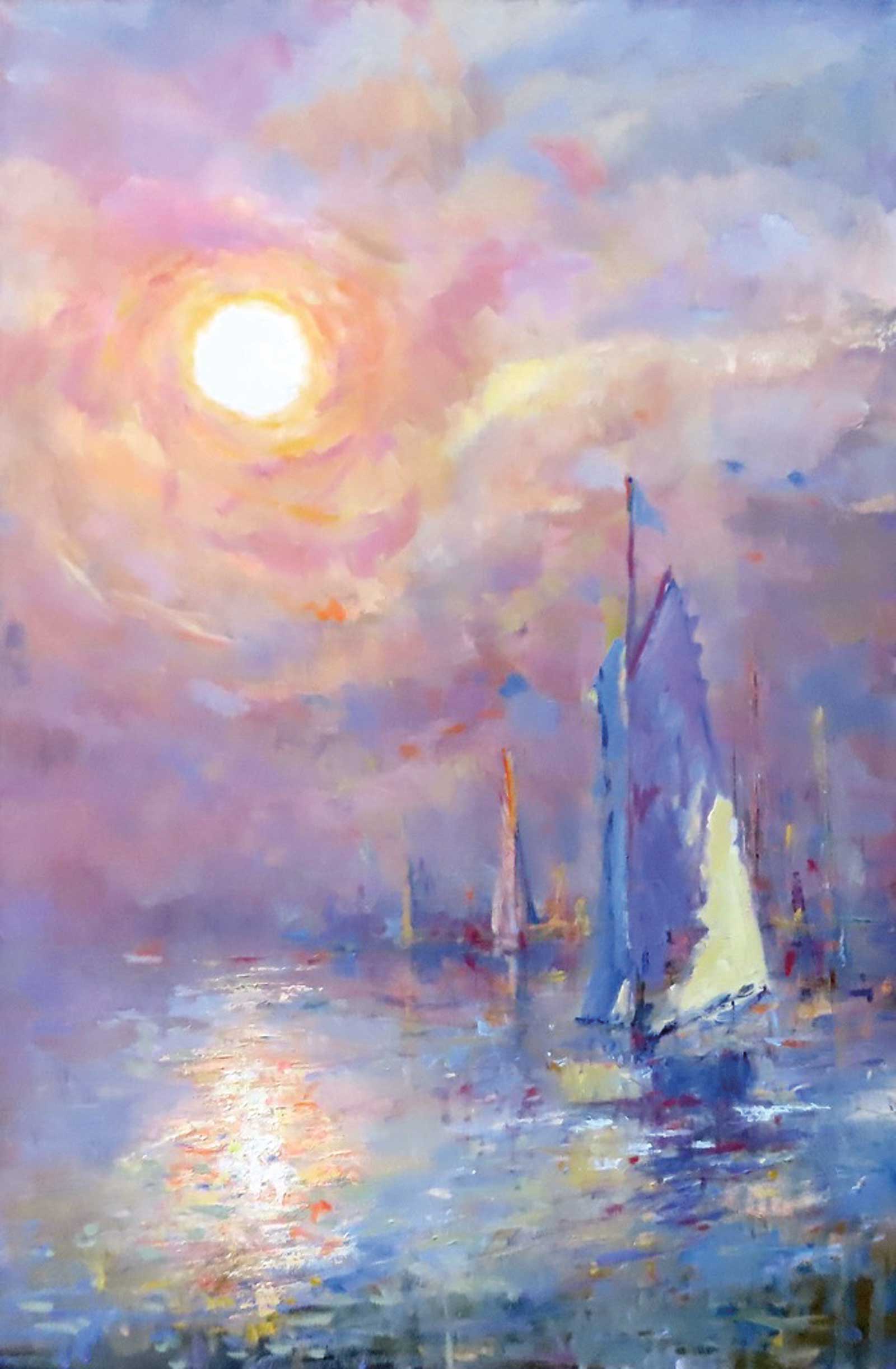
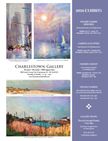
Charlestown Gallery, Sun Sail Sip, oil on canvas, 36 x 24 in.
The American impressionists were more cosmopolitan than the French. Their works reflected the industrialization, urban life and society. Artists like Childe Hassam were struck by the constant motion of cities and captured scenes in rapidly rendered vignettes.
“The work of William Merritt Chase, Robert Vonnoh and Daniel Garber resonates deeply with my own artistic sensibilities. Chase’s achievements in figurative painting, landscape and still life helped define the American impressionist movement. Childe Hassam, whose brushwork reflects a distinctly French influence, remains one of my favorite American impressionists,” says Mundy. “Impressionism endures because of its sense of playfulness and invitation to participation, allowing viewers to complete the image in their own imagination.”
Honest depictions of middle-class life, that capture both beauty and reality, remain compelling subjects to artists and collectors alike. While modern lives look different from those of 1880 city dwellers and French farm workers, holding up a mirror to everyday moments remains an important act. In this first special section dedicated to impressionism, we offer a selection art works that demonstrate the ways in which the style continues to remain relevant from leading artists in the genre.
At Argosy Gallery, in Bar Harbor, Maine, the surrounding landscapes have long drawn artists to capture their natural beauty. Only the Hudson Valley and Catskills of New York have an older and more storied history of American landscape than Maine's Mt. Desert Island. Artists started sketching the area as early as 1828, and Thomas Doughty’s oil painting of Mt. Desert Rock was exhibited in Boston in 1836, likely inspiring Thomas Cole to visit shortly thereafter.
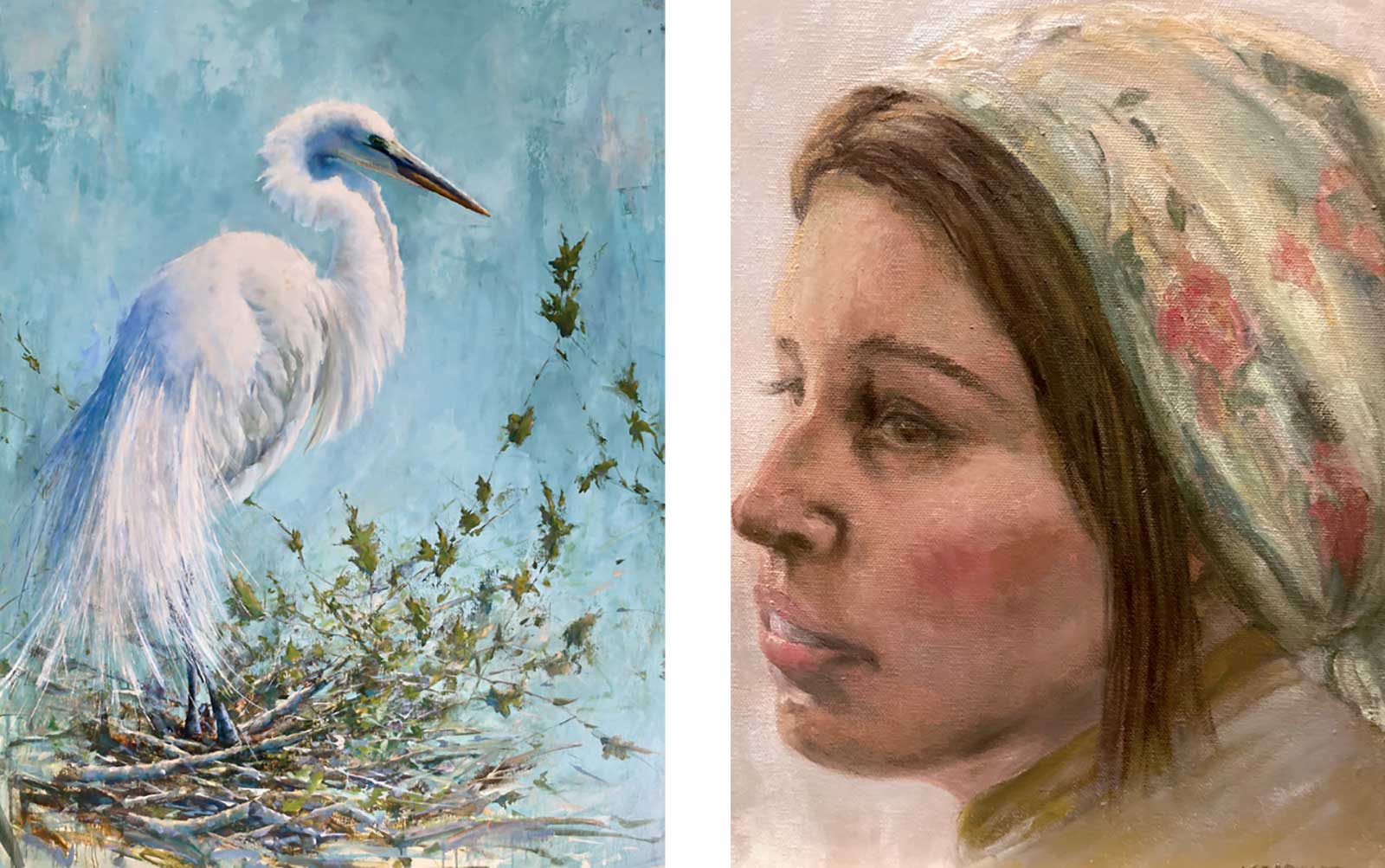
Rana Jordahl, Nestled In Blue, oil, 36 x 48 in. Josie Gearhart, Portrait of Lisa, oil on canvas, 11 x 14 in.
Several generations later, American impressionists were equally taken with the land and the light. Since 1916, the island has been home to Acadia National Park. Artist Dwight Blaney invited his friends to Ironbound, his island retreat just off the larger island. These artist friends included John Leslie Breck, William McGregor Paxton, Hassam, and last but not least, John Singer Sargent. For contemporary impressionists from all over the country, the area is still a favored destination. All strive to capture the effects of natural light, using visible brushstrokes with marks of color that coalesce into realistic images in the viewer’s eyes. They paint in all seasons and are concerned with the effects of sunlight, shadows, weather and time of day.
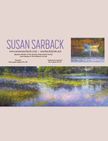
Across the country, Susan Sarback draws similar inspiration from the atmosphere and vastness of Northern California. “Like the impressionist painters, my work is rooted in observing how light transforms the world around us. Across seasons, times of day and changing weather, I explore how light affects color and sets the emotional tone of a scene,” says Sarback.
“I’m especially drawn to landscapes because they reveal my fascination with atmosphere and rhythm. Subtle transitions—fog lifting from a hillside, cool shadows stretching across late afternoon fields, or wind rippling in layered patterns across a river—are the moments that inspire me,” Sarback continues. “I respond to these fleeting qualities through suggestion rather than detailed description, using color and expressive brushwork to capture the essence of a feeling, a time or a place. My paintings aim to evoke the poetry of atmosphere and the beauty found in moments that are both immediate and ephemeral.”
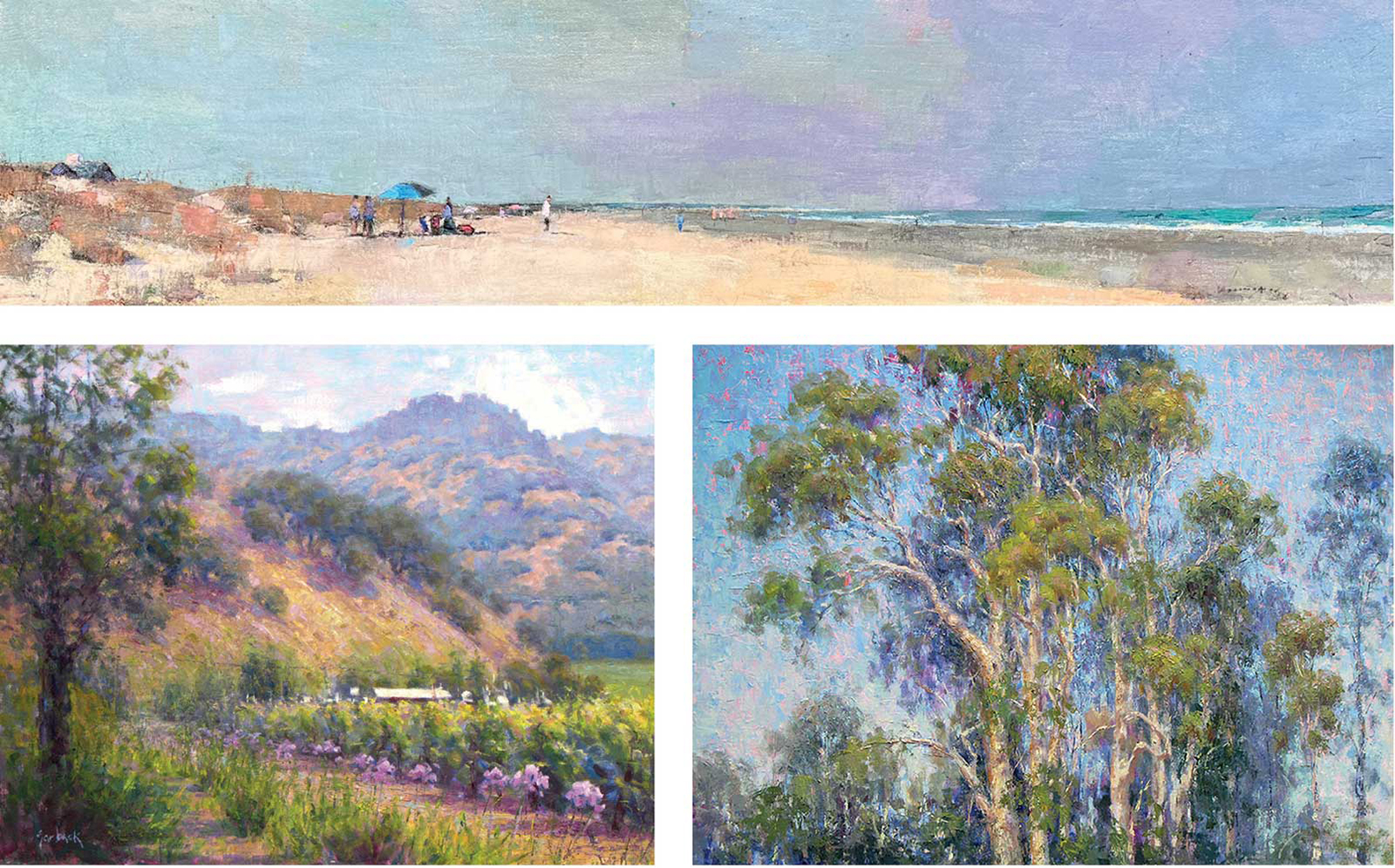
Top: Charlestown Gallery, Morning Haze, oil on canvas, 10 x 44 in., by Larry Horowitz. Bottom: Susan Sarback, Napa Valley, the Silverado Trail, oil on panel, 16 x 20 in. Susan Sarback, The Eucalyptus Grove, oil on panel, 18 x 24 in.
Rana Jordahl works in a style she describes as contemporary impressionism, blending representation with expressive abstraction to capture the beauty and personality of her subjects.
“While rooted in the landscapes, wildlife and coastal beauty that surround me, my goal is never to create a literal record of a place or subject. Through abstract impressionism, I seek to capture the emotion, movement and atmosphere that make a moment memorable,” says Jordahl. “Layers of texture, expressive brushwork and unexpected color allow me to move beyond representation and into interpretation. The resulting paintings invite viewers to complete the story through their own experiences and memories.”
“I am particularly drawn to the balance between spontaneity and structure, where intuitive mark-making and layered compositions create a sense of depth, discovery and visual conversation. I am most inspired by the fleeting qualities of light, the rhythm of nature and the energy that exists beneath the surface of everyday scenes. My hope is that each painting evokes a strong feeling, creating a connection that is both personal and lasting.”
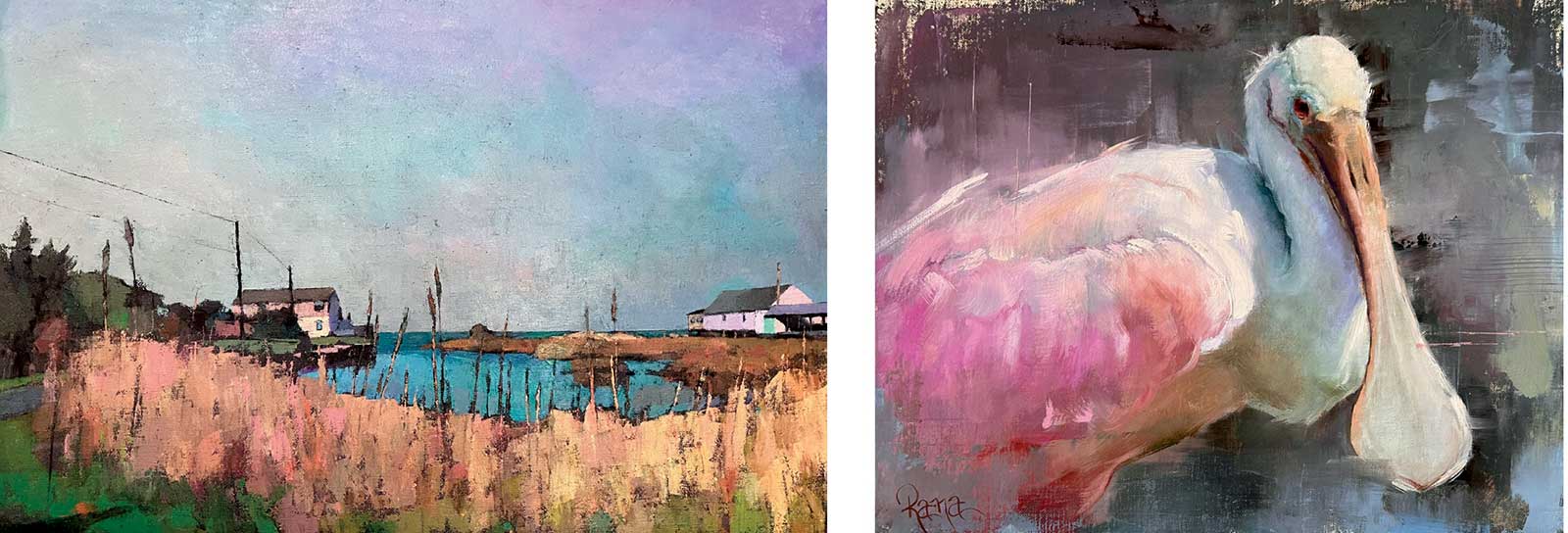
Charlestown Gallery, Cove, oil on canvas, 34 x 52 in., by Larry Horowitz. Rana Jordahl, Pinkaboo, oil, 11 x 14 in.
Charlestown Gallery in Rhode Island is showcasing two modern American impressionist painters: Anthony Tomaselli and Larry Horowitz. Both artists' work captures everyday landscapes, including a beach and neighborhood roads, and the people who inhabit them. In these impressionist paintings, the use of light and color and depictions of everyday beauty in middle class life upholds the tradition of the style.
Capturing the meaning inherent in the subjects is at the core of impressionism. Josie Gearheart paints to depict the nuances of humanity and life with quiet intention.
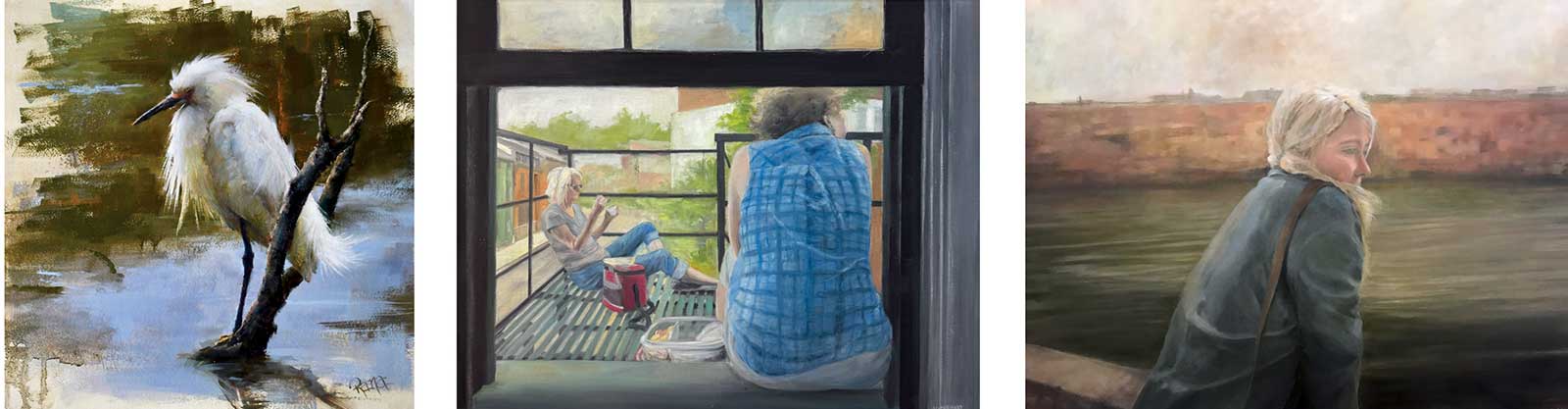
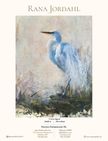
Rana Jordahl, Egret Nothing, oil, 12 x 12 in. Josie Gearhart, The Escape, oil on board, 24 x 30 in. Josie Gearhart, In the Beginning, oil on canvas, 36 x 48 in.
“Although I’ve done many a landscape and still life, I keep coming back to the fact that people and their humanity are a very worthy subject matter. Living our day-to-day lives, being human by doing what we do, becomes the narrative I seek out for my paintings,” says Gearhart.
Working primarily in oil on canvas and panel, she aims to capture a certain mood in a carefully crafted scene. “Most often, the result is quiet and contemplative. As I later applied the oil on the canvas slowly and with intention, the result becomes more reminiscent of my days spent with powdered graphite and pencil. With a master’s in lithography, my drawing background seems to still be a central point to my work, shaping the visual elements,” she says. “What we interact with, what becomes our thoughts…this is our reality. I strive to paint these intangible things. They become the mood of the painting. Gazing out a window, walking down an alleyway, sitting and eating lunch…all enjoying the journey.” —
Featured Artists & Galleries
Argosy Gallery
6 Mt. Desert Street, Bar Harbor, ME 04609
(207) 288-9226 www.argosygallery.com
Susan Sarback
www.susansarback.com
ssarback@att.net
Rana Jordahl
Charlotte, N.C., (704) 496-9181
rana@homesc.com
www.ranajordahl.com
Instagram: ranajordahl_fineart
Josie Gearhart
(513) 404-2629
josiegearhartart@yahoo.com
www.josiegearhartart.com
Instagram: josiegearhart
Charlestown Gallery
5000 S. County Trail, Charlestown, RI 02813
(401) 364-0120 charlestowngallery@cox.net
www.charlestowngalleryri.com
Powered by Froala Editor