
Connoisseurs of contemporary realism have seen and felt the pleasure when pictures by highly skilled representational painters momentarily pause time, when great technique suspends us in the brief slice of the present that splits our slippery past from our unknown future. But achieving that simple timelessness is only the beginning of a painter’s work as they enter the doors and mysteries of relativity opened by their creativity. For although the fourth dimension is altered and bent by the magic and illusion they make when three-dimensional space is created upon two-dimensional surfaces, the rhythms of these songs are tightly measured by the metronomic beat of the ticking clock. The greatest artists access other astonishing planes, opening the doors of perception to inconceivable and infinite possibility, entering further dimensions beyond the limits of space and time. In the voices of imagination, painters may sing songs beyond reality, beyond prognostication and beyond history. It is imagination that lifts us higher in the hierarchy of ideas. It is imagination which breaks the boredom and boundaries of the mundane world.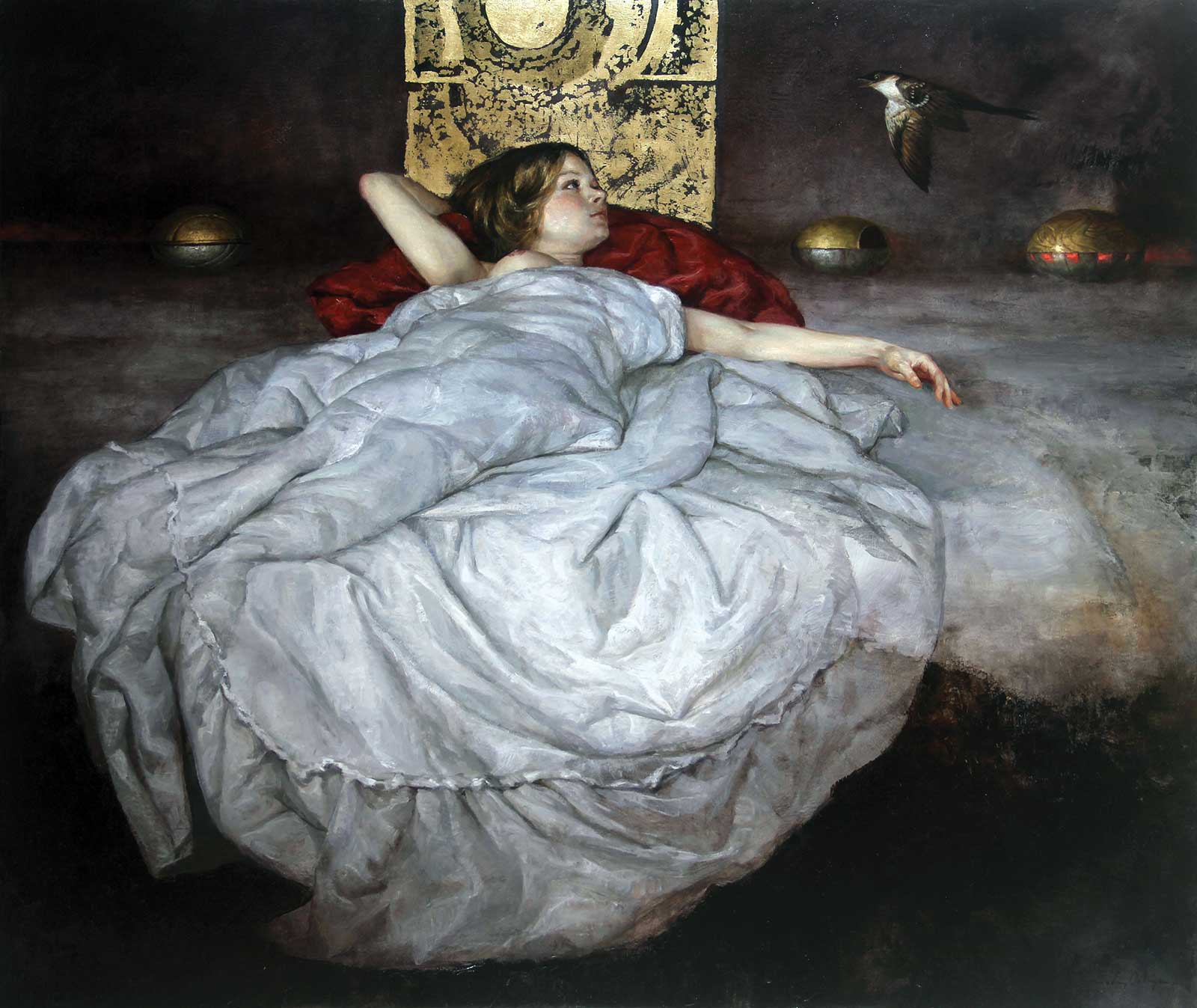 Amanece, 2017, oil on canvas, 43 1/3 x 51 in. Private collection.Ricardo Fernández Ortega’s paintings are miracles of an opened imagination that exists beyond the realms of time. They not only free us from the beat of temporal authority but also liberate us from the pains and pleasures of reality, from the ordinary experience of our four-dimensional lives. His ivory palace of predictions and magic memories opens like visionary scenes from an alternate universe, too impossible to be real, yet offering truths of human experience.
His shows are gorgeous walls of women. “I like women,” he says, “I like them all. There’s something that is truly deep.” But whereas many men gaze at paintings of women with the possessive look of lust and an eye guided by eros, Ortega’s images have a depth of insight that is not present in the most superficial of them. He explains, “My paintings are like somebody, not like something. I want every woman in my paintings to have a name, to have an interior, to have things to do, not just a beautiful body, not just a beautiful face, but somebody with a rich interior.”
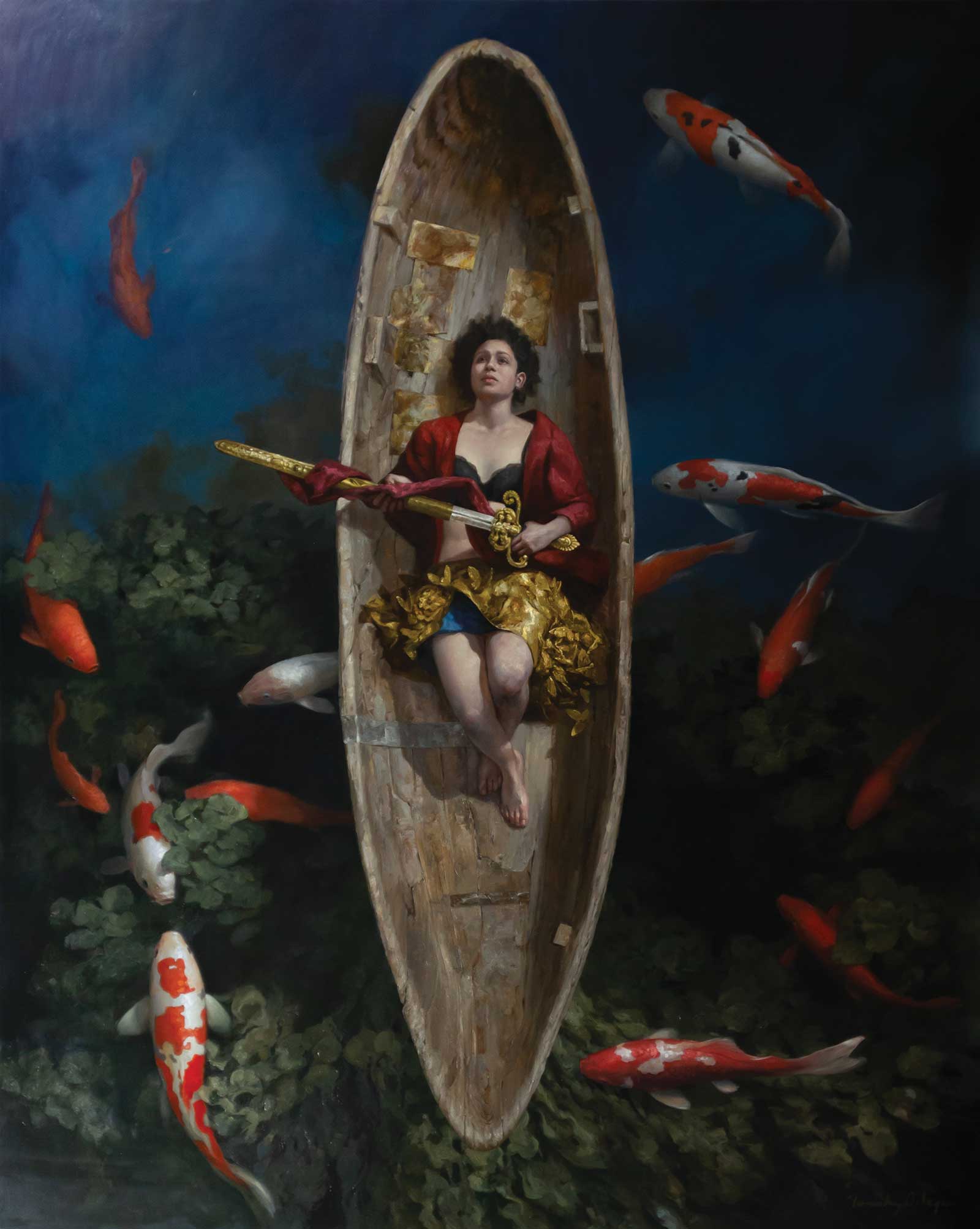 Ella Inicia la Jornada, 2003, oil on canvas, 114 x 90½ in. Private collection.
Painting girls and women is especially meaningful to Ortega. “It’s because I have a daughter who passed away 20 years ago,” he continues. “She was a child when she passed away. I started to paint girls to give her a life that she didn’t get. That’s why I paint women and girls flying, and having love, and making stuff, and girls with animals. I would love her to have a life like that.” In Ella Incia la Jornada, he reveals a maiden drifting over still water, borne by a hollowed log canoe, an aging vessel patched with copper plates and sheeted steel, its oars long lost. But although she has no control of her destiny, which is shaped by the eternal current of her emergent culture, she is the lake’s lady, armed with the gilded sword Excalibur. To Orphic Ortega she is Euridice in the underworld, riding ferryman Charon’s boat on the Lethe, crossing into the shadow world where memory and time fade, and souls forget themselves, the myth reminding us we are creatures of mind and when our recollections of the past are lost, so are we, our identities fading with our thoughts. “They are symbols that everyone can understand,” he says, “One of those symbols is a boat. The current takes us to other lands. There is that meaning in the boats that I paint.” But he begins his work in an open space of mind, allowing imagery to arrive from the secret place where imagination dwells. He says, “The paintings are not inspired by my dreams, but they are the brothers of my dreams. They come from the same place dreams come from…Everything I paint is unconscious. I don’t like to think of anything when I paint. I like to feel when I paint. Then, when I see the painting finished, I start to know what I have painted. It’s like someone else paints the work. I see images, and I have to read images, and then I see what I want to tell myself, not to anyone else. My paintings are me trying to tell myself the meaning of something, of life.”
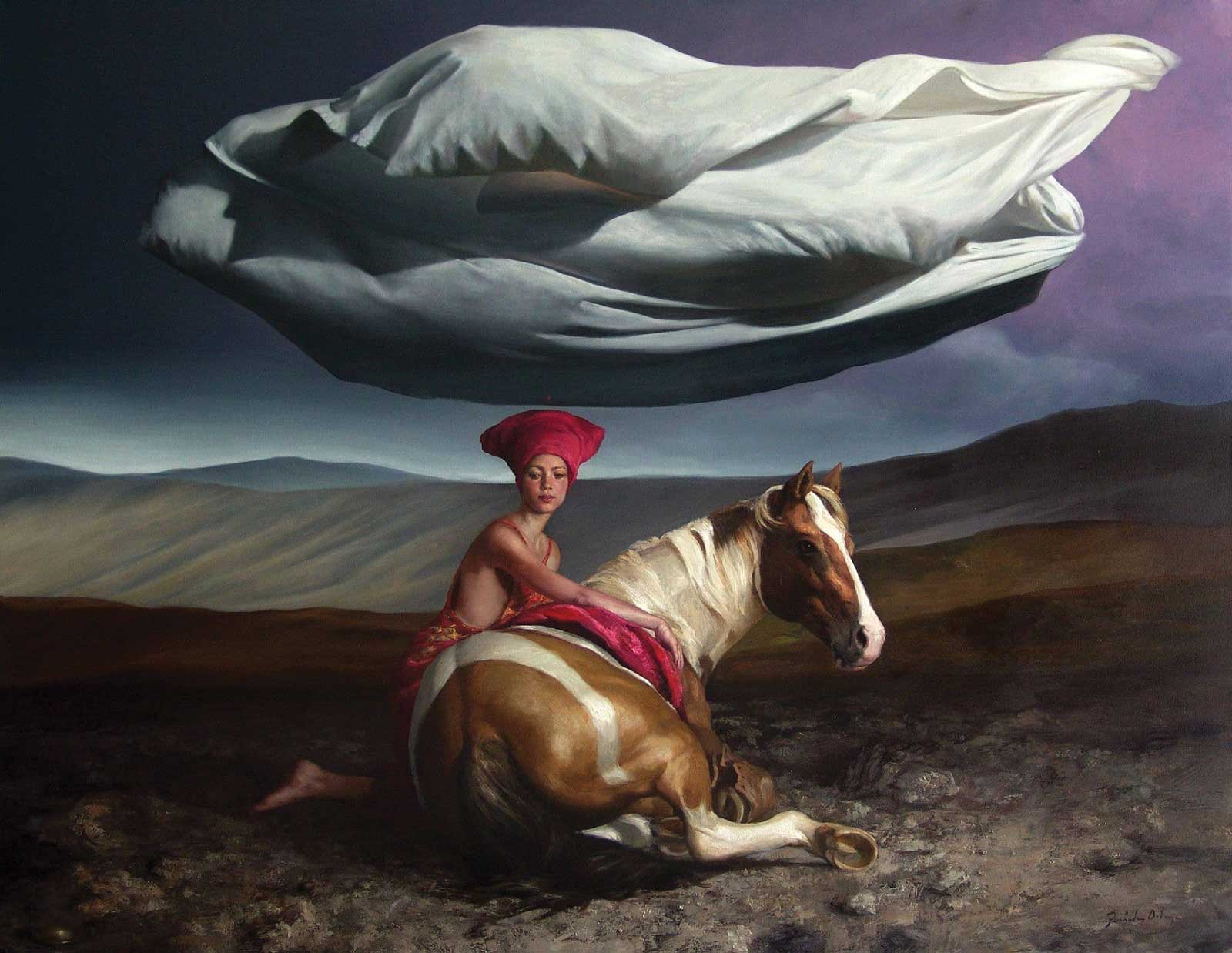 Journey Partner, 2017, oil on canvas, 35½ x 47¼ in. Private collection.
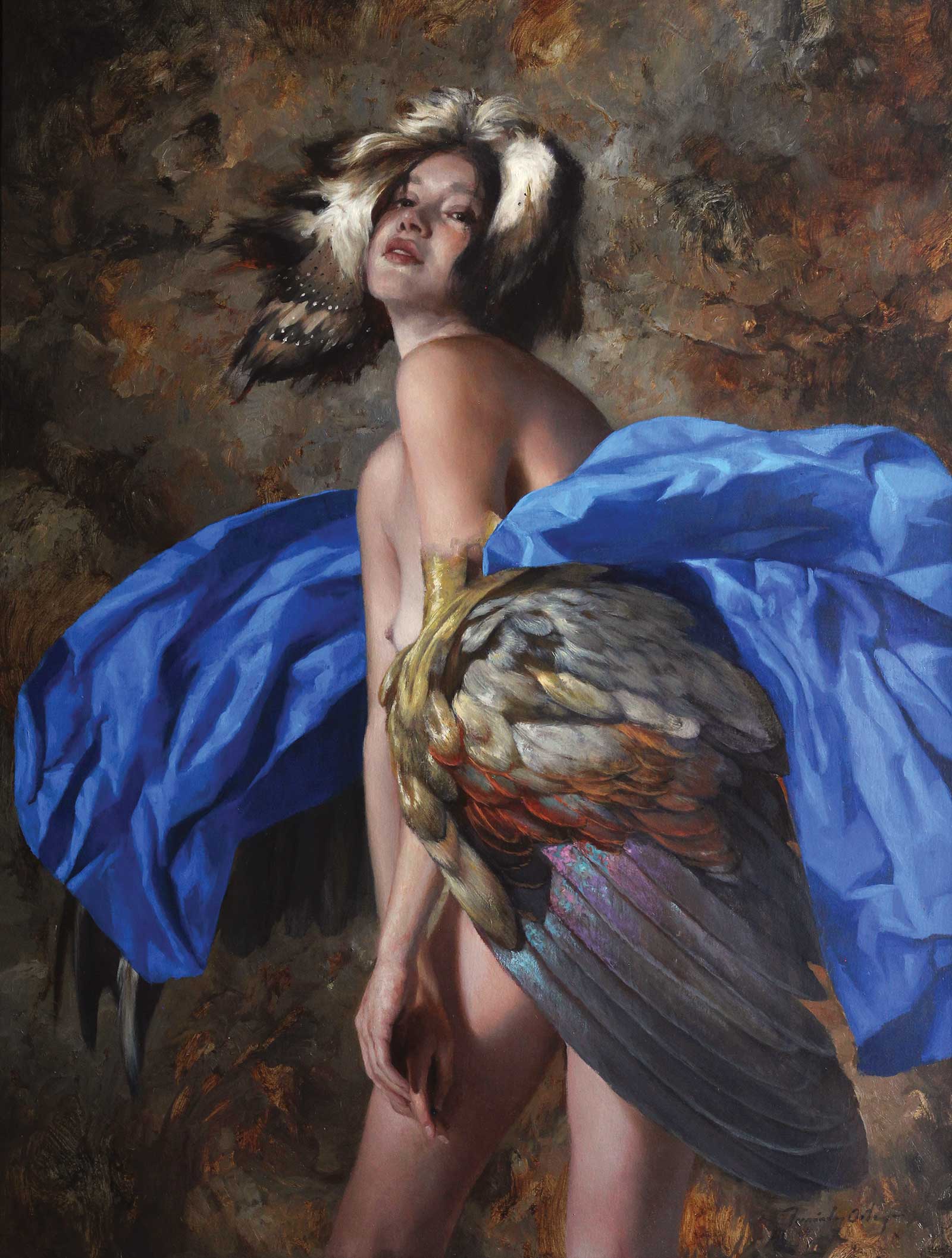
Delirio Pupilla, 2023, oil on canvas, 47¼ x 35½ in. Private collection.
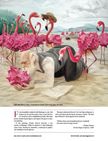
His daughter, whose name was Lupita Fernández, had a weak heart that failed her when she was nearly 5, and the desperate rend and rip of her loss shaped Ortega’s life. “My world turned upside down,” he explains. “All of my life, everything I believed before that moment came down. It changed the way I see the world. I think the way I had to learn to live since that moment was trying to paint how I would like her to have lived. I wanted to make a life for her that gives a sense for my life.” He longed to give her his own heart. Often, his archetypal maiden is ready to fly in the eternal heavens of the spirits, but she hasn’t left yet. In Umbral, she is partially armored and though the scarlet and dun feathers of her wings and her long gaze suggest she may launch herself into the air over the distant domed temple into the cumulus of that sunset sky, her familiar cat snuggles into the strange, gilded steel collar of her pauldron, grounding her in domesticity. In the hallucinatory Delirio Pupilla she wears the feathered wings of flight again, and a swath of Marian blue to lift her from the mortality and element of earth into the transmutation of the sky. In Jaguar Devorando Todas las Palabras she is turning to stone as her living memory becomes calcinated, and the iconic jaguar of the Azteca myths devours all the words of life in its symbolic role as darkness, the night sky, and as the god Tezcatlipoca, ruler of sorcery and destiny. In Evanescere she is wrapped in accumulated gold, and multi-armed like dancing Shiva, the sun-disc hat characteristic of the bohemian gypsy tribe, and the halo of the saints. Though this is a painting of loss and grief—for she must disappear as she becomes golden—she is also a glowing image of treasured and eidetic memory as she becomes a goddess engraved into Ortega’s imagination.
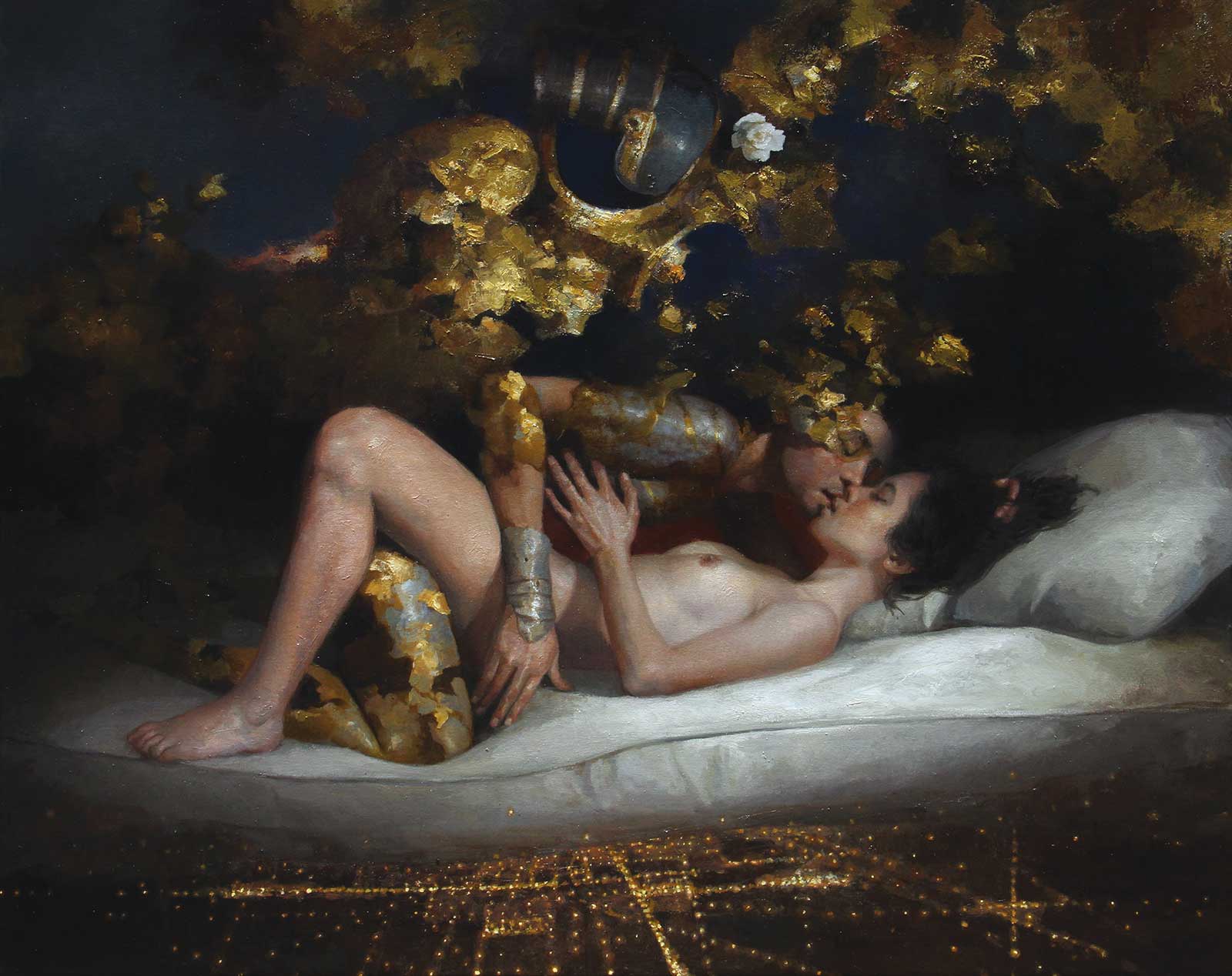
Ah, 2024, oil on canvas, 31½ x 391⁄3 in. Collection of the artist.
If the pull and weight of tragedy is a theme and anchor of many of his paintings, Ortega is also freed by his love to rise into the dreaming places of gravid romance and desire for the feminine ideal, searching the mysteries of imagination for images of iconic and archetypal women as the beloved, as the fertile goddess, as the mother, as the maiden, as the huntress. He is self-conscious of his role as an admirer, as a suitor and as a supplicant. He continues, “Not all of my paintings are about my daughter…I also want to explain my relationship with my wife and other women. I like women’s physicality and their interior, as well.” This is not a shallow endeavor—women’s tides are deep. “The interior life of men is the interior life I know,” Ortega adds. “The interior life of women is an unknown world. I can’t imagine what is in her interior, so I try to find that interior with my paintings.”
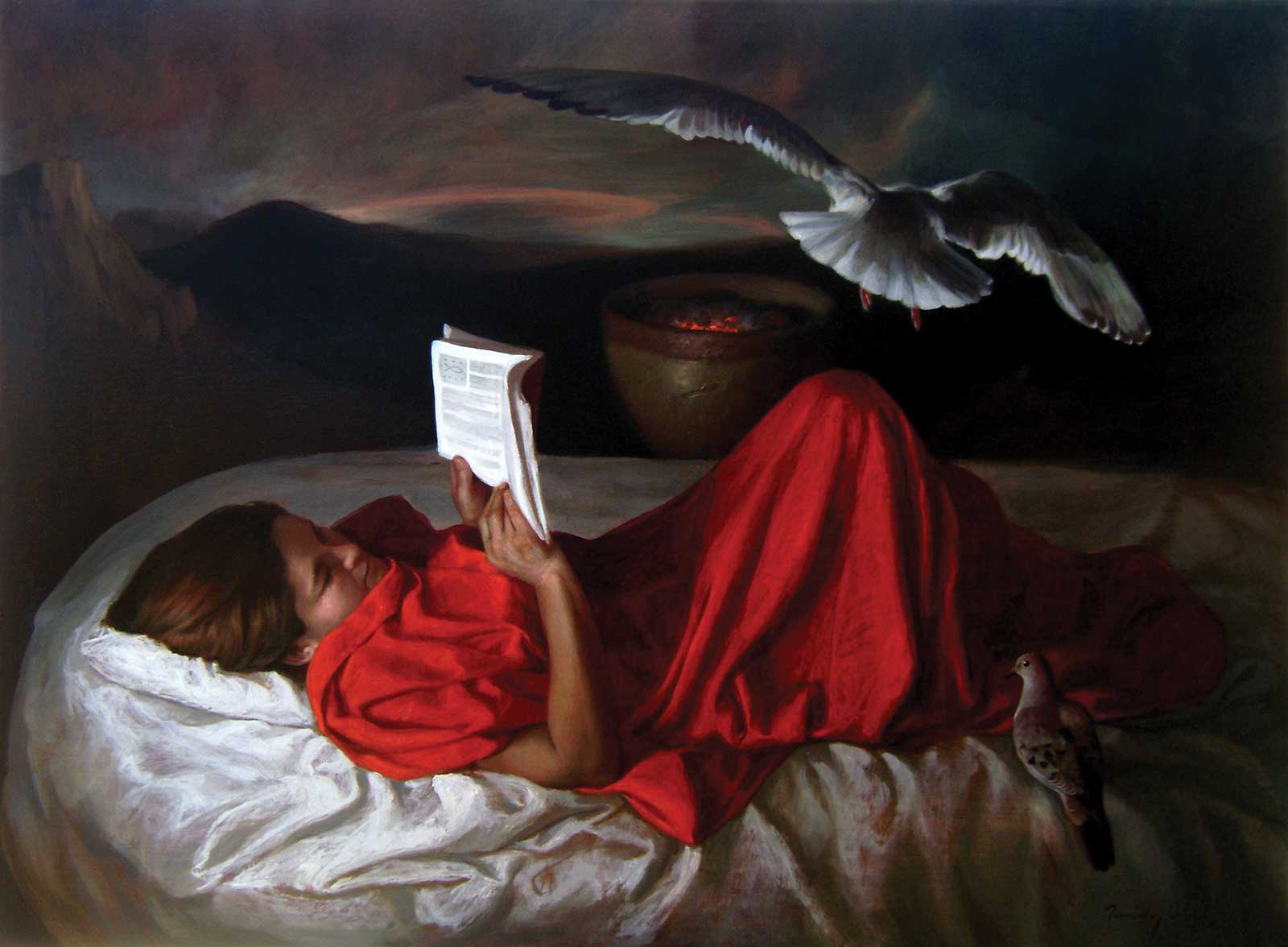
Instructivo Para la Crianza, 2009, oil on canvas, 391⁄3 x 47¼ in. Private collection.
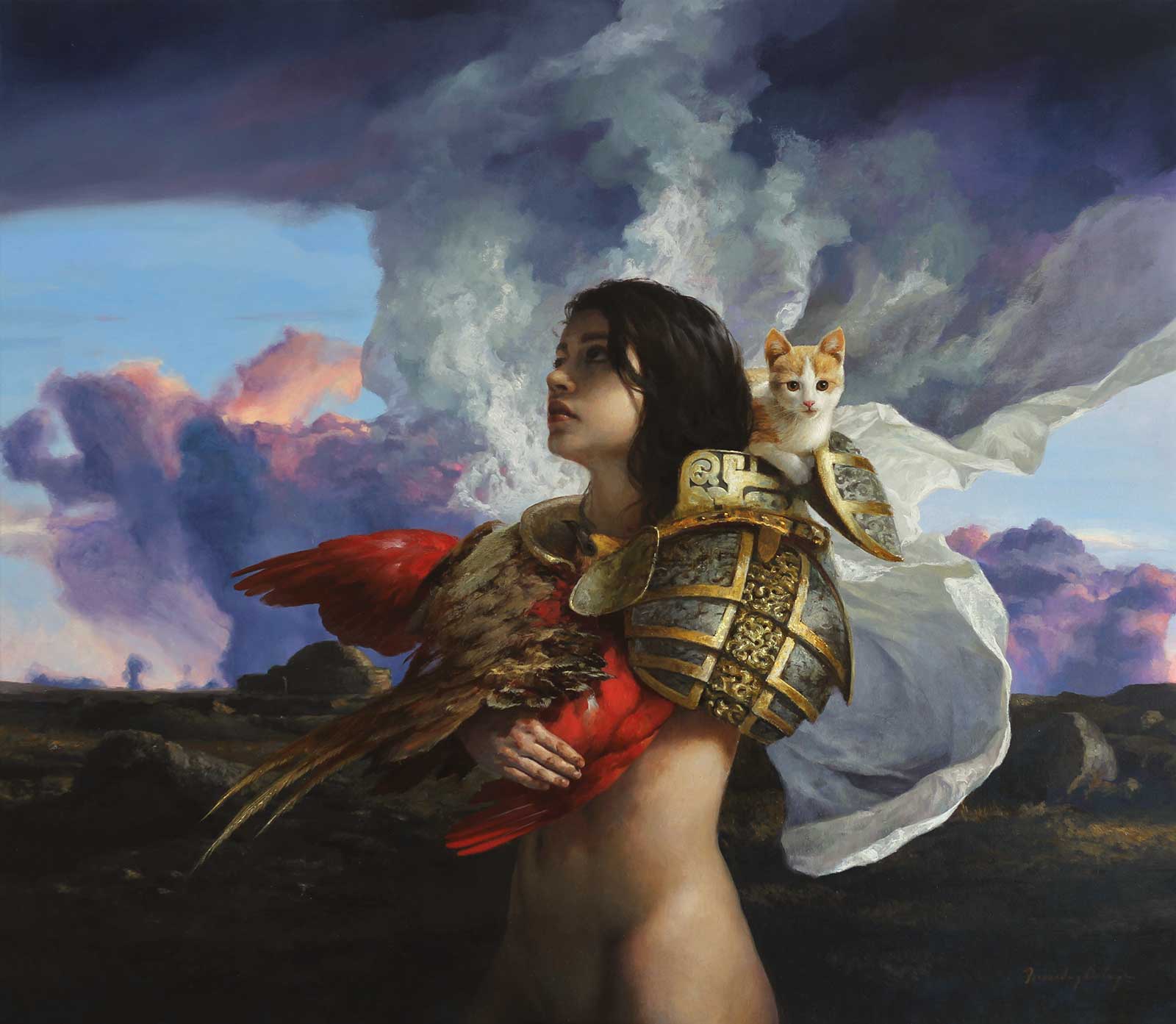
Humbral, 2022, oil on canvas, 431/3 x 51 in. Collection of the artist.
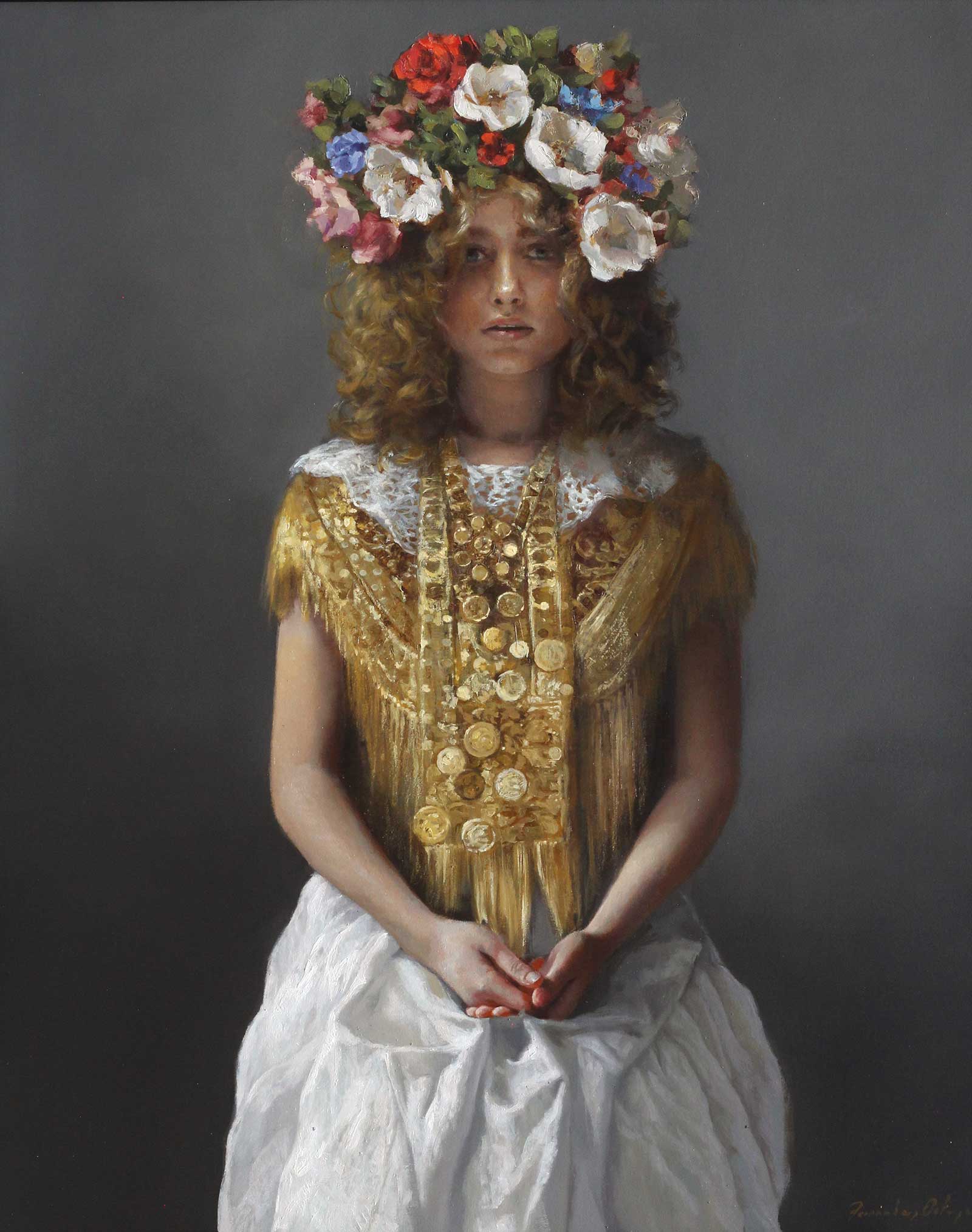
Antesala, 2023, oil on canvas, 47¼ x 35½ in., Collection of the Federal Government of Mexico.
Like many lovers and creators of contemporary representational art, Ortega learned to paint during the inauspicious late 20th century, when the sickness of avant-gardism dominated the cultural establishments of the West. When he was 15, he began attending a painting school in his hometown, Victoria de Durango, Mexico, where he says he learned a great deal, but nothing of technique. To understand the genius of the old masters he went elsewhere. He visited the Prado in Spain and was astonished by Velázquez, cursing as he witnessed the master’s excellence. Another important source gave him guidance as he felt his way along his life’s path in art—his earliest memories of paintings were tightly bound to Christian faith. “I have to tell you one thing,” he interjects while describing his training, “when I was a kid, I had the Catholic religion. Then, my mother had a fat bible, and I found paintings of Rembrandt and Titiano. To me those paintings were like movies. Then, I could imagine all the stuff that was happening in them. I was really excited by those images. I remember that bible was my hobby. I kept looking at those pictures for hours. That’s why I like my paintings to have chiaroscuro. All that stuff I was looking at in that bible when I was 6 or 7 years old was very, very important to me.”
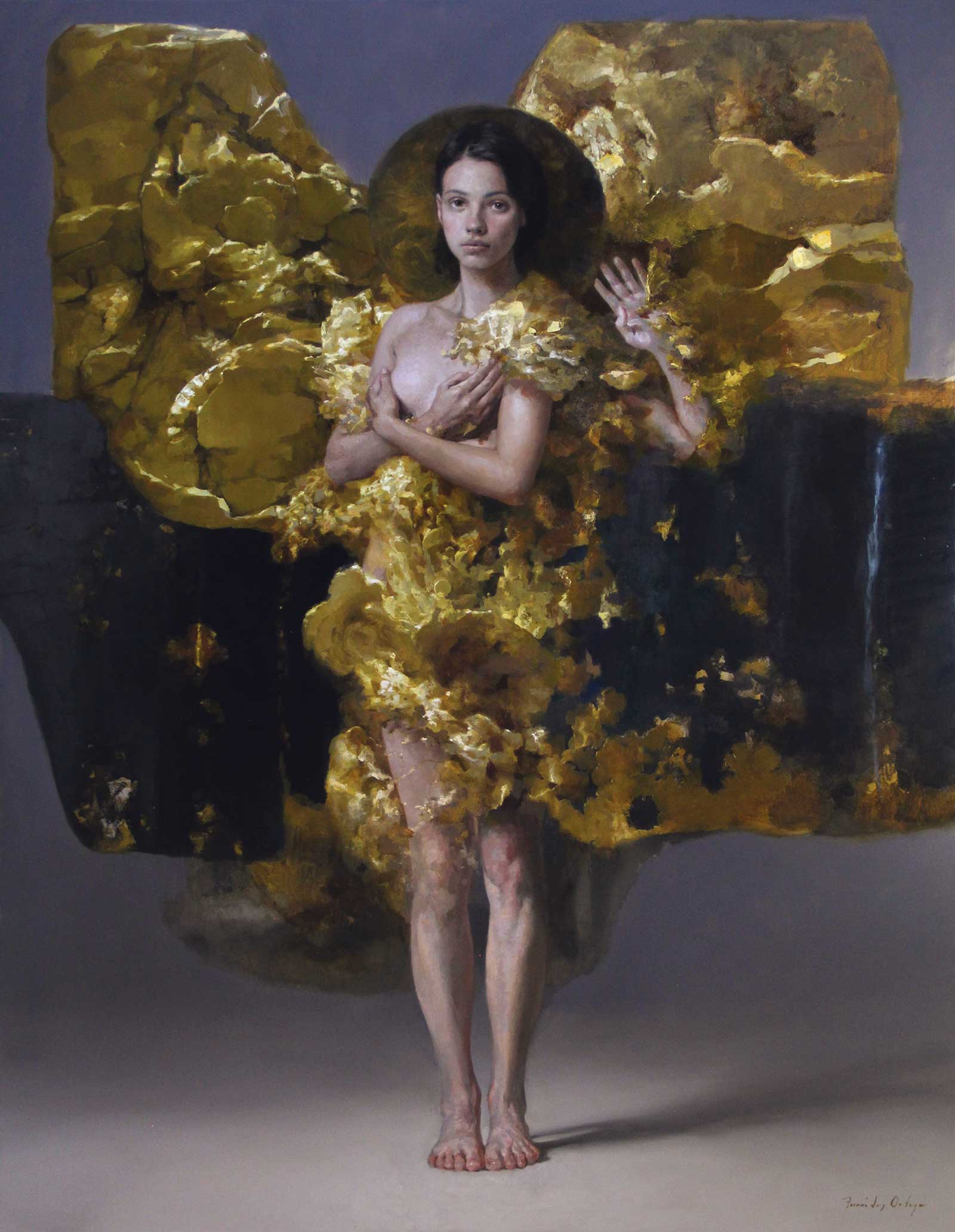
Evanescere, 2024, oil on canvas, 71 x 55 in. Private collection.
The religious iconography of the saints emerges repeatedly in Ortega’s paintings, but he was also excited by the imagery of American comics, which led him to the mannered excess of extravagant musculature and supernatural abilities endowed by radiation. “When I was a kid, I was for hours drawing horses and superheroes—Spiderman, Superman, all that stuff,” he shares. “I think there are some of those superheroes in my paintings now, when women fly. I think it’s because I like the expression of the body in the superheroes.” Like an inspired composer whose music is channeled through the mysteries of miracles and metaphors, the paintings reveal the deep thoughts of his imagination as a chain of allegory woven into imagery. He paints without knowing what his brush will bear, breaking open the doors of ordinary perception, and only looks for meaning after the compositions are complete. “There are a lot of things I didn’t know that I knew,” he says. “I discover my real feelings when I see my paintings. I know what is happening in my heart, my soul. There are no answers in my paintings. They are questions.” —
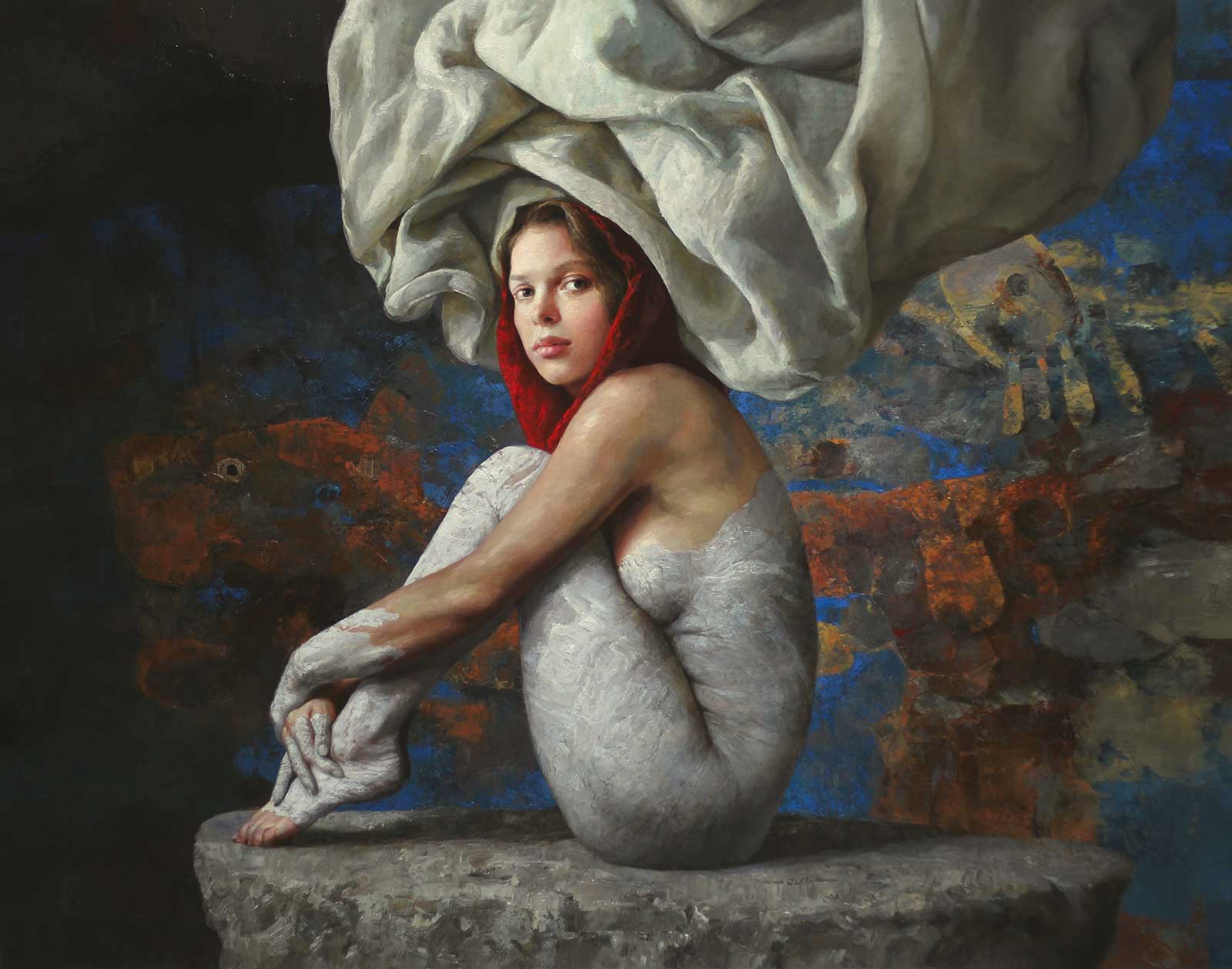
Jaguar Devorando Todas las Palabras, 2017, oil on canvas, 431⁄3 x 51 in. Private collection.
Powered by Froala Editor