The abundant salt marshes along the coast of South Carolina are rich with life, providing critical habitat for shorebirds, fish and shellfish. Unseen bacteria and fungi break down the rotting marsh grasses, making it edible for other creatures. Gathering information for her painting of an oysterman, Oyster Bank, Mary Whyte found an oyster company online and asked if they would take her out on their boat to watch and to sketch them hauling up baskets of oysters along the edge of the marsh.
Sketching, photographing and remembering the experience of being with her subjects at their work are the elements of her preparing for a portrait. The sound of the oysterman’s boots pulling up out of the mud, the quiet of the marsh and the sudden appearance of two seagulls gliding silently by all animated her creation of the painting.
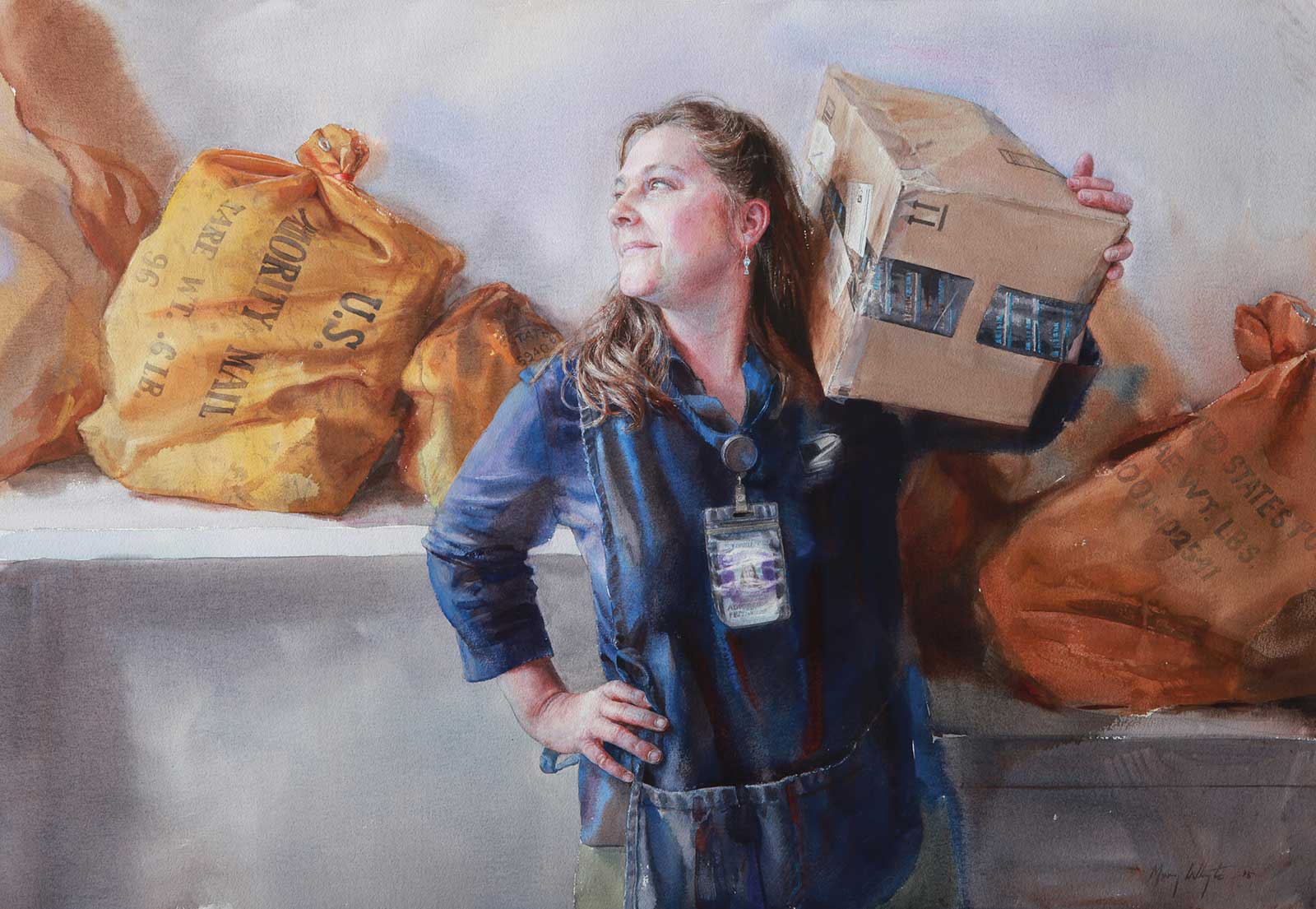
Special Delivery, watercolor on paper, 27¾ x 40¼ in. Courtesy Grohmann Museum, Milwaukee, WI.
Oyster Bank is included in the exhibition Mary Whyte: Salt of the Earth at the Gibbes Museum of Art in Charleston, South Carolina, May 22 through September 27. The paintings were introduced by the Charleston Symphony Orchestra when they were projected behind the orchestra in their concert Portrait of a Nation: America Celebrates 250 in late March. In its promotional material, the orchestra explains, “This extraordinary concert pairs the stunning artistry of Whyte’s portraits—honoring the grit and spirit of everyday Americans—with a stirring orchestral performance that captures the heart of our nation.”
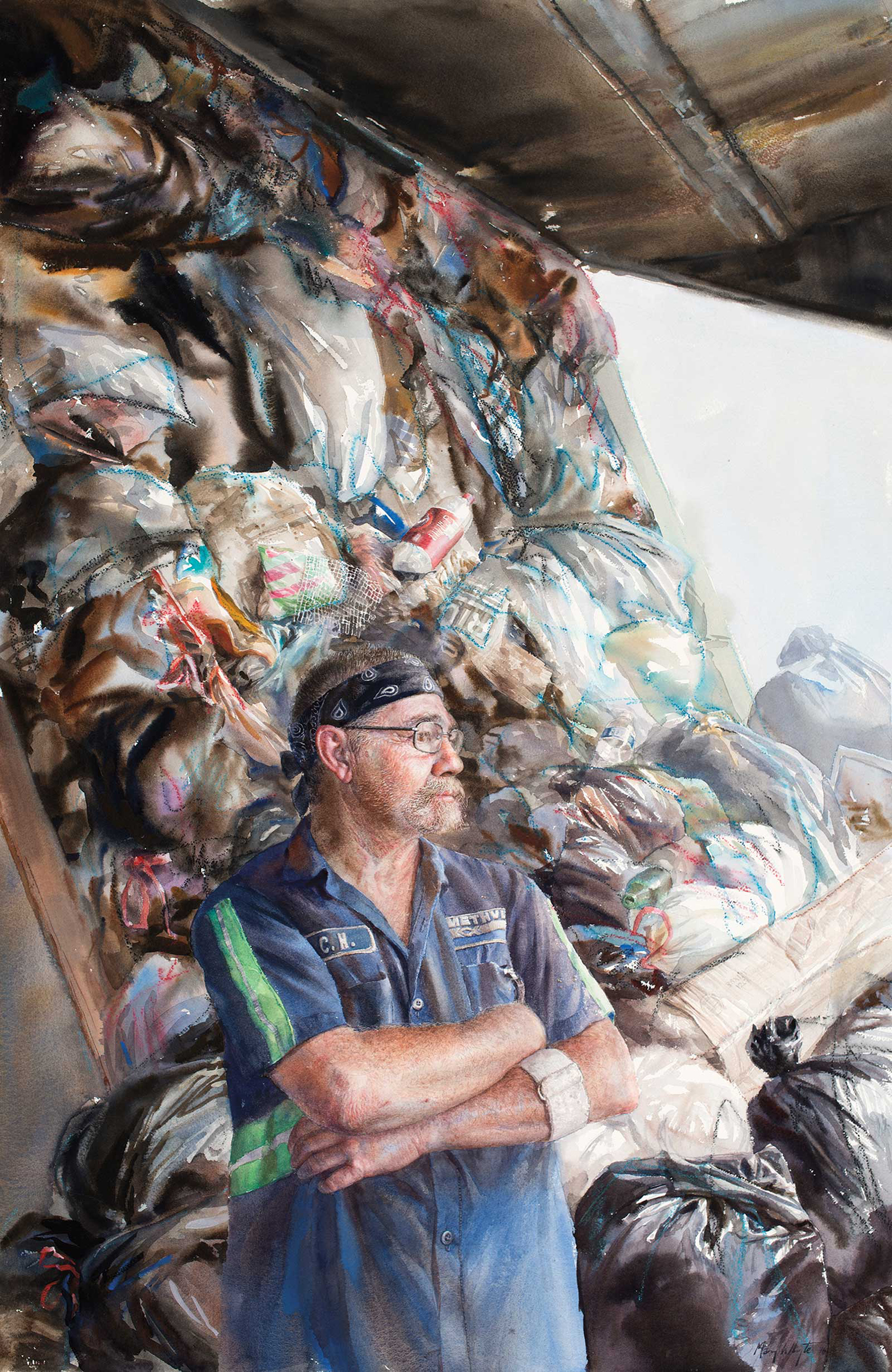
Overflow, watercolor on paper, 40¼ x 26 inches. Courtesy Grohmann Museum, Milwaukee, WI.
The paintings were carefully selected to accompany each piece in the program that included familiar works by Morton Gould, John Williams and Aaron Copeland. I was expecting Copeland’s “Fanfare for the Common Man” to be among the selections and was pleasantly surprised to see Joan Tower’s “Fanfare for the Uncommon Woman, No. 1.” The piece is part of a series using the same instrumentation as Copeland’s fanfare and is dedicated to adventurous women.
In her book, An Artist’s Way of Seeing, Whyte writes, “Subject matter is neither pretty nor ugly, as the beauty of a painting lies in the work itself. Everything is worthy of being painted, even a gray day.”
“I’m attracted to everyday people,” she says. “It’s nice to paint a mayor or a senator but I want to paint the person who is wonderful in the very ordinariness of his or her life. There is a heroic quality as they go about their lives without many expectations, providing service to others.
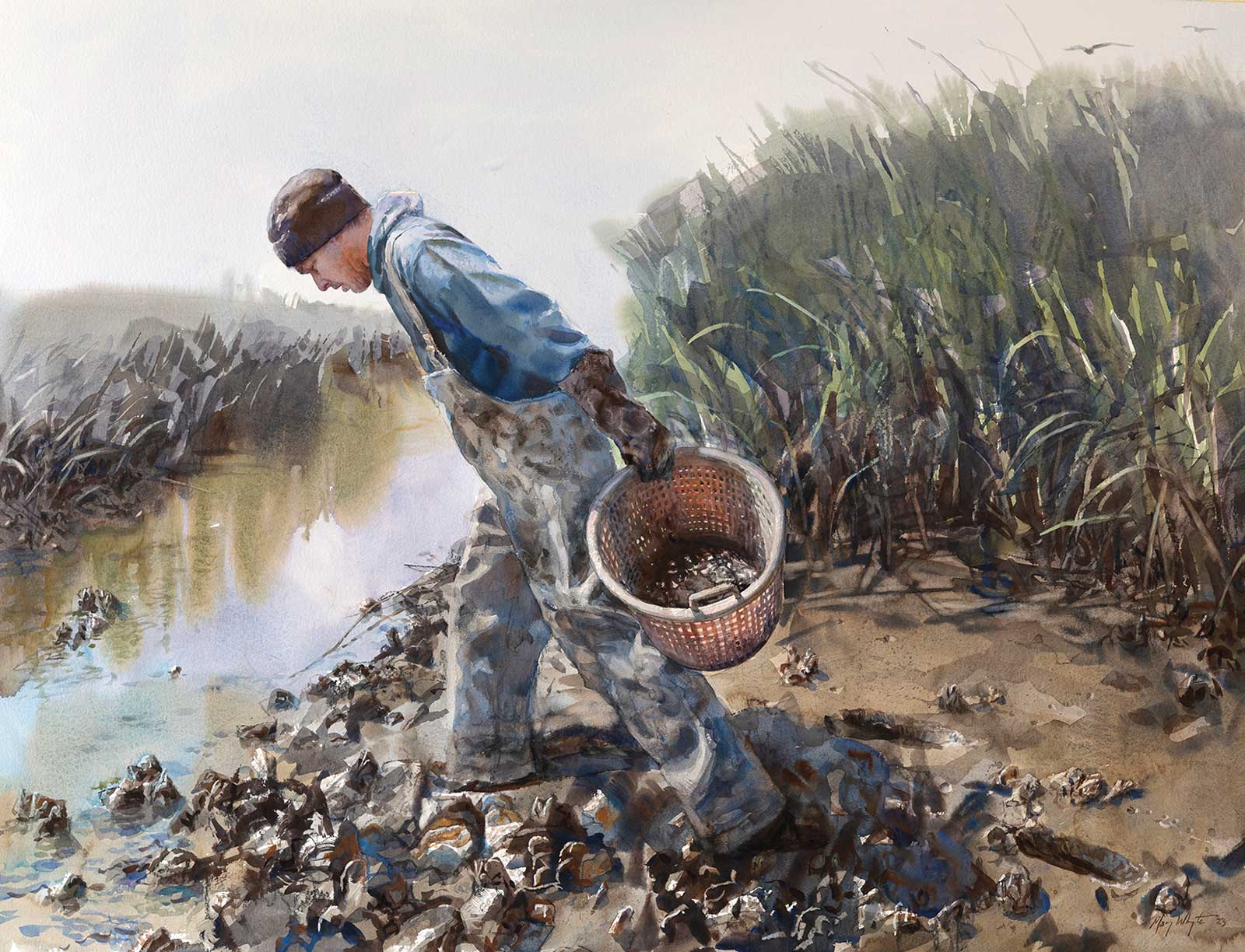
Oyster Bank, 2023, watercolor on paper, 373/4 x 47¼ in. Image © Mary Whyte. Courtesy Gibbes Museum of Art, Charleston, SC.
“I sketch from life as much as possible,” Whyte continues. “The paintings start with thumbnail sketches of an idea while I think about how I can strengthen the idea. I start the painting with a common No. 2 pencil on Arches cold-pressed watercolor paper. I paint the backgrounds first with big, fast and loose brushstrokes and slow down as I bring in the details. I probably tear up one of every four paintings if it’s not strong enough.
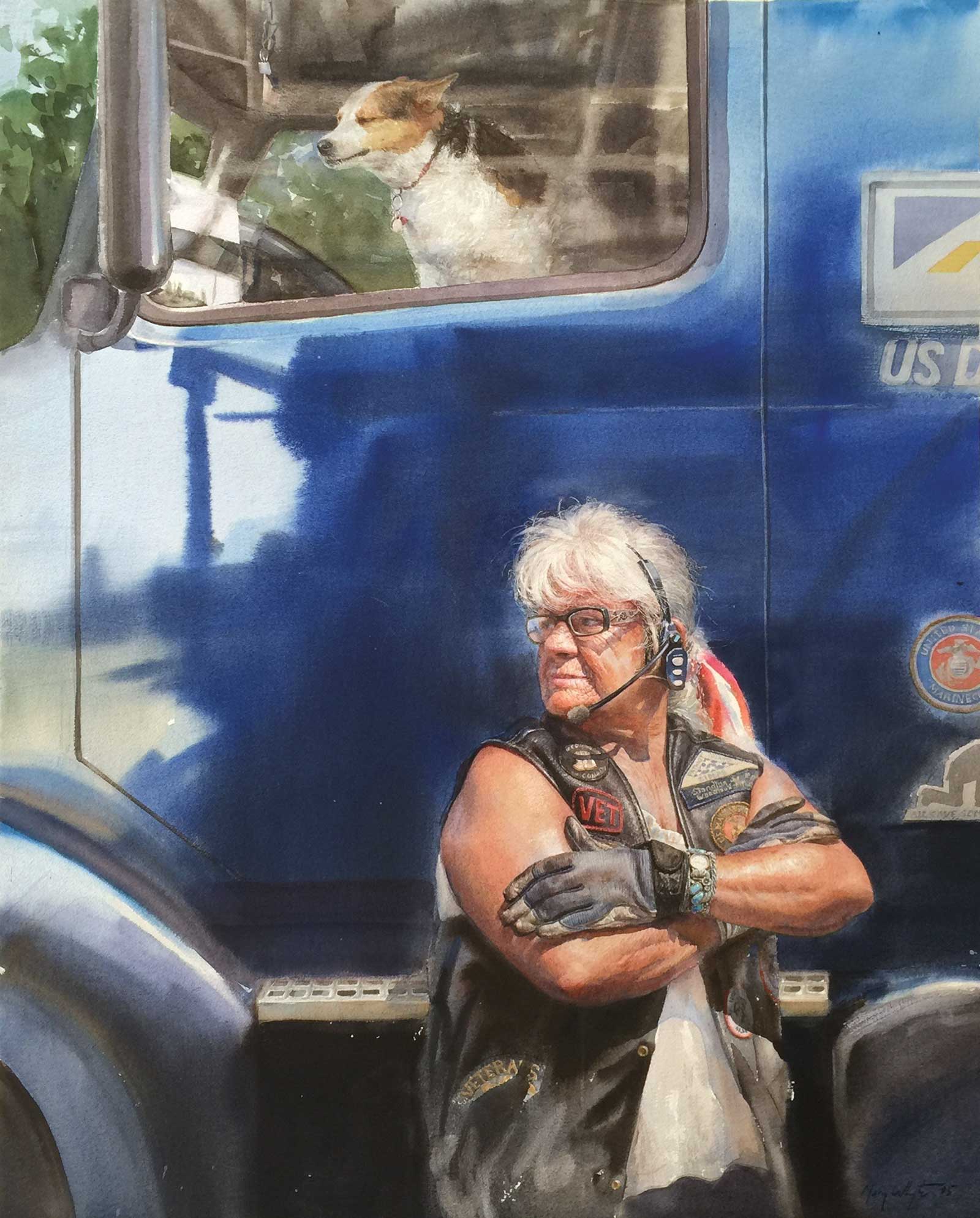
Long Haul, watercolor on paper, 37¾ x 28½ in. Courtesy Grohmann Museum, Milwaukee, WI.
“I’ve always wanted to paint people. They’re the most interesting thing on the planet. When I was in my 20s, 30s and 40s, I painted hundreds of commissioned portraits. I painted the Gullah women of the Lowcountry and made good friends among them as I have with people across the country. A certain trust has to happen before a model can relax and be true to themselves. Once they know you have their best interest at heart, they relax.”
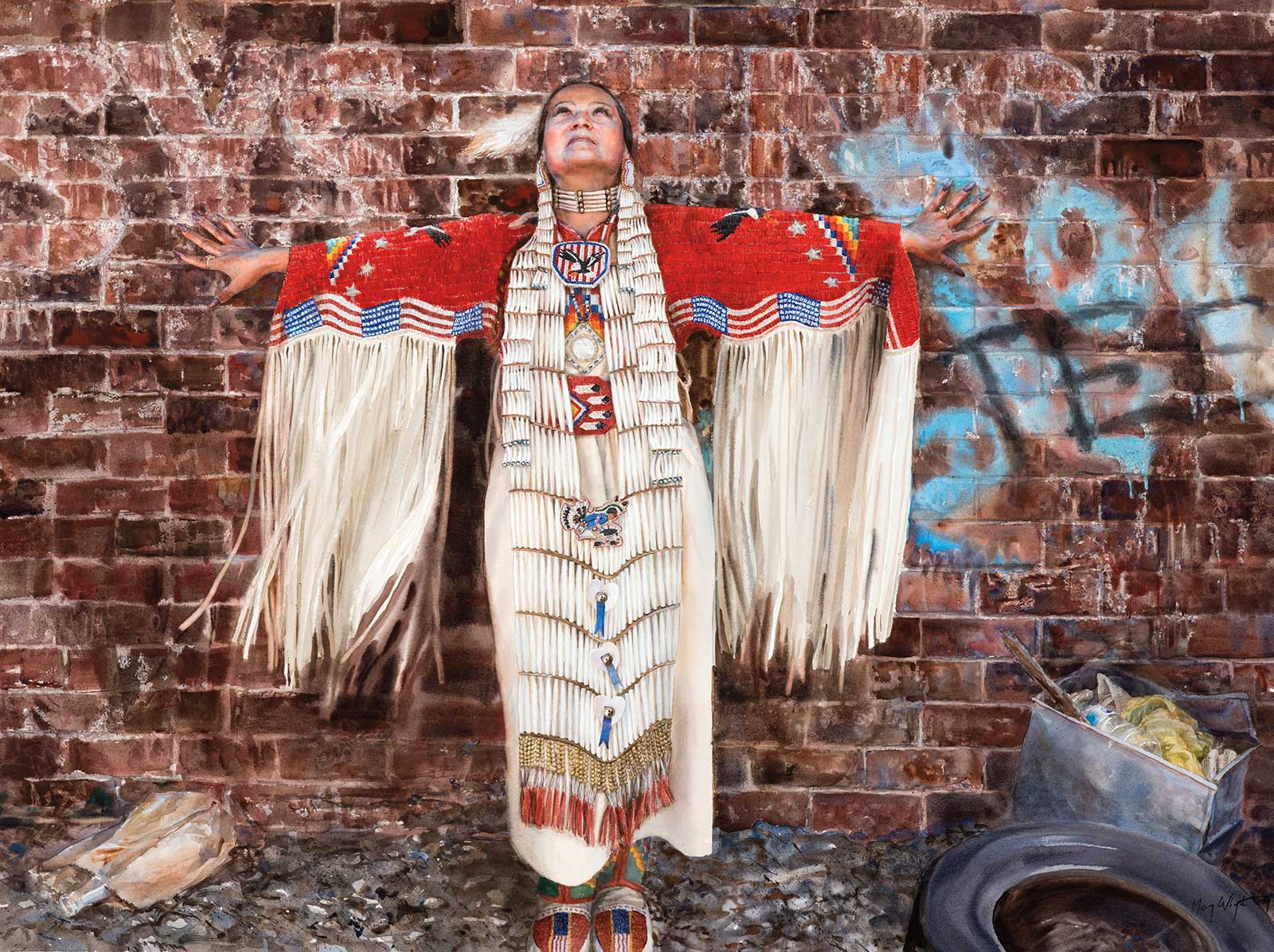
America, watercolor on paper, 40 x 53 in. Courtesy Grohmann Museum, Milwaukee, WI.
The title of the exhibition, Salt of the Earth, is a phrase spoken by Jesus in the biblical Sermon on the Mount. Salt, used to preserve food, was always a valuable commodity and sometimes worth more than gold. Jesus referred to his followers as “salt of the earth,” symbolizing their being good, honest and trustworthy. An earlier series of Whyte’s watercolor portraits is being shown at the Grohmann Museum in Milwaukee, May 7 through August 23. The 50 paintings in We the People: Portraits of Veterans in America depict military veterans in their daily lives—one from each state. She comments, “The paintings will be paired with my first thumbnail sketches so people can discover how a painting evolves.”
She traveled the country at her own expense and kept the project a secret. “I didn’t want people telling me who I should paint,” she explains. “I made a list of the roles I wanted to represent, from an astronaut to a homeless person. As I traveled, I had many approaches to find veterans, from knocking on the windows of trucks at a truck stop to ask if any of the truckers were veterans, to stopping by the Dairy Farmers Association of Missouri to ask the same question. I would roll into a town and go to the chamber of commerce to ask my question and one time I was told about a veteran who is a falconer. The series took over seven years to complete. I discovered that there is a common thread among the veterans despite their diversity and that is a desire to continue to serve. They’re still serving in different ways.
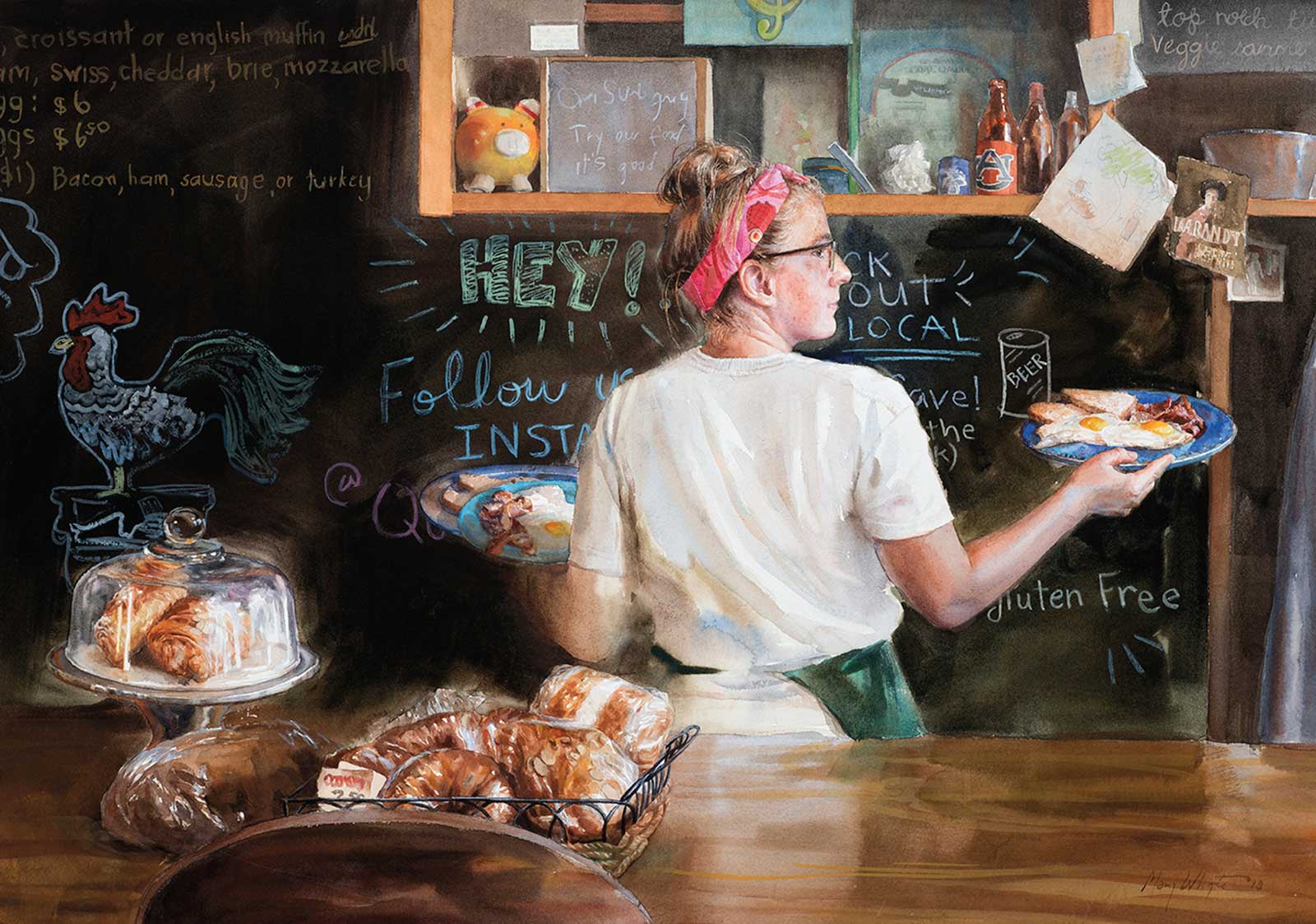
Blue Plate Special, 2018, watercolor on paper, 37 x 46 in. Image © Mary Whyte. Courtesy Gibbes Museum of Art, Charleston, SC.
“When veterans come to the exhibition, I want them to see themselves or similar people whom they know, to realize that they matter. Often, I would hear, ‘You don’t want to paint me. You should paint colonel so-and-so.’ I want them to know that they matter as much as the colonel.”
One of the paintings of veterans, America, is a portrait of a Lakota traditional dancer from South Dakota. She is wearing moccasins beaded by her husband who, Whyte recalls, helped her don her regalia in a careful ceremonial manner. “Her regalia was so pristine and perfect. I could have put her against a blue sky and clouds but that would have been contrived. I decided to put her in a real, contemporary setting against grit, dirt and grime. She is gazing up with her arms raised looking hopeful. To make something look soft, you need to put it against something hard.”
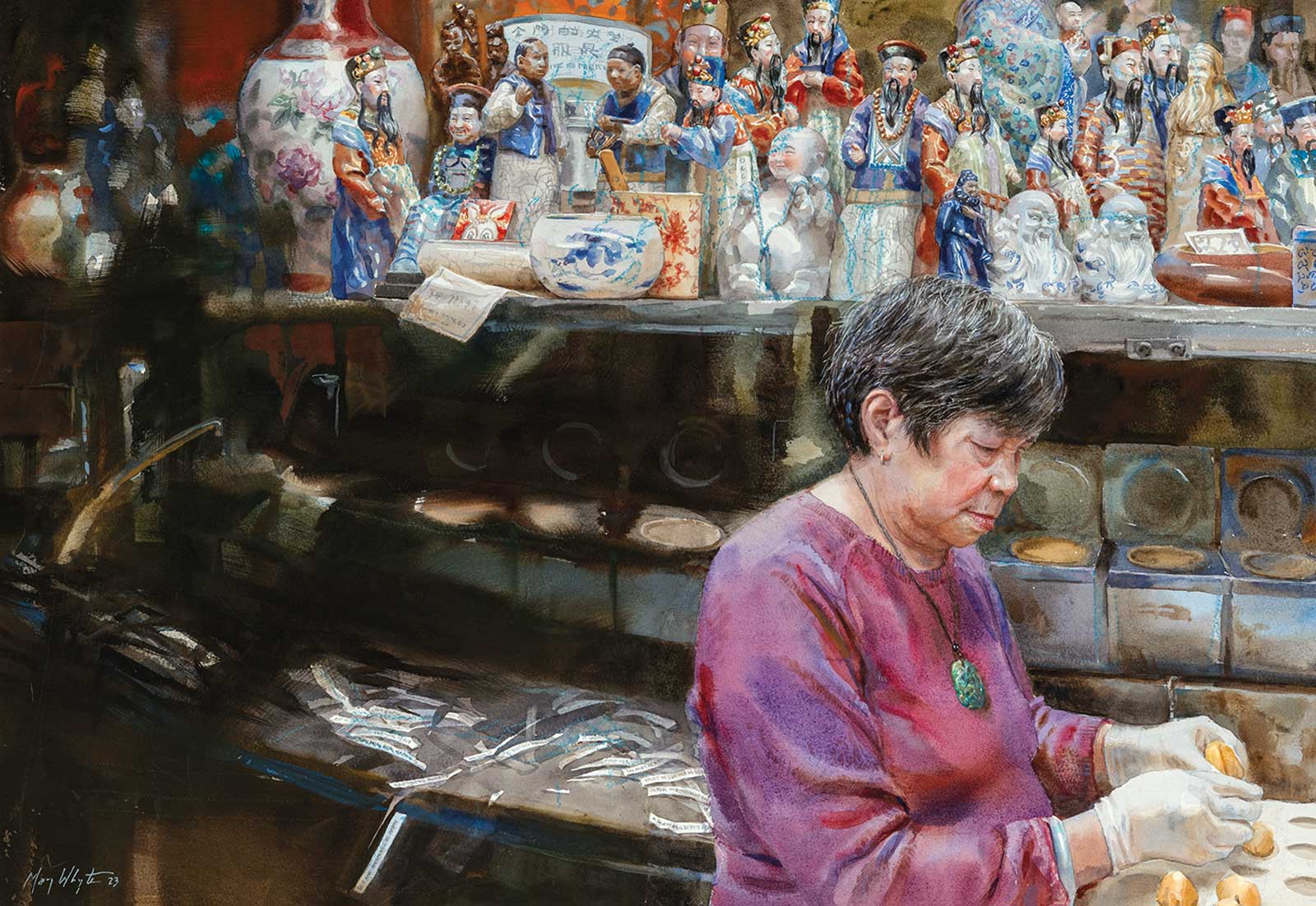
Fortune Cookie, 2023. watercolor on paper, 28 x 37½ in. Image © Mary Whyte. Courtesy Gibbes Museum of Art, Charleston, SC.
Whyte’s compositions often break the “rules” of art, with subjects about to walk out of the picture frame, as in Evolution, or only suggesting a truck with little detail in Long Haul. In the latter, the strong, seasoned trucker’s tender side is suggested by her traveling companion looking out the truck’s window. Whyte practices what she tells her students: “Be a poet, not a journalist.”
In 2019, when We the People was shown for the first time in Charleston, more than 22,000 people viewed the paintings. Whyte realized the response, especially from veterans, showed the power of art “to communicate and connect.”
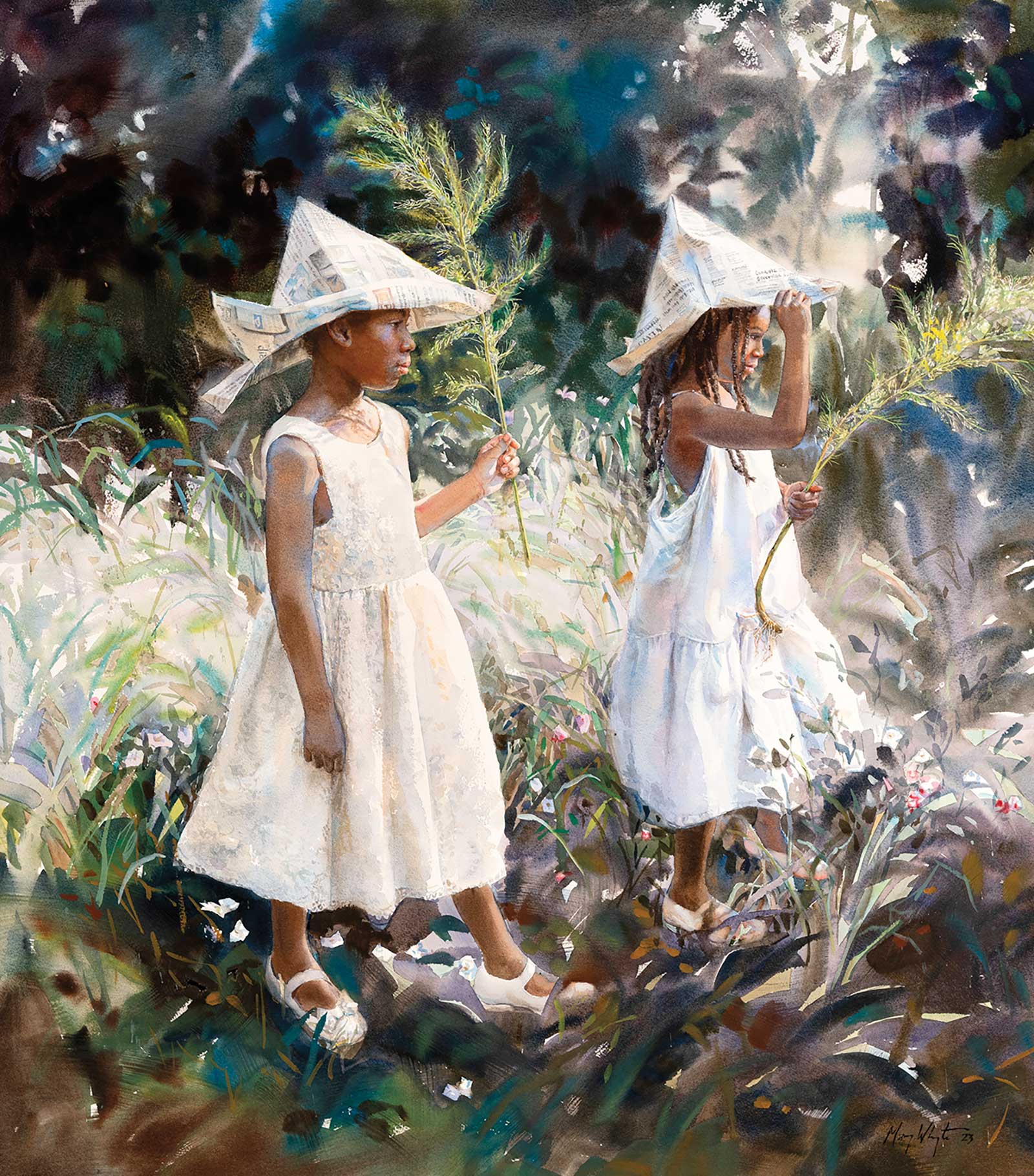
Eden, 2023, watercolor, acrylic, charcoal on paper, 42 x 40 inches. Collection of Jason and Heather Ward. Image © Mary Whyte. Courtesy Gibbes Museum of Art, Charleston, SC.
She expresses compassion and empathy in her paintings, and also manifests it on a larger scale. In 2019, she founded the Patriot Art Foundation whose mission is “to provide free education and materials to veterans who desire to use art as a conduit for self-expression, connection and purpose.”
Its dream is that, “Through the healing qualities of art we hope to give veterans a much needed way to express themselves when words can’t, and to provide a way to navigate a sometimes difficult world with creativity, purpose and joy.”
The foundation and the educational platform Terracotta have collaborated to offer online “Watercolor Boot Camps” to veterans who can paint in secure comfort at their kitchen tables.
The foundation also offers weekly, one-hour, Zoom meetings for veterans who have completed Watercolor Boot Camp. The first sessions are led by a facilitator who guides the participants into becoming a peer-led group. Participants “present work, share ideas, and ask for support in service to growth as well as to create a fellowship of encouragement, inspiration, and support for the development of a sustainable art practice.”
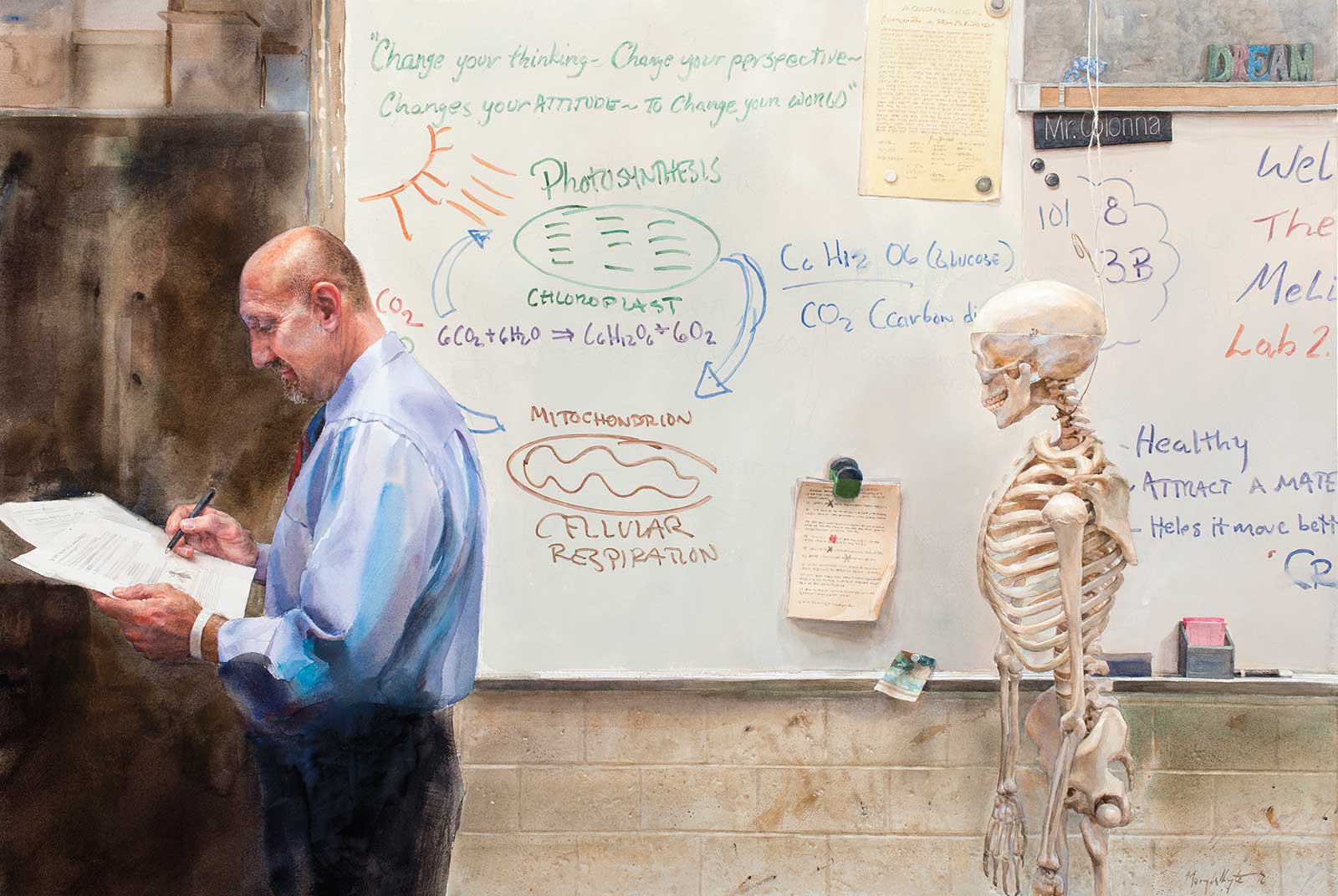
Evolution, watercolor on paper, 32½ x 287⁄8 in. Courtesy Grohmann Museum, Milwaukee, WI
In An Artist’s Way of Seeing, Whyte also writes, “In my studio I have a small plaque that reads, ‘The most beautiful things in life cannot be touched.’ It was a gift from my friend Georgeanna, and a constant reminder of what it is we artists try to express. It is not the days we remember in our lives but the small moments.” —
WE THE PEOPLE: Portraits of Veterans in America
May 7-August 23, 2026
Grohman Museum
1000 N. Broadway, Milwaukee, WI 53202
(414) 277-2300, www.msoe.edu/grohmann-museum
Mary Whyte: Salt of the Earth
May 22-September 27, 2026
Gibbes Museum of Art
135 Meeting Street, Charleston, SC 29401
(843) 722-2706, www.gibbesmuseum.org
Click here for Episode 376 of the American Art Collective podcast.
Powered by Froala Editor