Richard MacDonald is master of the space between the touch, of the electrical tingle anticipating the moment before skin meets skin, of the vibrating bridge of sensual communication. His sculptures are erotic and ethereal, soft melodies composed with the feminine spell and power of the ancient dryad, like harmonies of light with a counterpoint of hard bronze, a firm and masculine edge of solid physical presence. They are images of becoming, of the moment between contact, and of finding unity.
Nightfallis the pregnant heart of MacDonald’s dreamy aesthetics, where everything is in the moment of becoming, where everything is in suspension. She represents the threshold of potential, because her step is the paradigm of all steps, each taken in the liminal space between the past and the future, each taken in the moment of change, each one an initiation.
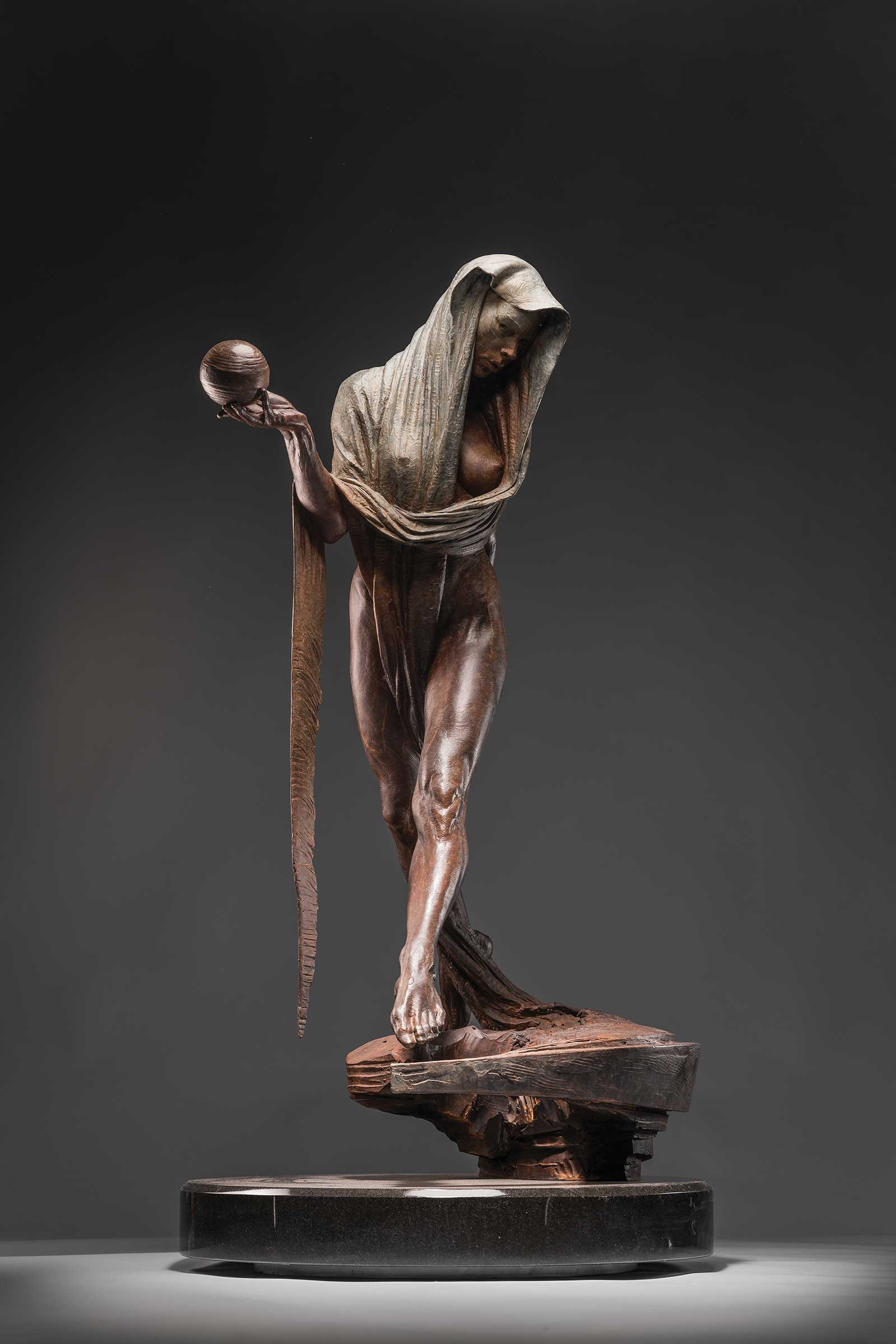 Nightfall, 2009, bronze, half life-size, 44 x 31 x 15 in.
“Nightfall is the universal,” says MacDonald. “That’s why I took her out of this world, so to speak, floating across the crescent moon. And you’re right, she’s in the present moment…and she’s beautiful, seductive, elegant and confidant, and she strides through life with the hope of the future, and releasing the past. I think we have the greatest difficulty staying in the moment…You’re either angry about the past or fearful of the future.”
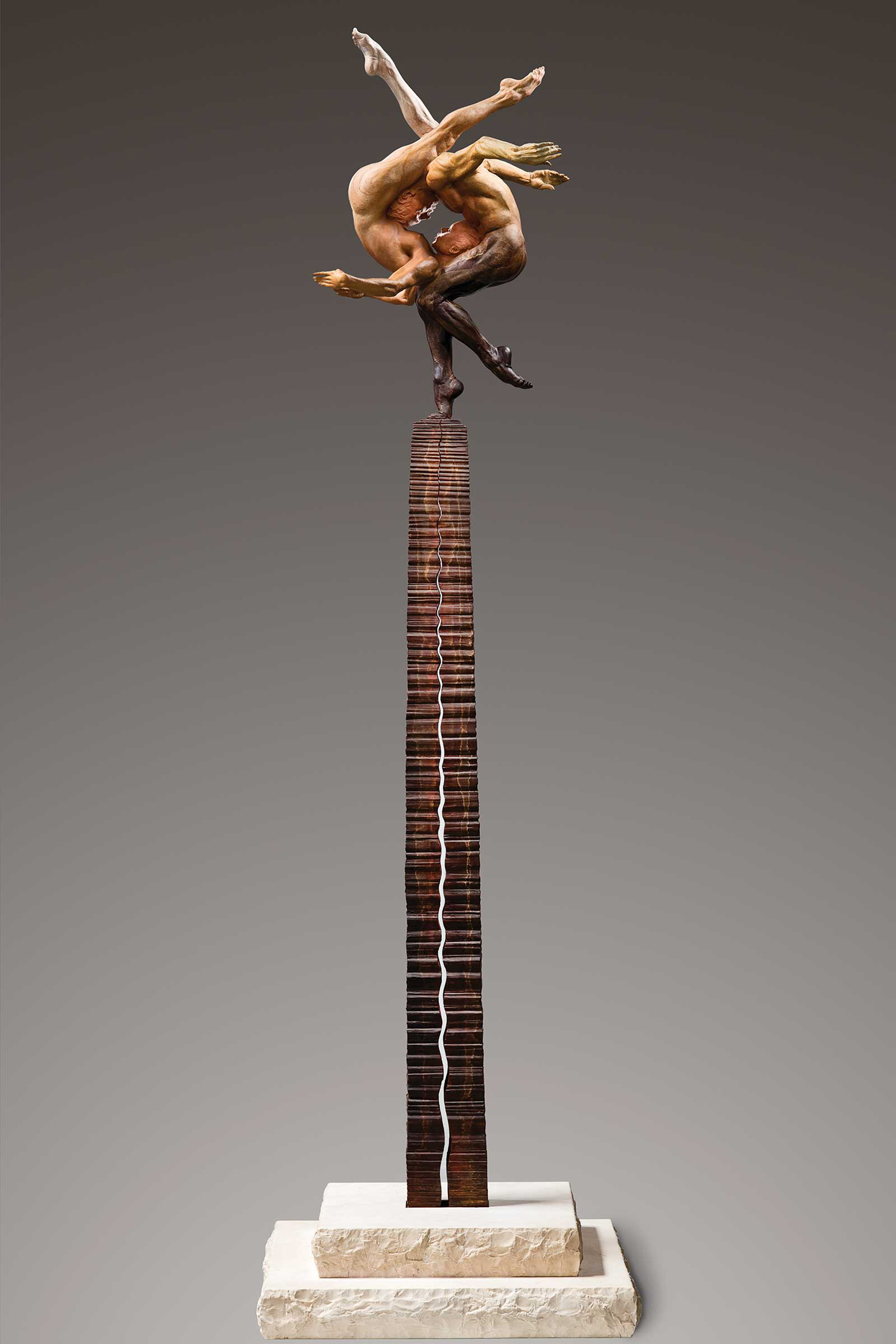 Duality (Ying & Yang II), bronze, 75 x 17 x 17 in.
She is covered but vulnerable, sensual and sublime. The figure in Nightfall looks at the cosmic slab beneath her, restrained and self-assured, self-aware of her place within the flow of time. Though formed in the flesh and frame of a nude, she is the eternal spirit of the space between future and past. She embodies this moment…and this moment...and this moment...The stone and weight beneath her is the present, the thin, infinitely small instant eternally moving between the endless waning past and the infinite waxing future, those covert and unknown countries where what has happened and what will be are mysteries of mind and memory, each of them lightly grasped in her long fingers as the spheres of completion—before her the promised future, in her leading fingertips, almost known, almost in sight; behind her, the past, slipping from her grip to fall into the void of memory.
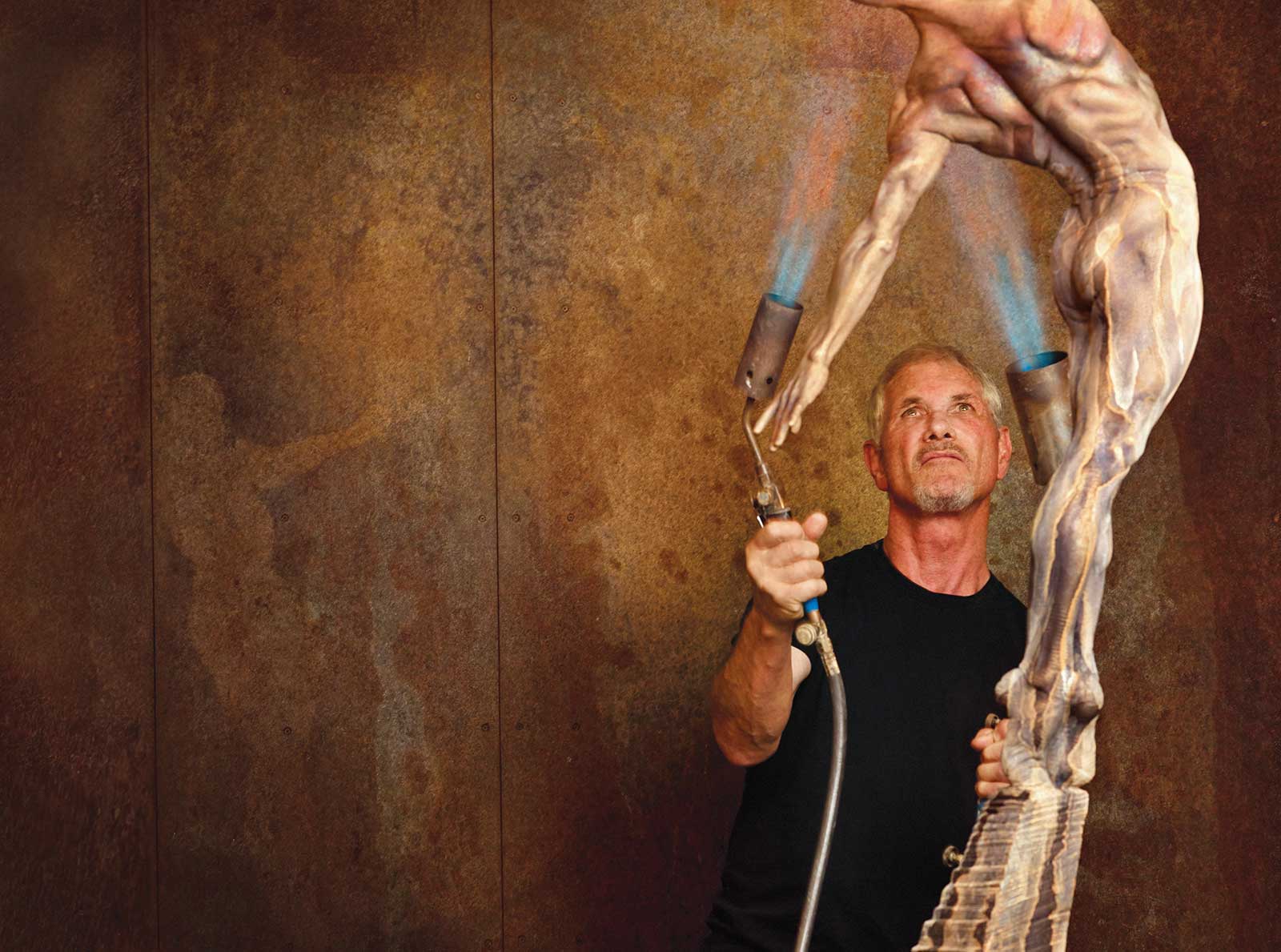
Richard MacDonald applying patina.
“We are becoming us.” MacDonald continues, “You are becoming more and more you, I’m becoming more and more me, and we are looking at that, we become consciously aware of that. I think one of my goals should be to find who we are, philosophically, intellectually, or whatever. We get caught up in this construct, we call it our society, but it’s a construct. We get up, we go to work, you live in a neighborhood, it’s a grid, this is what you do, and then you pay your taxes, and you have this construct that you’re actually forced into unless you go off the grid somewhere. So, being able to move through life and find yourself and really understand it, that’s fascinating.”
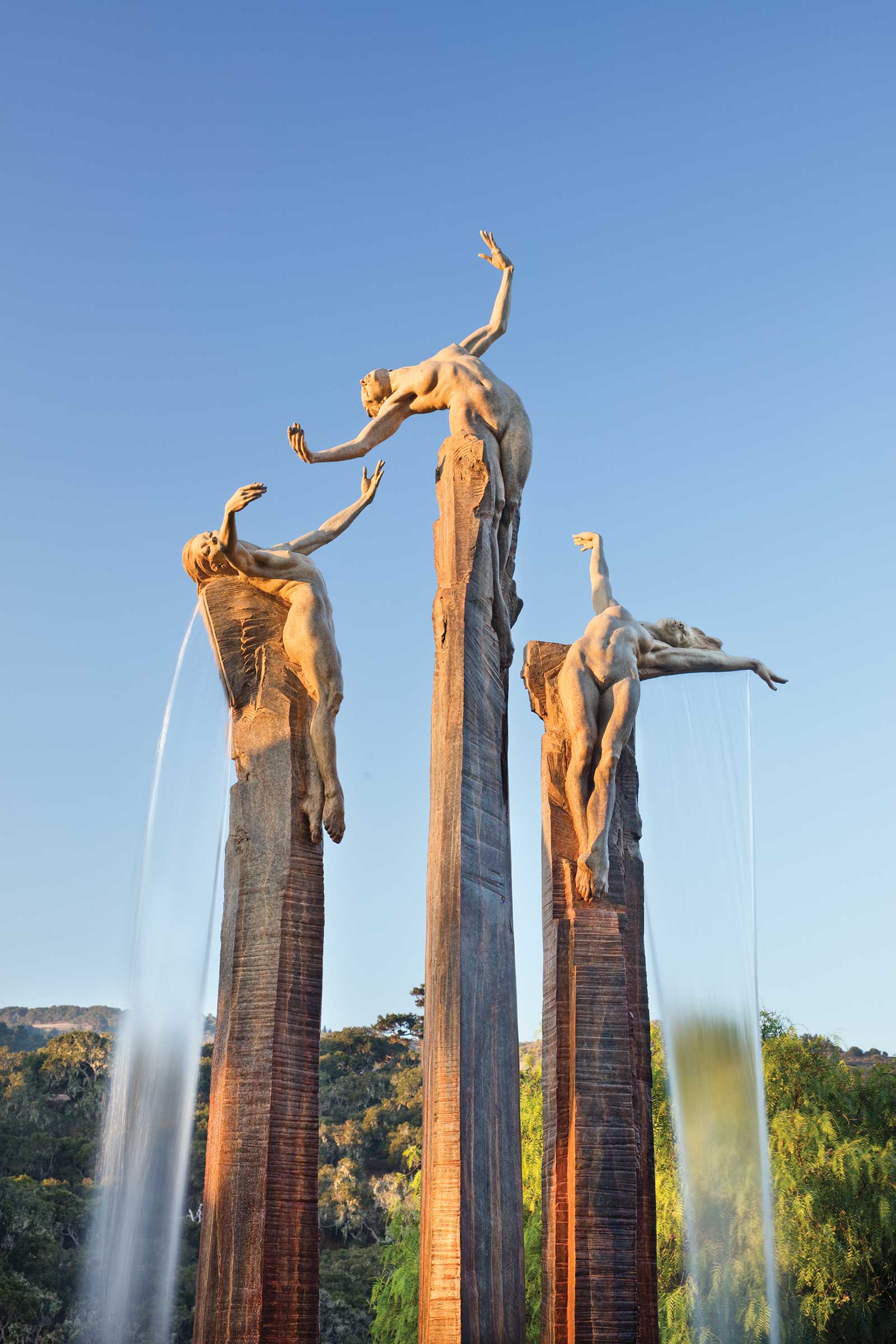
Richard MacDonald, Gathering of Graces, 2017, 148 x 72 x 42 in.
She is the archetype and form of a woman stepping through a stride suspended between point and point of an arced shelf extended around a rocky base—she is Selene to our Endymion, visiting us while we sleep in bliss and ignorance of the metaphysical universe. Like our moon, she is an ever-present and luminous satellite orbiting the material and earth of our base existence which binds us by the tide and weight of invisible gravity. So, she is the mother. But she is lean, this spirit of the moment—this naked and ambiguous body, her perfected bronze physique fantastically lifted only by the soft flow of fabric that drapes her perfect figure. She is strong, wearing a body of trained musculature. She is the tarot Fool, a pilgrim traveler passing between the tides of time.
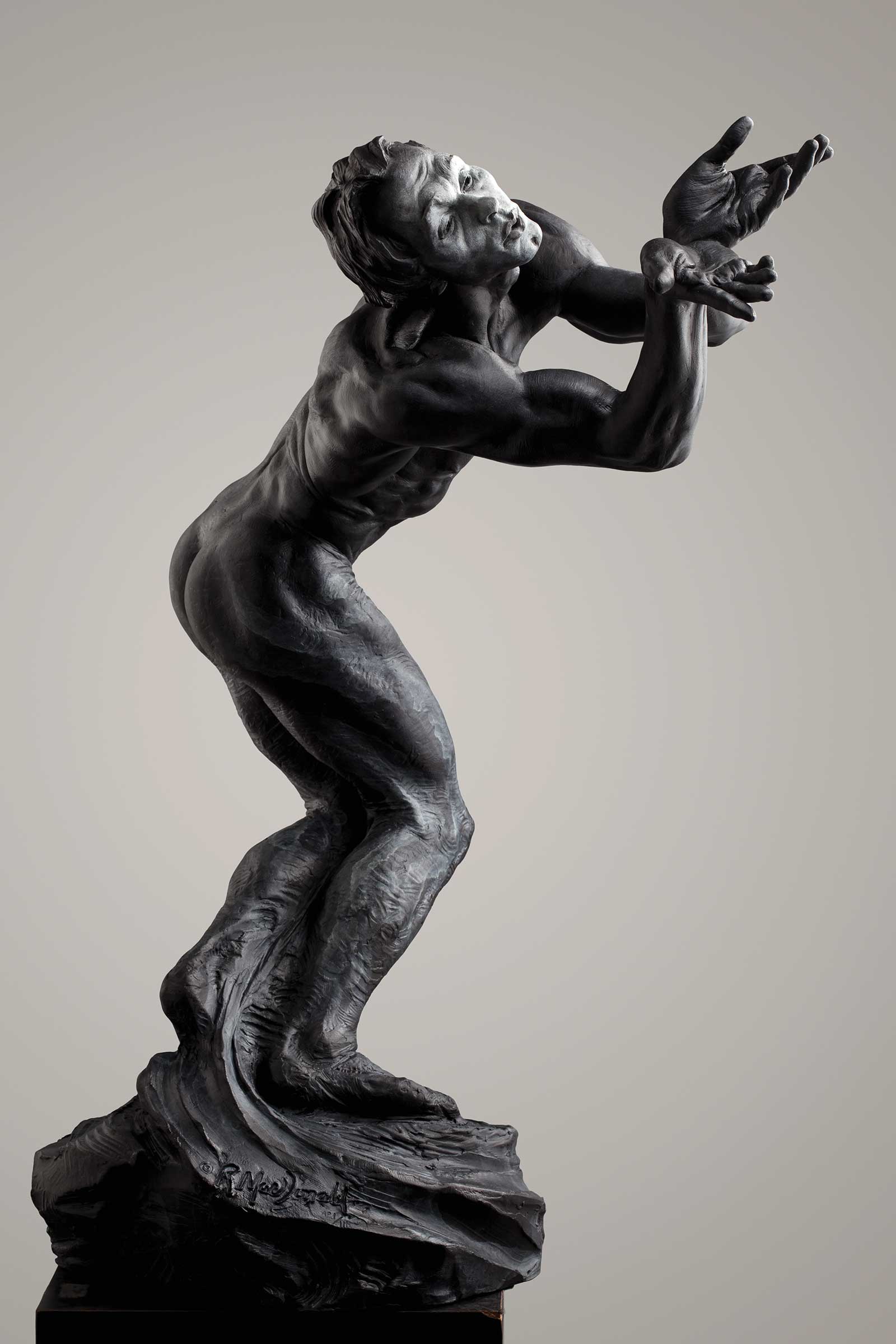
Butterfly, 1991, bronze, third life-size, 21½ x 8 x 19 in.
Nightfall is a perfectly balanced composition that is beautifully poised from every angle. The twist in her torso turns her against her stride, while her left hand delicately crosses her back. MacDonald is fond of the turning body. His Butterfly is an elemental figure posed in a delicious rising pirouette of perfect anatomy emerging like the first man from the primordial ground, and expanding upward from earth to become a delicious expression of air breathed to blow. We arrive at his hands a moment after the release, charging us to imagine the absent fritillary fluttering away. He explains, “Butterfly is one of those pieces that uses a baroque spiral which causes you not to want to stop, to go around. It’s an ancient composition...He’s swirling from the raw essence of the earth, and as he’s coming out of it, he becomes more and more refined, until eventually, with the subtlety of the fingers, he releases the butterfly, which is himself. I was listening to (Luciano) Pavarotti’s ‘Nessun Dorma’ for the first time, and I was in my underwear finishing this piece and the sculpture was absolutely coming alive— I could see it. I could feel it, and then his music was so fine, I was absolutely bawling. It was a fantastic moment.”
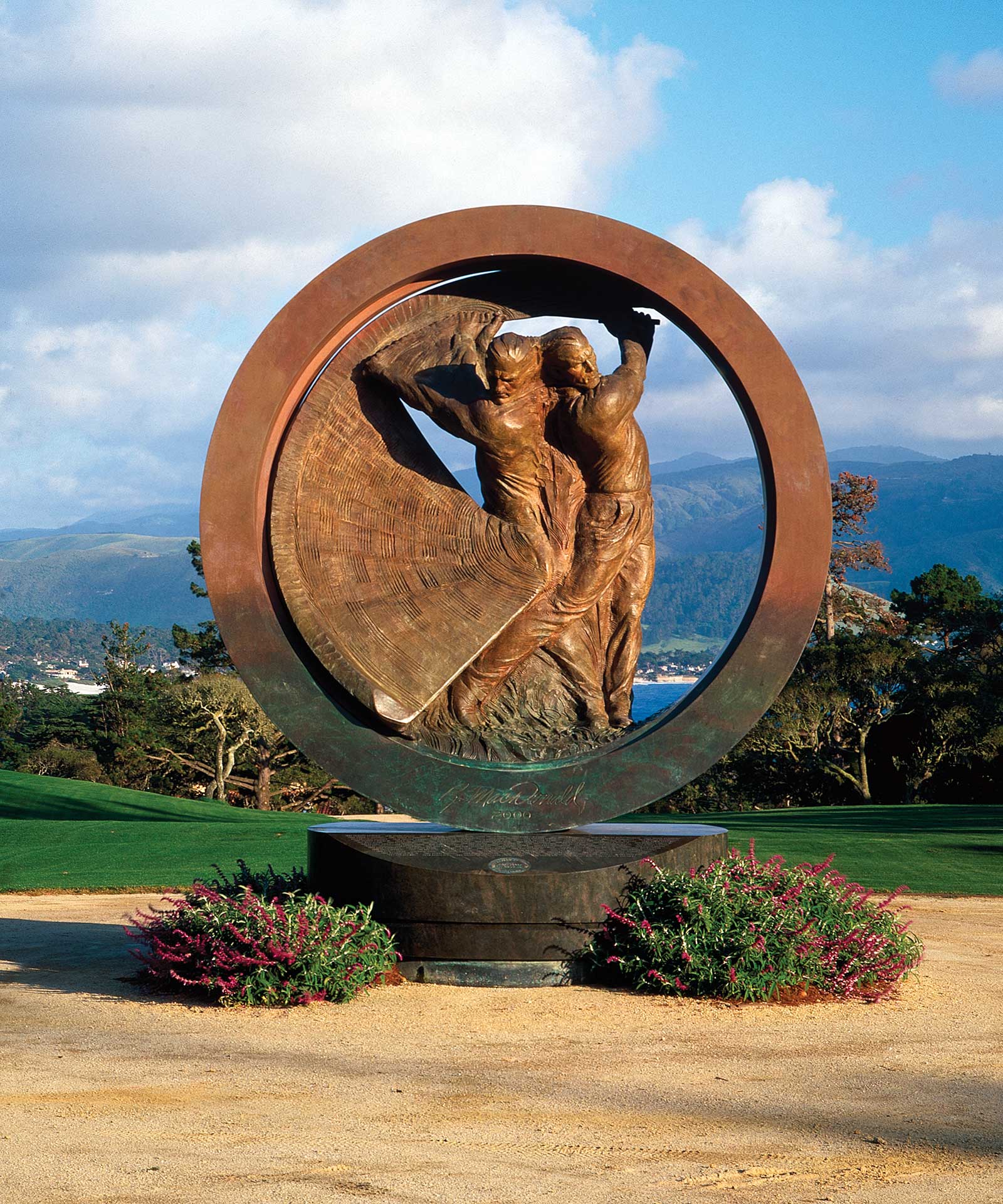
Momentum, 2000, bronze, 16 ft. The sculpture was created to commemorate the 100th anniversary of the U.S. Open Golf Tournament at Pebble Beach in California.
In 1996, he met the maestro at an Opera Pacific awards ceremony and presented him with a half-sized edition of the sculpture. Later, Pavarotti gave MacDonald one of the best compliments he ever heard. He said, ‘Ricardo, you are the artist. Me, I have Puccini. You have no one.’ At the singer’s birthday party in New York there were 50 guests from around the world, and when he spotted MacDonald, Pavarotti came to the table and cupped his hands, and blew through his fingers in imitation of the sculpture. “Hey Ricardo,” he said, “Butterfly.”
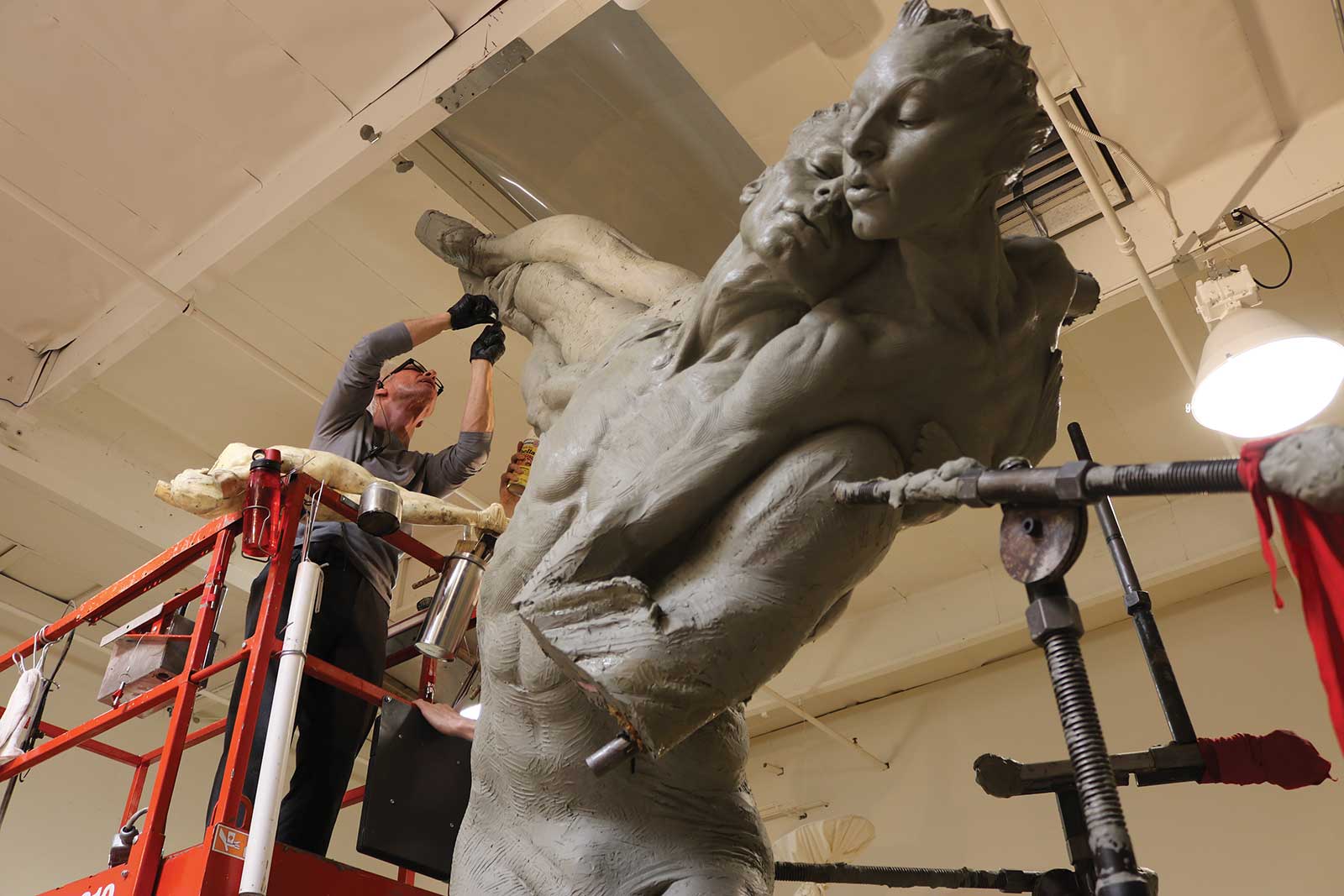
Richard MacDonald sculpting Grand Coda.
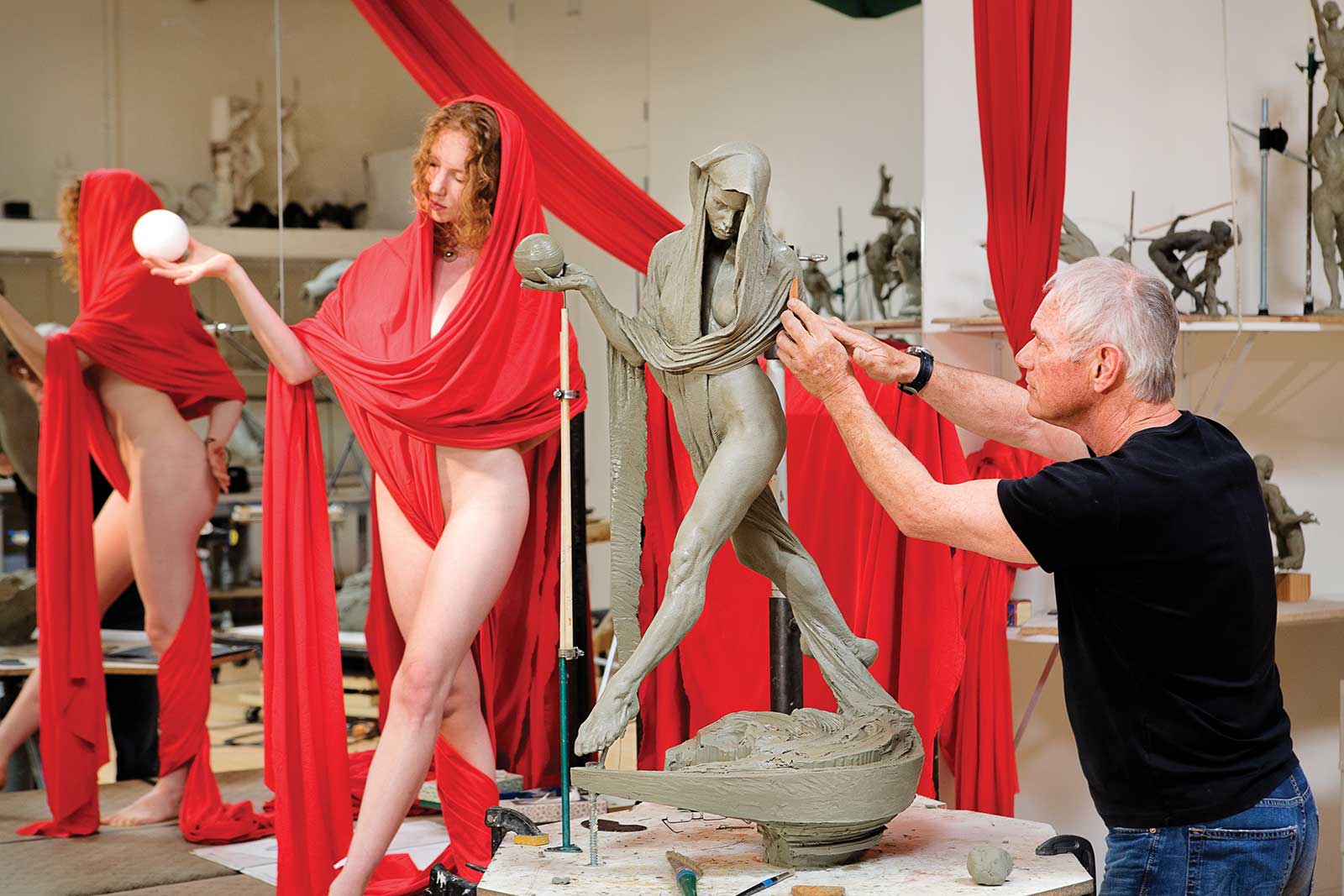
Richard MacDonald working on Nightfall.
The greatest magic and beauty of MacDonald is when his virtuoso mastery finds the subtle equilibrium between the solemn weight of metal and the gravitas of metaphysics—this is the ancient balance between being and becoming—the materiality of bronze against the mystery of ethereal thought.
The essential illusion of weightlessness has been his preoccupation since the earliest days of his career as a sculptor, when it was embodied in the grace of his first piece, which combined a miraculously suspended 3,000-pound bronze figure of the redeeming Christus Rex with a stained glass window in the sanctuary of St. Patrick’s Episcopal church in Atlanta. Together, they created the illuminated illusion of the risen Jesus resurrected and liberated from the cruel weight of human suffering, transfigured, and raised to the heavens. A cleverly engineered armature disguised as cloth supports the divine figure from behind, but from almost every angle the sculpture appears to levitate magically behind the altar. It is a truly evangelical message of great power, propagating Christian faith with the light and spectacle of gifted skill.
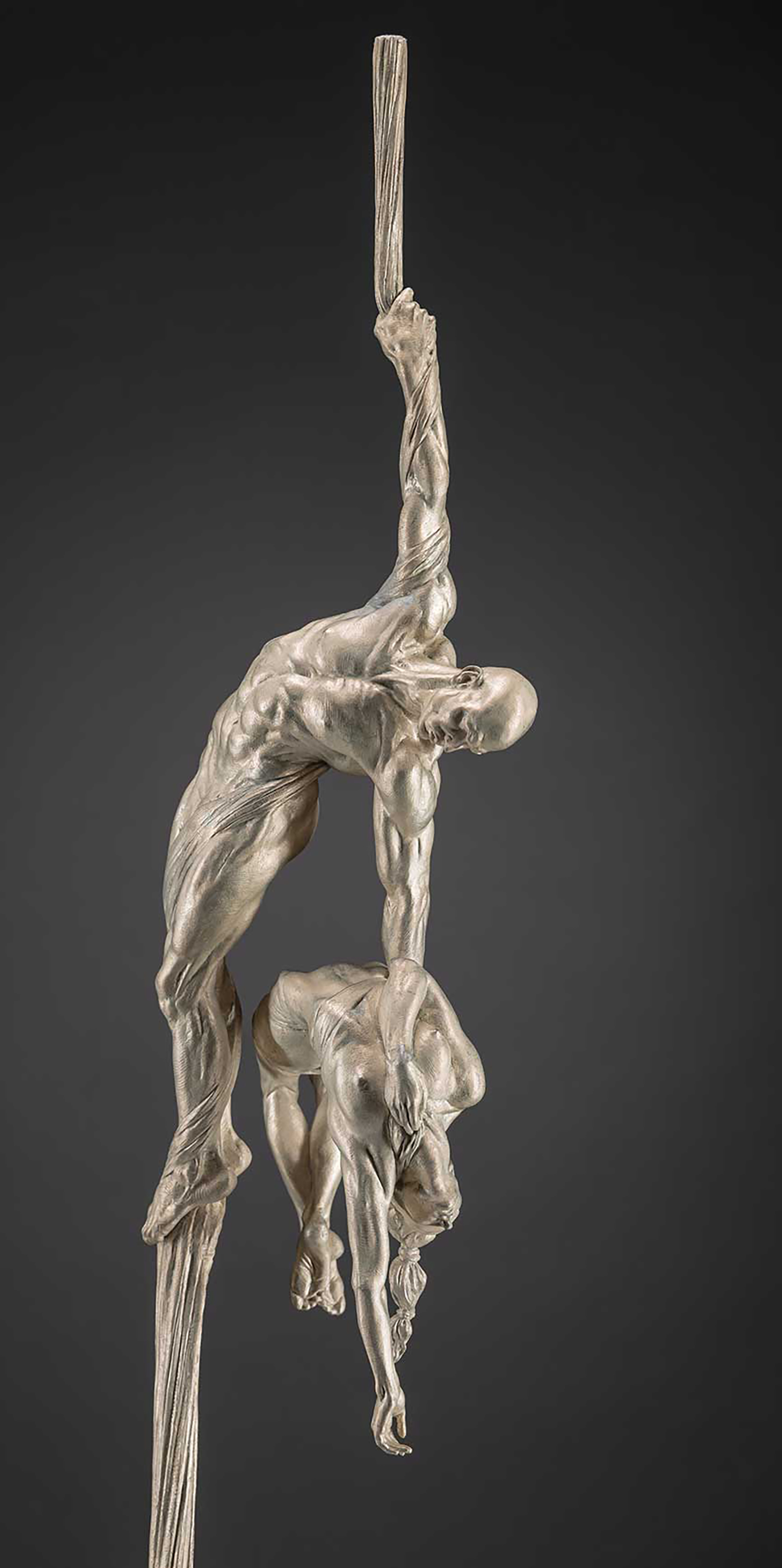
Orpheus Ascending, 2025, bronze and 24K white gold leaf, quarter life-size, 91 x 23 x 23 in.
Ovid’s Metamorphoses tells the tale of the tragic musician Orpheus and his beloved Eurydice, who was bitten and killed by a serpent soon after their wedding. Mourning Orpheus, whose music was so magical that wild animals gathered to him enraptured, followed her into darkness to the court of Hades, King of the underworld. Orpheus played his enchanting lyre and sang his songs with such melodic beauty that Hades allowed him to return to the living world with his bride. In the most famous version of the story, Hades admonished Orpheus that should he look back at Eurydice, and lose faith in her following him back to Earth, she would be eternally lost to the grip of death. But as anxious and loving Orpheus passed through the shadows, he forgot the warning, and turned around to check on his suffering bride, and was doomed to watch helplessly as she faded into the misty arms of the lost shades. MacDonald prefers the version where the lost couple escapes to live again together in love—a solid story of the strength and power of the arts. In his sculpture, superhuman strength allows Orpheus to retrieve his beloved Eurydice from the underworld by raising her limp body from the grip of death in the cup of one hand as he climbs the cloth stretched between above and below. Eurydice’s eyes are covered by a lightly tied cloth as a symbol of her total faith in the miracle of her rescue. This is a romance of love hopelessly lost and yet regained, and the idealization of masculine strength.
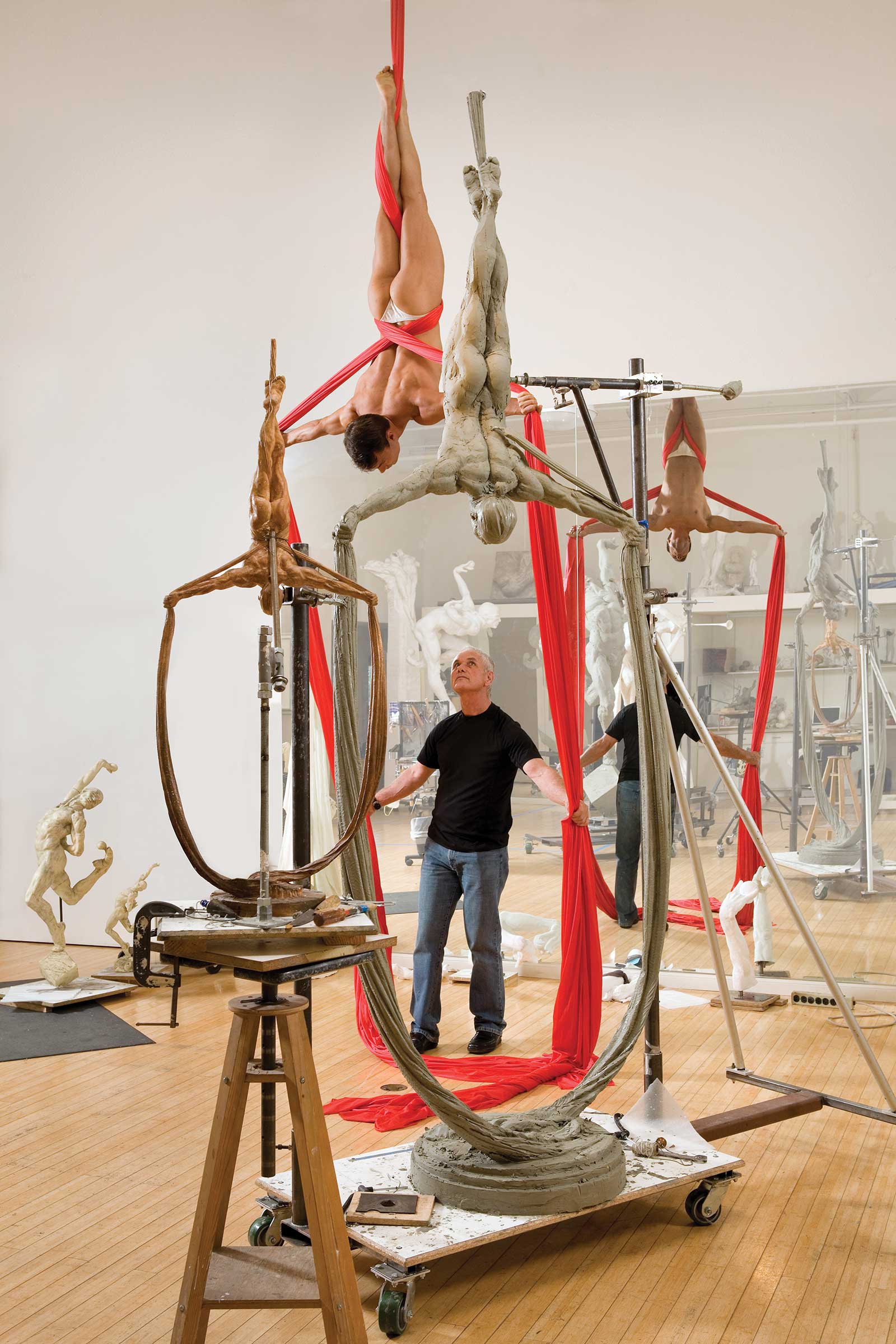
Richard MacDonald working on Transcendance.
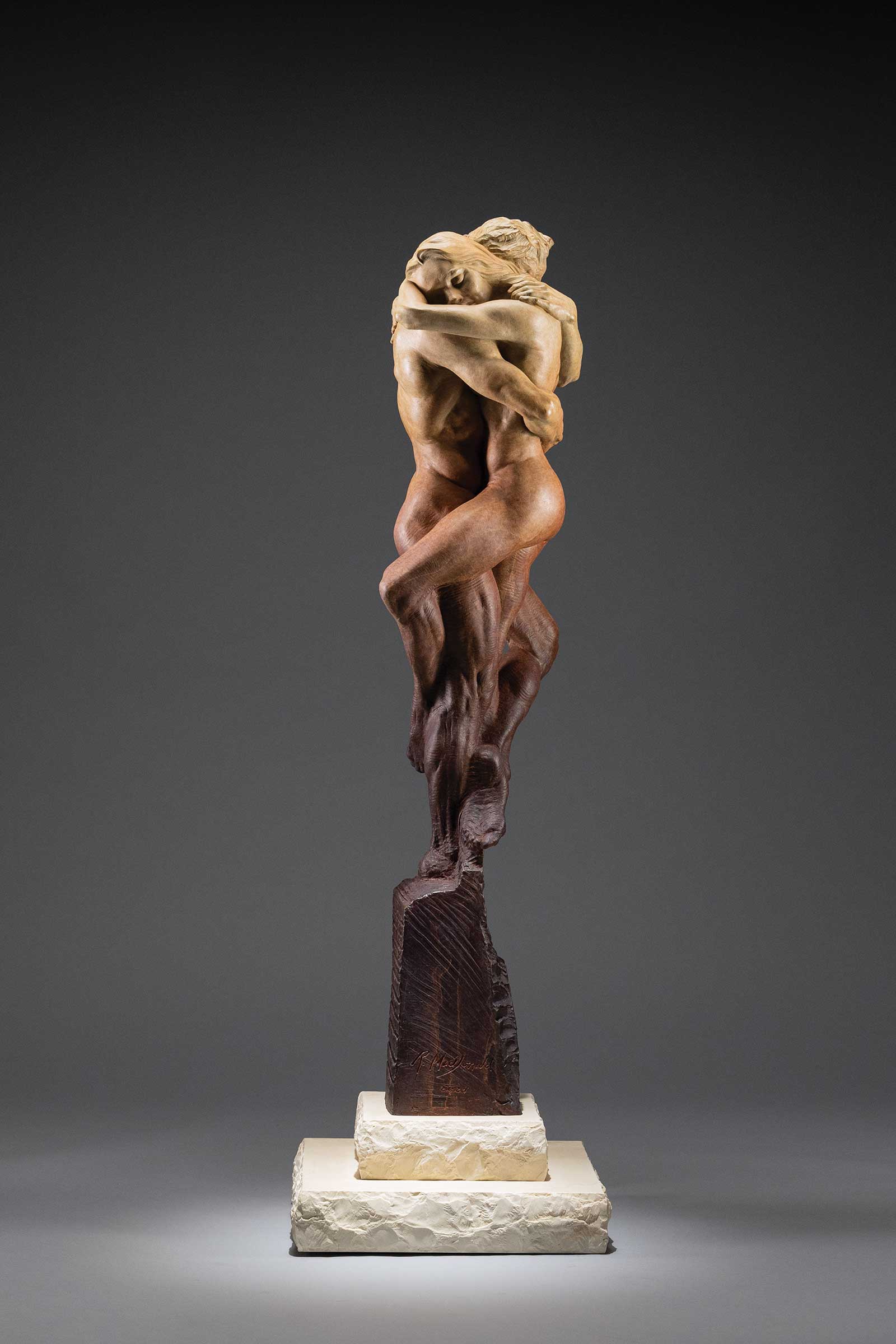
Origins, 2023, bronze, two-thirds life-size, 47 x 13 x 11 in.
Another monolith is topped by a couple composed in an ecstatic yin and yang of balanced bodies and perfected musculature. Their tower is split in two beneath the athletes, who seem to be on the edge of toppling, held briefly in the moment and equilibrium of harmony. The brokenness of the column evolves upward and joins and there, at the meeting of the two halves, there the perfect balance of the male and the female is found.
Mouths approach the kiss. A hand hovers over the tender skin in the instant before contact, and our senses tingle before the touch. A transformed individual, MacDonald is fascinated by the space between the one and the other, and how two become and create one in the true moment of creativity. His Origins is a beautiful moment of the eros and spirit of poured emotion. It is the moment of desire and longing embodied in the perfect physiques of lovers winding spiraled with wrapped limbs clinging in the tight embrace of eternal and total love. He has raised their figures on a slender column, dreaming of monoliths “…carved into strata like the earth to create the idea of time, and then in between there’s a sensuous curve, going through our lives. What it does is point out the differences between male and female, and the simplicity of the whole thing, and the essence of who we are…I think a lot of people forget that they’re human beings, that they are flesh.” —
+++
Michael Pearce is a dynamic writer, curator, and critic, and a champion of art that emerges from popular culture and shapes the spirit of the age. He has published hundreds of articles about art and artists, and is author of Kitsch, Propaganda, and the American Avant-Garde.
Powered by Froala Editor