Peter Waite’s painting Winter House, 2005, is a study in physical, historical and metaphorical layers. Beneath the white polyethylene Tyvek is the wood sheathing, and beneath that, the studs of the house’s frame. After the snow and perhaps as late as spring, the Tyvek will be covered with clapboards, the dumpster will be taken away, a family will move in, and the grounds will be landscaped. Waite also looks into the future when the house is sold to a new owner who doesn’t like the kitchen, brings the dumpster back and tears the kitchen out.
The house, itself, is a classic New England structure, modeled on the style of 17th century homes which, in turn, were inspired by the symmetry of ancient Greek temples, which Waite likens to the red hotels and green cottages of a Monopoly game.
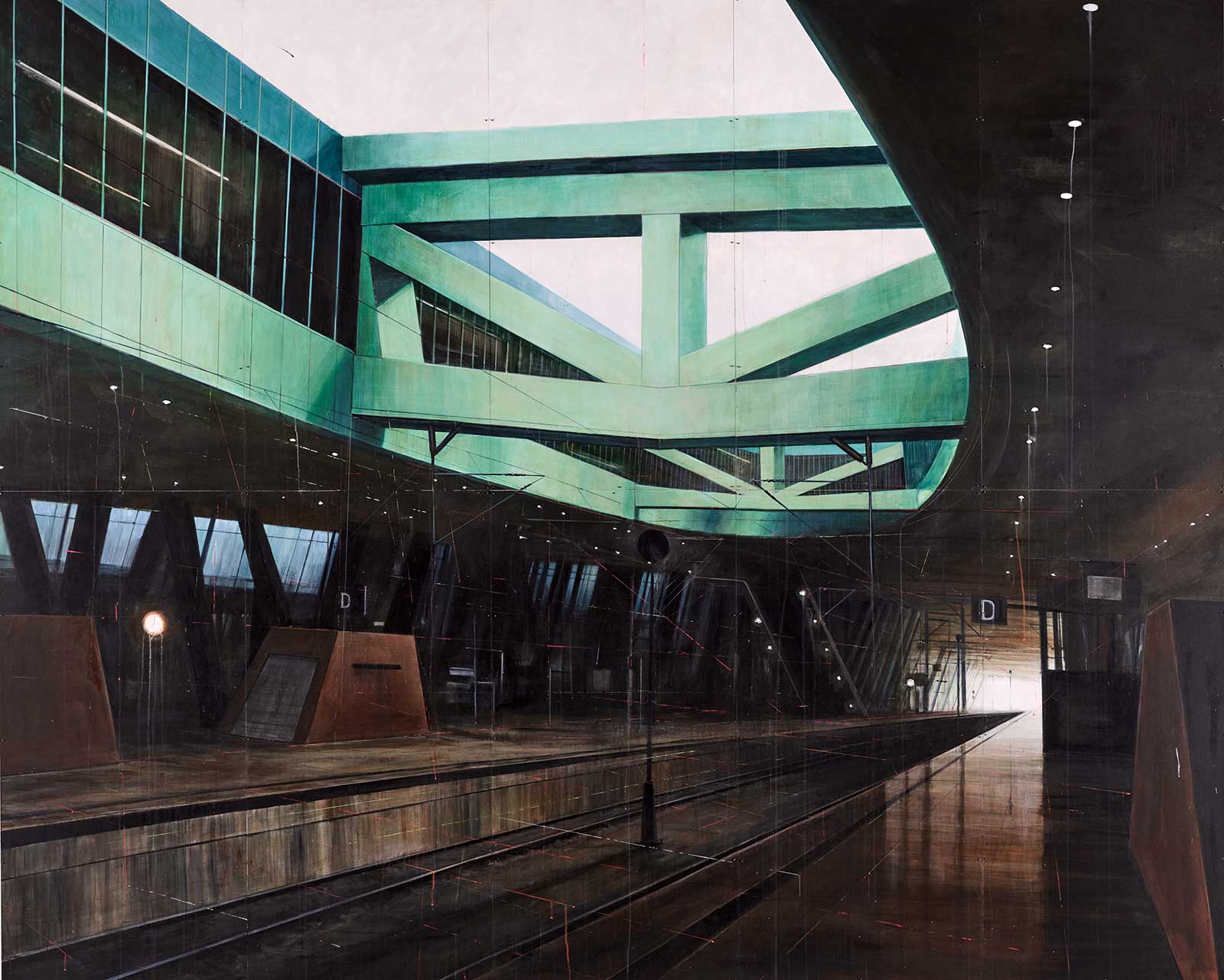 Station/Frankfurt, 2004, acrylic on PVC panels, 96 x 120 in. Wadsworth Atheneum Museum of Art, Alexander A. Goldfarb Contemporary Art Acquisition Fund, 2007.9.1.
He and his wife, Christine Ciccone, visited Sicily to see the Doric temples constructed at about the same time as the Parthenon in Athens. Unlike the white marble of the Parthenon, the temples in the Greek colony of Sicily were constructed of the local brown limestone. The white marble Parthenon and its sculptures that we all admire were originally painted in bright colors. The temples in Sicily were covered in brightly colored tiles which have fallen off just as the Parthenon’s colors have worn away.
Transition—from one state of being to another, from once place to another, from one time to another—is a recurring theme in Waite’s work. Station/Milan, 1992, is literally a place of transition where people come and go from the station’s massive steel and glass trainshed. A blend of Beaux-Arts, Art Nouveau and Art Deco styles, it became more massive with symbols of power to reflect the ideals of fascist Italy when Mussolini came to power. More recently, a chrome escalator was inserted into the vast space.
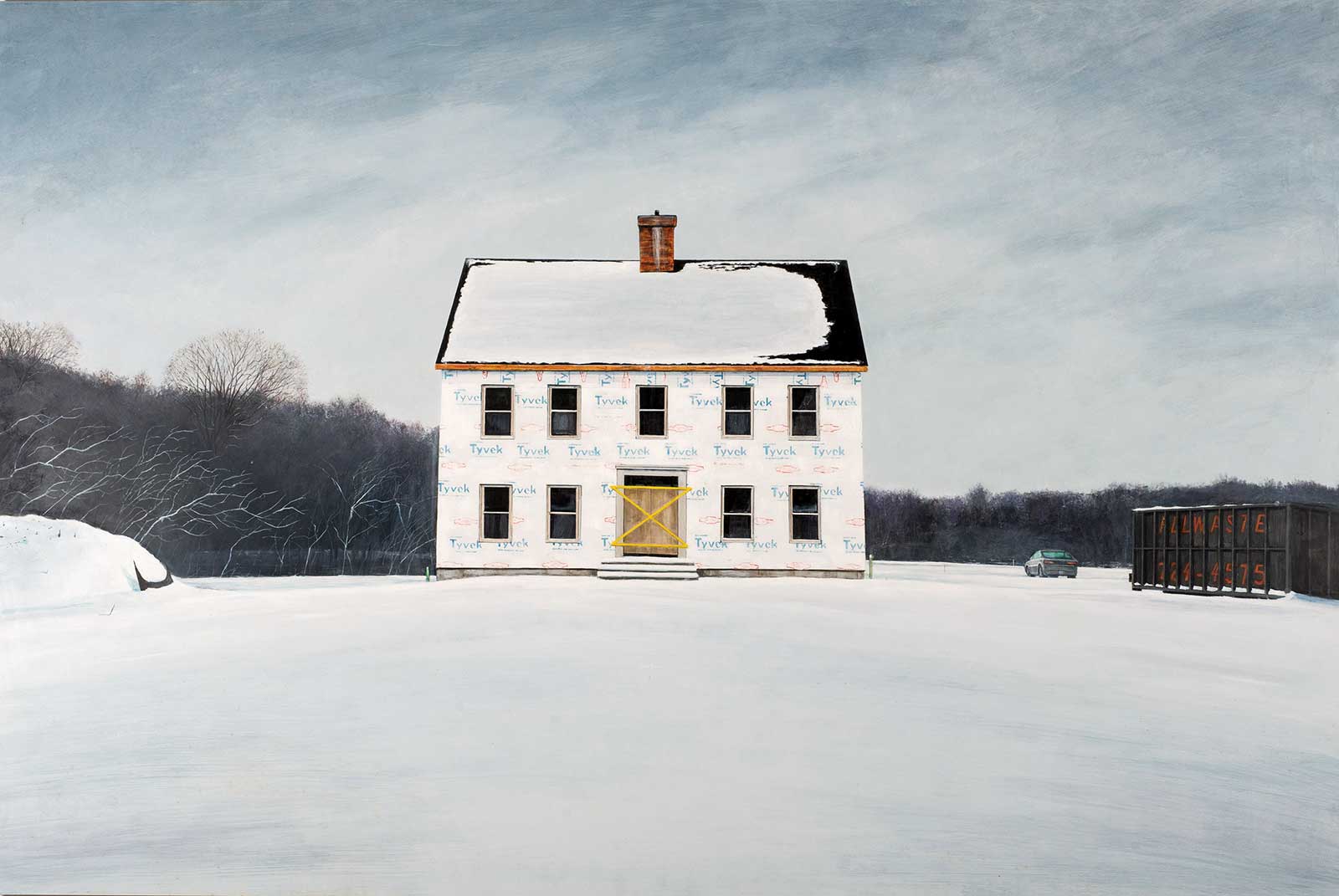 Winter House, 2005, acrylic on aluminum panel, 60 x 90 in. Collection of the artist.
Unknown to nearly all travelers through the station, Waite notes, are the tracks beneath those now in use from which Jews from northern Italy were loaded onto boxcars destined for the concentration camp at Auschwitz.
Seventy of Waite’s often monumental paintings of vast and modest public spaces are being shown in the exhibition Peter Waite: Social Memory, Paintings 1987-2025, at the Wadsworth Atheneum Museum of Art in Hartford, Connecticut, through March 15.
Waite was born in North Adams, Massachusetts, and brought up in nearby Williamstown, the home of Williams College. He attended Hartford Art School and the Art Institute of Chicago and was the recipient of a Guggenheim Fellowship in 1995. He is a longtime resident of Connecticut.
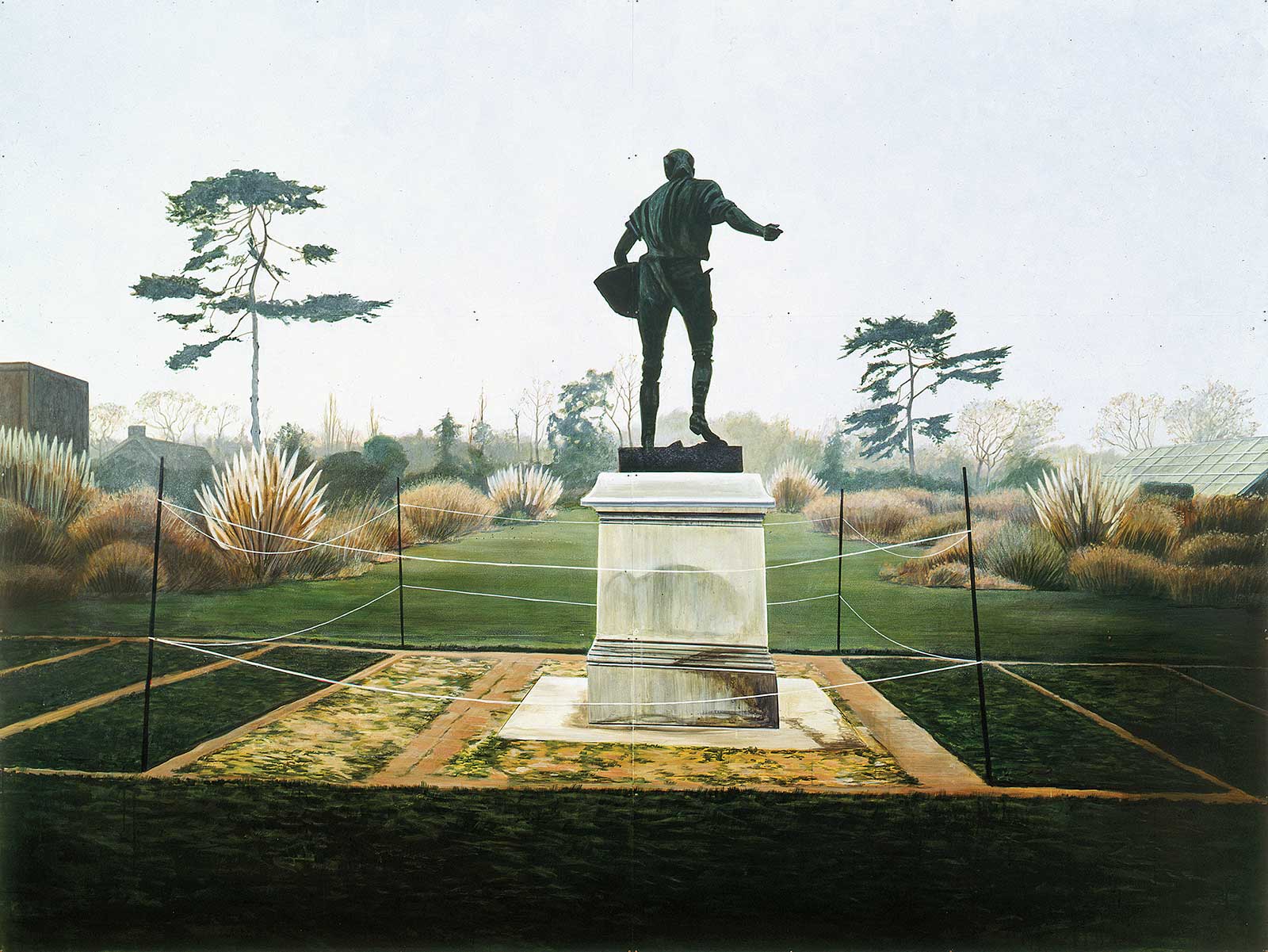
Sower/Kew Gardens, 1991, acrylic on PVC panels, 72 x 96 in. The William Benton Museum of Art, Gift of Judie and Howard L. Ganek, 2010.13.
He describes his paintings as “the antithesis of photorealism. I work from snap shots and quick sketches. A great deal is memory. Before digital photography and the smartphone, I used a cheap tourist camera. Sometimes I used a cardboard disposal camera and would wait until the end of the week to take it to the drug store for processing when I knew the chemicals were at the end of their life. The prints looked washed out like 19th-century sepia-colored photos. I supplied the color later. Seen from a distance, the paintings seem realistic and as you approach they completely become something else. The larger paintings are on 2-by-4 feet rectangles of plastic that I sand with a rotary sander and wipe down with denatured alcohol. I can stack up the panels, put them in a box in the back of my car, take them to the museum and have them pinned to the wall.”
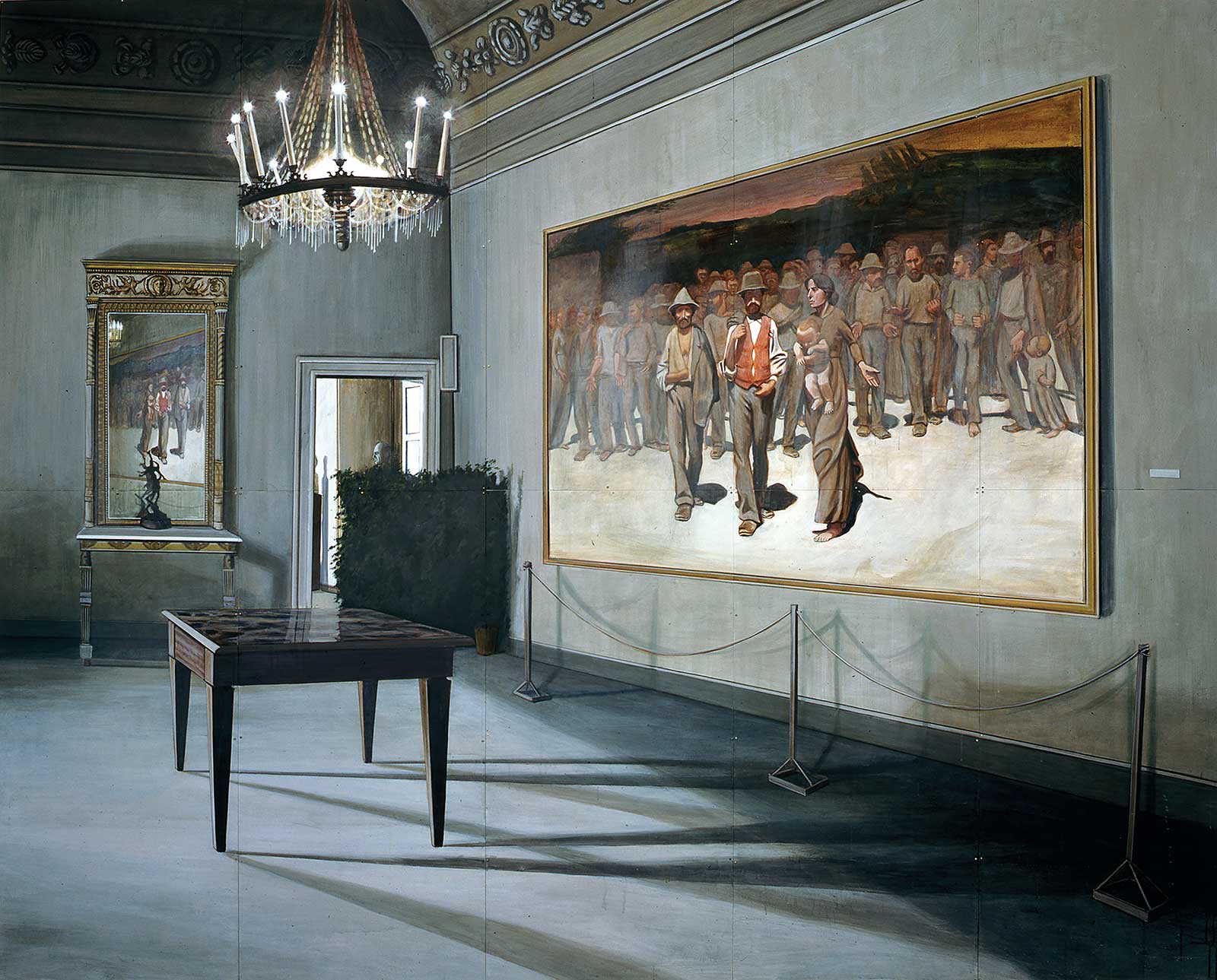
Lessons of the Fourth Estate, 1990, acrylic on PVC panels, 96 x 120 in. Wadsworth Atheneum Museum of Art, the Ella Gallup Sumner and Mary Catlin Sumner Collection Fund, 1990.27.
Basketball Court, 1994, is 96 by 72 inches, composed of the 2-by-4 feet panels. He says, “This building in my hometown, Williamstown, was one of the first architectural spaces that haunted me as a kid, particularly the college’s basketball court which my friends and I would sneak into to play on, eventually to be shooed away by the staff. There is an oval cork running track above the court and a lattice work of steel beams supporting a heavy slate roof. Wooden bleachers pull out from the tile walls and go right up to the court. Home games were intense affairs.”
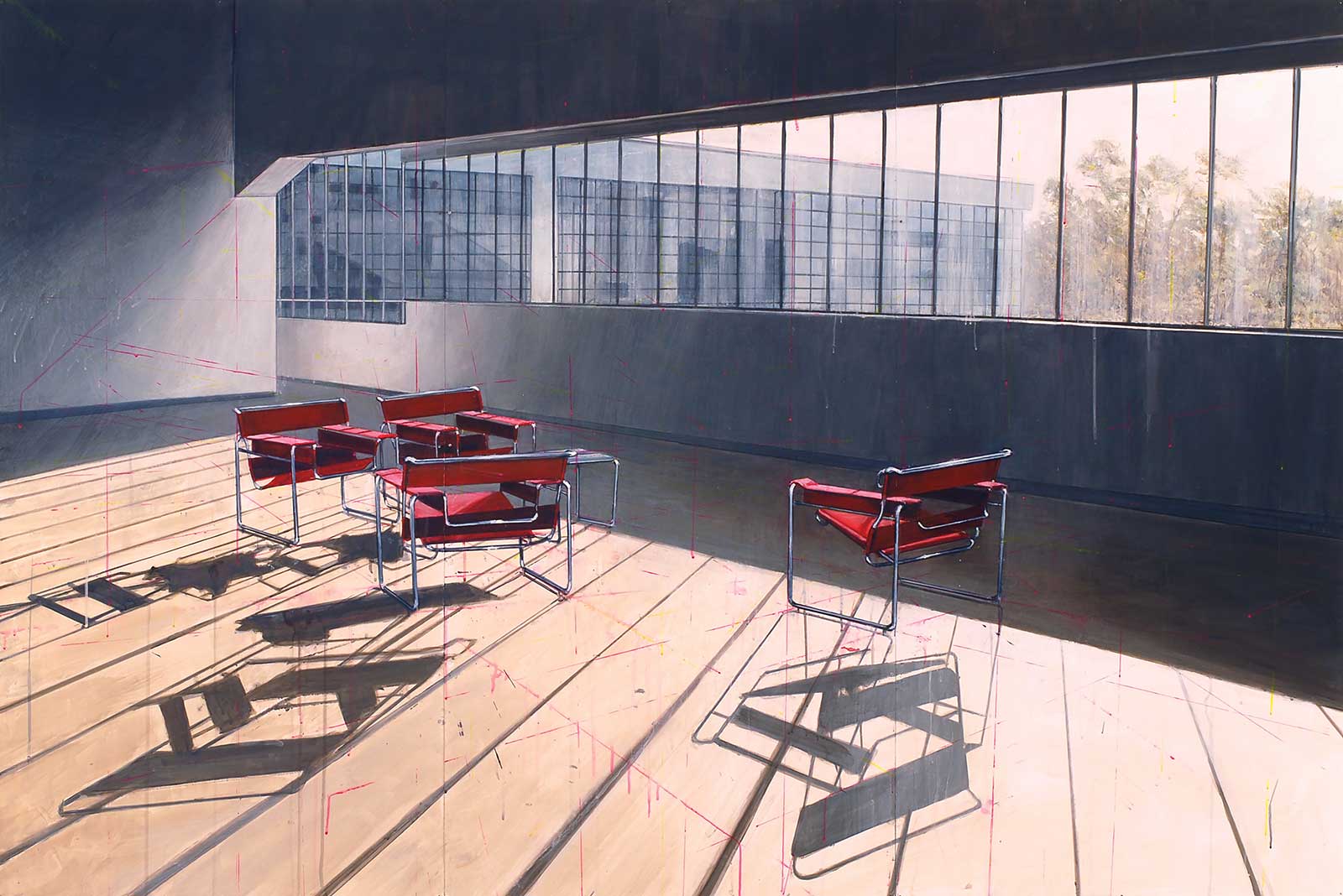
Bauhaus, 2007, acrylic on PVC panels, 48 x 72 in. Connecticut Office of the Arts, Connecticut Artist Collection.
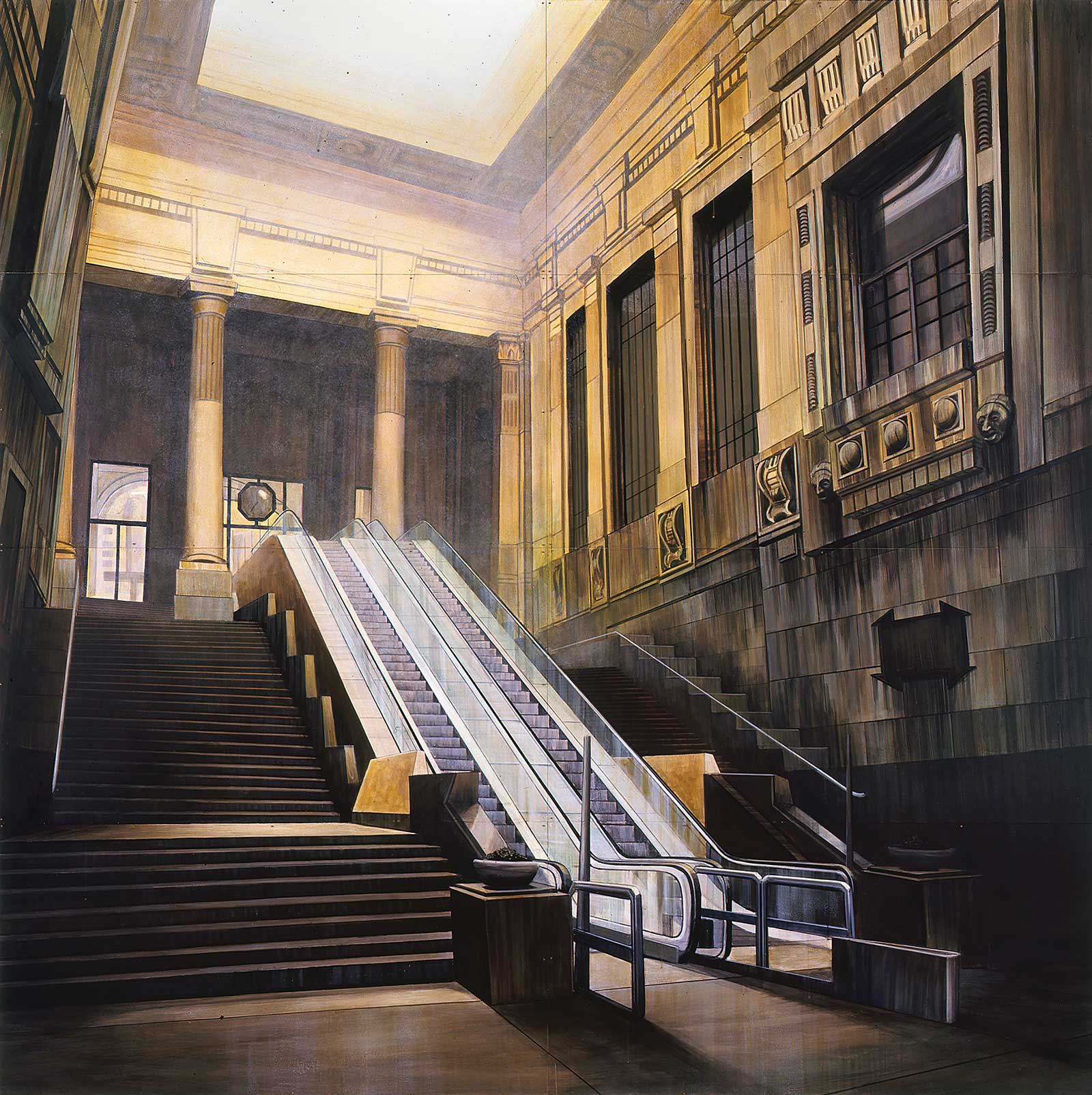
Station/Milan, 1992, acrylic on PVC panels, 96 x 96 in. Collection of Cynthia and Charles Peabody.
In her notes on the paintings in the catalogue to the exhibition, Laura Leonard, Art Bridges Project coordinator and curatorial researcher at the Wadsworth, comments, “Flooded with natural light from a large arched window, the empty gymnasium evokes the solemnity of a cathedral. This familiar site of play and assembly becomes a space of quiet reverence where communal rituals take place. By linking the vastly different spaces together through shared human experiences, the spiritual dimension of community gathering becomes evident.”
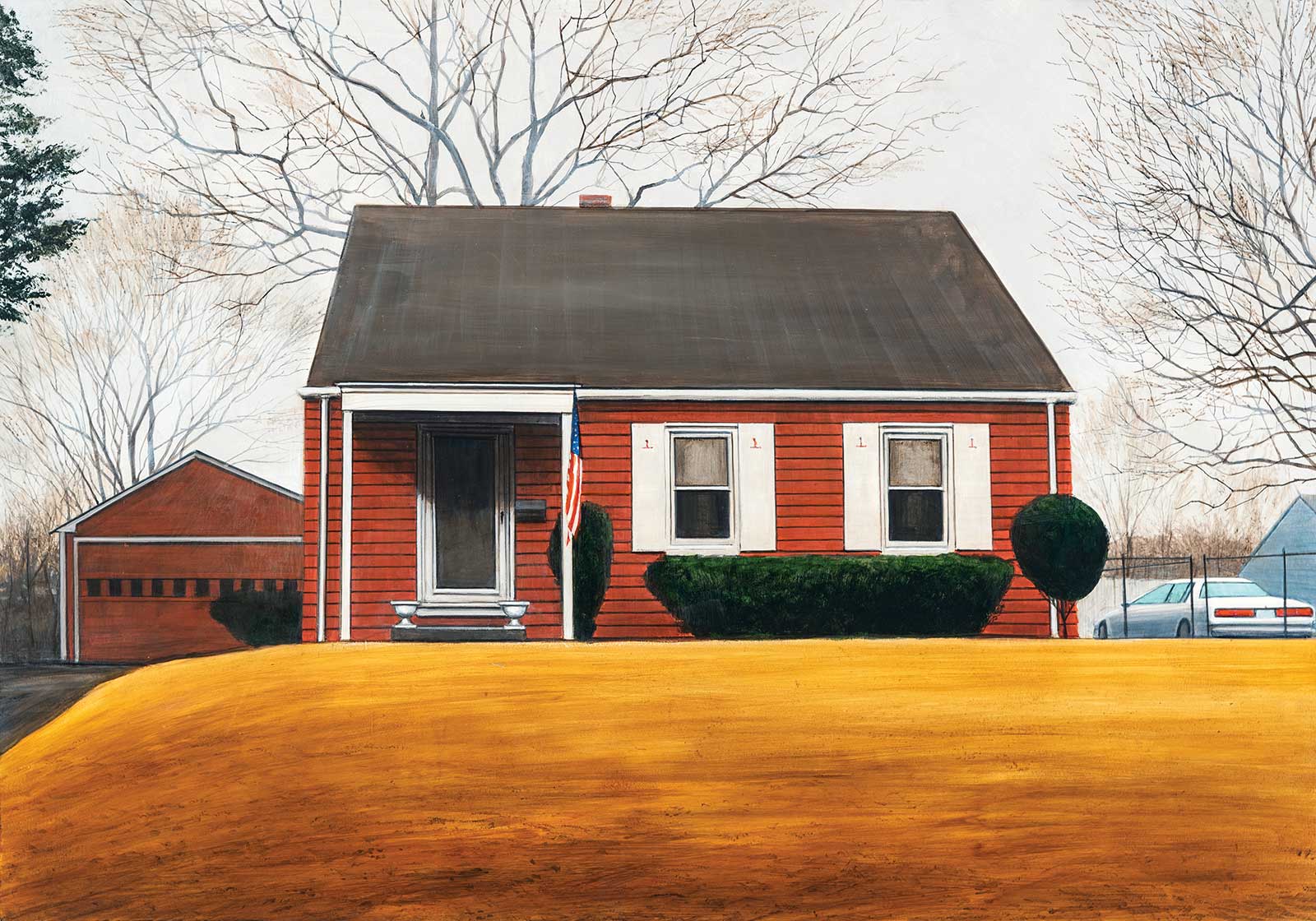
House #6, 2002, acrylic on PVC panel, 30 x 43 in. Courtesy the artist.
The catalogue text is written by the sculptor and critic Robert Taplin, Waite’s longtime friend. Echoing Waite’s own observations of the train station in Milan, Taplin writes about the painting Bauhaus: “Although Waite’s paintings are entrancing in their detail and fluid, quick rendering, they often invoke a dark backstory which is sometimes more, and sometimes less evident. The gorgeous light flooding through Bauhaus throws complicated shadows from the elegant Wassily Chairs, with their once innovative but now pervasive design. The chairs remain but Marcel Breuer, the artist who designed them, was chased out of Germany by the Nazis, and the school was shut down. By the time Waite made his visit to Dessau, the school had reopened and the scene he depicts is the school lounge, the dark history of the ‘30s effectively buried.”
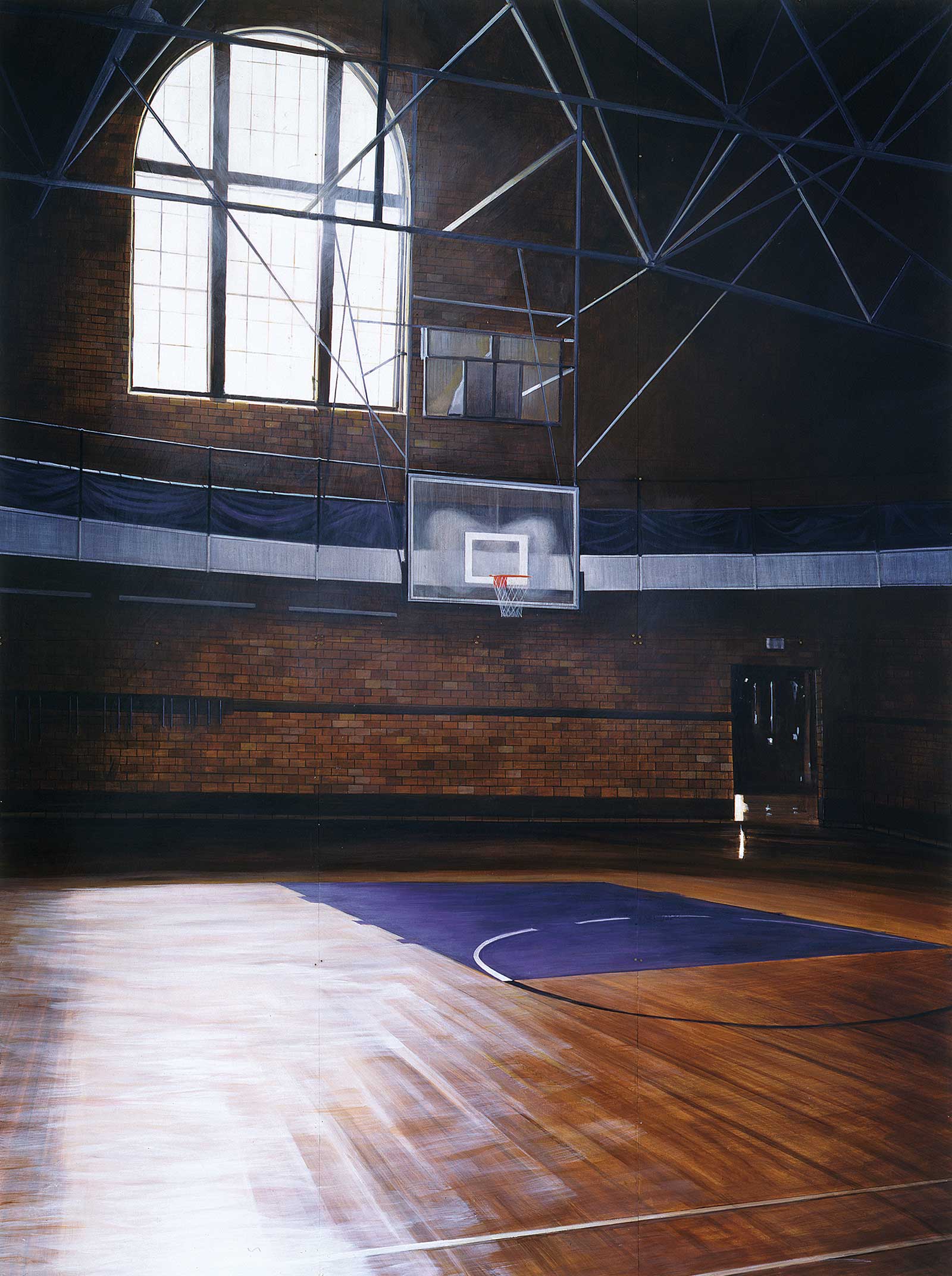
Basketball Court, 1994, acrylic on PVC panels, 96 x 72 in. Collection of Cynthia and Charles Peabody.
Waite uses simple one-point perspective in his paintings as a “hook to draw someone in,” something he notes that Stanley Kubrick uses in his films. In one-point perspective, all horizontal lines converge in a point as you experience track tracks, for instance, receding in the distance.
“As a kid growing up in the Berkshires of western Massachusetts,” he explains, “we were surrounded by mountains and seldom experienced anything flat. My family and I took three trips to Europe and back on an ocean liner. It was cheaper than flying. I really remember all the smells and the excitement and the motion and the horizon line of the water, and the fact that it’s just you and a fabricated thing on water.”
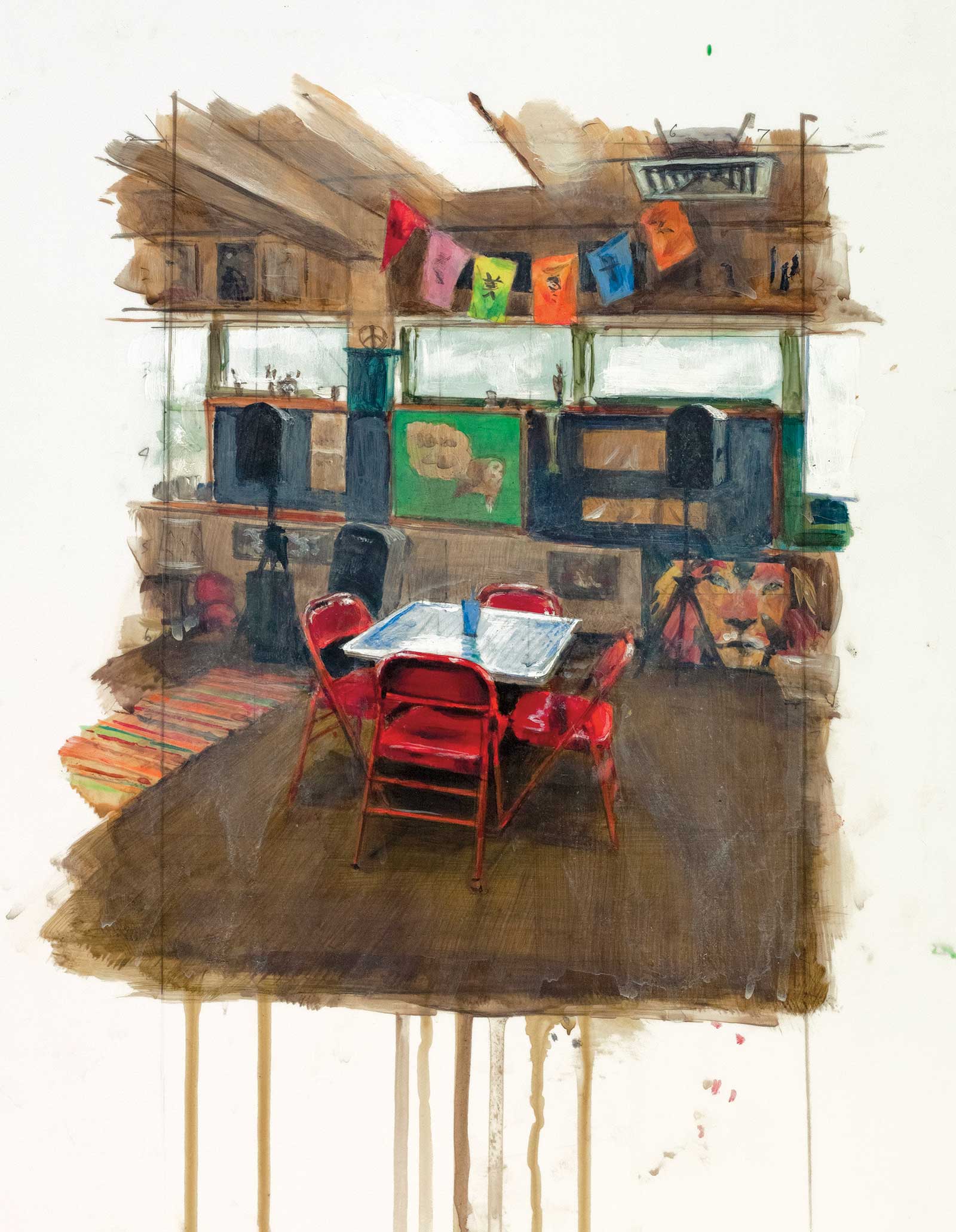
School Studies, 2018, acrylic on polypropylene, 14 x 11 in. Courtesy the artist.
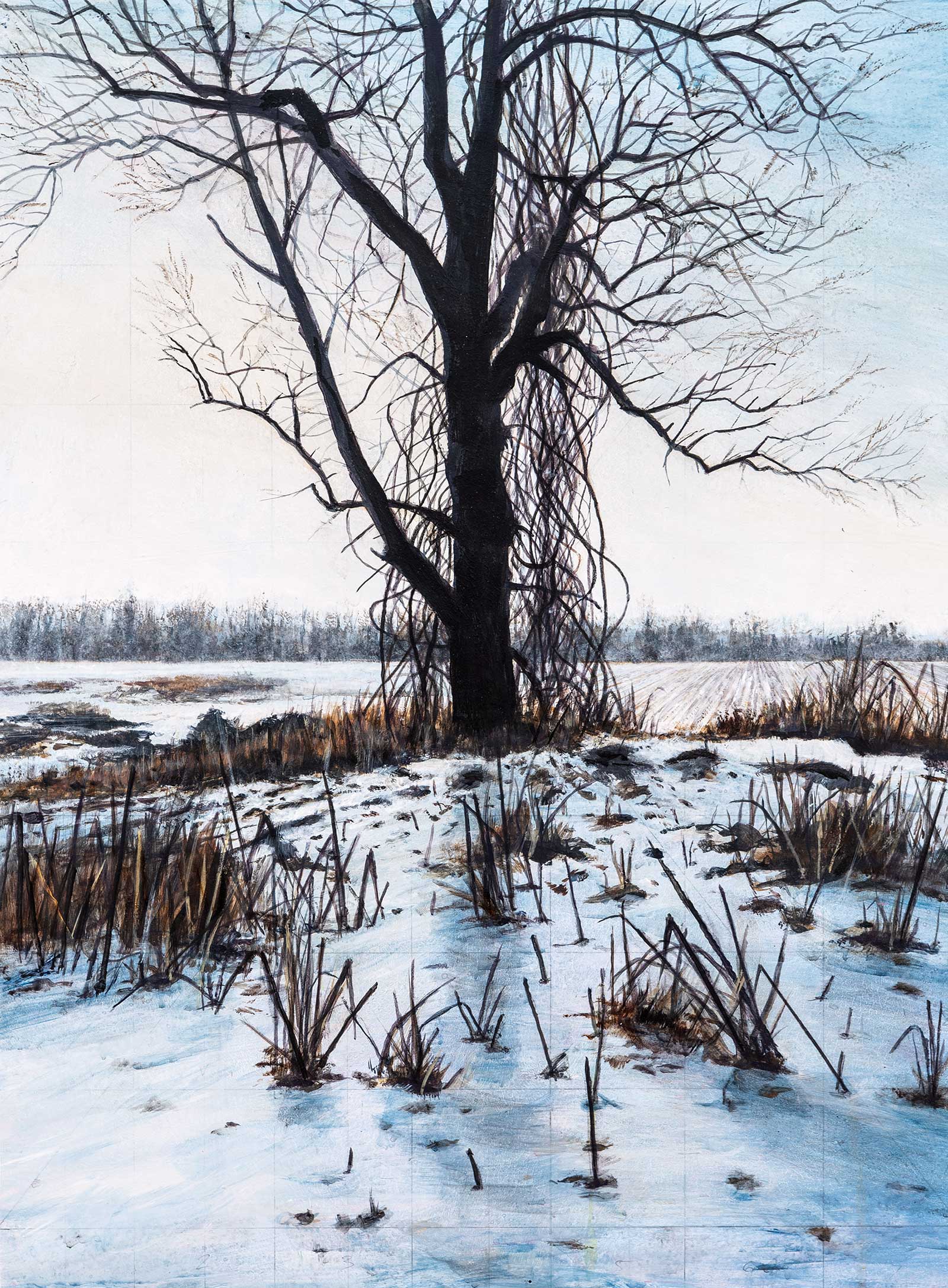
Winter Tree, 2022, acrylic on PVC panel, 24 x 18 in.
His discovery of the horizon is echoed in the poem “Horizon” by Billy Collins, former poet laureate of the United States, which Waite has posted on his Instagram page—a delightfully simple exposition of the world changing with a single line.
You can use the brush of a Japanese monk
or a pencil stub from a race track.
As long as you draw the line a third
the way up from the bottom of the page,
the effect is the same: the world suddenly
divided into its elemental realms.
A moment ago there was only a piece of paper.
Now there is earth and sky, sky and sea.
You were sitting alone in a small room.
Now you are walking in the heat of a vast desert
or standing on the ledge of a winter beach
watching the light on the water, light in the air.
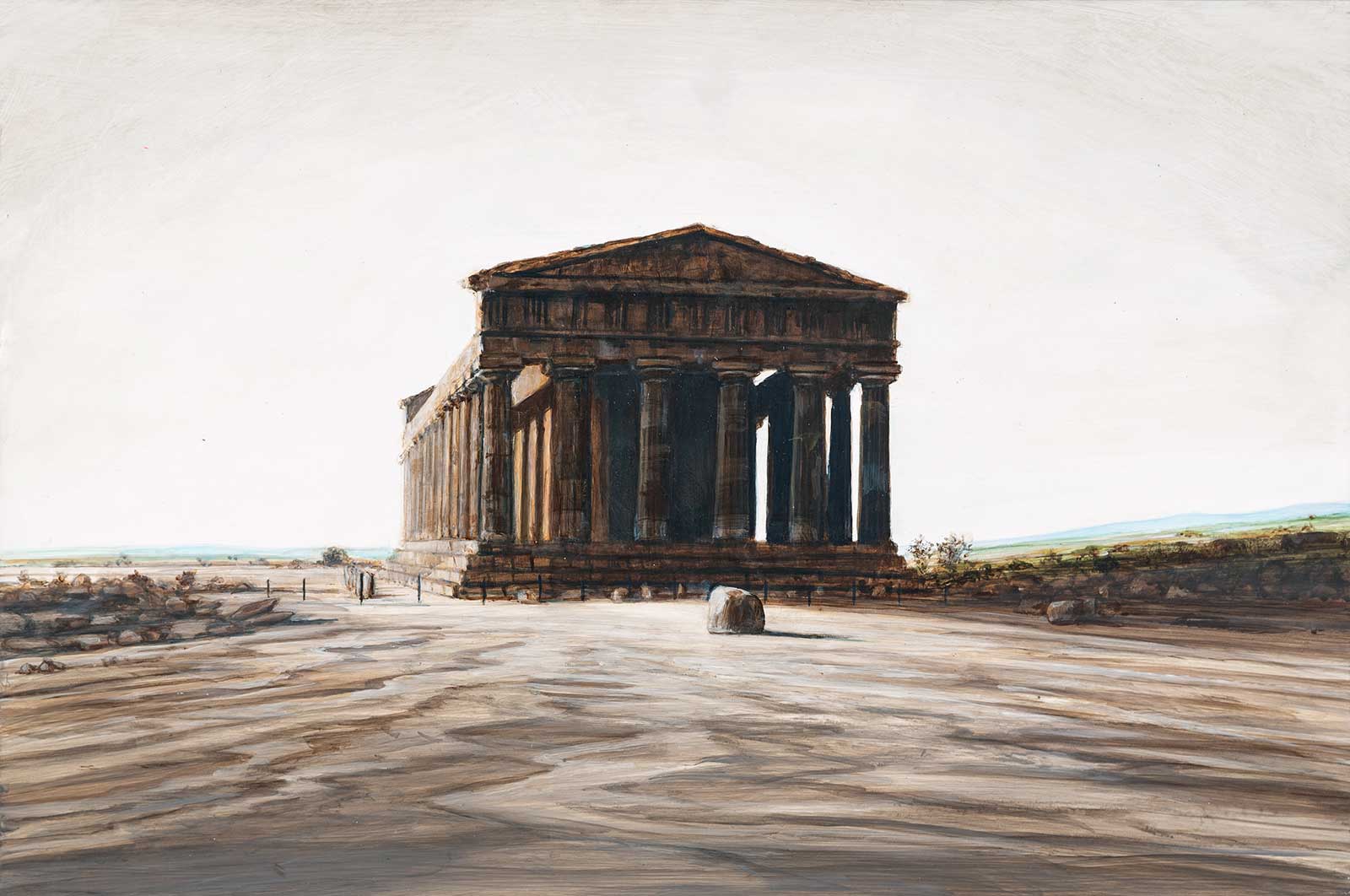
Temple, 2004, acrylic on aluminum panel, 16 x 24 in. Courtesy the artist.
Taplin ends his essay with, “His images are fully legible but full of subterranean currents, both personal and historical. They do not purport to critique the structural operations of representation, but they do insist that what you see is determined in large part by what you know, what you have done, and where you have been. Looking at one of his paintings is to a great extent an act of recognition. As viewers, what each of us carries inside can rise slowly to the surface in an act of contemplation. Peter Waite’s paintings call for that response.” —
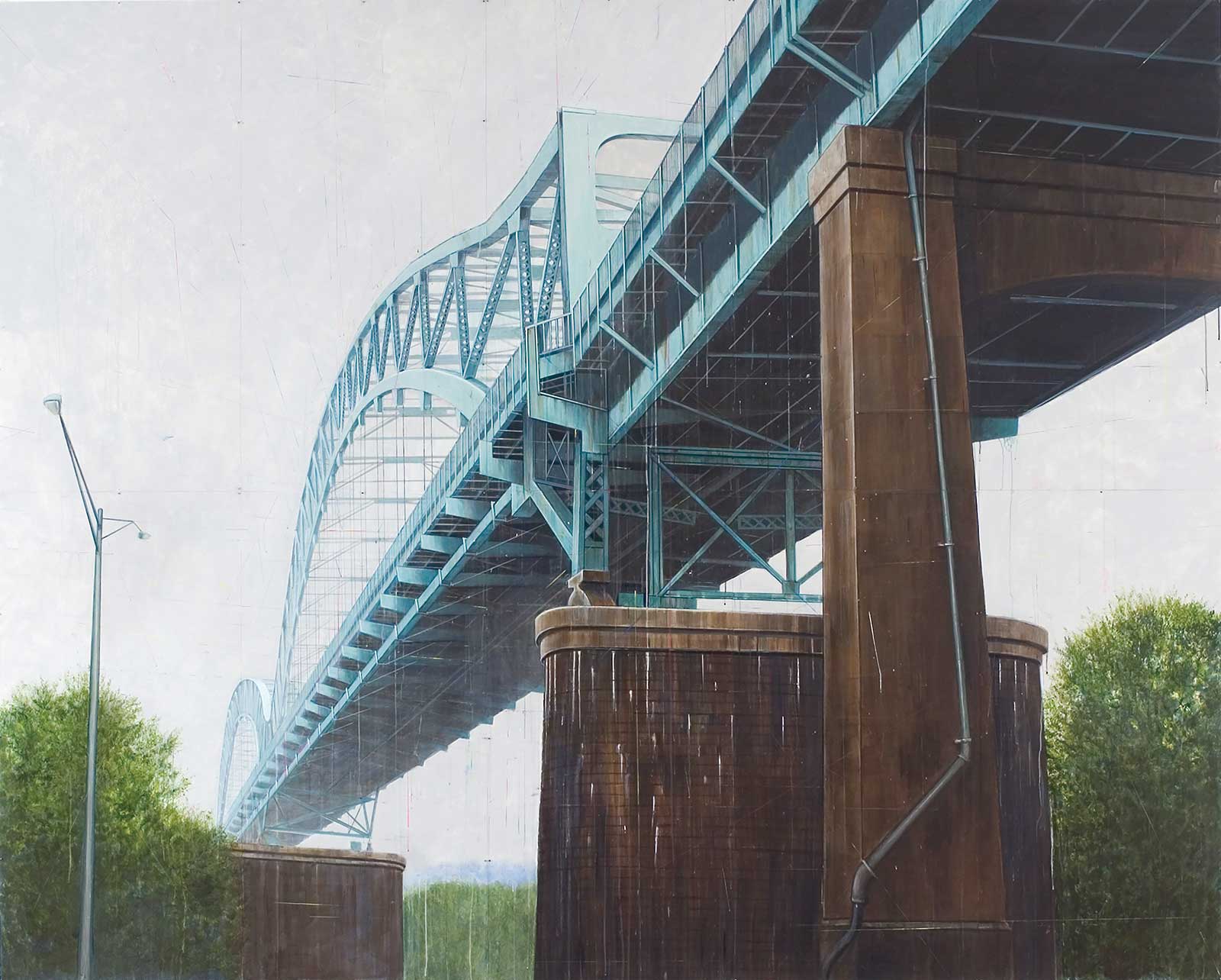
Bridge, 2006, acrylic on PVC panels, 96 x 120 in. New Britain Museum of American Art, Berkshire Taconic Foundation and Stephen B. Lawrence Fund, 2006.127.
Peter Waite: Social Memory, Paintings 1987–2025
Through March 15, 2026Wadsworth Atheneum Museum of Art
600 Main Street, Hartford, CT 06103
(860) 278-2670, www.thewadsworth.org
Powered by Froala Editor