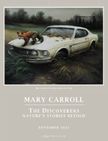
Humans have homes, which are most frequently some sort of wood, glass or metal box where we store our stuff, eat our meals, sleep and experience the ups and downs of life. For the animal kingdom, home is the entire planet—no box needed. For Mary Carroll’s newest show at RJD Gallery, she explores nature, home and how they intersect with living beings of all types.
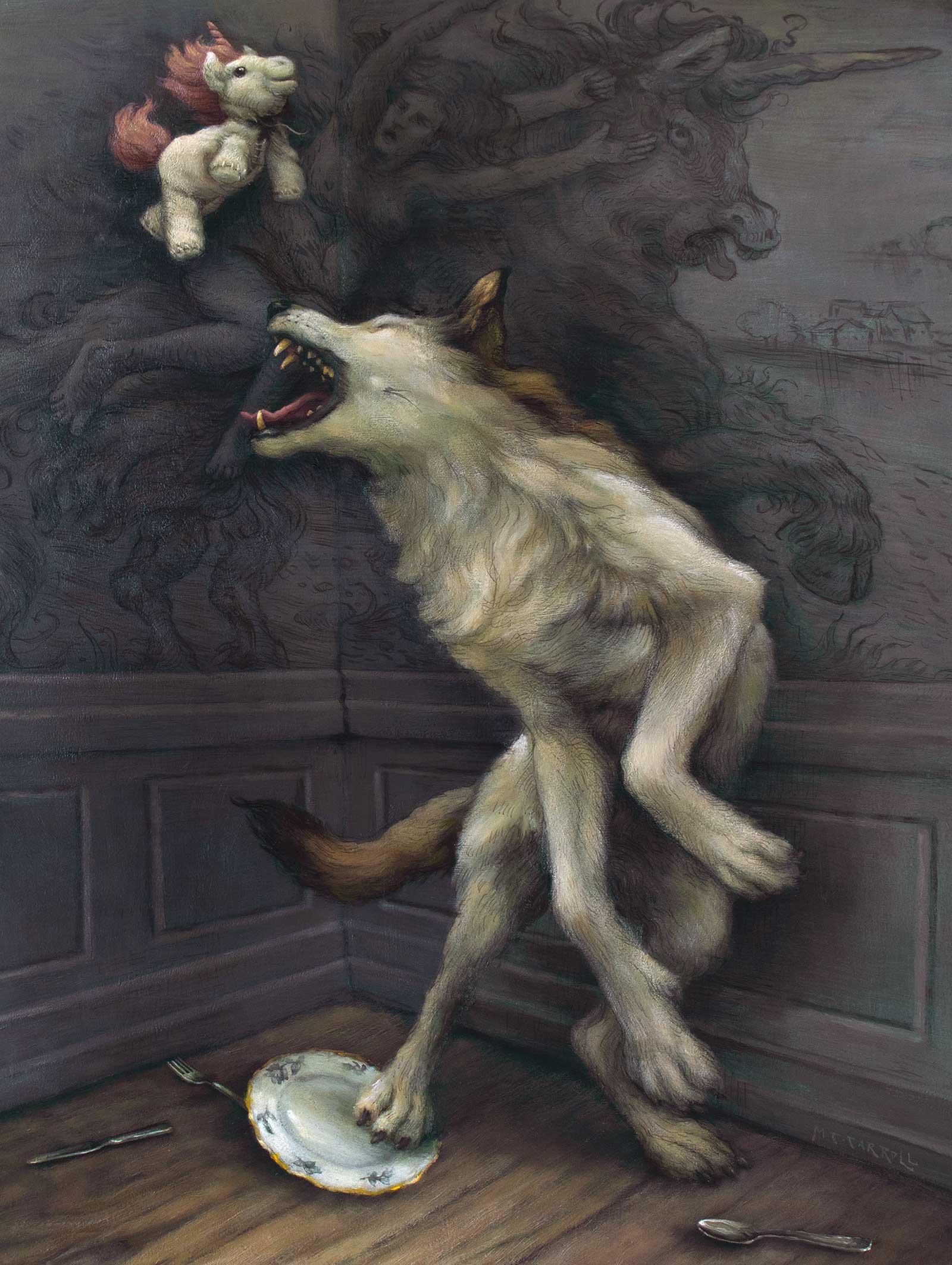 Feast of the Unicorn, acrylic and ink, 24 x 18 in.“I fight to cling to ways in which I feel like I belong to this world. I feel out of place, or perhaps out of time. I often find my thoughts longing to go back to somewhere I think of as ‘home,’ but I don’t know what, or where that place is. It seems like a place in the wild that is free of human constructs and timelines, and the pandemonium around our society,” Carroll says. “I wanted to develop a body of work that described the idea of lost and silenced places—where the wild has come to grow back in, and the human things are falling away. These paintings explore the idea of being animal, and the way they live in the immediacy of experience without the burden of ego and excess of humanity, and then into a world abandoned to rewild.”
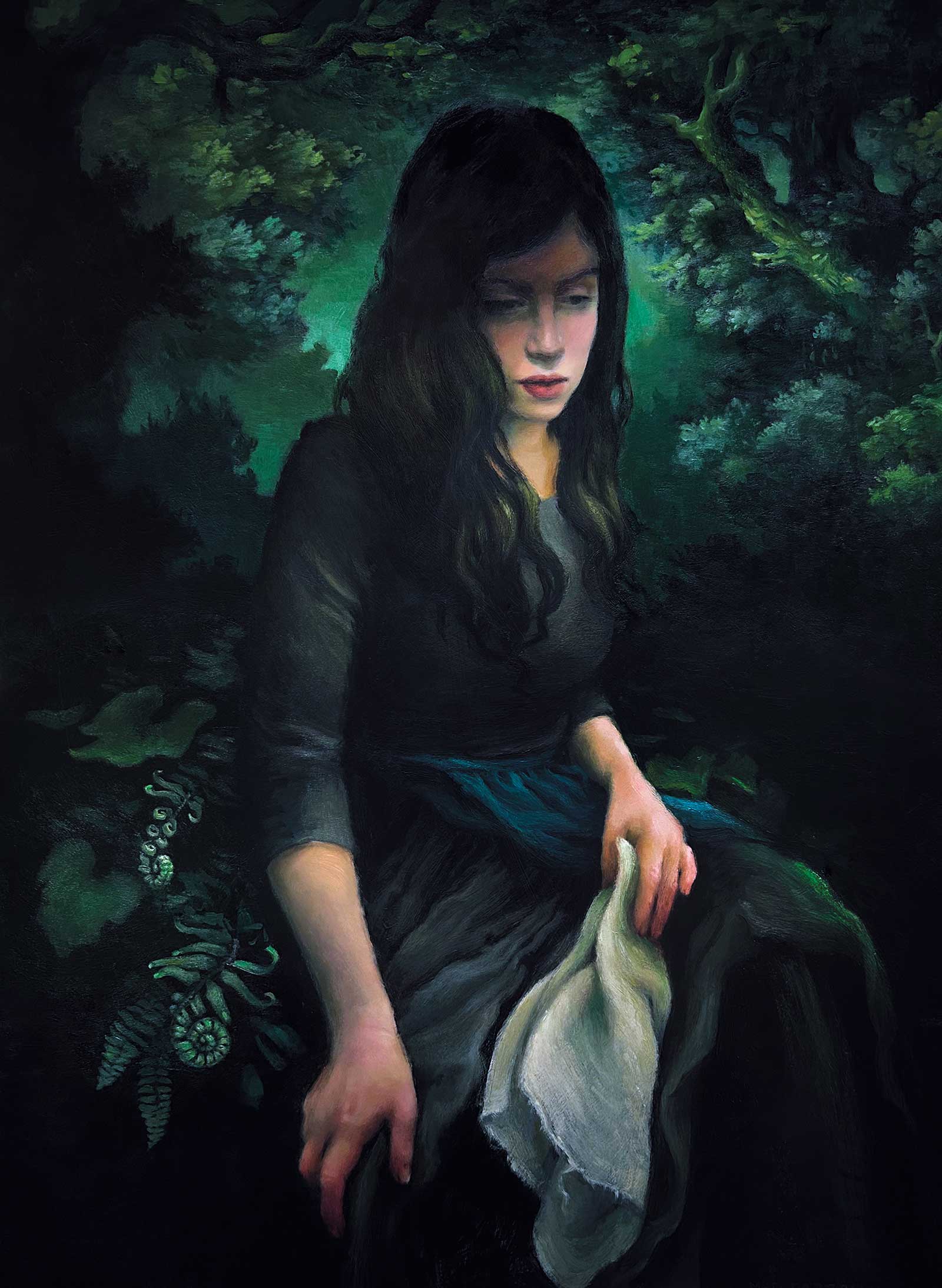 The Shadow That Comes Inside, acrylic, 24 x 18 in.
Her new show, titled The Discoverers – Nature’s Stories Retold, was directly inspired by the Wendell Berry poem “The Peace of Wild Things,” which echoes many of the themes Carroll is exploring:
When despair for the world grows in me and I wake in the night
at the least sound in fear of what my life and my children’s lives may be,
I go and lie down where the wood drake rests in his beauty on the water, and the great heron feeds.
I come into the peace of wild things who do not tax their lives with forethought of grief. I come into the presence of still water.
And I feel above me the day-blind stars waiting with their light. For a time I rest in the grace of the world, and am free.
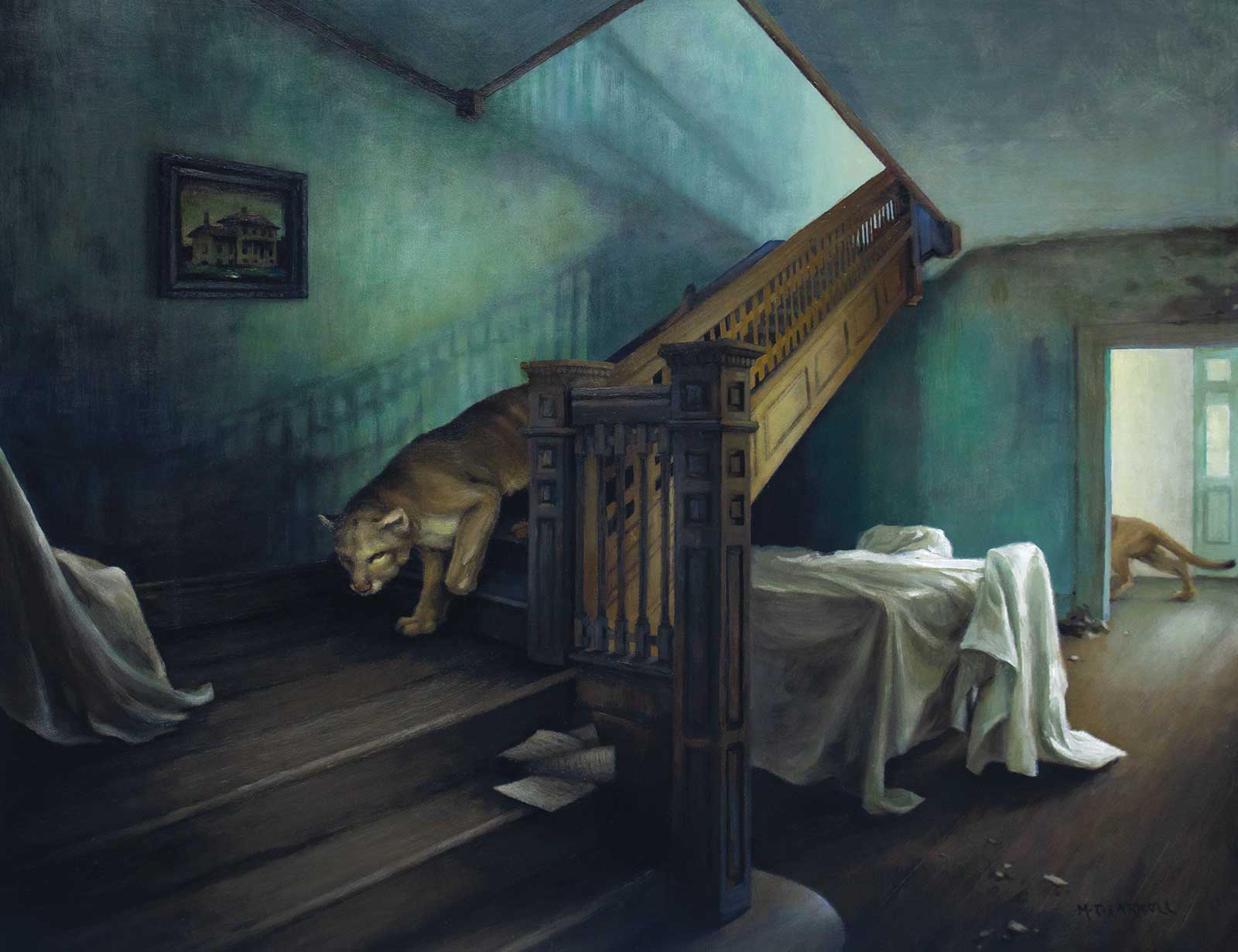
The House on Eden Road, acrylic, 24 x 30 in.
One of the key pieces of the new body of work is The House on Eden Road, which has mountain lions occupying an abandoned home. “I adore old fables and mythologies and spent a lot of time as a child illustrating little stories that I wrote. Each of my paintings comes from the beginning of having written something down. A story as simple as one or two lines, or pages worth of ideas and narratives come until the origin of the painting surfaces,” she says. “But The House on Eden Road was an outlier in that it was influenced by Daniel Mason’s 2023 book North Woods, which I found to be an entirely staggering work. The novel chronicles generations of people that have lived on a single area of land in western Massachusetts over the span of 400 years. It tells of the transformation of the land, once described as a new kind of Eden, and the house that was built there, which later fell into disrepair and was claimed by mountain lions. ‘Through silent hall the great cat slunk, her whiskers taut, her eyes ablaze. The moon through window cast its glow and lit the halls be-silenced maze.’”
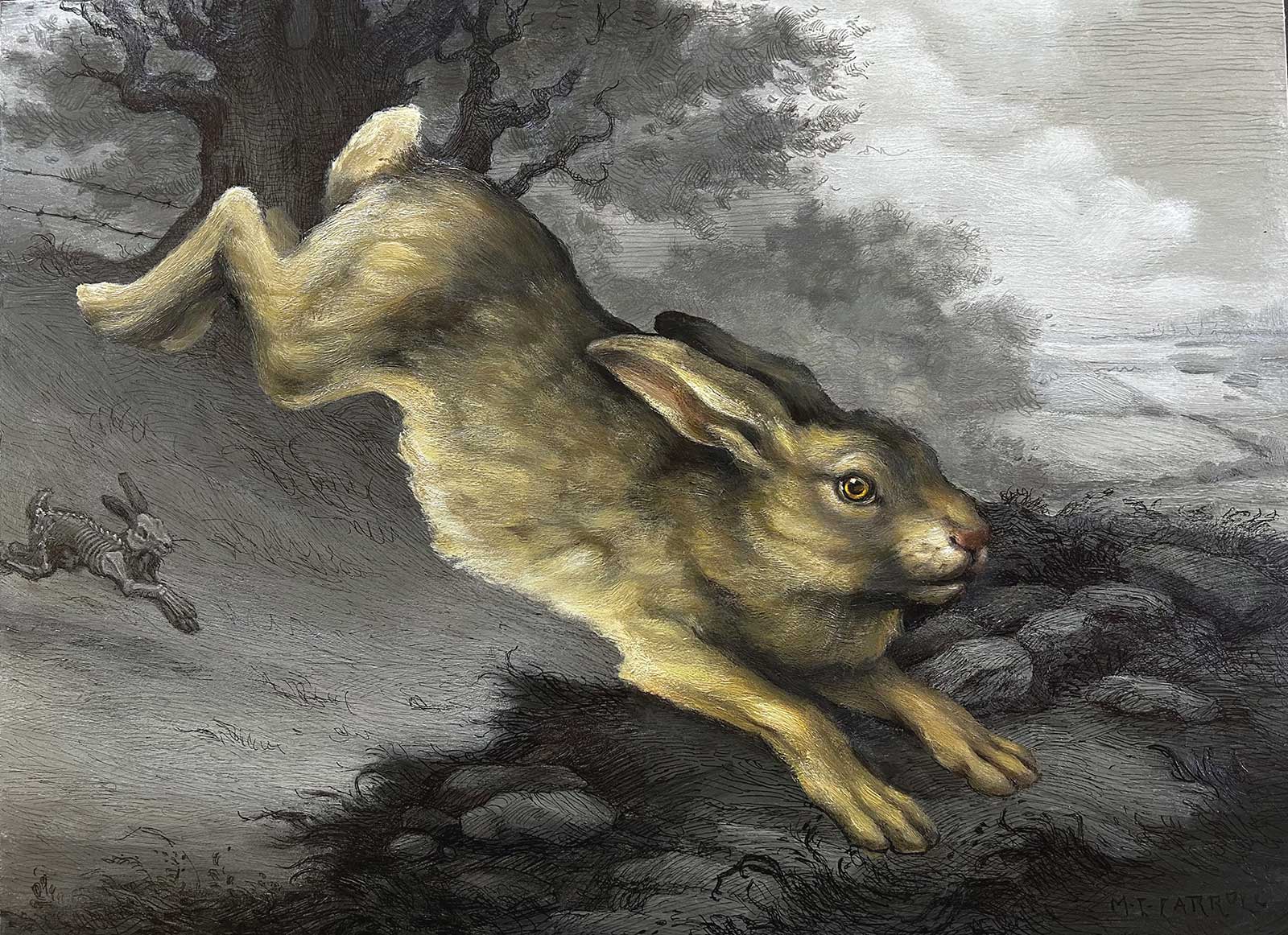
The Fear of Man, acrylic and ink, 12 x 16 in.
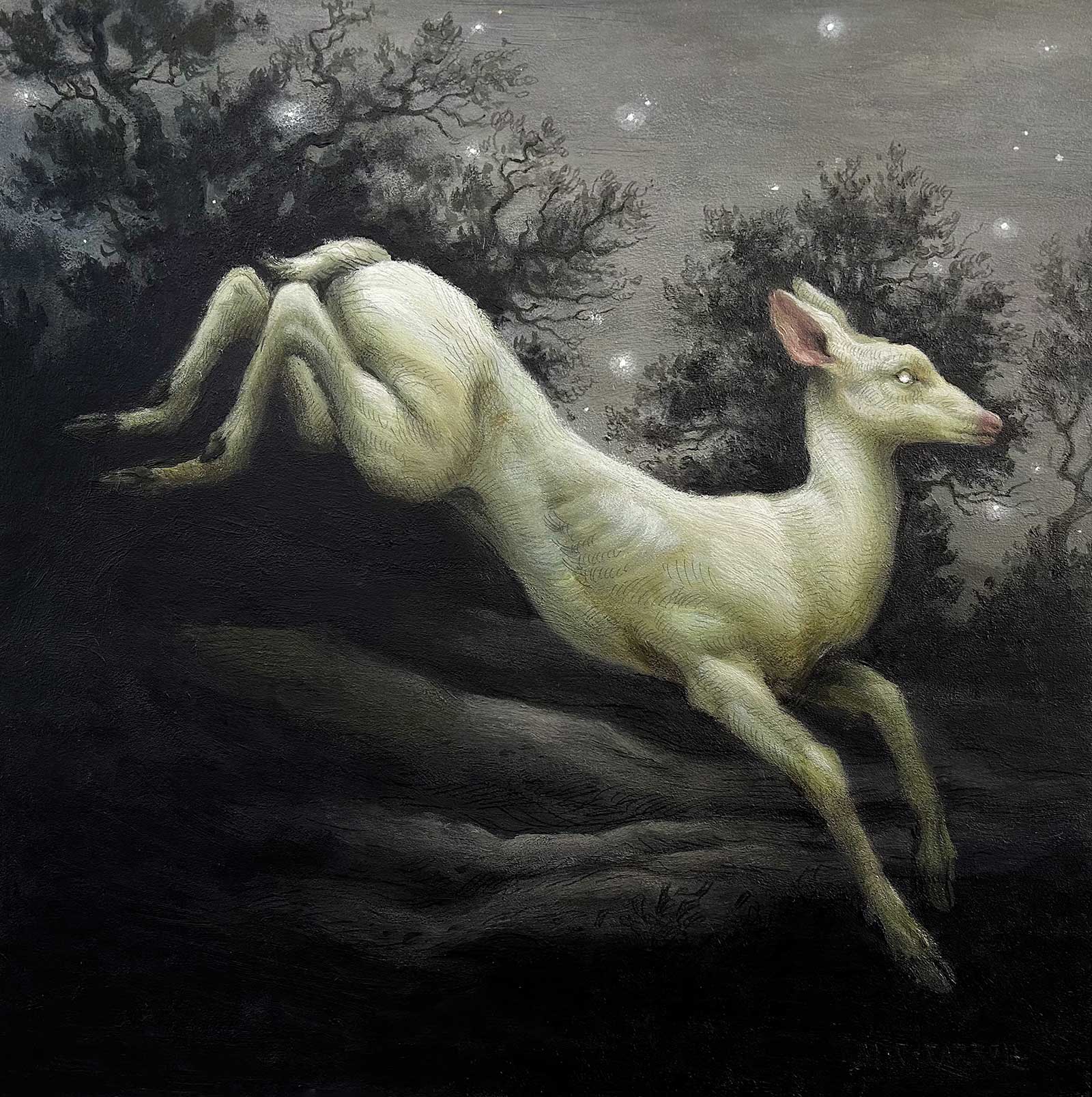
Stargazer, acrylic and ink, 12 x 12 in.
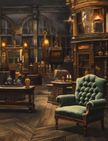
Another work in the show is Feast of the Unicorn, which continues her theme of animals in abandoned domestic settings. “The dining room in the painting Feast of the Unicorn is one of these forgotten places; vestiges of past lives show up in the child’s unicorn stuffie and the mother’s fine China, but now the wolf has come. I envisioned it playing with the stuffed unicorn so that the two worlds would overlap,” she says. “The unicorn serves as a symbol of our mythologies in ancient times, and the wallpaper in the back shows [Albrecht] Dürer’s 1516 etching of Persephone’s abduction to the Underworld. I composed the painting with his etching as wallpaper not only for his depiction of the unicorn, but also for the idea of our world becoming barren and dormant, as winter comes once Persephone is gone. It shows us the cyclical mark of the seasons, or of death and rebirth.”
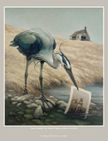
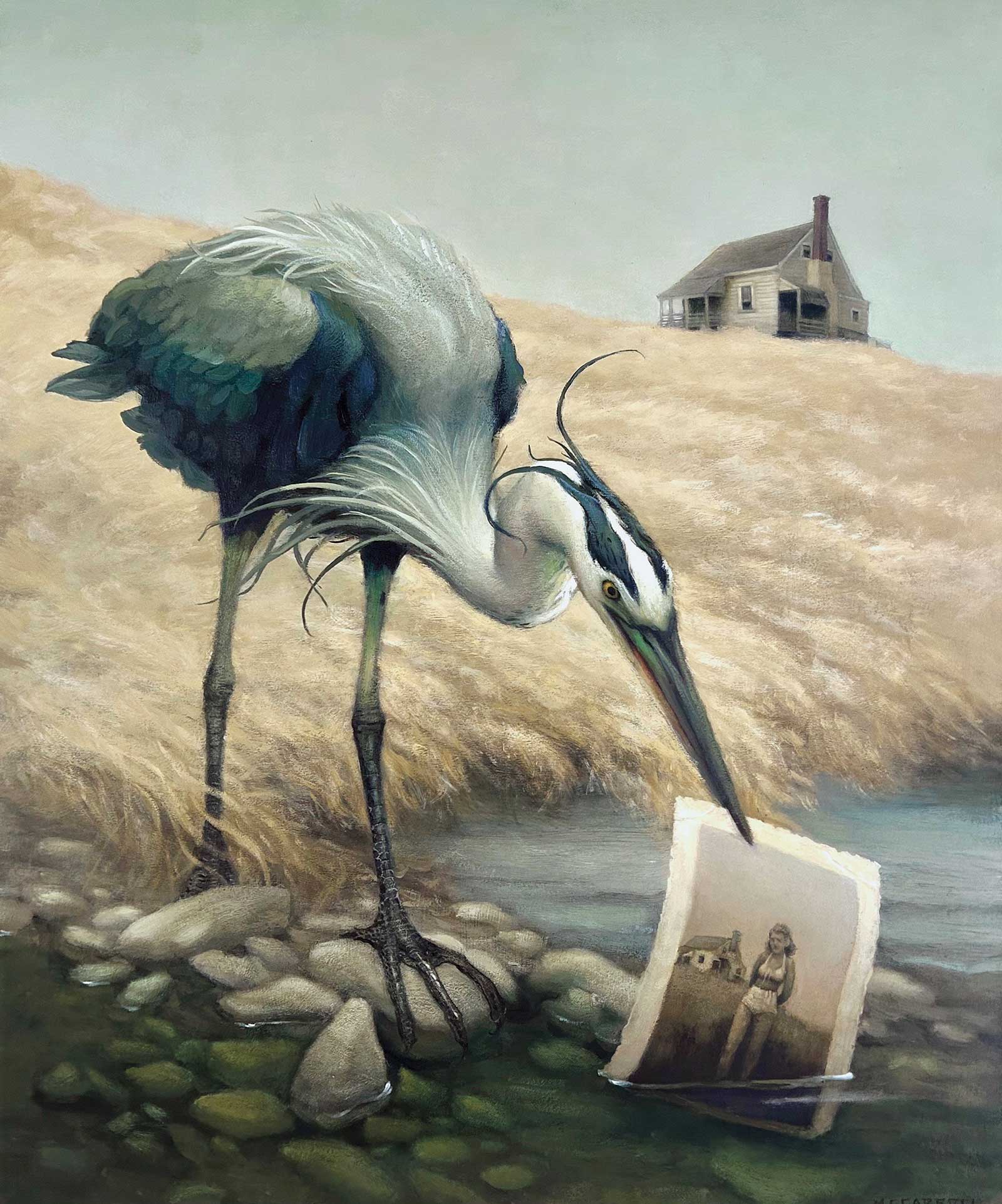 The Water’s Edge, acrylic, 24 x 20 in.
Carroll continues: “There is a bend in the river at the edge of the woods, where nearby a blue heron nests. It stabs at the water like a lightning strike and snatches out a minnow after having been statue—still for minutes on end. I spend what time I can settled into the still places of the land around my house, observing. I wanted to write the heron into a narrative about its living alongside us, but in lives past and places left behind, as seen in The Water’s Edge. The bird pulls an old photograph from the river with the same instinctive ease that it catches its minnows. Behind it stands a small old homestead on a hill. The woman in the photo from the 1940s was in a stack of old family portraits and snapshots, but I don’t know of what relation she is to me. In the photograph, she stands in a bikini in the front yard of the same house in the distance that I painted behind the heron. I hope that you can feel her there still, standing in front of the old home, if even as a phantom.”
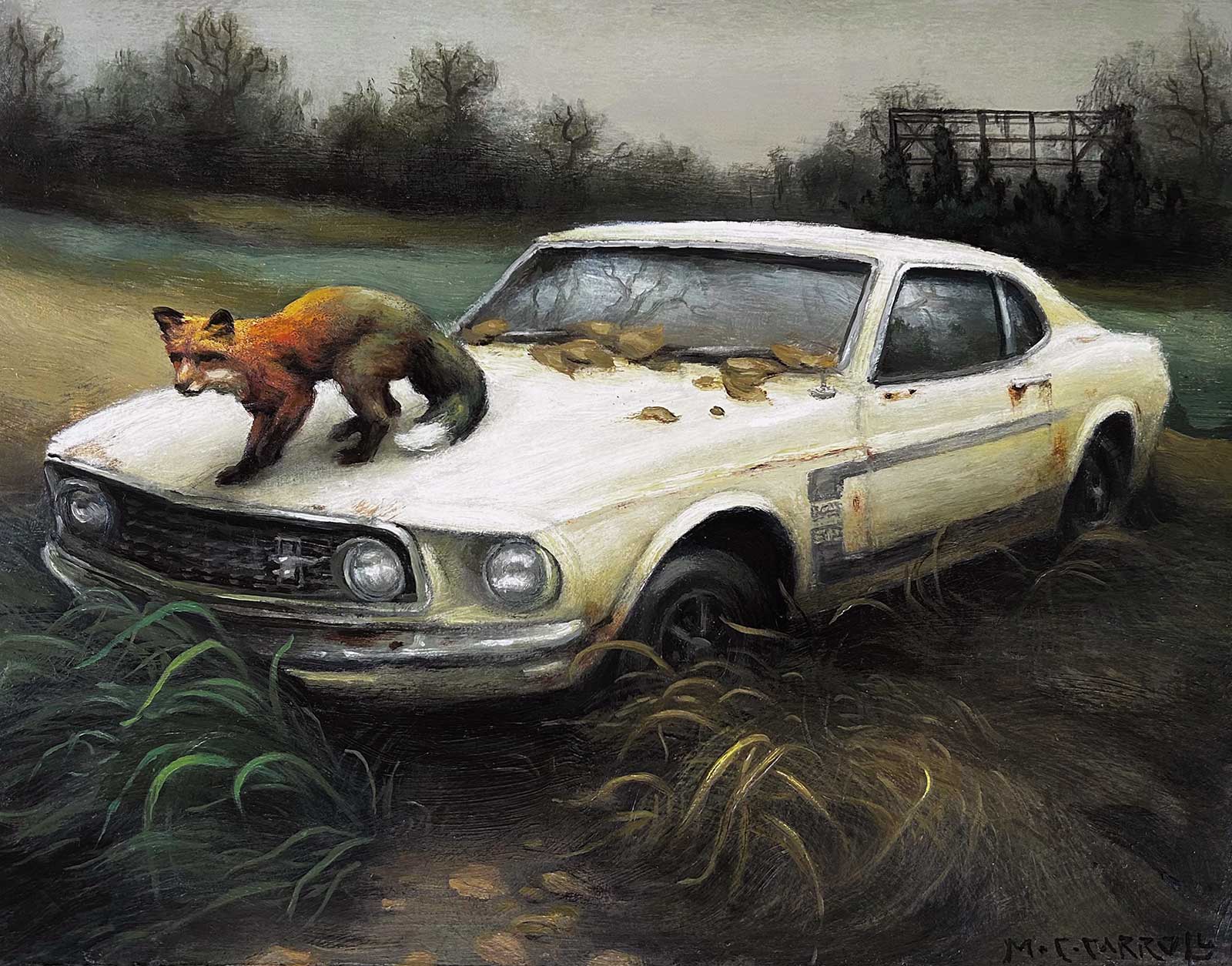
Drive-in, acrylic, 8 x 10 in.
Joi Jackson Perle, RJD’s gallery director, says, “Mary Carroll imagines a world seen through the eyes of wildlife—discovering, and rediscovering, the earth in our absence. How might animals respond to the remnants of our manmade environment, to the objects and treasures once so cherished? Her work invites us into an evocative mystery, where the stage is set for modern-day fairy tales.”
The show hangs through November 30. —
RJD Gallery 227 N. Main Street • Romeo, MI 48065 (586) 281-3613 • www.rjdgallery.com
Powered by Froala Editor