Mark Dion and Alexis Rockman met at the School of Visual Arts in New York City in the 1980s. Dion, a conceptual artist, and Rockman, a painter, have been inspired by the environment from an early age and each has gained international recognition for their work.
The first shared survey of their work, the traveling exhibition, Mark Dion and Alexis Rockman: Journey to Nature’s Underworld,concludes its over-two-year tour at the Palmer Museum of Art in the College of Arts and Architecture at Pennsylvania State University on December 7.
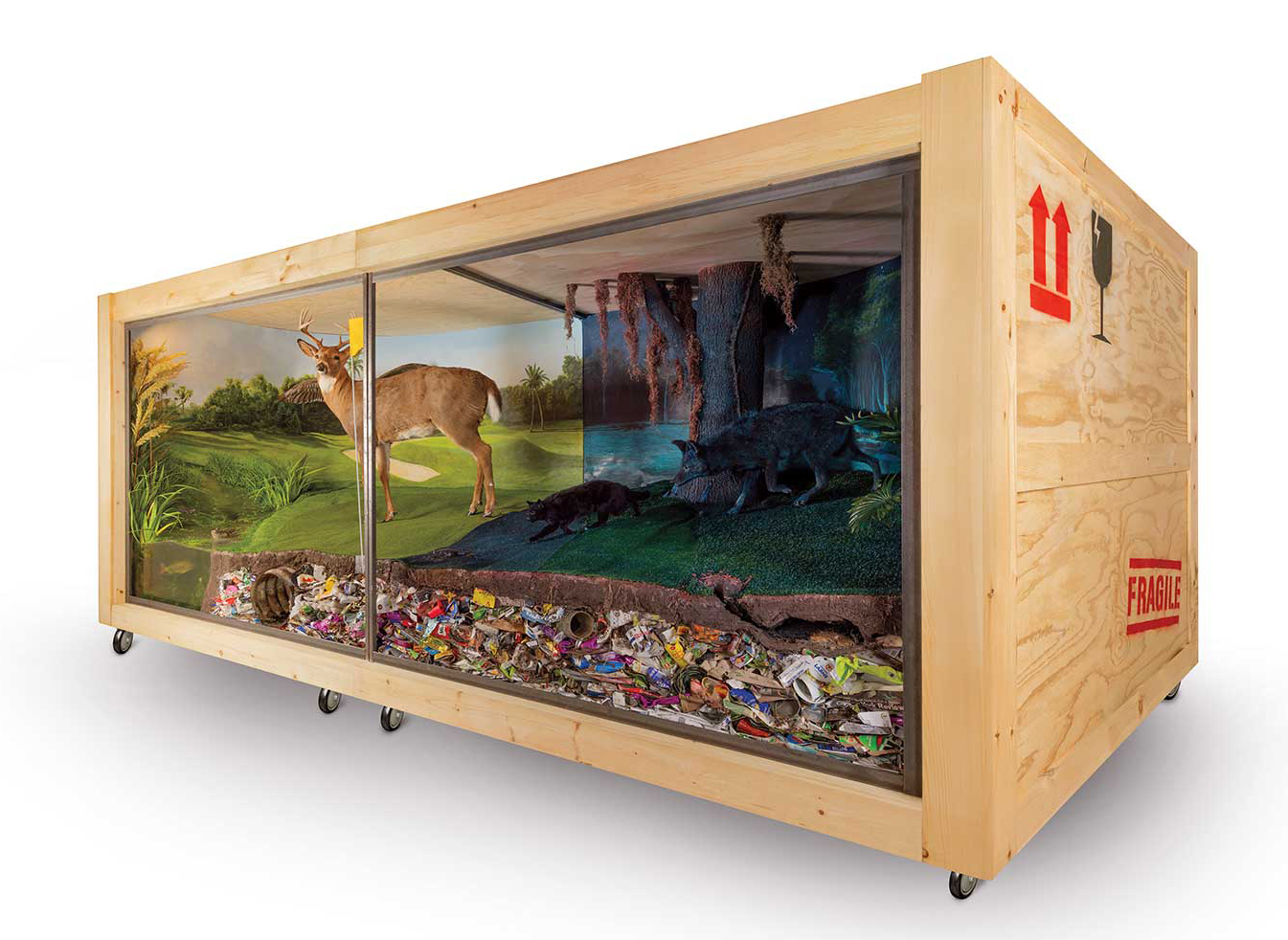
Mark Dion and Alexis Rockman, American Landscape, 2022, mixed-media diorama with taxidermy, found objects and painted background, fabricated by Aaron Delehanty and Loud Cow Studio, 96 in. x 16 ft. x 87 in. Courtesy the artists.
In an interview when the exhibition was shown at the Frances Young Tang Teaching Museum and Art Gallery at Skidmore College in Saratoga Springs, New York, Rockman described their meeting: “We heard about each other when we were both undergraduate students at the School of Visual Arts in the mid ’80s. I was told about Mark and I was skeptical because I thought I was the only one that was interested in this stuff and knew what I was talking about. But when I eventually met Mark, we had so much in common and he was so generous with his information. He also knew a lot about things that I hadn’t caught up on in terms of the research being done and on invasive species and the biodiversity crisis and the texts from the scientific community. So he encouraged me to look into that, and we really have been working off and on for almost 40 years on these issues.”
The exhibition was organized by the American Federation of the Arts whose director and CEO, Pauline Forlenze, writes in the foreword to the exhibition catalog, “Dion and Rockman were among the earliest artists to foresee and address the epic ecological problems we now face, and their vision has become increasingly urgent in the era of environmental collapse.”
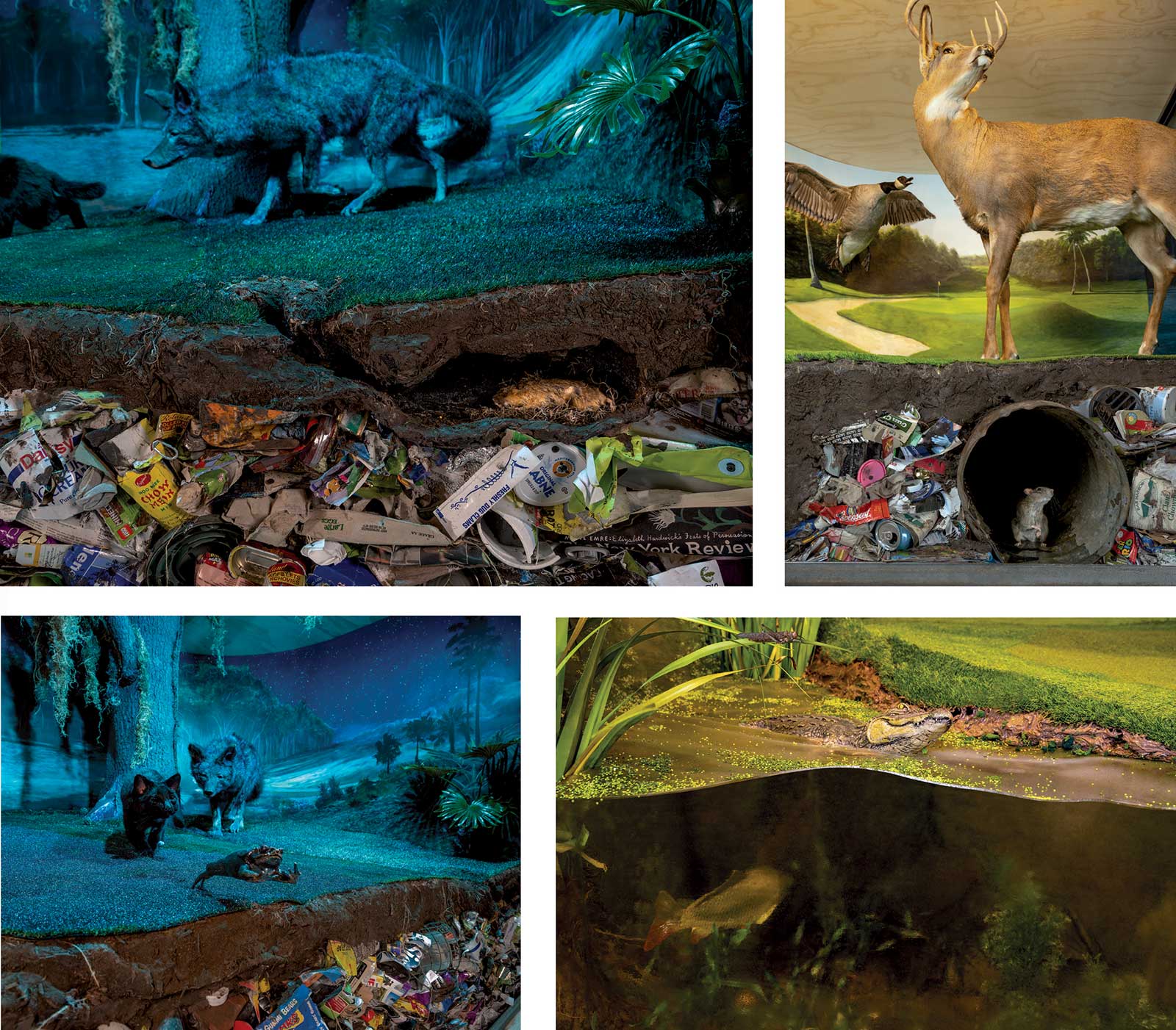
Detail from American Landscape.
Neither Dion nor Rockman consider themselves activists. Both observe and experience the environment firsthand, study the science and history—and create art. Rockman notes that the history of the world is on our smartphones but experiencing a painting or other works of art in person, at scale, is a visceral experience.
In the exhibition catalog, art critic Lucy Lippard writes about Dion and Rockman as artists. “Much as I admire the many eco-artists working today in endless different directions and media, Dion’s and Rockman’s arts, dissimilar as they are stylistically, share unique insights on nature, history, and a precarious future. Both depart from natural history and go off in their own directions. Both are research and science-driven with very specific results, but the art remains primary. Each has the unique ability to deliver truths that continue to be ignored.”
Dion’s assemblage, The Classical Mind (Scala Naturae and Cosmic Cabinet) introduces the exhibition. He remarks that while Rockman paints, “I shop!” He pulls from his collections of antiques and “stuff” to populate his assemblages and environments.
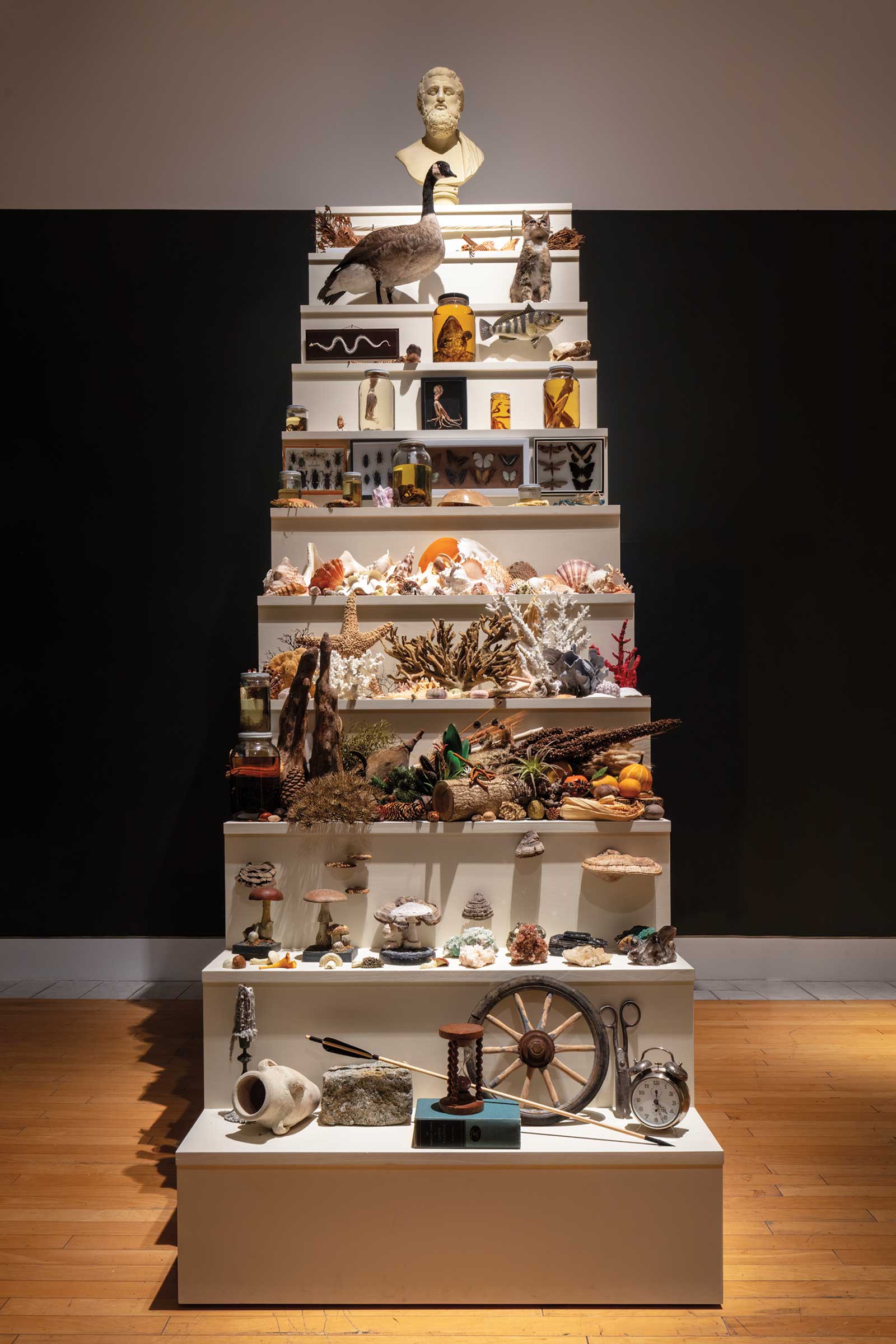
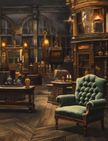
Mark Dion, The Classical Mind (Scala Naturae and Cosmic Cabinet), 1994/2017, stepped wooden plinth, taxidermy specimens, found objects, plaster bust, paint and LED lights, 132 x 144 x 42 in. Installation view, Mark Dion and Alexis Rockman: Journey to Nature’s Underworld at the Lowe Art Museum, University of Miami, Coral Gables, FL, 2025. Photo by Steven Brooke. Courtesy of the artist, Lowe Art Museum, Miami and Tanya Bonakdar Gallery, New York, NY.
In his Scala Naturae, Aristotle ranked all things in nature in a hierarchy with mankind at the top. Dion notes, “This notion of hierarchy, this notion of some things being better than others, this notion of humans on top, is one of the most poisonous and pernicious and long-lasting ideas in the history of Western thought. And it’s the justification of all sorts of rankings and taxonomies and modes of oppression.”
The stairway of The Classical Mind begins at the bottom with inanimate made-made artifacts and proceeds upwards from mushrooms and fungi to an imperious classical bust of Aristotle at the top. On the side of the construction is a door leading into a black room with a chair and stars twinkling overhead, a reminder, perhaps, of mankind’s insignificant place in the universe.
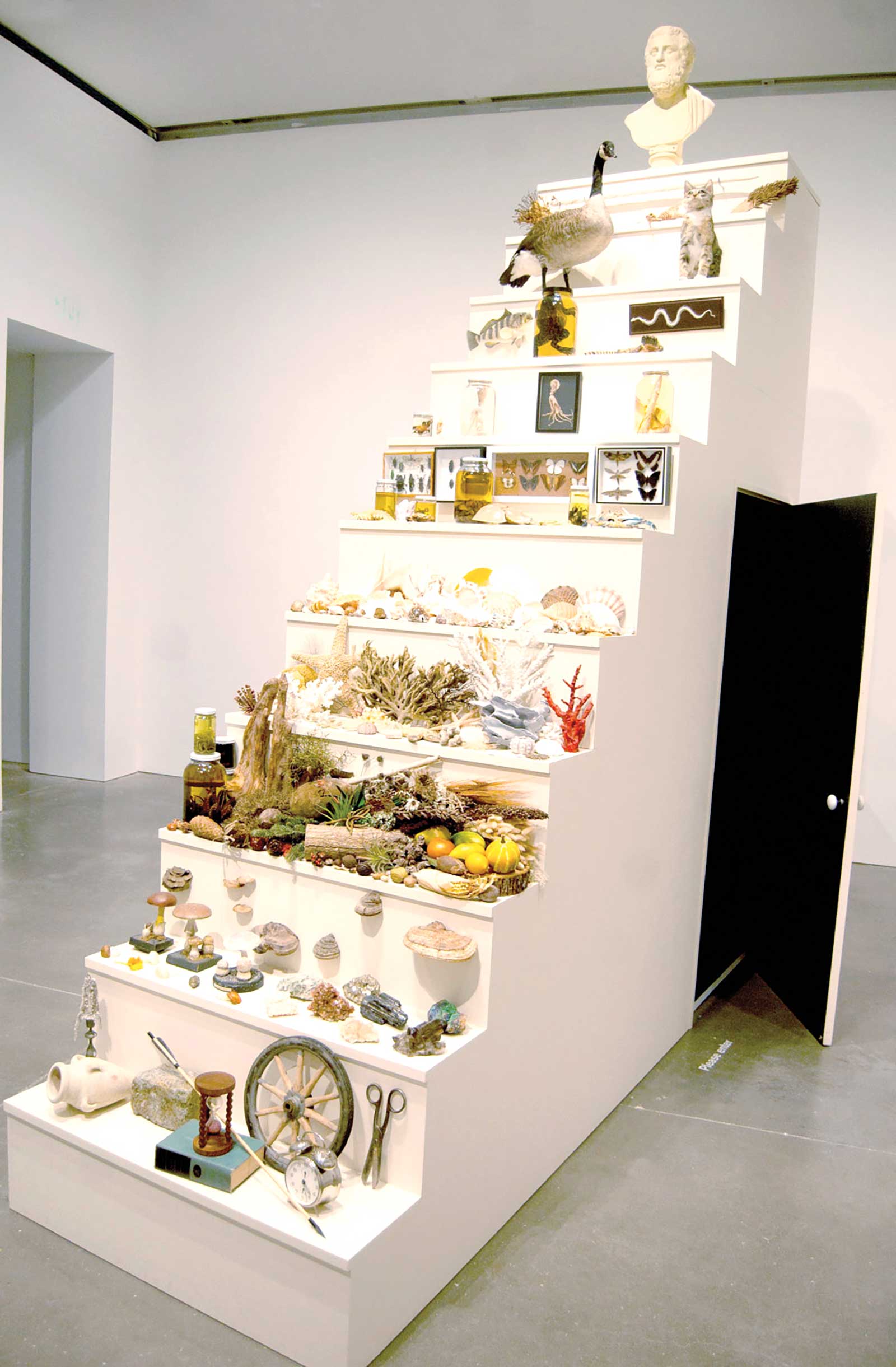
Detail of The Classical Mind.
Both artists have been influenced by dioramas in science and history museums. The two have collaborated on a sculptural diorama in a shipping crate measuring 96 inches by 16 feet by 87 inches. It was fabricated by Aaron Delehanty of Loud Cow Studio in Spencerport, New York. Of American Landscape, Dion relates, “I think we both have a very similar relationship to collaboration. Collaboration should be a situation in which each person gets to do what they want, not that each person has to compromise. And so this is something Alexis and I have been really interested in for a long time…We share a vocabulary and we both are immersed in the history of art. We also have developed a pretty good understanding of natural history.”
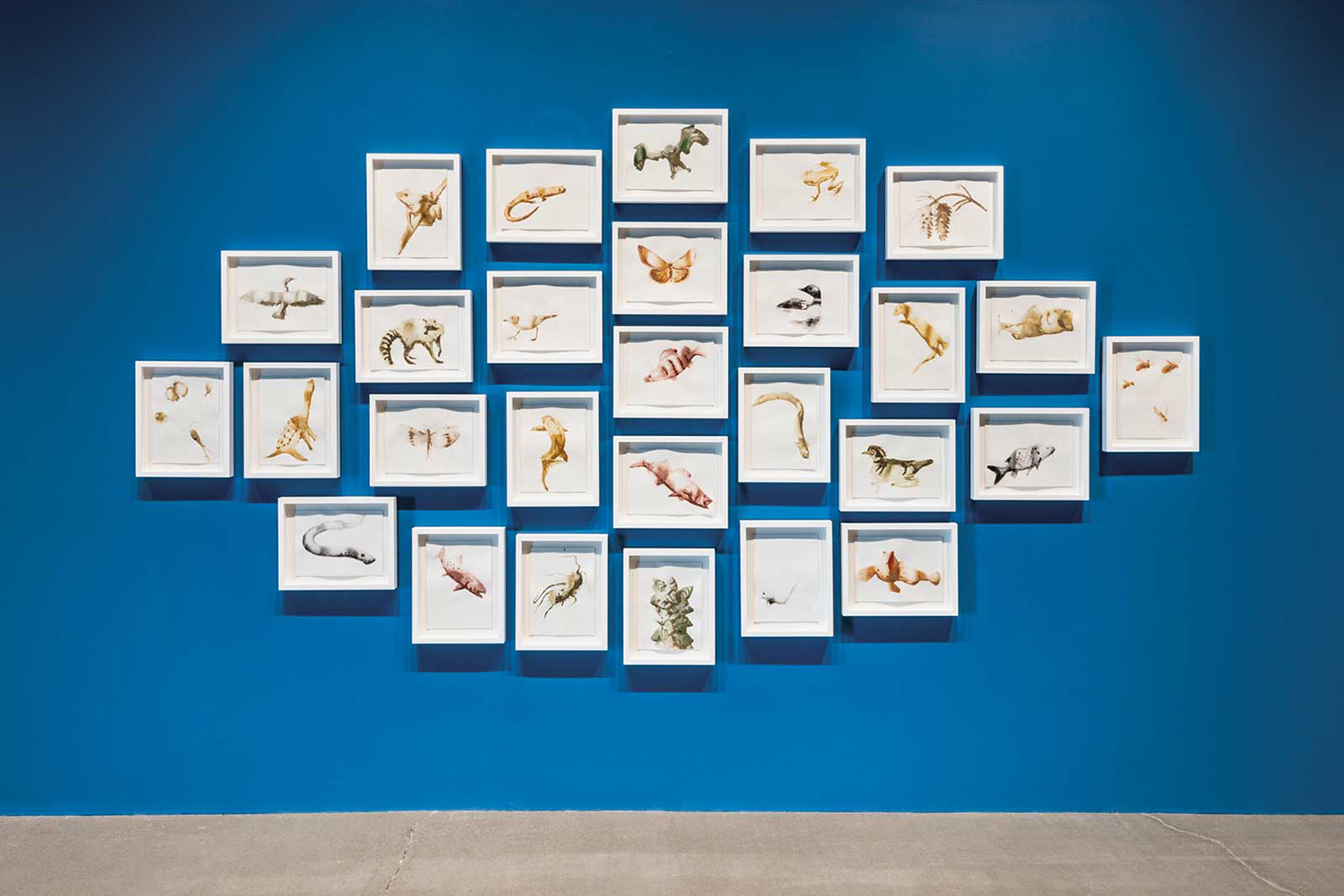
Alexis Rockman, Great Lakes Field Drawings, 2017, suite of 28 works, soil, organic materials from various sites and paper, each 12½ x 9 in. Collection of Alexis Rockman.
Rockman recalls their starting out with a rectangular space and one suggesting day and night and the other suggesting above and below. The result is a complex representation of the artificial landscape of a golf course and what it took to get there.
The trash beneath the manicured fairways contains the packaging of herbicides and insecticides use to create the pristine environment above—“the most reprehensible landscape you can imagine,” Dion says. Rockman comments on the trash, “You can’t make art about ecology in the 20th century and not include it. It’s the reality of the state of the planet.”
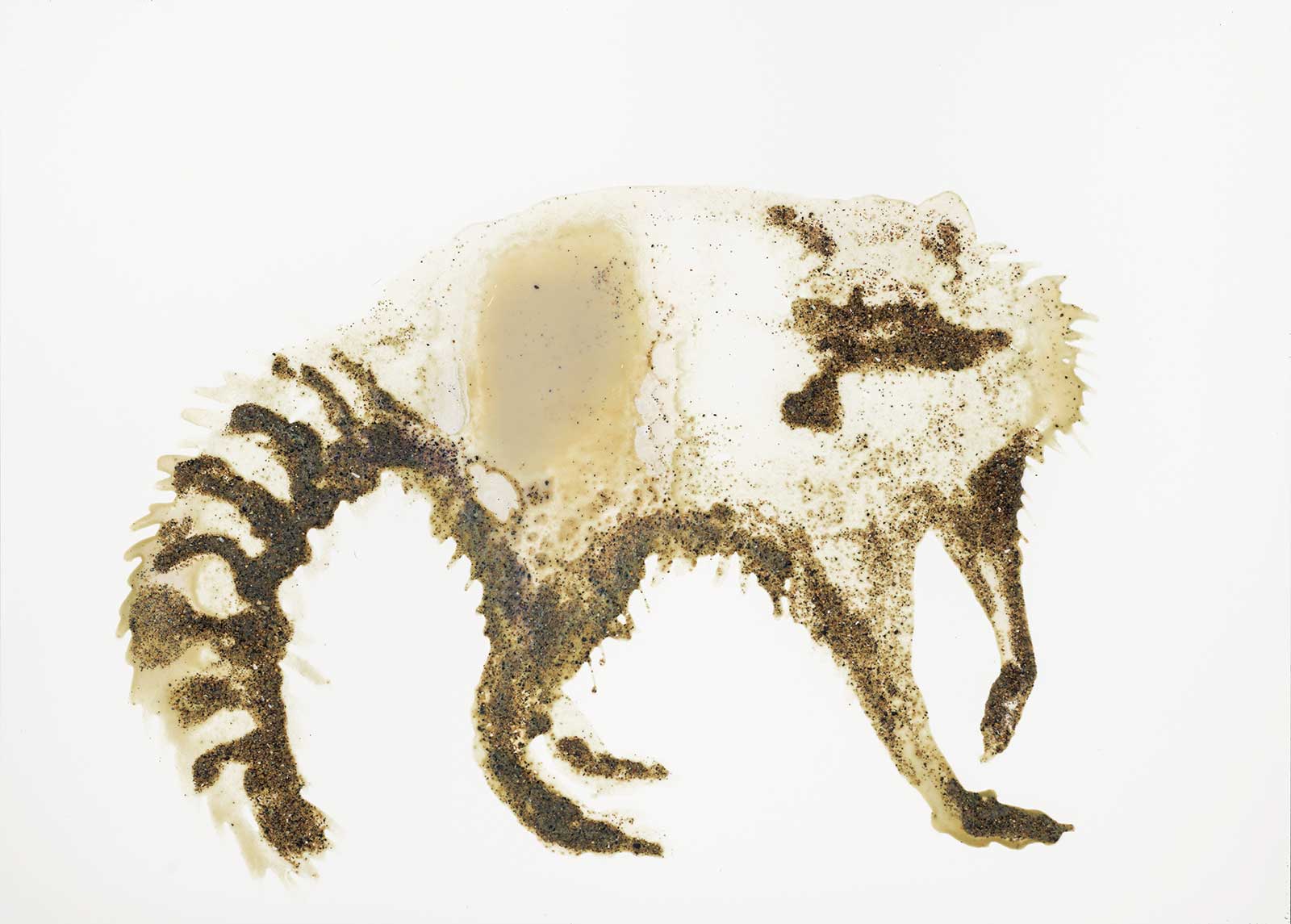
Alexis Rockman, Racoon, Cuyahoga River, Whiskey Island, 2017, organic materials from various sites and paper, 12½ x 9 in. Collection of Alexis Rockman.
In 2018, I wrote here about Rockman’s paintings in his monumental series, The Great Lakes Cycle. The 6-by-12-foot Pioneers is a time travel from life returning naturally to the lakes after the last ice age, and from the life introduced in the ballast dumped from ships from around the world. Although his paintings have been called surreal, Rockman considers himself to be a documentarian.
Part of his research for the series involved interviews with scientists and his own field studies painted with “mud, sand, coal and leaves, along with other organic and inorganic matter.” His Raccoonlived on Whiskey Island in the Cuyahoga River in Ohio. In 1969, the Cuyahoga caught fire due to the industrial pollutants in the water.
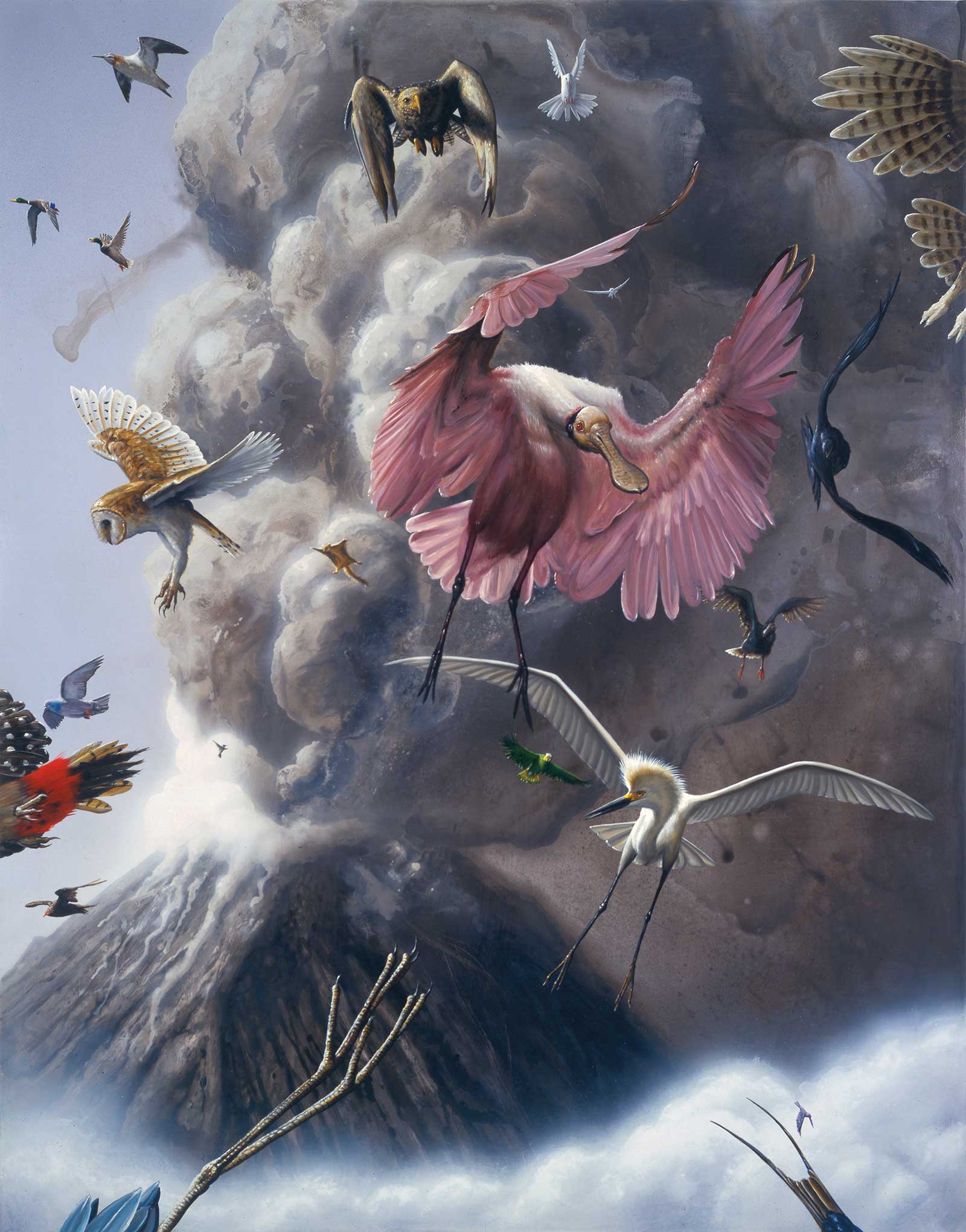
Alexis Rockman, Flight, 2005, oil and acrylic on wood, 56 x 44 in. Collection of Beth Rudin DeWoody.
The exhibition was conceived of and curated by Suzanne Ramljak, vice president of collections and curatorial affairs at the Frederik Meijer Gardens & Sculpture Park in Grand Rapids, Michigan. In her catalog essay she writes, “Both artists agree that ‘we need more art that searches for practical solutions, ignites curiosity, and motivates love for natural organisms and wild places.’ Dion and Rockman heed their own call, continuing their journey into nature’s underworld and beyond, urging us all to become suitors or lovers of nature.”
The exhibition catalog includes a fascinating timeline of the lives of the two artists that includes events occurring in the environment and in the broader culture. Dion was born in 1961, the year the World Wildlife Fund was founded. The WWF’s mission “is to build a future in which people live in harmony with nature.”
Rockman was born in 1962, the year Rachel Carson published Silent Spring.In it she wrote, “We stand now where two roads diverge. But unlike the roads in Robert Frost’s familiar poem, they are not equally fair. The road we have long been traveling is deceptively easy, a smooth superhighway on which we progress with great speed, but at its end lies disaster. The other fork of the road—the one less traveled by—offers our last, our only chance to reach a destination that assures the preservation of the earth.”
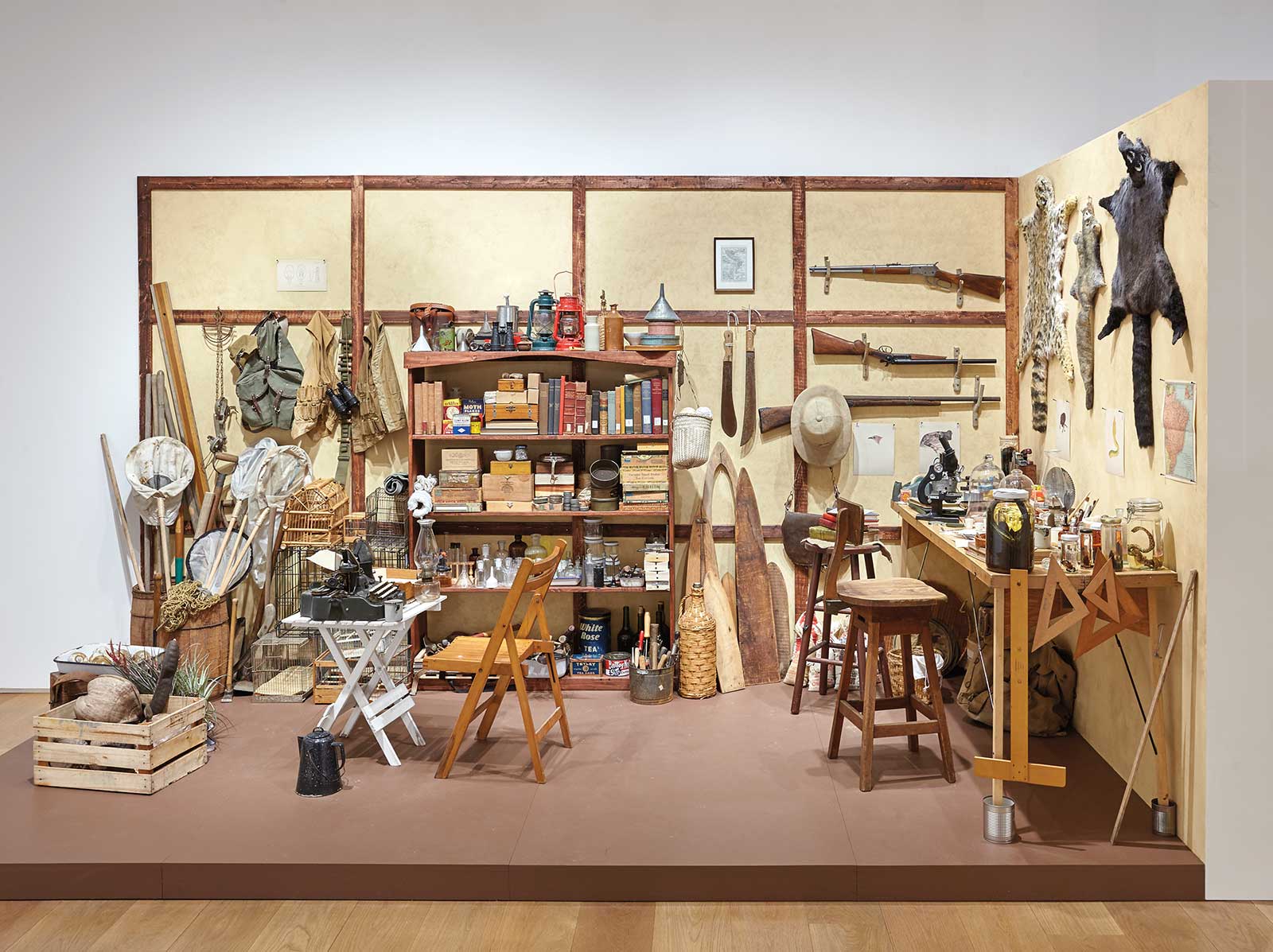
Mark Dion, Department of Tropical Research—Jungle Station, 2017, mixed media, 97 x 168 x 84 in. Courtesy the artist and Tanya Bonakdar Gallery, New York, NY.
Rockman relates that he is disheartened by the distance we have traveled down the easy path, and Dion states, “All the things we care about have gotten much worse. That doesn’t mean you stop trying. This is an all hands on deck moment.” —
Mark Dion and Alexis Rockman: Journey to Nature’s Underworld
Through December 7, 2025
Palmer Museum of Art
650 Bigler Road, University Park, PA 16802
(814) 867-3022, www.palmermuseum.psu.edu
Powered by Froala Editor