

American artist NFN Kalyan’s prodigious, brilliant imagery is a sensual and prolific parade, huge, colorful and intelligent, full of hundreds of quotations of images by other artists, duplicated, overlapping, altered and adjusted in great collages of visual information. These are paintings of emergence—the idea that phenomena may arise from great complexity to become unique things, like the movement of a massive flock of starlings in murmuration, swirling with collective mind, or a swarm of bees buzzing with intelligence greater than the sum of its parts. But the emergent mind that rises from the spectacular complexity of Kalyan’s paintings is uniquely born of the ancient Indian deity, Krishna.
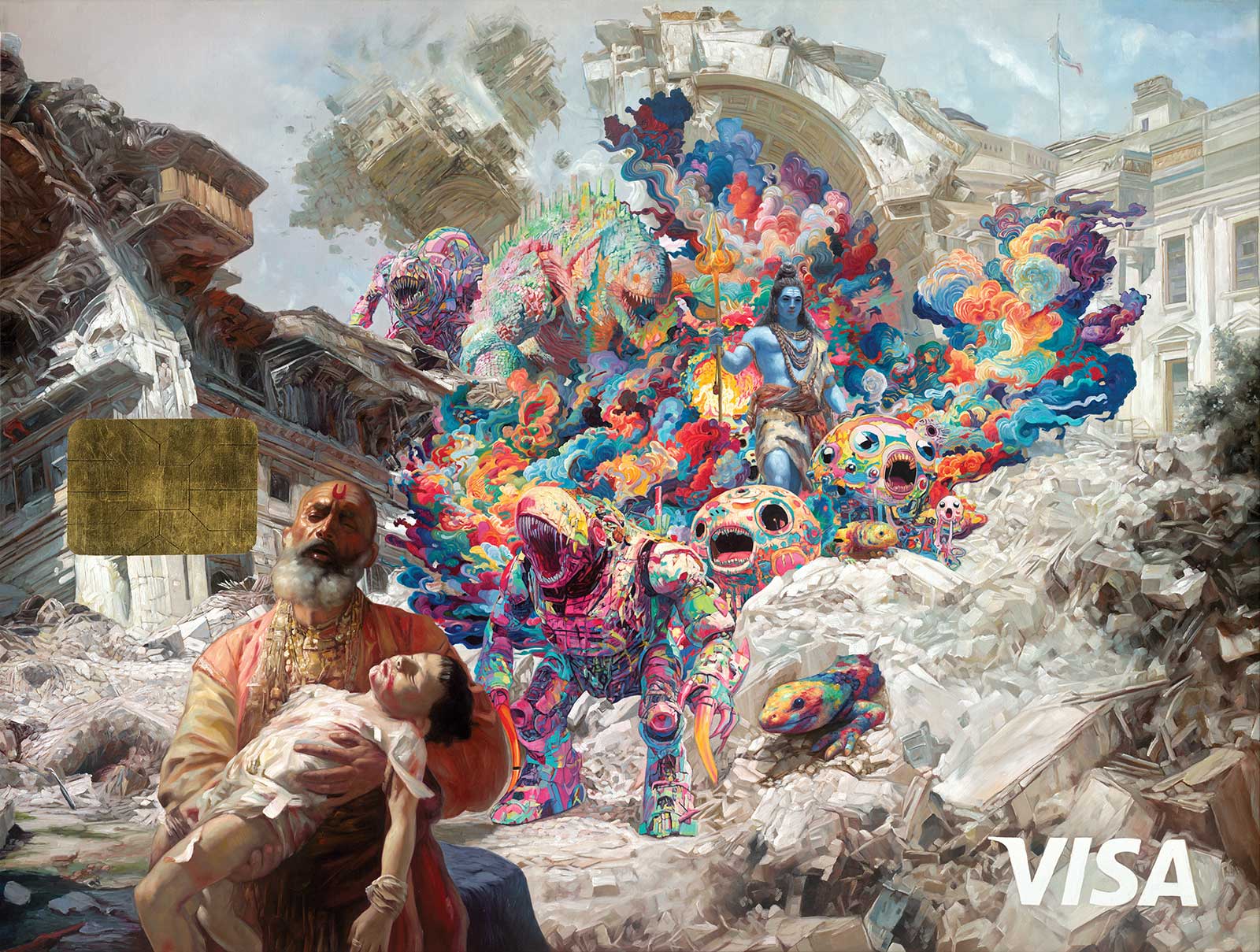 The Piano, 2025, oil on canvas, gold leaf, 48¾ x 64½ in.
Kalyan’s painting Arjun is named for the famed character in the Bhagavad Gita section of the Mahabharata. It is a masterpiece of our time, perfectly expressing the panic attack-inducing excess of postmodern imagery. In it, a suited man is thrown back on a couch, overwhelmed by the flood of floral and hallucinogenic imagery pouring from his chest, distorted by a projected screen of artificial intelligence, asking, “How can I help you today?” The imagery seems to be coagulating as a hooved creature, and the vibrant colors have painted the floor around the couch as much as they have painted the air. Incongruously clashing with his business suit, the man wears the headdress and jewelry of Arjuna as it appears in traditional versions of the Bhagavad Gita. Adding to the frightening mood of chaos and anarchy, shattered debris is scattered beneath his feet, and the siding and entrance to the indeterminate indoor and outdoor space is burning. Meanwhile, behind him Krishna displays himself in all his aspects, including an array of ferocious tooth-baring and simian heads, a tiger with glowing eyes, an elephant, as an angry Donald Duck, an armored alien, and a big-eyed, blue-skinned, and sentimental version of himself. Hanuman, his ape-headed and most loyal friend, gazes up at him in devoted awe. The entire right-hand end of the painting is a sideways simulacrum of the poster for the anime movie The End of Evangelion.
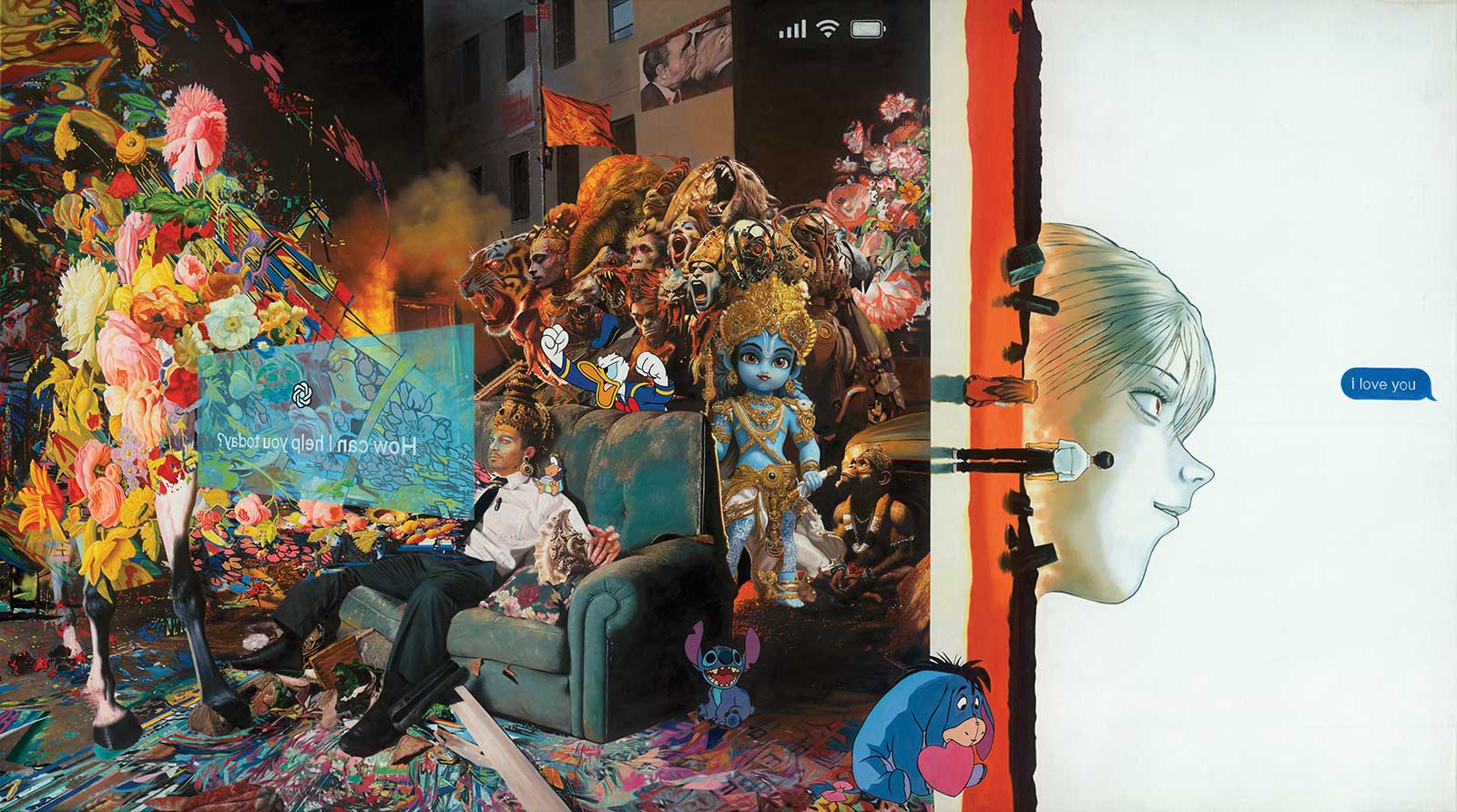
Arjun, 2025, oil on canvas, 40 x 72 in.
The painting is a dramatic re-telling of the spectacular transformation of Krishna in the Bhagavad Gita, when Arjun is allowed to see the God in his full supreme splendor—the moment famously paraphrased by J. Robert Oppenheimer in 1965 as, “Now I am become Death, the destroyer of worlds.” But the nuclear physicist’s comparison of the destructive power of his little bomb to the absolute and all-encompassing completeness of Krishna’s Godhead was hopelessly limited. Oppenheimer’s bomb only expressed the might and power of one part of Krishna’s being which the Gita compared to the light of a thousand suns exploding in the sky, warning that even that incredible sight would not resemble the full splendor of the exalted being. In traditional Indian expressions of the revelatory moment, Krishna transforms into an unlimited entity with many heads and arms, each illustrating a different aspect of his universal being, but even these remarkable and impressive images fail to show the fantastic excess and transcendent scale of the all-encompassing God. Kalyan comments, “When you read those passages, they’re so massive, the description of what Krishna becomes is basically everything in the universe, so to depict him as just many arms and heads is limiting, so I tried to show different aspects of how that can be portrayed.” He has attempted to show timeless Krishna as everything, all at once, as the entire universe divided but unified: the becoming, the being, and the ending of all things.
It is an impressively grand ambition. Kalyan fulfills it.
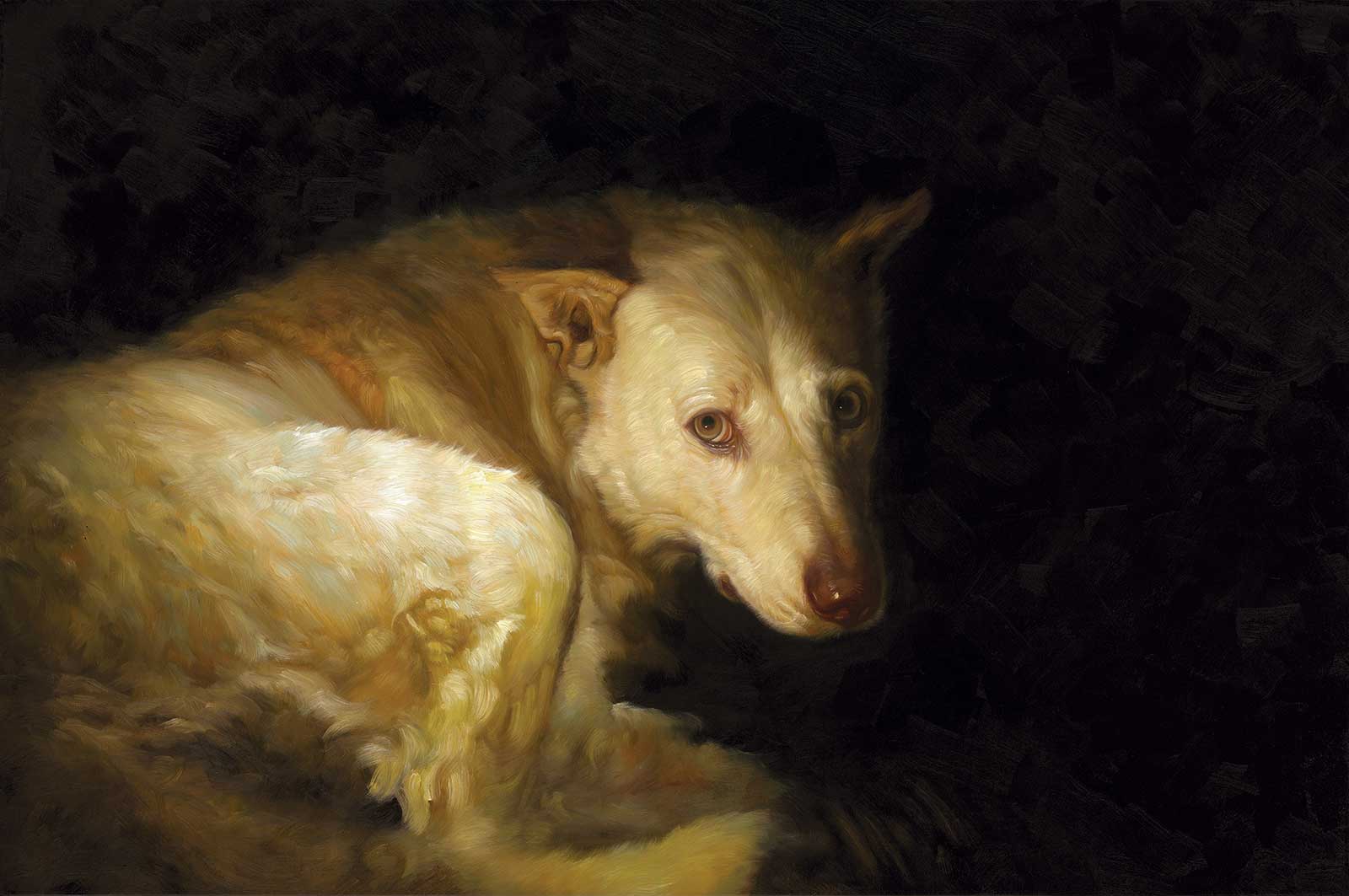
Light in August, 2025, oil on canvas, 281/4 x 42 in.
Kalyan comes to the violence and destruction of modern war in The Piano, recalling the annihilation of Warsaw in the movie The Pianist, starring the profound music of Wladyslaw Szpilman, who finds survival in the face of death by playing beautiful melodies while explosive catastrophe, and irrational cruelty surrounds him. The melancholy music and the violence are both part of the totality of Krishna’s complete manifestation, and everything, even corporate credit card companies and the tragic deaths of children are within his infinite scope.
The Bhagavad Gitahas been a guide to Kalyan’s actions as he works to live in art. At the beginning of the narrative, the general Arjuna stood at the center of a battlefield before a war began, gazing at the ranks of gathered armies preparing to enter the slaughter, and he saw members of his family riding in both sides of the opposing armies, and knew they must surely suffer and die. Full of sorrow, he asked his charioteer Krishna why he must fight, and Krishna replied that being a general was his duty in life—his dharma—and he was bound to act according to his nature because it was the work of God, and acting selflessly and without desire for the fruits of action would liberate him from karma.
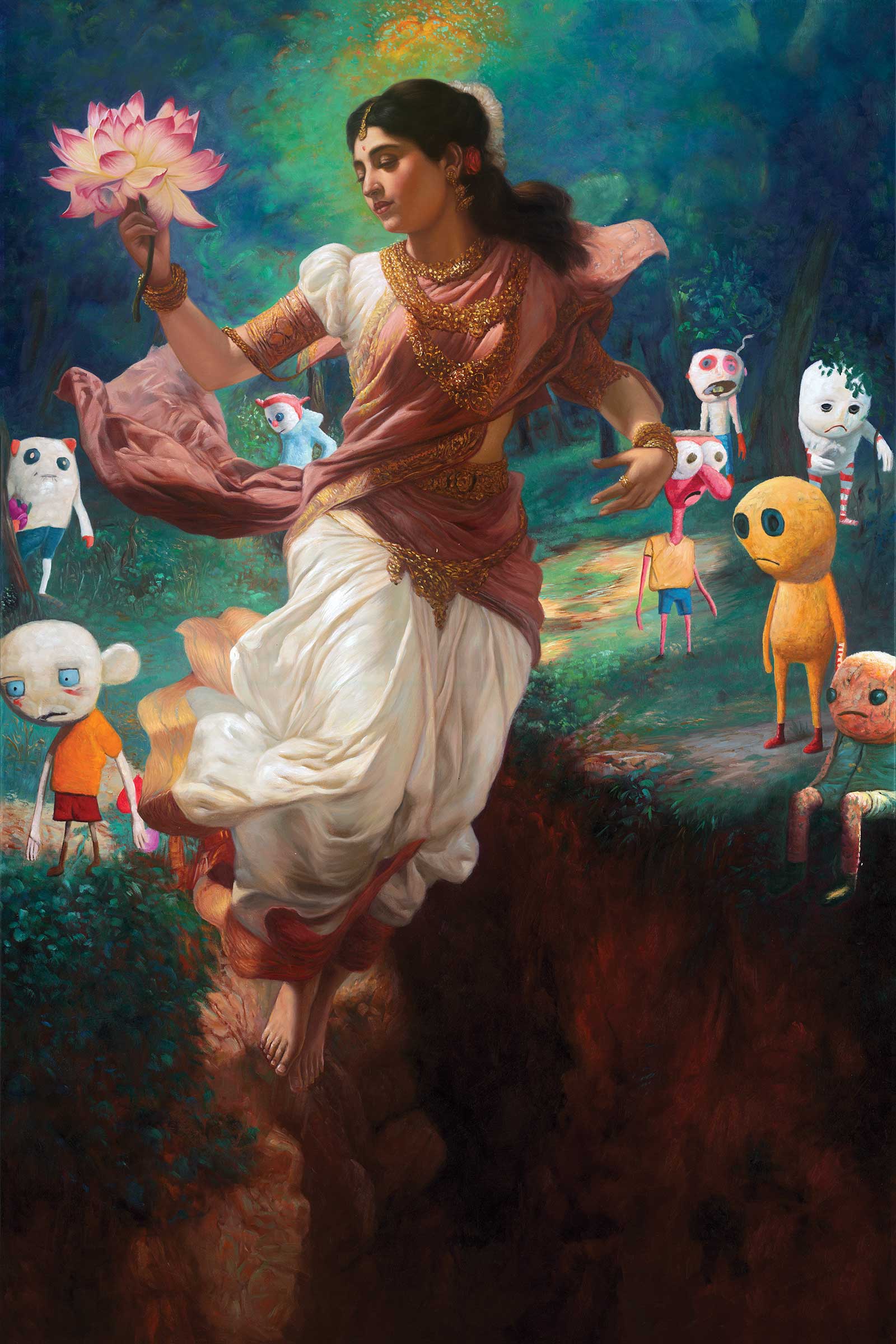
Burial, 2025, oil on canvas, 43 x 28½ in.
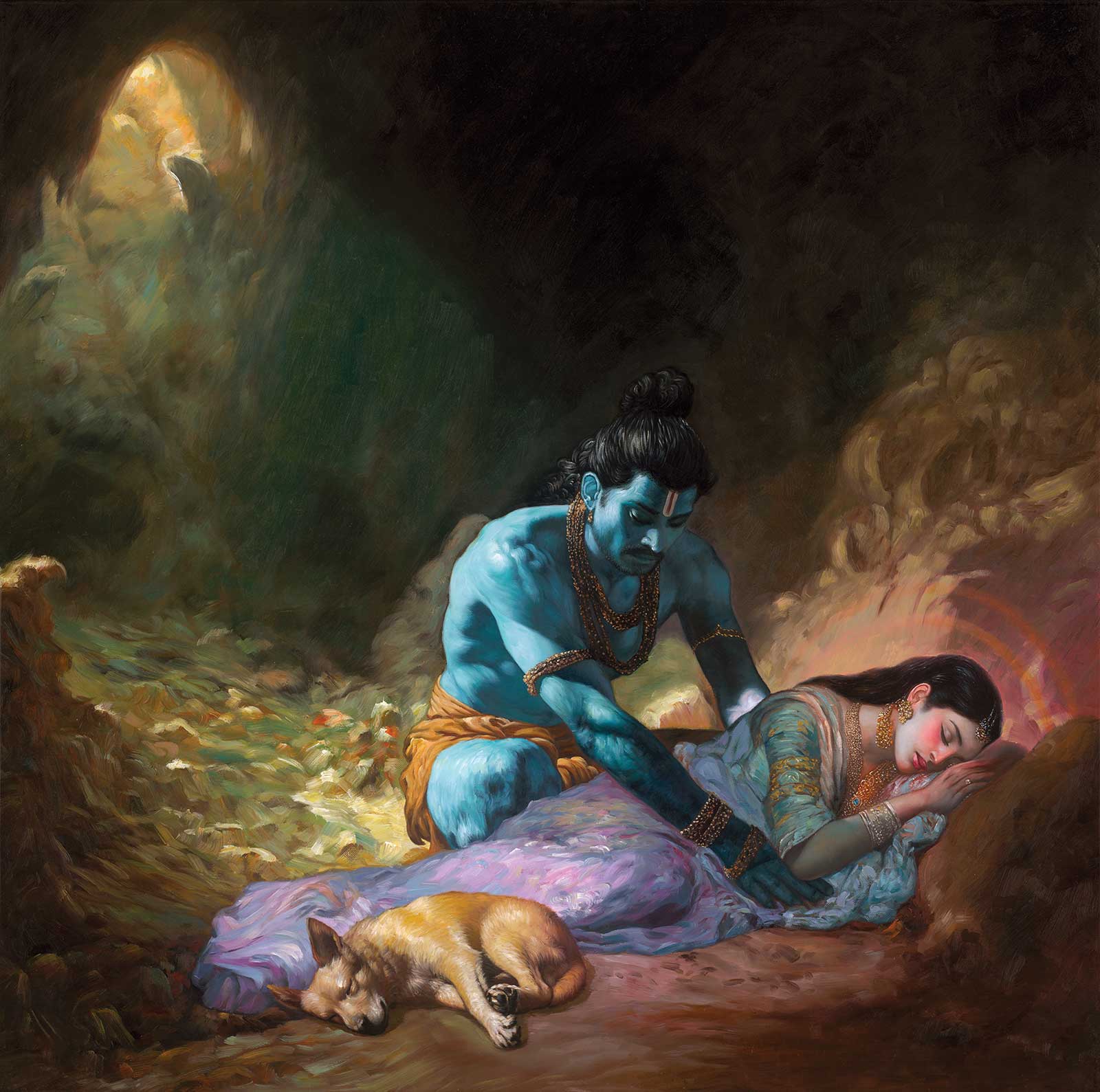
West of the Sun, 2025, oil on canvas, 36 x 36½ in.
Kalyan has felt the depth and weight of living his dharma. He says, “There have been various times I have considered giving up art, once about 10 years ago, and then most recently last year…I’ve put massive amounts of work and thought into this and I felt at times, ‘well, no one knows I exist, this is a little frustrating.’ Ten years ago, my crisis was that I saw artists as part of the problem at a very physical level and fundamental level, in that we’re just churning out things like a factory…and it’s as bad as any other activity, and the question I had for myself was, ‘Is it better to live completely off the grid, farm my own food? And that’s something I still have interest in. But it was that idea that Krishna had that made me realize that I had to live the path I had to live—this is the thing that I have to do...It was in my nature to create these things, and I had to follow the nature of what I was. So, in a way, it is fate, but in a way it’s simply for me, I must interact with the world in the way I must do it. More recently my decision not to quit was that I’m now 43, what the hell else am I going to do? I’ve just got to keep going with this thing until the wheels fall off.”
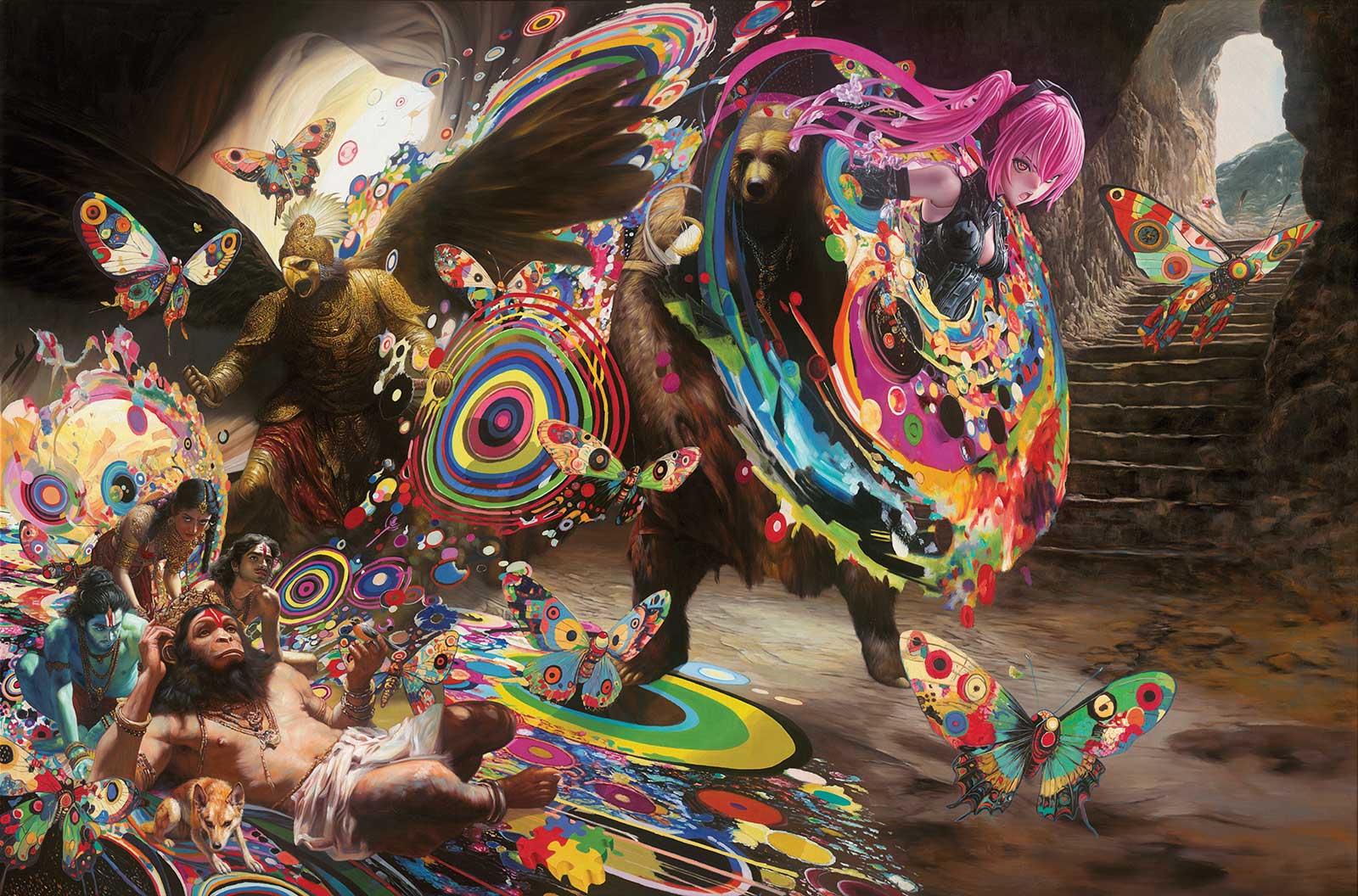
Pandora, 2025, oil on canvas, 40 x 61 in.
Although he uses no drugs, Kalyan is often told his work is psychedelic. This is a syllogistic error. The rush and arrival of the psychedelic experience comes as an overwhelming chaos and tumult of sensations and hallucinations which is a sublime and awe-filled period of discovering the expanse of a previously unimagined personal universe of possibility and patterns, and may also be felt as revelation, as a flood of emerging and unprecedented imagery and insight. But while any earth-bound and individual metaphysical experiences may be overwhelming, even sublime, they are incomplete—the ultimate revelation of Krishna includes all psychedelic experiences, the sum of which only reflect a tiny portion of his infinite expanse. Like atomic bombs, mind-expanding experiences are only small fractions of the unimaginable scale of Krishna.
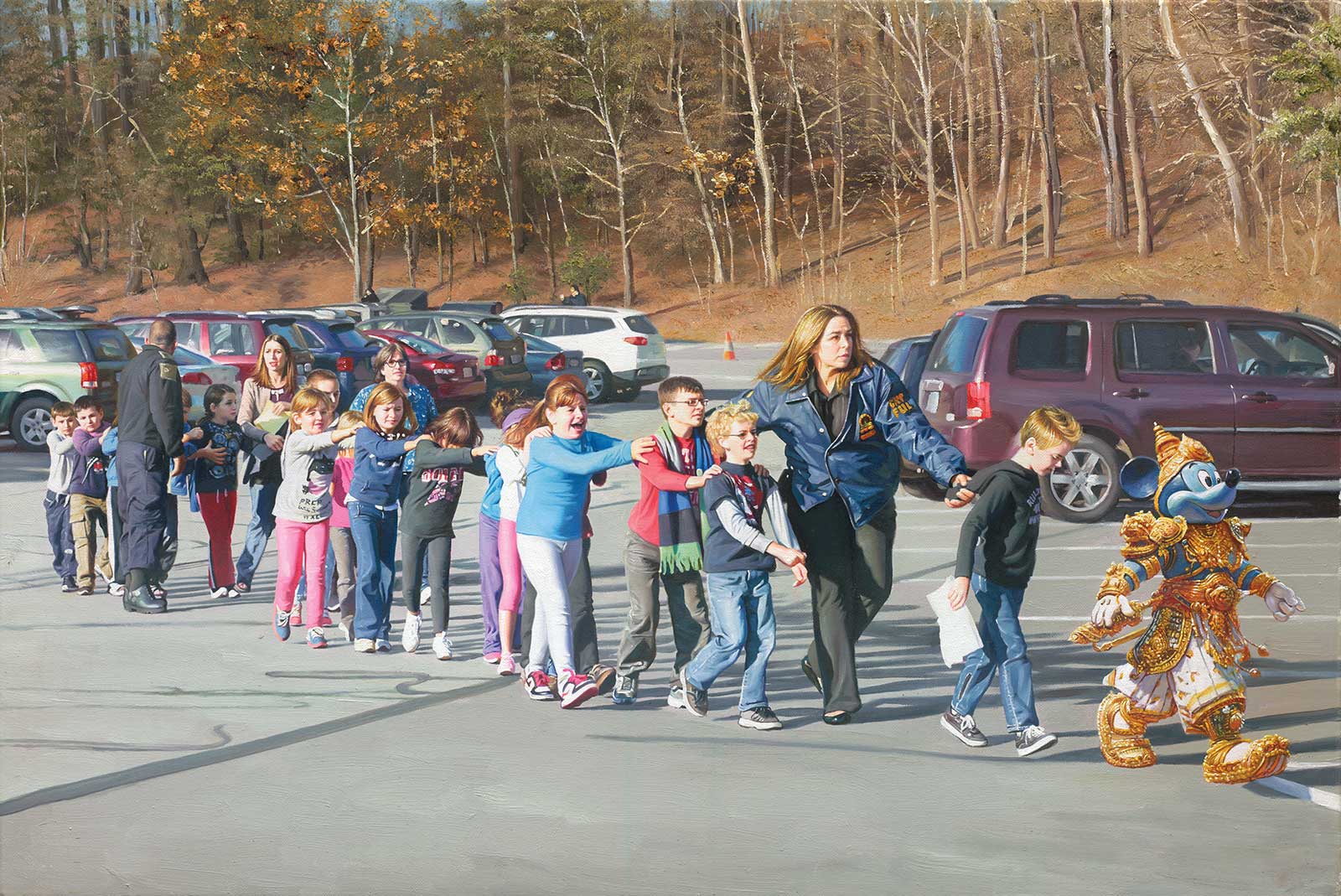
Field Trip, 2025, oil on canvas, 20½ x 30½ in.
Kalyan’s father was a respected mathematics Ph.D. from India, his mother a doctor of philosophy from the United States. Kalyan lives with his wife and children in Florida, where he is free to work distanced from the danger that would face him in the old country, and also immersed in the cultural chaos of 21st-century digital America, which, like the psychedelic experience, is a head-tipping cascade of imagery pouring from contemporary media and gluing crouching consumers to their devoted phones. Kalyan says, “The way I’m reacting to describe the world is that we’re inundated with so much information, and it’s juxtaposed against other information which is totally different: 13 dead in Gaza; Kim Kardashian has a baby; buy coca cola. It would not be shocking to see these three things next to each other. So, I’m trying to put everything, because I feel that that’s what the world is right now. It’s everything, all at once, and that’s how I’m trying to describe it.” Fascinated by the flood, he ties the wave and tide of the digital torrent to the society of the spectacle.
Like Arjun, his painting Pandora is a colorful splash filled with a chaotic influx of patterns and pictures. Manga characters and mythic beings tumble among spectral flux underlain with wobbly geometry, and envisioned butterflies flittering from the chaos. Pandora was the first woman, given to man by Zeus, who used her to take revenge upon Prometheus for gifting the goodness of fire and self-knowledge to humans, who the king of heaven had previously kept in a state of dumb and muddy stupidity. Presented as a gift, beautiful Pandora came to man with a jar filled with all the evils in the world, which spilled out over the previously arcadian lands of wonderful primordial earth in its golden age of plenty. Kalyan seizes the similarity between the sudden arrival of a flood of entities from the jar to the manifestation of Krishna in all his forms.
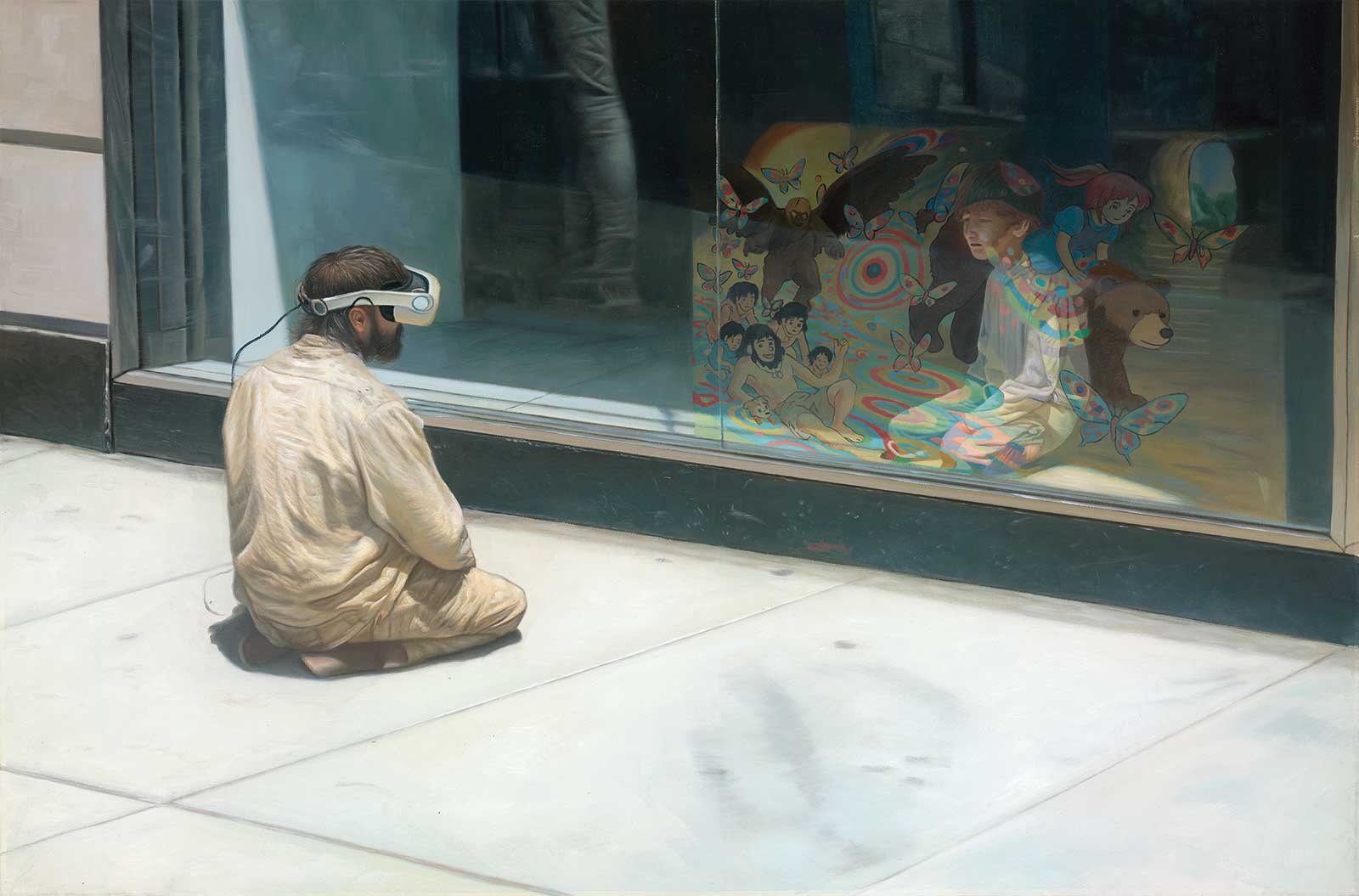
Remembrance, 2025, oil on canvas, 24½ x 37 in.
The emergent phenomena that rise from the hypercomplex universe that is Krishna are neither good nor evil, they simply exist—plagues are as much an emergent phenomenon as murmuration. Kalyan explains, “…it ends up being this chaos, because I’m not just trying to describe the harshness of it, but the beauty of it, the humanity of it, the coldness of it, the alienation of it, everything at the same time in some of them, that’s how it becomes so dense.” Consequently, Kalyan paints with a certain detachedness– the luxurious flood includes elements of darkness as well as light. “I know my work has a certain feel to it, but the feeling inside me when I’m creating is always cold and ruthless about the world, even though I’m trying to show the beauty, too…” The totality includes good and evil and everything in between.
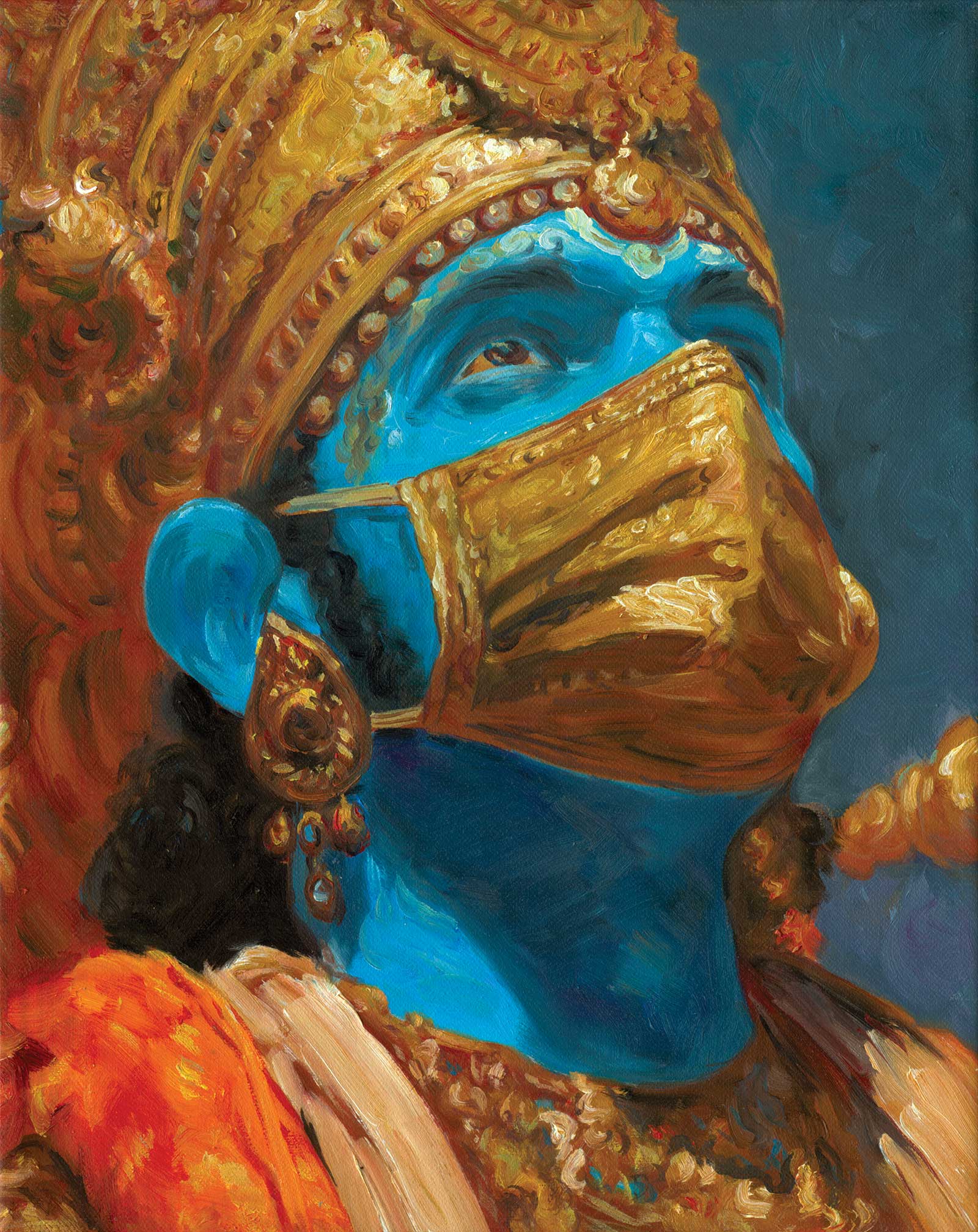
N95, 2025, oil on canvas, 15½ x 12½ in.
The danger Kalyan faces in India is real. With absurdly open language, the Indian Penal Code criminalizes acts—including art—made with “deliberate and malicious intention of outraging the religious feelings of any class of citizens of India.” Consequently, anyone who feels offended may prosecute an artist who uses religious iconography. This legislation has stifled creativity and progress. When Kalyan posts his paintings including unorthodox images of the ideal Lord Rama, his wife Sita, and ape-headed Hanuman on social media, he receives occasional death threats from people fixated on tradition, but he also hears from young artists who feel freed by his spectacular canvases, liberated from the constrictions of old traditions. The burgeoning question for young Indian artists is how to emerge from beneath the burden of hundreds of years of convention—to emulate Indian art in the bold new era. The last thing to tip from beautiful Pandora’s jar of horrors was hope, and NFN Kalyan’s canvases are the hope-filled and embodied spirit of this new age of Indian painting, and his is a reinvigorated and emboldened pantheon for a new, emergent era. —
NFN Kalyan: Fugue
Through November 1, 2025
Anthony Brunelli Fine Arts
186 State Street, Binghamton, New York, 13901
(607) 772-0485, www.anthonybrunelli.com
Powered by Froala Editor