There is a lot of scholarly discourse about why Jenny Saville is an important artist, and rightly so, but it also muddies the waters of what can be summed up in one word—visceral. And visceral, by its very definition, is felt in the body, like a punch in the gut, or the slash of a knife. Its domain is the flesh, not the intellect. Saville knows this.
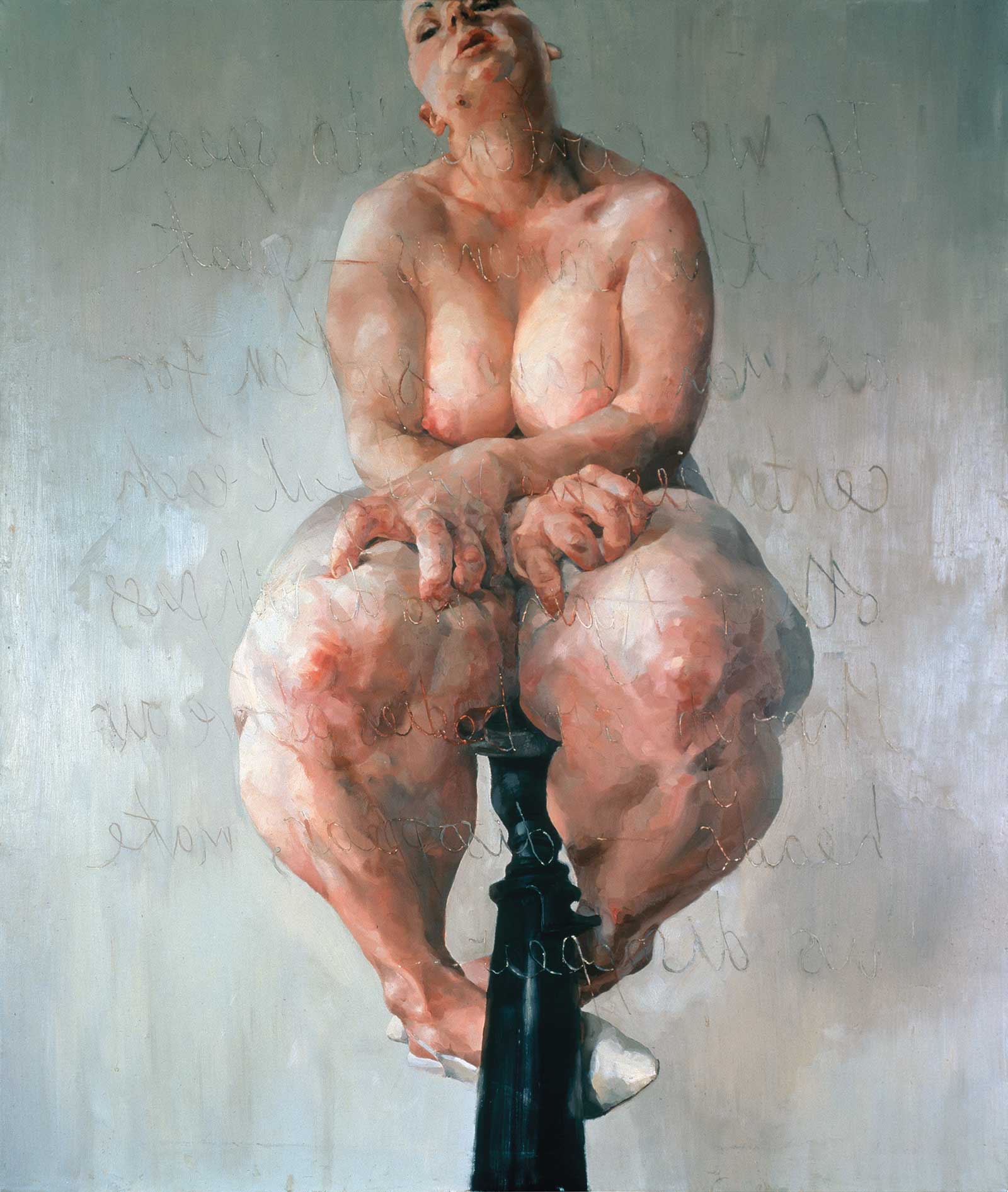 Propped, 1992, oil on canvas, 84 x 72 in. SAV.32.A member of the loose group of painters and sculptors, the Young British Artists, Saville emerged into prominence in the early 1990s, with works like Propped, which depicts a disproportionately large woman with huge dimpled thighs, gargantuan hands and enormous, squished-together breasts, perhaps harkening back to those of her piano teacher that she remembers observing so long ago. One of her seminal works, the monumental canvas not only played a role in reviving contemporary figurative painting, but redefined the portrayal and perception of the female form with its unapologetic intensity.
In his catalog essay, “The Anatomy of Painting,” which is also the title of an exhibition organized by the National Portrait Gallery, London; and opening this month at its only U.S. venue, the Modern Art Museum of Fort Worth, John Elderfield writes, “Saville places her viewers in a comparable position, where the picture, as an imitation, may be painful to see, while the paintingof it, if not quite pleasurable to see, is so extremely compelling of our attention that we do not want to look away—a conflictedness to which I will return.”
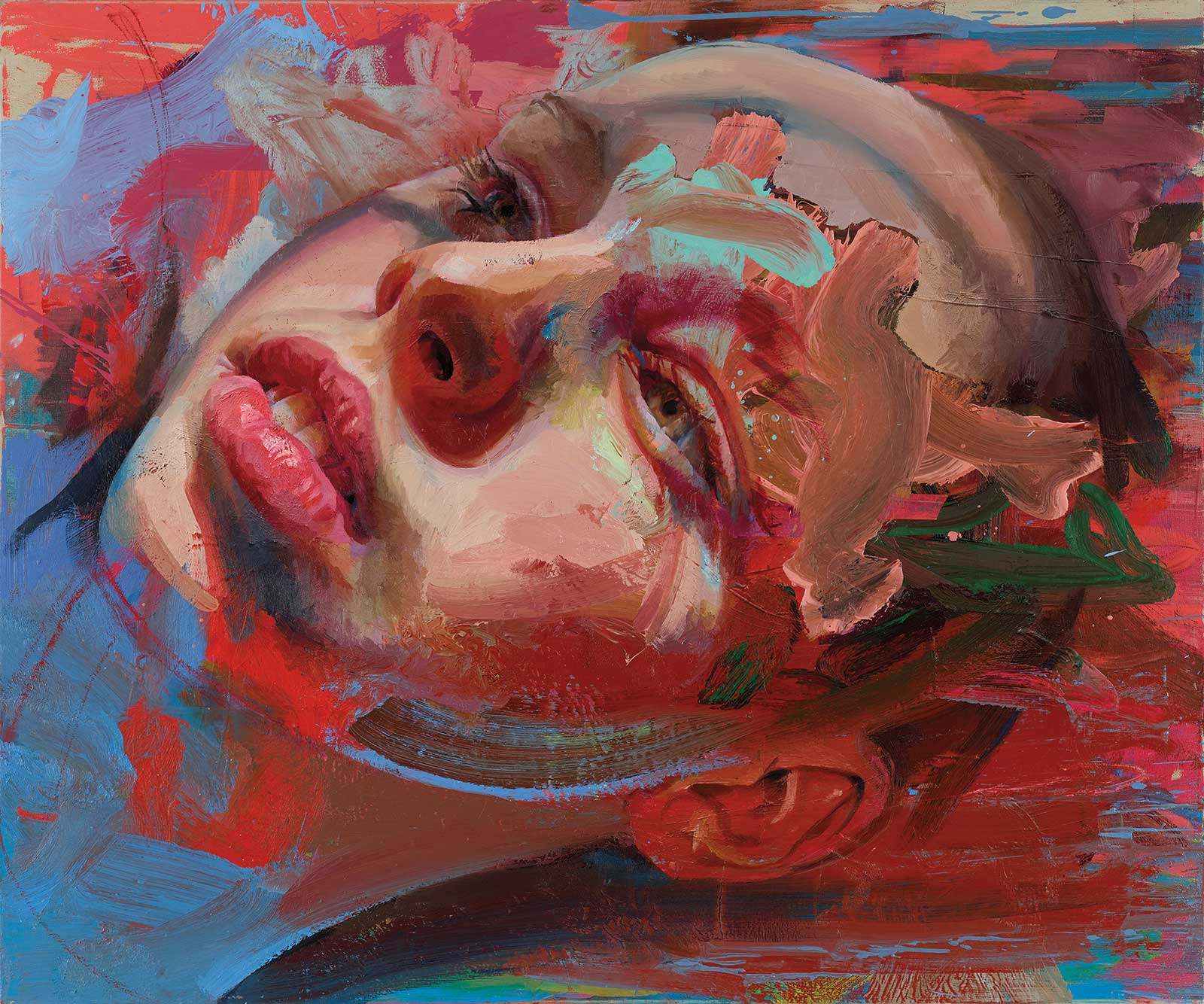 Drift, 2020-2022, oil and oil stick on canvas, 39 3⁄8 x 47¼ in. Private Collection. Courtesy Gagosian, 54.2025.5 SAVIL 2022.0005.
Elderfield continues, “Saville’s woman’s body set upright on a stake in Propped reprises the frightening anthropomorphism of Chardin’s giant fish, which, although suspended, appears to be standing to attention at the back of his composition. In Chardin’s painting, art historian and curator Philip Conisbee observes, ‘the young cat arching its bristling back seems to echo the frisson of horror felt by the spectator at the frightful sight of the grimacing fish, its bloody entrails on full display.’ Saville did not need to represent a spectator; Propped was made with the spectator in mind, to be seen in the mirror that it invites us to face in order to read, scratched backwards in the paint, a defiant text by the feminist author Luce Irigary, calling for the time ‘When Our Lips Speak Together.’”
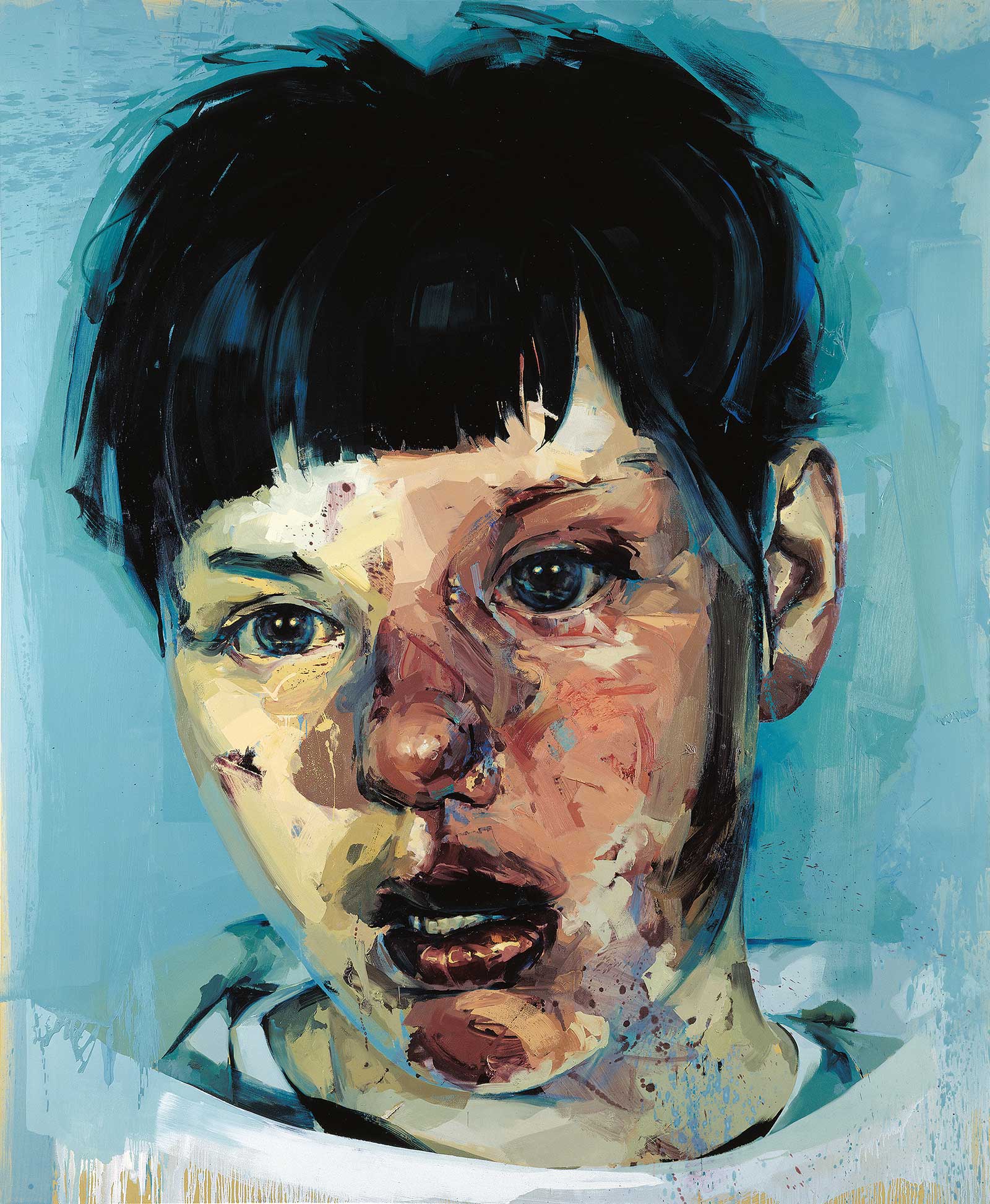
Stare, 2004-2005, oil on canvas, 1201⁄8 x 98½ in. The Broad Art Foundation 75.2025.1.
The whole of Saville’s career has been a meditation on flesh, informed by a desire to challenge gender norms and the idealized depictions of the female form; by the classical figuration of artists like Titian and Tintoretto, as well as more modern painters like Matisse, de Kooning and Picasso. Born in Cambridge, England, in 1970, Saville attended the Glasgow School of Art from 1988 to 1992, where her interdisciplinary studies focused on “the imperfections of the flesh.” In 1994, while on a fellowship in Connecticut, she spent time with a plastic surgeon, watching while he reconstructed human flesh, which Gagosian, the gallery that represents the artist, notes, “was formative in her perception of the body—its resilience, as well as its fragility. Her time with the surgeon fueled her examination into the seemingly infinite ways that flesh is transformed and disfigured.” She took her studies even further, exploring the manifestations of disease, cadavers, animals and meat; as well as less macabre subjects like classical and Renaissance sculpture, and humans in various forms of embrace and entanglement.
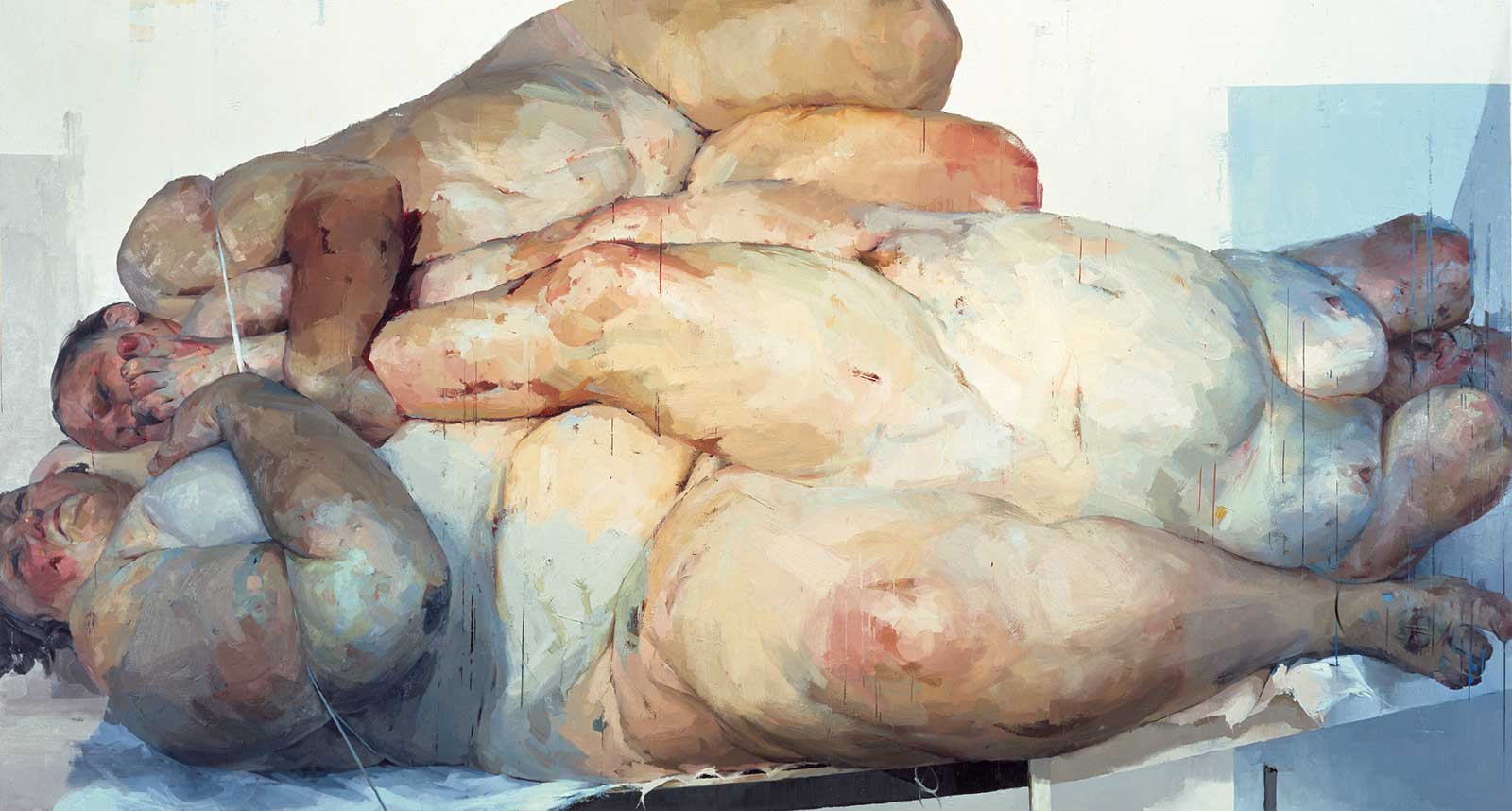
Fulcrum, 1998-1999, oil on canvas (triptych), 103 x 192 x 409⁄16 in. The Broad Art Foundation 67.2025.1.
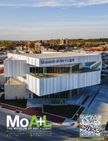
Jenny Saville: The Anatomy of Painting, on view at the Modern Art Museum of Fort Worth from October 12, 2025, through January 18, 2026, brings together nearly 50 works that trace the Saville’s evolution as an artist from the early 1990s to today. Featuring key examples of her larger-than-life oil paintings, as well as smaller-scale charcoal drawings and studies, the exhibition was curated to highlight Saville’s intrepid inventiveness.
In addition to Propped, Andrea Karnes, chief curator at the Modern Art Museum of Fort Worth, points to Fulcrum from 1999, in which Saville tackles a towering mass of intertwined figures, and the 2020 piece Cascade, which Karnes says “fracture and overlay viewpoints of a portrait, dissolving the face into fields of color. These strategies underscore her constant reinvention of what figurative painting can be.”
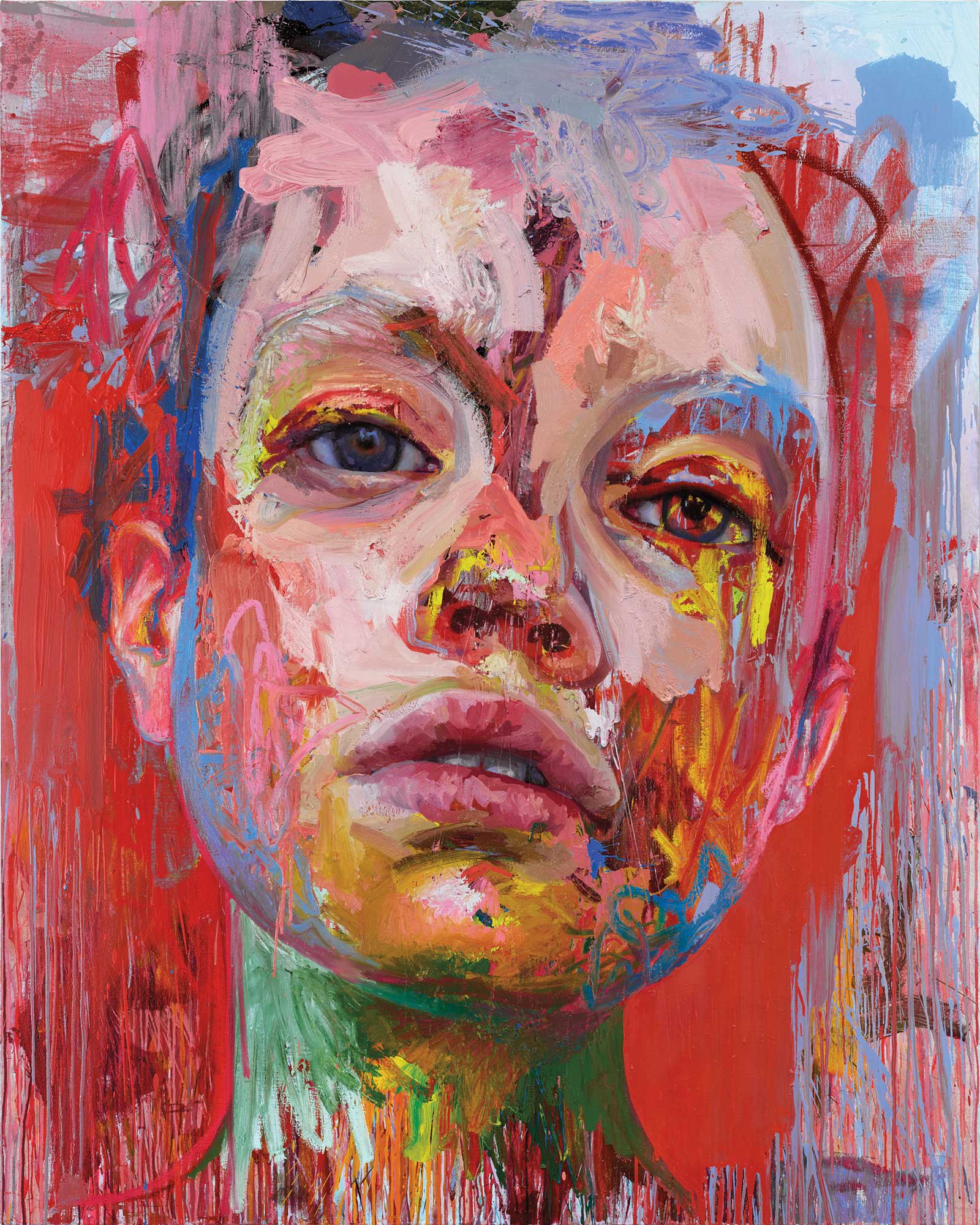
Rupture, 2020, acrylic and oil on linen, 78¾ x 63 in. SAV.37.
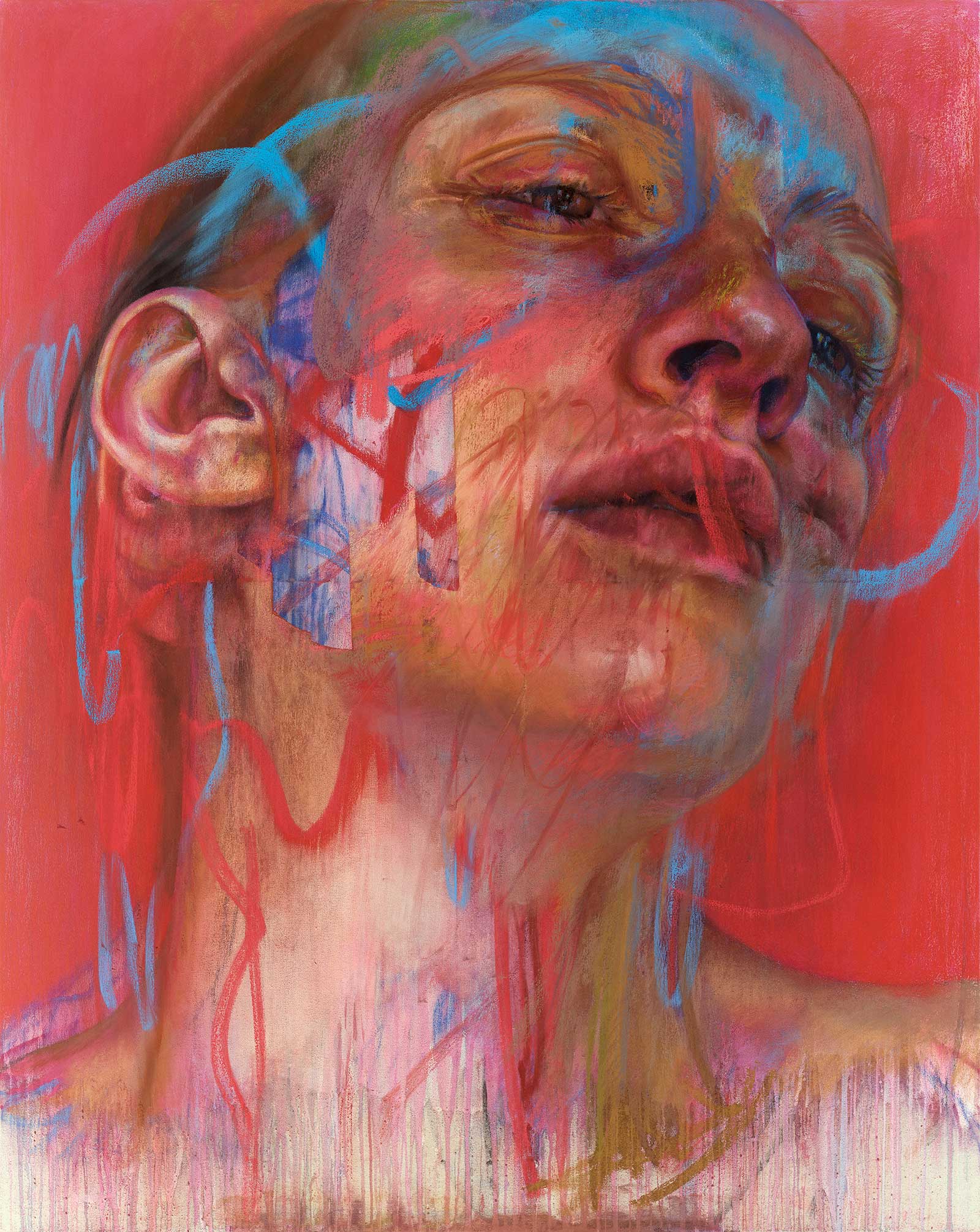
Latent, 2020-2022, acrylic and pastel on canvas, 591⁄6 x 47 ¼ in. 79.2025.1.
Karnes continues, “Jenny combines forensic attention to anatomy with expressive, almost sculptural paint handling…Cascade characterizes how, in her works, form collapses into streams of color to balance representation with abstraction. Her palette in Stare, 2004-2005, for example—bruised violets, luminous flesh tones—adds psychological depth in a way that is unmatched.”
Saville’s most recent series of “portraits” maintain the artist’s signature styles while veering further into abstraction, and explore the intersection of our physical reality and the digital world.
In works like Drift, 2020-2022, and Rupture, 2020, Saville zooms in on the head, the faces emerging from and receding back into the thick, almost sculptural (one might say flesh-like) layers of paint and bold contemporary palette. In many ways, Saville’s preoccupation with flesh has turned toward the physicality of paint itself.
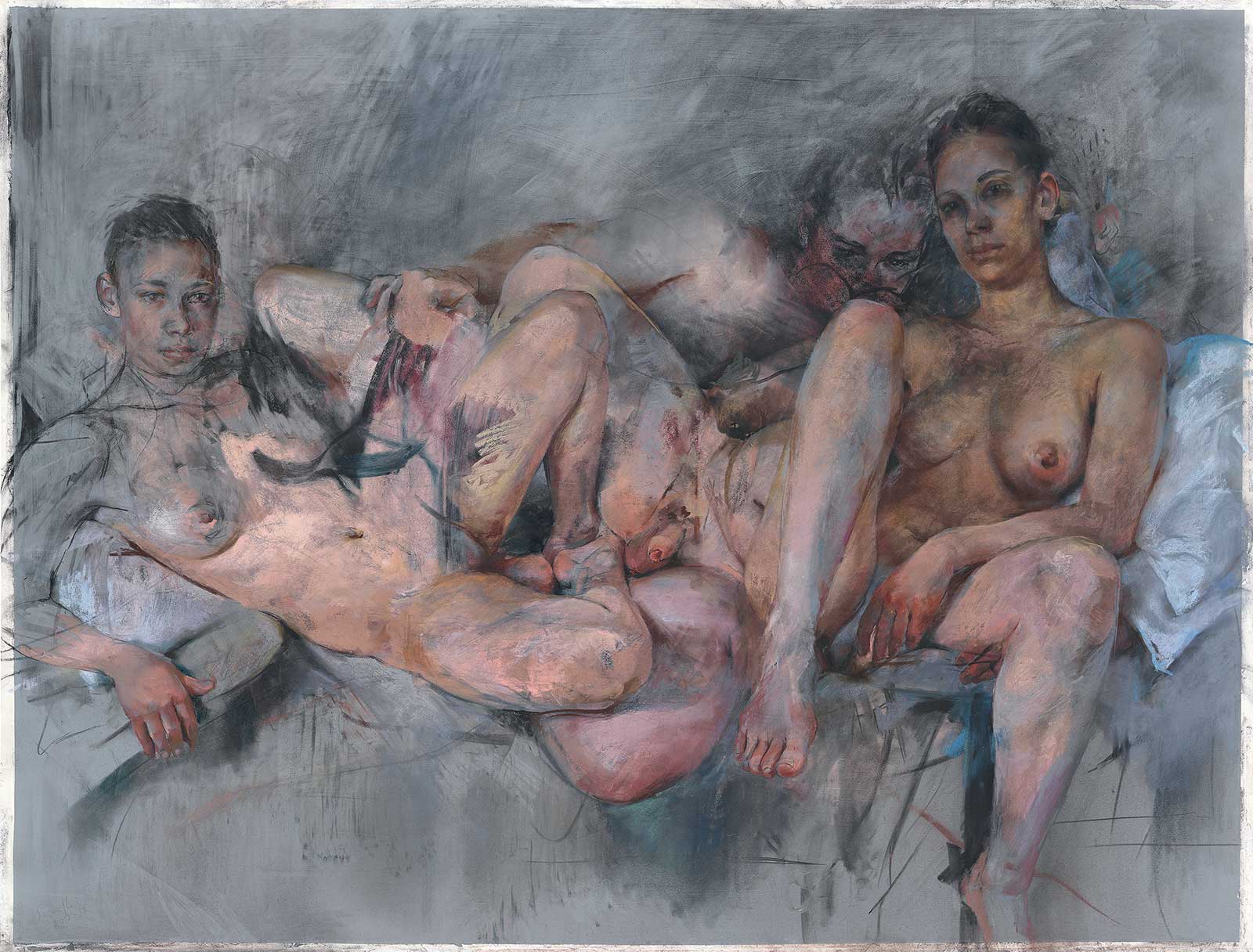
Compass, 2013, charcoal and pastel on paper on board, 60¼ x 78¾ in. SAV.15.
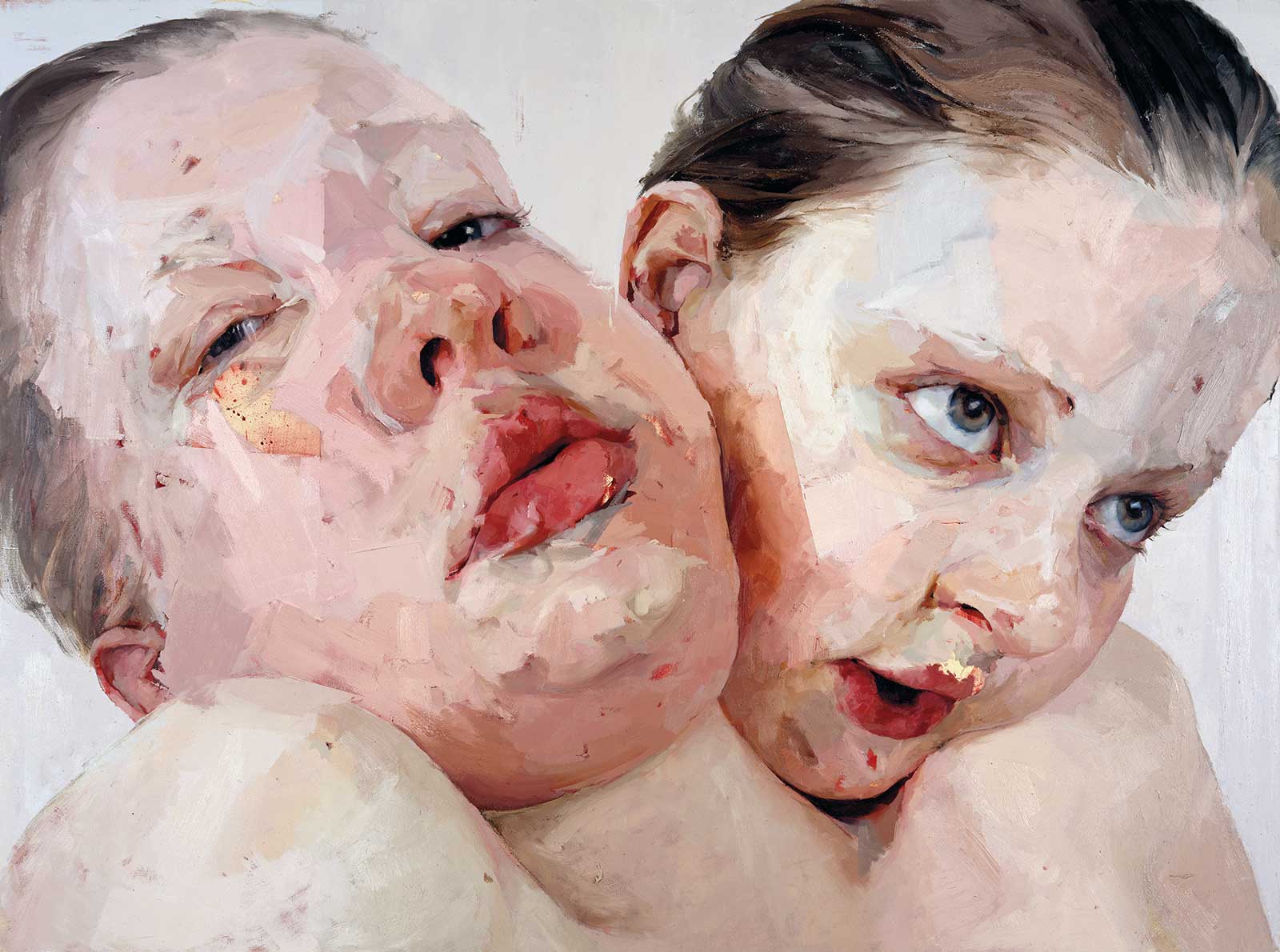
Hyphen, 1999, oil on canvas, 108 x 144 x 37⁄8 in. Private Collection Courtesy Gagosian 54.2025.1 SAVIL 1999.0003.
This is evident in works like Red Stare Head I, 2007-2011, where Saville, incorporating glazes into her impasto technique, has scraped and dragged the paint across the canvas to bring attention to its materiality, and the idea that paintings are both illusory and substantive—like reality itself.
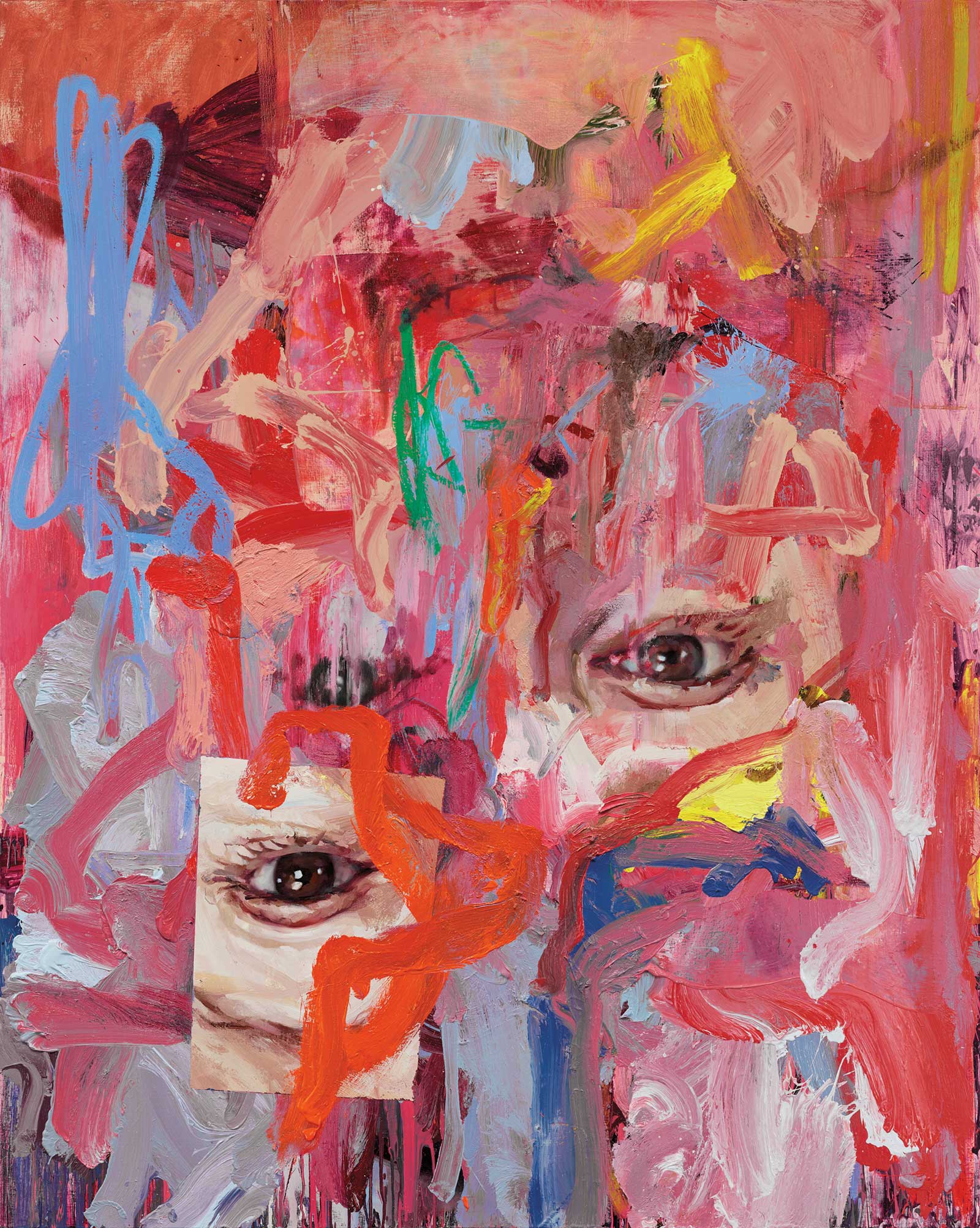 Cascade, 2020, oil on linen, 78¾ x 63 in. SAV.29.
“In her depictions of the human form, Jenny Saville transcends the boundaries of both classical figuration and modern abstraction,” notes Gagosian. “Oil paint, applied in heavy layers, becomes as visceral as flesh itself, each painted mark maintaining a supple, mobile life of its own. As Saville pushes, smears and scrapes the pigment over her large-scale canvases, the distinctions between living, breathing bodies and their painted representations begin to collapse…Saville’s paintings refuse to fit smoothly into an historical arc; instead, each body comes forward, autonomous, voluminous and always refusing to hide.” —
Jenny Saville: The Anatomy of a Painting
October 12, 2025-January 18, 2026
Modern Art Museum of Fort Worth
3200 Darnell Street, Fort Worth, TX 76107
(817) 738-9215, www.themodern.org
Powered by Froala Editor