
Two exhibits at the Parthenon in Nashville celebrate the 35th anniversary of the unveiling of sculptor Alan LeQuire’s 42-foot-high recreation of its colossal statue of ancient Athena. The first show, Goddess in Progress, reveals LeQuire’s extensive research into the long-ago lost original, the engineering that supports the enormous weight of the modern sculpture, and the lengthy creative process of shaping the gilded goddess. The second exhibit, titled Monumental Figures, showcases recent work by the artist.
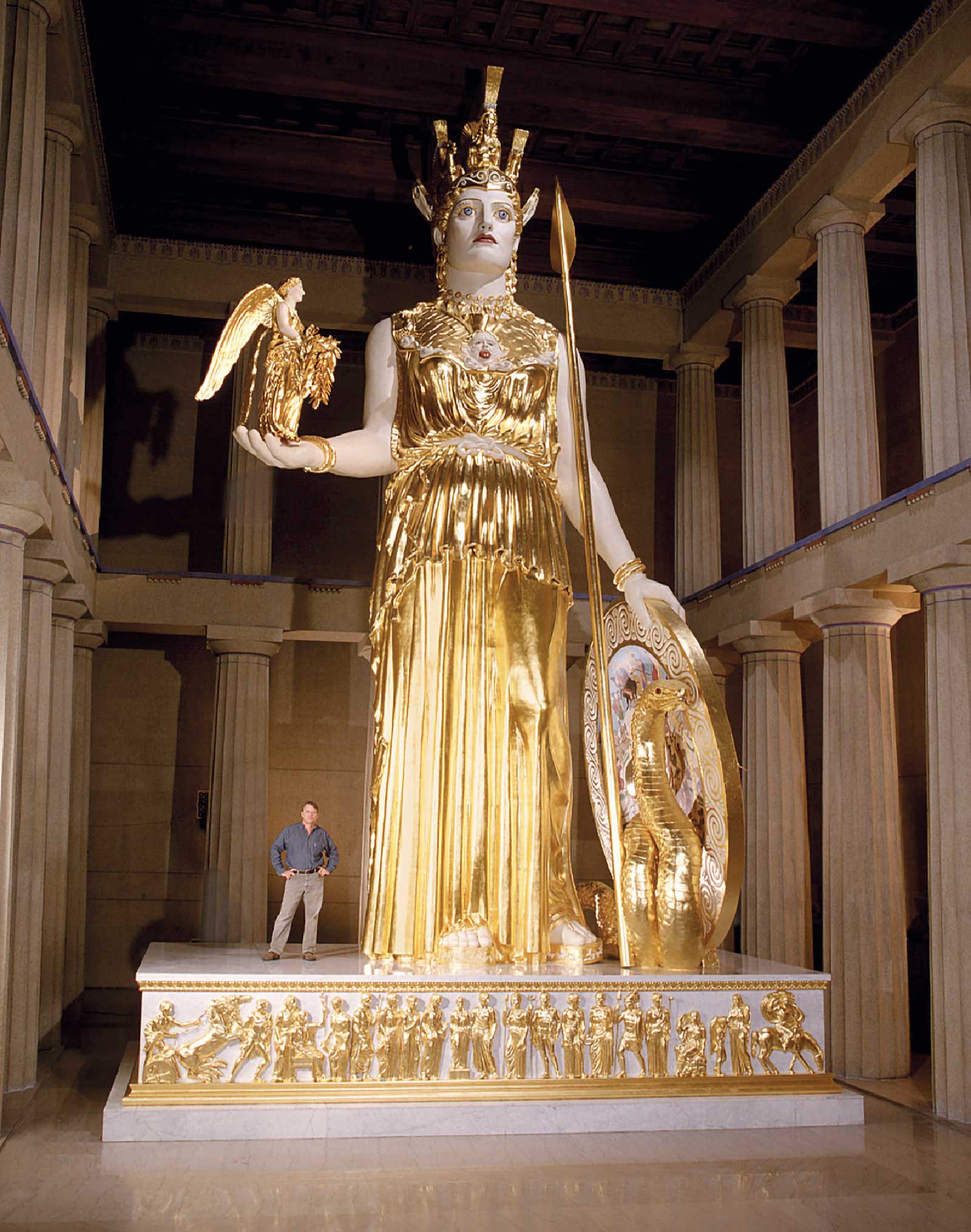
Alan LeQuire standing beside his colossal Athena Parthenos, located inside the Nashville Parthenon.
We owe the existence of the world’s only full-sized replica of the Parthenon as it stood two and a half thousand years ago in Athens to the wise minds of the last days of the 19th century who guided the Tennessee Centennial and International Exposition of 1897, celebrating 100 years of statehood. The organizers of the event hoped to attract vast numbers of visitors to the site, developing business relationships and helping to build the economy—railroad companies were among the principal supporters of the project while it was proposed and organized. During the six months of the exposition 1.75 million visitors passed through the grounds.
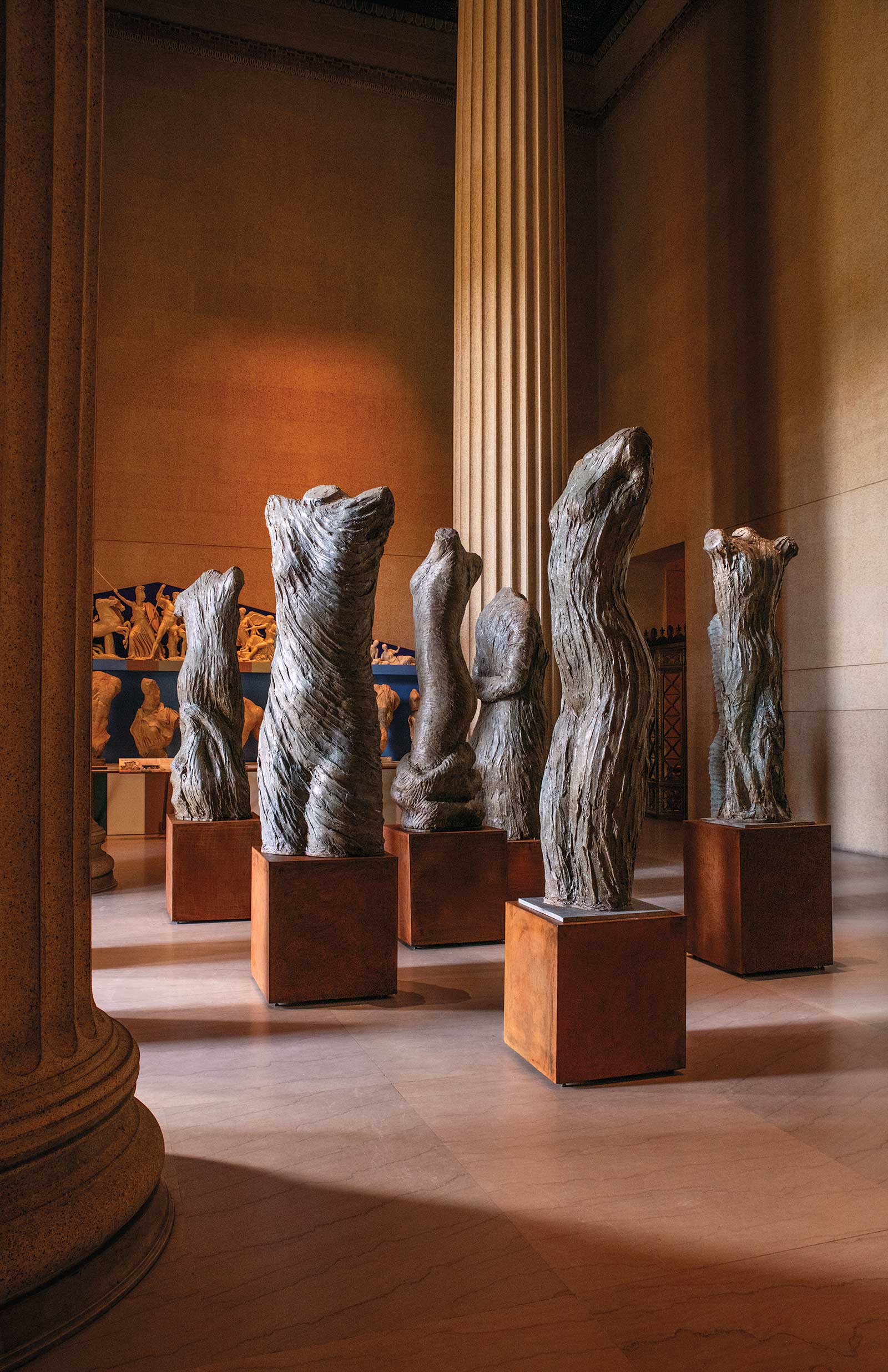
Alan LeQuire, Ten Torsos.
The new Parthenon was designed as the centerpiece of the Exposition, a building for the fine arts divided into gallery spaces exhibiting a spectacular display of more than a 1,000 sculptures and paintings gathered from Europe and the United States. It was at the heart of a beautifully landscaped park of a hundred structures set in bluegrass lawns spreading about the shore of a newly filled Watauga Lake which was crisscrossed by romantic Venetian gondolas slipping beneath medieval bridges. Next to it there was a towering replica of a pyramid, and a statue of Athena as a reference to the majesty that once stood within.
By the end of the 19th century, Nashville was known as “the Athens of the South” because of the keen enthusiasm for education demonstrated by the city fathers. What better way could there have been to honor the guidance passed down the ages from the birthplace of democracy than by recreating the temple that once stood over the ancient city as a shining light on the mountaintop to guide citizens through the darkness? The original Parthenon was built in the fifth century B.C. as a treasury guarded by the goddess Athena after the Greeks triumphed over Persian invaders, and fledgling democracy prevailed against tyranny. The Athenians secured most of the wealth of their state in a room behind the statue of their divine patron, but the statue was a repository of capital itself, for parts of the priceless fabric of the goddess were made of gold, a resource intended to be re-used in desperate times. The original sculpture by Phidias was made of cedar wood overlaid with sheets of the precious metal as the folds of her clothing, and ivory as her pure skin. The new Nashville Parthenon emulated the role of the Greek temple, but instead of storing and safeguarding the city’s money, it shared and exalted art as the true treasure of American culture, dedicated to the traditions of the fathers of democracy. A modern gallery beneath the Nashville Parthenon shows a fine collection of paintings by American artists contributed by insurance executive James M. Cowan when the gallery first opened.
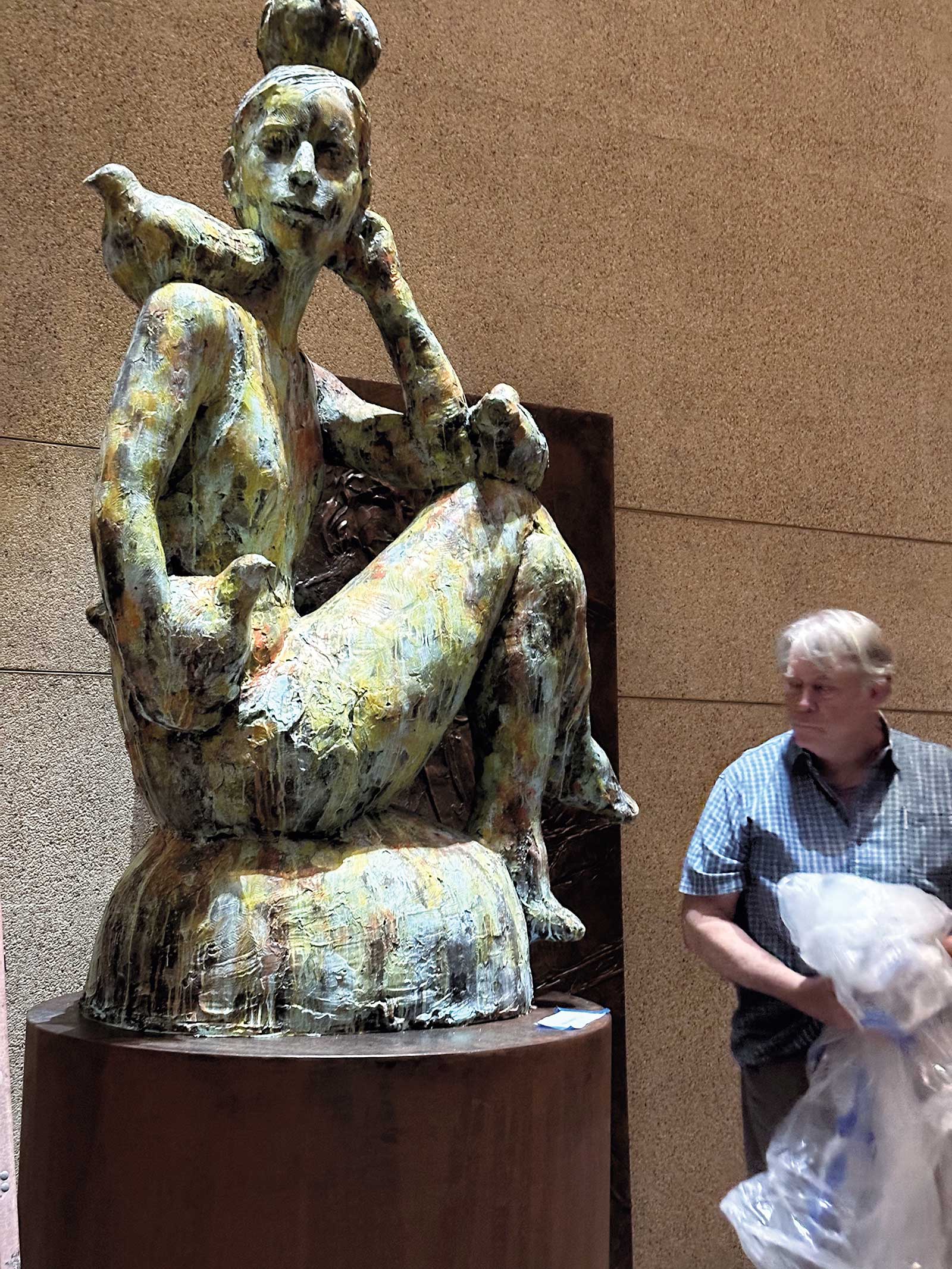
Alan LeQuire unwrapping his new sculpture of Aunt Eleanor, one of many heroic-scale pieces exhibited throughout the naos of the Nashville Parthenon. Monumental Figures, 2025.
The first Parthenon dominated the skyline of Athens, the principal city of the Delian League. Athena was the embodiment of Athens’ wisdom, military strategy, and craftsmanship; she was a weaver and a warrior, named for the city, guiding its people in war and art. The lost sculpture filled the sanctuary, almost touching the high roof, and was a spectacle so famous that its image was stamped into coins, copied in small-scale reproductions, and described by classical authors.
The buildings erected for the Exposition were not intended to survive longer than the duration of the event, but the iconic replica Parthenon was popular among the new Athenians of Nashville and funds were raised to make it permanent. During the 1920s, the roof, walls and load-bearing columns were rebuilt in reinforced concrete, and the architects carefully included important but subtle details in their work, the heritage of ancient masons who understood how to counter weight and mass with the subtle art of geometry to give an appearance of lightness. Like the Athenian original, the pillars were gracefully bowed and tilted slightly inward, and the length of the platform was constructed with a slight camber, and a delicate balance between power and grace was achieved. The polychromed figurative works wrapping the building were not neglected. George Zolnay recreated the lost sculptures of the pediment in plaster in 1897, and returned to recreate the metopes of the Doric frieze. Belle Kinney and Leopold Scholz sculpted the permanent figures for the pediment, basing their work upon Zolnay’s temporary plaster models and a set of 14 plaster casts taken from the badly damaged original marbles purchased from the Victoria and Albert Museum in London.
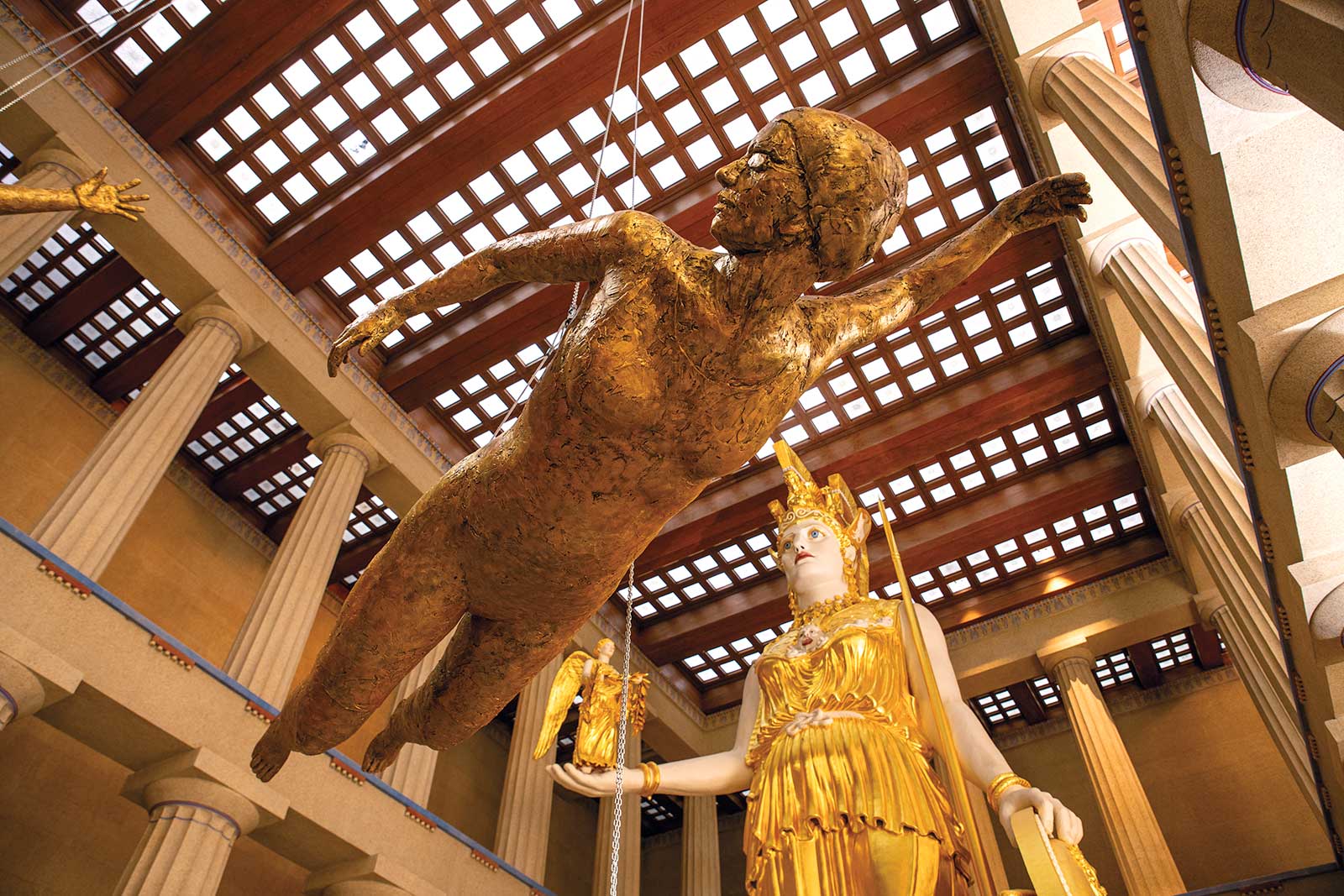
An Olympic swimmer suspended from the ceiling inside the naos of the Nashville Parthenon shares space with Alan LeQuire’s colossal Athena Parthenos. Monumental Figures, 2025.
Although the permanent building was opened to the public in 1931, it had been a challenge to find the funding to complete it while America endured the Great Depression that crushed the world’s economy, and perhaps the most important part of the project—the Athena—was left undone, dependent upon future fundraising.
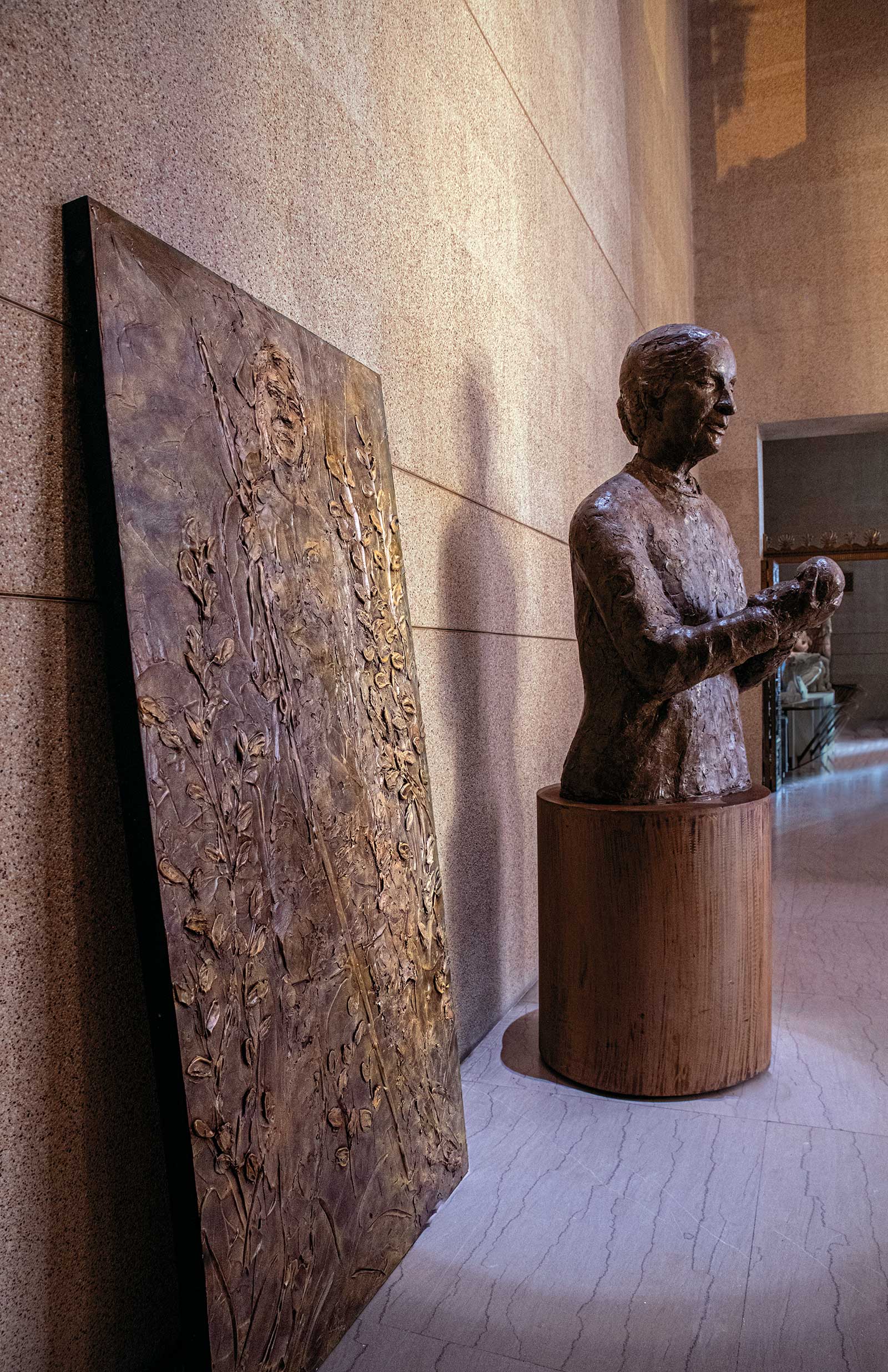
An 8-foot relief painting by Alan LeQuire awaits installation beside his heroic-scale portrait inspired by renowned neonatal pioneer, Dr. Mildred T. Stahlman inside the naos of the Nashville Parthenon. Monumental Figures, 2025.
Slowly, gifts accumulated, but it was not until 1982 that the Parthenon had enough to finance the enormous sculpture. A competition was held, and seven sculptors submitted proposals to recreate the statue, but ambitious, young Alan LeQuire’s proposal was chosen for his commitment to recreating the original Athena using the fragmentary evidence of ancient copies and casts, and traditional methodology, working up from preliminary scaled models to the epic proportions of the monumental whole. He was only 25, and still a graduate student when he submitted his proposal for the commission.
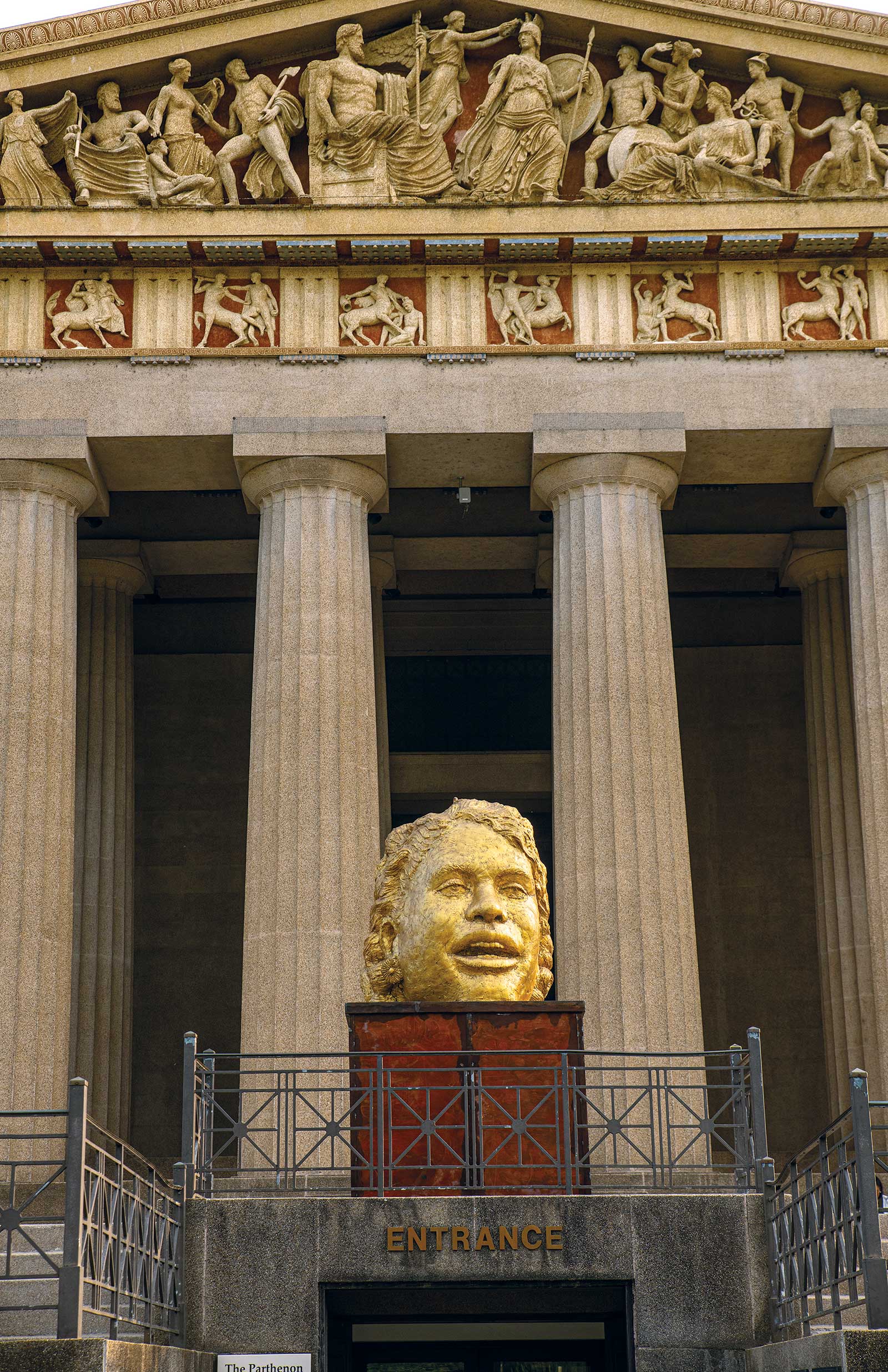
Alan LeQuire’s 14-feet display of new work inspired by Fannie Lou Hamer on view at the entrance of the Nashville Parthenon directly below the Eastern Pediment.
LeQuire comments, “I got lucky…anyone could have entered to recreate the lost statue of Phidias. It just happened at the right time. I was the only one foolish enough to want to make it at the full scale.”
For help and advice, LeQuire consulted experts on ancient Greek sculpture, and looked for fragments of the destroyed monument that had survived the ages. Sensibly, he asked for wisdom from his teachers. “I’d never done that kind of thing before,” says LeQuire. “I had a lot of great advice from my primary mentor, Milton Hebald. I would call him and say, ‘What would you do?’ He helped me to figure out how to enlarge without a machine or digital technology.”
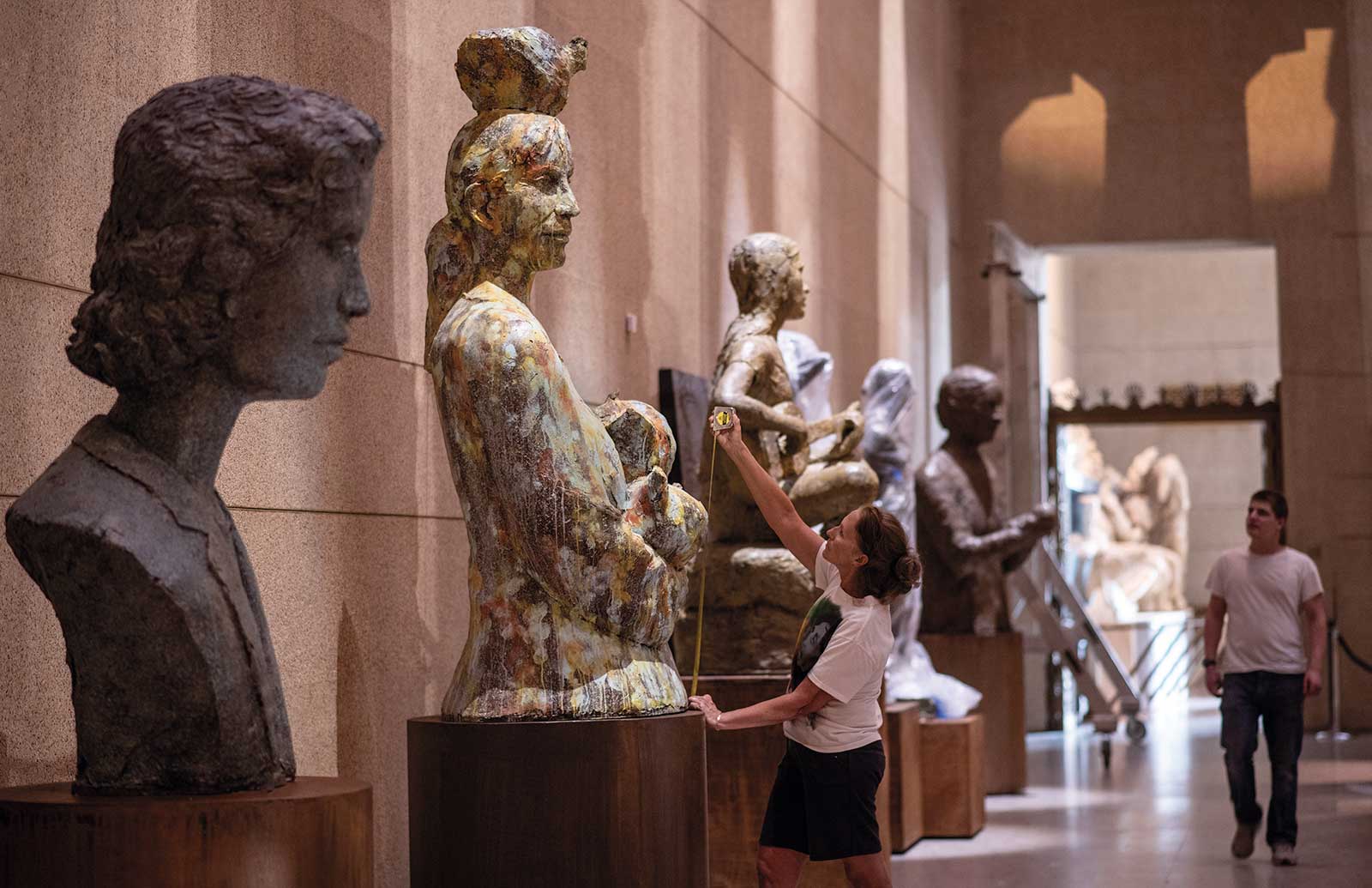
Monumental Figures team members check details in preparation for opening night. Nashville Parthenon.
A small Roman copy of the sculpture known as the Varvakeion Athena dating from 200-250 A.D. was the most complete surviving replica, but LeQuire thought it was incorrect, and was convinced the damaged Patras Athena was the most accurate of the copies he referred to as he formed 1:10 scaled version, then 1:5 scale model which became the basis for the full-sized statue. The shield and snake were a complex challenge. “I was very fortunate,” he says, “because Evelyn Harrison had just done her recreation of the shield, where she compiled all the evidence and created an assembly of all the fragments. Brunilde Ridgway was probably the archaeologist I worked with most closely.” For the frieze around the plinth, LeQuire consulted Pausanius’ brief description and found Neda Leipen’s research especially useful.
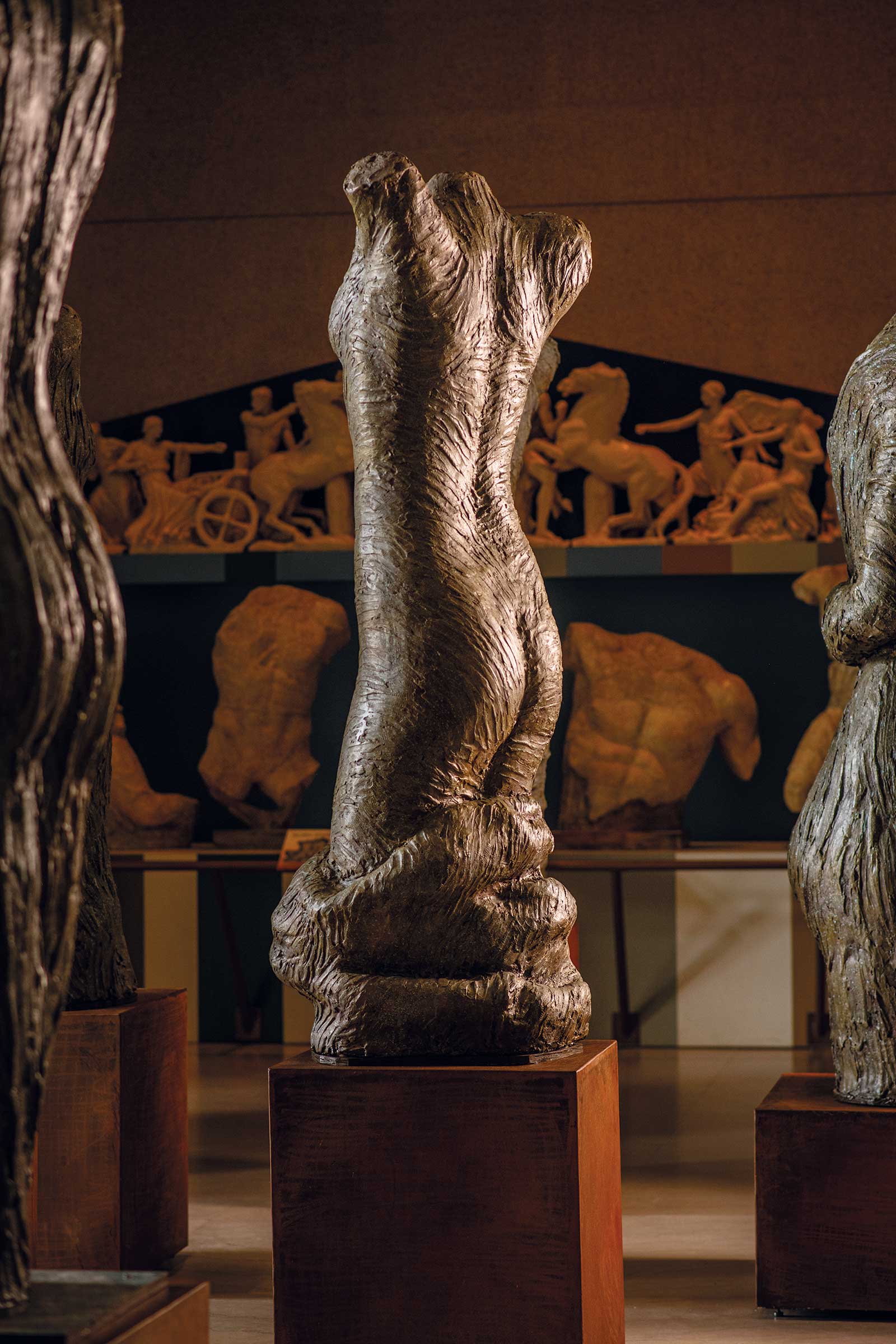
Heavily textured torsos by Alan LeQuire on view at the Nashville Parthenon create an exciting juxtaposition with the Parthenon Marbles.
Although the figure of the goddess was finished by 1990, she was incomplete without the gold and ivory finish of the original. Another round of fund-raising culminated in 2002, when three months of gilding and painting finally completed the magnificent monument as a replica as close as possible to the priceless materials of the original. The first Athena was created by the legendary Phidias about 438 B.C.; the Roman copies hundreds of years later. Almost miraculously, traces of paint had survived embedded in the marble of the copy of the British Museum’s shield, and red and yellow color were found on the Varvakeion Athena. These were a guide to LeQuire as he developed the appearance of the goddess. But, LeQuire says, “I was hesitant even to gild the statue. I wanted to be archaeologically correct. The skin was painted to look like ivory, but I’ve stopped there, because we just don’t know.”
The second show celebrating the anniversary, Monumental Figures,fills the space in front of Athena. “There are 24 major sculptures that I’ve made in the past 12 months, and then eight wall reliefs,” explains LeQuire. “I call them relief paintings—they’re all vertical 4-feet-by-8-feet panels. The whole show is about honoring women, and the achievements of women, ordinary women and my personal heroes.” There are three pieces that honor Olympic athletes suspended in front of Athena. A figure swoops in the curve of a dive, almost touching the floor of the hall. She is inspired by the gymnast Simone Biles, who has won 11 medals at the Olympics, seven of them gold. LeQuire’s runner was motivated by Nashville athlete Wilma Rudolph, who won medals for track in the 1960s, and a third figure is based on the Olympic swimmers Alex and Gretchen Walsh. A giant head of activist Fanny Lou Hamer looms over the eastern entrance to the Parthenon, memorializing her work to secure votes for women and civil rights. LeQuire remembers hearing her testimony at the 1964 Democratic National Convention recalling her attempts to register to vote as a Black woman in Mississippi when he was only 9 years old, and being deeply moved by her words.
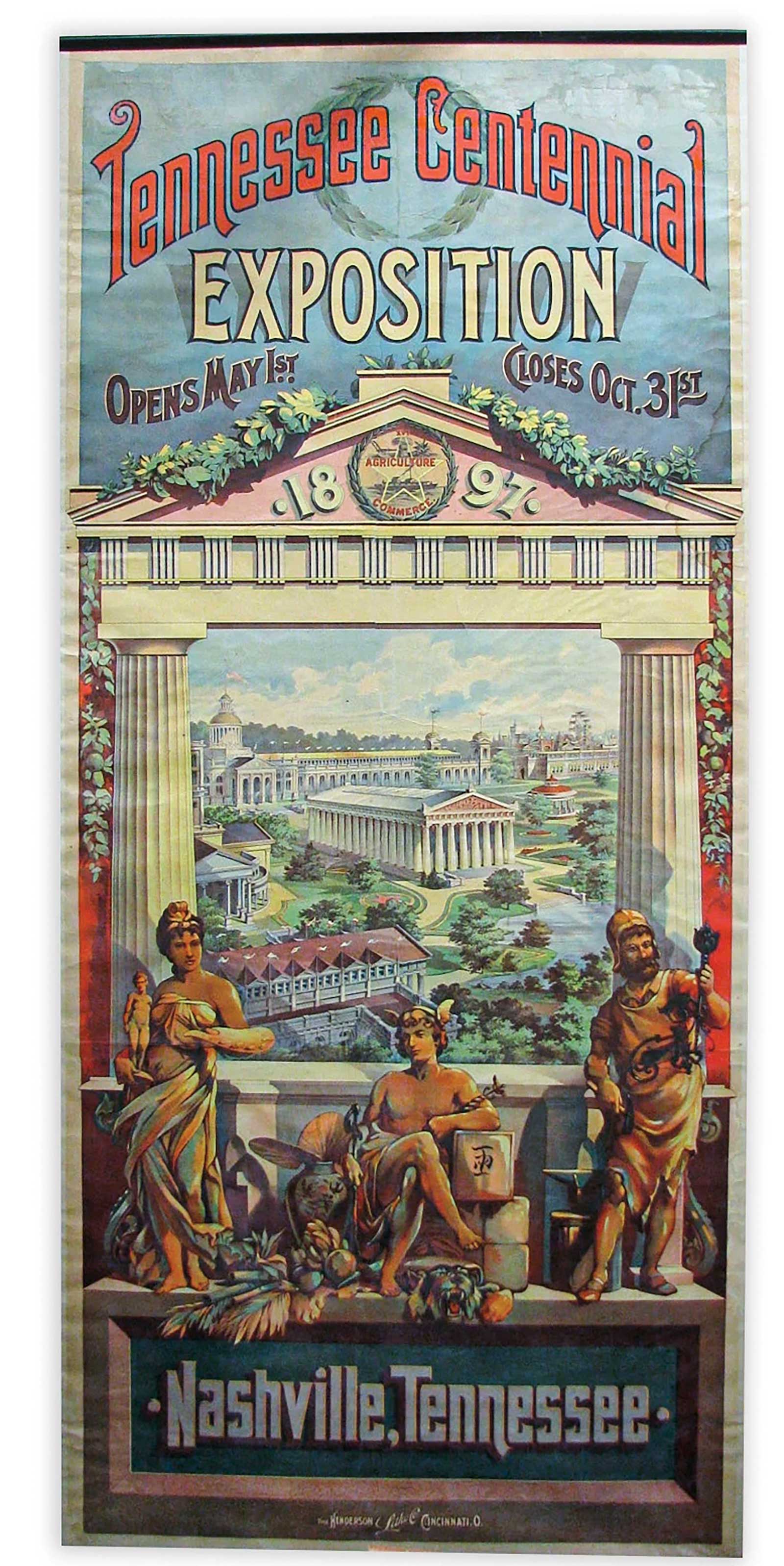
The poster for the 1897 Tennessee Centennial and International Exposition.
“I was worried how all the pieces would relate to each other in that space, but everything has worked out, and Athena has taken a back seat,” says LeQuire. “It’s hard to imagine that she would not dominate the space, but it’s a mythological figure versus real people, and the real people are holding their own.” The new sculptures are filled with lively spirit, contrasting with the perfected surfaces of the goddess. “More vigorous, because they were done quickly,” says Lequire, “A greater sense of life in the surface, all the toolmarks are there in the surface texture.
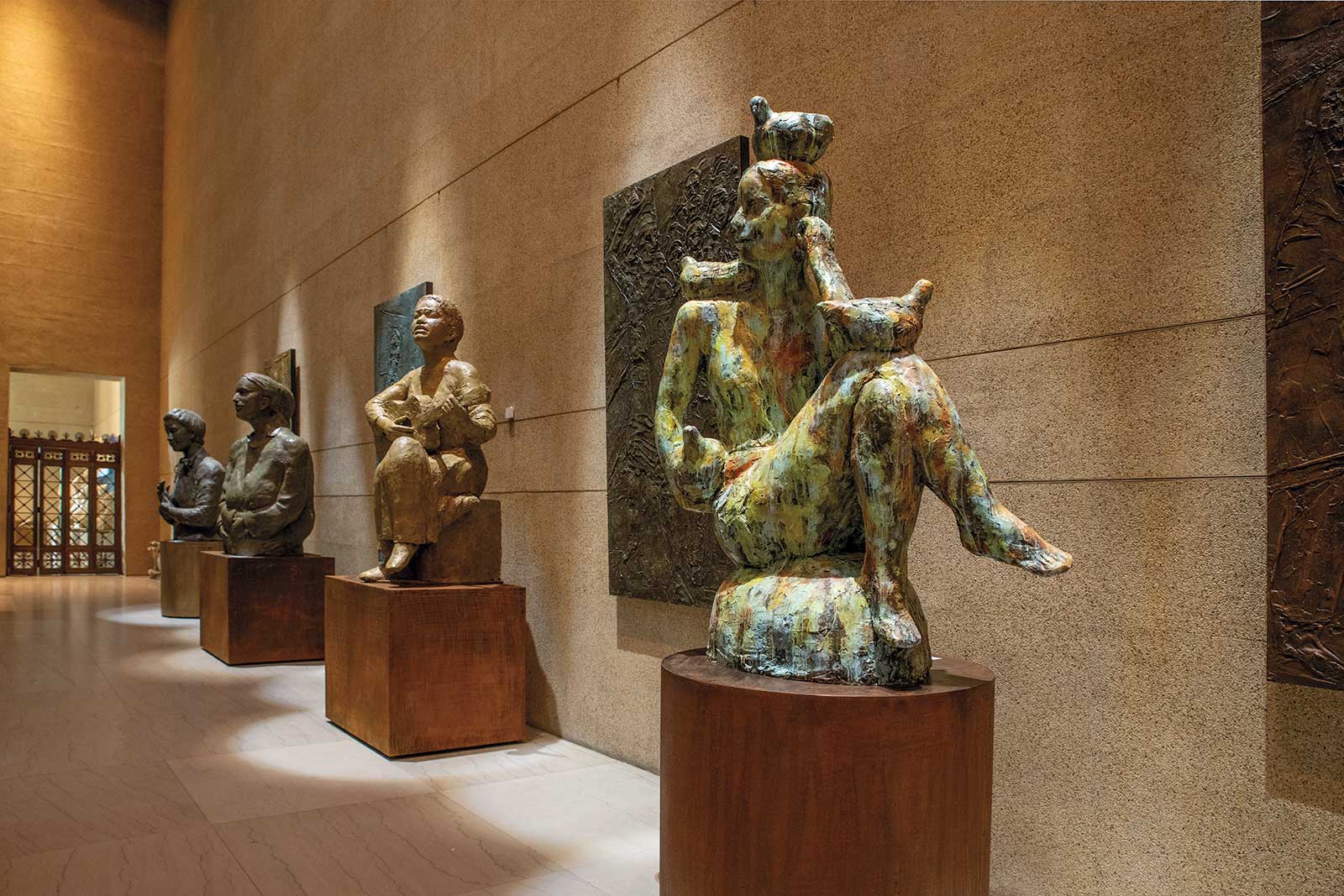
One of the two colonnades in the naos of the Nashville Parthenon filled with new work by Alan LeQuire for his Monumental Figures exhibition.
“I spent three years inside the Parthenon finishing Athena, so I have this relationship with her that’s hard to explain, but it effects the way I think about sculpture. It’s a very sculptural experience just being in there. The Doric column itself sums up everything I know about sculpture. It swells outward, so it has a warm feeling of human presence inside the column, but the column has a negative surface because of the flutes. And that’s what Phidias did in his sculpture, too. Those figures are wrapped in drapery which is all concave, and that creates an ethereal feeling…you feel a breathing living presence inside the inanimate material. That’s what I’ve been fascinated with for my whole career. I’m returning to the beginning, here.” —
Monumental Figures: Alan LeQuire
Through April 19, 2026
Goddess in Progress: Alan LeQuire
Through September 21, 2025
The Parthenon, 2500 West End Avenue, Nashville, TN 37203
(615) 862-8431, www.nashvilleparthenon.com
www.lequiregallery.com
Powered by Froala Editor