A portrait serves many purposes. It can remind us of who we are or who someone once was, whether depicted in great accuracy or through symbolism. While our fascination with a portrait is often an ineffable experience, there’s one simple explanation of the appeal of a human face: connection—made possible through technique, style and color.
Take for example, the most famous portrait of all time—the Mona Lisaby Leonardo da Vinci. His use of sfumato, a painting technique that softens the transition between colors, eradicating hard lines in the composition and emulating the way the eye sees; combined with his startling accuracy—a result of the artist’s obsession with science and anatomical precision—created an effect that was quite revolutionary. The added allure of mystery within the painting, stemming from the subject's subtle smile and delicate charm, keeps the viewer engaged. The more time they spend contemplating the piece, the more they connect with it. One could argue that it becomes deeply psychological, bordering on the spiritual.
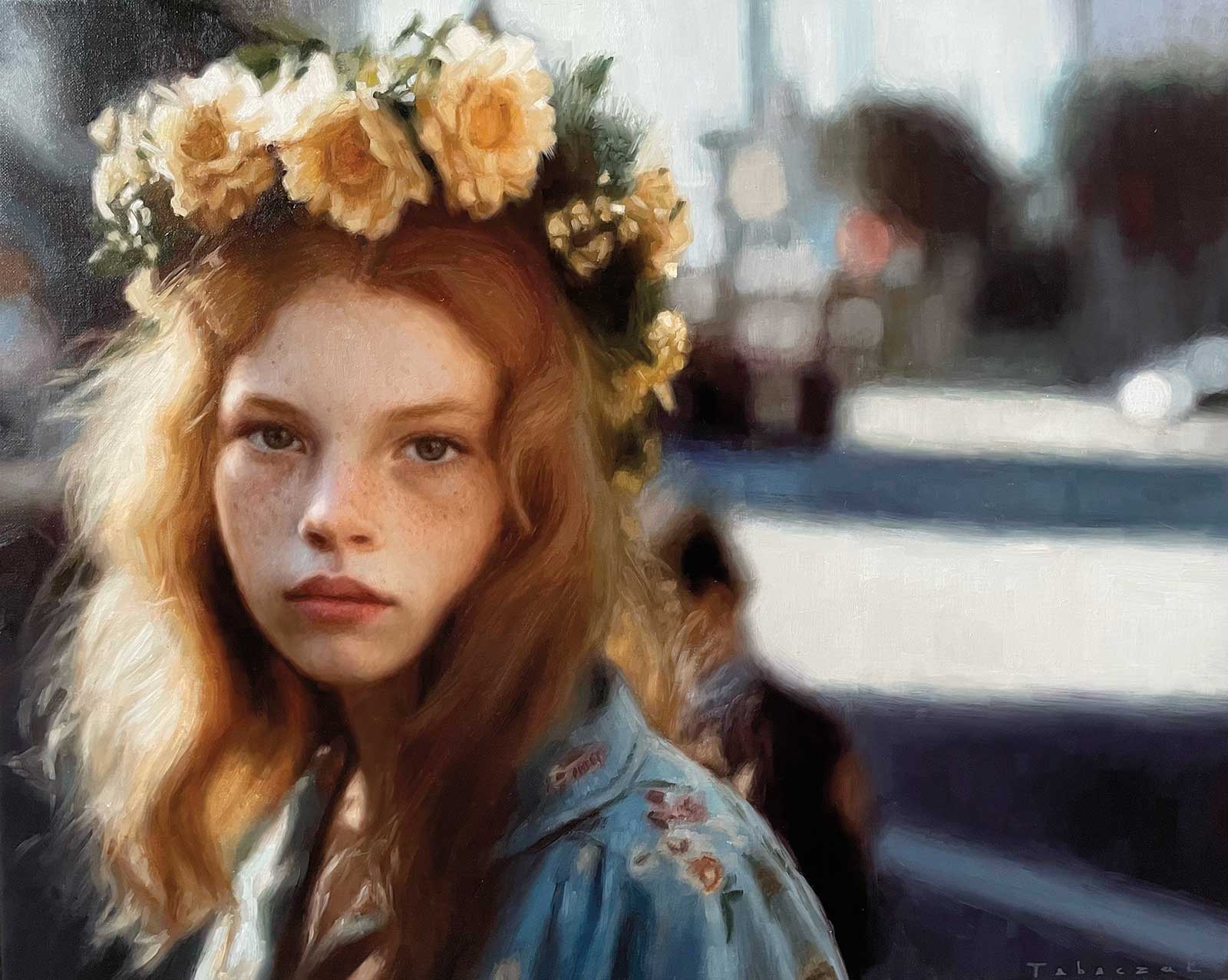
Arcadia Contemporary, Street Blossom, oil on linen, 20 x 16 in., by Kesja Tabaczuk.
Today, we see artists providing connection through these very same principles, while expressing their own individual style. In a preview of her solo show at Arcadia Contemporary last year, artist Mary Jane Ansell shares, “A significant influence was the loss of someone very close to me, who embodied the extraordinary strength and leadership of women. I wanted to capture and celebrate this strength, showing young girls reveling in their power and exploring their own narratives. Additionally, the symbolism and narratives of Greek and Roman myths have always fascinated me, blending these ancient symbols with modern contexts to explore themes of love, relationships and inner strength.”
Ansell’s work Reminiscence, is soft yet striking, pairing two beautifully-lit women against a dark, floral background. Their poses suggest a relationship built out of support and kinship, and, you guessed it, connection.
Another Arcadia Contemporary artist, Kesja Tabaczuk, also paints the figure and faces of young women and girls. Images like Street Blossomare steeped in nostalgia, while also playful, whimsical and dream-like. “I am very nostalgic, and I cherish my childhood and teenage years very much,” she says. “It’s probably some period of my life that I haven’t said ‘goodbye’ to yet, or maybe I’ll never say it.” Tabaczuk also plays with themes that illustrated “how as adults, we often lose touch with our inner child, which can help us see life and its problems from a fresh perspective, free from complex thoughts,” she says.
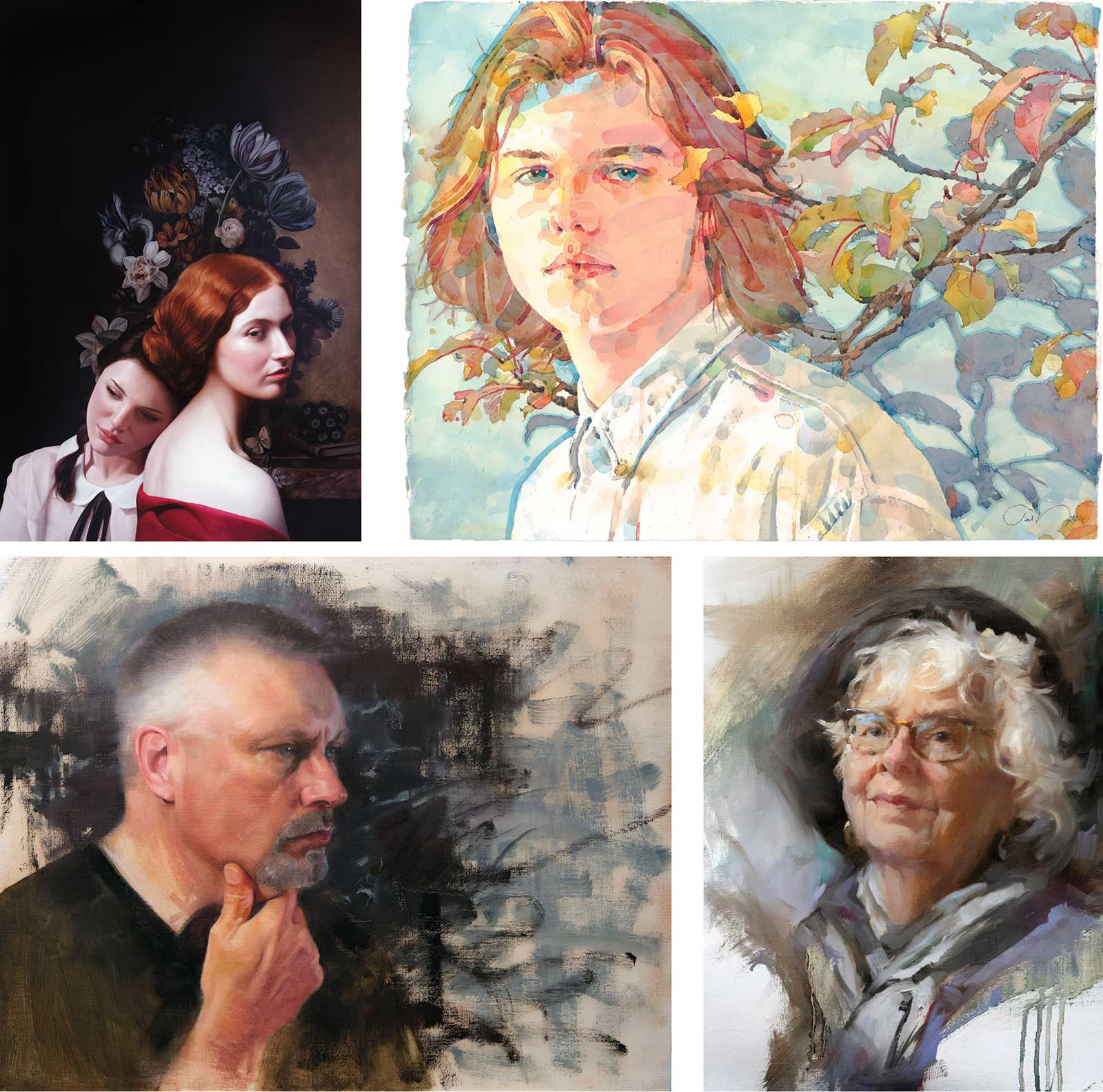
Top: Arcadia Contemporary, Reminiscence, oil on linen, 27 x 18 in., by Mary Jane Ansell; American Impressionist Society, Evrett, watercolor, 15¼ x 19½ in., by Ted Nuttall. Bottom: American Impressionist Society, The Thinker, oil, 16 x 20 in., by Chris Rossow; American Impressionist Society, A Life Well Lived, oil, 12 x 9 in., by Kathie Wheeler.
While there are many portrait artists, those who are most successful can create what may at first seem like a simple face—as is the case of the Mona Lisa—and imbue it with life, emotion and, most importantly, the power of human connection.
Throughout this section, we hear from additional artists that excel at creating connection through the human face. They, and representatives of arts organizations, discuss the art of portraiture and provide insight into collecting the genre.
The American Impressionist Society presents impressive portrait examples in its 26th Annual National Exhibition,which runs August 1 through September 2 at Cassens Fine Art in Hamilton, Montana. The exhibition features 181 impressionist paintings created by the organization's professional member artists. All the works in the exhibition are for sale and span landscapes, interiors, seascapes, figurative pieces, wildlife, still life, cityscapes and portraits. “It is assumed that portraits do not sell unless the buyer knows the individual in the painting,” says Liz Ahrens, AIS executive director. “Actually, many savvy collectors enjoy adding portraits to their collections. Why purchase a portrait? They add personality to a collection, breaking up the typical imagery of landscapes and still lifes. The emotion in a portrait captures a mood or sets a tone for a collection. The originality of portrait work can draw in a viewer; and often, a painting of a different culture, historical subject or costumed portrait adds whimsy and character to a collection.”
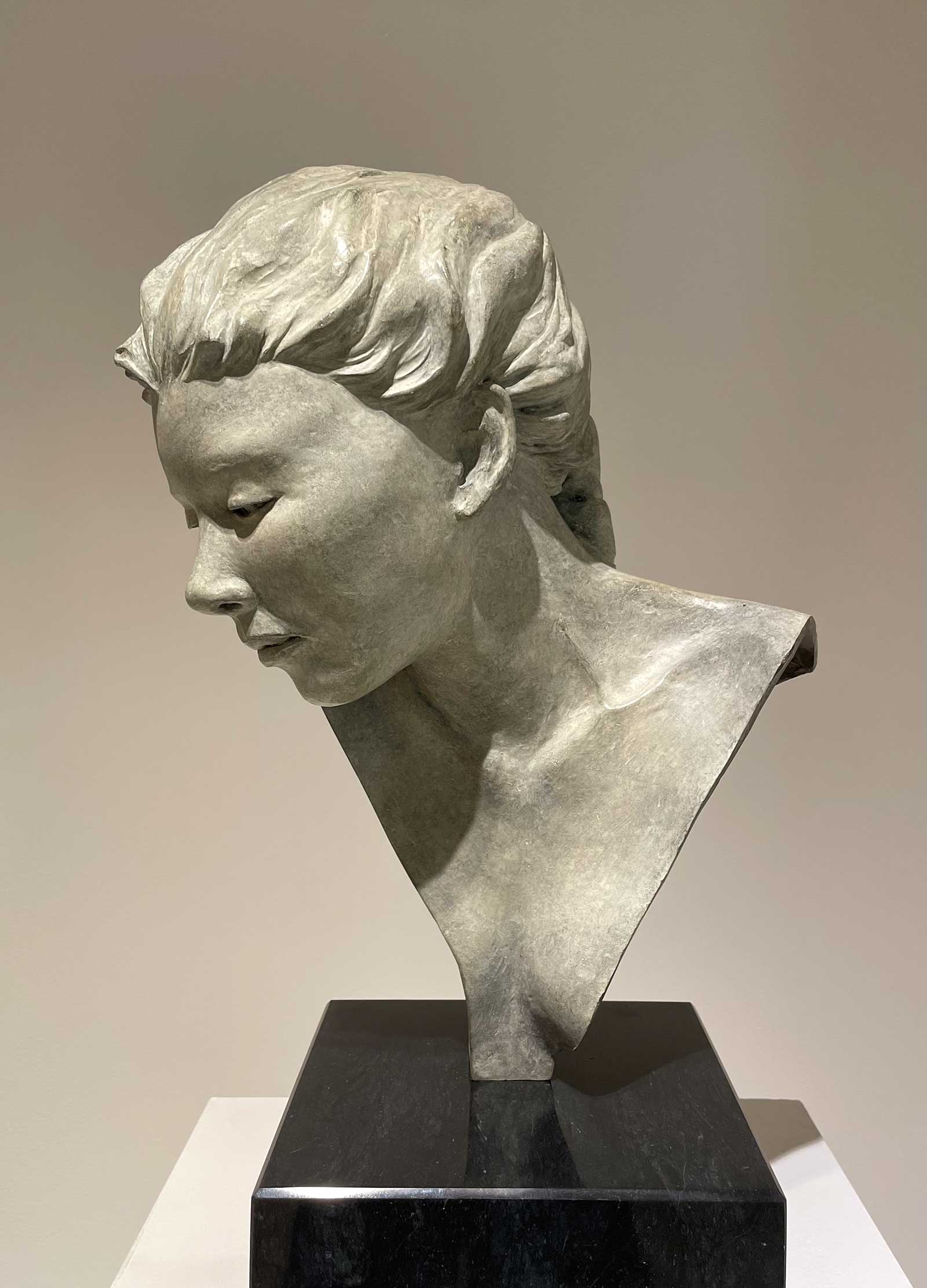
Betty Branch, Portrait of a Young Woman, bronze, 17 x 8 x 8 in.
Artist Betty Branch sculpts portraits, finding inspiration “from the subject, of course,” she says. “Whether [I'm working from] a live model or a photo, I focus on the mannerisms and attitude, as well as the physical characteristics of the face and body. I also like to find a theme or context for the creation of a portrait; surroundings, clothing and personal objects can all supply important information. If the subject is available for a walk, a conversation, coffee or cookie break before settling into the chosen pose, I can glean even more exciting, personalized information to help the portrait come alive.”
When deciding to invest in a portrait, Branch says, “the buyer should be strongly drawn to the piece, having a visceral reaction or simply trusting one’s gut instinct. When it comes to buying art, it is the surest way to build an impressive and continually rewarding collection. If you love it, you will find a place to put it. And, if already an avid collector, the next purchase may depend, to some extent, on the mood or genre already established.”
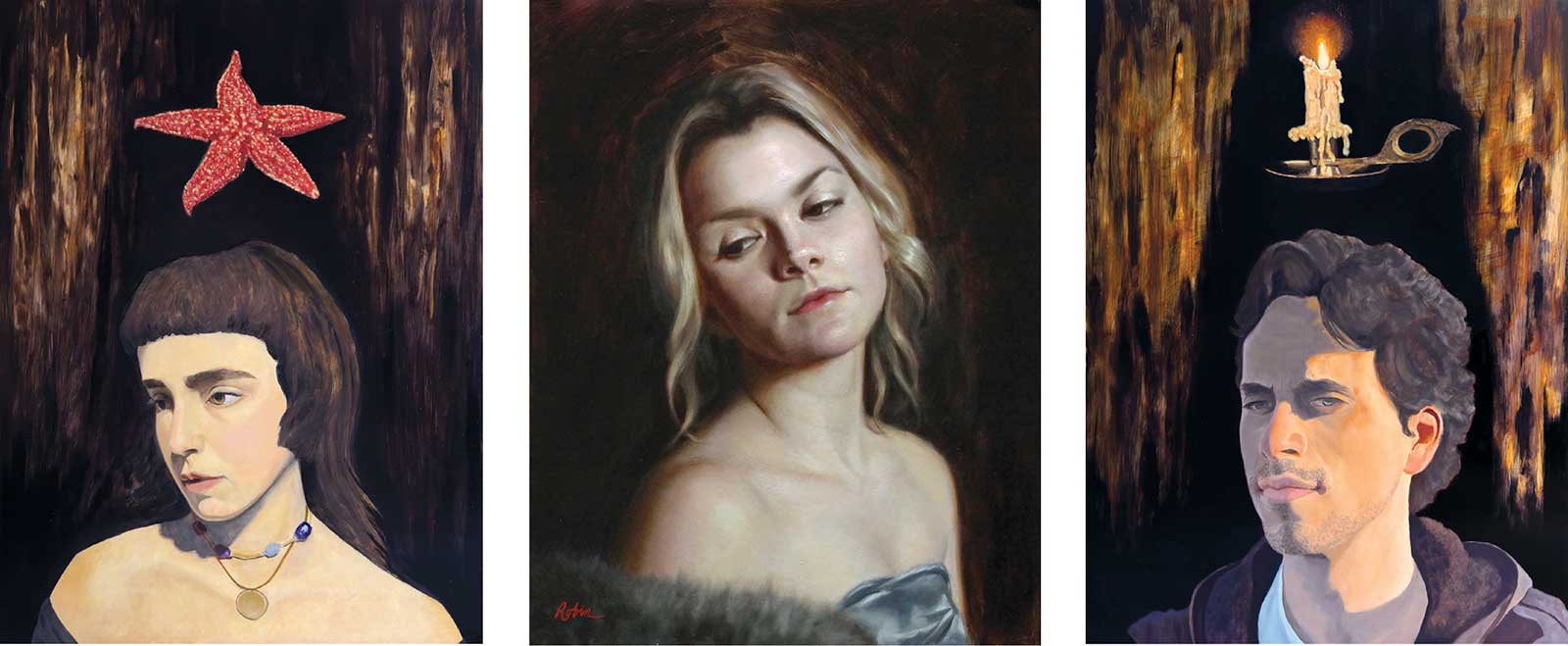
Danny Schreiber, Lost Between the Stars and Foam, oil on wood, 24 x 18 in.; Robin Williamson, Beyond the Frame, oil on wood panel, 14 x 11 in.; Danny Schreiber, A Torch Passed Through Unseen Hands, oil on wood, 24 x 18 in.
The portraits A Torch Passed Through Unseen Hands and Lost Between the Stars and Foam, are part of Danny Schreiber’s Oracles series, which explores how the various systems of power we encounter throughout life influence our self-perception and shape who we become. “The Oracles series began as a personal reckoning—with the roles I inherited, the beliefs I was shaped by and the parts of myself I learned to quiet,” explains the artist. “These figures aren’t just symbolic, they’re mirrors. They hold that charged moment we all encounter; when the inner voice begins to rise and the path forward asks us to become more fully ourselves.”
Schreiber continues, “These particular pieces hold symbols of reflection, truth-seeking, and the ongoing work of reclamation through healing and transformation. Committing to a daily painting practice has given me a process that is not only cathartic but one that invites viewers into their own moments of inquiry. My hope is that the work opens a space for reflection, resonance and return.”
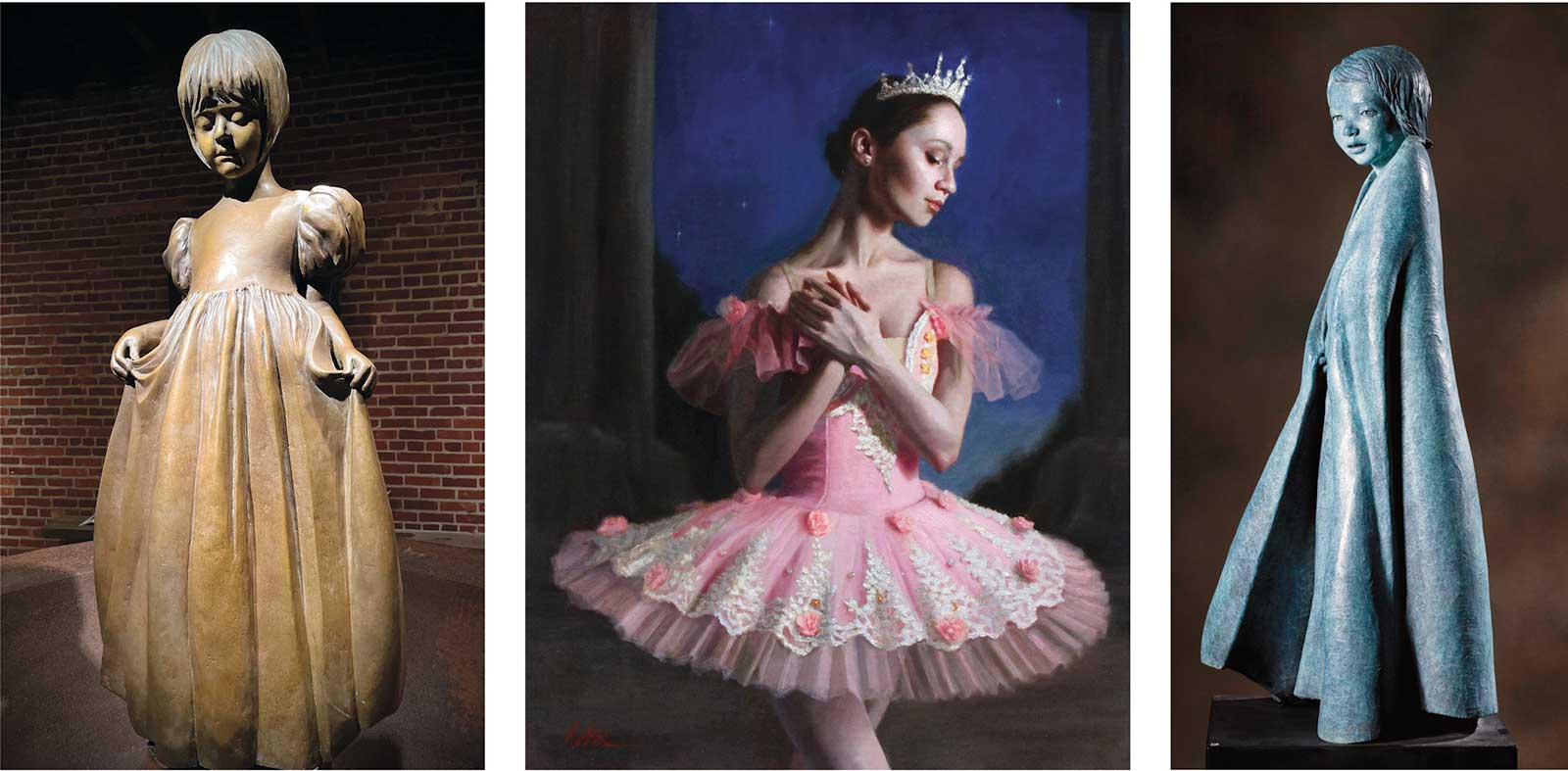
Betty Branch, Laura/Flower Girl, bronze, 33 x 17 x 11 in.; Robin Williamson, Before the Slumber, oil on linen, 18 x 14 in.; Betty Branch, Emma, bronze, 33 x 16 x 16 in.
When collecting for the genre, Schreiber says, “The right portrait isn’t just a likeness, it’s a reflection of something internal, unresolved and essential. Trust your emotional connection to a piece and collect the ones that take your breath away and invoke contemplation.”
Portraiture for Robin Williamson, is an intimate exploration of the human spirit. “Every face tells a story—a quiet accumulation of life, emotion and identity—and I’m drawn to the challenge of capturing that depth in oil,” she says. “My inspiration often stems from a single expression, a moment of stillness or the quiet presence someone holds when they are simply themselves. I approach each portrait not merely as a likeness, but as a reverent study of individuality and connection. Influenced by the great figurative masters of the 19th century, I strive for a timeless realism that allows the subject’s inner life to emerge subtly through the paint. Whether working from life or reference, I spend time understanding the person—their gestures, their rhythm—so that the portrait becomes more than an image; it becomes a lasting testament to their presence in the world. My goal is not perfection, but an image that resonates beyond the surface and into the heart of the viewer. A powerful portrait doesn’t just resemble someone; it reveals them. My advice is to choose pieces that evoke a story or a feeling you can return to again and again.” —
Featured Artists & Galleries
American Impressionist Society
(231) 881-7685
www.americanimpressionistsociety.org
Arcadia Contemporary
421 W. Broadway, New York, NY 10012
(646) 861-3941
www.arcadiacontemporary.com
Betty Branch Sculpture Studio & Gallery
Roanoke, VA, (540) 344-4994
www.bettybranch.com
Danny Schreiber
Tumwater, WA, (360) 357-5375
danny@thecopperwolf.com
www.dannygordo.com
www.thecopperwolf.com
Instagram: cognitronic
Kesja Tabaczuk
www.kesjatabaczuk.com
Mary Jane Ansell
www.maryjaneansell.com
Robin Williamson
Sugar Land, TX
www.robinwilliamsonfineart.com
www.thedavincistudios.com
Powered by Froala Editor