Portraiture is one of the most enduring and essential forms of artistic expression, not only because it captures physical likeness, but because it reflects the inner life of both the sitter and the artist. Through brushstrokes and subtle nuance, portraiture offers something deeper than realism—it’s a record of humanity.
For 27 years, the Portrait Society of America’s International Portrait Competition has championed this tradition. Artists from around the world submit work in hopes of being recognized not just for skill, but for their ability to communicate with the viewer. With a $50,000 grand prize and a legacy of excellence, the Internationalstands as one of the most prestigious portrait competitions globally. It is more than a contest—it is a celebration of stories, craftsmanship and courage.
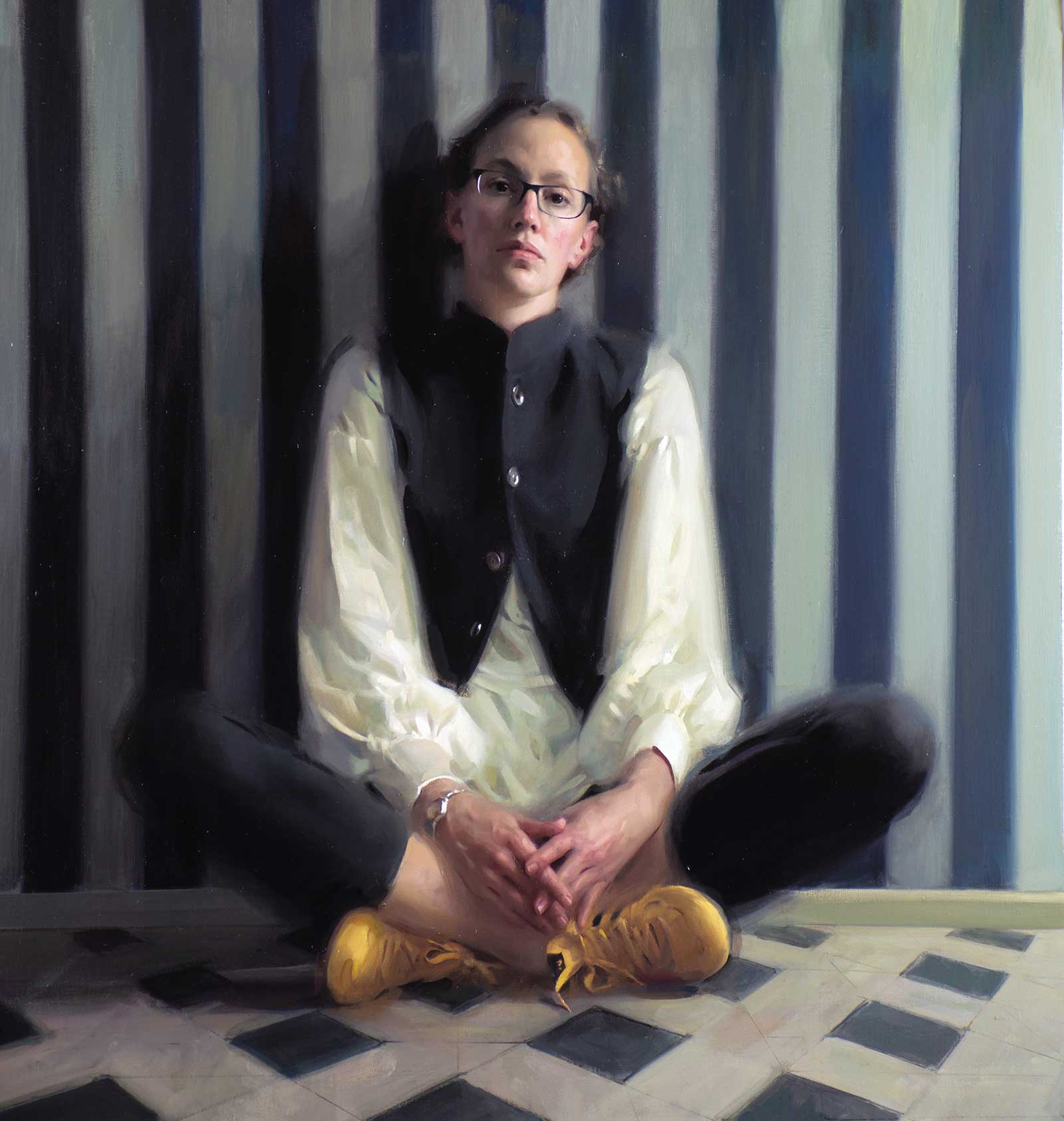
Grand Prize: Frances Bell, Yellow Trainers, oil on canvas, 35½ x 37½ in.
This year’s finalists have created not just visually arresting portraits, but emotionally resonant narratives that linger long after the viewer steps away. In speaking with the winning artists, a powerful thread emerged: each portrait was forged through deeply personal experiences, making each work of art a product of vulnerability as much as a display of talent and study.
Selected from almost 3,000 entries, this year’s 19 finalists were on display during the annual conference where a panel of judges determined the winning placements after reviewing the original artworks. Frances Bell’s self-portrait earned her the prestigious Draper Grand Prize. “Painting a self-portrait is the contradictory occupation of turning attention inward but also taking a step back to assess oneself more broadly, so it can often feel like a tension between the objectivity of the observer and a highly personal self-examination,” Bell explains. Though not her first venture into self-exploration through art, this piece reflects a deeper sense of maturity, introspection and curiosity.
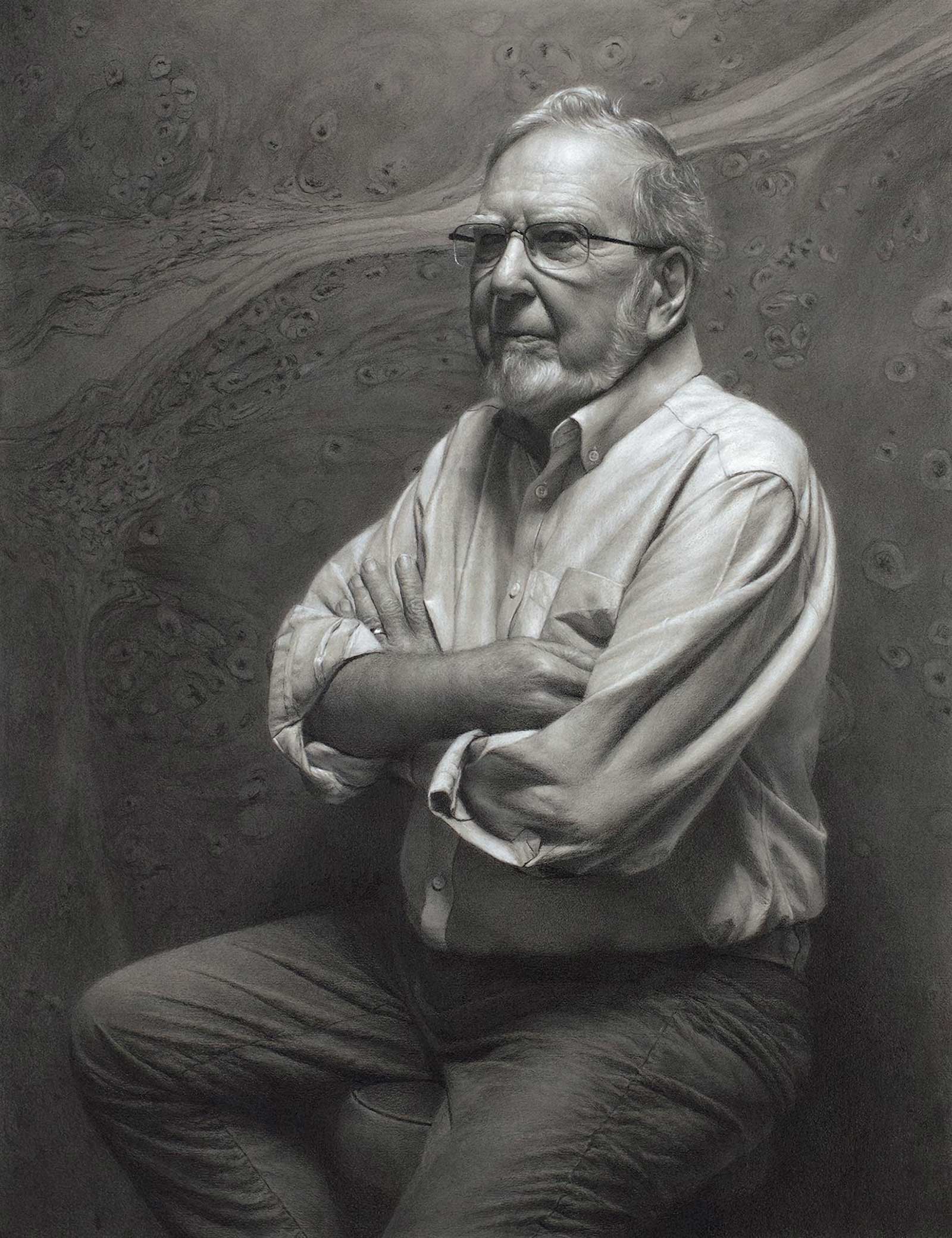
First Place Drawing: David Jamieson, Pathologist–Portrait of Dr. Maurice Jamieson, graphite, carbon black, pastel, ink wash on paper, 26 x 20 in.
Bell’s composition is striking. Black-and-white stripes dominate the environment, a dizzying pattern extending across both wall and floor that plays with perception and symbolism. “In this portrait, both the floor and the wall are an attempt to consider domineering pattern, and in so doing, explore a narrative in relation to myself at this time of my life,” explains Bell. “I see the black and white here as symbolic of the reconciliation that we are all engaged in around the zero sum demands of our lives, from the privilege of family and friends, to more prosaic daily demands and our polarized culture as a whole. The black-and-white striped theme is a long-held curiosity in my work, especially in thinking of how to tackle the strongest of contrasts in a pattern which transgresses the cardinal rules of keeping parallel lines and sharp distractions around the figure at bay,” she continues. “But there is something so beguiling about stripes with their regularity and order, and they appear all over our aesthetic lives, from our clothes and furniture to within nature itself.”
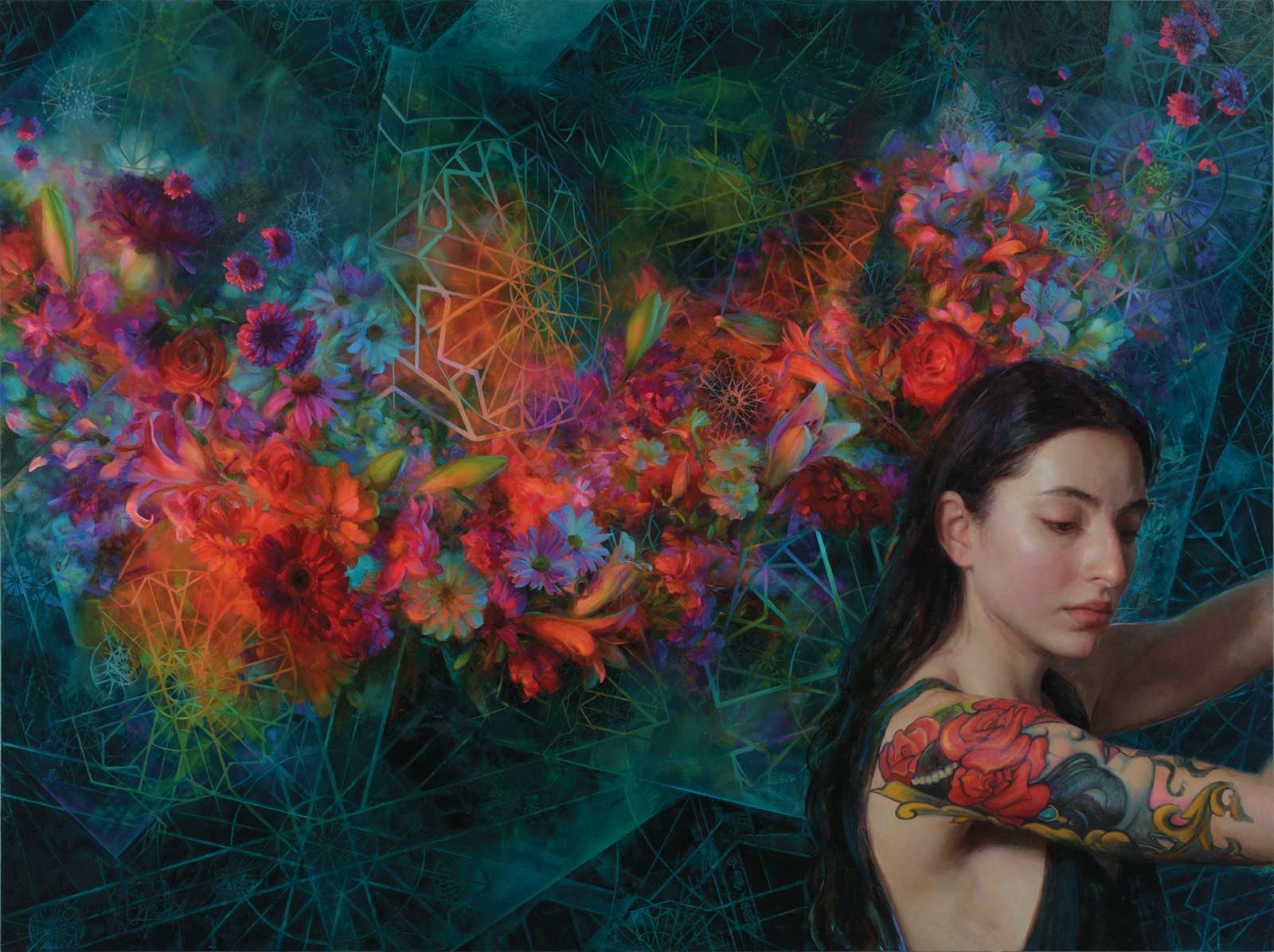
Exceptional Merit: Rose Frantzen, The Impossibility of Feeling Worthy of a Universe of Infinite Beauty, oil on panel, 36 x 48 in.
In the center of this calculated chaos sits the artist herself, composed but contemplative as a figure both at home and at odds with her surroundings. Her yellow trainers disrupt the monochrome with a playful rebellion. They were “the most whimsical—like they had plans of their own,” she says. Ultimately, the painting is a hopeful statement on individuality: “Can one sit among these dogmatic, seemingly inflexible elements and try to make them softer, more pliable and accommodating around oneself? Can one comfortably inhabit an individuality between the extremes? I simply pose the question.”
Anna Rose Bain’s striking portrait of her son Everett, which was awarded Fifth Place, is a masterclass in narrative portraiture. The image simultaneously reveals a moment in time and an entire emotional landscape. Bain wanted this painting to capture both the chaos and the deep, unwavering love she has for her son. “It was born out of one of the hardest seasons of my life,” Bain recalls. Her young son had recently been diagnosed with autism. Life was turbulent. Each day presented new challenges. “At just 3 years old, his behaviors were peaking, every day felt like an uphill battle, and we faced constant challenges, from being asked to leave two daycares to struggling over the simplest tasks.”
Bain found creative solace in Maurice Sendak’s Where the Wild Things Are,a childhood classic that mirrored her son’s fierce spirit. “I saw so much of Everett in Max—the defiant, boundary-pushing child who longs to be king, only to realize that true belonging comes from love and home.” The painting captures that contradiction. Everett stands regal yet tender, a small boy surrounded by strange creatures that may be guardians or inner demons. The ambiguity is intentional because the animals in the painting are open to interpretation. Are they real-world threats, the child’s own vices, or guardians watching over him? Either way, they reminded the artist that while her son may test the limits, he is still a child, free to imagine, explore and learn. But above all, capturing Everett’s expression was the most important thing to Bain because it had to embody both the defiance of a boundary-pushing toddler and the innocence that makes childhood so sweet.
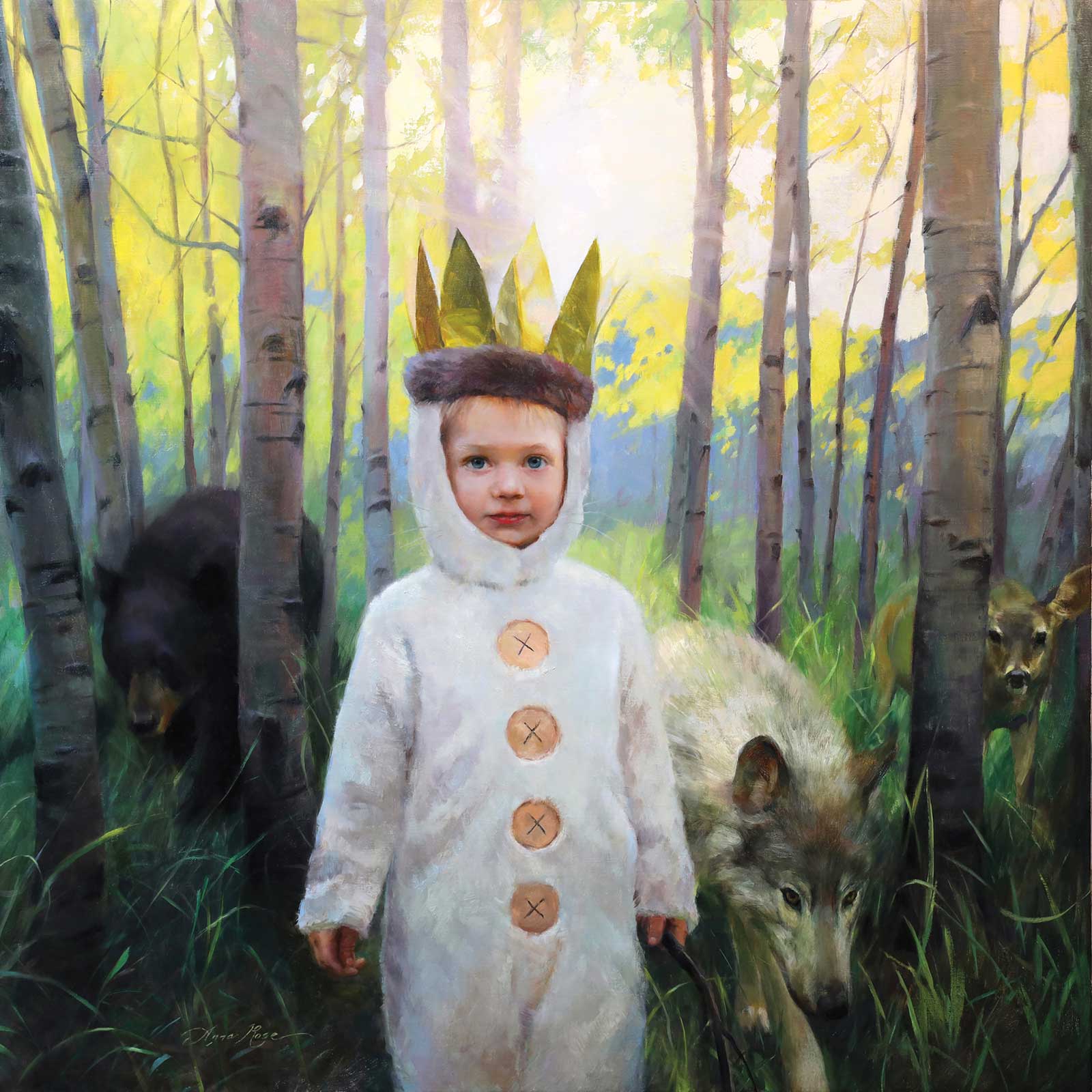
Fifth Place: Anna Rose Bain, King of the Wild Things, oil, 30 x 30 in.
For decades, Rose Frantzen has explored the mystical and metaphysical through her art. This year’s entry, awarded an Exceptional Merit, continues that exploration, weaving portraiture with abstract, symbolic design in a composition that is both intimate and cosmic. The subject, “B.,” gifted Frantzen a book of essays by poet Mary Oliver that included a passage that struck a deep chord: “Something is wrong, I know it, if I don’t keep my attention on eternity.” The painting became a meditation on that idea, conveying a visual poem to presence, impermanence and the longing for transcendence.
“Looking at B. was like seeing poetry,” Frantzen says. Her work moves beyond likeness. It speaks to timeless truths and spiritual yearning. For Frantzen, the act of painting is sacred. “Some moments arrive so full, so vast, they press against the edges of me, aching to become something that can stand in the world,” she says. Her layered approach, blending realism with organic forms, mathematical geometry and subtle symbolism, has earned her acclaim worldwide. Yet at its core, her process remains deeply personal: “Making [art] was never a choice, but a necessity,” shares Frantzen.
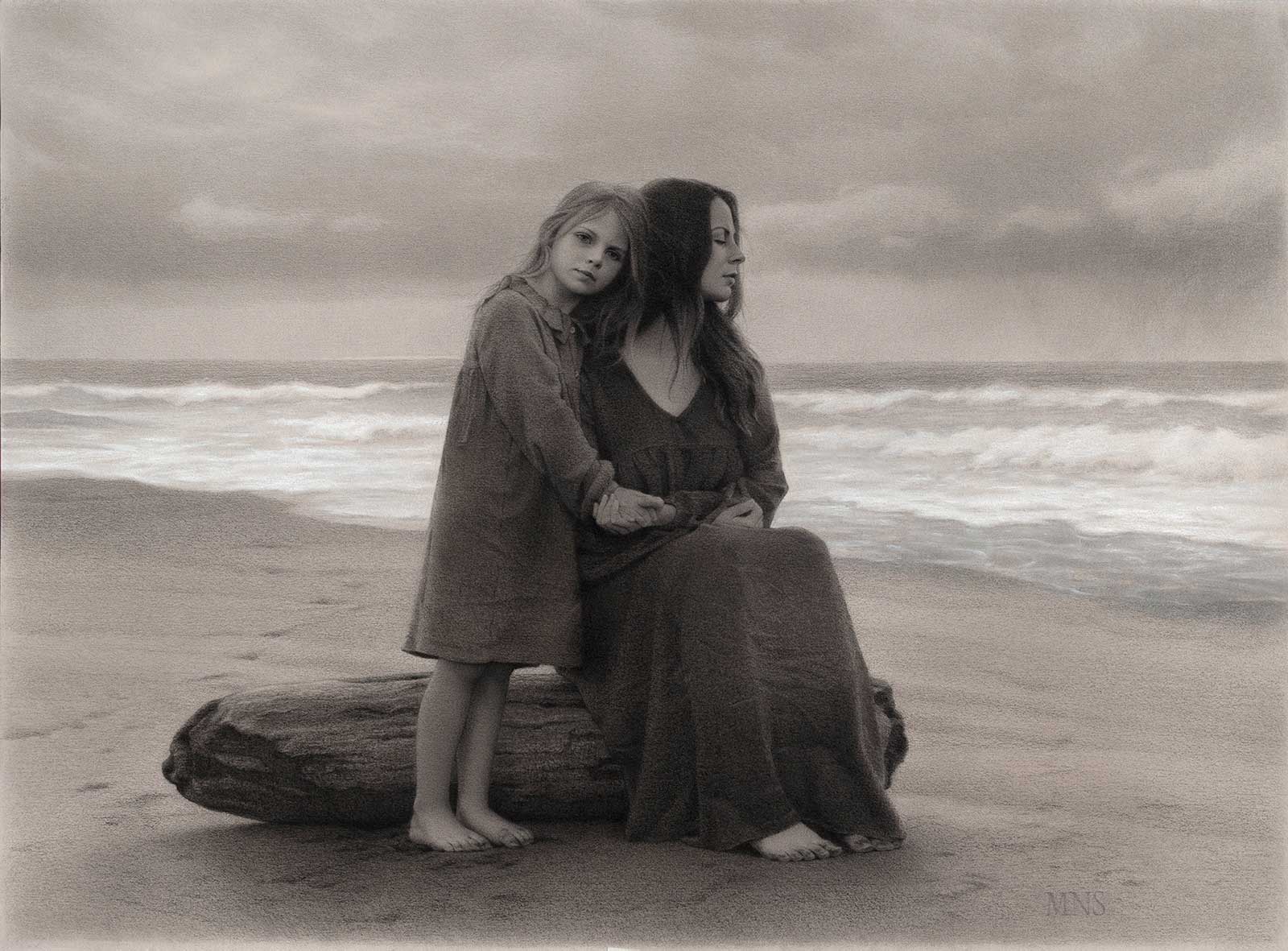
Exceptional Merit: Meghan Sours, Secret Sorrow, charcoal and chalk, 22 x 30 in.
The judges awarded Canadian artist David Jamieson First Place Drawing for his tender portrait of his father, Dr. Maurice Jamieson, serving as a reflection on vocation, legacy, and what it means to truly see someone. His father spent decades examining the unseen by diagnosing illness from tissue samples. In contrast, Jamieson spent years examining light, form and feeling. Yet as the artist began drawing, he found common ground. “In this work, I’ve attempted to honor my father’s appearance and intellect, but also our shared devotion to professions that demand careful observation and patient attention to detail.” Behind the figure looms a pathology slide, symbolizing his father’s lifelong service. But it’s the steady and familiar expression that holds the emotional weight. “As a dedicated physician who loved his work, he inspired me to find similar fulfillment as an artist,” Jamieson says. “This portrait stands as both a testament to his influence, and an expression of deep love and gratitude.”
Timothy Rees’ luminous portrait of his daughter Aspen, awarded Fourth Place, is an ode to a moment suspended in time, the fleeting transition between childhood and adolescence. Rees says, “For me, it was a bittersweet recognition of the passing of time and that sweet innocence that is often associated with the youngest days of youth. Whether it was from the more turbulent circumstances of our life this last year or the very nature of her spirit, Aspen seems well beyond her years. From her entrepreneurial scheming, to her generosity, to her thirst for knowledge, to her penchant for exacting poignant and surgical revenge upon those who may have slighted her, she is a force to be reckoned with.” As Rees explains it, this marked a shift in her life as she was outgrowing flowered dresses and growing bolder in spirit. He wanted to portray her straddling the two worlds as the little girl of yesterday and the young woman of tomorrow. Set in dramatic lighting with echoes of Sargent and classical tradition, the piece radiates both nostalgia and reverence. It’s a painting of contrasts: light and shadow, innocence and wisdom. But more than that, it’s a love letter to fatherhood and the beauty of watching your child become more fully themselves.
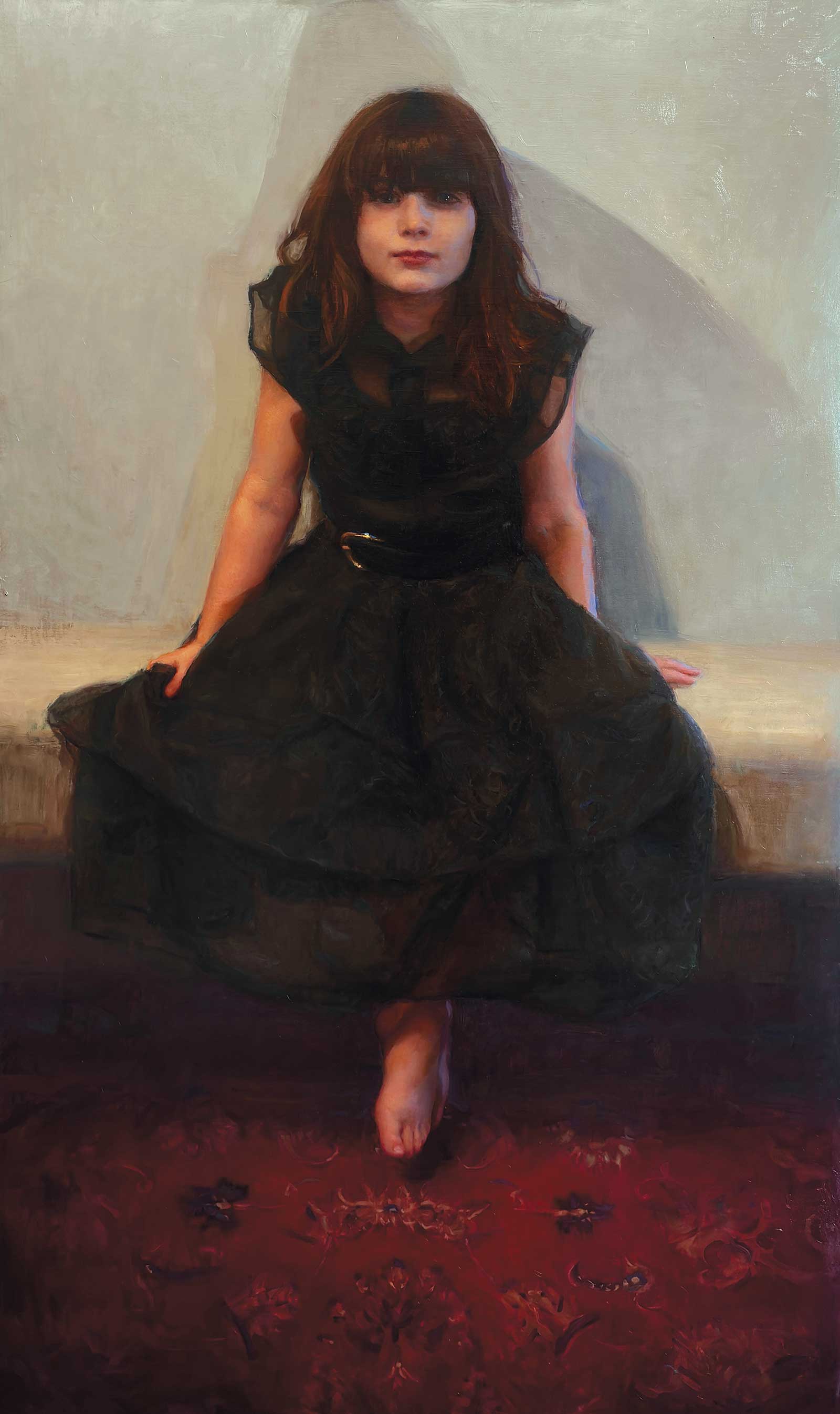
Fourth Place: Timothy Rees, Dark Whispers and Black Lace; Passing of Youth, oil, 50 x 30 in.
Few paintings in the competition carry the emotional weight of Meghan Sours’ Secret Sorrow, a self-portrait with her young daughter, which emerged from a season of grief after her second miscarriage. “I couldn’t find the words to express my sorrow,” she explains. “So, I turned to my art.” Every stroke became an act of remembrance of the life that was lost and of the love that remained. The drawing took six months to complete, each moment a struggle, as the work became an intimate part of Sours’ healing.
“Women endure so much, yet there are so few resources when it comes to loss; we grieve in isolation or in whispers,” she says. “Through my art, I hope to create space for those unspoken sorrows, to let women know they are not alone, and to open conversations that are too often left unshared.” The image, quiet and powerful, speaks to the hidden strength of mothers and the silent grief so many carry.
The 2025 finalists of the International have given us more than beautiful portraits. They have offered truth. In a variety of mediums, they have made space for pain, joy, transformation, memory and hope. Their work reminds us that portraiture is not about vanity or fame. It’s about humanity and, through their stories, we’re reminded that the most powerful art doesn’t just show us what people look like, but helps us understand who they are.
To view all of the 2025 finalists and learn more about the Portrait Society of America, visit www.portraitsociety.org. —
Christine Egnoski has served as CEO for the Portrait Society of America since its founding in 1998. She attributed the growth and success of the Portrait Society to the many artists and supporters that donate their time and talent in a collective effort to further the visual arts.
Powered by Froala Editor