In recent paintings, Noah Buchanan has found a richness and fluidity in his paint that builds upon his earlier work. He attributes the change to his reading of Carl Jung, the innovative 20th-century Swiss psychiatrist who was father to many of the concepts at the mystery and heart of analytical psychology: the archetypes, the collective unconscious, the healing and transformational power of numinous experiences, the shadow, and the self. Buchanan noticed a parallel in Jung’s description of the mind and his studio practice: “I’ve always shunned being a direct painter,” he explains, “and I’ve always shunned anything other than single source lighting, stark shadows and light, and I realized that I was doing exactly what Jung was talking about, denying and repressing things that appeal to me. I find myself really marveling at paintings that are not painted in those modes, both in the lighting and in the methodology.” The shadow is everything the conscious mind conceals about itself. The sinister shadow, the dark side of mind, the spill of concealed convictions and clouded thoughts of the unconscious that must be confronted and assimilated if we are to achieve self-actualization.
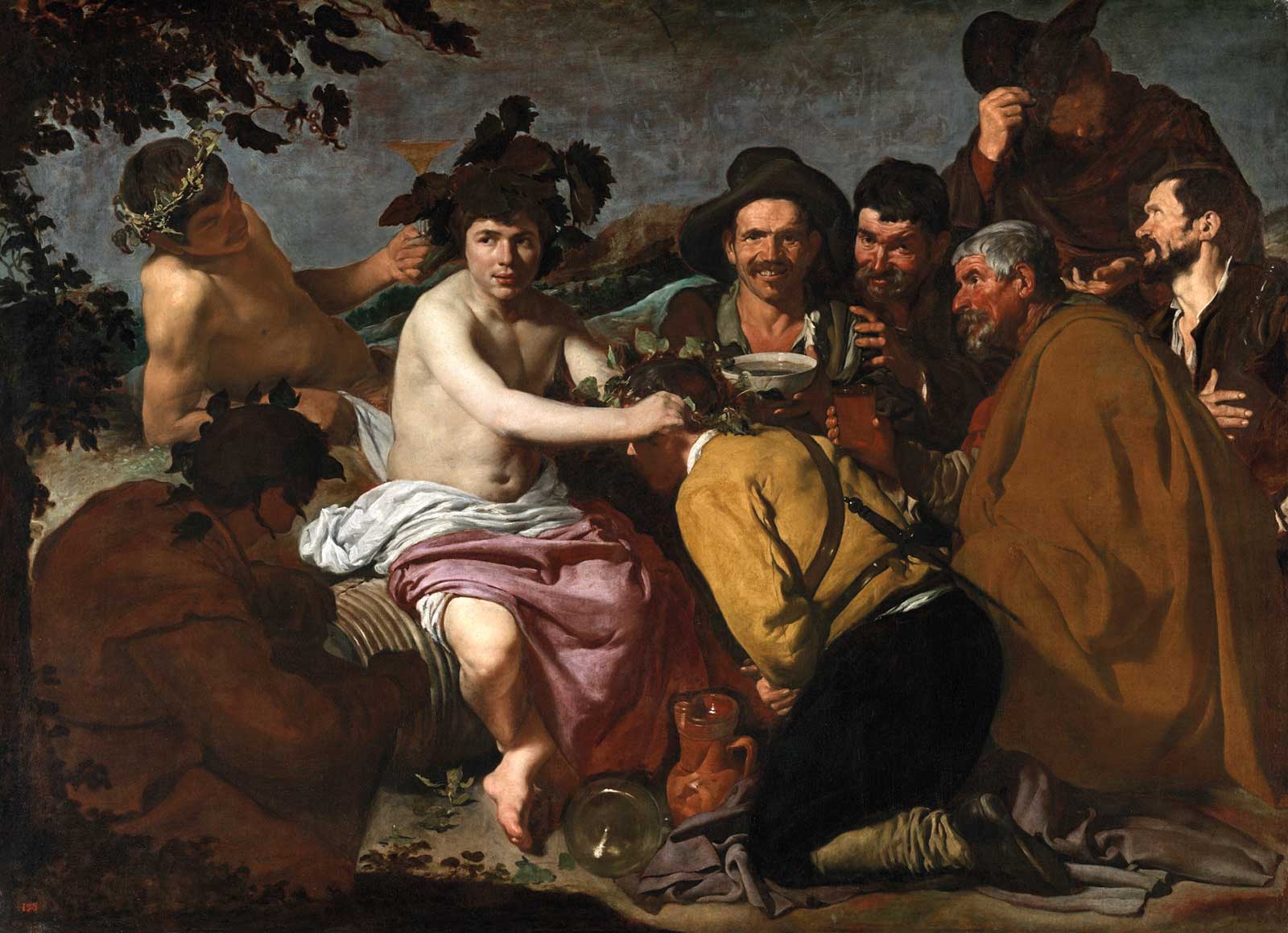 Diego Velázquez (1599-1660), El Triunfo de Baco o Los Borrachos, oil on canvas, 1628-29. Collection of the Museo del Prado.He continues, “I realized, wait a minute, that’s in my shadow as Jung would describe it. I’m stuffing it into my subconscious and avoiding it…Jung talks about having to look into your shadow and find things in there that are actually of value, and I realized quite literally I needed to look into my shadows. I started to embrace subject matter where rather than treating shadow as a dark earth-toned void, the way Caravaggio or Ribera would handle it as a black dark mass, I would refocus my eyes, look inside and paint the information in the shadows. It’s opened a whole new world for me. Not just embracing different types of light, but new colors too…I allowed myself to be free with the paint, slather the paint on, be painterly with the paint, not to have to rely on an underpainting all the time. It felt reinvigorating as a painter, something completely new, and allowing that part of myself I had repressed to come out, and giving voice to that painter, to all the beauty in the shadow. I think that’s metaphorically consistent with what Jung was talking about.”
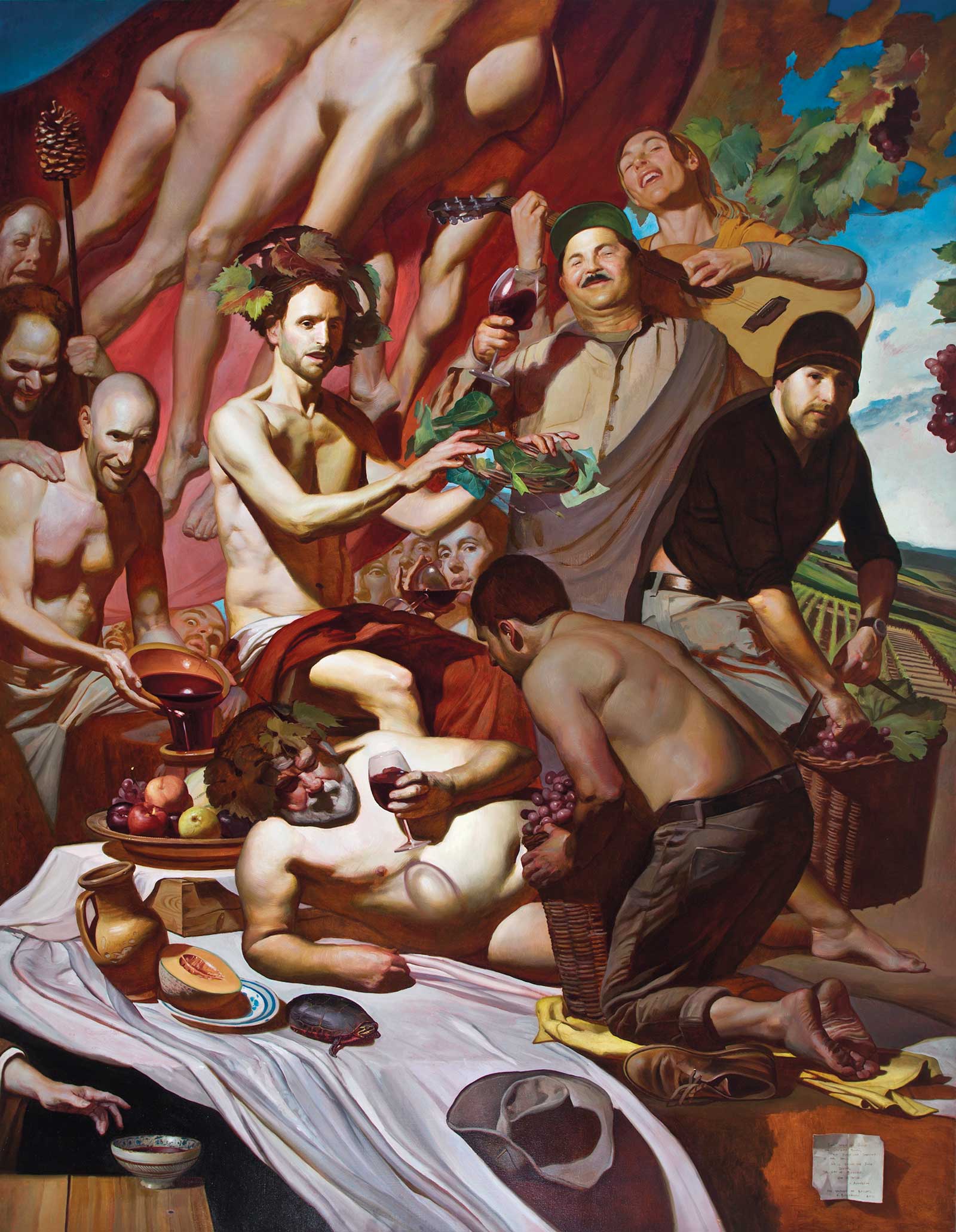 Noah Buchanan, The Triumph of Bacchus, 2017, oil on linen, 80 x 62". Collection of Patty Jenkins.His willingness to experiment and evolve is admirable. Past paintings were the proof and pride of a master of grisaille. He won the prestigious competition for the commission to paint the venerable Salmagundi Club library doors for their 150th anniversary, creating two symbolic paintings, the Allegory of Intelligence and Education and the Allegory of Visual Perception and Light. He was delighted by the space when he visited, savoring its beautiful cabinets filled with antique books, its tables with study lamps, its hidden surprises of paintings and sculptures. Buchanan says, “I wondered what they would want for allegorical figures on the library doors of an artists’ club whose members included William Merritt Chase and George Inness belonged to. It’s got a long tradition of historic members. So, I thought it should have themes of study and intelligence and education, but it’s also a library for artists, so there should definitely be themes of visual perception, and how light is the principal tool of representational painters.”
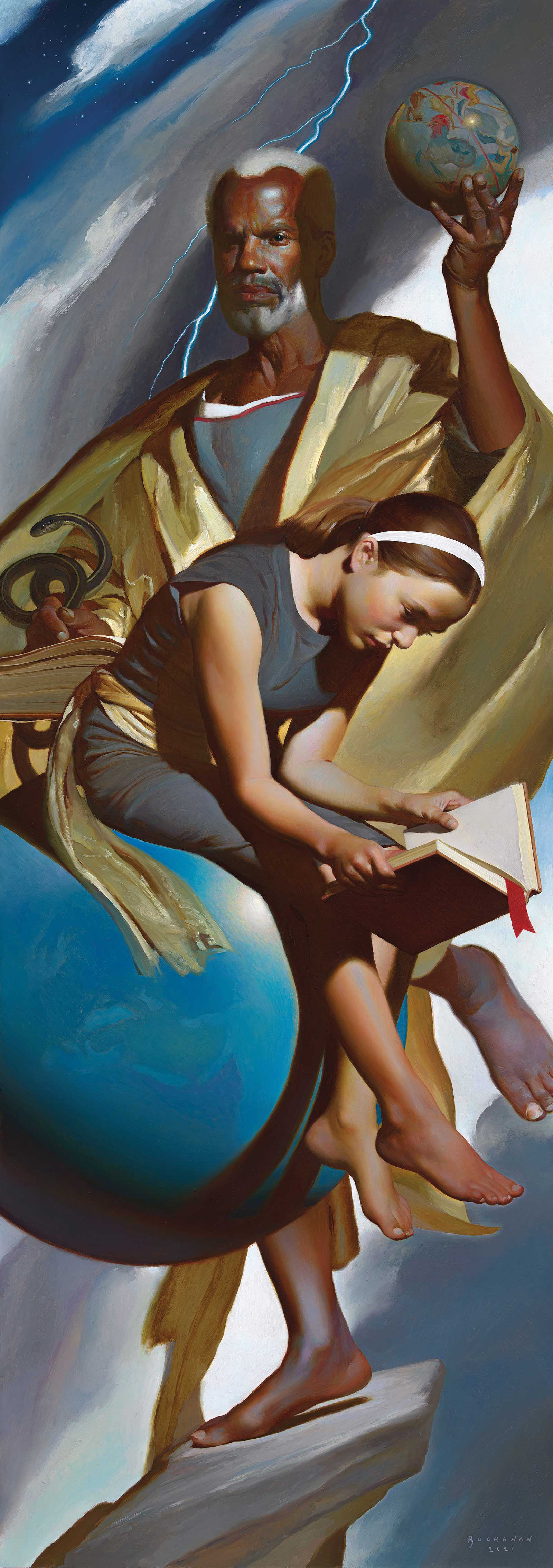 Noah Buchanan, Intelligence and Education (Allegory), 2021, for the Salmagundi Club library doors, oil on linen, 66 x 24", Collection of the Salmagundi Club, New York, NY.
On one side, Buchanan’s wife, who is his muse and model, poses as a painter with a palette kneeling on a stack of books, the symbol of wisdom shielding her eyes from bright sunlight to see her subject clearly. On the other, a child reads from one of the volumes, while a man lifts a globe of the constellations and a snake, symbolic of the mind’s investigation of the sciences, crawling deep into the earth to delve into its mysteries, with lightning passing through his head signifying the activity of his brain.
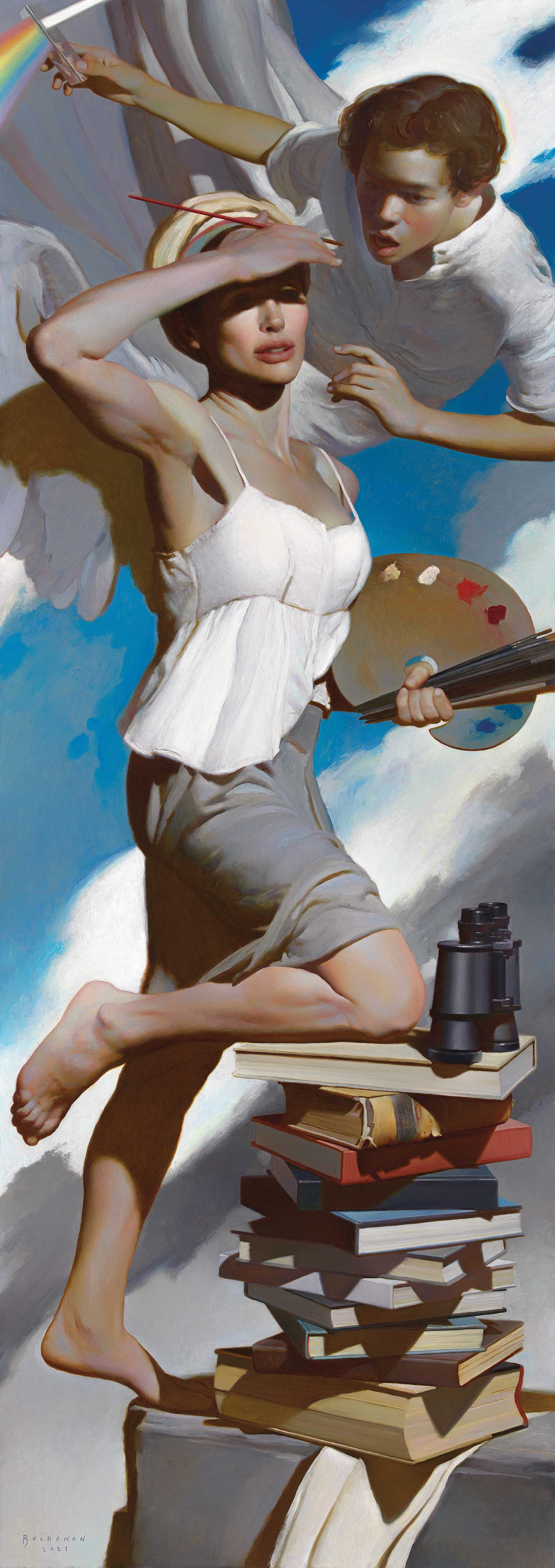
Noah Buchanan, Visual Perception and Light (Allegory), 2021, for the Salmagundi Club library doors, oil on linen, 66 x 24", Collection of the Salmagundi Club, New York, NY.
Buchanan shares the same hope and faith of all farmers, his fruit a harvest of imagery cultivated through nurture and trust in providence and the past. His bright Triumph of Bacchus is a pleasure beside Diego Velázquez’s, whose young Dionysus nods and smiles sideways at his venerable self, at the continuation of his ancient cultus through the 350 years of art history spread between him and Buchanan’s Triumph of Bacchus, his victory the initiation of another kneeling disciple crowned with a garland of vine leaves bending over the corpulence and flesh of drunken Silenus and his glass. Clues to Buchanan’s homage to Velázquez are scattered throughout the composition—there, in the wide-brimmed hat thrown from a smiling head in the 17th century, a pinch-spouted pitcher and a plate; there, in the strange shadow shapes thrown around the figures, cutting them from the space; and especially there, in the positions of the supplicant and the god and the man with the big smile curtained beneath the bush of a fireman’s moustache. On the right, Buchanan poses as a Napa vintner gathering grapes to a deep basket destined for the press, inviting his audience to join the barefoot celebration of success. A kicked shoe lays sideways, and the naked bodies of a mannerist ceiling fly headlong into debauchery outside the frame of the imagination. And though the invitation to join the inebriate festival is complete, there in the corners of the painting are two appeals to the god. On the right a trompe l’oeil note of a poem by Anacreon that reads, “For when we quaff the gen’rous bowl / Then sleep the sorrows of our soul. / Let us drink the juice divine, / The gift of Bacchus, God of wine.”
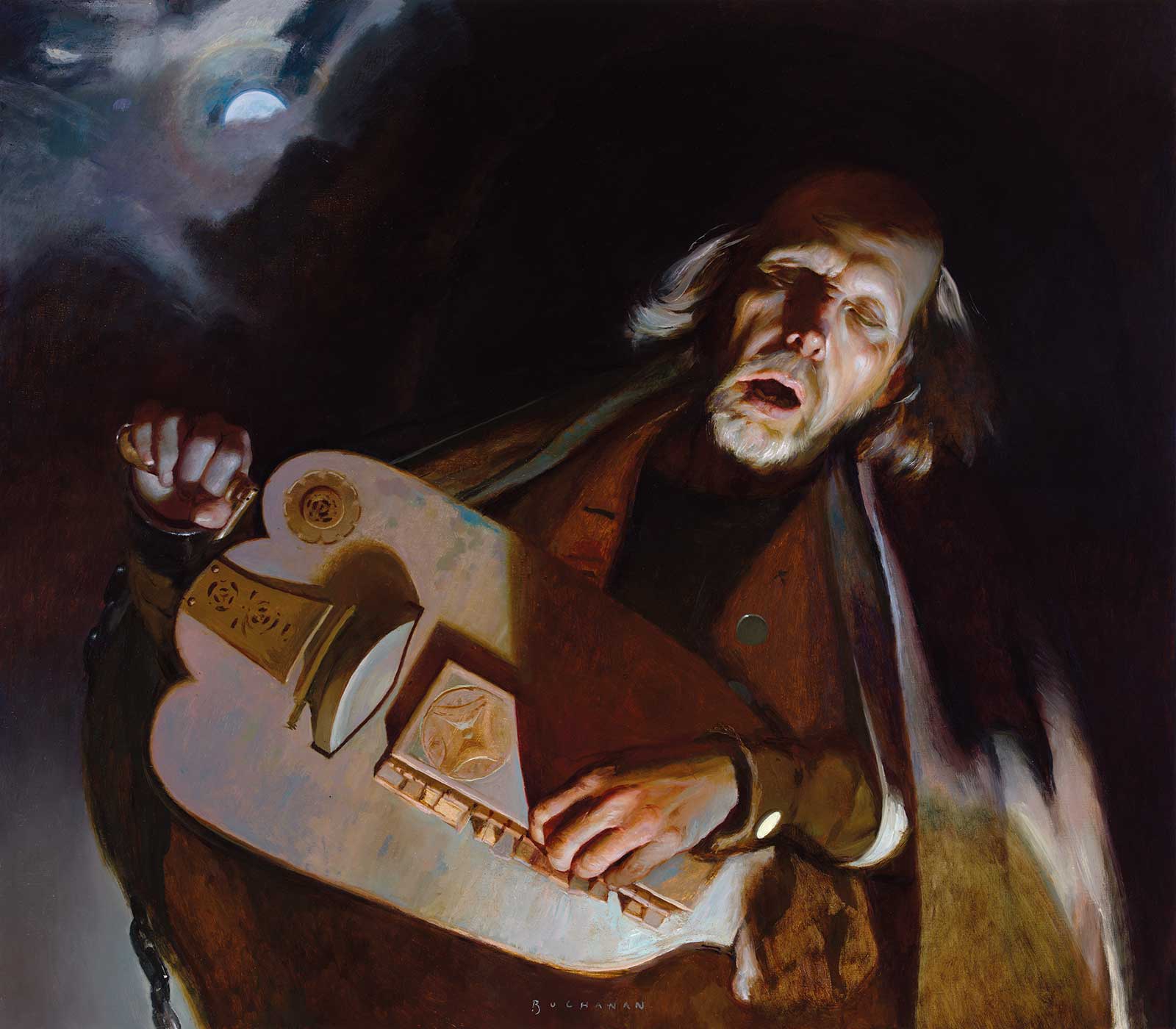
Noah Buchanan, The Hurdy Gurdy Player, 2025, oil on linen 30 x 24". Courtesy the artist.
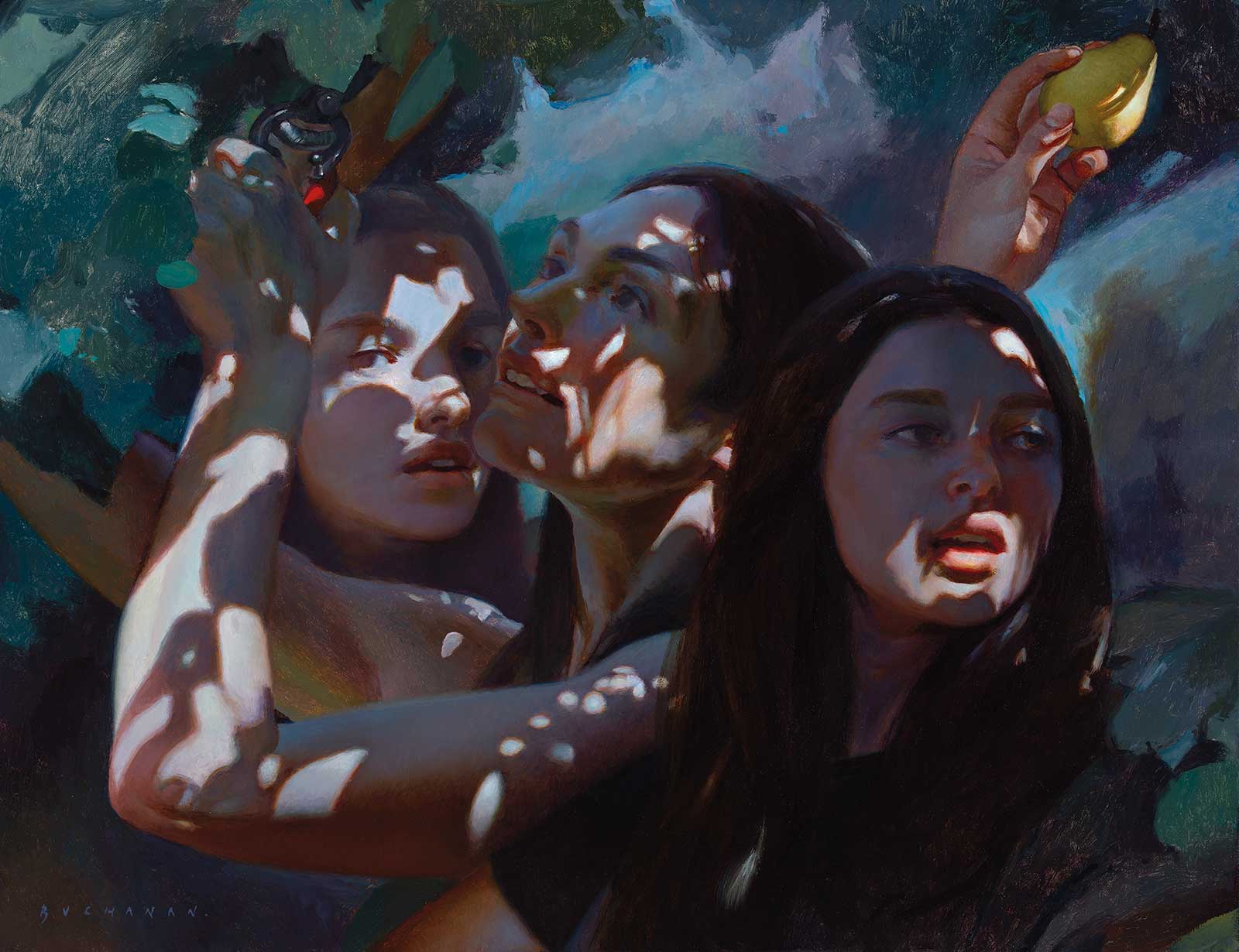
Noah Buchanan, The Night Harvesters, 2025, oil on linen, 20 x 26". Courtesy of the artist.
On the left a disembodied reminder of the offering of redemption at the wedding at Cana where water was turned to wine in the first miracle of the gospels, as Christ’s arm reaches into the painting for the grail. “He’s reaching in to appropriate the meaning of the wine,” says Buchanan. “In pagan tradition, the wine has all the things we know are attached to Bacchus, but then Christianity comes along and says, ‘no, this is what the wine means.’ …In the end it’s a Christian painting. That’s one way to see it. That’s what I love about art history. There’s so much pagan tradition, there’s so much Christian tradition, from the hand of the very same painter. Look at Velazquez’ Bacchus and you feel all that drunken splendor from the Dionysian lens, and then you look at his Christ crucified, and you want to go to church and kneel down and cry.” Patty Jenkins, the director of two Wonder Woman movies and Charlize Theron’s Monster, bought Buchanan’s Triumph of Bacchusand displayed it prominently in her home.
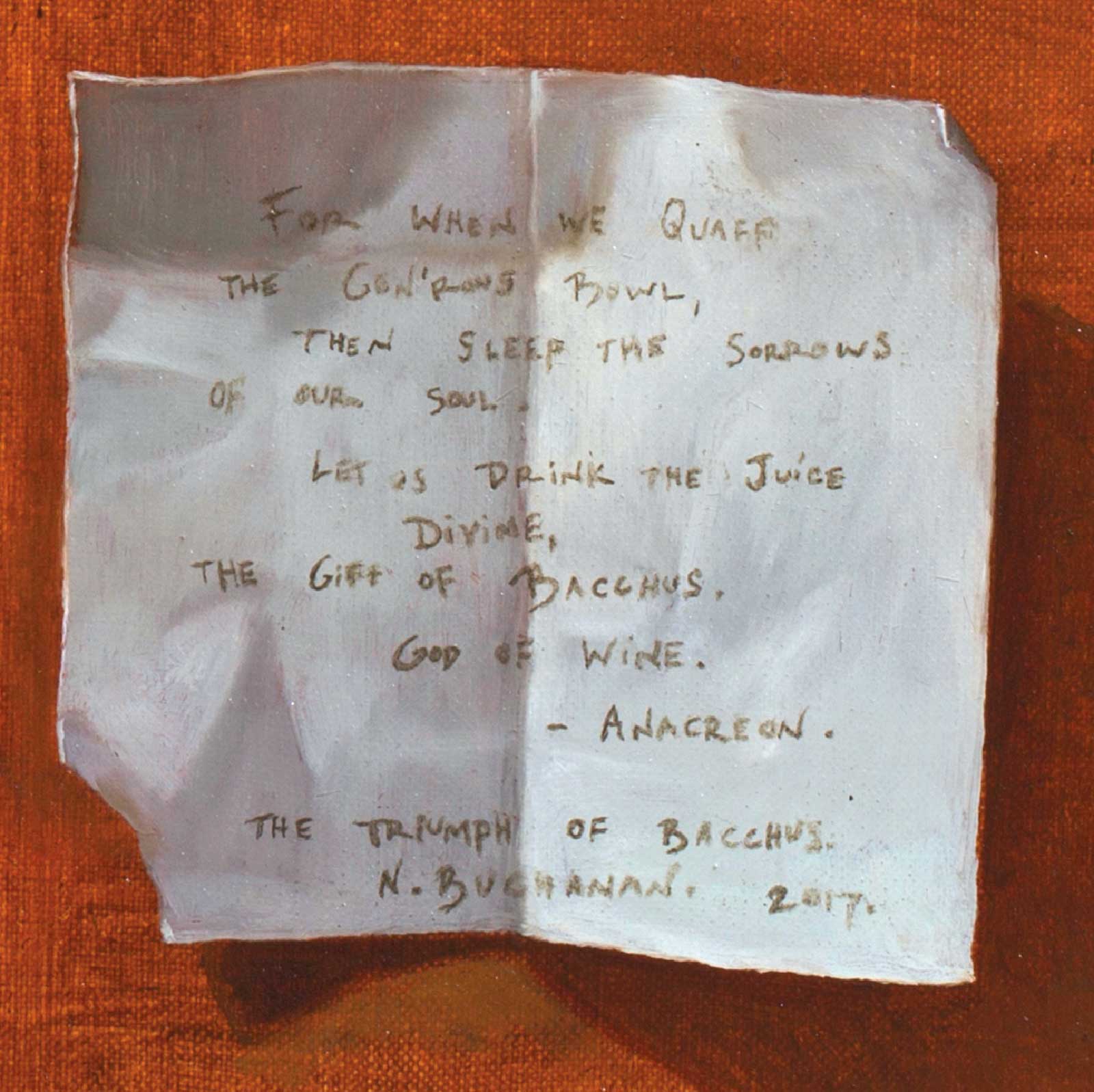 Noah Buchanan, The Triumph of Bacchus (detail), 2017, oil on linen, 80 x 62". Collection of Patty Jenkins.
A reminder of Jesus is there, too, in Buchanan’s Symphony, a spectacle of a painting, where a rejoicing congregation of musicians and singers gathers around a dreaming woman covered in the white shroud of death, foreshortened like crucified Christ in Andrea Mantegna’s Lamentation, but here the covered figure is center to a celebration of their clear rejoicing voices, not the grey dirge of a few wailing women.
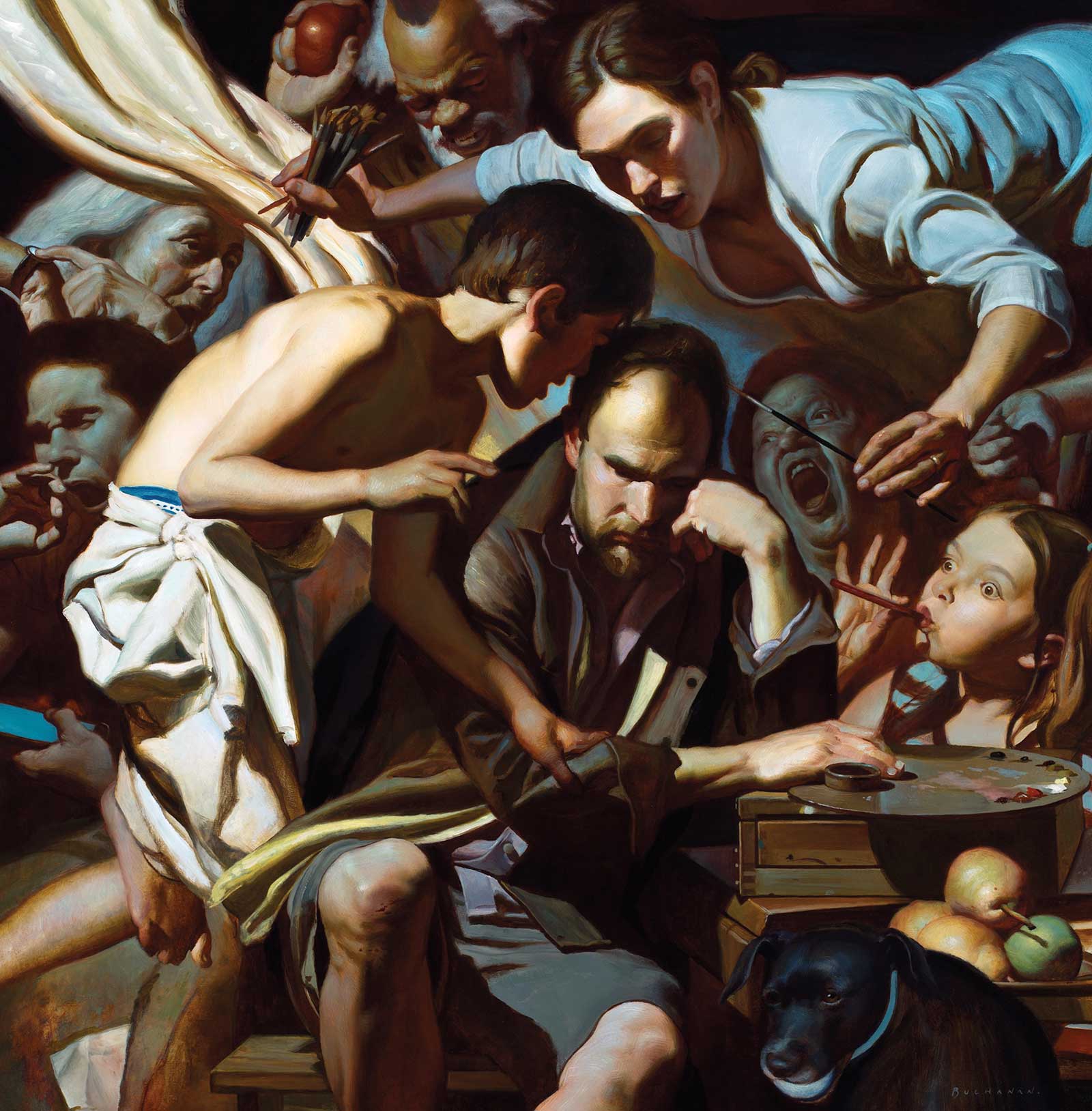
Noah Buchanan, Melancholic Painter, 2018, oil on linen, 35 x 34". Private collection.
These are master works, and wonders cool and clean, to be sure, but that new and dappled light splashing across the lovely faces of the beautiful chestnut-maned women in Buchanan’s new painting The Night Harvesters is the warm smile of a harvest sun passing through the leaves of a summer orchard, where hungry pears fill themselves with abundant life, where the dreaming women pluck the pastoral fruit of a gold and summer growth like a modern mother Eve and her hermetic daughters. They gather close in the shelter of this glimmering garden, in a jubilee season of innocent and sunny freedom, Eve’s arms raised in the splash of light and shade to prune the dry leaves from the brown past and renew and redeem the loving bounty of this Eden. It is a sensual painting. Buchanan comments, “My wife is my muse. She inspires me on all levels, both as a subject in terms of her beauty, but also there’s an intimate relationship, and that spark comes through when I paint her…I like that aspect to the paintings, [it] charges the image with something else, this extra spark that makes the muse more felt, and experienced.”
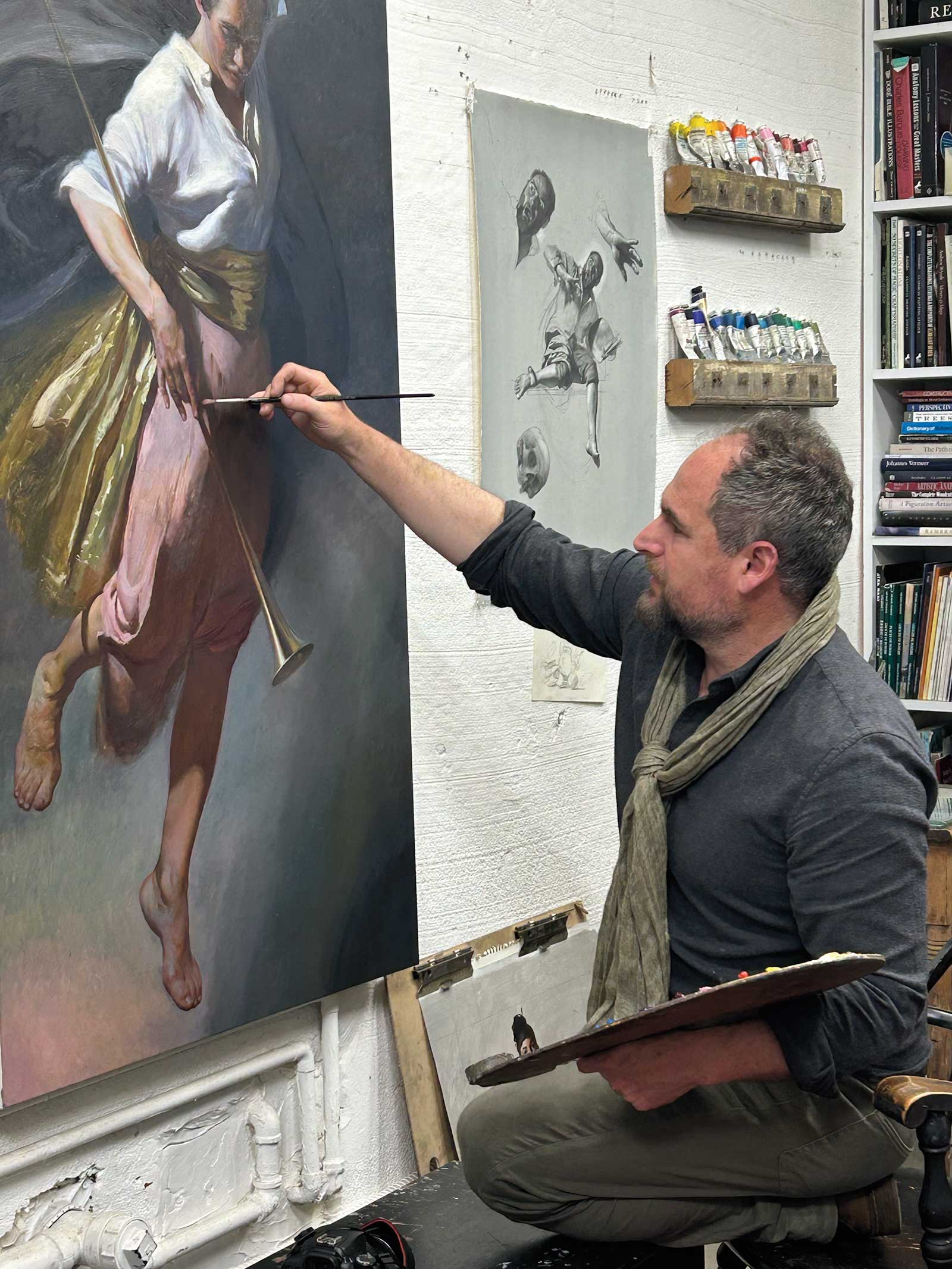
Noah Buchanan in his studio.
That light of The Night Harvesters is the charm and cheer of John Singer Sargent’s Carnation, Lily, Lily, Rose, that fantastic conjuration of magical twilit lanterns held in the glowing hands of fascinated children gazing at the flames among hanging blossoms, innocent, and entranced by tea lights hidden in colored Chinese paper. It is in Buchanan’s shadows of the thick leaves spreading over naked skin, in fragile potential and pleasure, in fear and the future. It is the luminous glow of his immanence, this direct and fluid and luxurious indulgence in the sensual spread of paint from palette to picture, shaping pigment into flesh and form.
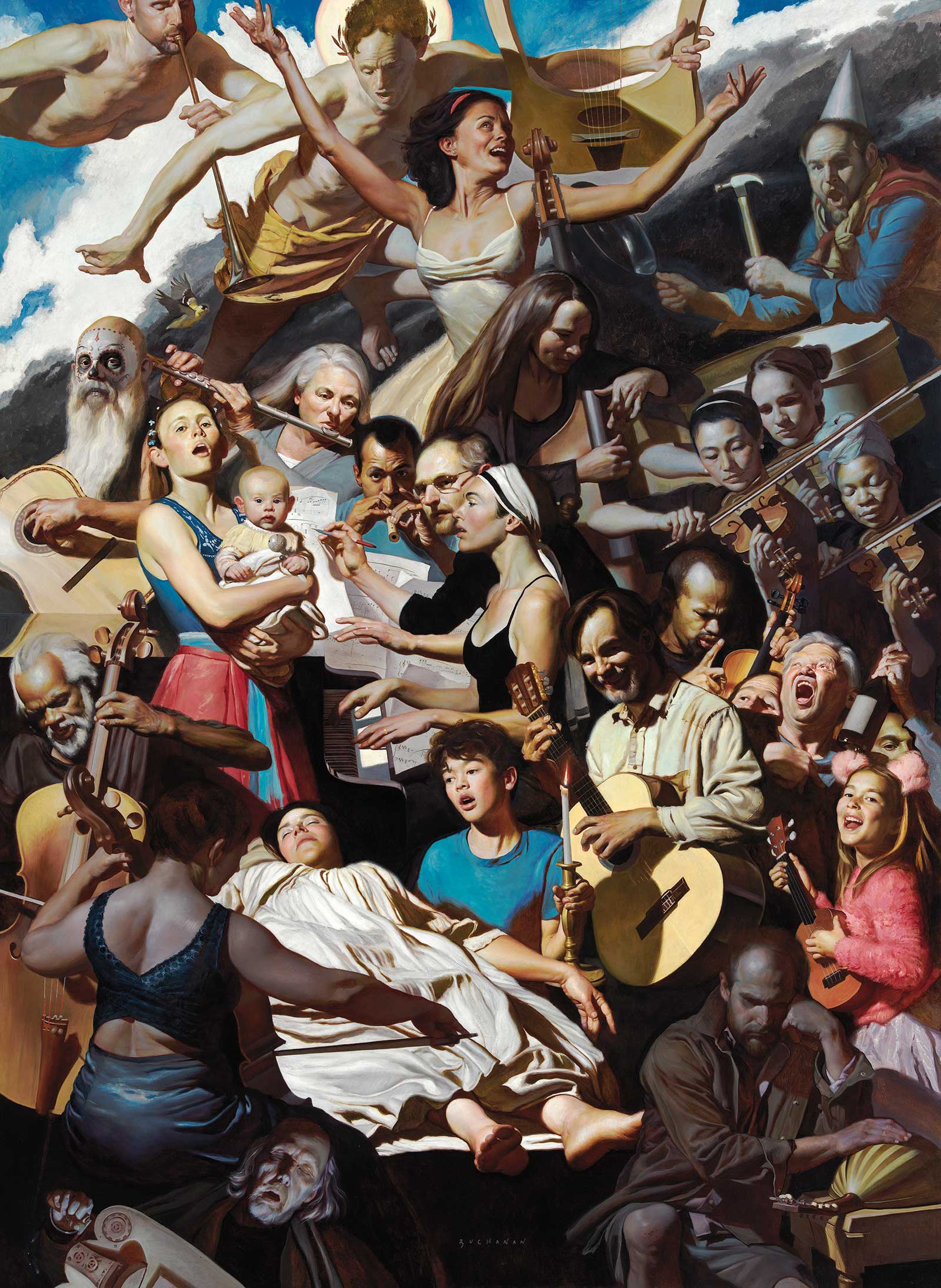
Noah Buchanan, Symphony, oil on linen, 2020, 96 x 70"
And in a gas-flamed and footlit glow Buchanan’s Hurdy Gurdy Player turns his handle as the moon goes to split the high clouds, and into the darkness drift rich comfort and the sounds of the earnest drone and sotto clicks of the keyboard punctuating the long floating strings of his music, a reassurance from the past to the present, a medieval song sung on a darkened stage; the singer cast and costumed as a minstrel for this moment. How should we measure the staggering wealth of history that brings Buchanan to this pregnant second of possibility? Not least by noting the pitch and tone of the long melody of modest light and a deep dark soul, a tenebrist’s delight in drama and the stage. Not least in the Dionysian urge to pleasure, and the sensual delight in luxurious paint. And certainly not least in details, like the precise levity of the highlighted button on his player’s ochre coat, carefully composed on one third of the canvas, placed with the musical precision of a prince of painting. Hallelujah! Here I am, it says, see the silver and circled treasure of the moon reflected in me, bearing witness to the reckoning song of the spheres and the harmonic satellites spinning in fourths and fifths, the music of the heavens above and the rhythm of the earth below, binding the most of man to God. —
Powered by Froala Editor