Like the chicken and the egg, and which one came first, art has a similar conundrum. What came first: the idea or the drawing? Or, to put it another way, did the initial sketch lead to an idea, or did the idea lead to a sketch? And what ultimately inspires a painting?
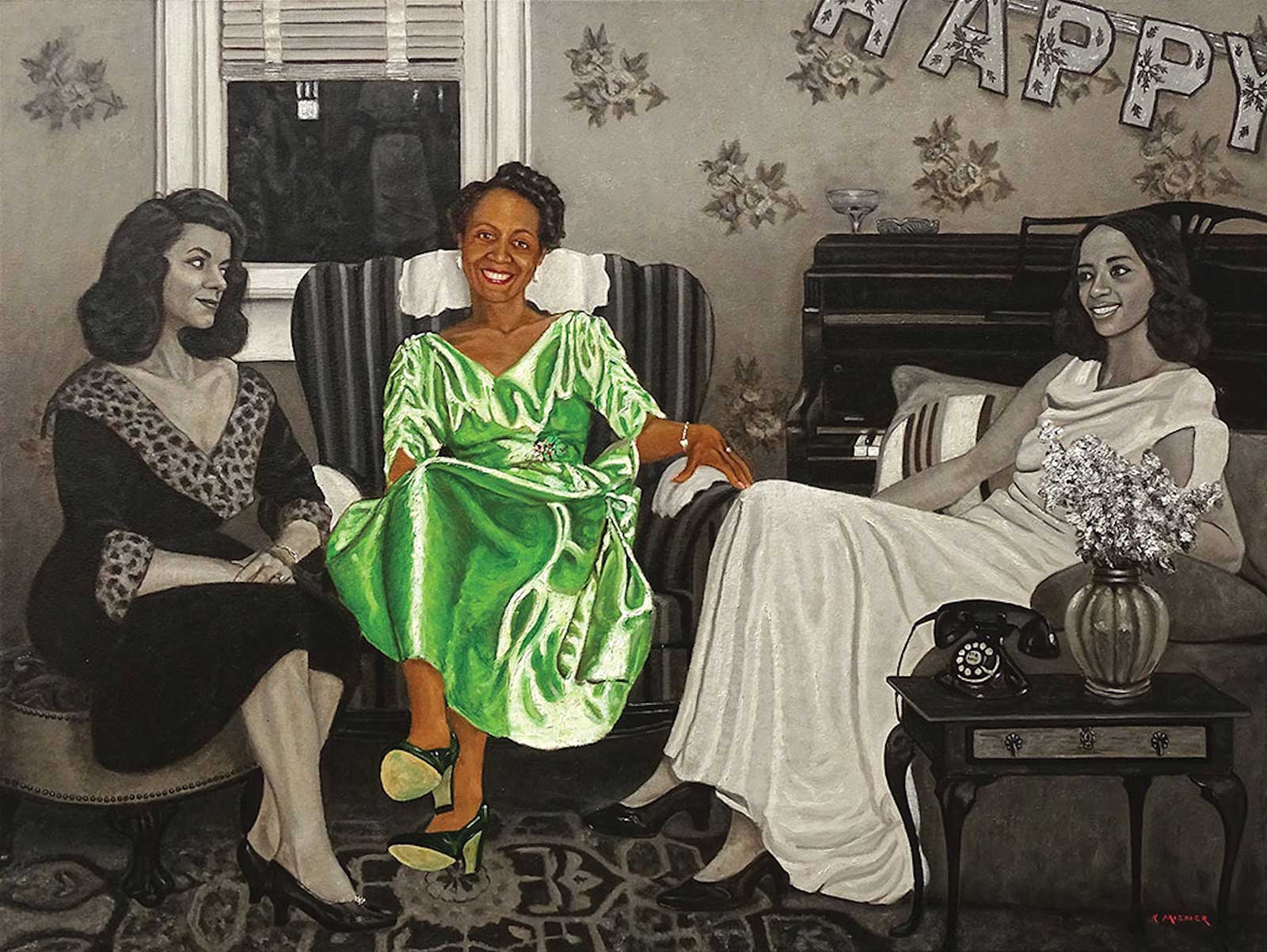
Kevin Mizner, Happy New Year, 2025, oil on canvas, 30 x 40"
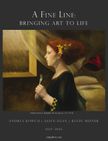
These questions about the origin of an artwork’s identity prod at an even deeper question: When does art come alive? Answers will be explored in RJD Gallery’s newest show, A Fine Line – Bringing Art to Life, opening July 1 in Romeo, Michigan. “Bringing art to life begins with a single line—then another, and another—each mark a step in a mysterious, transformative process,” says Joi Jackson Perle, RJD’s gallery director. “For those of us who aren’t artists, and perhaps even for those who are, the magic of that journey never fades. In this exhibition, Andrea Kowch, Allen Egan and Kevin Mizner masterfully demonstrate how a line becomes a figure, a figure becomes a story, and a story takes on a life on its own.”
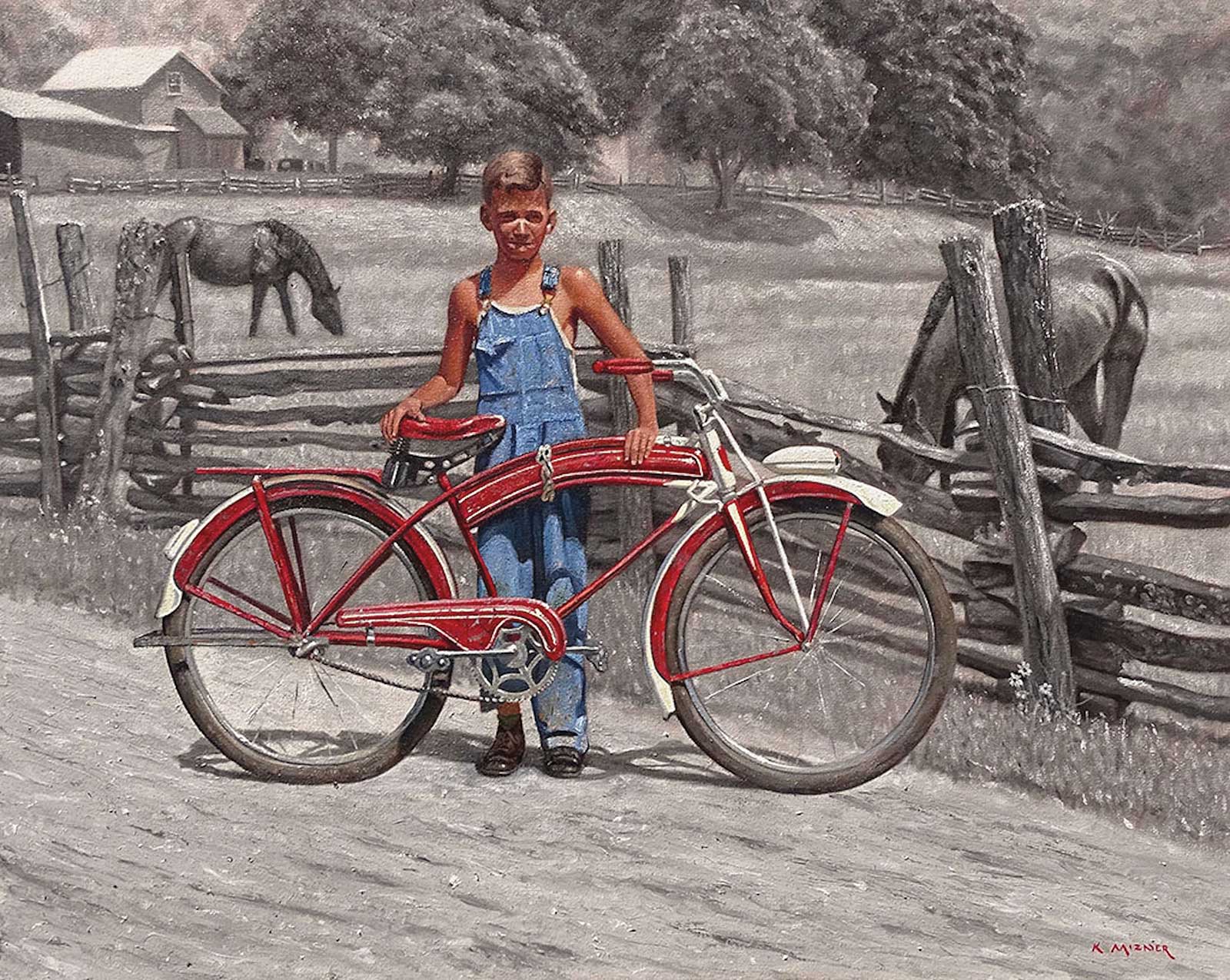
Kevin Mizner, Summer of ’41, 2025, oil on canvas, 24 x 30"
For Kowch, her process begins with the initial drawing, where she finds the “true essence of the image…” before painting the final piece. “My compositions first tend to appear wholly in my mind before any work begins. This is the first root of the creativity to follow. As with anything, however, once the ideas are laid out, developed and become physically concrete, the course of their progressions inevitably call for certain changes and extra final touches of varying degrees. Nonetheless, the main idea is absolutely worked out on paper before any paint to canvas occurs,” she says, adding that she keeps gestural drawings in her studio as reminders of these intricate journeys. One of the pieces in the show is a drawing for her famous work The Courtiers, a painting that took a full year from concept to creation. The final painting is now on view at the Muskegon Museum of Art, in the new Bennett Schmidt Pavilion. The drawing will be at RJD Gallery.
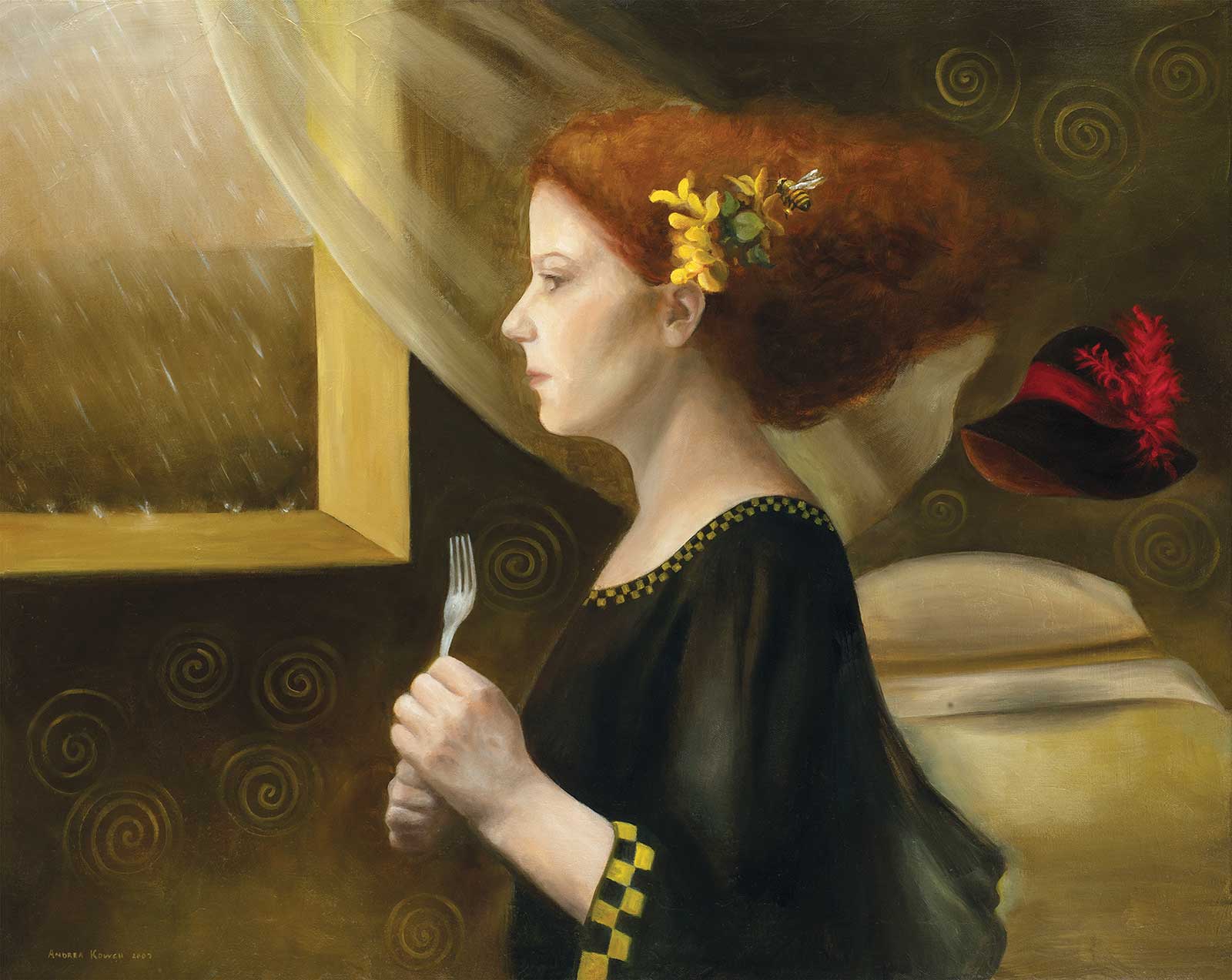
Andrea Kowch, Rainfall, 2007, oil on canvas, 24 x 30"
“Whether an artist enjoys going through the preliminary steps in creating a work of art or not, sketching will always be an important, valuable and necessary step to realizing one’s greatest ideas, goals and potential of their artmaking. I used to create detailed sketches far more in the past than I do now, which is making the existence of sketches of mine somewhat rare as time goes on; yet, to this day, paper is where I still work out all compositional challenges that may arise,” Kowch says. “The original drawings are the first physical representation of my deepest thoughts, and the origin of my emotional journey that is later expressed with each brushstroke. Solving the details beforehand allows me to explore all my options and choose what works best so as to limit the possibility of any unwanted surprises later on in the painting process. The drawing is not necessarily the end-all result of what the painting will look like. It is simply a solid plan to have in place to allow me to fully envision a work.”
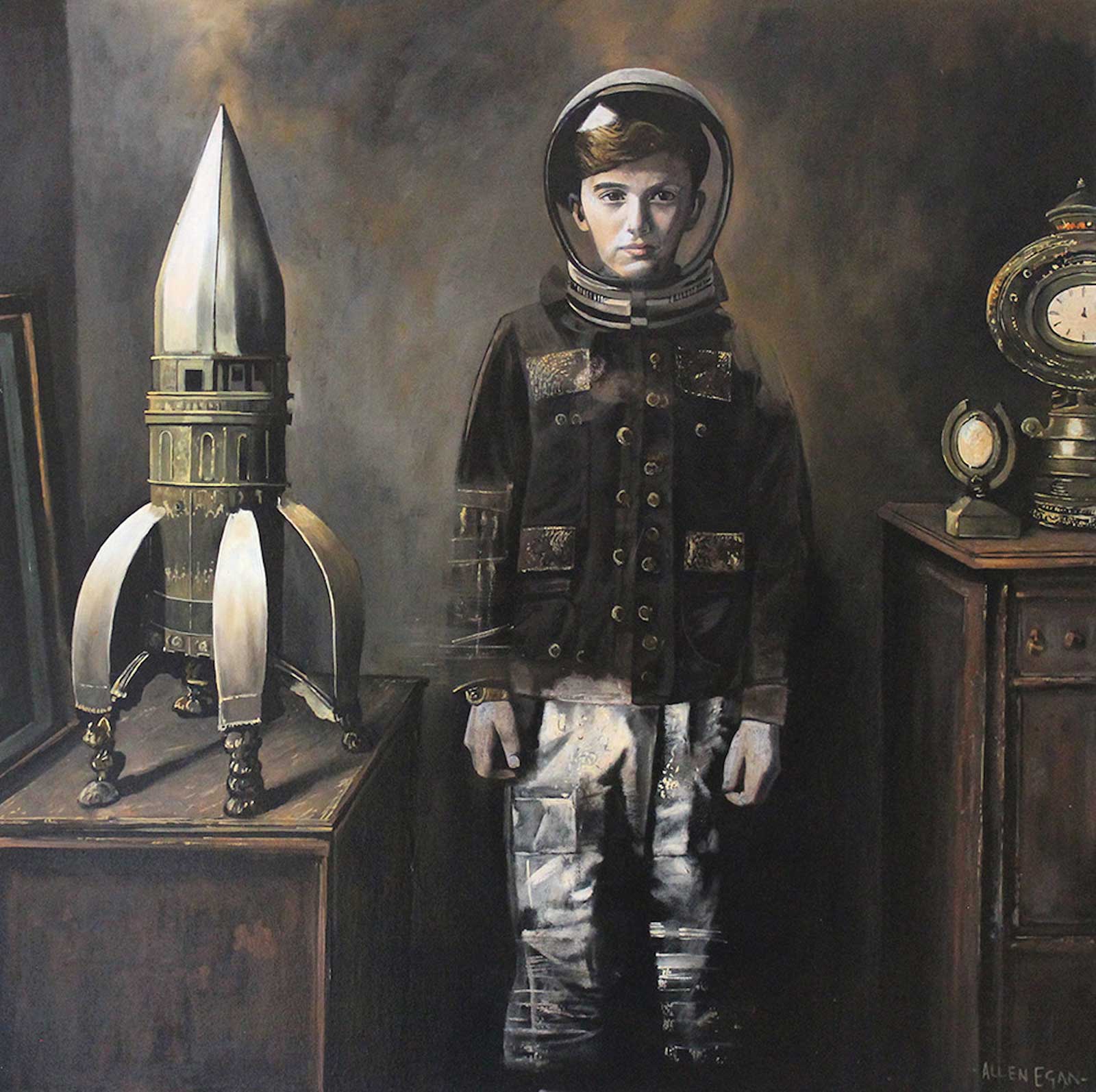
Allen Egan, Mission Possible, 2024, oil on canvas, 36 x 36"
The gallery will also have her 2007 work Rainfall, which “began as a visual representation focusing on the subject of rain and the folklore and allegory surrounding it.”
“It was a fundamental artwork in that it marked the beginning of my exploration with design, development of narrative and, most notably, the figures’ hair, which has evolved to be such an expressive component and trademark of my work,” the artist adds.
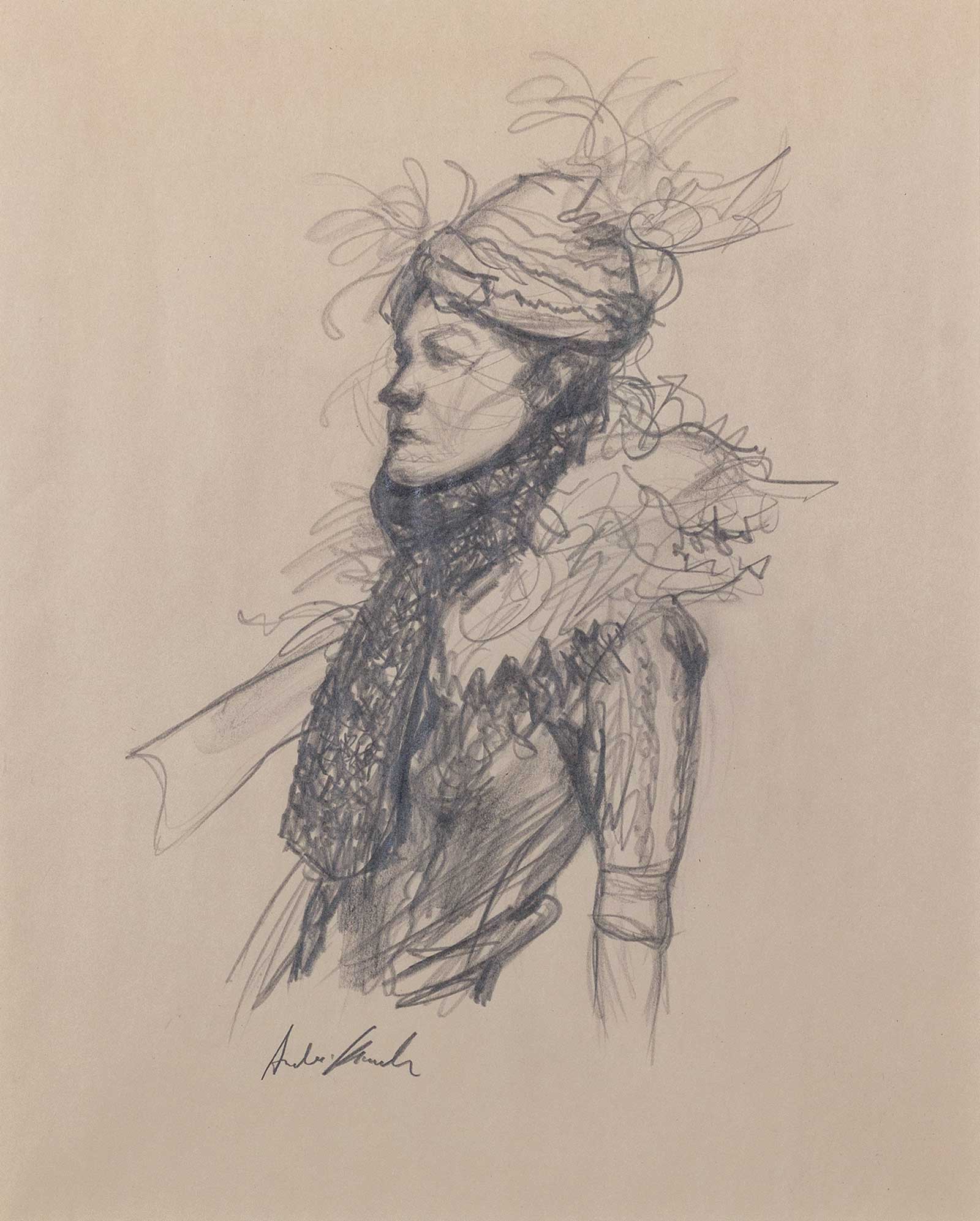
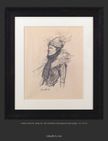
Andrea Kowch, Study for the Courtiers, 2015, drawing on artist paper, 20 x 16"
Mizner will be showing as many as three works from his Continuum series, which presents black-and-white scenes with key elements in color. In Summer of ’41, his subject in color is a young boy posing with a red bicycle. “This painting started, as my Continuum pieces do, from an old reference I have of a young boy and his big bike. He was standing in the yard of a non-descript house. I felt it was visually lacking, and didn’t say anything about his world,” Mizner says. “I sketched out some ideas of backgrounds to both tell his story and to help in the composition, and eventually settled on a rural, farm background. The idea is that his world is about to open out as he gets the freedom to ride his bike anywhere off the farm he wants to go. As my reference photo was in black and white, I chose to depict the scene in red, white and blue to symbolize the upheaval and patriotic fervor that was about to engulf the U.S. as we entered into [World War II]. Like the boy and his bike, nothing was going to be the same after the summer of ’41.”
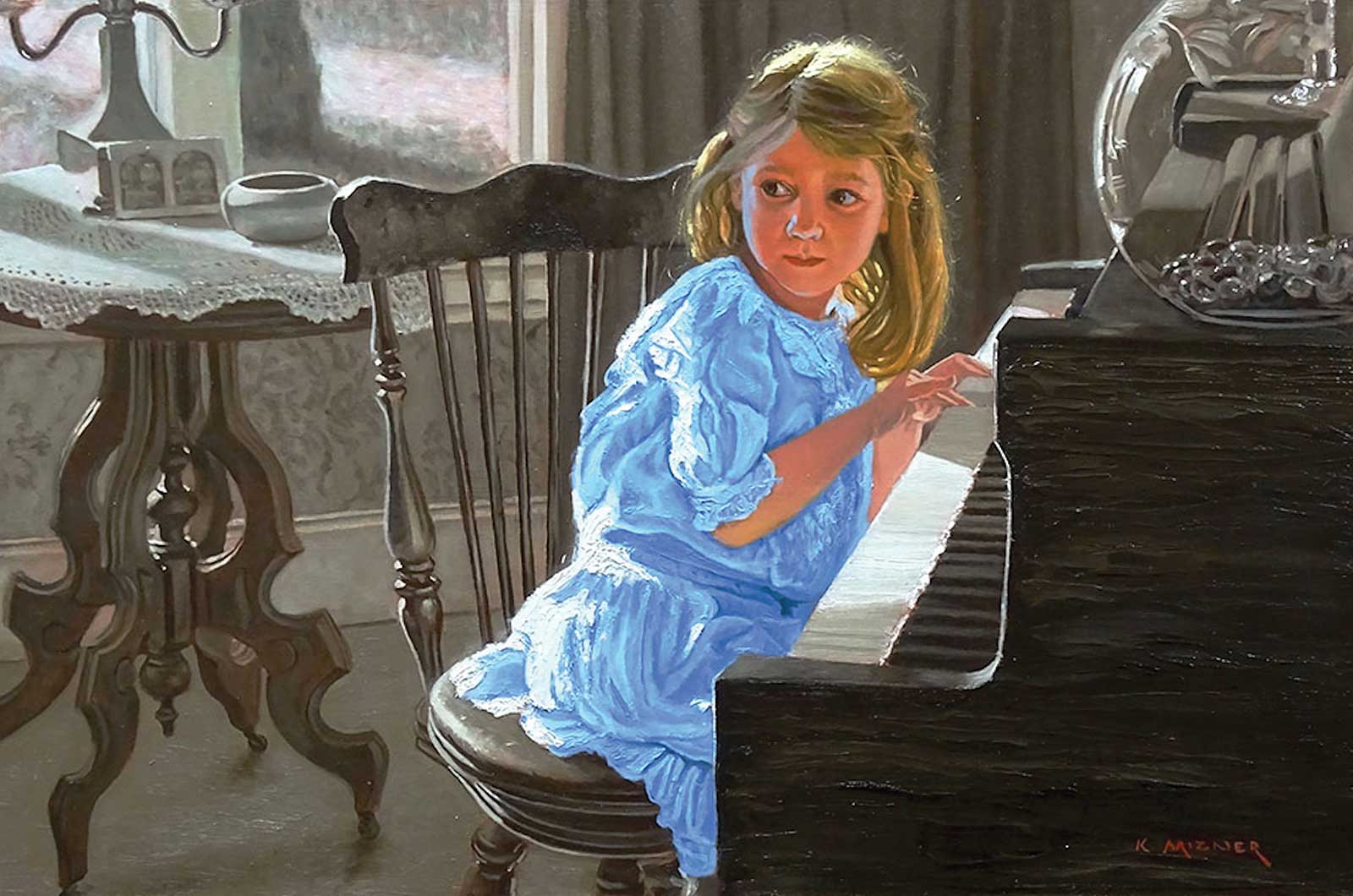
Kevin Mizner, Distracted, 2025, oil on panel, 12 x 18"
The artist adds that his preliminary work before an oil painting is just as vital as the final painting itself. “For me, drawing is creating. Just as important, I can’t paint what I can’t draw. Painting has its own creativity in the use of color, but for my style of work, the drawing comes first,” he says. “…I use drawing to explore the subject and place it into the proper physical and emotional context that works best for the idea of the painting. I also use drawing to train my brain and hand to know and fully understand how and what I’m painting.”
For Egan, he will be showing Evening Bird and Mission Possible, both of which show young figures at ease within strange surroundings. While Kowch and Mizner use sketches and drawings to build up to a final piece, Egan bypasses that stage as he brings his paintings to life. “I’m a non-traditional artist in that sense. I haven’t done a sketch since art college 40 years ago,” he says. Instead, he elects to collage his work together digitally before putting paint to canvas. “The idea for a painting usually comes about as I play with the images that I have gathered together in [Photoshop]. It may start off as one idea but morphs into something else or is similar to the original idea. My work is in the magical realism/surrealism genre so I have to think of ideas that, though realistically portrayed, have an edginess to them somehow. I’m afraid it’s difficult to relate how I do this but it’s not difficult by using various unique objects and backgrounds to give the feeling of an alternative and unique environment. My figures are usually emotionless but confident. They look at the viewer intensely thereby compelling the viewer to look back at them and ponder. They are intended to hold the viewer’s gaze.”
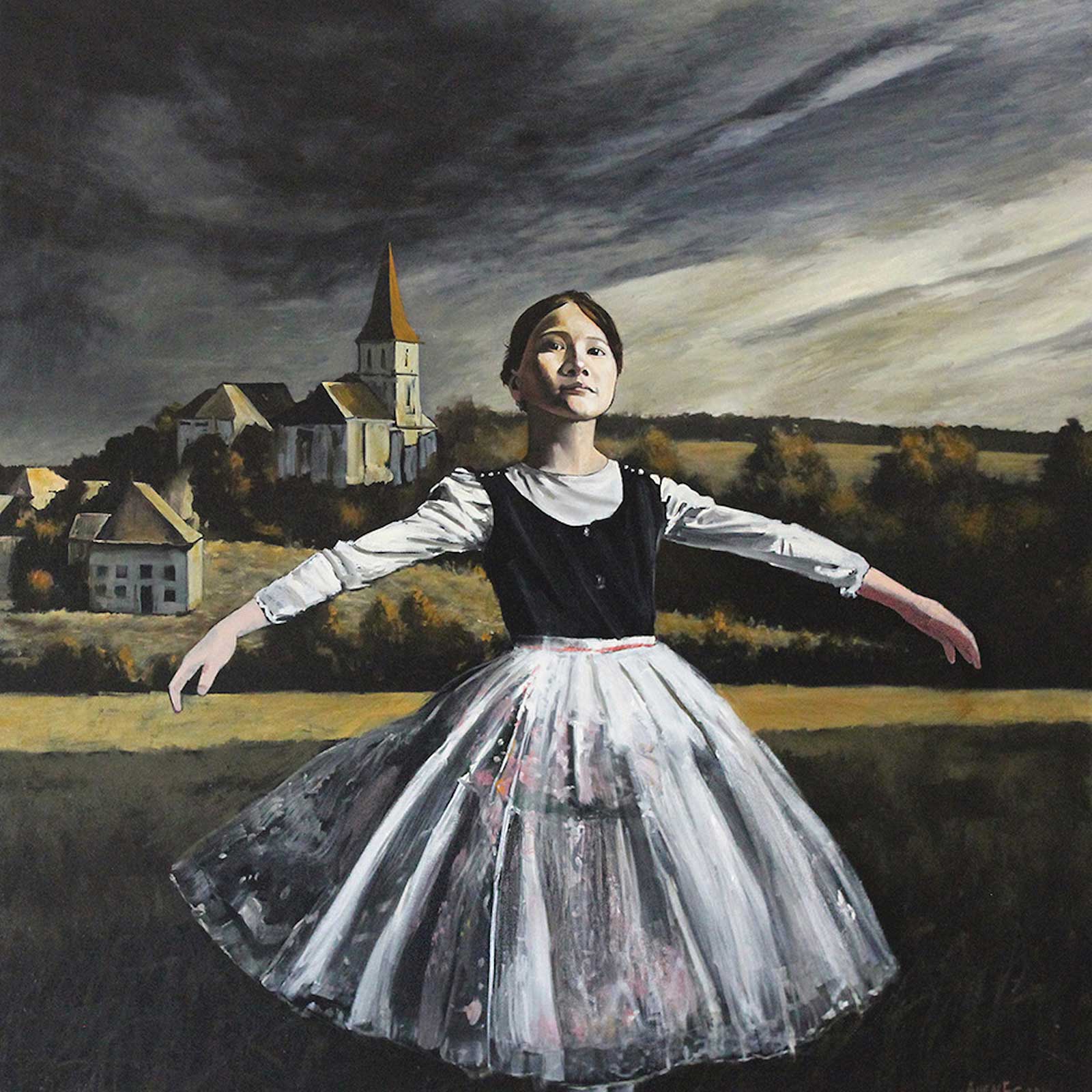
Allen Egan, Evening Bird, 2024, oil on canvas, 36 x 36"
A Fine Line – Bringing Art to Life will remain on view through August 3. —
RJD Gallery 227 N. Main Street • Romeo, MI 48065 • (586) 281-3613 www.rjdgallery.com
Powered by Froala Editor