For most people, the art movement known as photorealism emerged on the scene in the late 1960s and ’70s and quickly vanished. Anna Katz, senior curator at the Museum of Contemporary Art, Los Angeles (MOCA), has assembled an exhibition, Ordinary People: Photorealism and the Work of Artsince 1968, that “argues that photorealism was not an end but, rather, the beginning of something that continues to this day. It has been a compelling, vital impulse and presence in contemporary art. It argues that photorealism has been a key chapter in the ongoing project to repopulate the museum and world of art with faces and places that, historically, have been excluded or marginalized.”
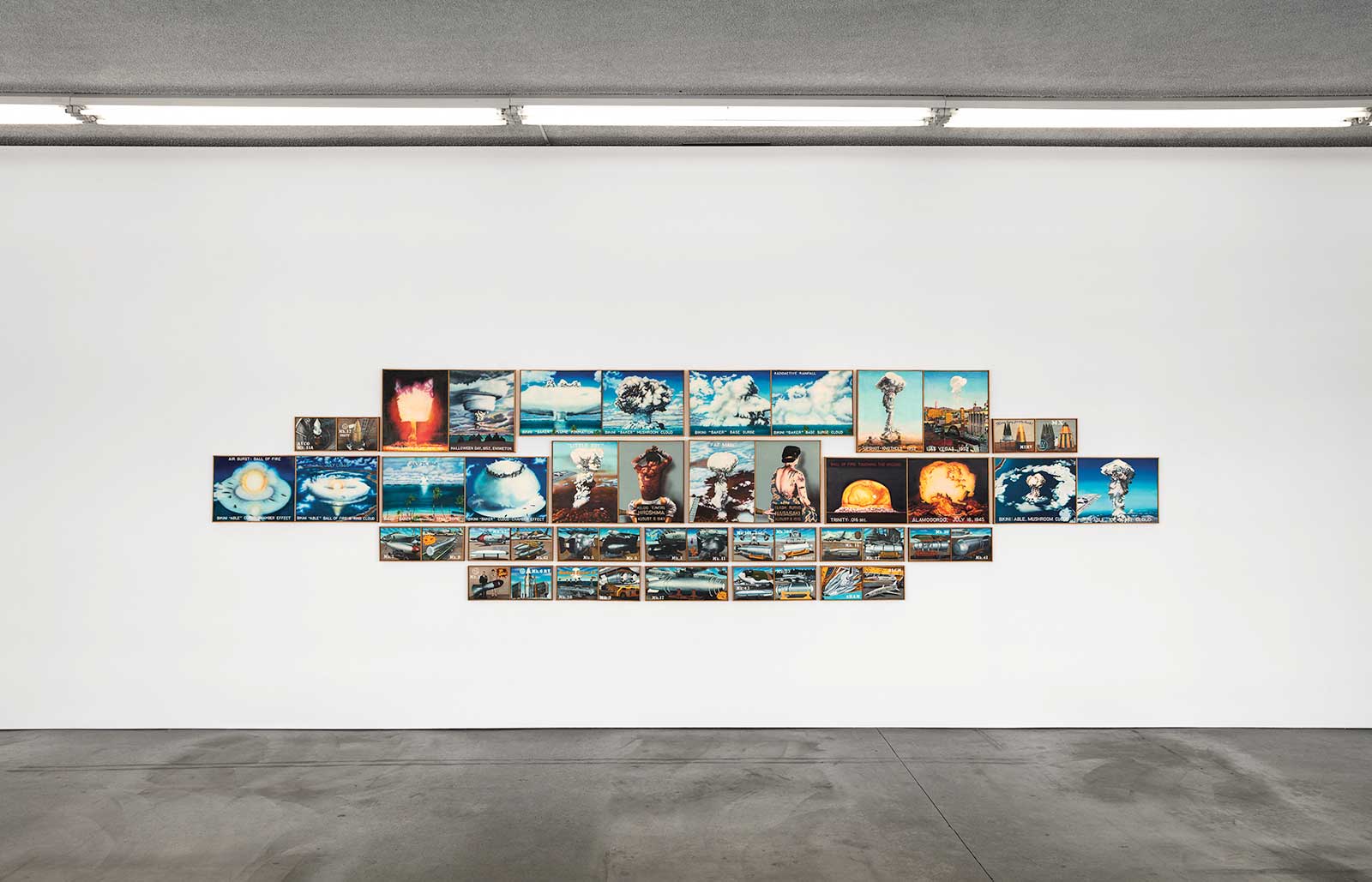
Ben Sakoguchi, Bombs, 1983, acrylic on canvas with wooden frames, 55 x 229". The Museum of Contemporary Art, Los Angeles. Purchase with funds provided by the Acquisition and Collection Committee.
Photography, since its advent in 1839, has always had a problematic relationship with fine art. Able to capture fine detail, it allowed painters to explore techniques that allowed other ways of representation, emphasizing color, light and movement. It became a useful but rarely acknowledged tool for many artists. Its influence can be seen in the cropping of Degas’ horse track paintings, for instance.
Alfred Stieglitz formed the Photo-Secession in 1902. The following year he wrote, “Its aim is loosely to hold together those Americans devoted to pictorial photography in their endeavor to compel its recognition, not as the handmaiden of art, but as a distinctive medium of individual expression.”
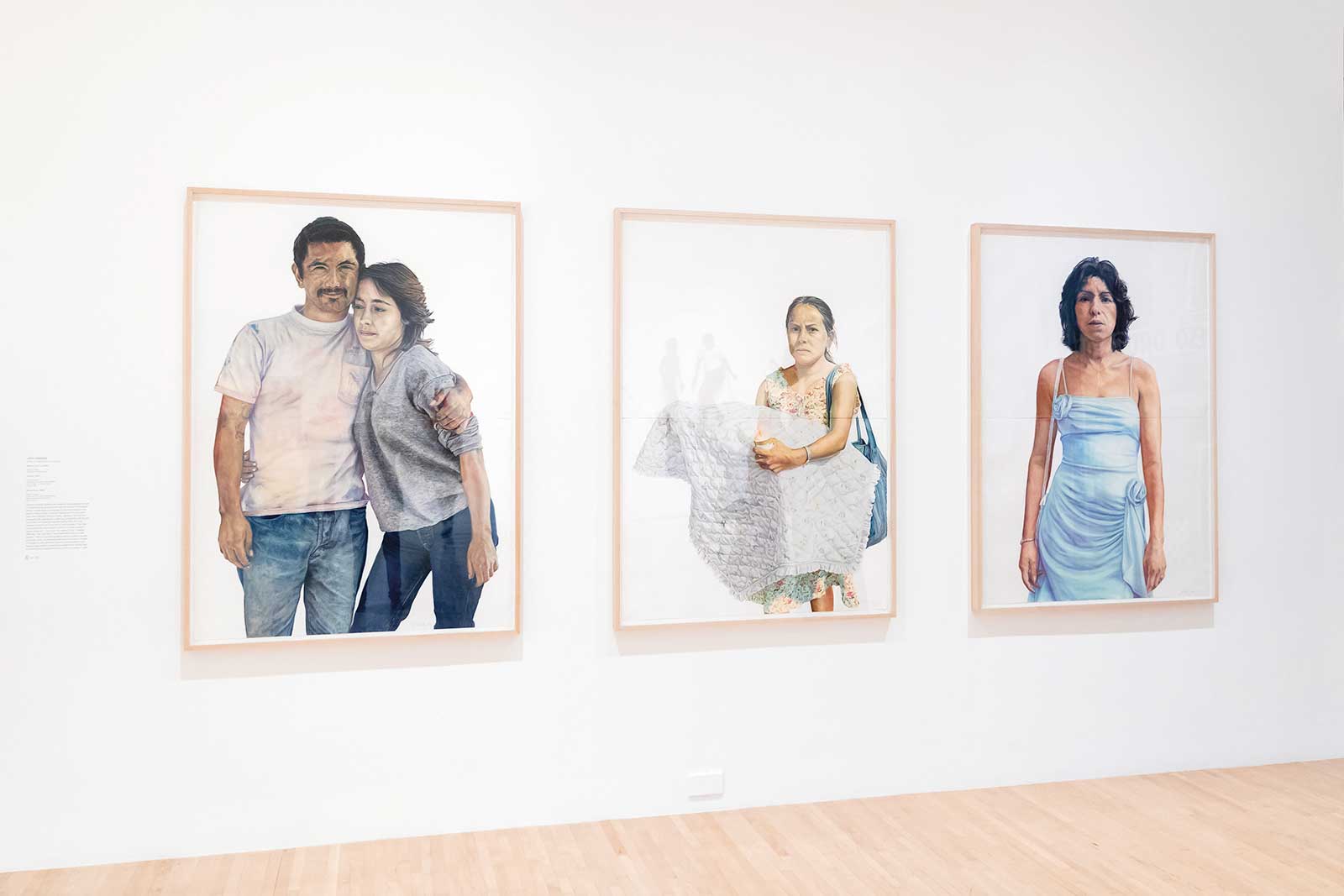
Installation view of Ordinary People: Photorealism and the Work of Art since 1968, at MOCA Grand Avenue through May 4. Courtesy of The Museum of Contemporary Art (MOCA). Photo by Jeff McLane.
Photography as fine art is still a touchy subject for some. Photorealists used their skills as painters to reproduce as accurately as possible the visual effects of a photograph. “While its accessibility has often been held against it,” Katz says, “this exhibition takes seriously photorealism’s popular appeal, suggesting that it is rooted in the ways photorealists honor the work of making art.”
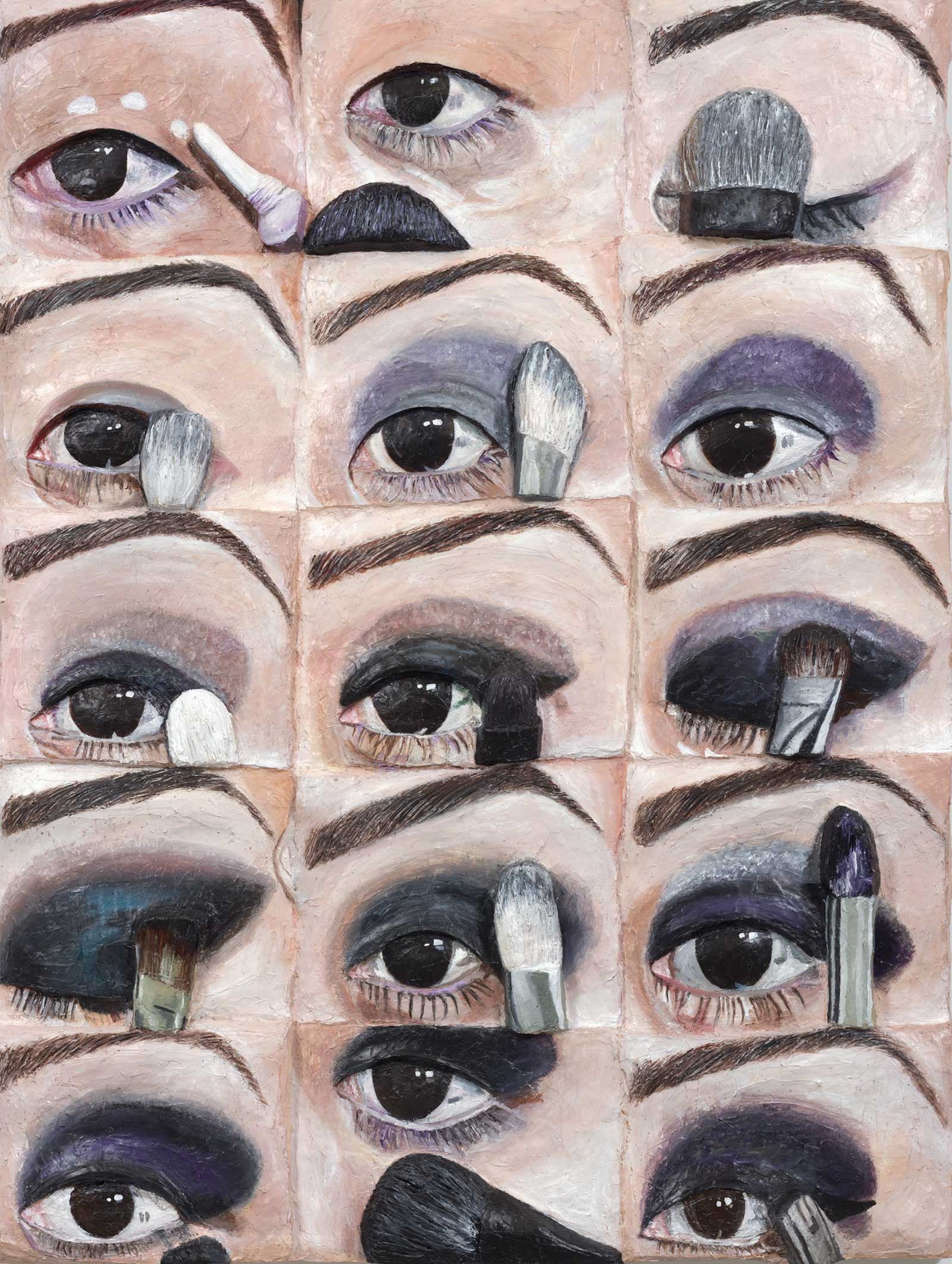
Gina Beavers, Smoky Eye Every Step, 2020, acrylic and foam on linen on panel, 96 x 72 x 6". The Museum of Contemporary Art, Los Angeles Gift of Andrew Stearn.
Alameda Gran Torino, 1974, by Robert Bechtle (1932-2020), is painted with such arduous precision that we can see the car was purchased at Golden Bear Ford. He commented on painting cars accurately in an oral history interview with Robert Bechtle in February 2010 now in the Smithsonian’s archives of American art. “But with a car, the contours, especially, require paying attention to, because if they get off a bit, it’s not going to look—it’s not that it’s not going to look like a car, but it’s going to have that sense of not being quite right, and anybody that is aware of cars (I’m not sure that that many people are anymore because they all look the same)…would look at it and feel that, well, you didn’t quite get it, you know. Something has gone astray.”
Richard Estes’ paintings of mundane scenes of reflective shop windows and displays of merchandise we pass without acknowledgement, are masterful paintings. The paintings are observations without a message. He says, “The subject is just the vehicle for doing the painting.”
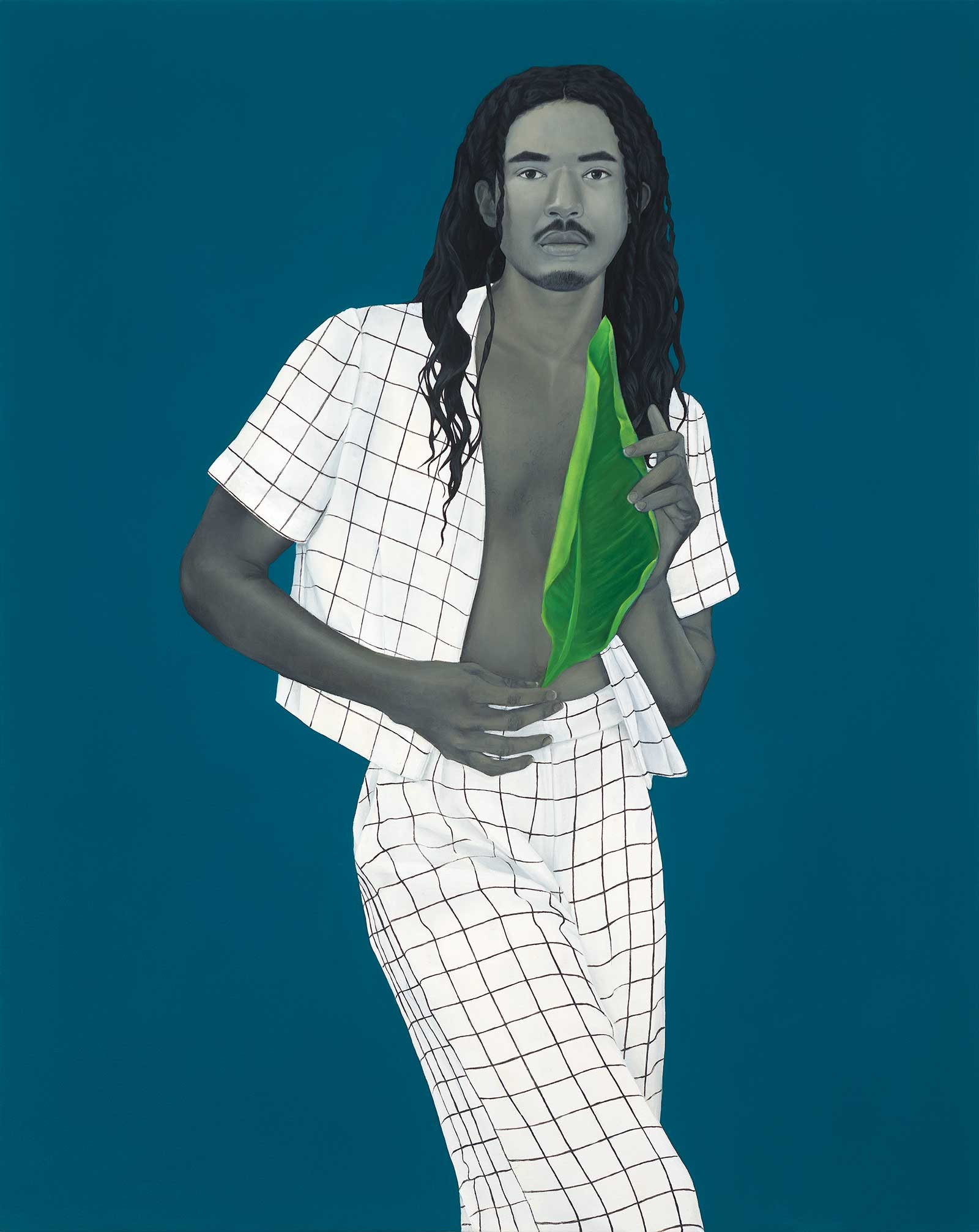
Amy Sherald, The lesson of falling leaves, 2017, oil on canvas, 54 x 43". The Museum of Contemporary Art, Los Angeles. Purchase with funds provided by the Acquisition and Collection Committee.
When I asked him about the criticism of photorealism he replied, “If you’re working from life, you’re just copying. What’s the difference? Paint is a muddy thing—linseed oil with different kinds of dirt. A painting can never be like a photograph which is a mechanical process.”
His paintings are about observing and painting. The novelist John Updike writes, “Estes depicts, with Vermeer’s coldly sensual touch, what up to now seemed too ugly to depict or to bleak to view.” Independent curator, Patterson Sims, writes, “Though the perspectives in his compositions can be very challenging, he feels the hardest part of the paintings for him is not the drawing but keeping the color values in proper balance. As he transcribes the photographs, the color must constantly be carefully adjusted.”
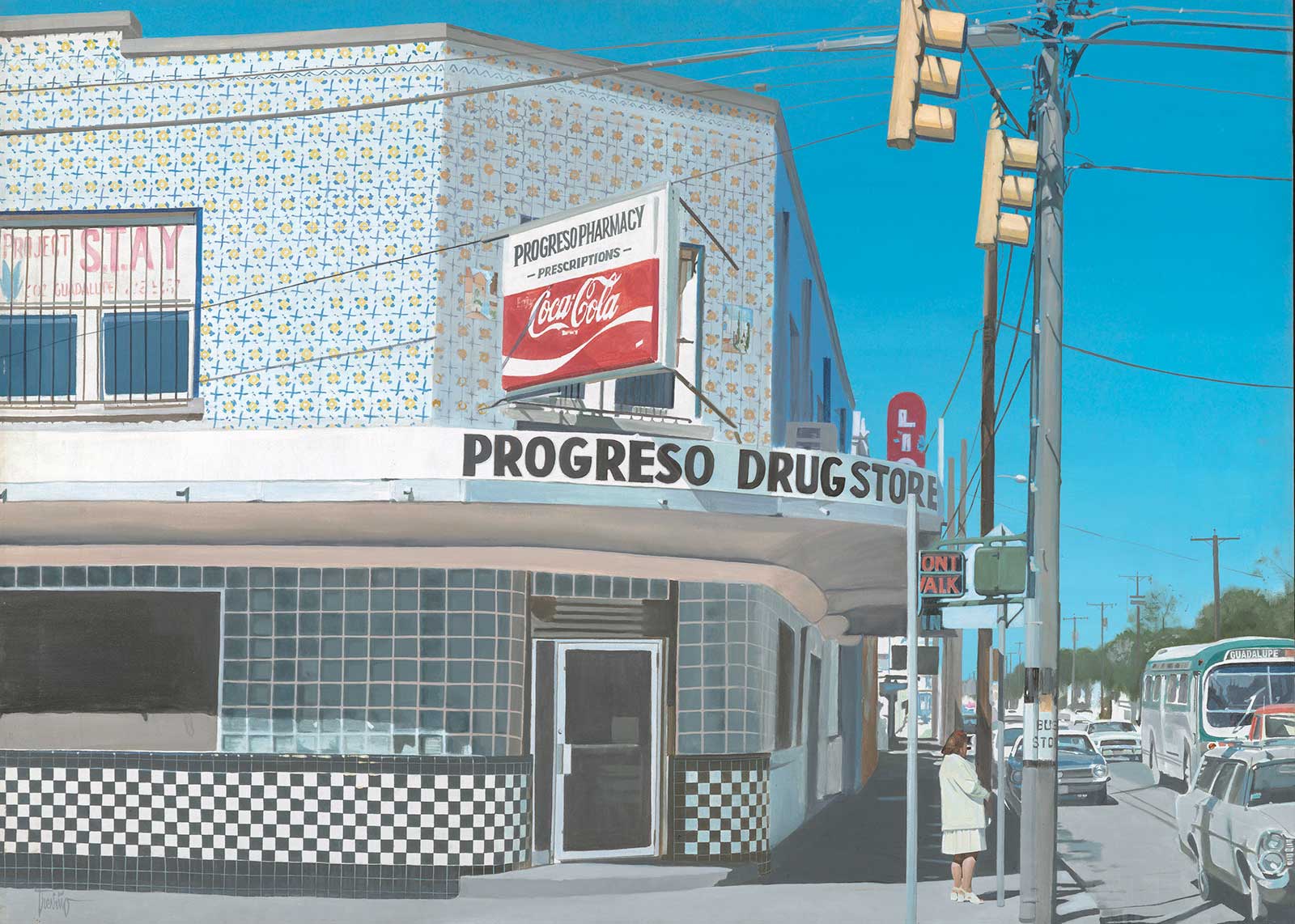
Jesse Treviño (1946-2023), El Progreso, 1979, acrylic on canvas, 50 x 60". Collection of Kathy Sosa.
Audrey Flack (1931-2024) was the most prominent woman among the photorealists. Her 1974 painting, Leonardo’s Lady, is typical of her work at that time, a contemporary vanitas painting depicting a woman’s cluttered dressing table. Among the toiletries, pink champagne and a pink rose is the contrast of a book with a reproduction of Leonardo da Vinci’s La Belle Ferronière,1496, the portrait of a seemingly strong-willed woman who may have been the mistress of Francis I, da Vinci’s patron.
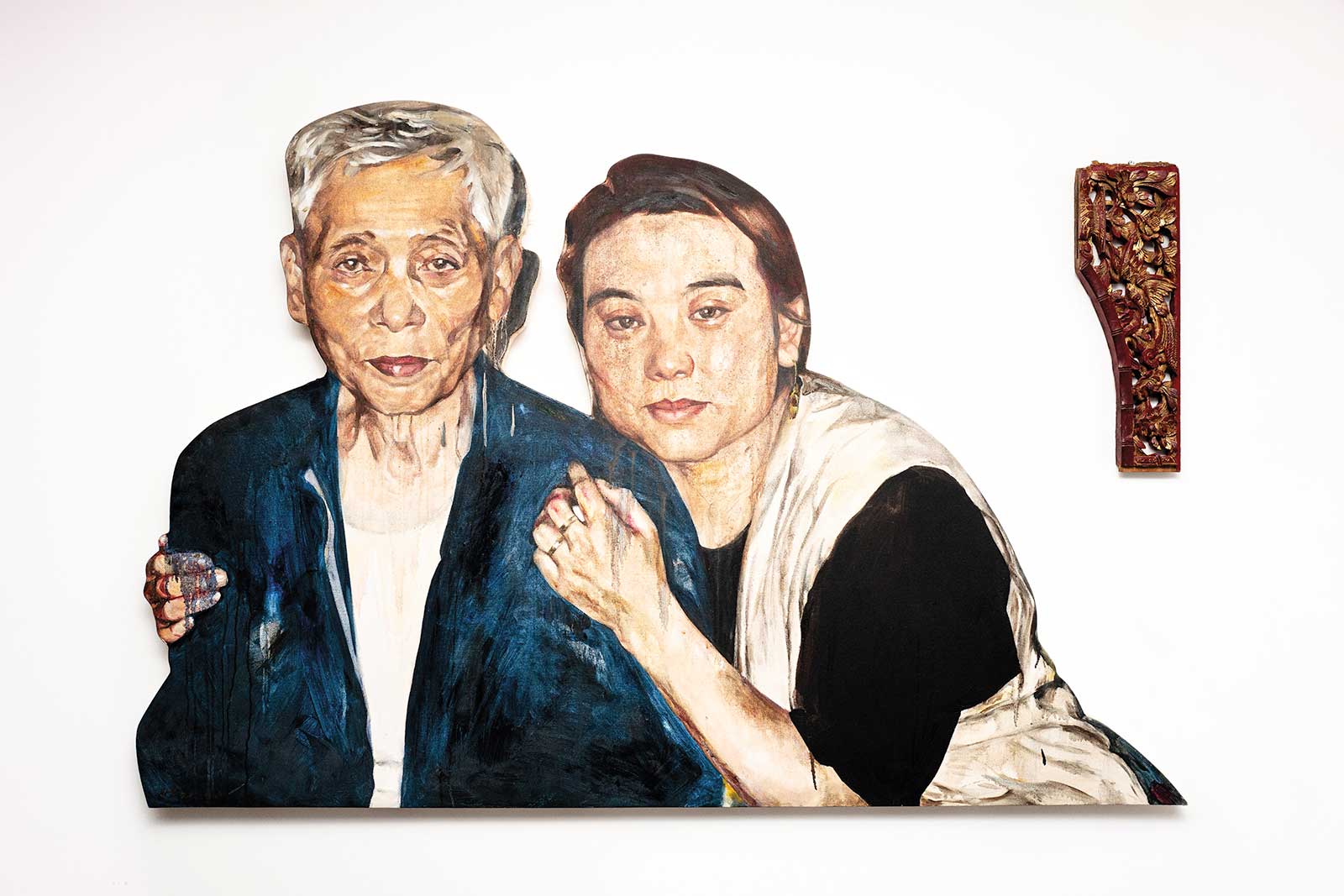
Hung Liu (1948-2021), Father’s Day, 1994, oil on canvas and found wooden object 54 x 72". Collection of Bernice Steinbaum, Miami.
MOCA’s director, Johanna Burton, says “Photorealism, at its core, is about seeing. It invites us to look closely at the world, to linger on the familiar, and to understand that even the most ordinary moments and the people that inhabit them are worthy of attention. Ordinary People reframes photorealism as a movement deeply engaged with the labor of representation both in its artistic techniques and its subject matter.”
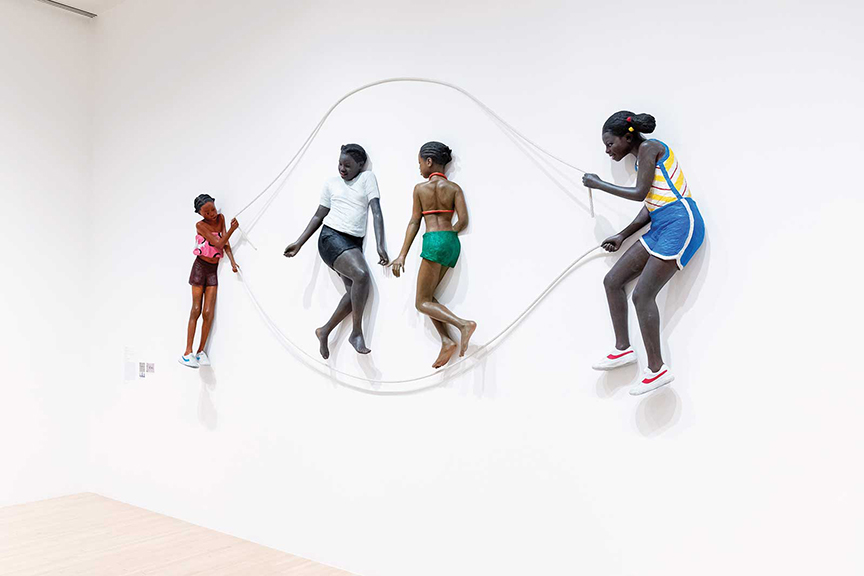
Installation view of Ordinary People: Photorealism and the Work of Art since 1968, at MOCA Grand Avenue through May 4. Courtesy of The Museum of Contemporary Art (MOCA). Photo by Jeff McLane.
Ordinary people appear in Look at This Photograph (L-R Primas Locas y El Mike, Flea, Go Shorty It’s Your Birthday), 2018, by Michael Alvarez., an enlarged page from a self-adhesive photograph album. Hung Liu (1948-2022) often based her paintings on historical photographs. A contemporary photograph is the inspiration for Father’s Day, 1994, inspired by the reunion with her father who had been imprisoned in a Chinese labor camp for nearly 50 years, and whom she assumed had died. She enlarged the photo for her painting on a shaped canvas protruding from the wall, bring the subject closer to the viewer.
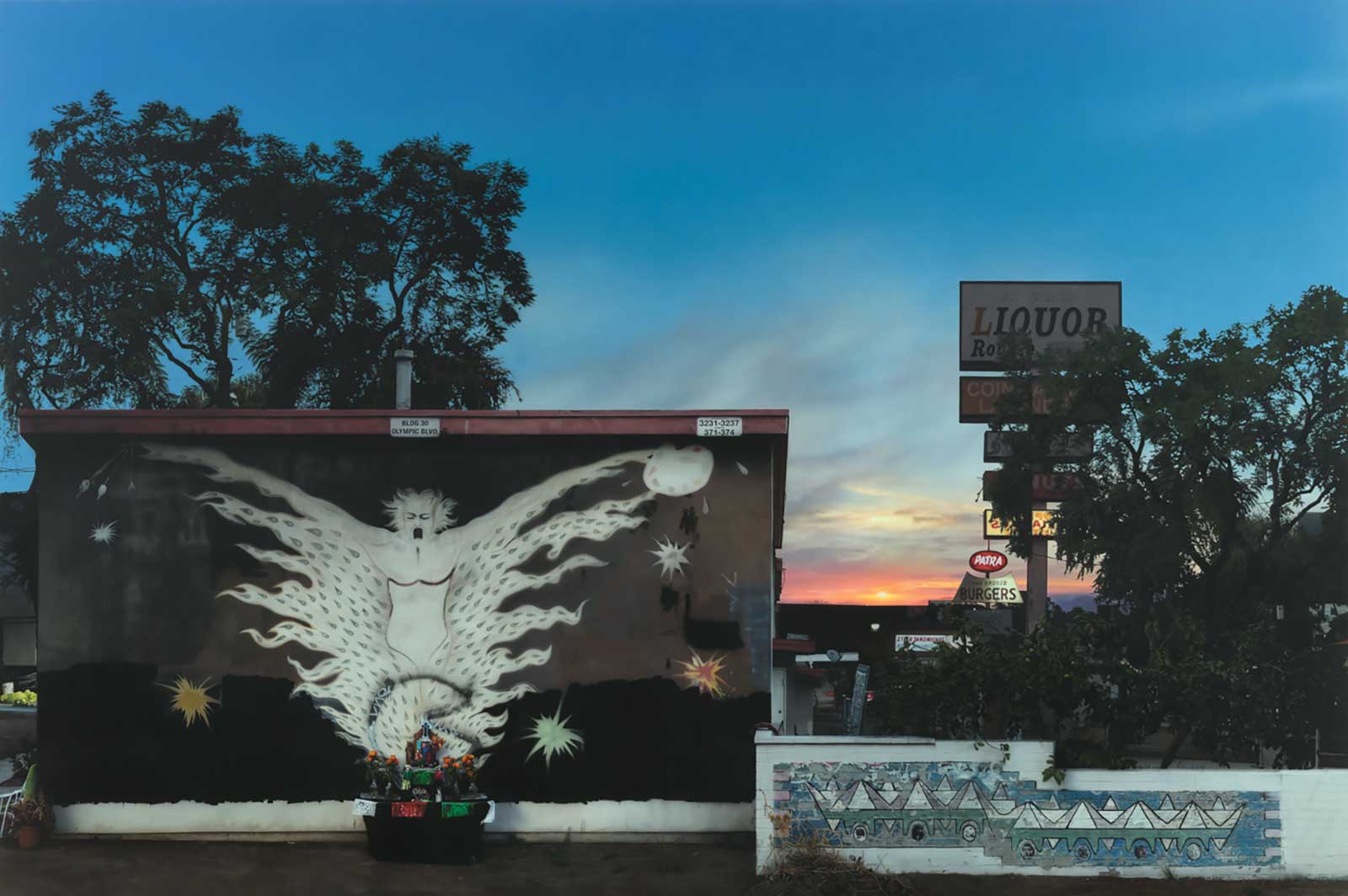
Sayre Gomez, 2 Spirits, 2024, acrylic on canvas, 96 x 144". Courtesy of the artist, François Ghebaly Gallery, Xavier Hufkens, and Galerie Nagel Draxler.
In correspondence with me shortly before her death Liu wrote, “Since roughly 1990, I have been turning old photographs into new paintings. This means of course I’ve been transforming black and white images into fields and surfaces of color. We tend to think of history as black and white—or at least my generation does. The risk of changing them into color is that you lose contact with their sense of the past. Nearly all of my subjects lived before my time, although since the invention of photography. That means there is a kind of natural distance between us, which I try to close as a painter. The brushstrokes, small and big, are direct responses to what I see in the photographs, which is often not much since old photographs can be grainy and blurry. Color existed of course when those photographs were taken, but the only way we can imagine its palate is by painting through our own memories of similar settings and moments in time. This means that the color in my paintings of the last 25 years have been filtered through my experience of growing up in revolutionary China, having worked as a peasant in the countryside during the Cultural Revolution, and having fled war and left home.
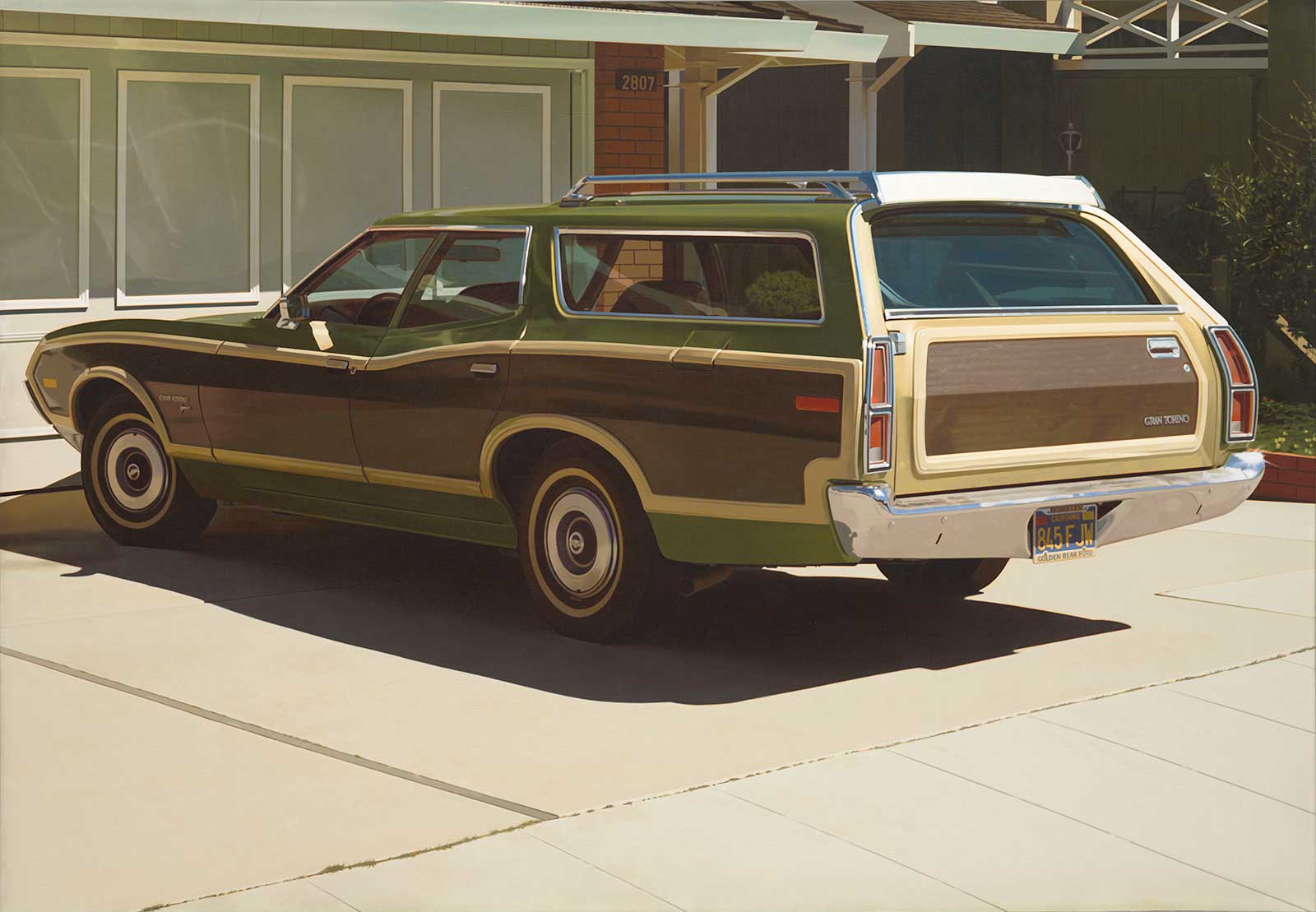
Robert Bechtle (1932-2020), Alameda Gran Torino, 1974, oil on canvas, 48 x 69". San Francisco Museum of Modern Art, T. B. Walker Foundation Fund purchase in honor of John Humphrey.
The once marginalized are represented by Amy Sherald’s The Lesson of falling leaves, inspired by the following poem by the Black poet, Lucille Clifton: “the leaves believe / such letting go is love / such love is faith / such faith is grace / such grace is god / i agree with the leaves.”
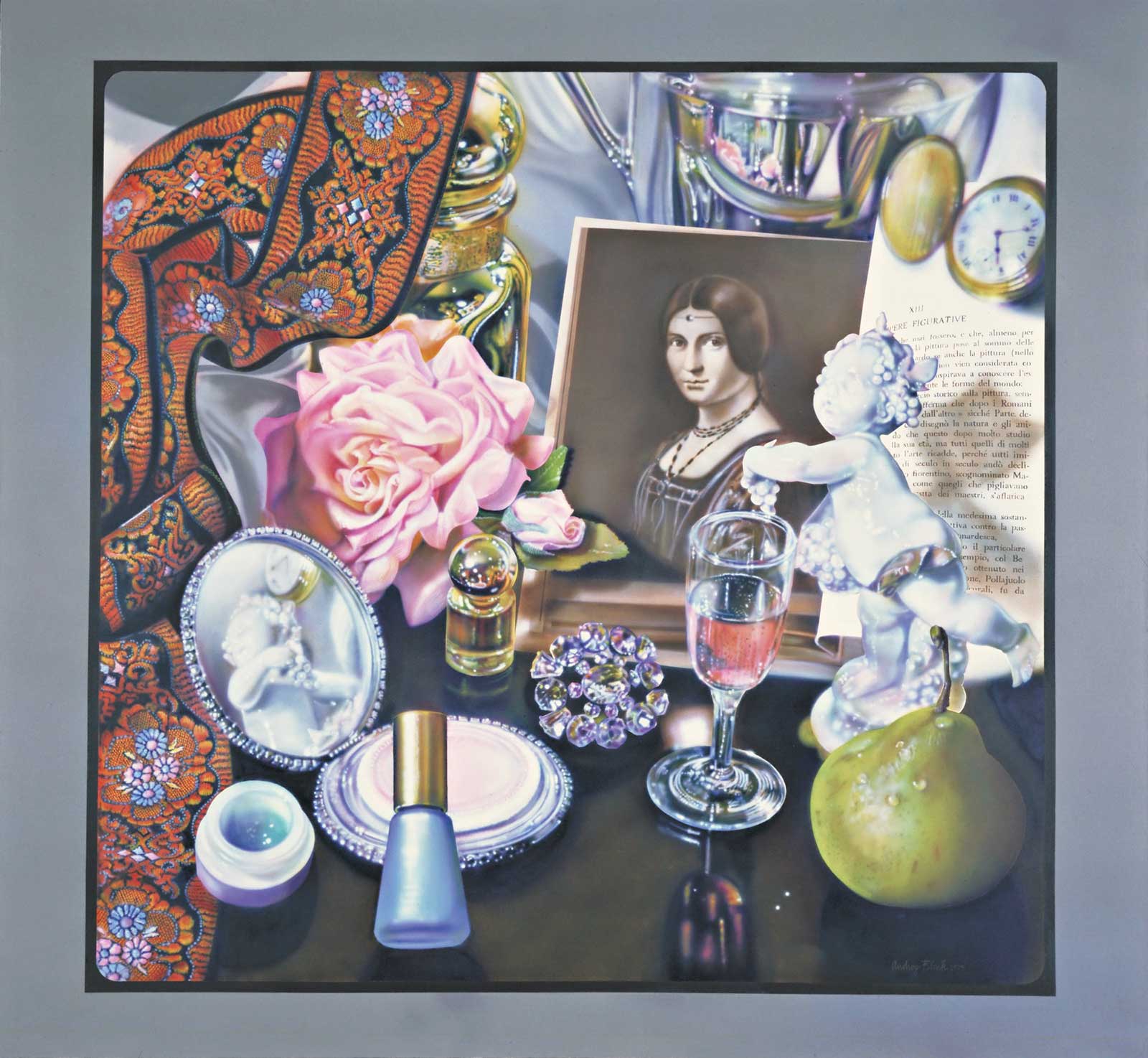
Audrey Flack (1931-2024), Leonardo’s Lady, 1974, oil over synthetic polymer paint on canvas, 74 x 80". The Museum of Modern Art, New York. Purchased with the aid of funds from the National Endowment for the Arts and anonymous donor, 1975.
In her catalog essay, Katz writes, “The dichotomy between painting and photography, drawn along lines of racial exclusion and inclusion, is stark in the work of self-described ‘American Realist’ Amy Sherald, who was catapulted to national fame at the unveiling of her portrait of First Lady Michelle Obama in 2018. The lesson of falling leaves exemplifies her selection of Black sitters, often strangers, whom she chooses for their ‘quality of existing in the past, present, and future simultaneously.’” Sherald’s gray skin tones recall 19th century daguerreotypes. They diminish ethnic identity and the intense gaze of her models invites a conversation between equals. Ordinary People continues through May 4 at Museum of Contemporary Art, Los Angeles. —
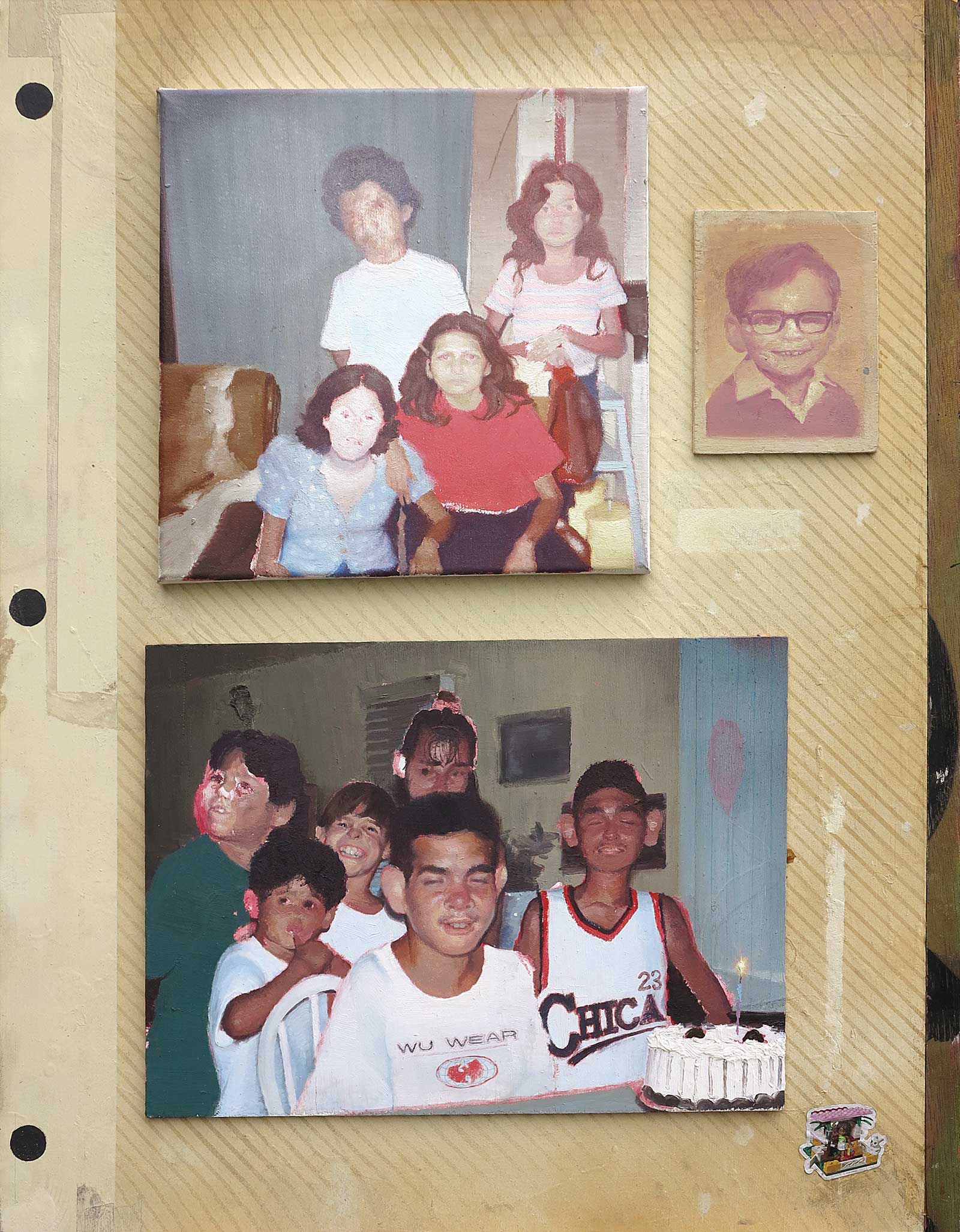
Michael Alvarez, Look at This Photograph (L-R Primas Locas y El Mike, Flea, Go Shorty It’s Your Birthday), 2018, oil, spray paint and graphite on canvas and panel, 31 x 24". Collection of Anthony Lepore and Michael Henry Hayden.
Ordinary People: Photorealism and the Work of Art Since 1968
Through May 4, 2025The Museum of Contemporary Art • 250 S. Grand Avenue, Los Angeles, CA 90012
(213) 621-2766 • www.moca.org
Powered by Froala Editor