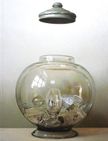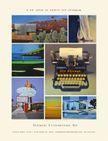
Hideo Tanaka’s work is, in a word, weird. Lightbulbs in wine glasses. Tablescapes cut precisely in half. Still life nonsequiturs an art professor might pull out of the supply closet and instruct, “Now paint.” I remember one class with a hammer and an egg. Tanaka would have nailed it.
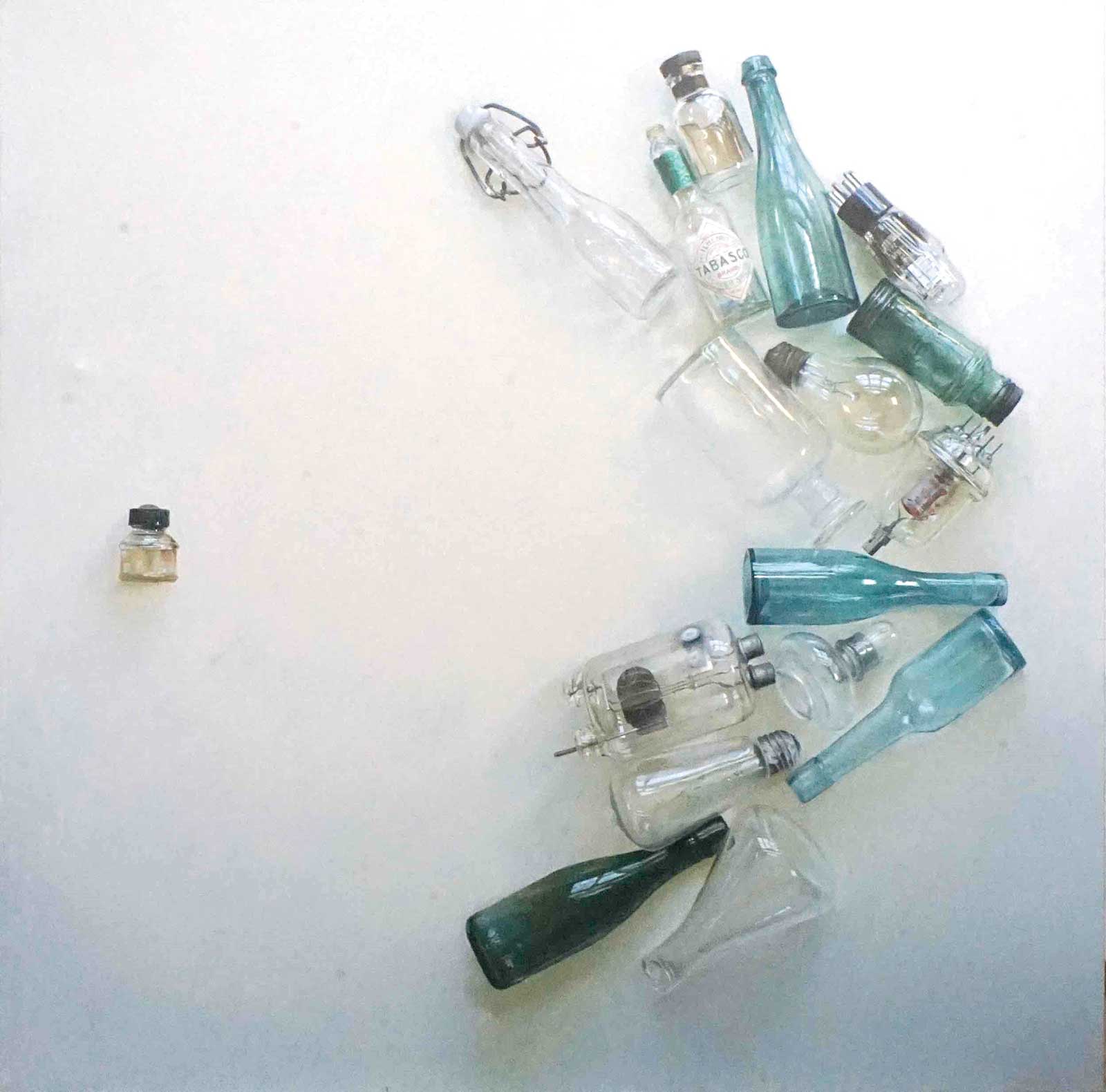
Father, acrylic on canvas, 36 x 36"
With titles like Balance, a row of bottles on the brink of toppling over, and Love, one fragile prop encircling another, Tanaka animates simple objects and lets viewers in on the joke. His technical prowess combines with a quirky sense of humor that might unsettle if it didn’t also amuse. Reflections rendered so deftly, one might wonder who else is in the room. He paints hyperrealism with a side of “why,” or more accurately, “why not?”
When I first got the assignment to profile Tanaka, I was not familiar with him or his work. I began by reaching out to set up a call. A few clumsy email exchanges later, we learned we do not speak the same language or wake under the same sun.
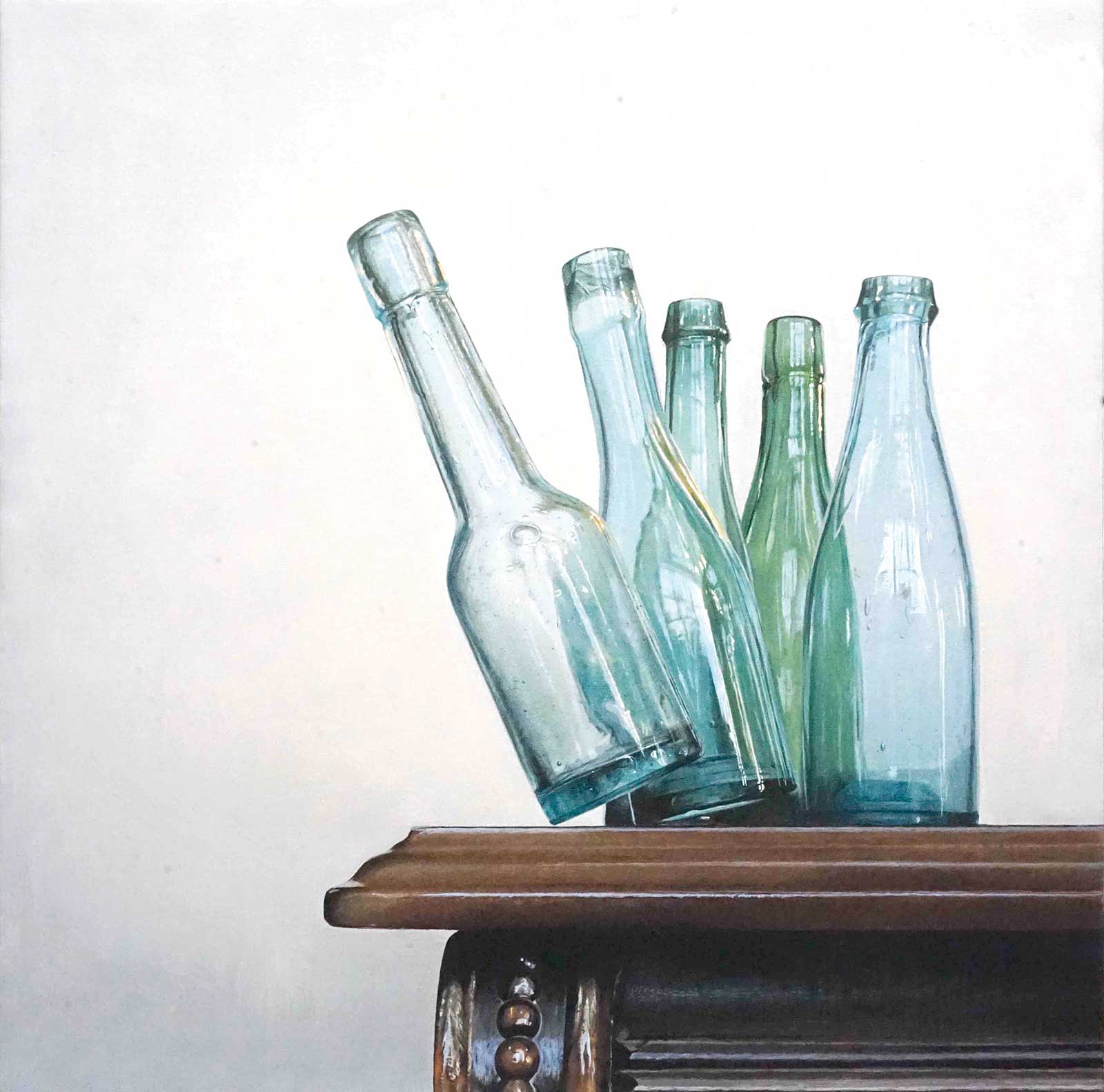
Balance, acrylic on canvas, 26 x 26"
At a dinner party that night, I explained the conundrum. “Sanaée speaks Japanese,” my sister-in-law tells me. Her friend Sanaée jumps in the mix. “I do [but] we moved when I was 12, so my vocabulary is that of a 12-year-old. But my dad could help,” she offers. The only hitch—her father doesn’t speak English.
Sanaée’s father speaks French and Japanese, so he would translate from Japanese to French, and Sanaée would take it from French to English for me. We could have one big, happy, most certainly beleaguered Brady Bunch of a Zoom call together. What could go wrong? I laugh and tentatively accept the offer, but only as a last resort.
This is what technology is for, I think, determined to do my own interview if and how I can. A few more email exchanges with Tanaka, and I have some baseline information about him and his upcoming show at Arcadia Contemporary. Now I also have his name in Japanese characters, which is a game changer when searching for background information and previous work.
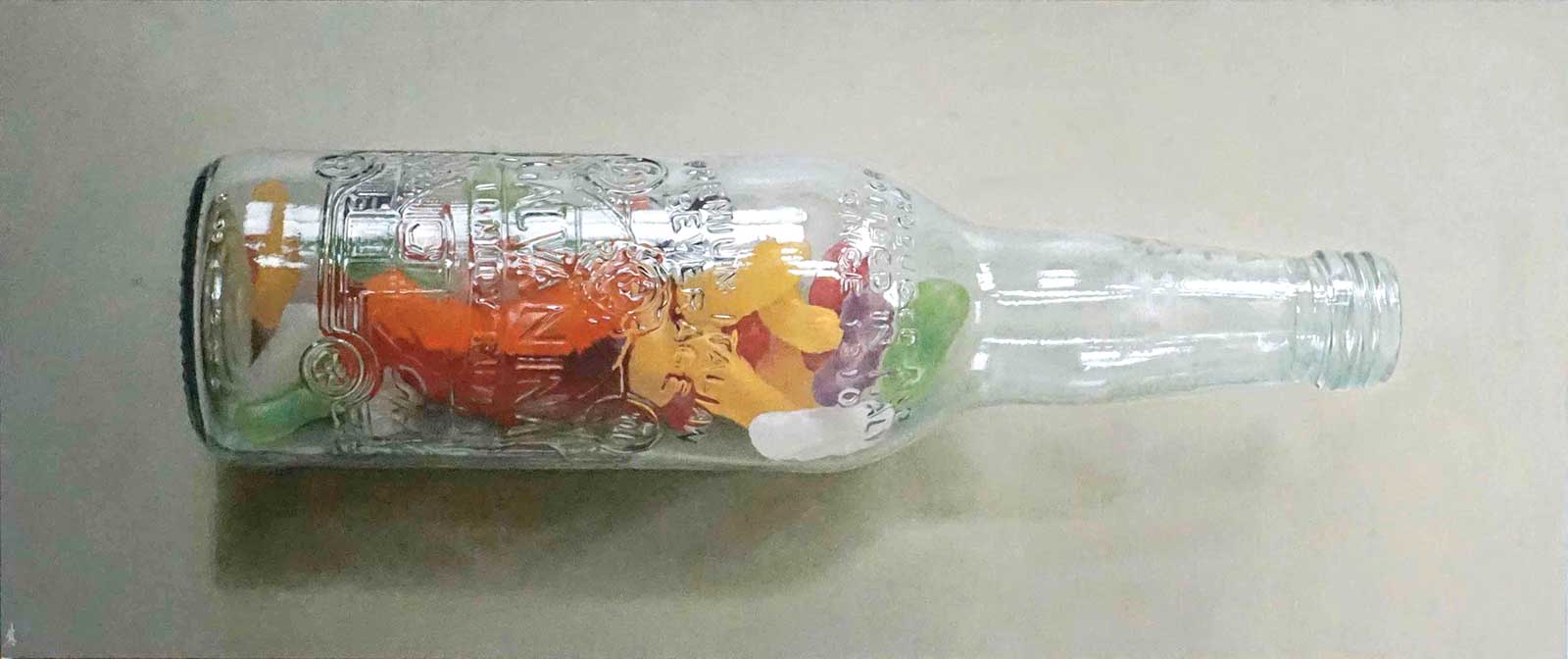
Colorful, acrylic on canvas, 16½ x 39½"
This article is not sponsored by Google Translate, but we’d both like to give credit where credit’s due. Me, to justify my decision to reach across the aisle and partner with the kind of robots coming for my job. And Tanaka, to put a disclaimer ahead of any quotes that are misinterpreted or stripped of vital nuance. From what I can glean from his work and our limited conversations, I think Tanaka is truly funny. Shave the edges off with a translator machine, and his responses are refreshingly blunt.
A few more Google-assisted one liners confirm my hunch that Tanaka is having fun with the Q&A. How have American audiences responded to his previous shows at Arcadia? “Ask that to an American, not me.” What he does when he’s frustrated with a painting or encounters a creative impasse? “I’ll drink some beer and go to bed.”
Tanaka, who lives by the sea in Ibaraki, Japan, didn’t study painting. He spent his professional life as a creative director, spinning up ad campaigns for clients like Sony and BMW. And if the string of ad industry awards is any indication, Tanaka has mastered the power of a well-composed image.
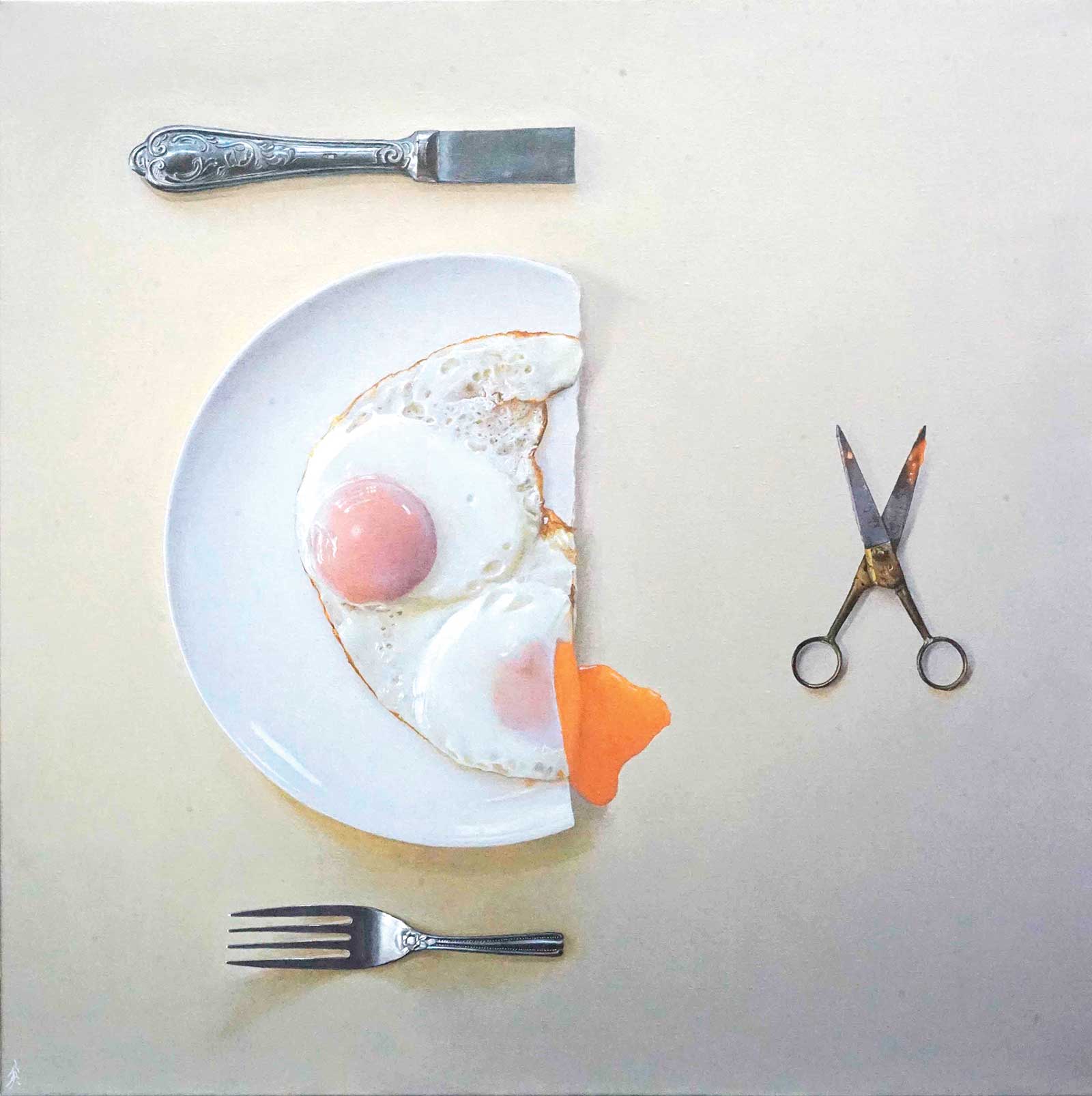
Cut, acrylic on canvas, 29 x 29"
In painting, his subjects, too, are presented in high definition with softly rendered backgrounds, negative space ready and waiting for the brand name and tagline, just like a glossy ad. “Making advertisements has had a big influence on me,” Tanaka says. “I met many wonderful creators. It didn’t affect the act of drawing, but it influenced my way of looking at things and thinking about gimmicks. Those things are still with me today.”
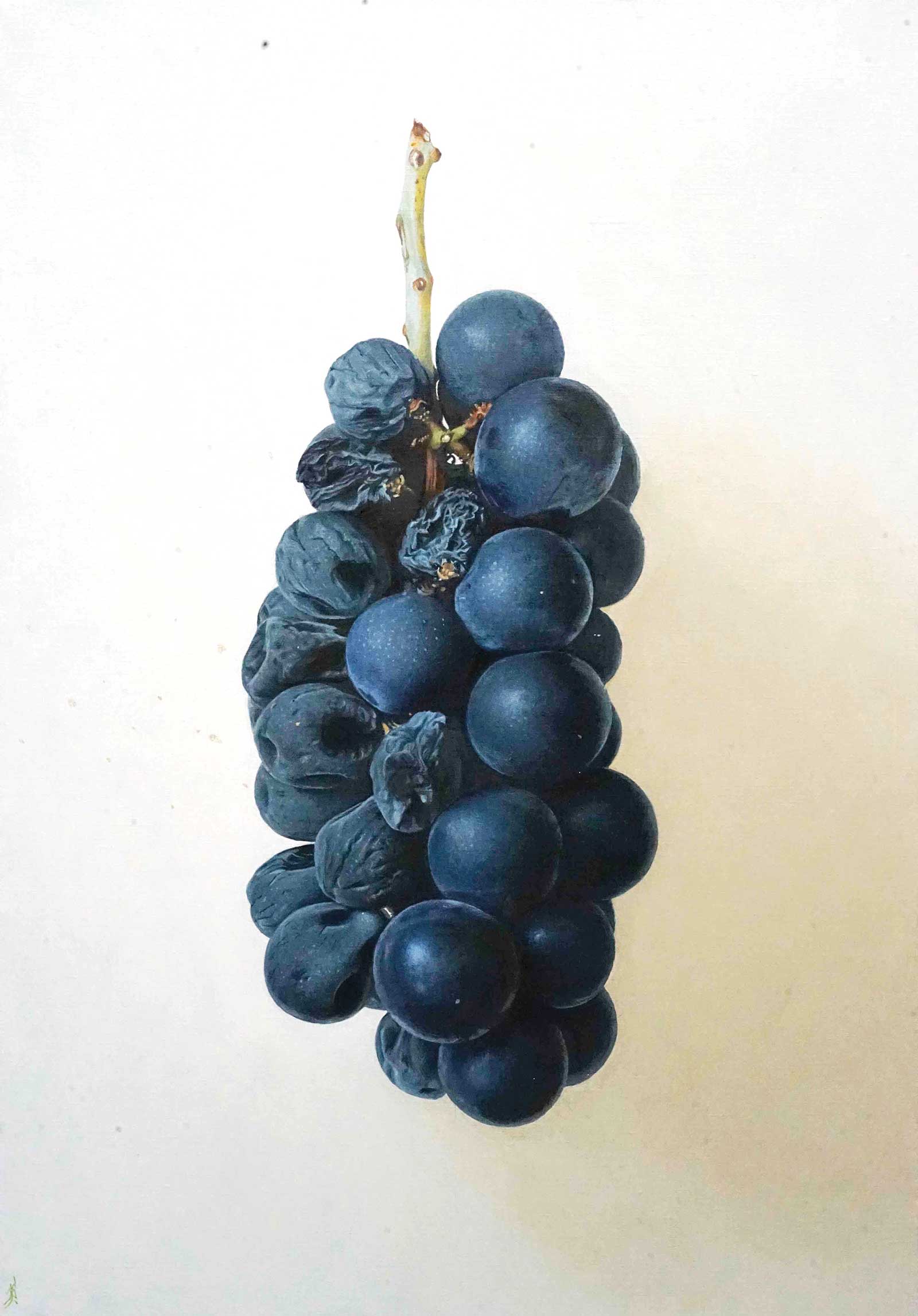
Half and Half, acrylic on canvas, 26 x 18"
I consider Tanaka’s use of the word gimmicks, or rather, the robot translator’s use of the word. Maybe Tanaka’s original intent was more closely related to words like concepts or techniques, but I can’t be sure. My search for the original Japanese word yields results like hanazō and bakī—according to Google, words “used to describe a trick or ploy that is intended to entice someone to buy something.” Most artists and art dealers are invested in selling things. And having a good hook never hurts. I like both readings.
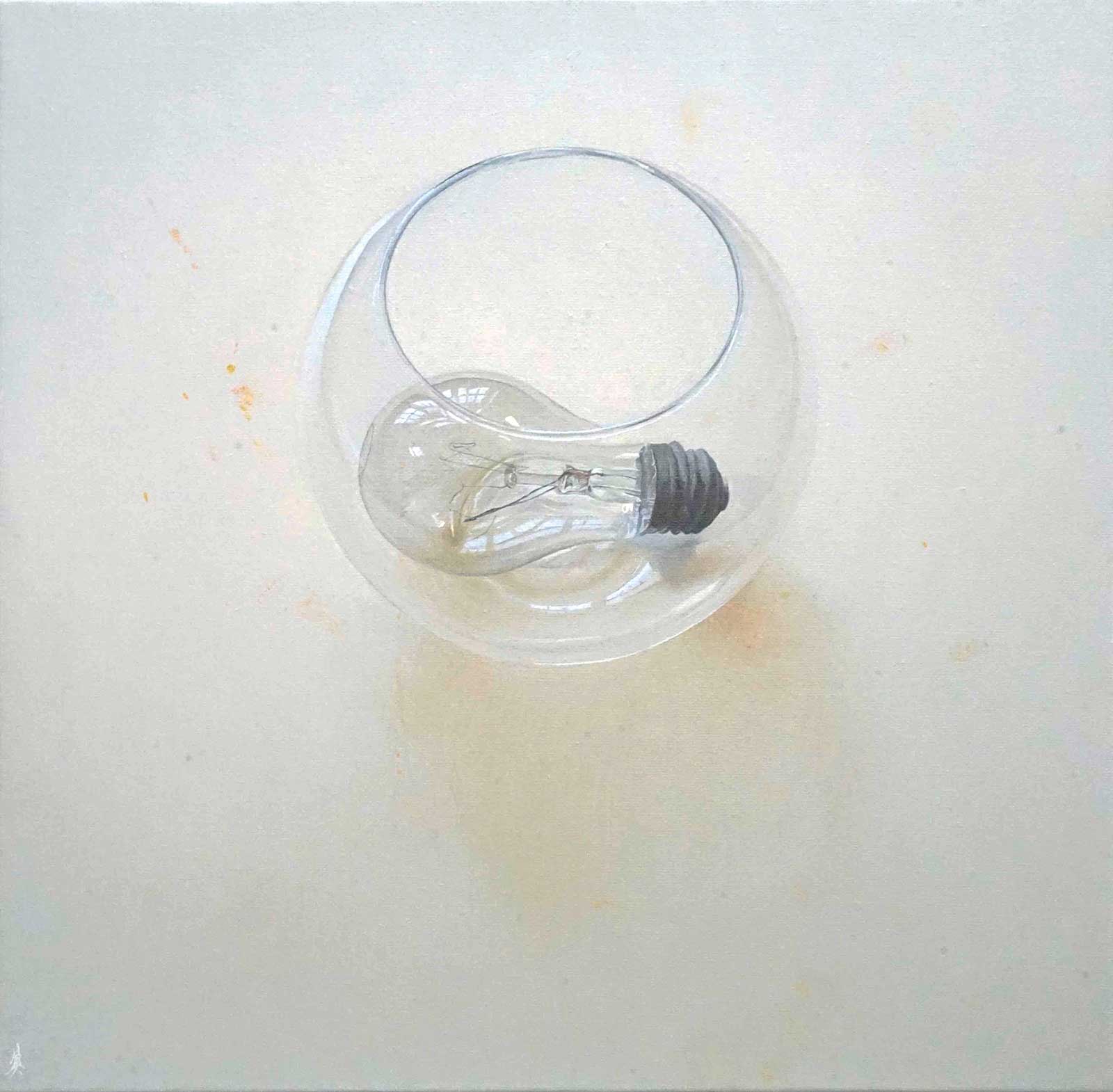
Love, acrylic on canvas, 18 x 18"
Tanaka’s paintings are full of ideas best understood alongside their titles. Father features one tiny ink bottle surrounded by a cadre of larger glass objects. Mother depicts a candy bowl with glass objects on the inside.
“I lost my father and mother last year and the year before,” Tanaka explains. “I drew these pictures because I wanted to leave my image of my father and mother. My mother has tolerance. My father has the power to break through. That’s the image I had.”
Tanaka tells me how he chooses his titles: “This is always a mood.” I don’t look for a better translation or other possible meanings. Mood says it all. —
Arcadia Contemporary 421 W. Broadway New York, NY 10012 • (646) 861-3941 www.arcadiacontemporary.com
Powered by Froala Editor