The origins of the term “history painting” can be traced back to the 17th century when it was first used to describe grand-scale, figuratively complex paintings depicting narrative scenes drawn from classical history, Greek and Roman mythology, and the Bible. In the 18th century, the genre expanded to include subject matter from more recent times.
Contemporary artists who draw from this tradition are faced with the challenge of how to create “history paintings” that hold relevance today. A new show at Laguna College of Art + Design’s LCAD Gallery explores this question through the work of Carl Dobsky, Perin Mahler and Benjamin Duke, and their different methods of modernizing a style of art-making that has roots in the early years of the Italian Renaissance.
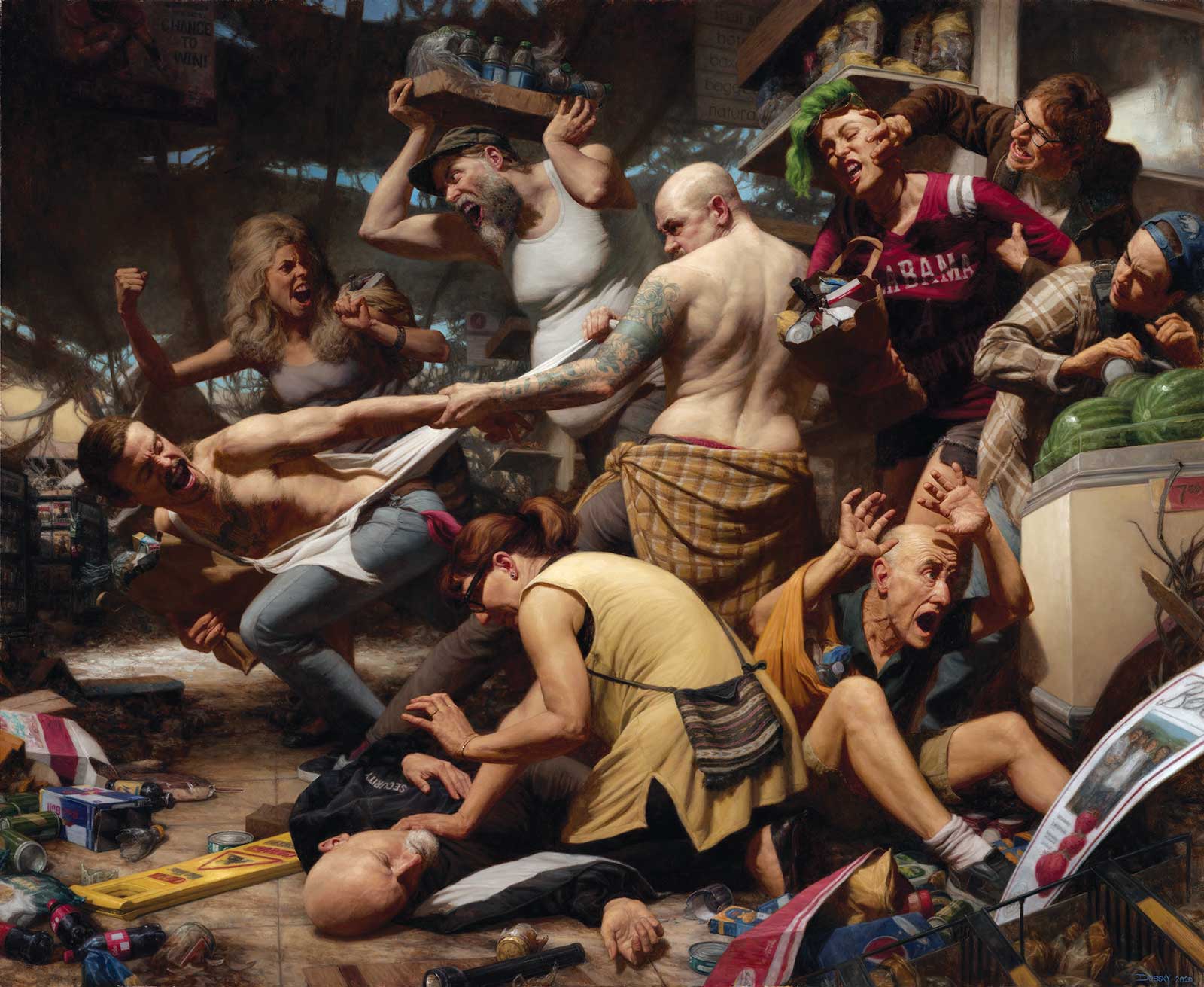
Carl Dobsky, Taken By Storm, oil on linen, 72 x 96"
Mahler, who co-curated Alternate History with LCAD gallery director Bryan Heggie, explains, “The show’s title is a play on the concept of the history painting, which has traditionally been considered the highest level of achievement in art due to the complex problem solving and technical demands of narrative and multiple figure compositions. All three of us have a deep respect for the past but realize that telling the kinds of stories in classical history painting is problematic in our time; we all take this tradition and update it in our own ways.”
Mahler’s approach involves placing classically rendered figures in fractured, flattened spaces to suggest multiple perspectives and narratives to address issues of political and cultural conflict.
Benjamin Duke, E, oil on canvas, 63 x 55
“My work of the past several years has been deeply influenced by our political climate,” Mahler says. “It seems that our society is existing in parallel universes with conflicting senses of truth and reality. This disjunction has appeared in my work in the form of clashing perspective spaces and juxtapositions of non-naturalistic color zones.”
Many of Mahler’s visual tactics appear in his painting Dreamer, although this piece doesn’t refer to a specific political or cultural issue. “Works like this one come to me unannounced, without a particular story attached,” he says. “In a painting like this, I am interested in contrasts—flat versus volumetric, color versus black and white, linear versus planar. In Dreamer, I am interested in intimating a narrative rather than spelling it out and hope that the contrasts suggest a strange, otherworldly and dreamlike state.”
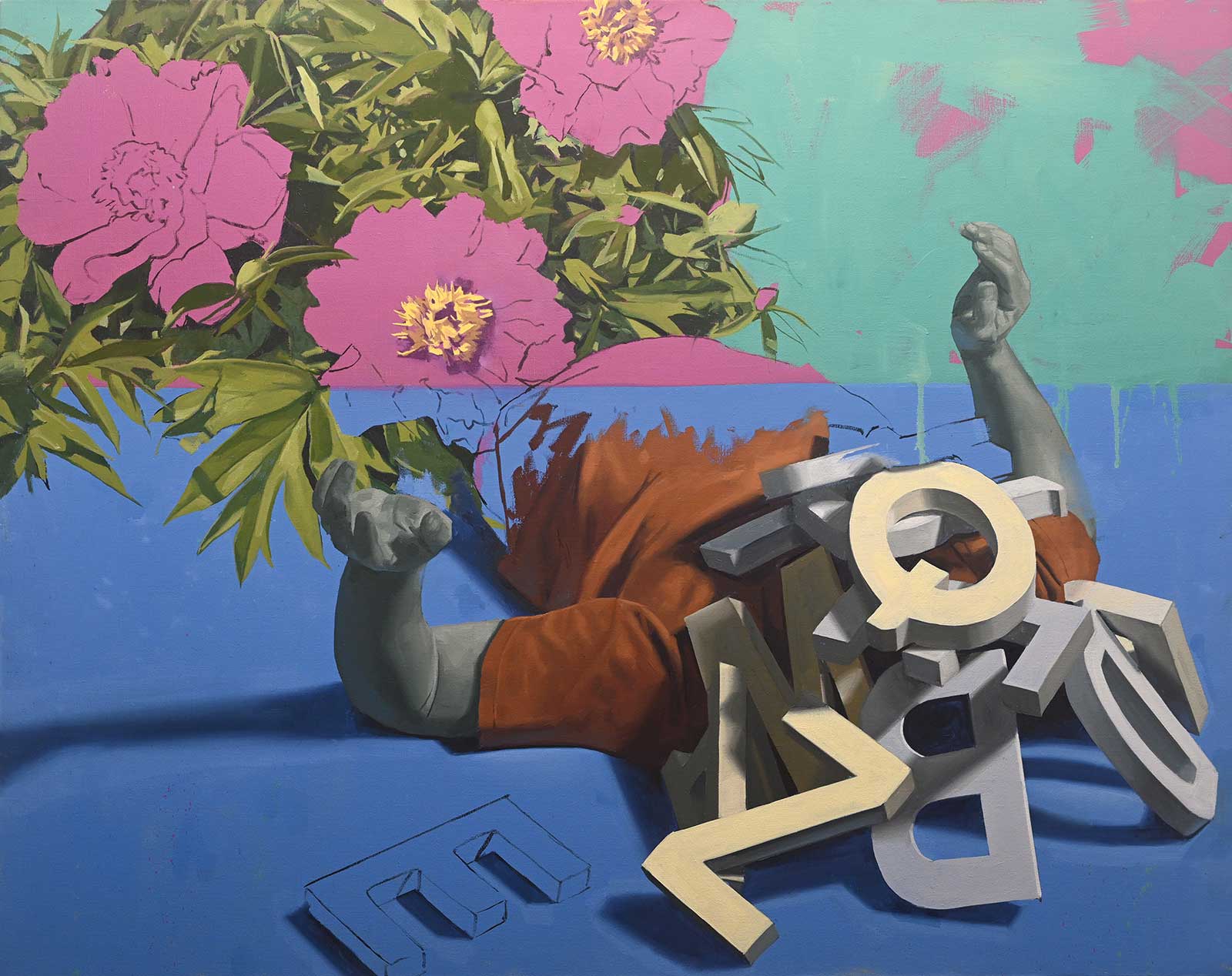
Perin Mahler, Dreamer, oil on canvas, 38 x 48"
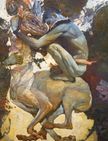
Of the three artists’ work, Dobsky’s massive, elaborate figurative tableaux most viscerally recall the impassioned allegorical works of the Renaissance and Baroque periods that epitomize the history painting genre. With a heightened sense of chaos and the grotesque. Dobsky’s classically-informed compositions deal with matters of the present, especially the ugliness of capitalism and consumerism in Western culture.
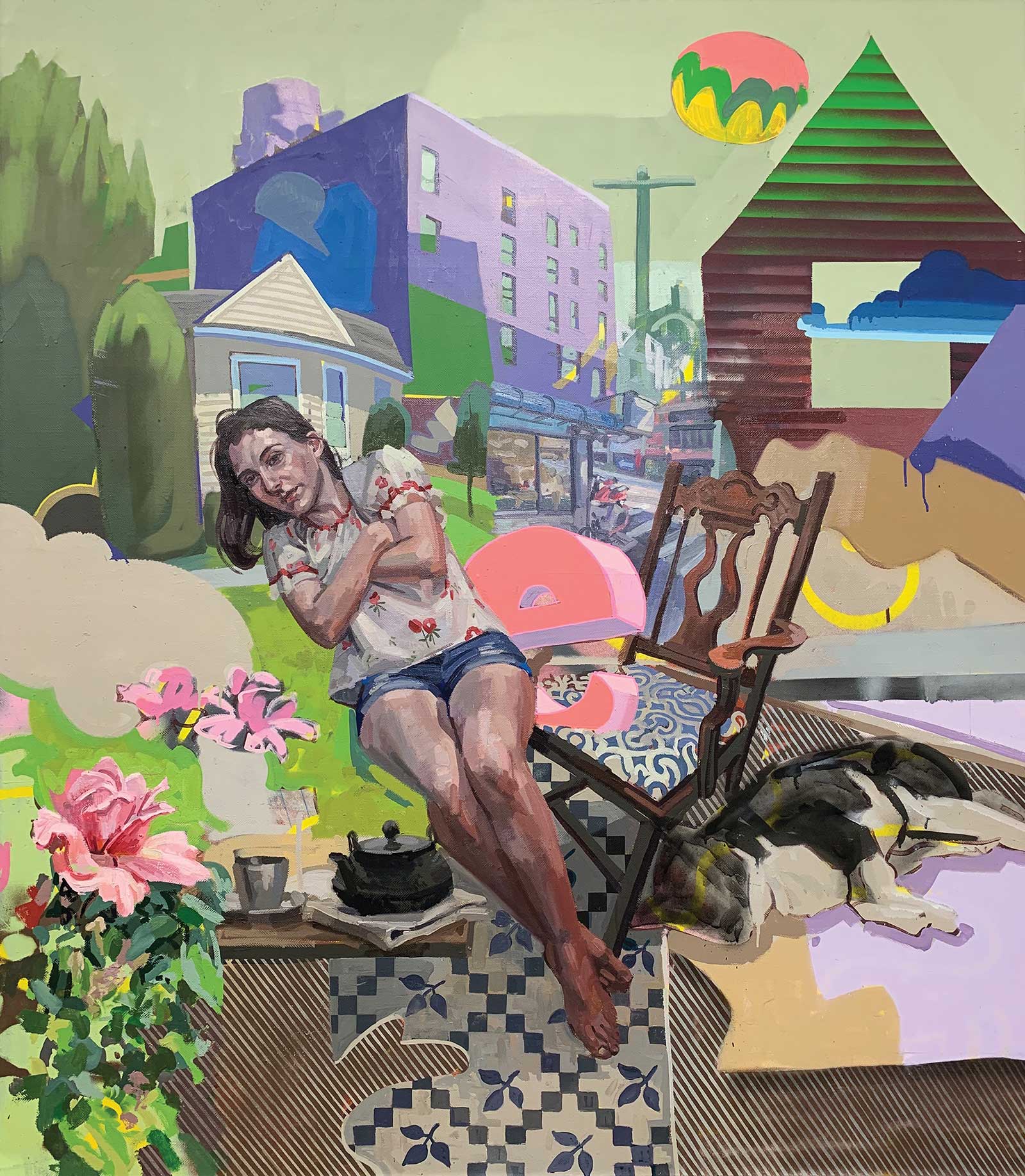
In Duke’s painting E, a female figure seems to be suspended in time and space, floating in a disorienting environment that is at once familiar and surreal.
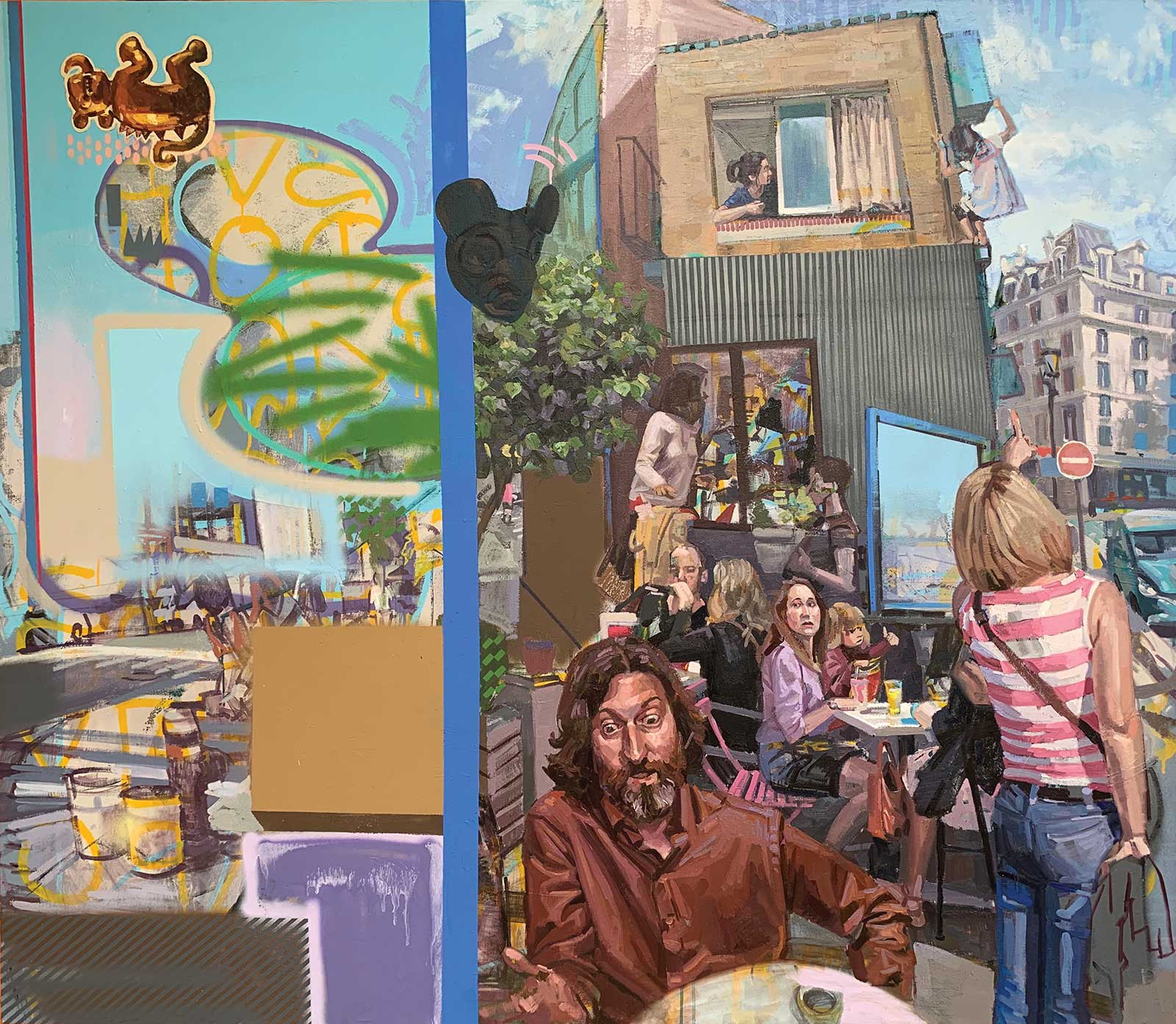
Benjamin Duke, The Conversation, oil on canvas, 63 x 55"
“The alternate history here lies in the rewriting of personal memory; a liminal subjective view,” says Duke. “The piece questions what’s real and what’s invented. The suburban setting evokes a specific cultural narrative, one that is often idealized, but the painting complicates that simplicity with visual disruptions that suggest a more complex, layered past.
“Presenting alternative narratives is important because it encourages viewers to question the accepted versions of history—whether personal, cultural or political—and consider what has been left out, what has been distorted, and how different perspectives can coexist. In this case, the painting allows for multiple realities, encouraging viewers to embrace ambiguity and the possibility that their own memories and histories might not be as concrete as they believe.”
Alternate History opens on December 5 with a reception from 6 to 9 p.m. and hangs through January 19, 2025.
LCAD Gallery
374 Ocean Avenue • Laguna Beach, CA 92651 • (949) 376-6000 • www.lcad.edu
Powered by Froala Editor