Collectors and connoisseurs! Take a wide-eyed tumble down the rabbit hole of Carrie Ann Baade’s exhibition Mirror Worlds at Florida's Museum of Art - DeLand. Fall into the chaos and madness of a hatter’s tea party-turned-funeral feast in her painting Allegory of Bad Government, where a nonchalant Alice sips among the smash and pile of porcelain wearing a midnight mourning gown and carmine camisole in the place of her customary blue dress, and white pinafore, while monstrous Balinese Leyak demons chomp on jewels and embroidered cloths set with shining stones, and lunge across a toppled canvas of Rembrandt’s stolen shipwreck, overturning platters of oysters, fat lemons and the cornucopia of plenty. Alice’s companion among the flotsam is a weasel-beast clutching a rat in one hand, and the other filling a sock puppet, overset by the weeping eyes of a Christ slashed from a medieval painting by a penitential master.
Tumble down toward the end of the eternally receding table, set for tea but deteriorating into a stage where men march off to war, the slain strewn on the blood-red tablecloth. Tumble over to the terrible toad, a bold narcissist dominating the scene at front of stage, smoothly elegant in a sharp suit, horny and complacent, the crack-cheeked king of his crimson court.
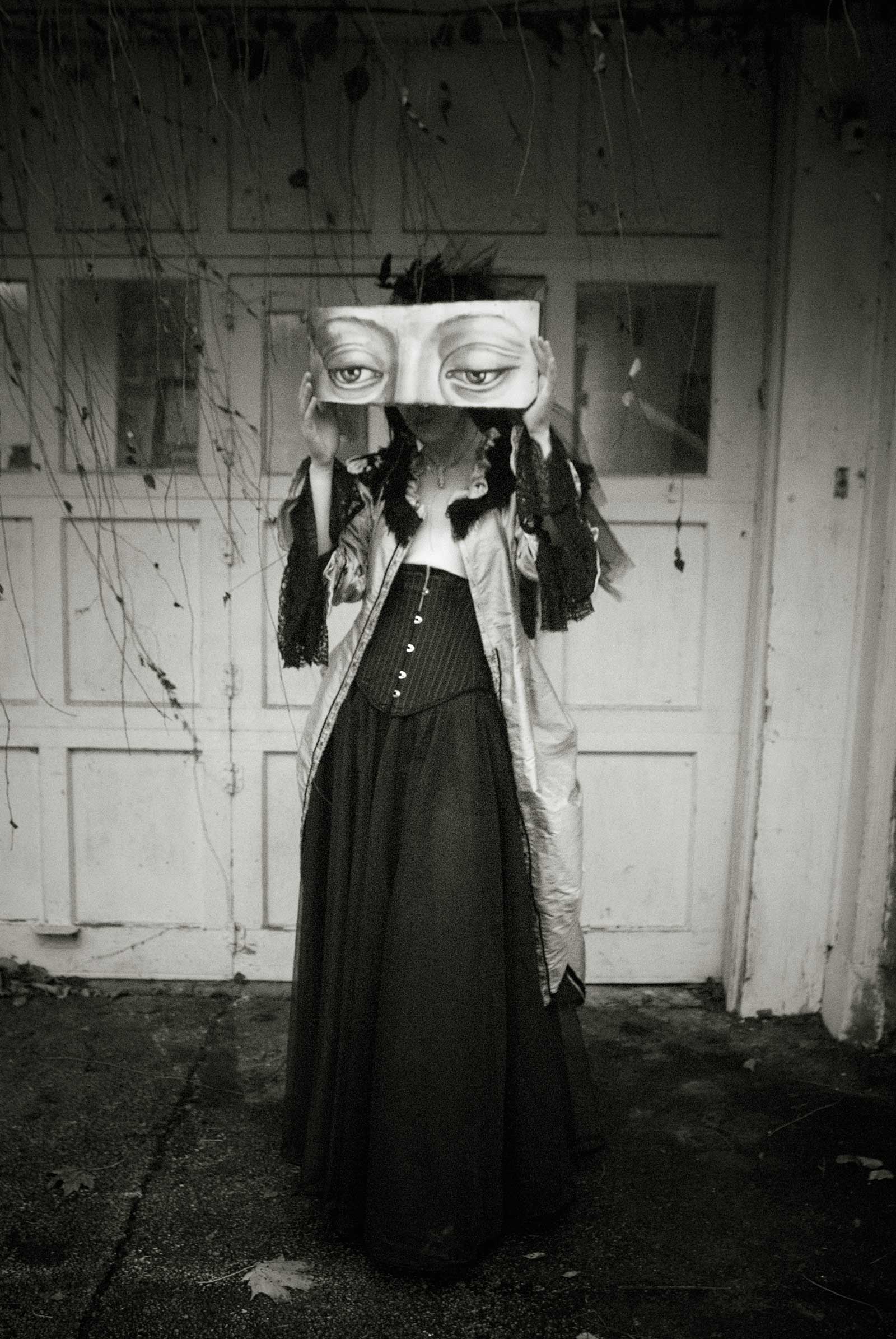 Carrie Ann Baade. Photo by Leah MacDonald.“I did want it to look like Alice in Wonderland’s tea party in hell and simultaneously the allegory of the seven sins.” says Baade. “It’s a response to Ambrogio Lorenzetti’s painting by the same name that was in Siena in the 13th century.” Her Alice wants propriety, normality and the wealth to insulate herself from the outrage of the ignoble slings and arrows of this suffering world. But she is in a Shakespearean knot of inescapable tragedy. Her Alice hopes to pretend “the world is not on fire, that the smell she’s been smelling is not her neighbors burning, and she wants to close her eyes to the things that are happening and go back to a safe place,” Baade says. Her Alice has open eyes, but would prefer not to see.
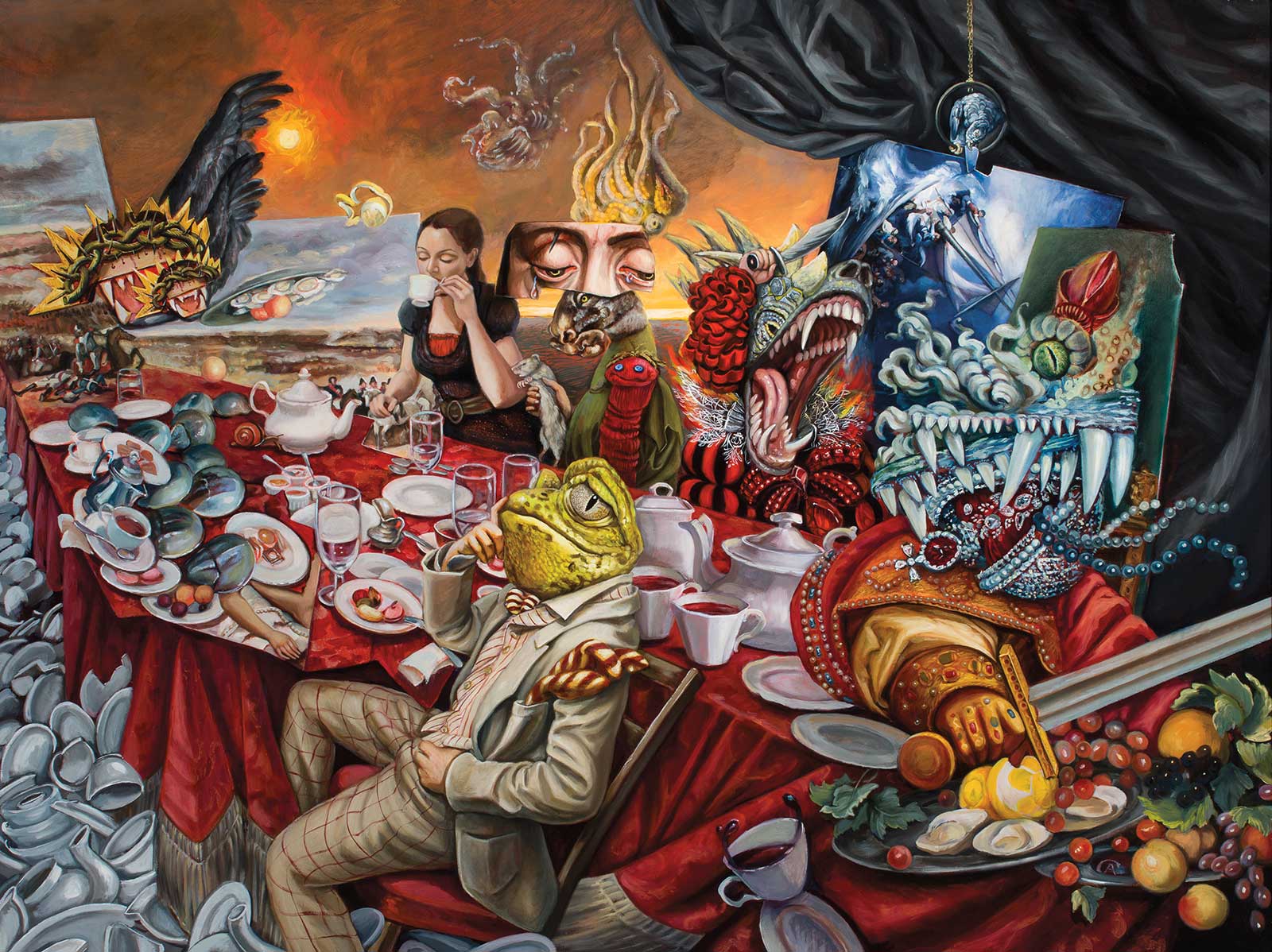
Allegory of Bad Government, 2012-2018, oil on linen, 36 x 48". Courtesy the artist.
As observer of the hum and folly of man unkind, Baade will inevitably find her critics, but this is not a sectarian requiem. Baade’s veiled painting is an allegory following the old tradition of emblem images designed with meaning, a parable providing a warning for all engaged by the spectacle of the current reign of chaos over contemporary global governance and civics. Our fall into the burrow leading to Baade’s dystopian Wonderland rides on rich historical reference, finding fine friends in artist Carl Dobsky’s biting contemporary invectives, in William Hogarth’s 18th-century satires, and in Lorenzetti’s crumbled, late-medieval frescoes of good and bad government. Lorenzetti painted his great allegories in the Sala dei Nove of Siena’s Palazzo Pubblico, where they delivered pointed reminders of the immense responsibility of honest rule, and the dangers of corruption. He worked in the governance of Siena and his criticism of the powers of the city might have been a perilous proposition. Baade shares the risk. Her work floats in the mainstream of the establishment’s waters. As an academic, she is cast as a jester at the court, and when free speech is threatened by authority the critical work of satire always walks the delicate line between commentary and crime.
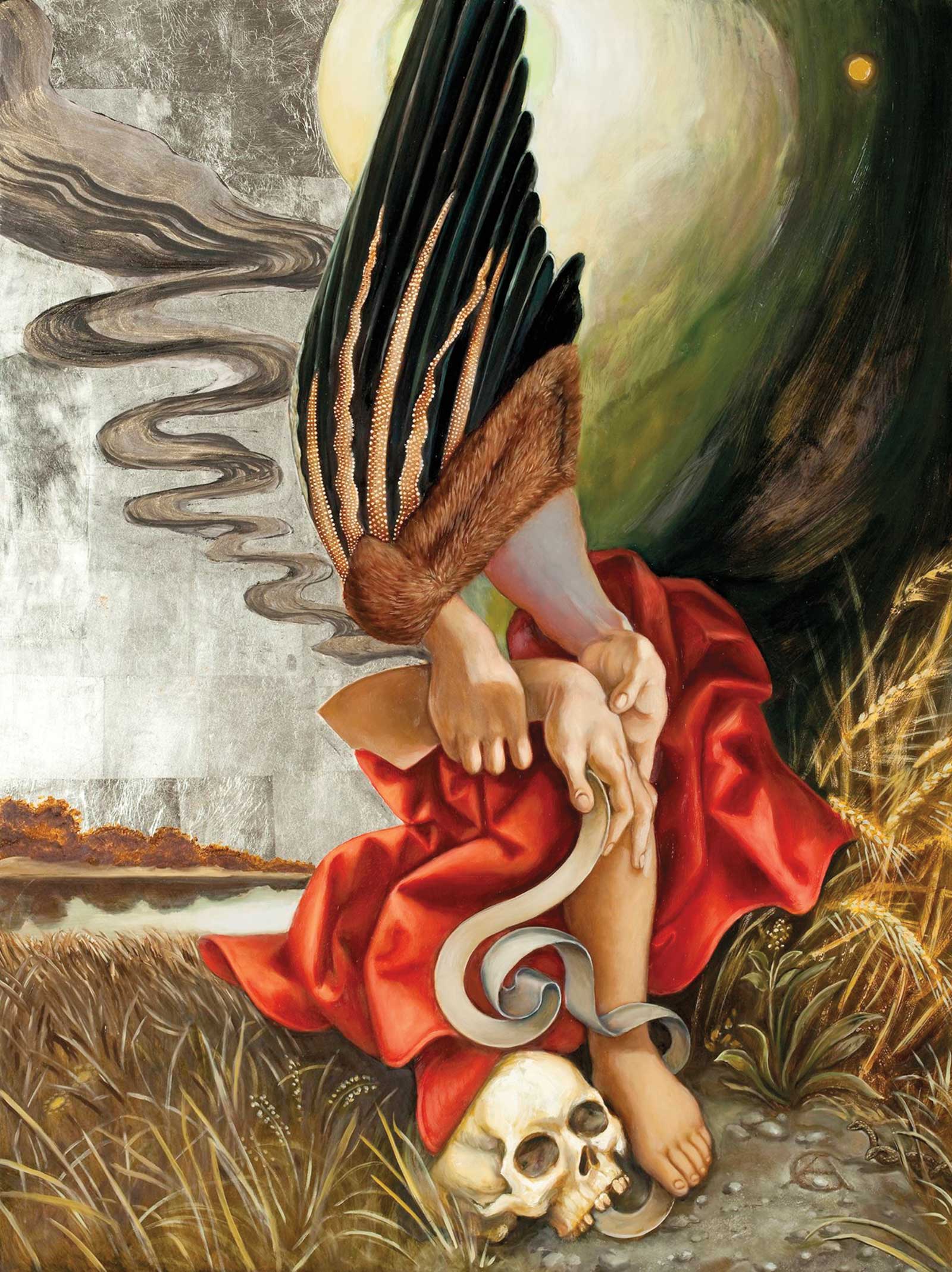
Ergot and Ashes, 2016, oil on panel, 36 x 24". Courtesy the artist.
Before she began the painting in 2012 (it would take six years to complete), Baade carefully researched the history of Lorenzetti’s images of civic critique. She explains, “I went to Siena, I interviewed people, read books on it, and really had to contemplate what bad government is—which is so much easier than figuring out good government.” The task was not simple. “The really slippery aspect of it that was so amazing was that I initially thought bad government was something outside of us, and aspects of the seven deadly sins are in all of us, but it really ended up being about internal states of mind. I think the mind is a garden and what you plant there grows.”
The path to Wonderland is a well-trod trail, but Baade avoids cliché by hinting at yet not gripping too tightly to the tropes tied to the visionary heart of Alice. In her work there are playing cards and nonsense, madness and monsters, but the Balinese demon queen Rangda stands in place of the Queen of Hearts, the ferocious ruler of her long-tongued and toothy Leyak minions, who feast on the dead, shapeshift and haunt the night as disembodied heads trailing entrails.
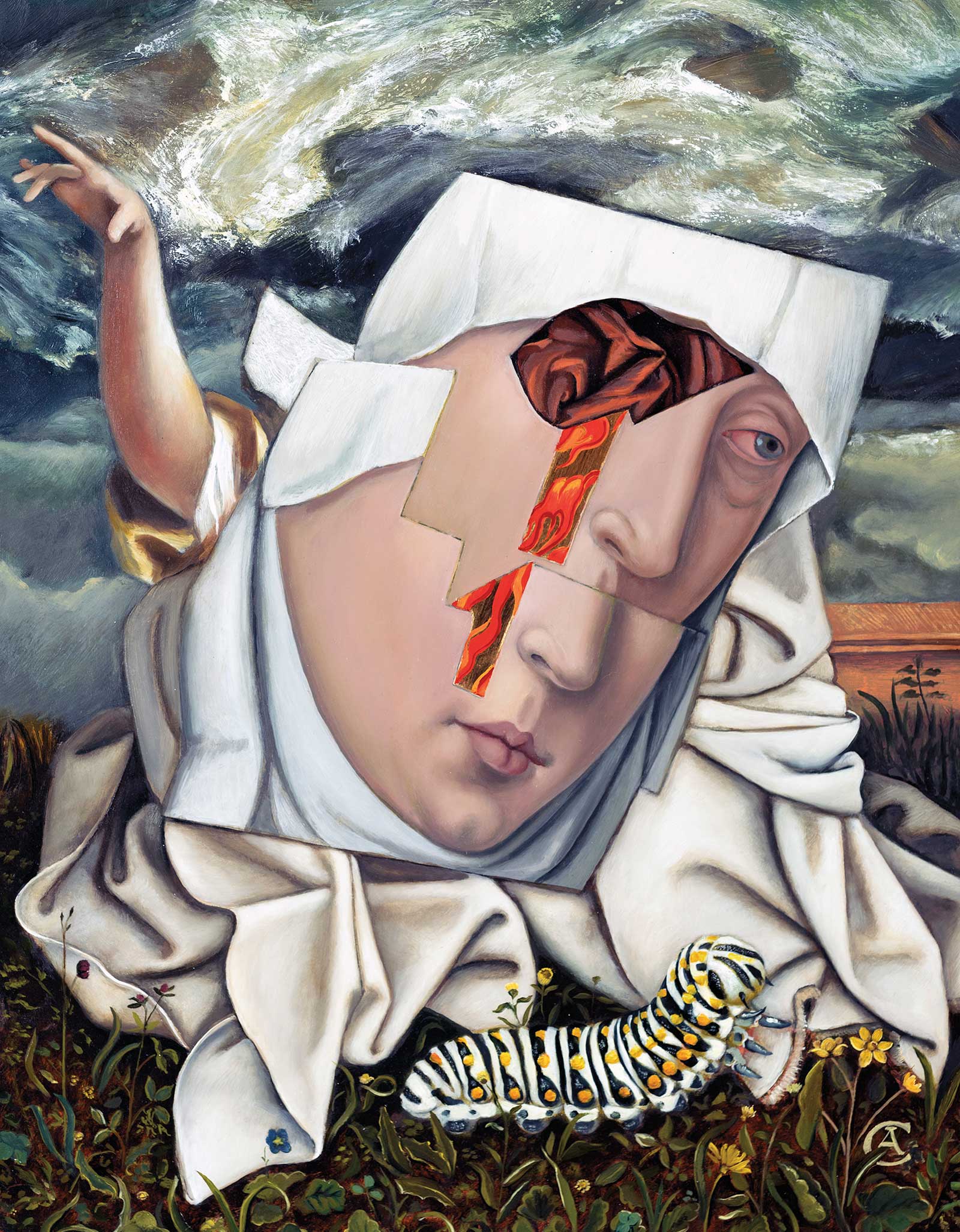
She Who Sings A Song of Self (madonna), 2022, oil on panel, 14 x 11". Courtesy the artist.
She Who Sings a Song of Self is an example of the frequent reference to her own experience. Baade confesses, “A lot of the paintings are records of consciousness.” She finds some uncomfortable. Her Self-portrait as Mephistopheles casts her in the cruel court of the auto-da-fé, where she is accused by her own brush of being the spirit to whom Faust sold his soul. It is a personal painting, a sort of confessional, and her voice tightens, “I did something bad,” she says. “It’s a record of wrongness.” A delicately rendered image of her face emerges from the center of a collaged figure built like a cadavre exquis in the surrealist tradition, the figure a mirrored queen snapped from the family flush, cut and recreated in a jumble of mask and costumes. She is being consumed by the maw of a Leyak, her mouth severed by her own scissors and replaced by the demon’s bestial teeth, her own voice stolen by the false interpretations of many tongues, the forked tongue the ancient symbol of the lie. Baade doesn’t allow credulity to enjoy the melodrama of demonology, deflating pomp and pretention with red Elizabethan ruffs and a flapping parrot, a puffball mushroom as a sign of delusional nonsense, and a juvenile drop of childish demons crossing a darkened sky of immature and ignorant nightmares. The idiot sock puppet appears again—a sure sign of deceit and devilry—creeping from behind the priestess. The painting is surely a narrative of her own witness to untruth. But mythic Faust was already damned by his own decisions before Mephistopheles gathered his soul. Mephistopheles simply revealed his perfidy and helped him find his proper place in hell.
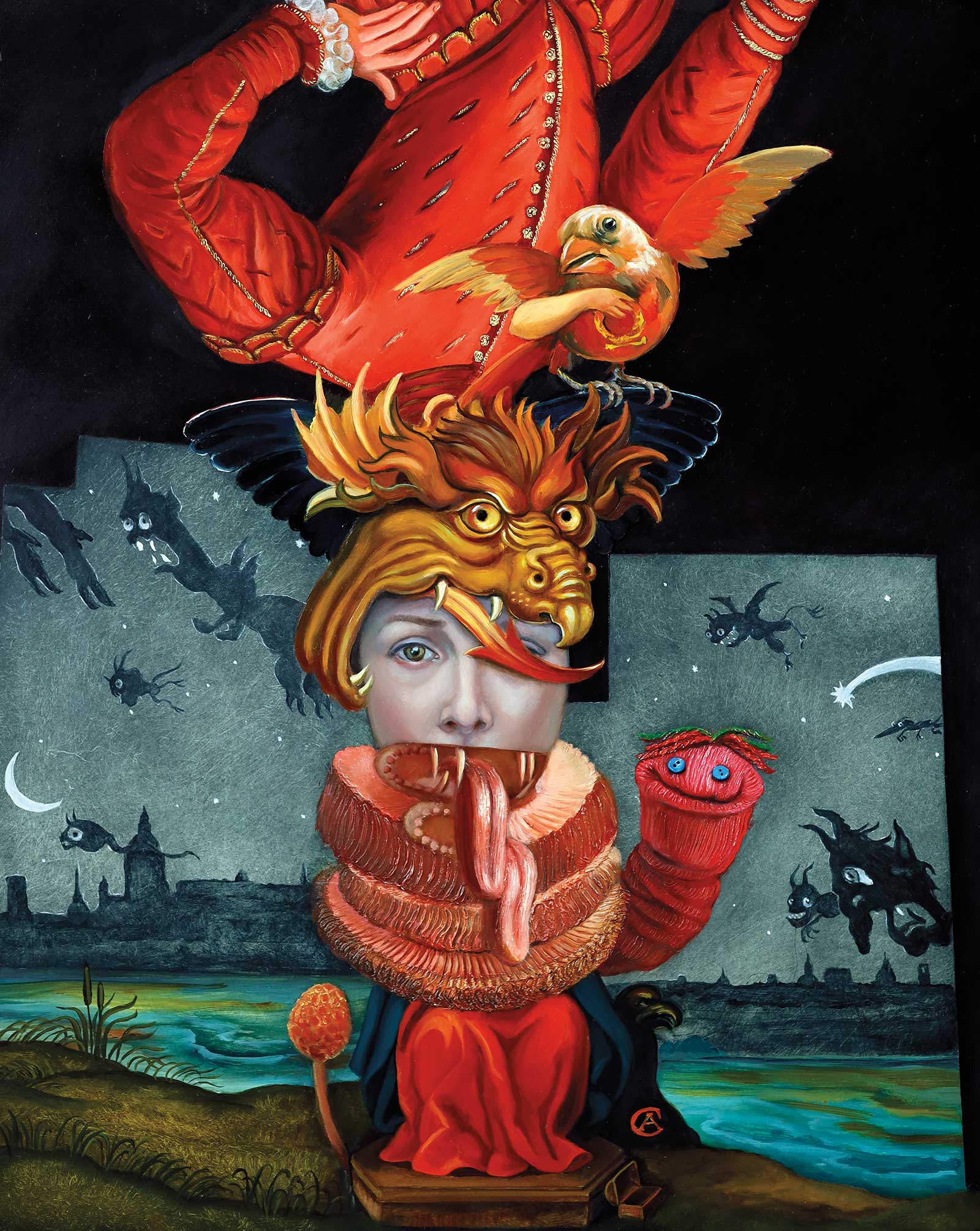
Self-Portrait as Mephistopheles, 2022, oil on panel, 24 x 18". Courtesy the artist.
There is madness in her method. The whole of Baade’s paintings appears to emerge from chaos, but order underlies the multitude of images she combines to complete each work. “I’m obsessed with scissors,” she says, and mirrors and blades are Baade’s tools as she begins her work. “I have a bin of collage material, and it has to be stoked because when things come out it’s depleted, so I’ll have to put new images in, and I’ll put all of it on the ground of my studio, so it’s a bit like tea-leaves, or an element of picking up cards, but I approach it with a question, and then I’m looking for things to illuminate within it that answer the question. Then once in a while something will get stuck together that’s absolutely sublime, but I realize that things I’ve put into the bin are pre-selected. It’s not completely random.” She builds a base of composition with clever clips and cuts, sketching with careful snips, then later painting from the patchwork of imagery. But the instinct and mask of surrealism cannot hide Baade’s intelligence.
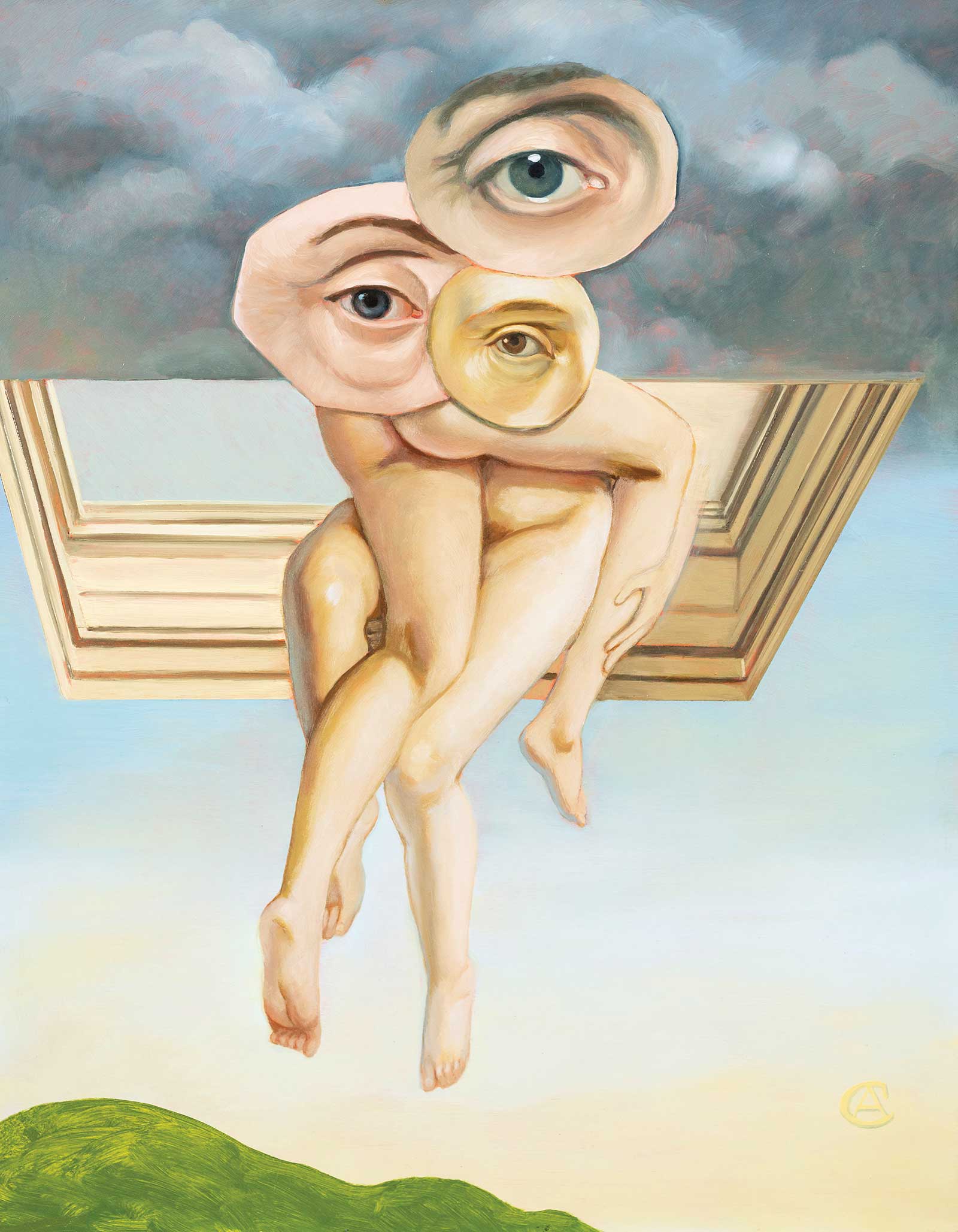
With Lovers Eyes, oil on panel, 2022. 14 x 11". Courtesy the artist.
André Breton and his circle hoped to break from convention, to find within subconscious meaninglessness a new mind for an utopian era guided by the hand of Marx, but allowed the chaos and clouds of random imagination to outweigh the power of interpretation. Baade is a latter-day surrealist saint, although her imagery is more sophisticated than any random juxtaposition of objects plucked from dreams and memories which formed aesthetic foundations for Breton’s clan. The well Baade has dug into the history of symbolism is more deliberately conceived than their haphazard contrasts, and runs deeper than the White Rabbit’s burrow. She explains, “We’re making incredibly synergistic configurations, and have knowledge at such a subliminal level that if you prompt the brain with a question, it’s seeing things that your conscious mind isn’t. It has a god-like interface in its sublime capacity to do things in a fraction of a second.”
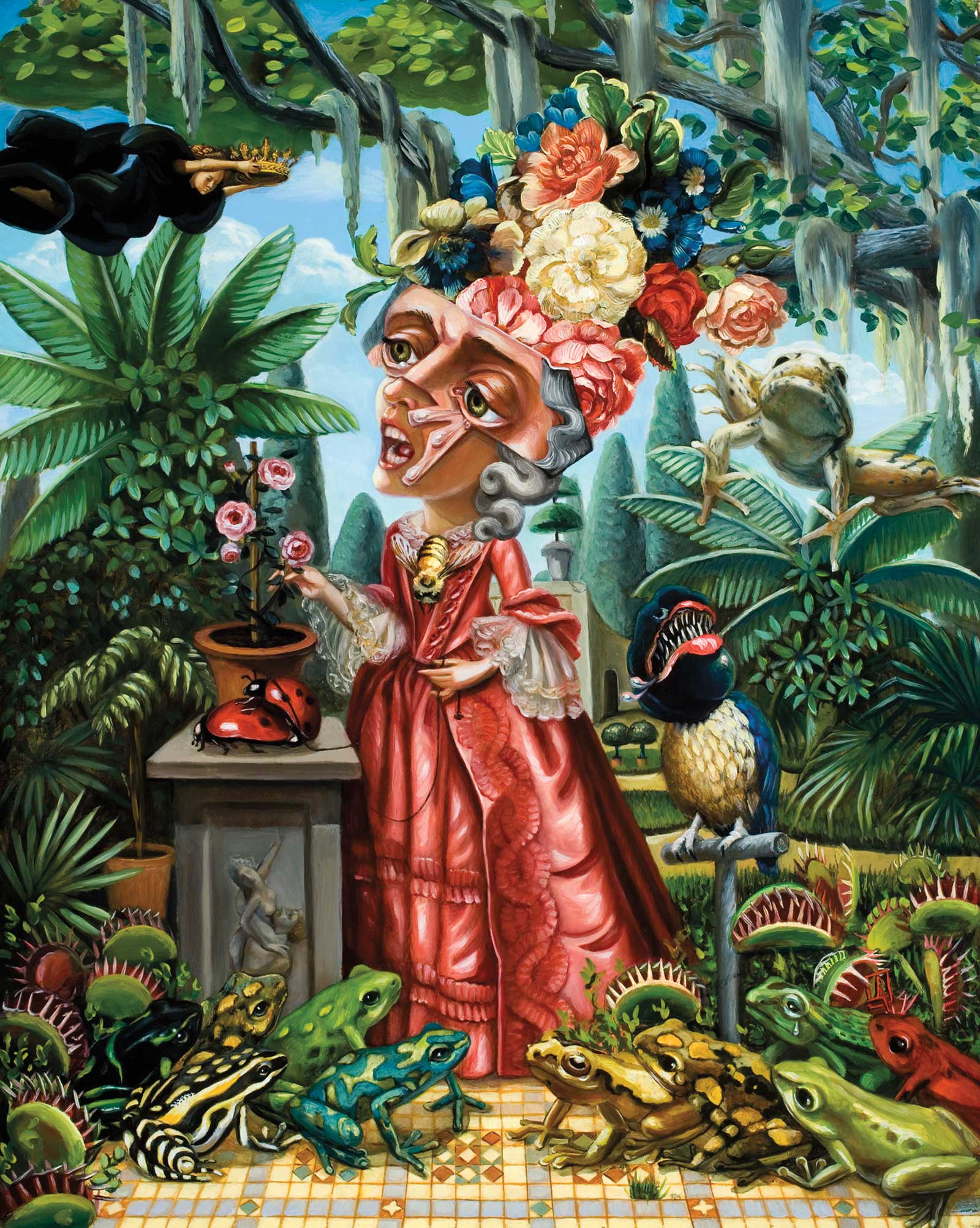
The Plague, 2008, oil on linen, 20 x 16". Private collection.
Baade is a champion of intelligence, taking her cues from the crafty artisans of the Renaissance who used subtle symbols to criticize society and guide a path to the ethical life. “Symbols speak through us,” she says, “I don’t like the word ‘channeling.’ I do think matter has consciousness, and I do think symbols have intelligence and form. As an artist who works with symbols, if I open myself up enough, I’m listening, I’m not just telling them. Is that a dialogue? Jung calls archetypes horizontal moving animals that move through our consciousness.”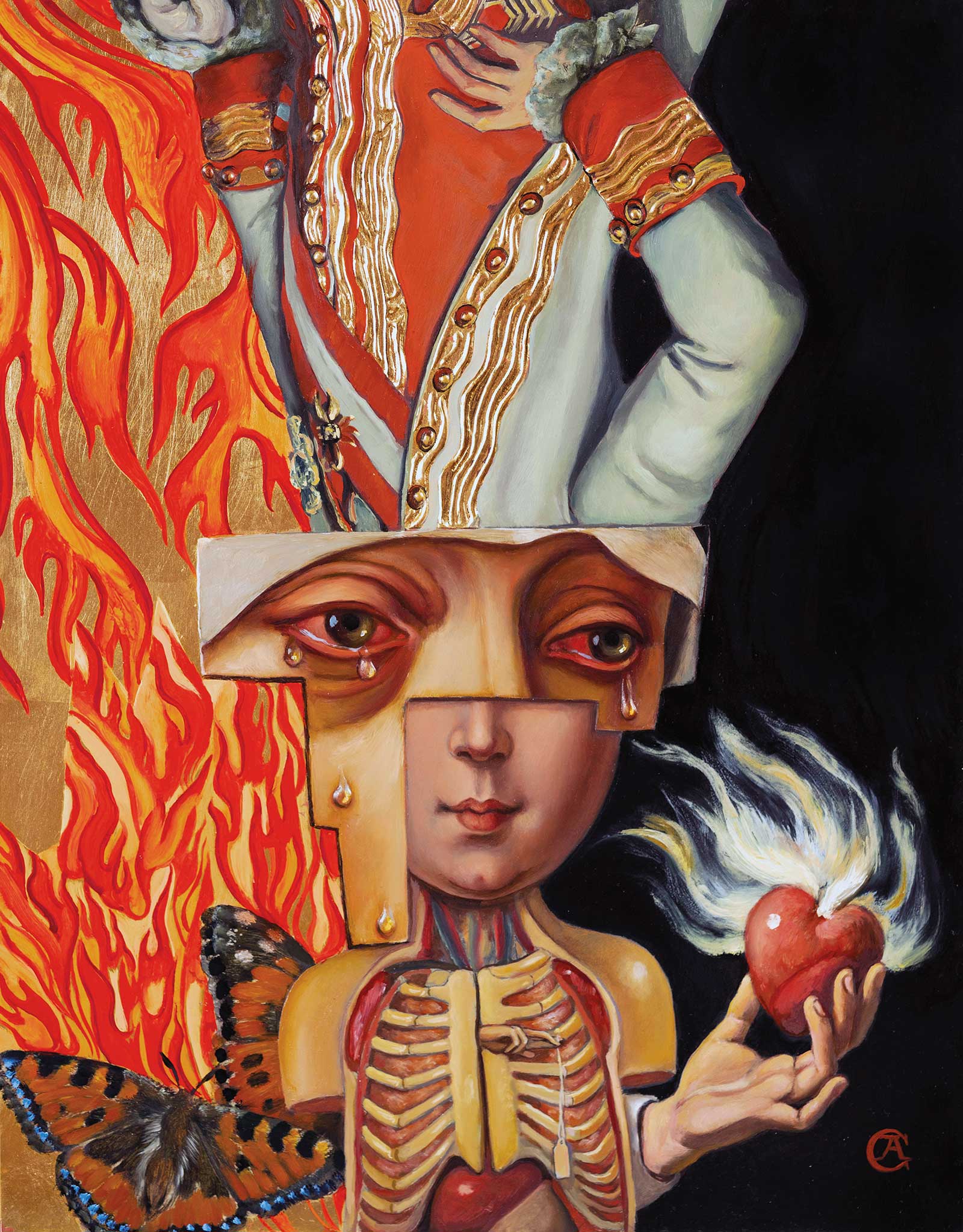
Her heart did whisper that he had done it for her, 2022, oil on panel, 12 x 9". Courtesy the artist.
Like the surreal dramatist Antonin Artaud, who was loathed by Breton for rejecting his authority and taking the perilous road less traveled into individual freedom, independent Baade has made her own metaphysical journey to dance with the Tarahumara, traveling into a living landscape where the earth is full of meaning, and the sensual world kisses itself at the threshold between perception and imagination. Ergot and Ashes reminds her audience that to live, the self must die and be reborn. Those who have eyes to see, can see. Baade loves Moreau. She says, “…if you’re at the intersections of things and you’re not at the epitome, then hopefully you’re more liminal, and you’re bridging between worlds, as opposed to just illustrating the epitome of one concept.”
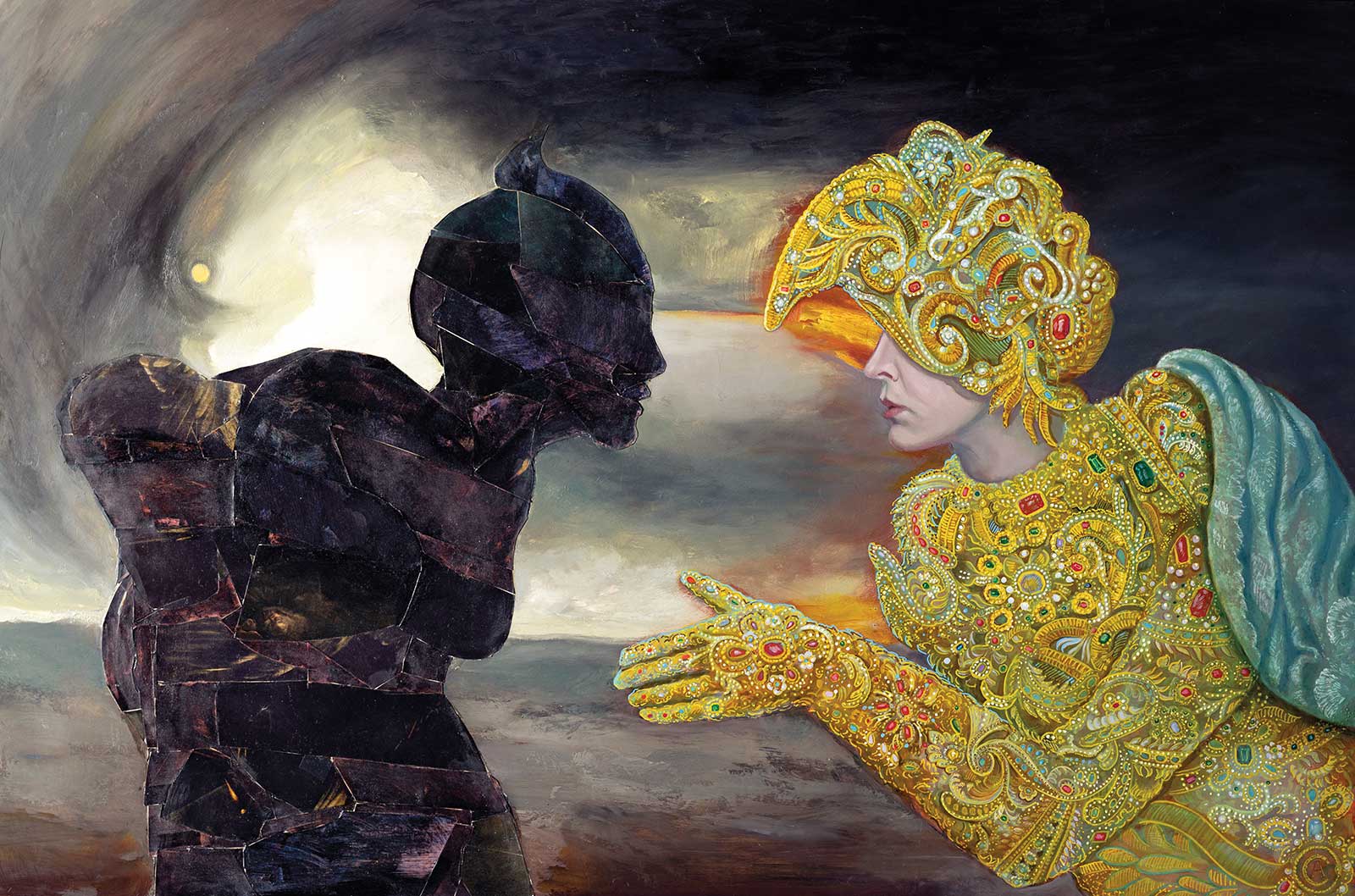
Light and Shadow, 2022, oil on panel, 24 x 36". Courtesy the artist.
The grand expanses and operatic dramas of masterworks like the magnificent Allegory of Bad Government are sensory spectacles destined for museum walls as exemplars of Baade’s achievement, but smaller, less overwhelming paintings in the exhibit are nevertheless fated to be important records of her work. She has deliberately entered the narrative of art history, quoting from past masters and applying her knowledge of their achievements to her imagery. In With Lovers Eyes, Baade takes two lesbian lovers wrapped in a tender embrace from Courbet’s erotic painting The Sleepers, and turns them into a mirrored transfiguration, ascending with pointed toes into the heavens through a frame in the sky—itself a classic surrealist icon borrowed from Matisse and reinvented—while three snipped eyes gaze wide over the scene. She leaves her viewers to answer the question of whether these are the traditional and tripled eyes of emblemed God, or those of a triangle of lovers slipped from 19th-century lockets, but images of eyes always ask who is watching who. To Baade, first and second sight are both inward and outward gifts of light and dark, looking above and below, seeing many sides of life, and she is witness to mirrored worlds. It is sensual, this metaphysical space of lovers. She says, “My predilection as an artist has been to be someone who is working with their eyes shut, it’s all a world of the mind, not necessarily dreaming…it’s a conscious mind with the eyes shut, this visionary world, this world of imagination.” —
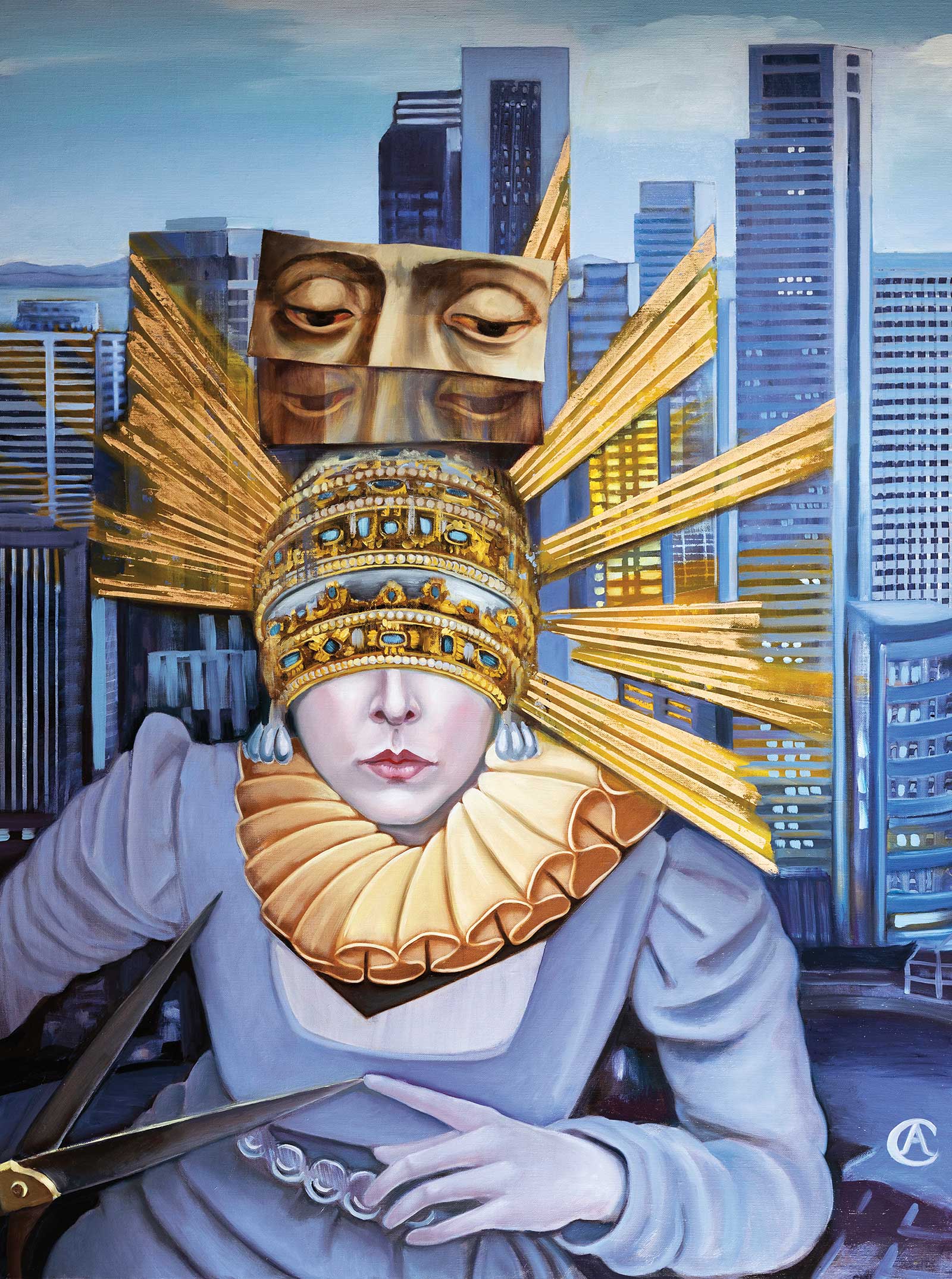
Atropos, 2022, oil on linen, 48 x 36". Courtesy the artist
Carrie Ann Baade: Mirror Worlds
Through November 24, 2024
Museum of Art – DeLand
600 N. Woodland Boulevard DeLand, Florida 32720
(386) 734-4371, www.moartdeland.org
+++
Michael Pearce is a dynamic writer, curator, and critic, and a champion of art that emerges from popular culture and shapes the spirit of the age. He has published hundreds of articles about art and artists, and is author of Kitsch, Propaganda, and the American Avant-Garde. He is Professor of Art at California Lutheran University.
Powered by Froala Editor