While the art of portraiture was once used to depict religious figures, as well as wealthier individuals to immortalize their place in history and society, the genre has beautifully evolved to include so much more dynamic artistry.
Historic artists who were known for their portraiture—John Singer Sargent (1856-1925), Leonardo da Vinci (1452-1519), Johannes Vermeer (1632-1675) and Vincent van Gogh (1853-1890), as well as modern artists like Andy Warhol (1928-1987) and Chuck Close (1940-2021)—explored different stylistic avenues that have advanced public perception on what “the portrait” really is—and can be.
Famous 20th-century artist Alice Neel (1900-1984) was known for her portraits that had “deliberate distortion, bold outlines, expressive brushwork and imaginative use of color,” says Romy Silver-Kohn, the Museum of Modern Art research assistant, department of painting and sculpture. “Neel gained her subjects’ trust by inviting them into her home and telling them stories…She trusted them, too, enough to temporarily lose herself, saying, ‘I come under the spell of a person—out of myself into that other,’” Patricia Hills writes in her book Alice Neel. In this same vein, Neel often used her artwork as therapy to process her experiences and losses.
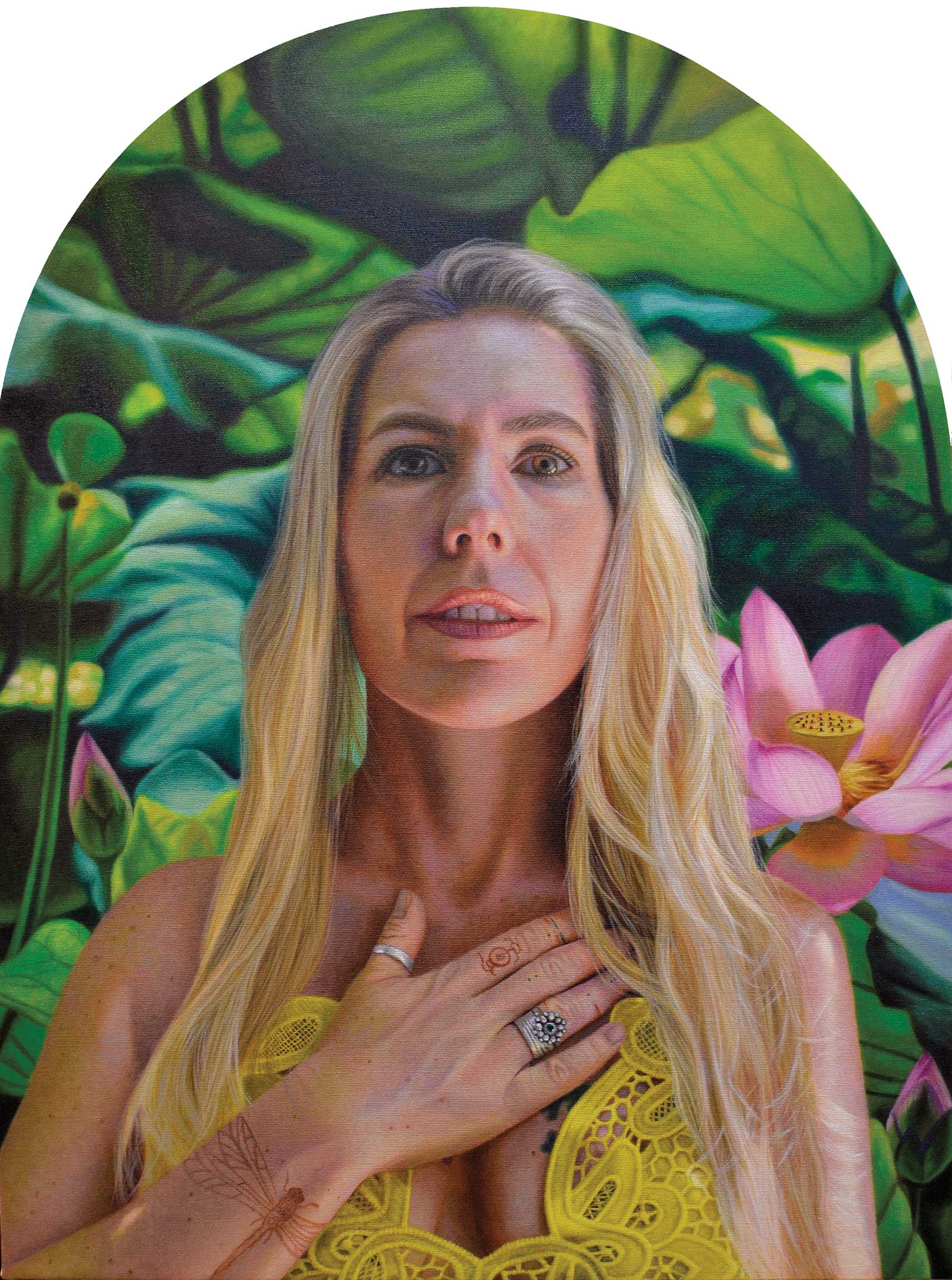
Diana Carolina Lopez, Kate’s Resilience, oil on canvas, 32 x 24”
Silver-Kohn continues, “[Neel's] dedication to the belief that people are worthy subjects, both as individuals and representatives of the spirit of their age, was finally rewarded in the last decade of her life, when she began to receive widespread recognition.”
Today, we see a plethora of female artist’s making a name for themselves within the genre—exploring, celebrating and examining the human face and form through their own unique lens. Diana Carolina Lopez finds peace within works like Kate’s Resilience—exemplifying the artist’s inspiration to create “different self-reflections about human elements that move us to relate to each other, and to generate complex social and psychological structures in order to achieve it.”
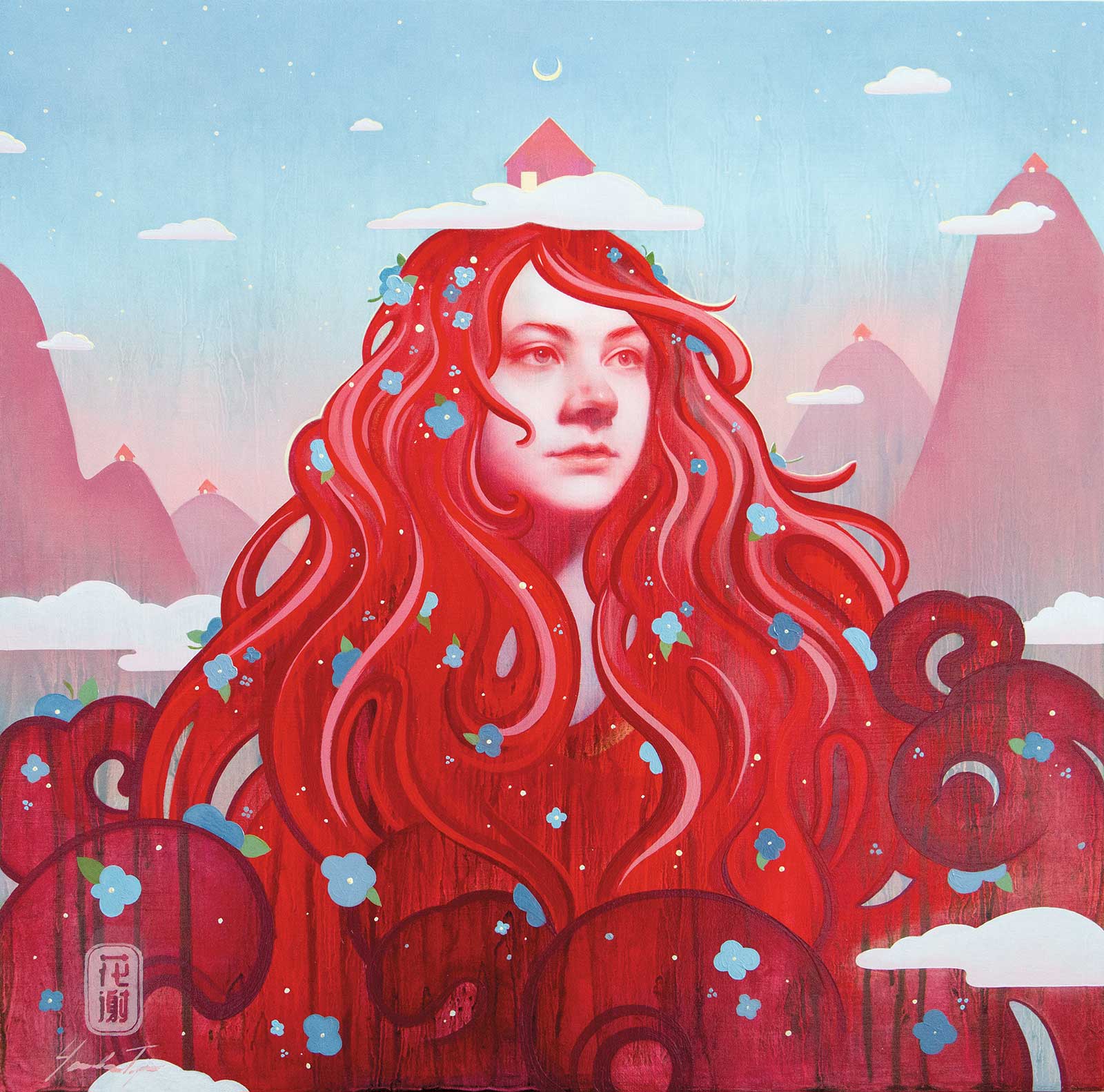
Hannah Tjia, The Moon and the Mountain, oil on wood, 12 x 12”
Lopez says of her subject, “When I met Kate, I was impressed by her energy, and seemed to me like a genuinely nice and kind person. We got along immediately, as if we had known each other for a long time. She shared her life story with me, how she had healed her wounds and strengthened her relationship with her mother…Her tattoos are full of stories, but the one that captured my attention the most was the one with the lotus flowers that she has on the back part of her arm. When I asked her for its meaning, she told me that it came from the capacity they have to arise from deep waters, as a metaphor of the resilience we can have as humans.”
Artist Hannah Tjia combines her portraits with illustration and decorative design, found in paintings like The Moon and the Mountain. “Figurative art and portrait painting has always had a special place in my heart,” she shares. “I think there is something so satisfying and magical about depicting the human form that never loses its charm. In my paintings, I love to experiment with whimsical and fantastical designs and creatures, but I always find myself returning to the figure as the main subject for its timeless elegance, and rhythmic subtleties and complexities.”
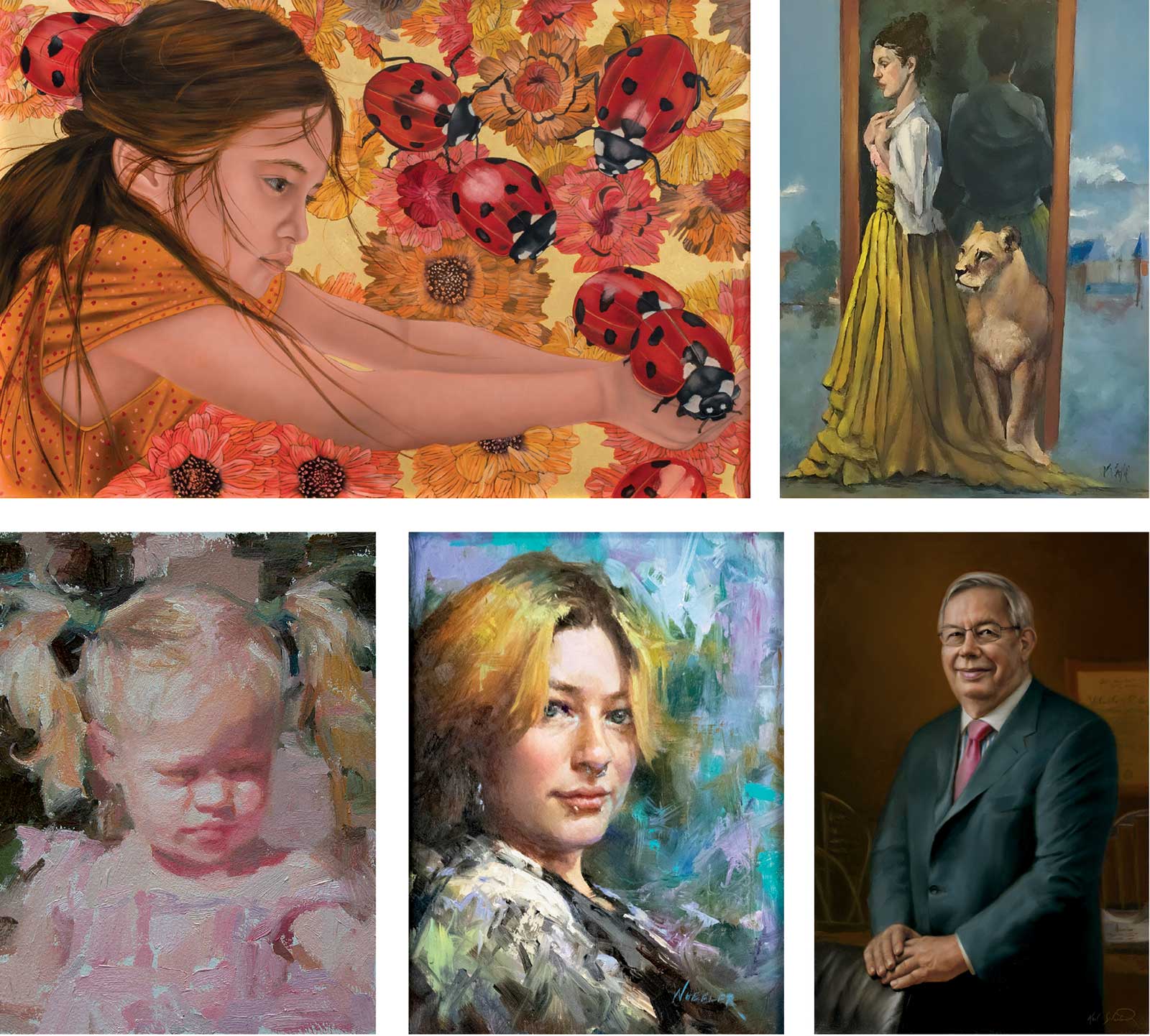
Top: Blue Rain Gallery, Journeying, oil and gold leaf on aluminum panel, 20 x 30”, by Robin Jones; Linda Leslie, Claire, oil on aluminum, 20 x 16”. Bottom: American Impressionist Society, Halley, oil, 12 x 9”, by Matt Linz; American Impressionist Society, Sabine, oil, 12 x 9”, by Kathie Wheeler; Karl Soderlund, Chairman, oil, 36 x 24”
“Portraiture is about so much more than likeness,” adds artist Ruth Fitton. “Every image we create is a frozen moment which implies the existence of a past, a future, a narrative for the person we are portraying. We are storytellers, whether we realize it or not. The stories we tell, and the differing ways in which we tell them, are what makes portraiture so magical as an art form.”
Fitton’s piece Sentinel, encapsulates a narrative that hinges on the gaze of the figure, which is fixed steadily on something the viewer cannot see. “She ignores the wind, the noisy motion of the gulls and the light breaking through behind her,” says the artist. “By surrounding the figure with this sensory onslaught, I was able to emphasize her poise, and the steadfast patience with which she keeps watch.”
Through the remainder of this section dedicated to the portrait genre, you’ll hear more compelling insights, stories and collecting advice from artists, galleries and institutions that are keeping portraiture alive and well.
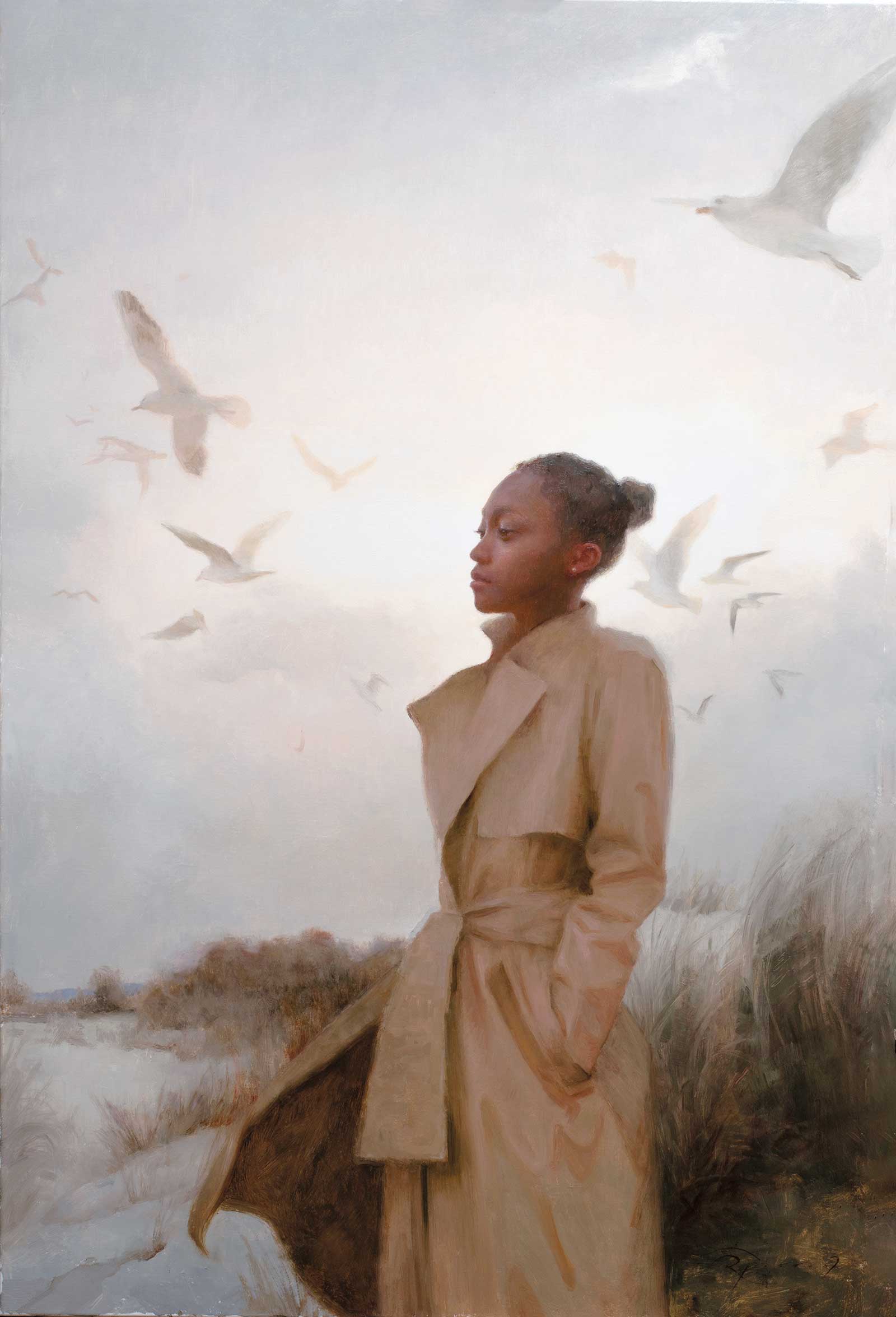
Ruth Fitton, Sentinel, oil on linen, 48 x 32”
Artist Robin Jones, represented by Blue Rain Gallery in Santa Fe, draws inspiration from the profound interconnectedness of all living beings and the pressing realities of global climate change and mass extinction. “Her figurative paintings, often depicting girls and women at the forefront of ecological and animal rights movements, aim to evoke empathy and compassion,” says Merlinda Melendrez, Blue Rain’s director of sales. “By highlighting the commonalities across cultures and emphasizing the shared impact of environmental decisions, her art aspires to be ‘portraits of the future.’ Jones’s use of non-conflict metal leaf adds a reverential quality, reflecting her commitment to ethical practices. Her background in theater deepens her appreciation for storytelling and human diversity, driving her to create art that compels viewers to consider their relationship with the natural world and the impermanence of life.”
When collecting figurative and portrait art that focuses on the natural world and environmental themes, “seek pieces that resonate deeply with your values and experiences,” says Melendrez. “Look for artists who use ethical practices, like non-conflict materials, to ensure your collection reflects a commitment to sustainability. Prioritize works that evoke empathy and provoke thought about our relationship with the environment and other species.”
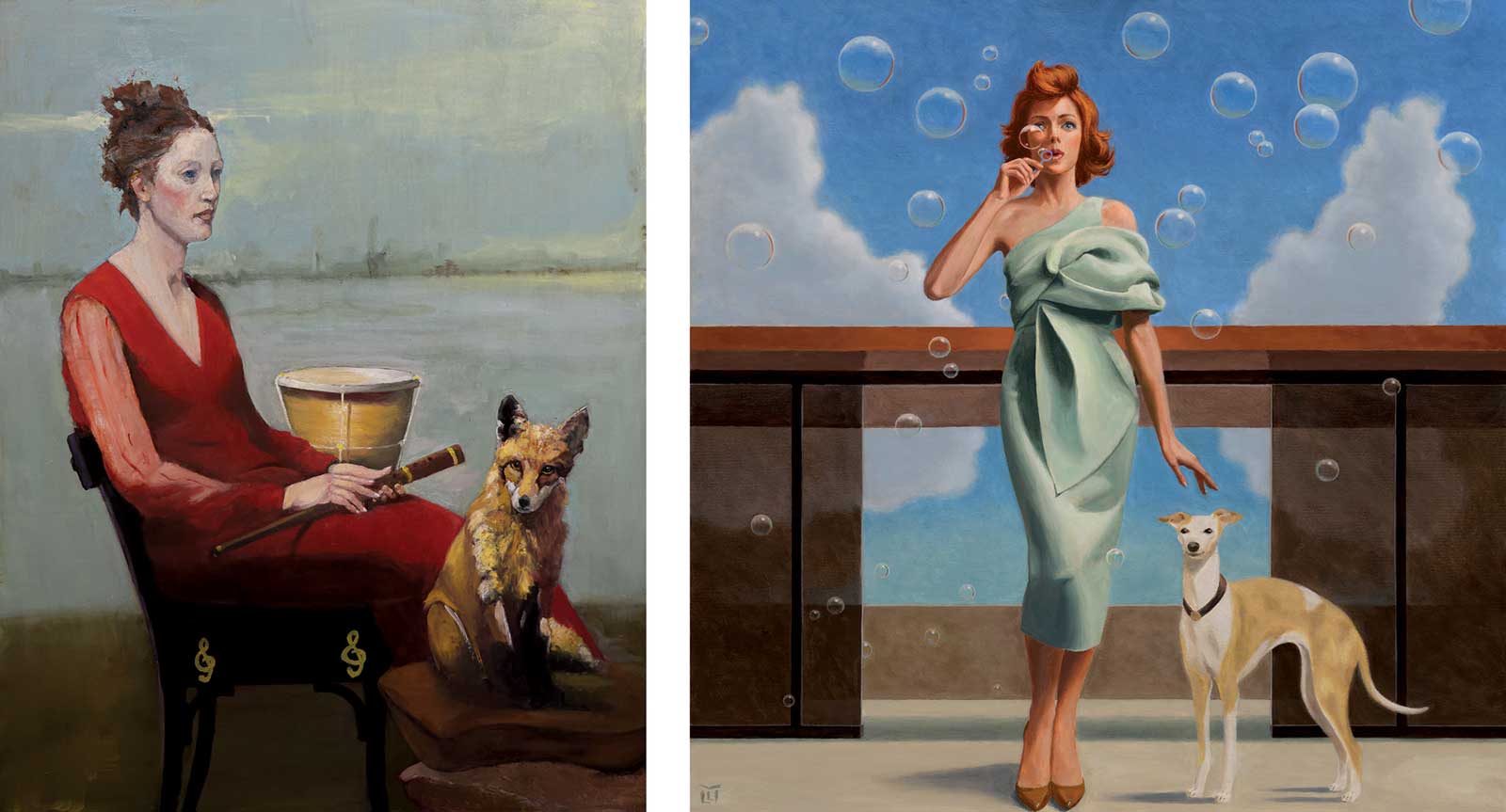
From left: Linda Leslie, Sarah, oil on aluminum, 40 x 32”; Lawrence McAdams, Effervescent, oil on canvas, 36 x 36”
Artist members of the American Impressionist Society apply their talent to many different genres, including portraiture. Executive director Liz Ahrens, notes that some collectors shy away from purchasing portraits, yet “at many AIS exhibitions, portrait work is sought after by many discerning collectors, looking to create a balance of imagery.”
AIS artist Matt Linz shares that he’s passionate to capture the essence and beauty of the world around him. “I’ve always found myself drawn to painting portraits. It’s not just about capturing a likeness, it’s about trying to capture the essence of a person,” he says.
Susan Hotard considers drawing very important, “as it is the armature underneath the subject,” says the AIS artist. However, rather than rendering a photographic record, she strives to create a unique interpretation of it. The catalyst might be the light cast or a gesture in the pose.
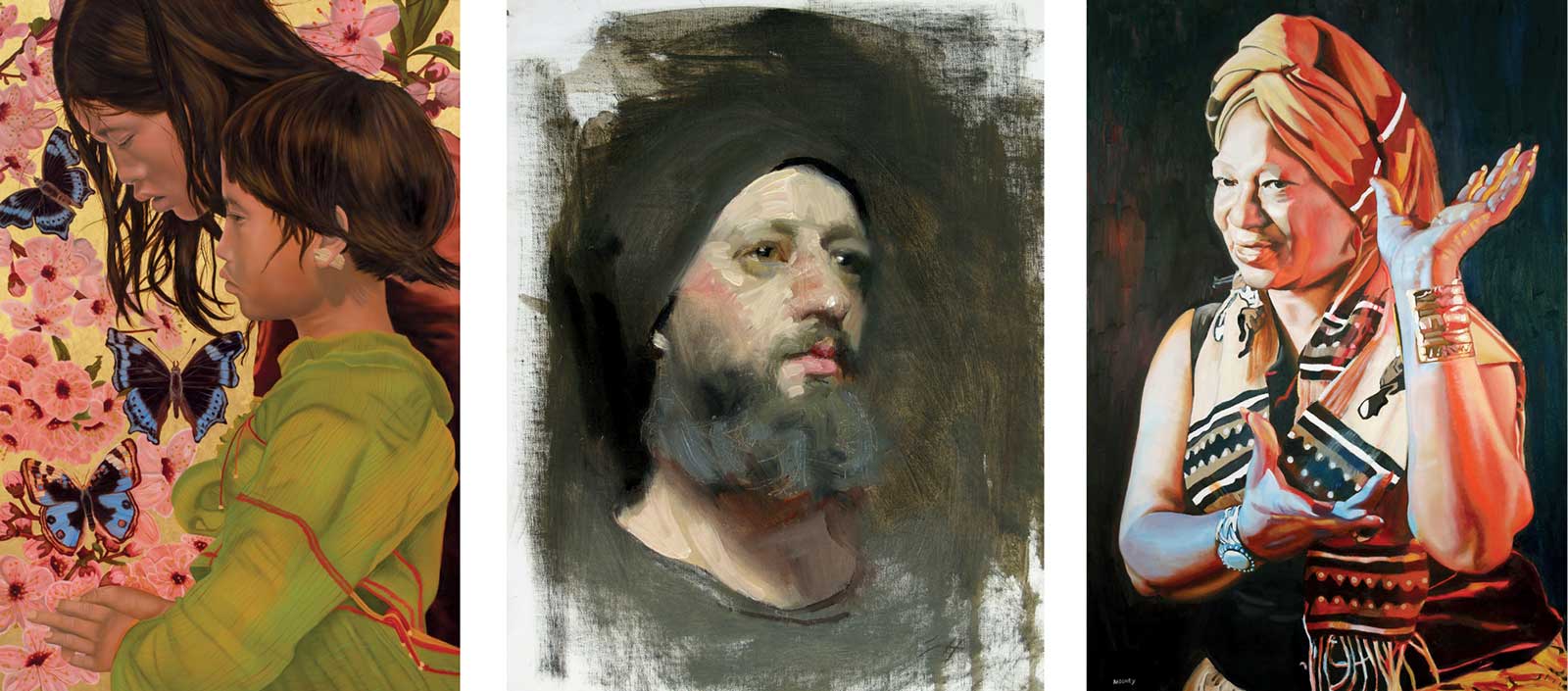
From left: Blue Rain Gallery, Meditation on the Holocene, oil and gold leaf on aluminum panel, 36 x 24”, by Robin Jones; American Impressionist Society, Jared Alla Prima, oil, 16 x 12”, by Susan Hotard; Christopher B. Mooney, Haoua Cheick, oil on canvas, 52 x 36”
Another AIS artist, Kathie Wheeler, shares that her paintings reflect the scenes and people in her daily life. “A portrait is an heirloom to be cherished,” she says. It can celebrate one’s life work, honor a loved one or capture the fleeting essence of a child.”
Karl Soderlund started out painting land- and seascapes until he discovered portraiture. “Over a period of several years, while my portrait paintings matured, I experimented with incorporating symbols into my art,” he says. “I soon began to develop a painting style with symbols that has become my own. While painting portraits, it became clear to me that developing a relationship with the subject was an important part of the process in making a painting successful...Coincidentally, as I began to experiment with symbols, I also discovered that I was able to share my relationship and understanding of the subject with the audience. As a result, each painting has their own unique story to tell.”
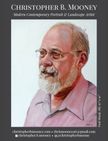
Christopher B. Mooney was born and raised on Long Island, where he was surrounded by a talented family of writers, musicians and architects, as well as New York City’s vast art scene.
Known for his wide-angle paintings of Oregon’s bridges, Mooney currently focuses on portraiture. Like many other artists throughout this section, painting portraits allows Mooney to get to know his subjects more intimately and utilize his talents more deeply. “I bring my subject’s emotional undercurrents and inner self to the surface,” says the artist. “My technique aligns with the Old Masters, but my paintings have a modern feel with contemporary ambience. I’m able to capture each sitter through careful brushstrokes.”
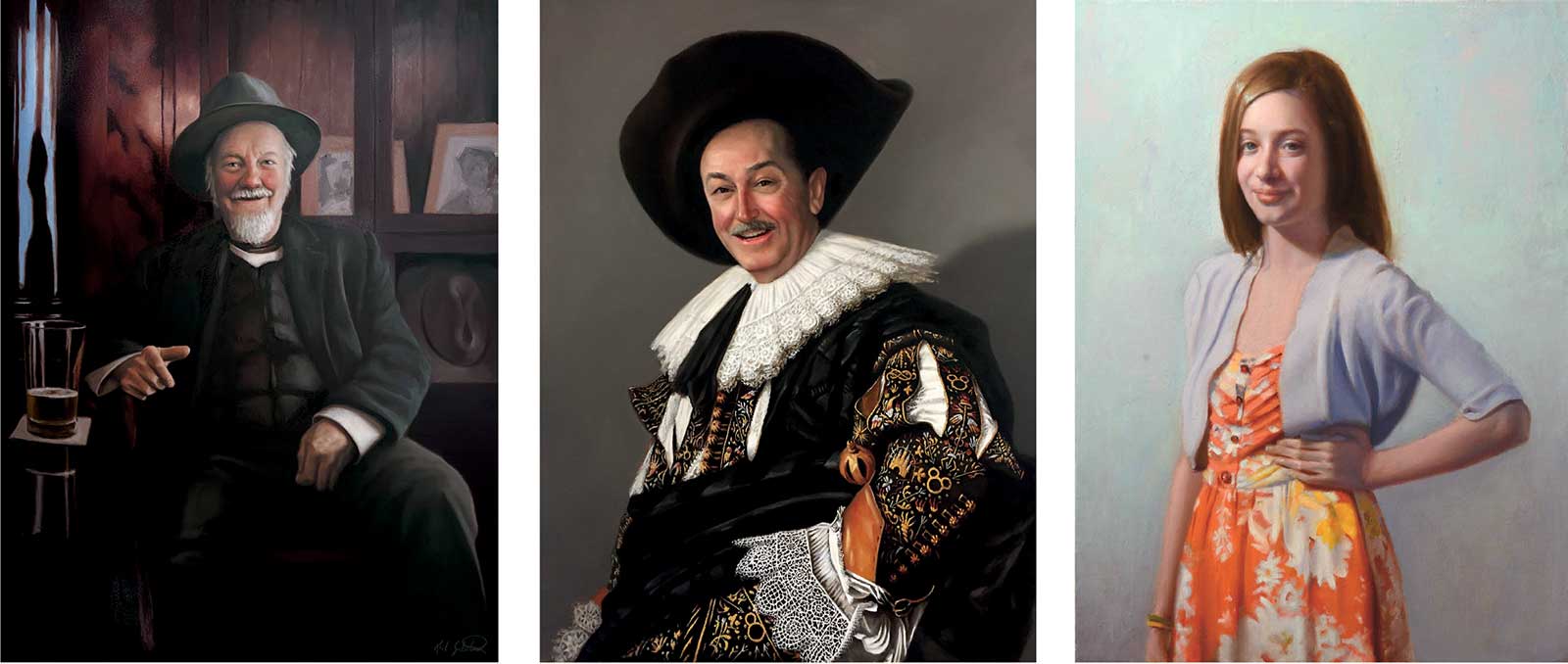
From left: Karl Soderlund, George (at the New Sheriden Hotel), oil, 40 x 30”; Karl Soderlund, Walt Disney (The Laughing Cavalier), oil, 40 x 30”; Sivananda Nyayapathi, Natalie, oil on linen canvas, 24 x 18”
“I love painting portraits, especially those that include a story that highlights something important to the subject’s life,” says artist Lawrence McAdams. “And although a lot of my paintings include lakes, streams, oceans and waves, this focus is more about living in a southern California coastal town for several decades than any particular theme. In addition, I am thrilled to share the news that my painting Effervescent has been acquired by the esteemed Hilbert Museum of California Art.”
McAdams also shares the captivating story behind Effervescent. “It began when I met the talented London Vale, at the Bowers Museum art opening, where we both had the privilege of being juried into the California Gold show. London, an accomplished artist and actor, mesmerized me with her Academy Award-style dress. Her modeling inspired the creation of Effervescent, a piece filled with mid-century modern architecture, a graceful whippet and a sky filled with playful bubbles. I just tried to capture her ‘effervescent’ personality!”
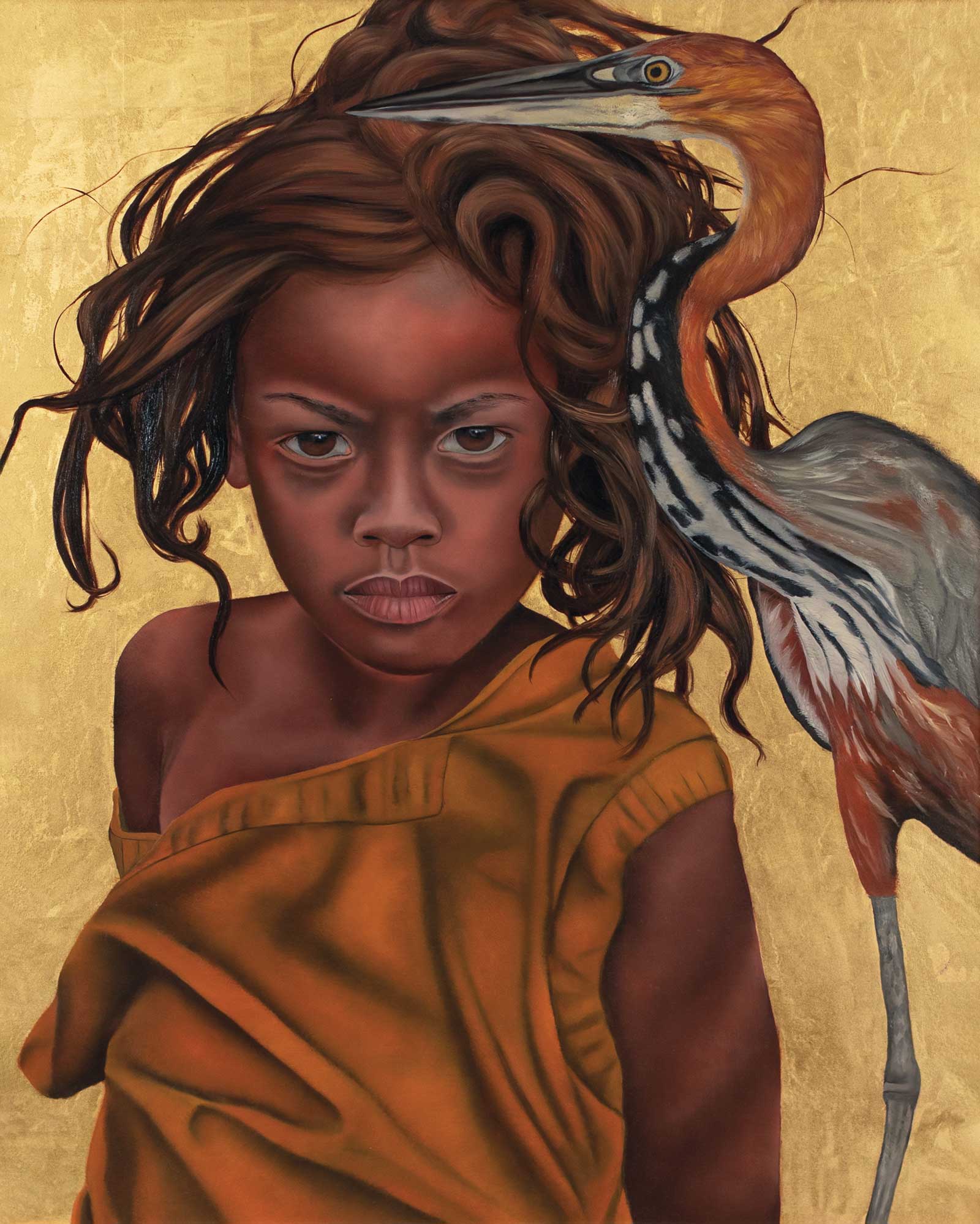
Blue Rain Gallery, Stealth Game, oil and gold leaf on aluminum panel, 30 x 24”, by Robin Jones.
Nothing inspires Loretta McNair more than people, their facial expressions, personalities hidden in their features and gestures, and the challenge of capturing exactly who they are on canvas. “The technical matching of skin colors, shadows and ambience that results from color mixing is also a constant intrigue,” she adds. “I never tire of the process. I love being able to include an object or background scene that portrays my subject’s life-purpose, if possible, and making every aspect of a portrait meaningful. It’s incredibly rewarding to be able to meet different people in life, hear their stories and paint them—knowing that what I leave behind will be the cause to tell many others those stories.” McNair’s portraits have been finalists in many art competitions, including those hosted by the Portrait Society of America, where she has been a member for almost 10 years.
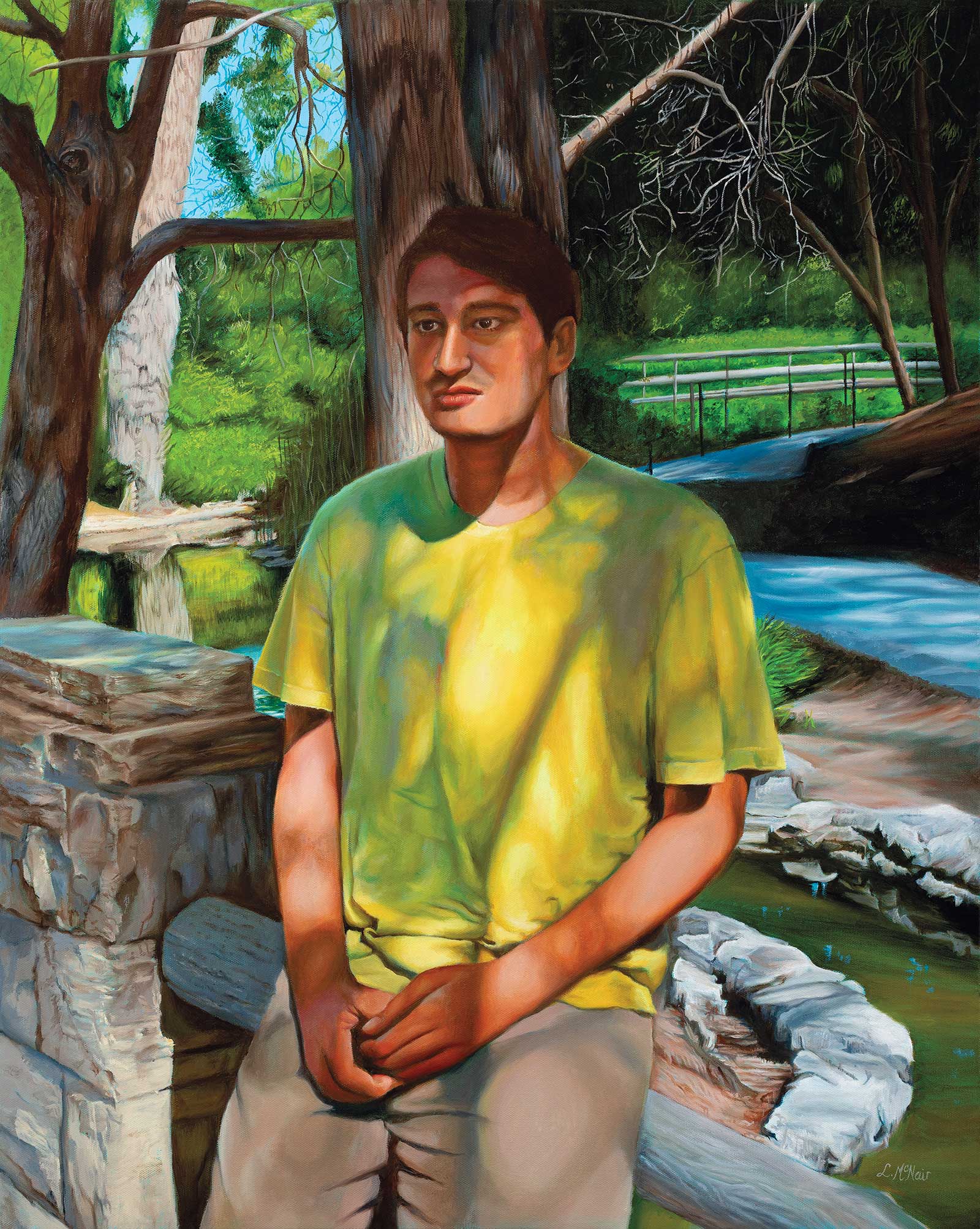
Loretta McNair, Yaron, oil, 30 x 24”
Sivananda Nyayapathi believes that art is the innate nature of humans. “It is one of the most natural ways of communication. Everyone drew as a kid,” he says. “As the kid grows, he or she develops other interests and drawing takes a back seat.” However, Nyayapathi continued with his interest in drawing. The reason could be that there was inspiration right at home—his father was an accomplished artist too. Nyayapathi learned to draw and paint with watercolor from his father for many years and started painting in oils while pursuing his studies in engineering. Today, Nyayapathi is recognized as an Associate Living Master by the Art Renewal Center. He is also a Signature Member of Oil Painters of America. He has also been honored with both the Maitri and Vamsi awards for excellence in art.
For commisioned works like Natalie,Nyayapathi says, “A portrait should capture the person’s likeness, age, mood and personality, apart from being technically adept. In this regard, consciously registering first impressions of the person helps a lot.”
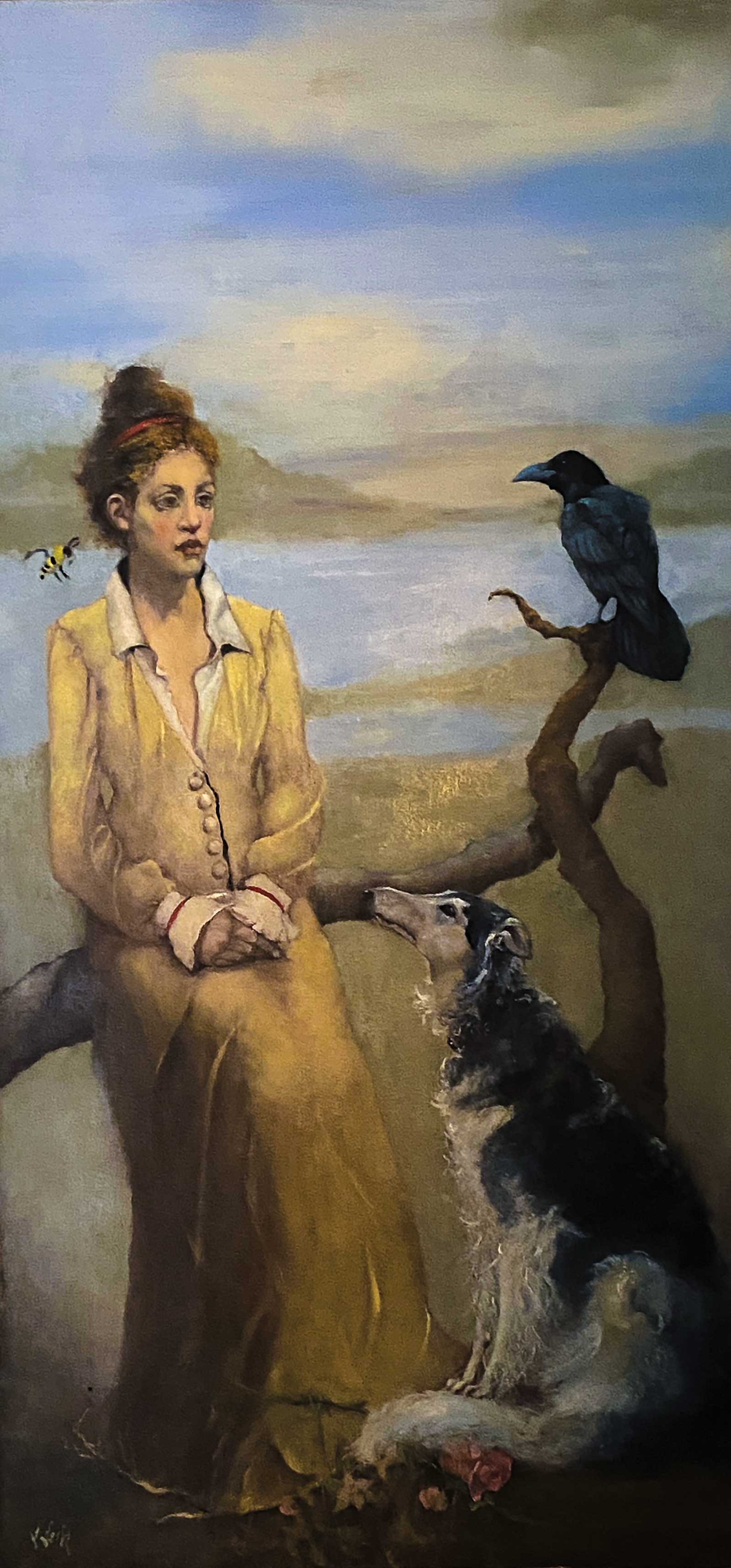
Linda Leslie, Mircea, oil on canvas, 48 x 24”
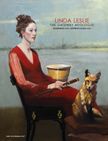
Artist Linda Leslie creates original oil paintings of characters from an imaginative fine-art fable. “In this concept, a group of artists and their animal counterparts are drawn to a mystic place and time where they are recruited to join forces, rekindling forgotten wonder and restoring lost beliefs in art and collaboration in order to help save humanity from cultural collapse,” she explains. “These paintings, as part of an upcoming installation featuring a total of seven artworks of characters from the book, will be presented along with one-of-a-kind costumes and 10 unique objets d’art.” These painted chests contain limited edition handmade books with prints of the paintings, as well as other illustrations by Leslie, which are threaded into a story written by John Witham. For more information about the exhibition visit the artist's website. —
Featured Artists & Galleries
American Impressionist Society
(213) 881-7685
aisdirector@gmail.com
www.americanimpressionistsociety.org
Blue Rain Gallery
544 S. Guadalupe Street, Santa Fe, NM 87501
(505) 954-9902
info@blueraingallery.com
www.blueraingallery.com
Christopher B. Mooney
www.chrismooneyart.com
Diana Carolina Lopez
Instagram: @diana.carolina.lopez
Hannah Tjia
www.hannahtjia.com
Karl Soderlund
www.karlsoderlund.com
karlsoderlund@hotmail.com
Lawrence McAdams
Corona Del Mar, CA, (949) 422-3318
www.lawrencemcadams.com
Instagram: @lawrencemcadams1
Linda Leslie
www.lindaleslieart.com
john@artcomdev.com
Loretta McNair
San Pedro, CA, www.lorettamcnair.com
Instagram: @portretts_biz /lorettamcnairartist
Ruth Fitton
www.ruthfitton.com
Sivananda Nyayapathi
Suwanee, GA , (770) 495-9069
siva@sivanandafineart.com
www.sivanandafineart.com
Powered by Froala Editor