

All Noah Saterstrom knew about his great-grandfather was that he was a traveling optometrist who disappeared from his family in 1925, and that he died at the Mississippi State Hospital in Whitfield in the mid-1960s. The circumstances and what transpired during the 40 years in between were a mystery.
Saterstrom had always been interested in the details of Dr. D.L. Smith’s life, but it was a taboo subject and if his grandmother, who was 7 years old when her father “lost his way,” had any other knowledge about him, she took it to her grave.
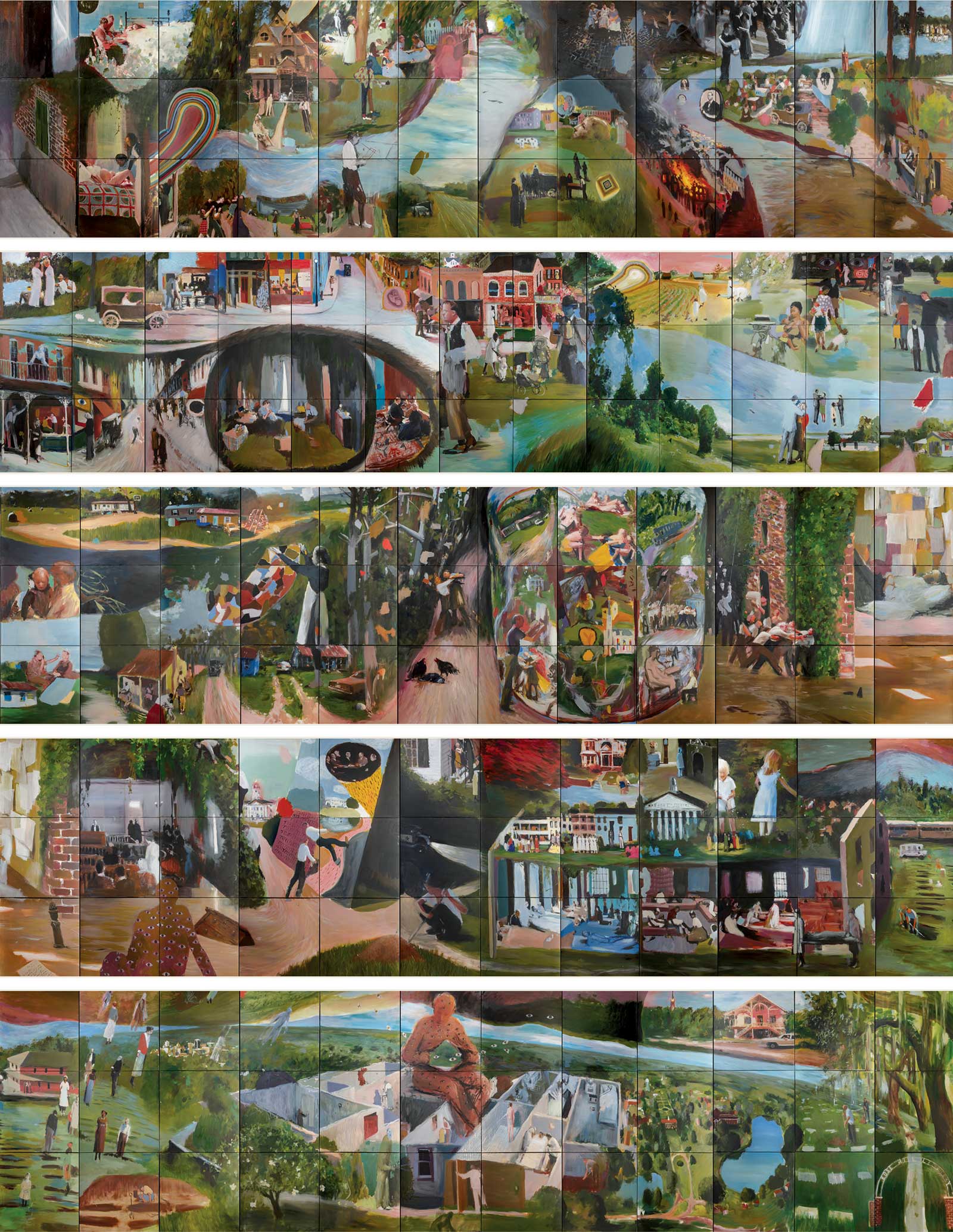
What Became of Dr. Smith, 2023. Oil on canvas, 6 x 122'. Courtesy the artist.
Saterstrom was no stranger to plumbing and portraying the depths of his family’s past—a story of aristocratic Southern slave owners so thoroughly documented, it made his great-grandfather's omission from record even more glaring. In 2017, Saterstrom was giving a talk about a painting that focused on his ancestors during the Civil War era at the Mississippi Museum of Art in Jackson, and the artist, who lives in Nashville, decided to visit the Mississippi Department of Archives and History.
The clerk brought out an old ledger from the hospital and there among the handwritten patient names was: “Dr. D.L. Smith, 1925, Claiborne County, MS.” While not much to go on, later that day in a serendipitous turn of events, Saterstrom met state librarian Stephen Parks, who said he would do some digging.
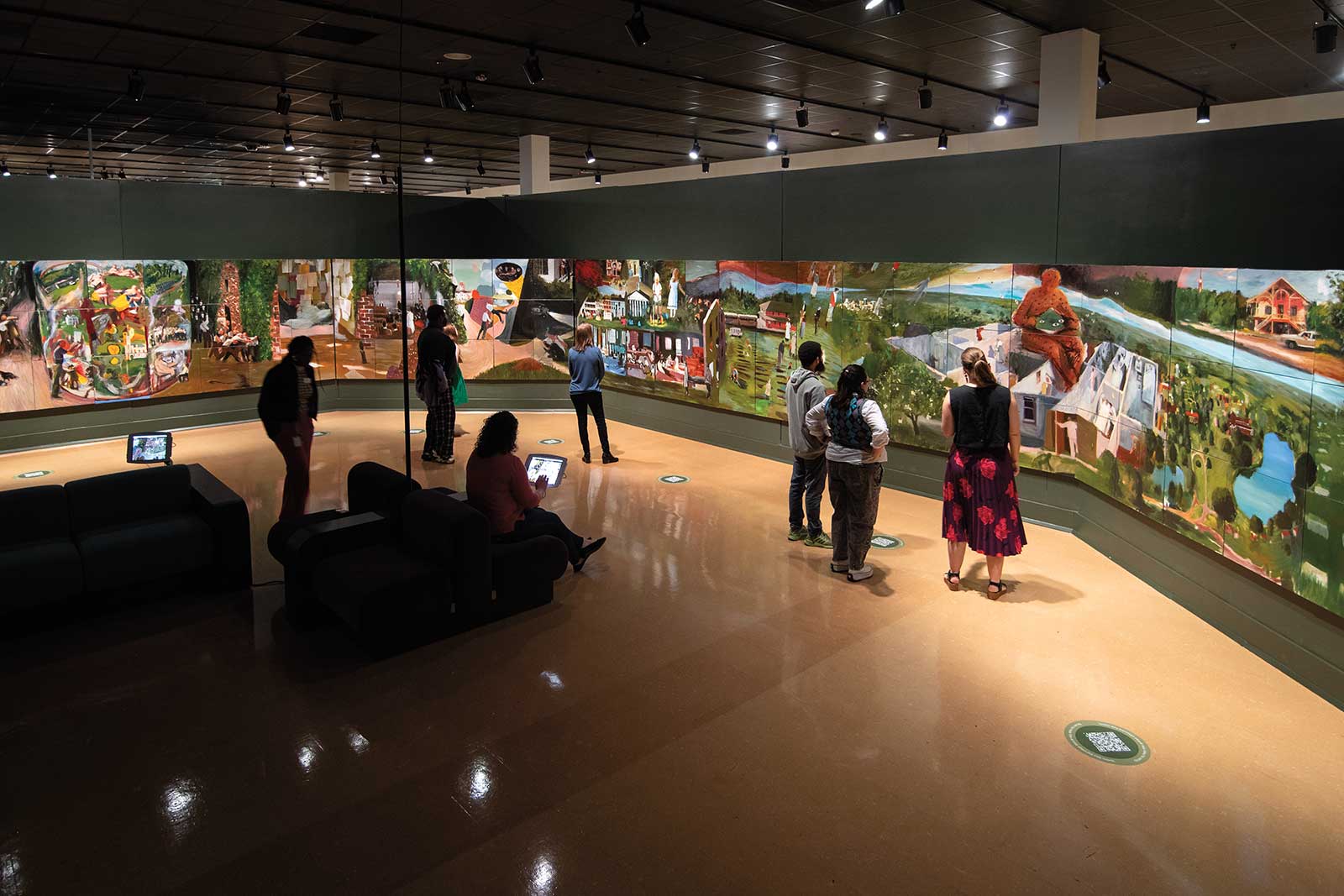
Installation shot of What Became of Dr. Smith. Photograph: Rory Doyle.
Parks “proceeded to unravel this century of silence just by looking and asking the right questions,” says Saterstrom. “He’d follow a lead he found in the news; go to the courthouse and find a whole file. It just started to peel away and peel away—it was just like unwrapping a mummy.” Over the course of a years-long investigation, Saterstrom learned that Dr. Smith was arrested in 1925, precipitated by a near-lynching after a 15-year-old female patient accused him of assault. In a state of acute psychosis, his behavior in jail led to a lunacy trial, resulting in his institutionalization, first at the Mississippi State Insane Hospital (also known as the “Old Asylum”) in Jackson, and later at another facility in nearby Whitfield.
These findings eventually unfurled into What Became of Dr. Smith,an epic 122-foot-long, 6-foot-tall painting spanning the life of Saterstrom’s great-grandfather that is now on view at the Mississippi Museum of Art through September 22.
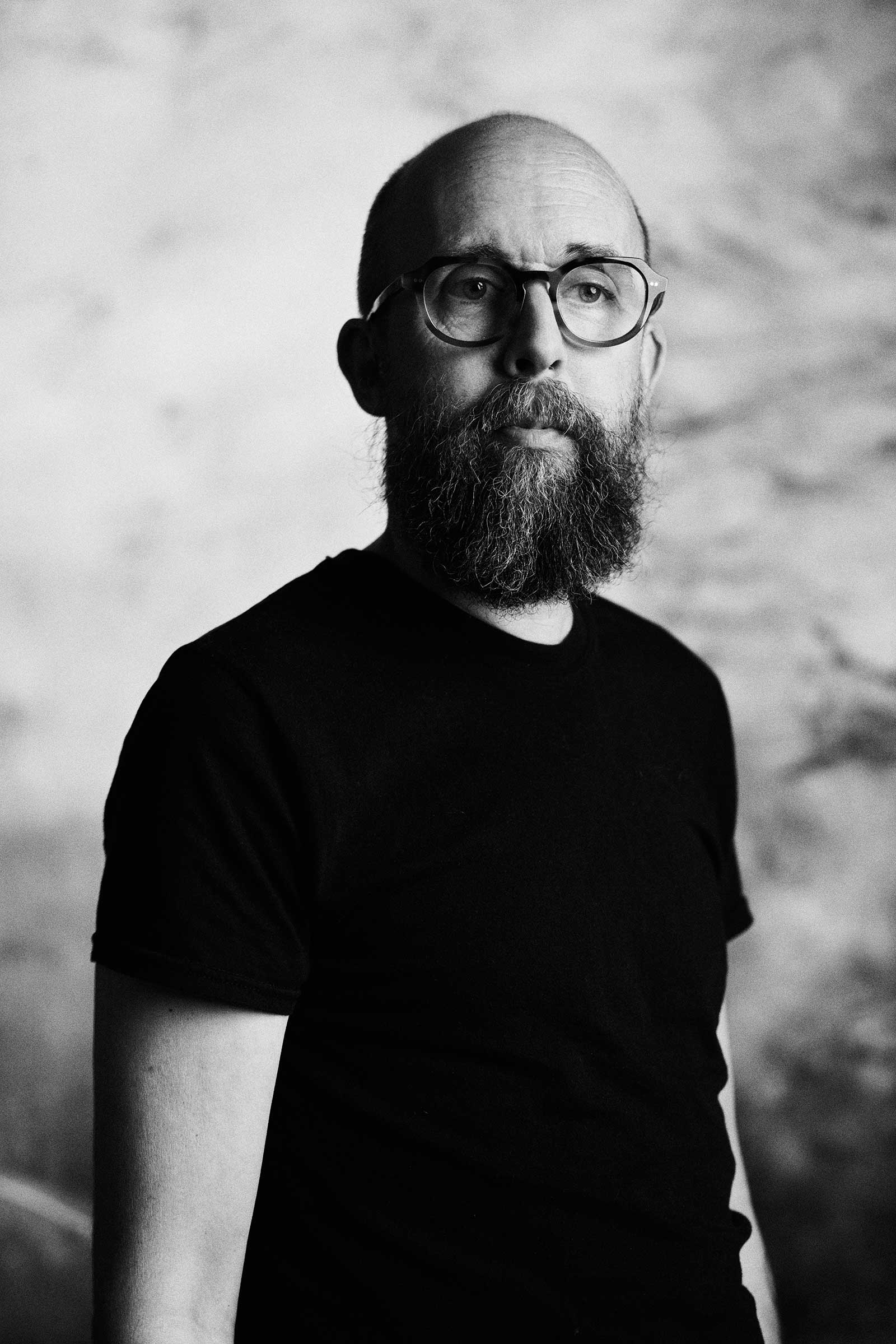
Artist Noah Saterstrom. Photograph: Jeremy Cowart.
Roughly in the center of the 183-canvas panoramic is a scene depicting the Christian myth of St. Dunstan’s encounter with the devil. One day, an old man appeared at Dunstan’s shop and asked the blacksmith to make a chalice for him. Dunstan agreed and set to work. But as he was working the visitor began to change shape: one moment he was an old man, then a young boy, then a seductive woman.
Dunstan realized that his guest was the devil, but went on with his task. Meanwhile, he surreptitiously laid a set of tongs in the fire. When they were red-hot he pulled them out of the fire, turned around and seized the devil by the nose. As Saterstrom tells it, the devil then turned back into an old man and ran from the house screaming that the blacksmith had attacked him.
For Saterstrom, this myth—a narrative about accusation and assault—was a logical starting point, and a metaphor for the pivotal moment in his great-grandfather’s life story. There was what came before and what came after, in his life and in the painting. “It’s where it begins,” says Saterstrom. “It’s like the ‘chunk’ of the thing and everything else is branches and vines that come off of it.
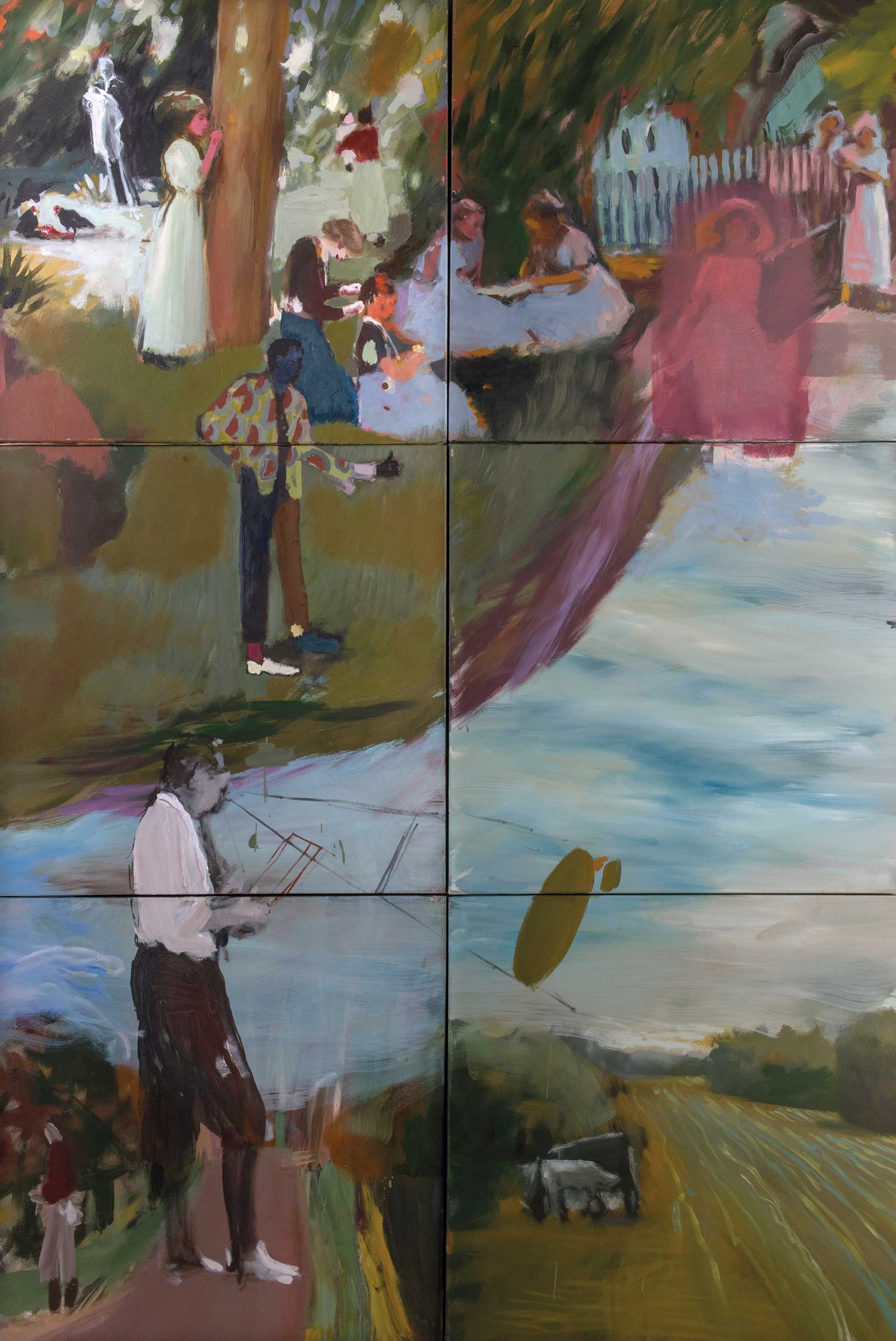
What Became of Dr. Smith (detail), 2023, oil on canvas, 6 x 122'
“The tale felt relevant to me because…from the outside, an old man walked in, and an old man left screaming and wounded. In Dr. Smith’s case, a girl went to him to get her eyes checked and she left saying he had assaulted her. He said he didn’t. What happened in the office is a mystery and will presumably remain that way. In both stories, St. Dunstan and Dr. Smith are protagonists in violent interactions with lots of uncertainty.
“The myth is about overcoming the devil,” continues Saterstrom. “But it also sounds like an episode of psychosis and the old man was attacked for it. I don’t want to demonize a mental illness but I also don’t want to discredit a young girl. But [the case] never went to trial so we’ll never know.”
In some panels, Saterstrom painted himself in place of Dr. Smith—notably in a scene showing “Dr. Smith” in his jail cell pasting photographs on the wall—but it wasn’t until the project was near completion, that Saterstrom realized it had been a means for him to come to terms with his own experience with mental illness.
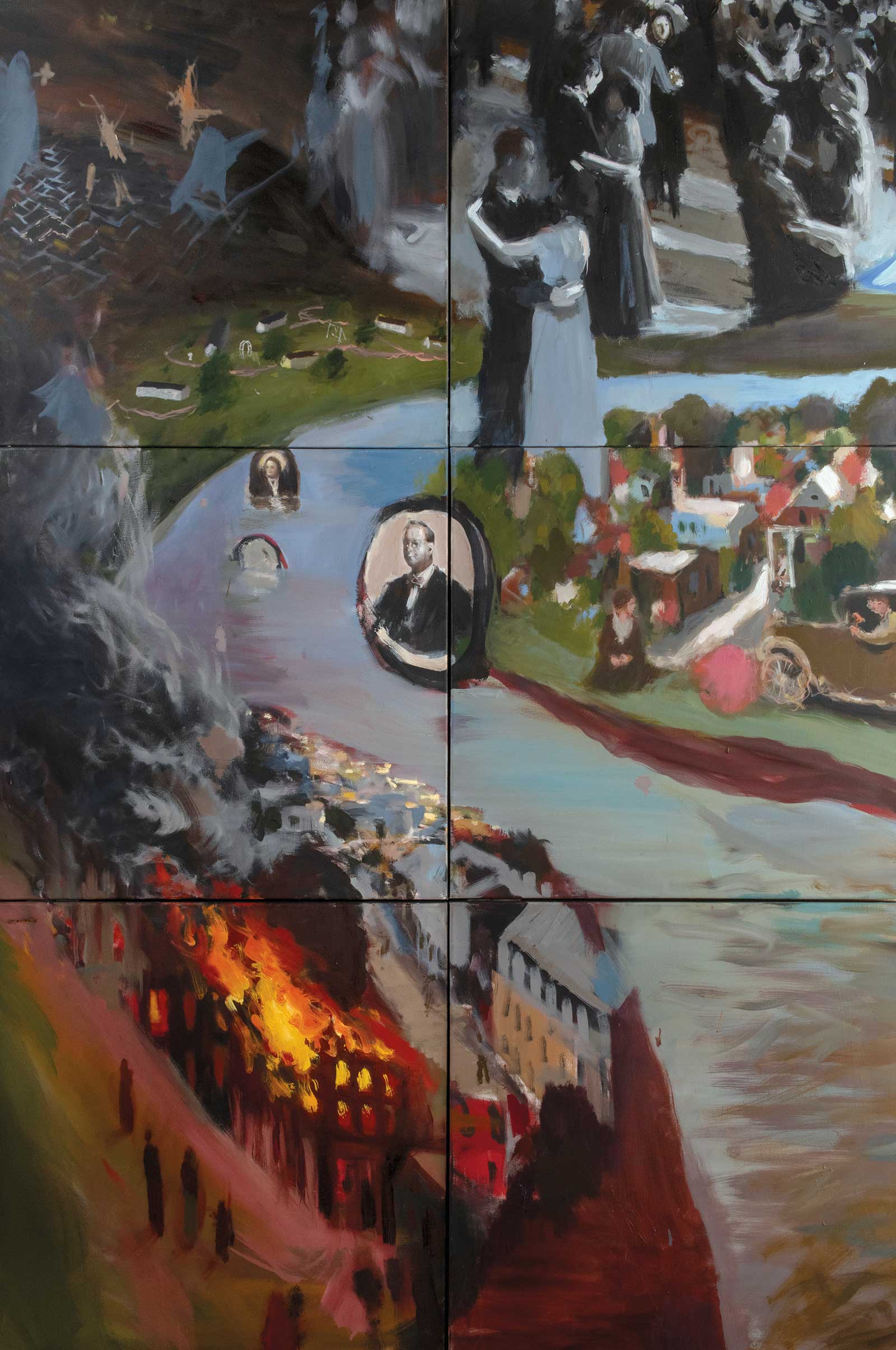
What Became of Dr. Smith (detail), 2023, oil on canvas, 6 x 122'
“It was totally unconscious throughout the entire process,” says Saterstrom. “Inserting myself in his place should have been a flag but it just seemed like a convenience at the time…If I knew that it was going to be about that, I would not have done it. I felt too afraid to think about it, much less talk about it—I was so afraid that it would call it back. It wasn’t until last fall that I started to really be able to get a grip on my own experience of mental disorder and how central it had been to my preoccupation with Dr. Smith.”
Saterstrom had actually been on a path to healing through art-making for years in the wake of an episode in 2001 when, in the midst of challenging circumstances, he went through a severe period of depersonalization—a state in which one’s thoughts and feelings seem unreal or to not belong to oneself.
“Even though I had all of my memories, they didn’t correlate with any actual experiences,” he says. “They didn’t possess any substance any more—they were like a Wild West set. I had the memories of them but was certain that they never happened because I had never existed. I was only existing now.
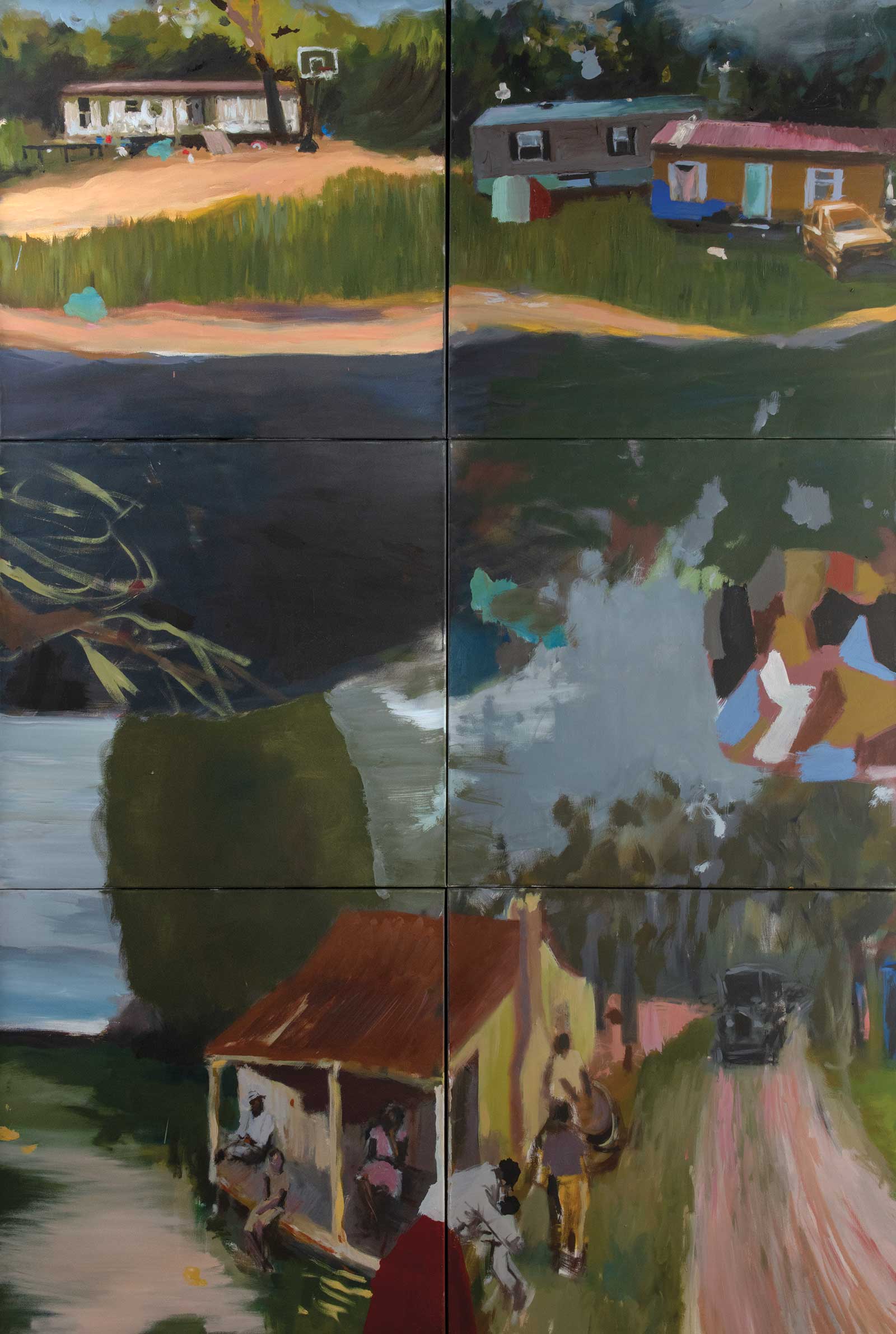
What Became of Dr. Smith (detail), 2023, oil on canvas, 6 x 122'
I had the world-facing self, but on the inside there was a complete absence of internal self,” he continues. “It was an absolutely horrifying situation. But you can’t die from that so I had to decide I’m going to keep living even though I’m not real—and maybe it didn’t matter.”
The crisis loosened its grip over time and five years later Saterstrom found himself pouring over and painting family photos—in a sense, staring himself back into existence. If he looked at a photograph from his childhood for long enough, other sensory memories would resurface—the sound of a train going by, the heat of a seatbelt buckle, a smell—that reaffirmed their realness, and his realness within them.
“I kept doing it and it started to take on more meaning for me,” says Saterstrom. “Painting family memories is pretty conventional and visually traditional but that wasn’t why I was doing it. I was doing it because the act of looking for hours at my history was powerful to me in some way.
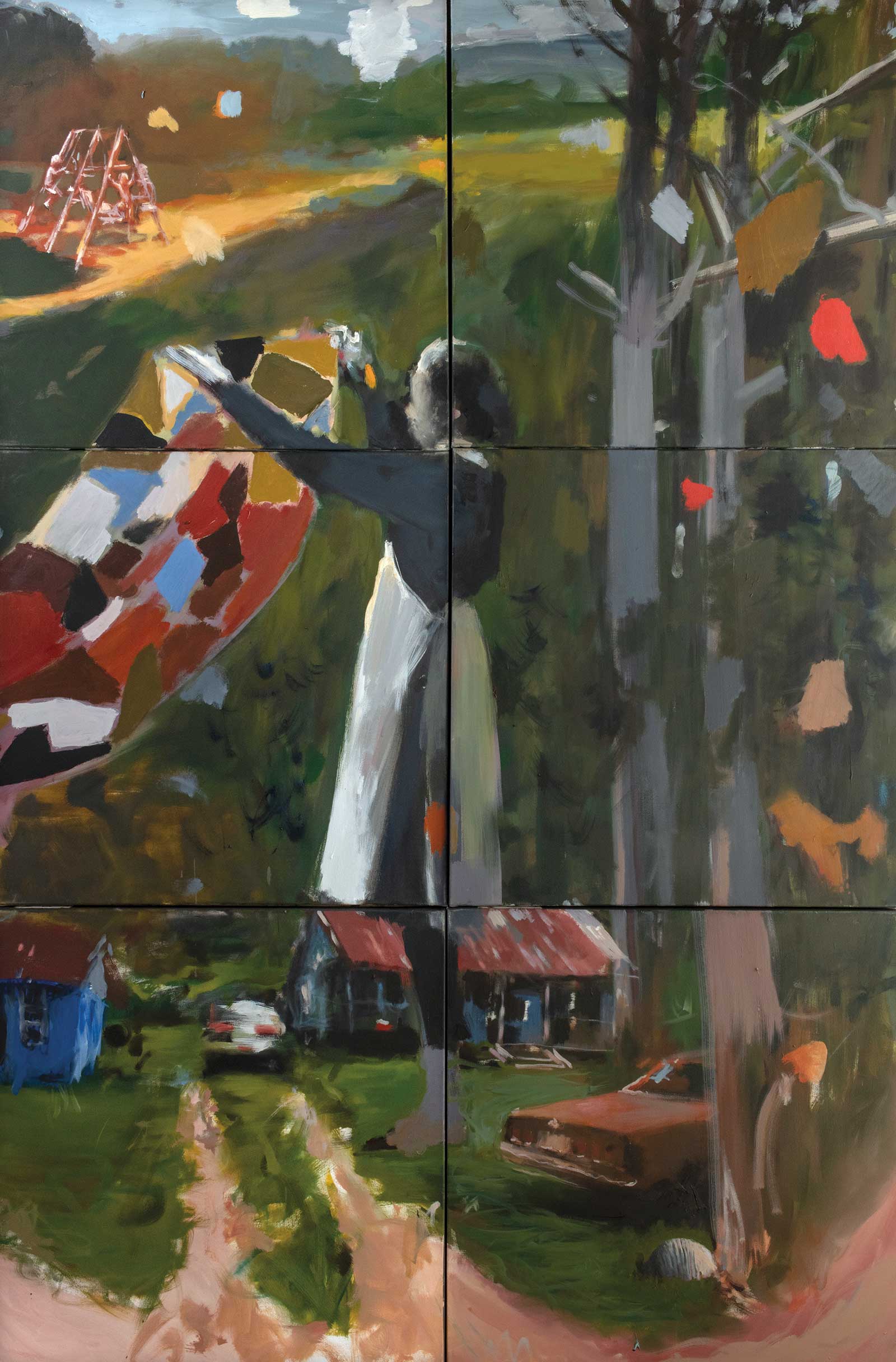
What Became of Dr. Smith (detail), 2023, oil on canvas, 6 x 122'
“After painting thousands of these, I only recently realized they spanned my grandma’s childhood through my mother’s and my own and my children’s. Out of this grew this continuity that I found really powerful. There was something very fulfilling about folding myself back into the current of life…I can go back and forth in a millisecond from 1920 and 1950 and 1980 and, if you’re trying to get as much from that image as possible, it is as close to time travel as it gets.”
On the heels of the realization that What Became of Dr. Smith had as much to do with himself as it did his great-grandfather, it struck Saterstrom that he would have to openly address his own experiences with mental illness or risk feeling like a hypocrite.
During his research, Saterstrom became aware of the Asylum Hill Project (AHP), a consortium of scholars formed in 2012 after 7,000 unmarked graves were discovered on the former site of the Mississippi State Insane Hospital. AHP’s mission is to investigate and share the history of the Old Asylum, to honor the experience and legacy of the individuals who were its patients over an 80-year period and combat the stigma around mental illness. In partnership with the Mississippi Museum of Art, an area of the exhibition is dedicated to AHP’s efforts, findings and the hospital’s history.
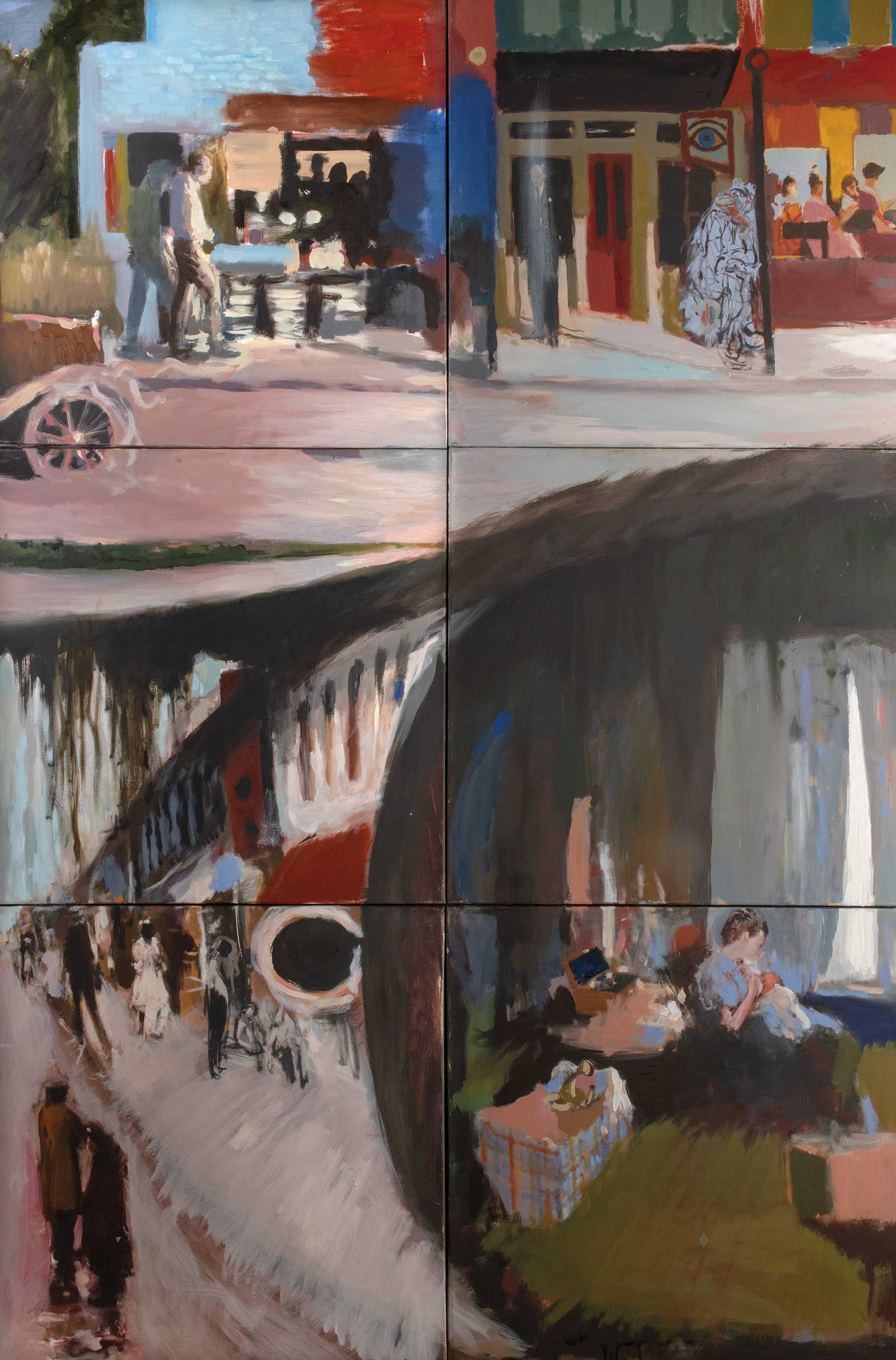
What Became of Dr. Smith (detail), 2023, oil on canvas, 6 x 122'
“I was doing the same things with my great-grandfather—trying to bring him back into humanity,” says Saterstrom. “I think about how harmful it’s been for his story to be suppressed for so many years and how dehumanized he was. I feel very strongly that if I make my current decisions based on fear and shame, and the trauma that my grandma experienced as a child, I am voluntarily opting in to her trauma, and passing it down to my own kids. The silence around mental illness doesn’t serve anyone at all. [Having spoken openly about my experience] my children are perfectly at ease with all of it. That is the cycle stopping in its tracks right there.”
The cycle may have been stopped, but the story—and potentially the painting—continues. Right before the show opened, Dr. Smith’s medical records were found, 235 pages detailing the entire 40 years he spent in state custody, much of it in his own words.
“I have chills that this man’s story found a willing host in me,” says Saterstrom. “It is as if he had been waiting for me to resolve that first part and, as soon as the show was up, it was like ‘here’s the rest.’” —
What Became of Dr. Smith: New Work by Noah Saterstrom
Through September 22, 2024
Mississippi Museum of Art
380 S. Lamar Street, Jackson, MS 39201
(601) 960-1515, www.msmuseumart.org
Powered by Froala Editor