Paul Harvey, a well-known radio broadcaster for ABC News Radio, hosted a weekday morning program called “News and Comment” from 1951 to 2008 that reached as many as 24 million people per week. He was famous for his segment “The Rest of the Story.” Each broadcast featured lesser-known facts on various subjects, with key details revealed at the end, always concluding with “and now you know the rest of the story.”
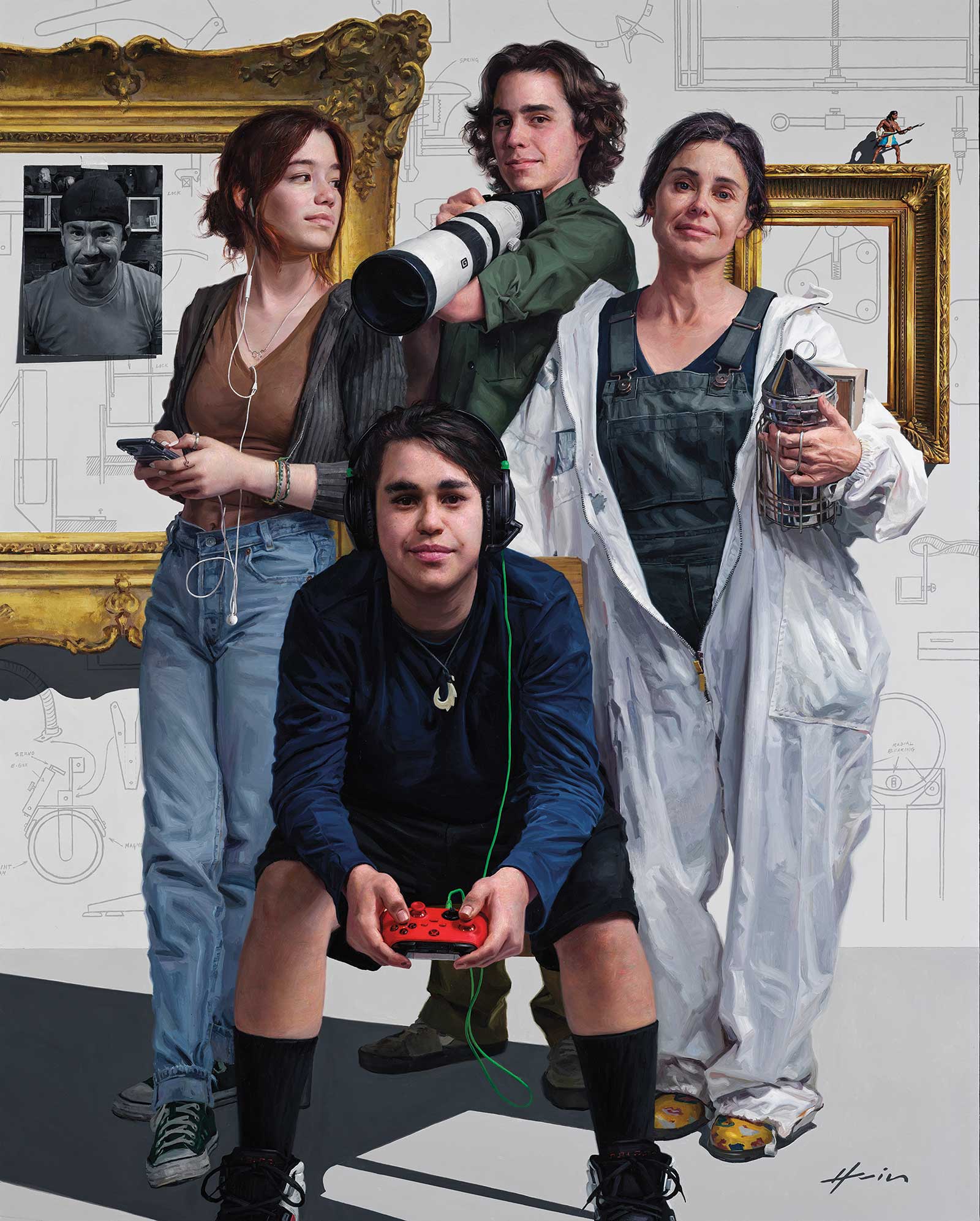
Jeff Hein, My World, oil on panel, 60 x 48”
For the past 26 years, thousands of artists have entered The International, the Portrait Society’s premiere competition with a $50,000 cash Grand Prize. With over 3,038 entries, the judges base their selection on a variety of factors with the overall aim of curating an exhibition showcasing the finest portraits and figurative artwork being created worldwide today. Specifically, they evaluate technical proficiency, fundamental skill development, originality, uniqueness in concept and design, aesthetic sophistication and cultural significance.
Upon viewing the collection of the 2024 winning pieces, each one stands as a technical masterpiece, skillfully hitting all the right notes of line, shape, color, value and form. Recently, I interviewed the top-winning artists and uncovered the inspiration and symbolism behind each artwork, and suddenly, the pieces take on deeper meanings.
For example, in Jeff Hein’s family portrait My World,which was awarded both Second Place and the People’s Choice, he says, “This painting is a portrait of this life, the life since my recovery, all of the things that matter to me, and the things that I’ve been able to accomplish and experience.” As a young man, Hein was diagnosed with a fast-growing cancer. He met his wife while recovering from his ninth surgery and the effects of chemotherapy. Before treatment, which could cause infertility, he was advised to bank his sperm. Eight years into their marriage, they met with a specialist and were soon pregnant with twins. Three years later they added a third child, but as Hein says, the years have not been all peachy. Despite continuing health challenges related to his diagnosis, he has been able to live an exceptionally rich life, and this painting is a reflection of that.
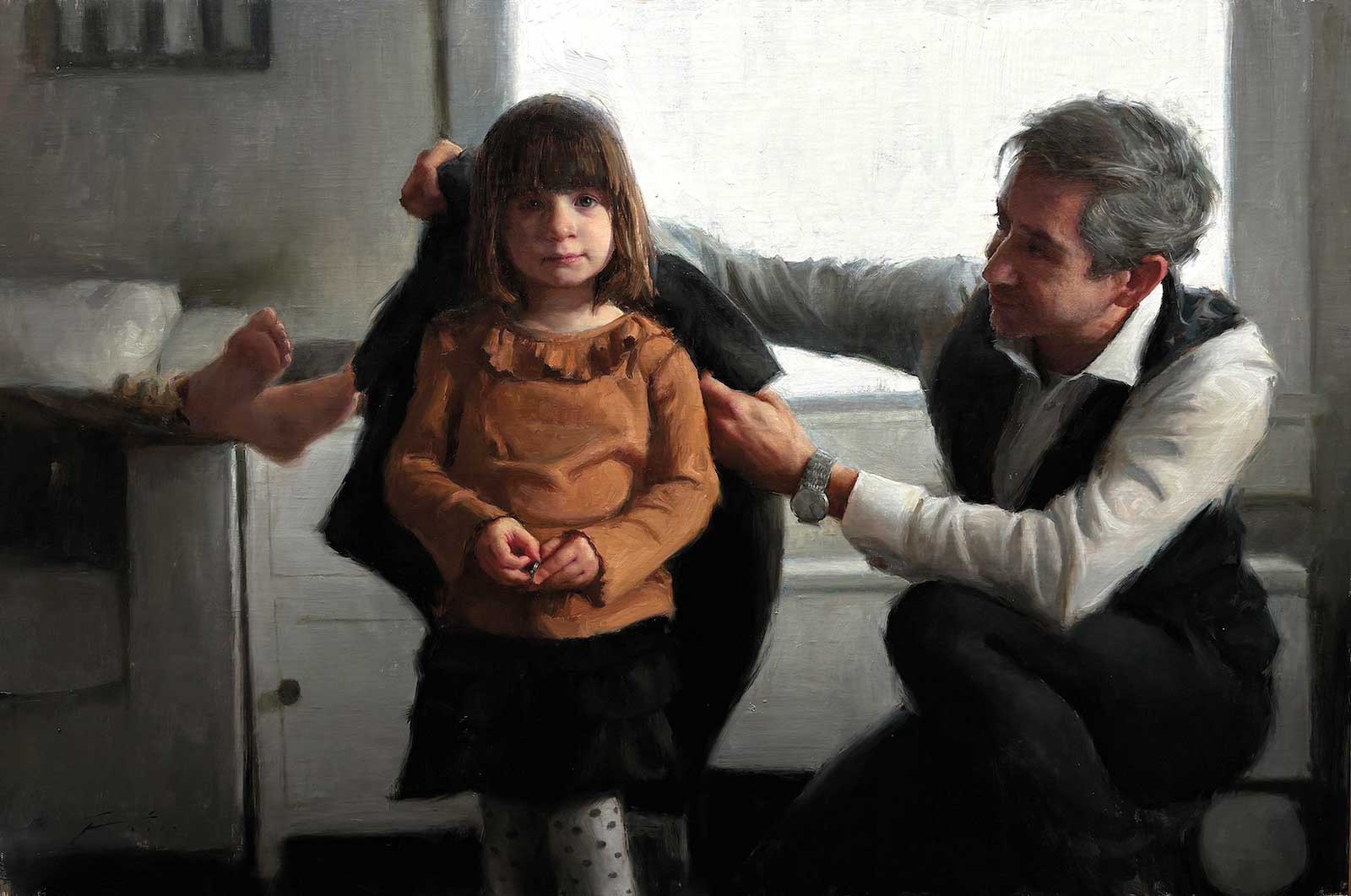
Timothy Rees, Her Mother’s Locket; Violet at age 3, oil, 24 x 36”
Central to the composition are his wife and children, but the frames in the background represent Hein’s painting career. “What a dream come true it’s been to have been able to make a living doing this,” he shares. “It’s also been a constant challenge because my ‘masterpiece’ is forever eluding me. The frames are empty to symbolize my hope for a great future work, my hope for the possibility of one day creating a true masterpiece.” Hein also included himself in the background, painted from the perspective of the camera at his online Atelier and podcast station to emphasize the significance of this aspect of his life, which includes teaching art since 2002 and podcasting for about two years. Lastly, the toy figure on the shelf was given to Hein by his youth leader as a teenager. When presented to the artist, his mentor told him a story about a great physical and spiritual warrior, which inspired Hein to be strong and have faith in difficult times.
Tim Rees, an artist living in Iowa who received First Place Painting for Her Mother’s Locket,also painted a family portrait, but one reflecting a change in the family dynamics. Rees says, “The subject of the painting is my daughter Violet and myself. It was inspired by recent circumstances in my life. Violet’s mother decided to leave, and Violet doesn’t always seem to understand why her mother no longer lives at home. The locket she is holding, which was given to her mother years earlier on Mother’s Day by her brother Fawkes, was one of the things left behind. It’s something that she and her sister, Aspen, recognize as important, and they carry it with them around the house.”
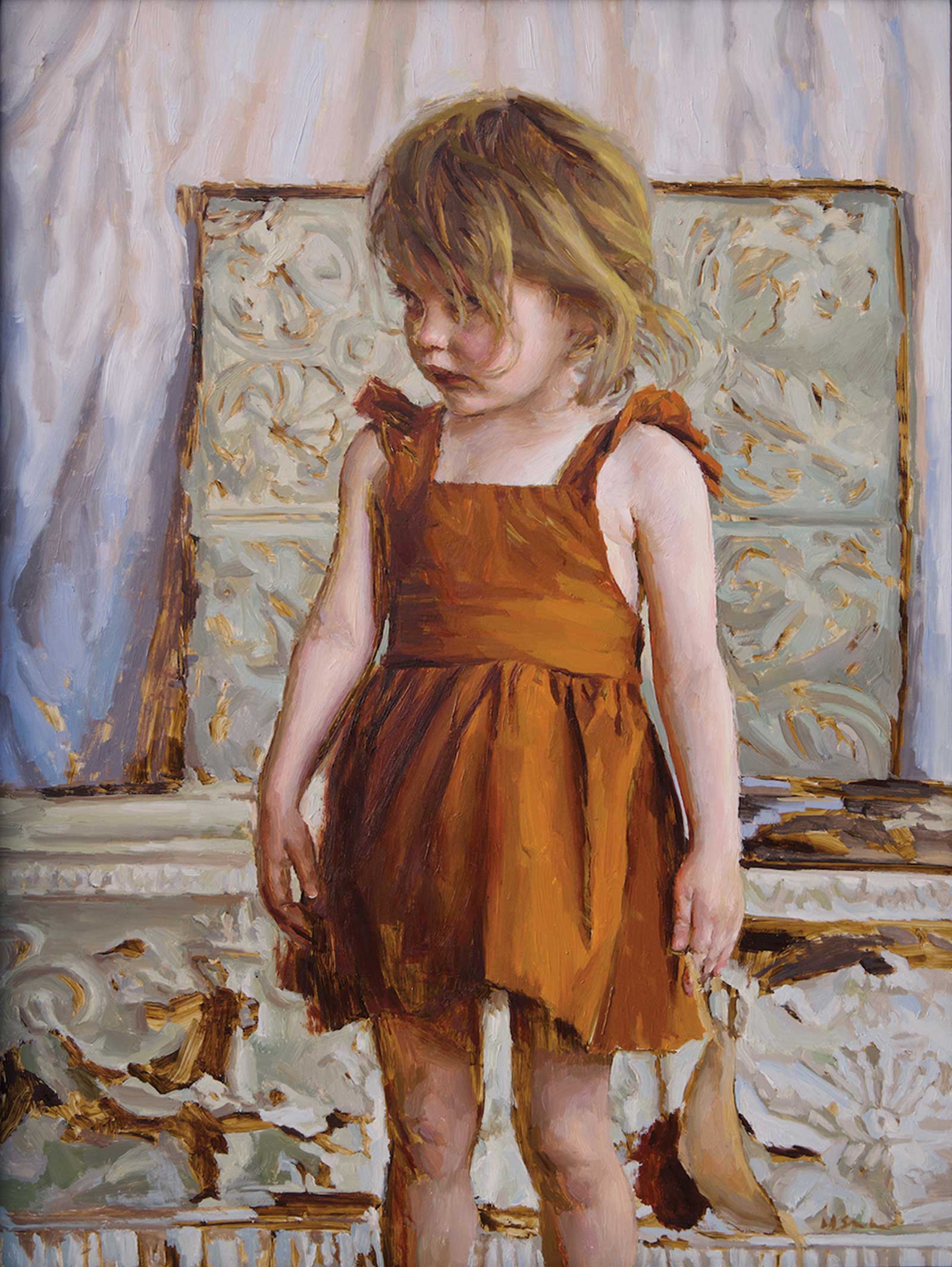
Mary Sauer, Before I Understood This Place, oil, 18 x 24”
Rees further explains, “I try to help her, Fawkes and Aspen through the daily challenges of life with sympathy, understanding and compassion, urging them to move forward, as depicted by me holding her coat and offering her the comfort of a smile.” The feet in the background are Fawkes’, in a casual pose, reflecting his ability to take life in stride, though at times he has his own challenges. Even the color palette was deliberate, chosen to reflect the somber mood, and the immediacy of the strokes relates the real-life challenge of trying to squeeze in time to paint while still caring for his children and offering them the love and support they need.
World events can also influence the arts as in First Honor award-winner End of Lockdown by Frances Bell, an artist born and raised in Suffolk, United Kingdom. In 2022, as the world emerged from Covid restrictions, Bell decided to paint her daughter Flora. Bell tells the story, “I had painted her at the beginning of the pandemic and my son Hugh as well, so [I] thought I’d bookend those strange couple of years by painting her again. Hugh then effectively photobombed the composition, and the dogs too. So, I had to adapt, which was symbolic of how flexible we all had to be during those two years, so I went with it. This painting is about Flora’s world essentially, with her vibe and dreamy, romantic creativity wrapped up in her home life. A sense of the quiet of that last disrupted period of time, she is attentive, optimistic, colorful and looking forward.” Technically, Bell decided to challenge herself to paint a paler picture, in flat light, with pattern, color and few darks to anchor the lights. It was a delicate balance, and one she felt the subject and the setting called for.
Like Bell, Mary Sauer finds much inspiration in painting her children. Receiving the Second Honor award, Sauer wanted to portray her daughter as she sees her. “This is a painting of my daughter Blythe who glides through life as if in a daydream and whose emotions bounce from bliss and pure happiness at the slightest circumstance to feisty and angry as bunny tantrums,” says Sauer. “I was interested in capturing her unrehearsed, unposed and perfectly real for this portrait. This expression on her face truly captures her essence as only a parent would know.”
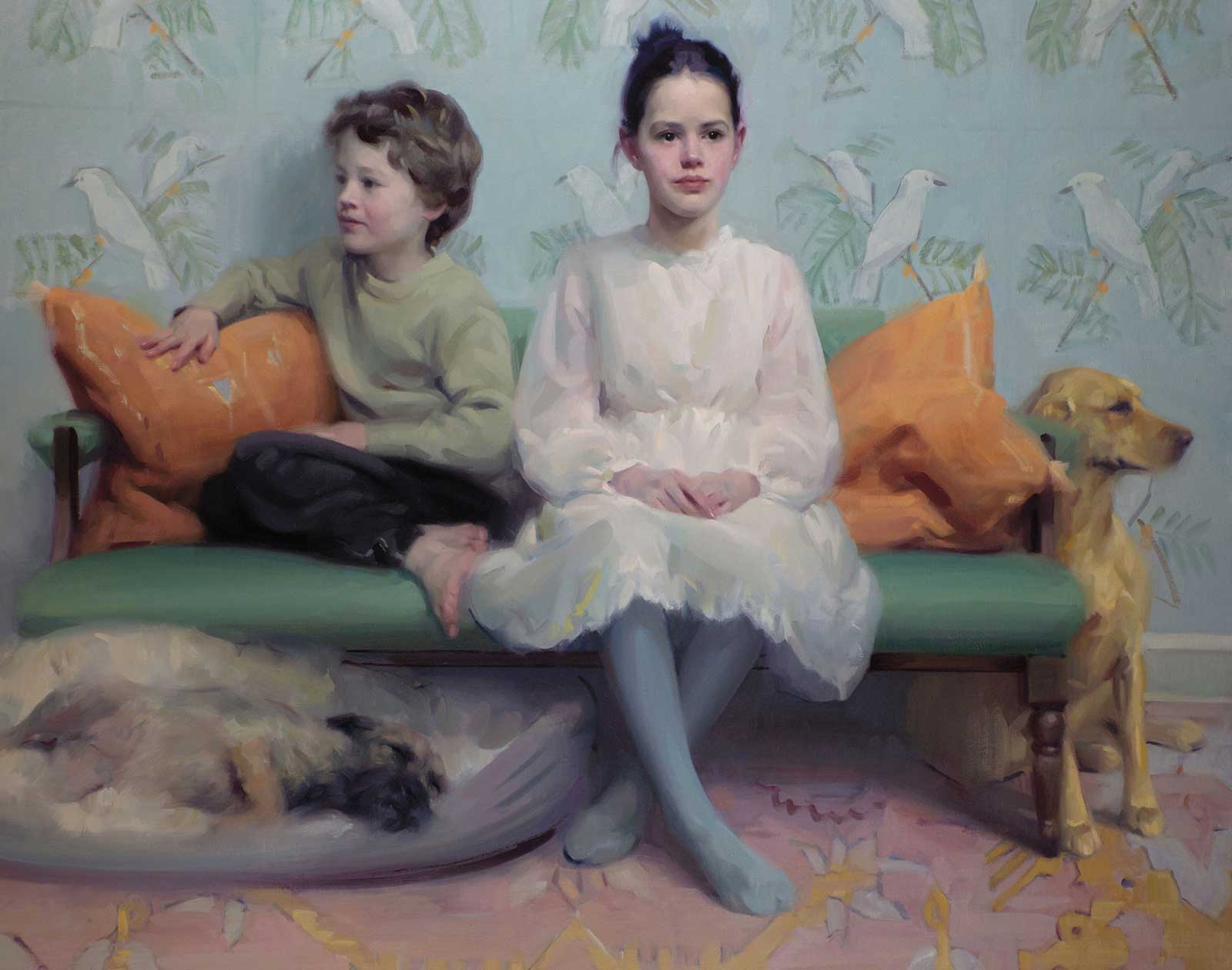
Frances Bell, End of Lockdown, oil on canvas, 39 x 49”
A connection to the sitter doesn’t have to be familial, as in Jeffrey Larson’s Grand Prize portrait of Edwin King Hall. In 2015 Larson purchased the St. Peter’s Church in Duluth, Minnesota, and converted it into the Great Lakes Academy of Fine Art. Hall lived in the same neighborhood as the former church and began taking evening classes when the school opened in 2016, and he has studied there ever since. “Ed is a tall man, well over six feet tall, who always conveyed that there was more to the story than one might guess,” explains Larson. “It was my wife Heidi who suggested he would make a wonderful subject for a painting.” Committed to painting the portrait from life and even though the painter and sitter knew each other for many years, it was during their long sessions together that Larson really began to get to know him and hear his life story. He continues, “Ed was a rock and would sit for two to three hours at a stretch, with the painting taking about ten sessions to complete. His career, as I came to learn, centered in and around the halls of congress, and he played a role in shaping and crafting national policies. I found the stories fascinating as current events would come up in conversations, and he often had a backstory or personal anedote concerning some of the key players. His career demanded intelligence, dignity and confidence along with a deep level of contemplation, which I hope I captured in the pose and expression. Getting to do such a monumental portrait entirely from life was a pleasure as well as learning about his life and observing his different expressions, both big and small, which in my mind was all vital to creating this portrait.”
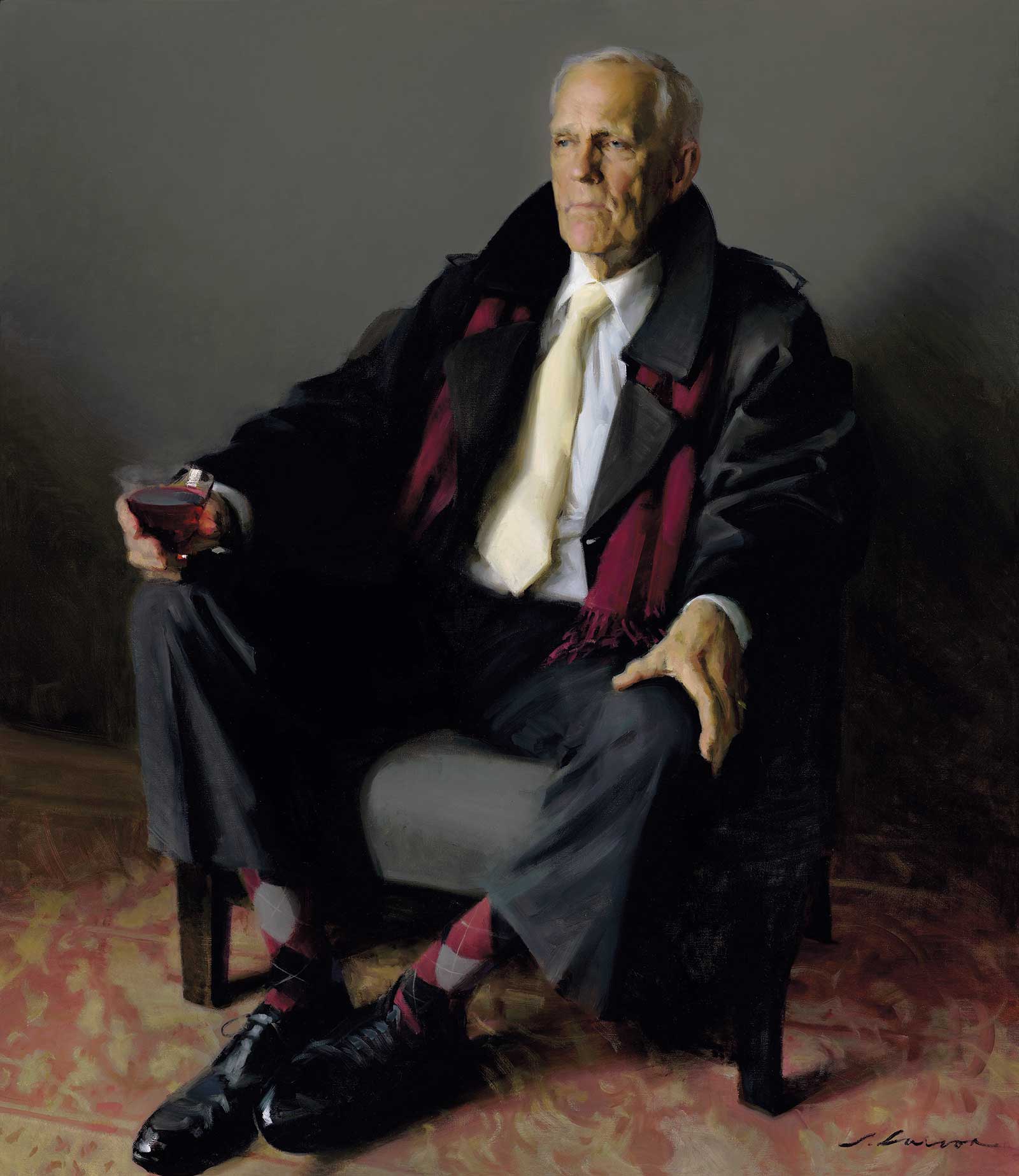
Jeffrey Larson, King Hall, oil on linen, 60 x 52”
Over the past 26 years, The International has served as a platform for artists worldwide to showcase their talent, and while the 2024 winning pieces exemplify technical mastery and artistic innovation, they are filled with thoughtful inspiration and symbolism. These artworks not only reflect a certain visual brilliance, but when you add the deeper meaning behind the works, you know the rest of the story which enriches our understanding of the artists and enhances our visual experiences. —
Christine Egnoski is the executive director of the Portrait Society of America and has served in this position since the founding of the organization in February of 1998. She can be reached at christine@portraitsociety.org.
Powered by Froala Editor