Connoisseurs of fine representational art will doubtlessly see German-born Canadian artist Jeanine Brito’s paintings hanging within the realms of stereotype, and note that as an avant-gardist primitive casting herself as a deskilled outsider of the American tradition she is far from possessing the technical mastery that would trump the clichés.
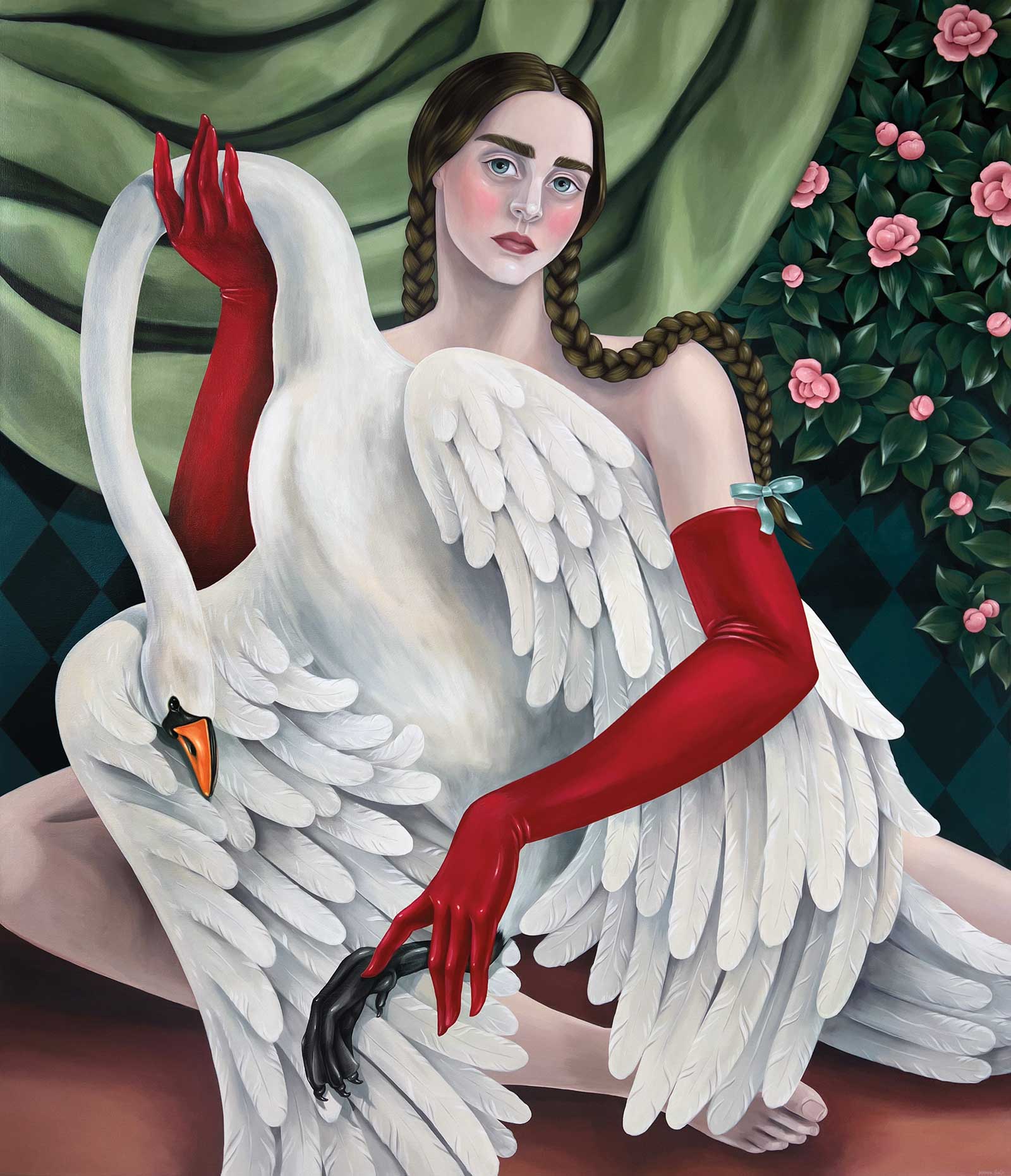 Death of a Common Enemy, 2023, acrylic on canvas, 71 x 61"
Her theatrical painting Some Vivid Dream uses many of the repetitive conventions of her didactic genre—the mask of makeup, the meat and marketing of the commercialized and exploited body, the innocent wings of virtue emerging from a wicked and corseted model dressed in the pale skin of an aughties angel Victoria’s Secret model, wearing the red-cheeked pancake and paint of masquerading Pierrot. Dorothy’s red shoes are well-worn pop culture icons, at least as tired and tiresome as blond and brash-boobed Barbie, and Brito’s simulacrum is presented as an innocent trapped in the role with the corseted and bare-bottomed bravado of a proud pin-up. Yes. In this self-portrait, the artist aims the direct gaze of confrontation at her audience, looking at us looking at her after Edouard Manet’s Olympia of 1863. Yes. She is conscious of the predatory gaze. Yes. We watch her paint the cut into the meat, self-conscious in the presentation of her flesh under the gaze of a predatory audience, conscious of the paradox of mimetic self-portraiture, conscious of the painting as the vehicle of erotic sensation and herself in the role of an objectified person in a fashionable theatre of desire. Yes, yes, yes.
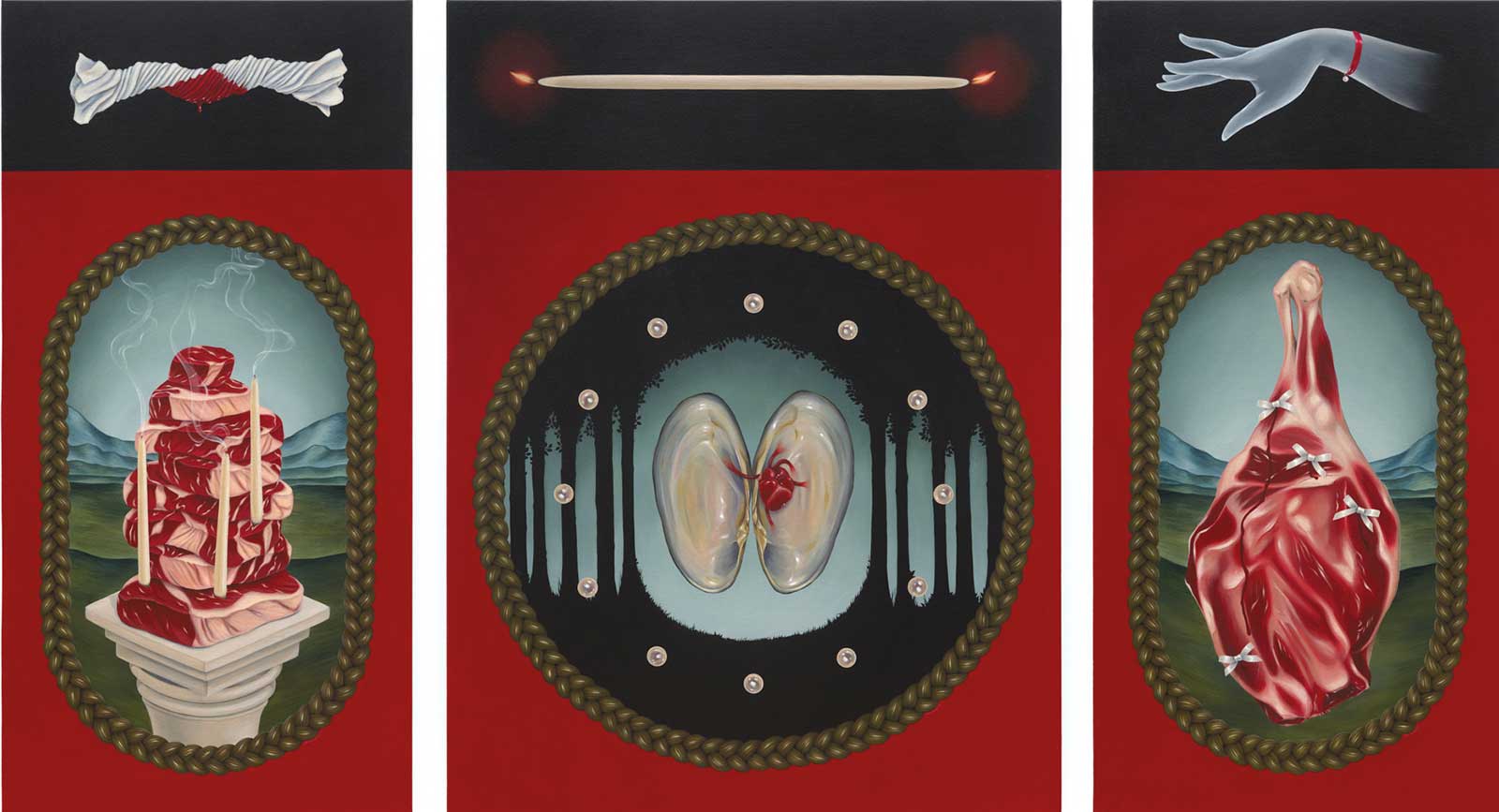
Triptych, 2024, acrylic on canvas, 24 x 82"
And yet, stereotypes are stereotypes precisely because they ring the bell of truth, and these tired tropes ask the good, just and necessary question of whether young women are eternally destined to play roles cast in dancers’ costumes and displayed to satisfy their consumers. Brito attempts to liberate herself from such banalities by presenting them with the fresh eye of her youth, combining the formal poses, flattened theatricality and light values of either Ivo Saliger or Adolf Ziegler’s versions of The Judgement of Paris with the shining scarlet vinyl of long fetish gloves and the blood of sparkling vampires, presenting the pleasure and the pain. And although the meat is Francis Bacon’s beef, and Brito borrows his agonizing imagery buried in the grip and violence of destructive self-loathing, she paints the cut as the subject of her selfie’s brush and presents herself on the stage as both a performer playing a role and as a set designer creating her own world, the imitation of her flesh as naked as the meat. This isn’t Kansas, Toto. We are three steps away from Plato’s ideal, but does Brito know it?
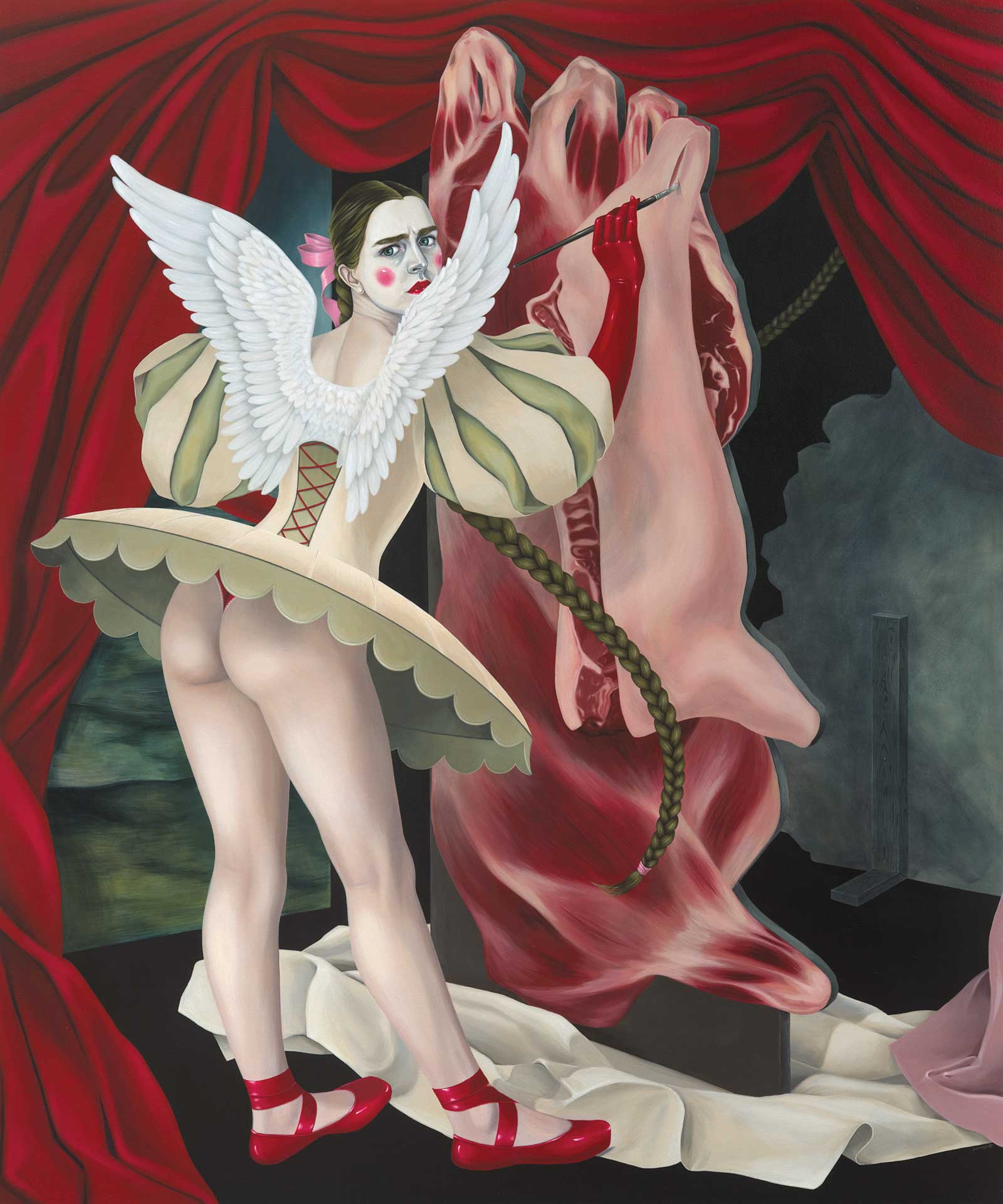
Some Vivid Dream (The Artist), 2024, acrylic on canvas, 86 x 72"
She does. As a body of work, Brito’s naïve paintings are a de-skilled crescendo, starting weakly, then, as frightening references are interpreted, building from the mundanities of feminist messaging toward a spectacle of disturbing outsider iconography popping with images of death and deicide. The flipside of child’s greasepaint is that clowns are always creepy—it’s a short skip from Pierrot to Pennywise and three rings of horror.
Brito’s stylistic similarity to the Judgement of Paris paintings of Saliger and Ziegler recall Ovid’s myth of the goddesses exposing their naked bodies to win the golden apple as the prize for their beauty, offering Paris bribes for his sleazy favor. And like Saliger and Ziegler’s judged goddesses, who were idealized baby-makers of duty unto the Third Reich, Brito’s nudes have as much erotic appeal as a breezeblock.
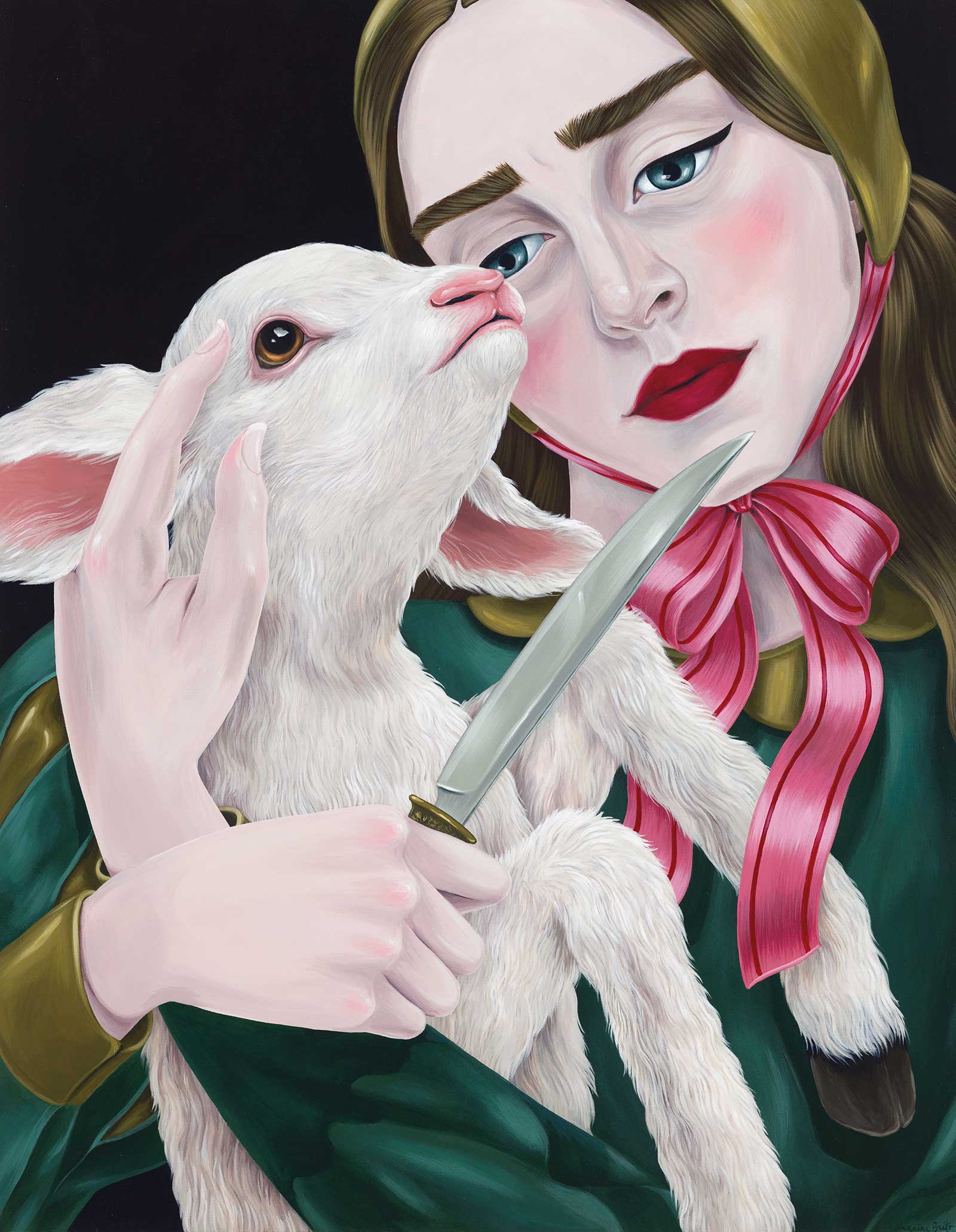
Gentle is the Knife She Wields So Nicely, 2023, acrylic on canvas, 36 x 28"
In her In Keeping With Tradition (The Girl), she turns to the self-sacrifice and stigmata of the saints in a spread and enigmatic display of blood-letting and collection, and her blood becomes a gift to the vampires of imagination, who trade on her image as the price of playing a part in the rituals of art, melodrama and the muse. She is in the open pose of sexual submission, yet the Pierrot’s mask covering her frowning and unsmiling face is a reminder of the false signaling of this offered body. Her braided hair becomes the flyman’s line of the backstage world, lifting and lowering the flat illusions of representation and the theatrical third wall in and out of each picture. The grand drape is a symbol of the suspension of disbelief, of the contract agreed when an audience attends a drama. Yet, the match of the grand’s red to Brito’s ruby blood suggests that the price of the contract is tied to the deep cut, to the sacramental wound of women who must play the scarlet muse. Her stylish superficiality was doubtlessly born from her work as a designer before publishing her paintings.
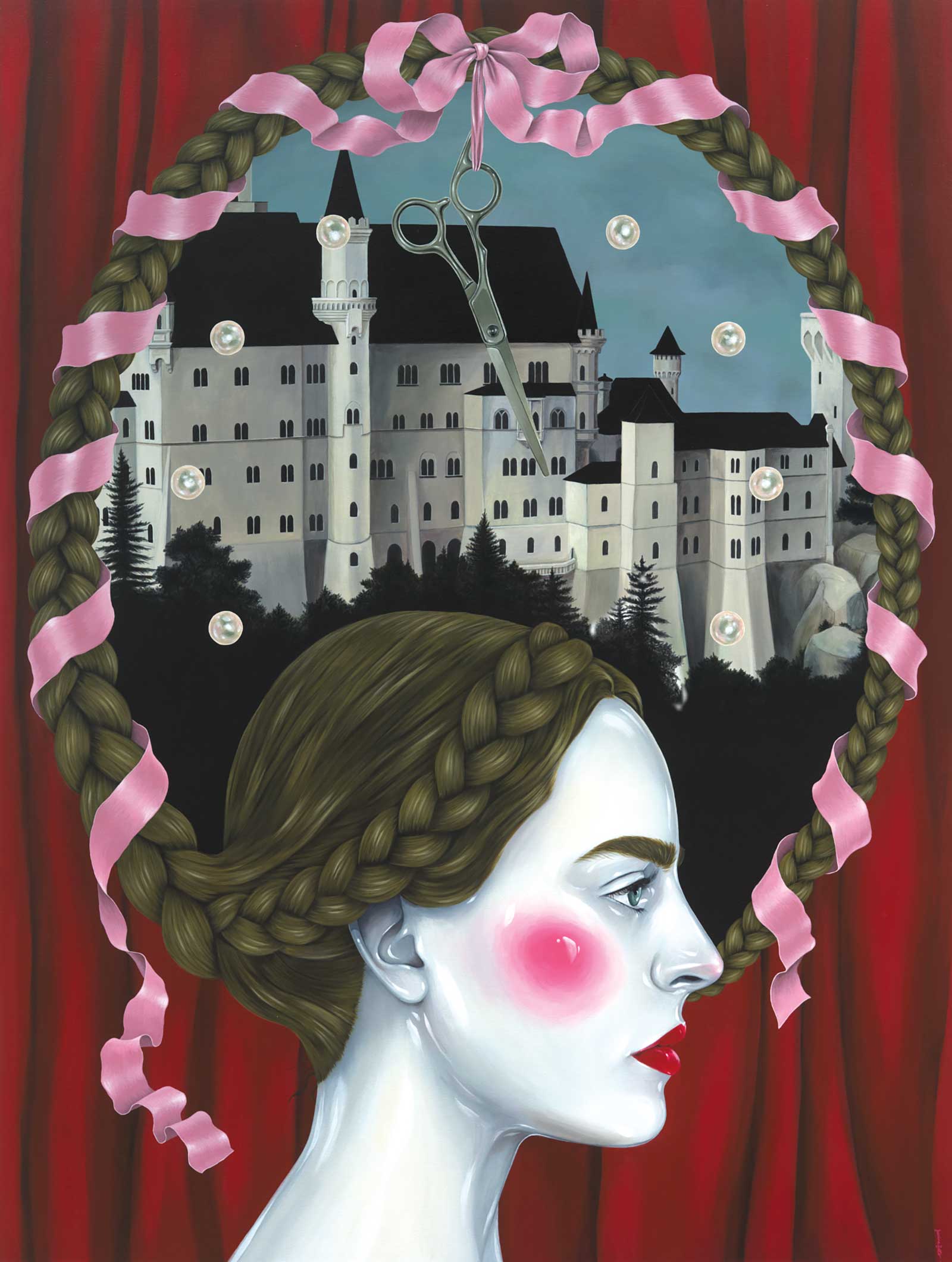
You Remember Too Much, 2024, acrylic on canvas, 66 x 50"
Her paintings are masks, for they are illusions of beauty, and idealizations of the real woman painted under the eye of anxiety. The iconography of the mask changed and intensified during the Covid quarantines of the twitchy ’20s—the conventions of the covered face became customary, and the ordinary masks of makeup and machismo were hidden beneath the wraps of medical necessity. The mask, once the concealment of crook or clown, became the sign of self-protection, a simultaneous symbol of fear and safety, of obedience and of obligation. Unmasked, the faces of new friends were surprising revelations.
When barefaced Brito re-enters the modified world of myth, she holds the corpse of a swan in her Death of a Common Enemy. The picture is set on her crudely draped and tragic stage, now in pastel viridian with limner’s foliage over a backdrop of harlequin checks. The common enemy is the god Zeus, the philanderer, who transformed into a swan to have his way with Leda. Still in her red vinyl fetish gloves, Brito seems as big-eyed sad as a Margaret Keane—and the image is ambiguous—and her audience must decide if this is deicide, a misandrist’s un-nuanced pictorial revenge on men, or a desire for the return of frank sexuality. In Gentle is the Knife She Wields So Nicely,she is ready to cut the throat of the paschal lamb, to blood the Passover door and save the firstborn child—behold the sentiment and symbol of the redeeming Christ-child, the willing victim of the knife.
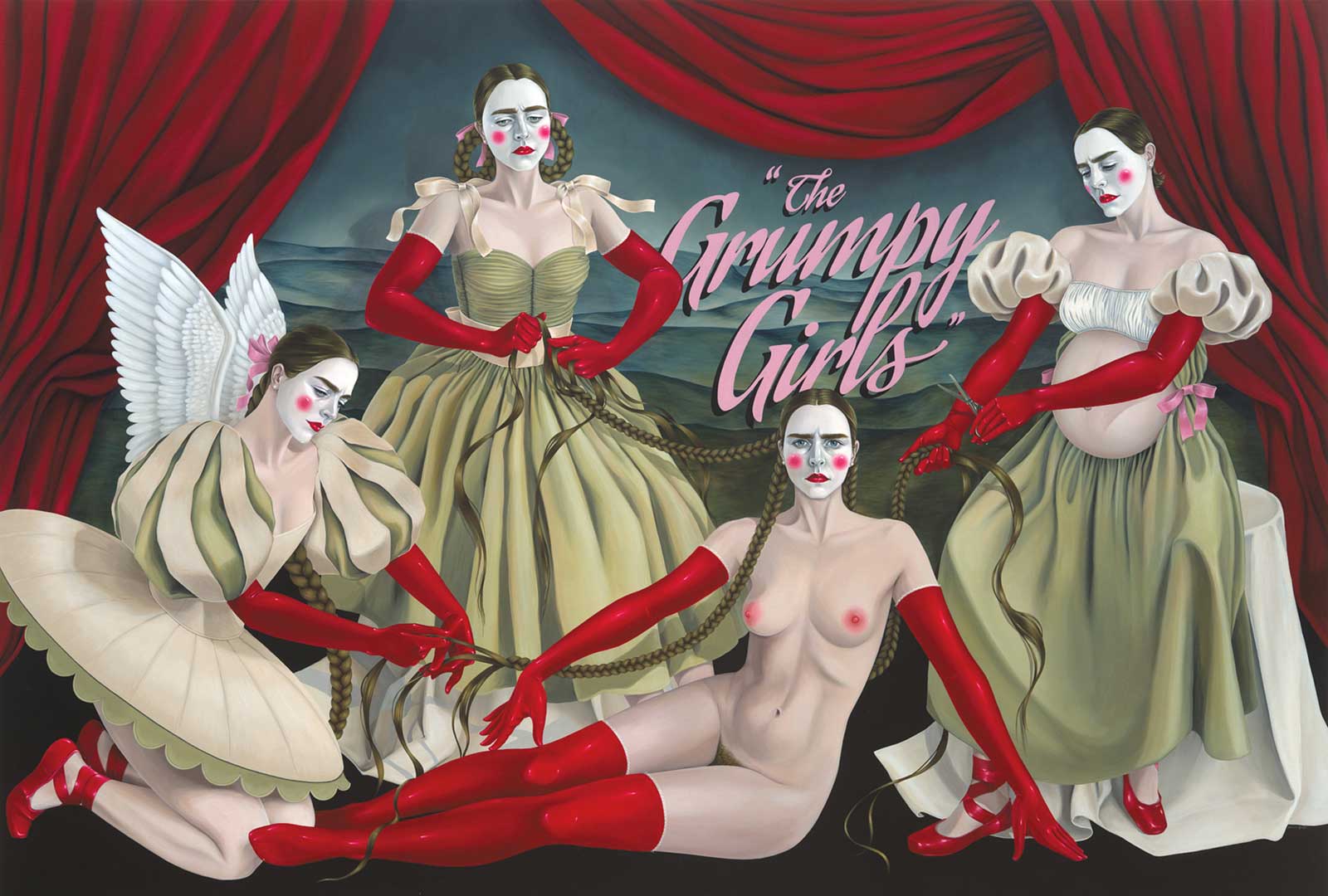
Opening Night (The Grumpy Girls), 2024, acrylic on canvas, 81 x 120”
Brito reveals All The Comforts of Love (The Mother), and her painted self is thrust forward on the stage within the frame of a crudely rendered drape of red before a void of black darkness. The stenciled folds of a printed cloth drape a block in pink and pale green and burgundy like a flattened and simplified altarpiece by Gentile da Fabriano but lacking the grace and sincerity and self-sacrifice of his faithful determination to consecrate every stroke of his work to his god. Primitive and pregnant, Brito exposes a bowling-ball belly from the ribbon-tied folds of her green dress and nestles a lamb. But the triple mirror reveals that seen from behind the sacrifice is a disembodied head and the lamb an iconic gesture. The weirdness of mixed symbolism has entered the imagery of Brito’s love, bearing the flattened but heavy weight of babied romanticism as thickly as Ford Madox Brown’s All the Pretty Baa-Lambs. But scissors are tied and hung from the braid of hair which slides across the empty loom of the space behind the expectant mother, who is Mary, who is a swollen Bo-Peep, who is a fetish ballerina. Images of adolescence are laid over each other.
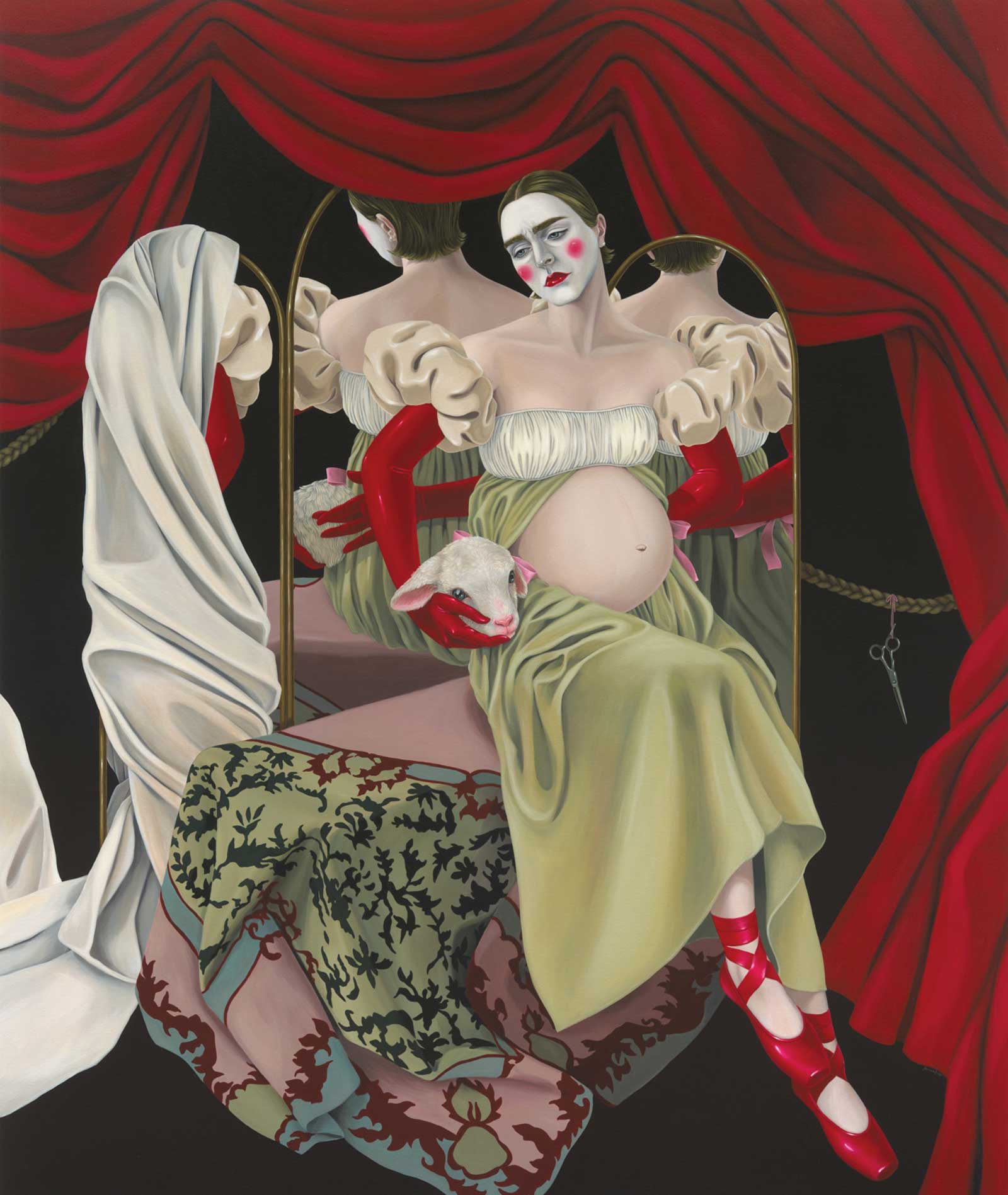
All The Comforts of Love (The Mother), 2024, acrylic on canvas, 86 x 72”
Brito’s scissors are provided to cut the braid and release her from the mask of her performance. They belong to the Grimm’s fairy story about Rapunzel, the beautiful girl imprisoned at the top of a doorless tower by a wicked witch. Every day the witch called, “Rapunzel, Rapunzel! Let down your hair,” and climbed up the braid to visit her. But a prince saw the witch’s climb and came to the tower at night and wooed the girl, and he too climbed Rapunzel’s braid, secretly spending the nights with her. When the witch discovered this romance, she cut off Rapunzel’s hair and banished her to the wasteland, and used the severed braid to trick the prince into the tower to have him for herself. When the fleeing Prince fell from the window he tumbled into long thorns and was blinded, and sightlessly roamed the woods eating roots and berries until, at last, he wandered into the wastes and found his waiting bride. She wept over his wounded eyes and her wet tears restored his sight. A woman now, short-haired Rapunzel presented him with his twin children, a boy and a girl, and the family lived happily ever after.
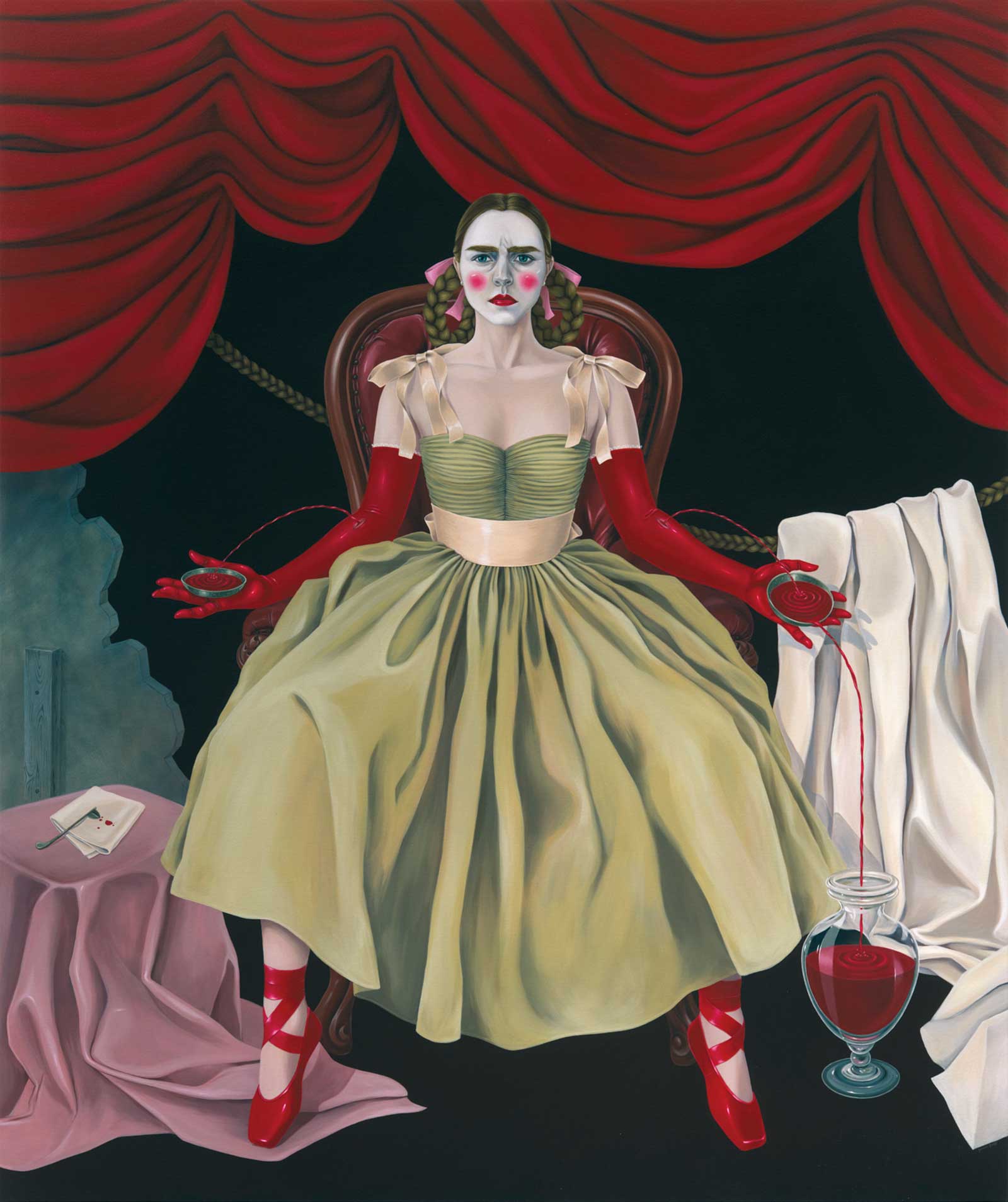
In Keeping With Tradition (The Girl), 2024, acrylic on canvas, 86 x 72”
Brito asks hard questions with her icons, and like a sensible tragedienne, wisely offers no answers. Firmly within the tradition of the didactic art of her generation, she courts controversy—but this is not the conventional political thrust of self-righteous indignation. Avoiding the dreary messaging of ordinary deskilled painters, Brito is difficult. You Remember Too Much is a self-portrait framed in an oval of Rapunzel’s braid, with scissors suspended ready for the witch’s cut, and backed by a painting of 19th century Neuschwanstein Castle, an architectural fantasy built on the border with Austria by King Ludwig II of Bavaria in homage to Richard Wagner’s operatic romanticism.
Painting this place comes with a price. What are viewers remembering too much of in this extraordinary make-believe medieval castle of chivalric knights and myth? The image speaks. The castle was also where Nazis hid looted art under the orders of Alfred Rosenberg. Red and black and white colored the banners of the party. Adolf Hitler painted Neuschwanstein in 1914. Can viewers ever forget, or forgive, the new generation of Germans for the unforgivable sins of their grandparents, or are they doomed to be trapped in the tower of memory, forever guilty?
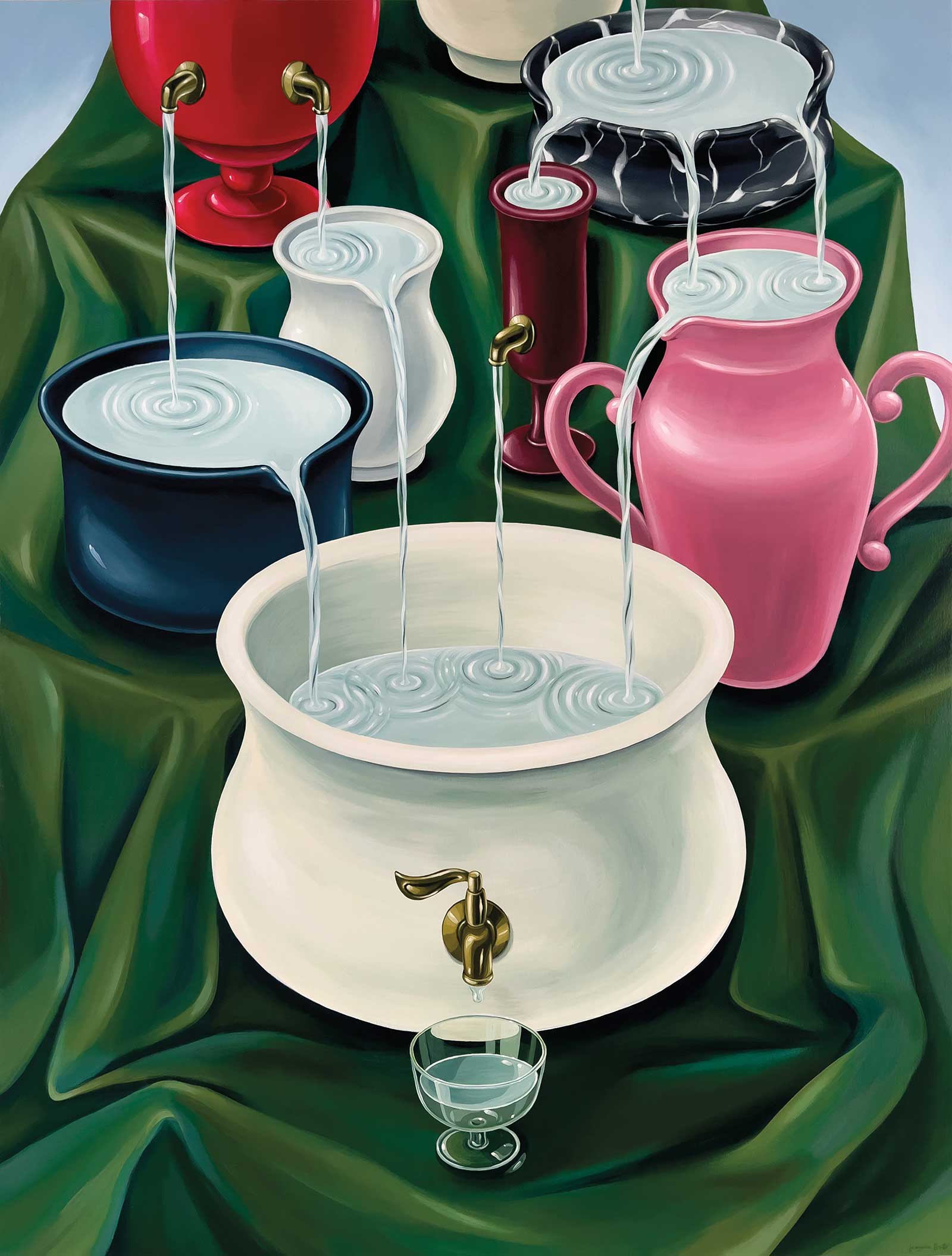
Passage Through Girlhood, 2022, acrylic on canvas, 50 x 38”
Perhaps the answer lies in Brito’s Opening Night (The Grumpy Girls). Here she is as asexually nude as Saliger and Ziegler’s Aphrodite, and prepared for judgement, and the carnival lettering blazons the chaotic mood of our times, and she submits to her selves braiding her hair, but the mother-self prepares to make the braided cut—Brito is witch and princess, sacrifice and priest. As living memories of the holocaust die with the cohorts responsible for the war and its aftermath, they become history, but for seven generations the burdened children of this new age must learn how to live with the sins of their fathers. In fear and loathing the ruby heels click. There’s no place like home. —
Michael Pearce is a dynamic writer, curator, and critic, and a champion of art that emerges from popular culture and shapes the spirit of the age. He has published dozens of articles about art and artists, and is author of Kitsch, Propaganda, and the American Avant-Garde. He is Professor of Art at California Lutheran University.
Powered by Froala Editor