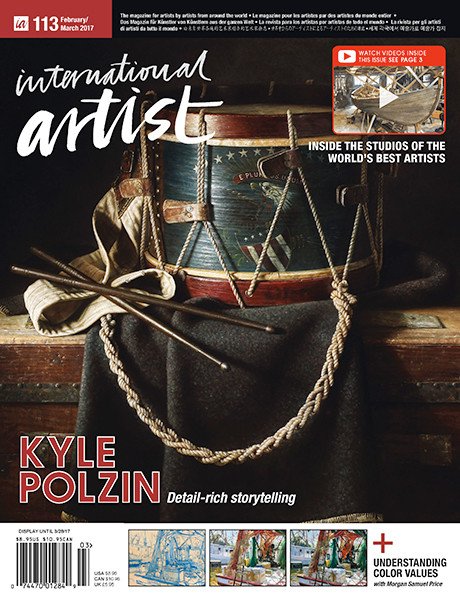
Toni Hamel creates peculiar scenarios that evoke a subtle sense of unease without disrupting their overall loveliness—one of many paradoxes that the artist is able to balance in her works and, in doing so, also in her mind.
“Art-making is a cathartic tool for me,” says Hamel. “It keeps my anxieties at bay and allows my mind to roam free from any cognitive encumbrances and restrictions. Since I think visually, I employ the marks of a pencil or the strokes of a brush to visually express what I see, perceive or concerns me. In a roundabout way I guess I try to explain reality, whether to myself or to others, arguing its very precept in an attempt to alter its course.”
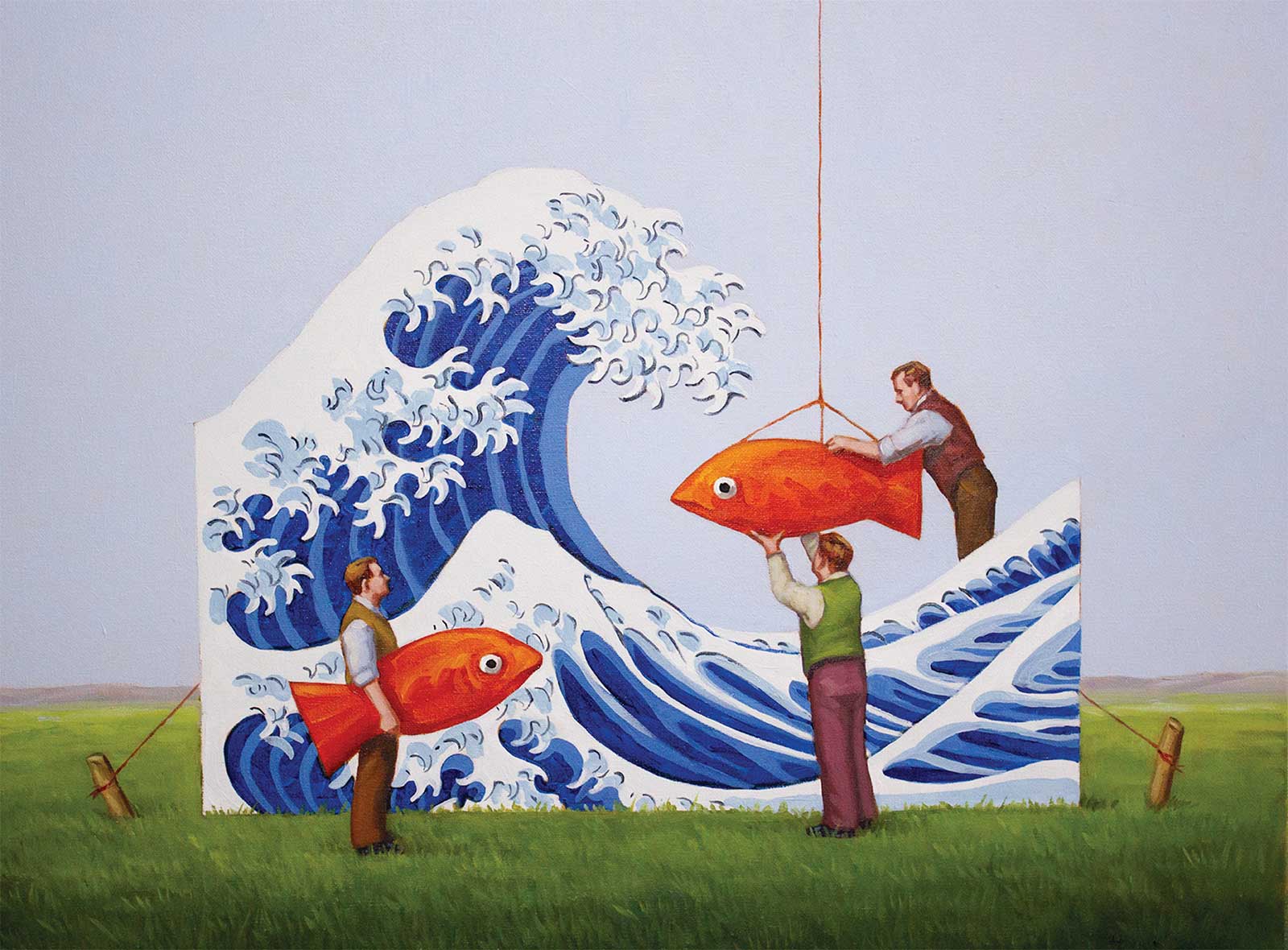
Kabuki 2 (The Performance), oil on canvas, 20 x 24"
In her latest series, on view at CK Contemporary in San Francisco through August 10, two women sew patchwork squares onto a stuffed polar bear; men erect a rudimentary Japanese-style stage set in a grassy, rural expanse; and two men rake the ground around a cardboard royal pine car freshener. Her characters’ style and dress imply an earlier, more innocent era, underscoring their unawareness of the futility or absurdity of the activities they are engaged in. In some of her pieces, natural, organic forms—blossoms, fruit, wildlife—dwarf the figures, drawing attention to humanity’s hubris. In Hamel’s pictorial realm, “all that is left is artificial turf, fake waves, plastic flowers and hand-painted rainbows.”
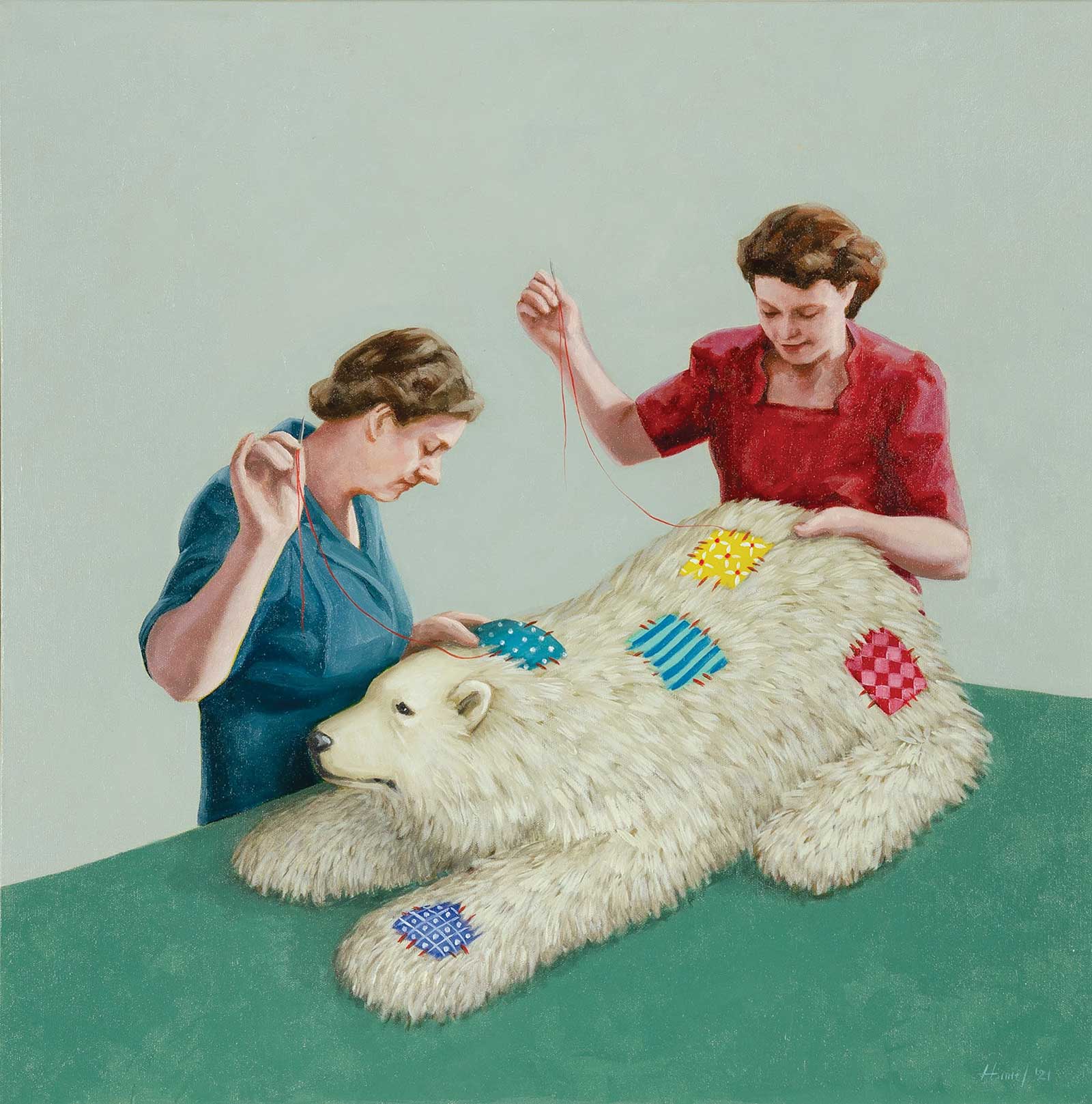
Patchwork, oil on canvas, 24 x 24"
Hamel explains, “The conceptual framework of my art practice has always revolved around human behavior and its conundrums: I observe it, dissect it, analyze it, uncover the most intriguing bits, and then report my findings in my work. The questions I pose to myself are always the same: what are the consequences of our actions? Do we ever truly think about the repercussions of our behaviors? Where will this lead? That is what interests me the most: the leftovers, the remains, the ‘corpse’ we leave behind.”
The meaning of some paintings is left dangling altogether, while in others the message is more clear. In Good Intentions, for instance, is the subject painting the oversized apple red to make it more aesthetically appealing or is he trying to cover up its blemishes?
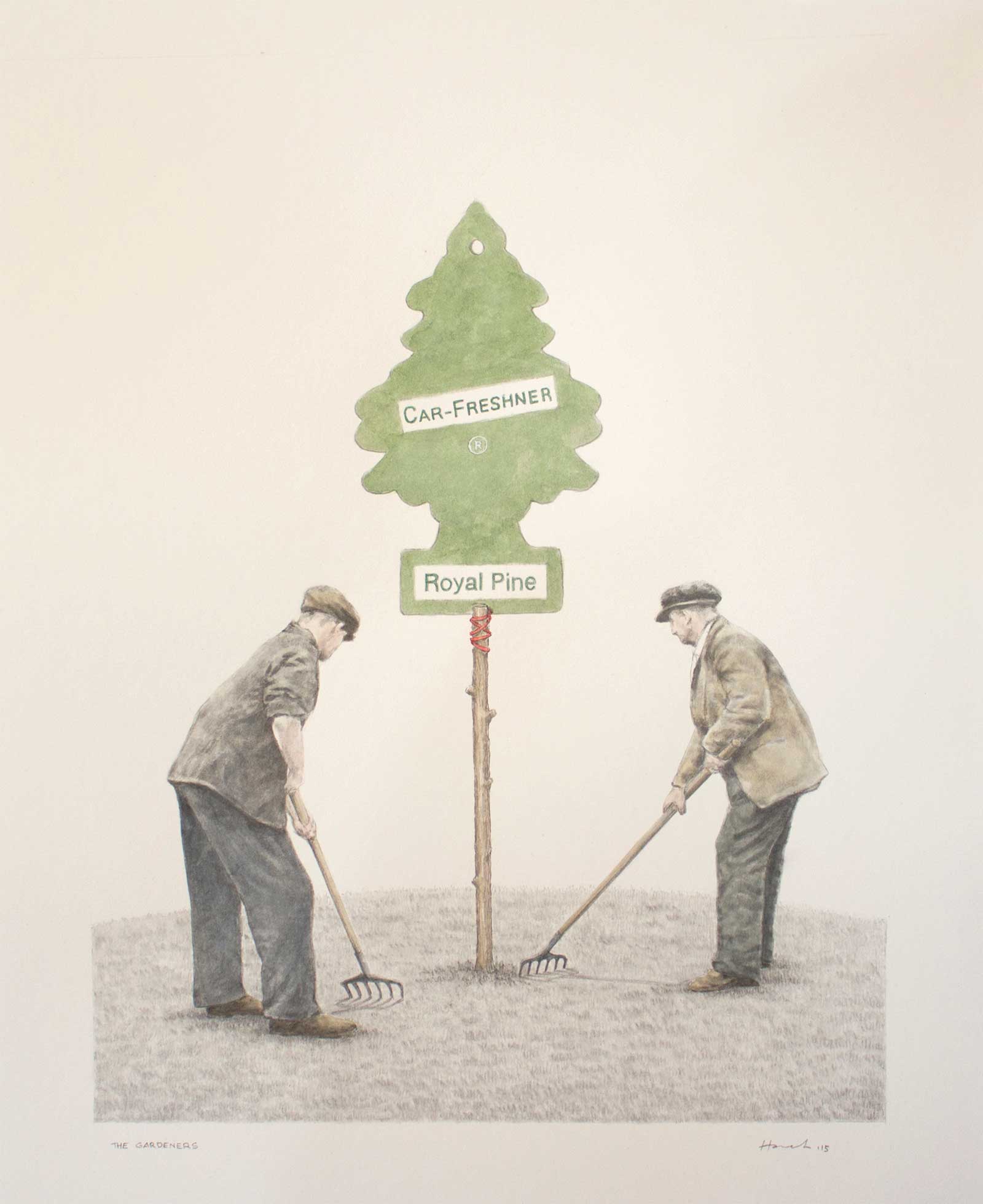
The Gardeners, graphite and watercolor on paper, 18 x 15"
Hamel enjoys toying with viewers’ perceptions and views cognitive dissonance as a tool to open peoples’ eyes. “My narratives reference a world full of uncertainties and anxieties,” she says. “I devise scenarios that are not clearly understood and, in most cases, defy logic. I always employ a skewed narrative because I want the viewer to engage, pondering the meaning of a piece rather than quickly scanning its rendered surface.”
When beginning a body of work, Hamel has a theme in mind, usually those that most preoccupy her and have a particular urgency—her concerns about humanity’s responsibility for the degradation of our natural environment, among them. “Ideally, I’d like for a series of works to read like a book in which every painting is a chapter.," she says. "Over time, eventually one series evolves into another, and so on and so forth until I feel that I’ve nothing else of value to ‘say’ about that topic.”
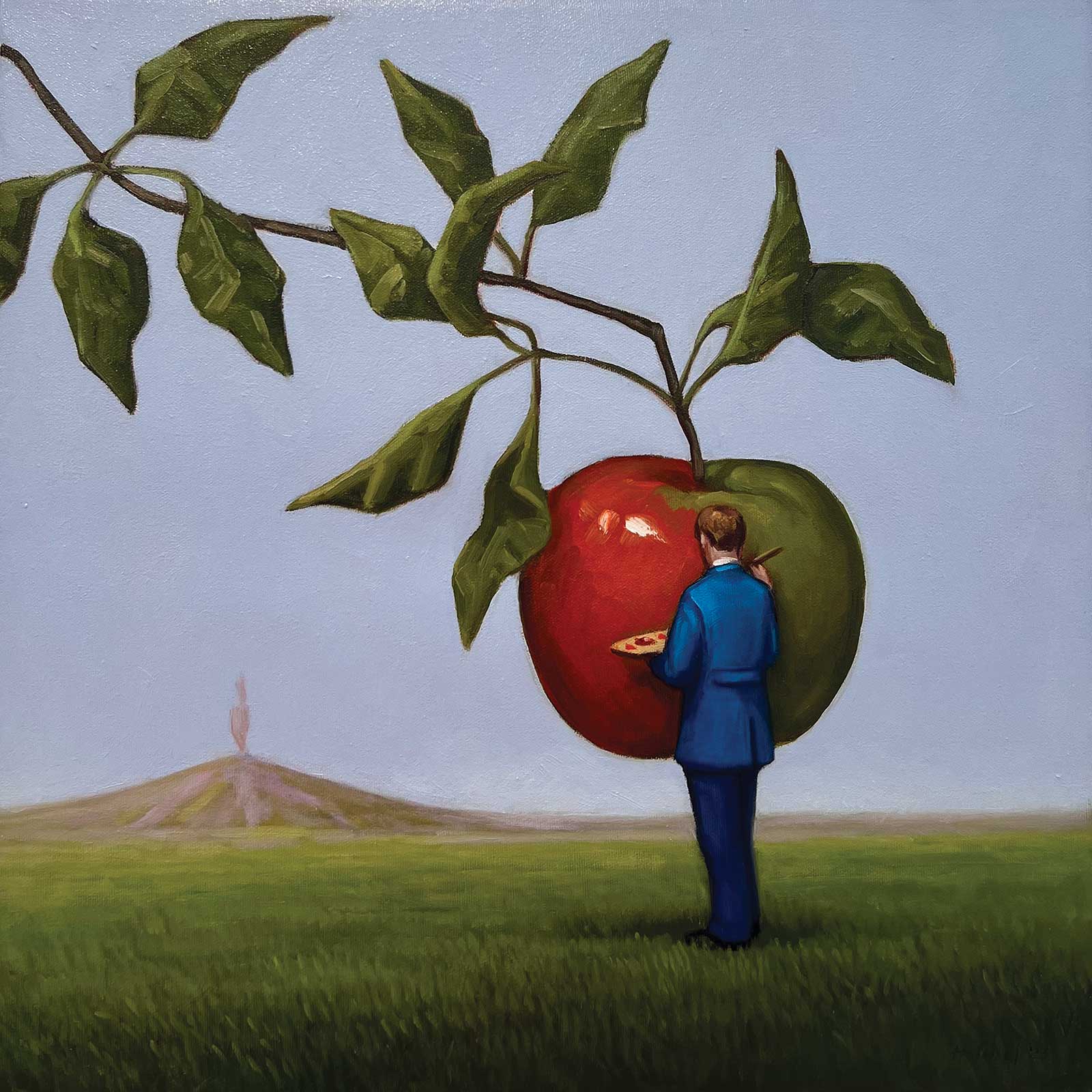
Good Intentions, oil on canvas, 18 x 18"
Hamel refers to her work as an “illustrated commentary on human frailties.” “However, my works could also be viewed as an illustrated compendium of unintended consequences,” she says. “The human psyche is always at its core, particularly those traits that usually lead us into misbehaving…The symbolism and satire employed in my work is in fact intended to stress the absurdity of our actions: humanity’s tendency to control, deceive, devise or alter its surroundings (whether natural or man-made) in the pursuit of personal gain and/or gratification. I depict a topsy turvy stage where everything is possible and nothing is what it seems.” —
CK Contemporary 246 Powell Street San Francisco, CA 94102 • (415) 397-0114 • www.ckcontemporary.com
Powered by Froala Editor