
The Colombian artist César Biojo paints portraits and then destroys them. Contemplating his paintings before encountering the benefit of his eloquent commentaries, I thought of change, essence, the gaze. It was obvious that he had created a fully realized portrait of his subject created over many hours. When the paint was still wet he ran a spatula over it, destroying its verisimilitude but leaving its substance—paint, and the memory of its subject. All the material of the sitter’s painted essence remains but is changed forever. The painting seems to be the opposite of a portrait—its perfection, and that of the sitter, is destroyed, and the accidental redistribution of the paint through the action of the spatula, reflects the contradictions or opposites that exist in all of us.
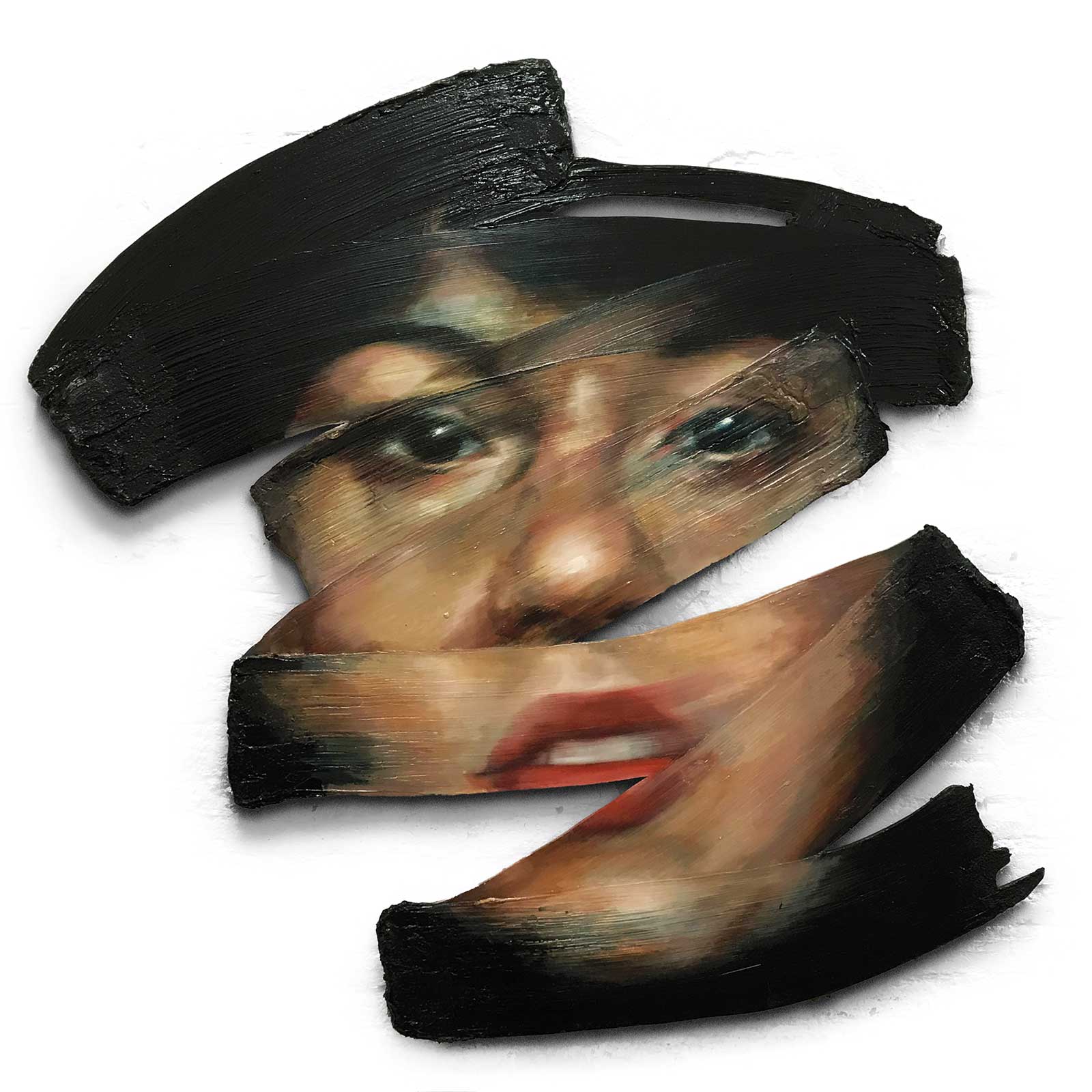
Cheliberti 4, 45¾ x 47"
Biojo explains his motivation, “When the painting is finished, I feel the need to make it imperfect. This person has conflicts and will suffer at some point. They might win the lottery one day or not, but it’s not a big deal. This moment is the most thrilling and exciting in my painting. I’m addicted to it; I can’t go without it. When I have them perfect, I need to make them imperfect to make them human.
“It is in these accidents that I find my creative drive and what makes me happy. What I want to invite you to do is simply change your mindset and stop seeing accidents and failures as negative. I’m not saying to see them as positive, but as part of a process, which removes the tension. All successes have their failures, and they must be understood this way.”
In his painting Superfertig 5,from his series Strokes, paint is added rather than removed. The subject peers out from behind thick strokes of white paint, inviting the viewer to gaze beyond the strokes to perceive the sitter, to communicate.
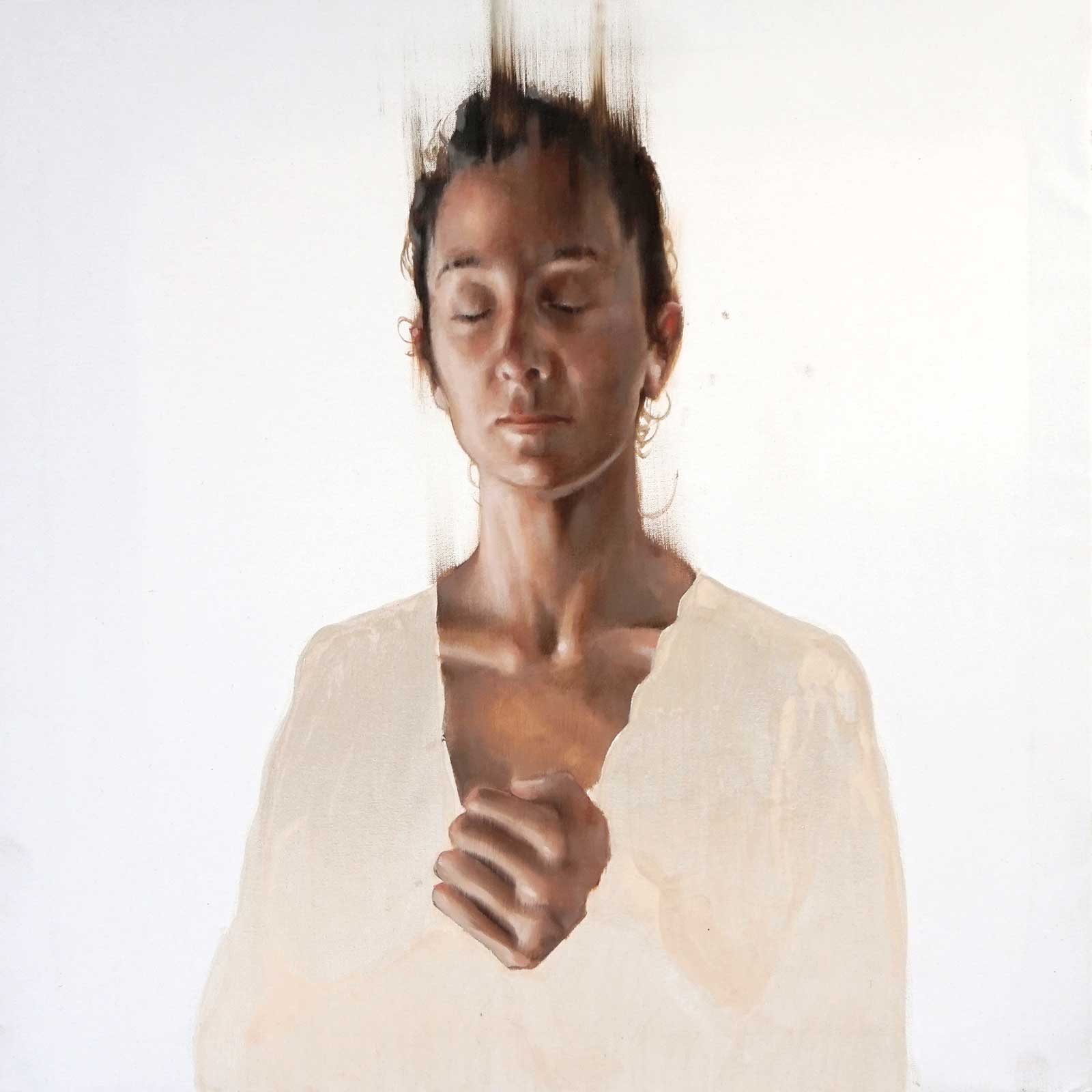
Blanca 20, 2024, oil and pearl powder on canvas, 19¾ x 19¾"
The series began as an experiment and evolved into an exploration of consciousness. He had participated in an ayahuasca ritual, consuming the plant-based psychedelic beverage that for him was a life changing experience. “The experience obviously raised more questions than it answered,” says Biojo. “And one of the questions that remains still with me is, ‘What is consciousness? Is it an individual perception? Is it individual or communal? Is it universal? Is it an illusion? Are we part of a matrix or a simulation?’”
He is also exploring existentialism and discovered a quote in Jean-Paul Sartre’s Being and Nothingness: “The gaze of the Other reveals our own existence to us.” When we gaze at a person we gaze through our own colored glasses, seeing what we want to see and projecting onto the person our own preconceptions. Biojo’s spatula-distorted faces remind us that our perception is often distorted. When we become aware of another gazing at us we also become aware that what they perceive may not be what we believe we are.
In his various series of portraits, Biojo explores these concepts, our internal conflicts, the confluence of opposites, creation and destruction.
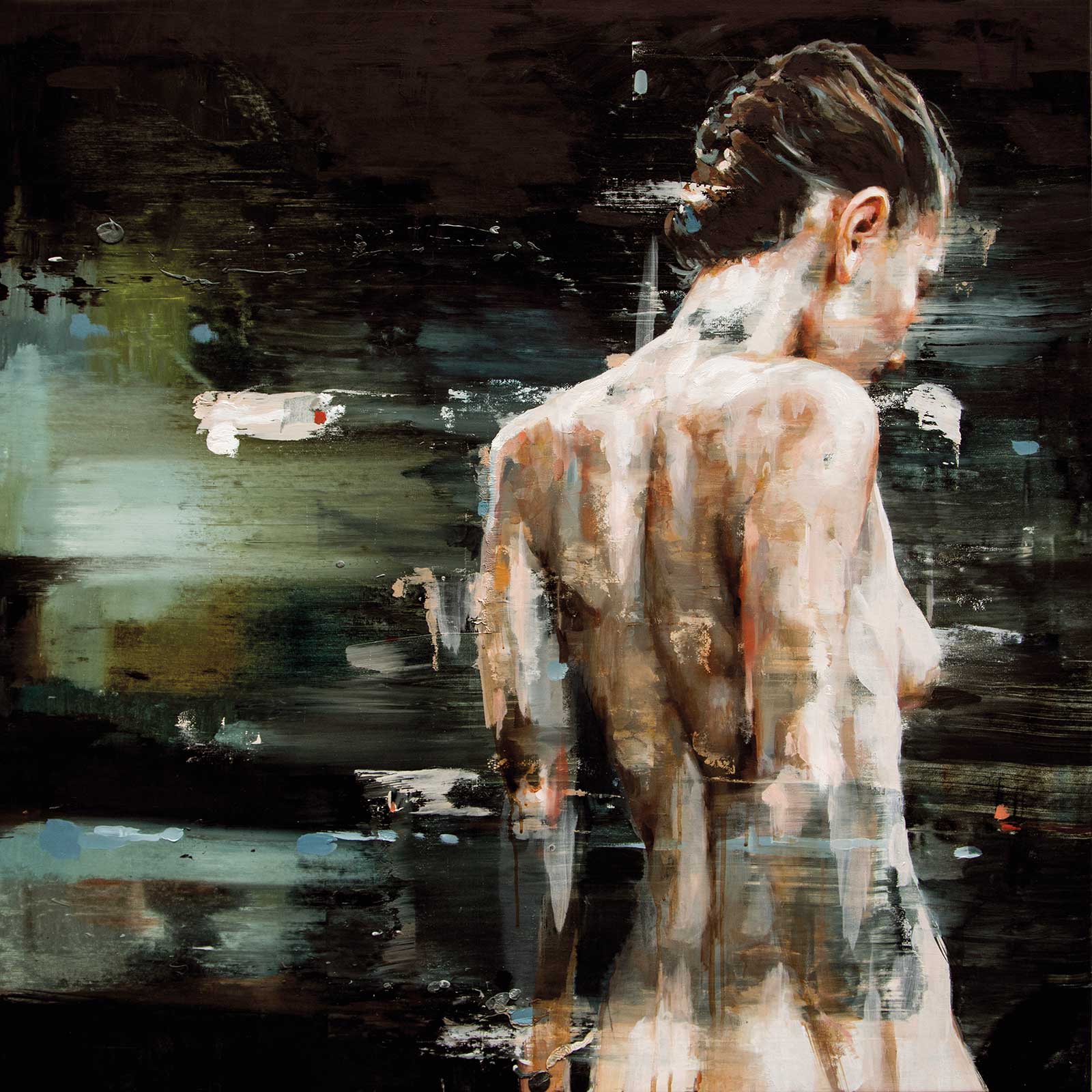
Unknown 73, 2020, oil on canvas, 391⁄3 x 391⁄3". Private Collection
In a TEDx Talk delivered in Spanish at the University of Navarra, Spain, he spoke about “Accident and Failure as the Creative Motor.” He graciously sent me a transcript in English.
His comments on accidents are cited above. “Failing, allowing oneself to fail, is a luxury we humans have because failure is the only way to find new things. Failure is unexpected; the normal is expected and has nothing new.”
With characteristic humor he said, “I wanted to be a chemist. Chemistry provided me with answers; it was a way to understand how the world worked. So, in a way, I consider myself a failed chemist. I’m also a failed poet, a failed writer, a failed pianist, a failed tennis player, a failed violinist, a failed singer. I love to sing, but I do terribly in karaoke, which I love. They always turn off my microphone.”
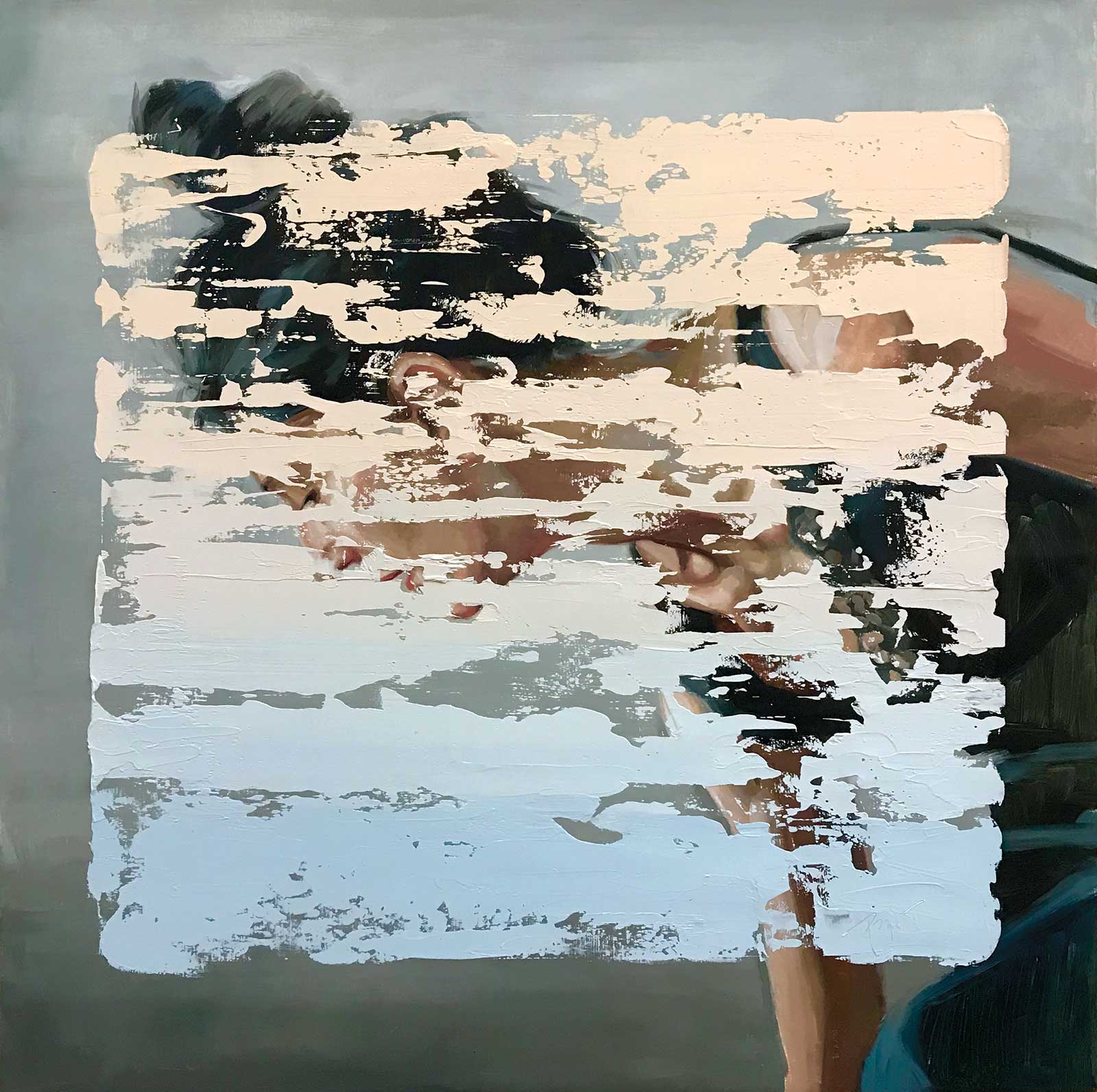
Blanca 1, 2020, oil on canvas, 31½ x 31½"
He came to the United States to study graphic design and discovered painting. When he went home to Colombia he told his father he wanted to be a painter. “My father, a surgeon, looks serious and says, ‘Son, you only have one life; you have to make the most of it, and dreams are meant to be fulfilled.’ And I thought, ‘Wow, I like that.’ He continued, ‘The only thing I ask is that you be the best you can be and give your best effort. If most painters create 30 works a year, you have to create 60. If most painters read five books a month, you have to read 15. If most painters paint six hours a day, you have to paint 18.’ And I thought, ‘OK, I like that because I want to excel.’”
Biojo has approached his painting and his exploration of consciousness, human nature and perception with passion—with a sincere affection for his sitters as well as true empathy.
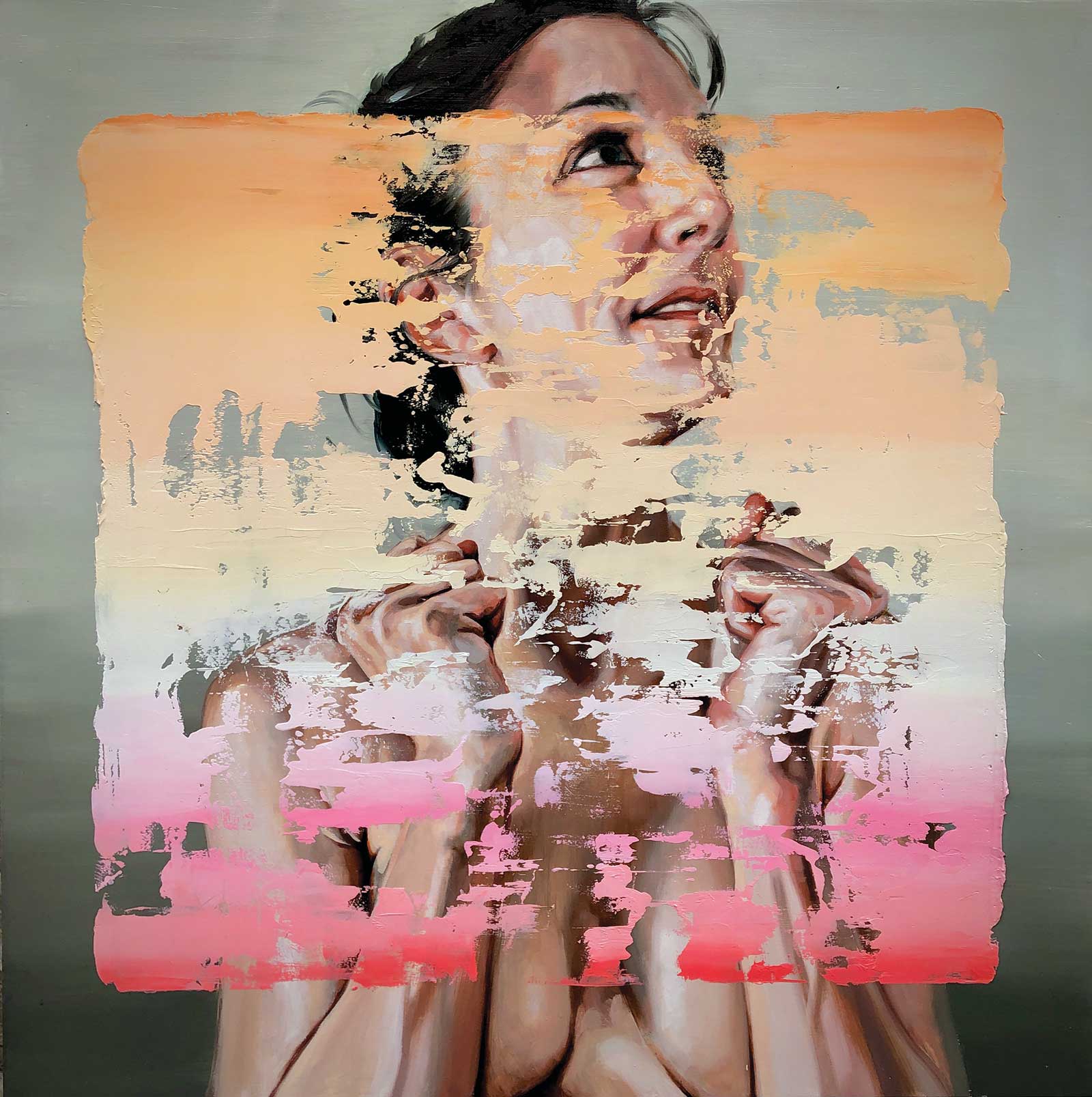
Blanca 10, 2020, oil on canvas, 31½ x 31½"
In Blanca 1 and Blanca 10, from his series Amaneceres (Dawns), he deals with his own life crises as well as those of his friend Blanca. He was going through a divorce and she “was also facing a very dangerous and emotionally taxing medical procedure,” he shares. “As we supported each other, since ‘misery loves company,’ she would constantly say, ‘...don’t worry friend, it is always dark before dawn.’ This phrase prompted this series of portraits executed in a figurative way in the background and ‘hope’ expressed in the abstract top layer with the colors of different dawns taken from all over around the world. This was my way of dealing with the pandemic, my grieving process, and my ‘hope’ message to humanity through…ART.”
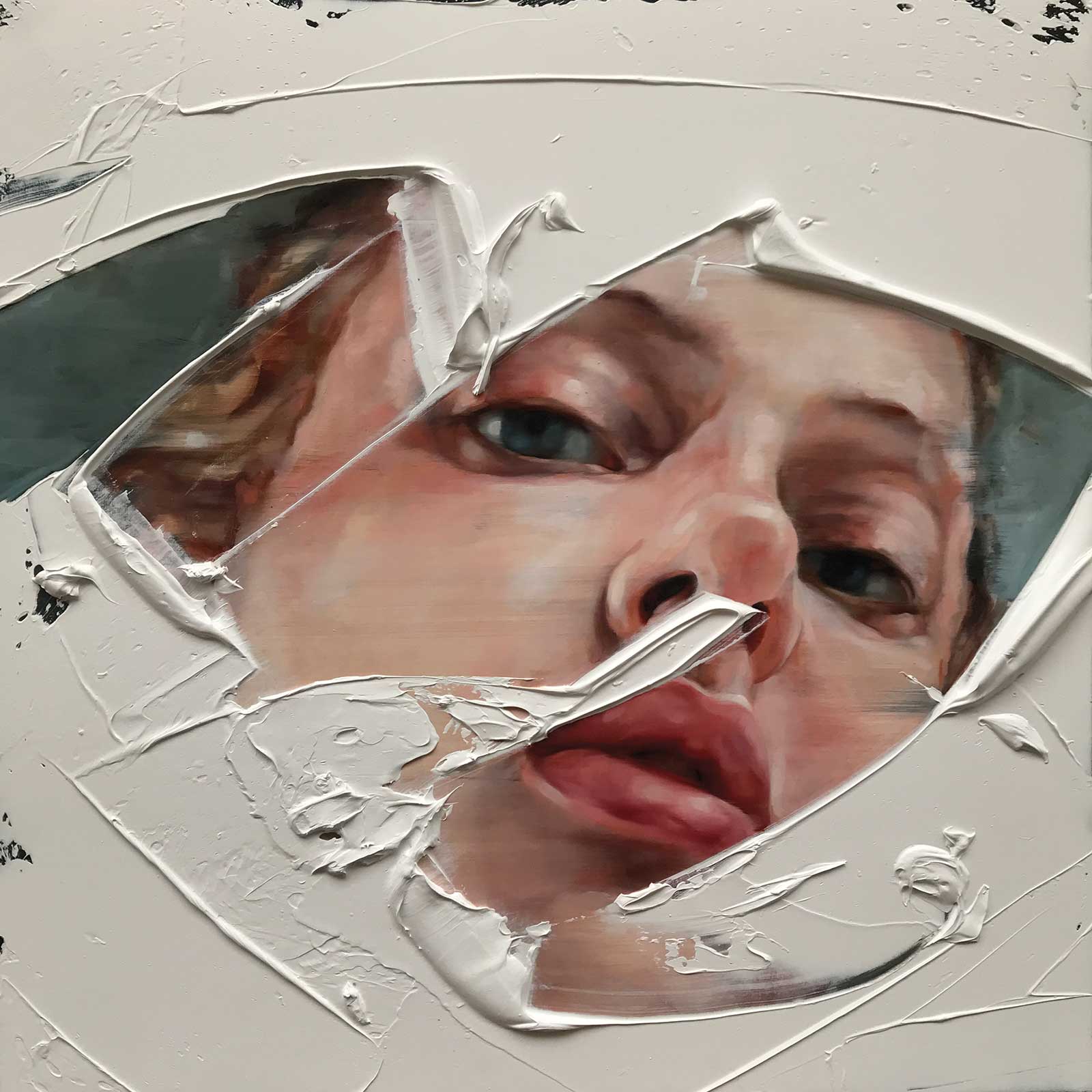
Superfertig 5, 2019, oil and acrylic on canvas, 31½ x 31½"
In his series Still, he continues to explore the coexistence of the two opposite forces—creation and destruction. Although he has another aspect of his life in which he is an “ambitious entrepreneur,” he is equally intensely pursuing the opposite practice of meditation. For his active mind, slowing down and allowing the stillness that is necessary for deep meditation is an almost futile effort as he seeks to find “the perfect equilibrium between doing and not doing.”
In a new series he is painting for an August exhibition at Galleria Ca’ d’Oro in Miami Beach, he will focus on portraits and reflections of the spectator on the material. “There will be lots of highly reflective surfaces,” he says. “I want to explore how the reflection of the person in front contributes to, changes, and alters the portrait in the piece. It is a dynamic visual dialogue that is unique, unrepeatable, unrecordable and ephemeral, only available to the person in front of the piece.”
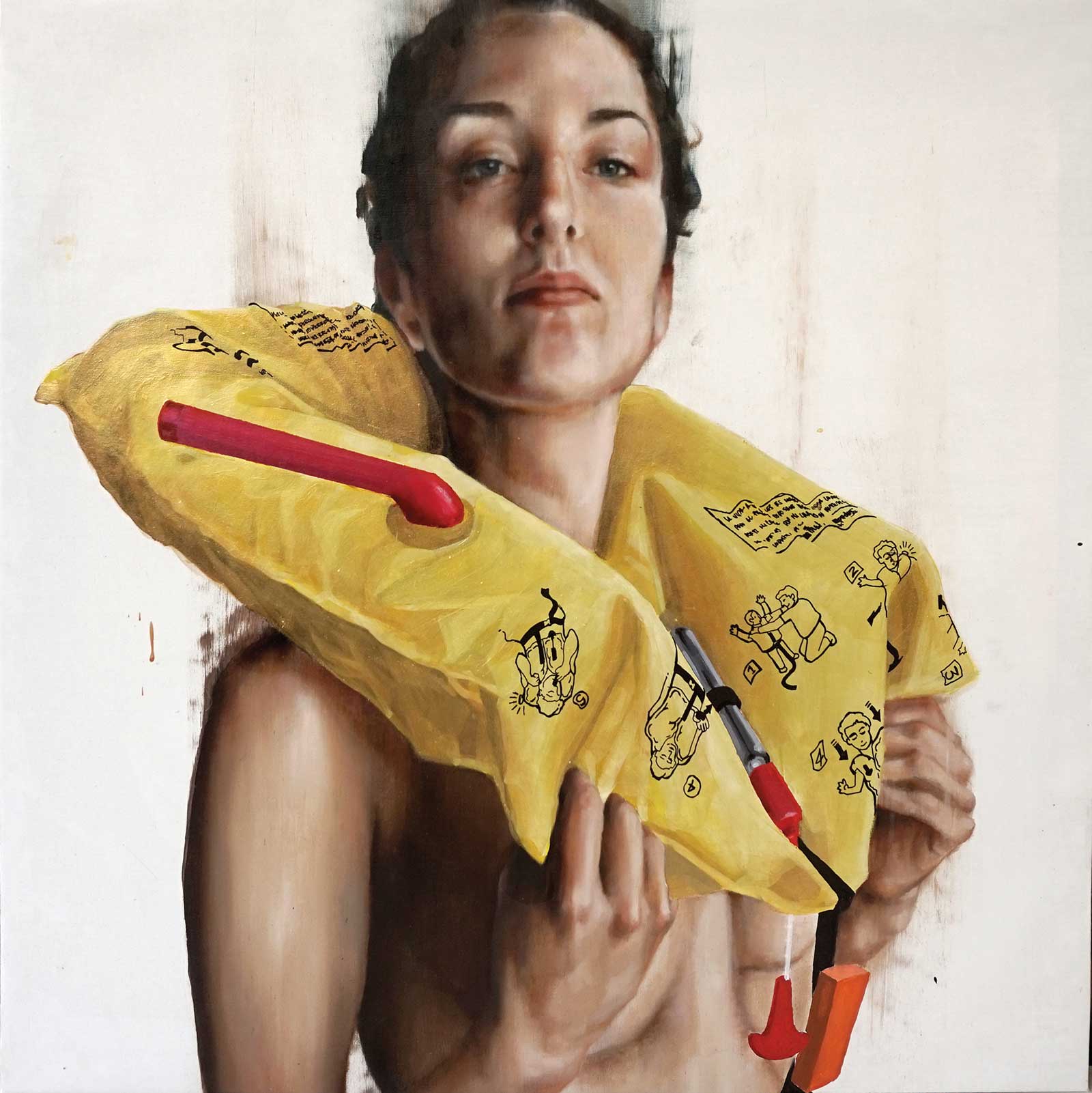
Raquel 16, 2021, oil and pearl powder on canvas, 31½ x 31½"
In addition to his own art making—and despite his being “erratic, impulsive and disorderly”—he is “committed to improving the art experience and helping artists through technology. This new technology will radically transform the way art is experienced, shared and owned online. This is the future of collecting art online. It is immersive, interactive and multisensory.”
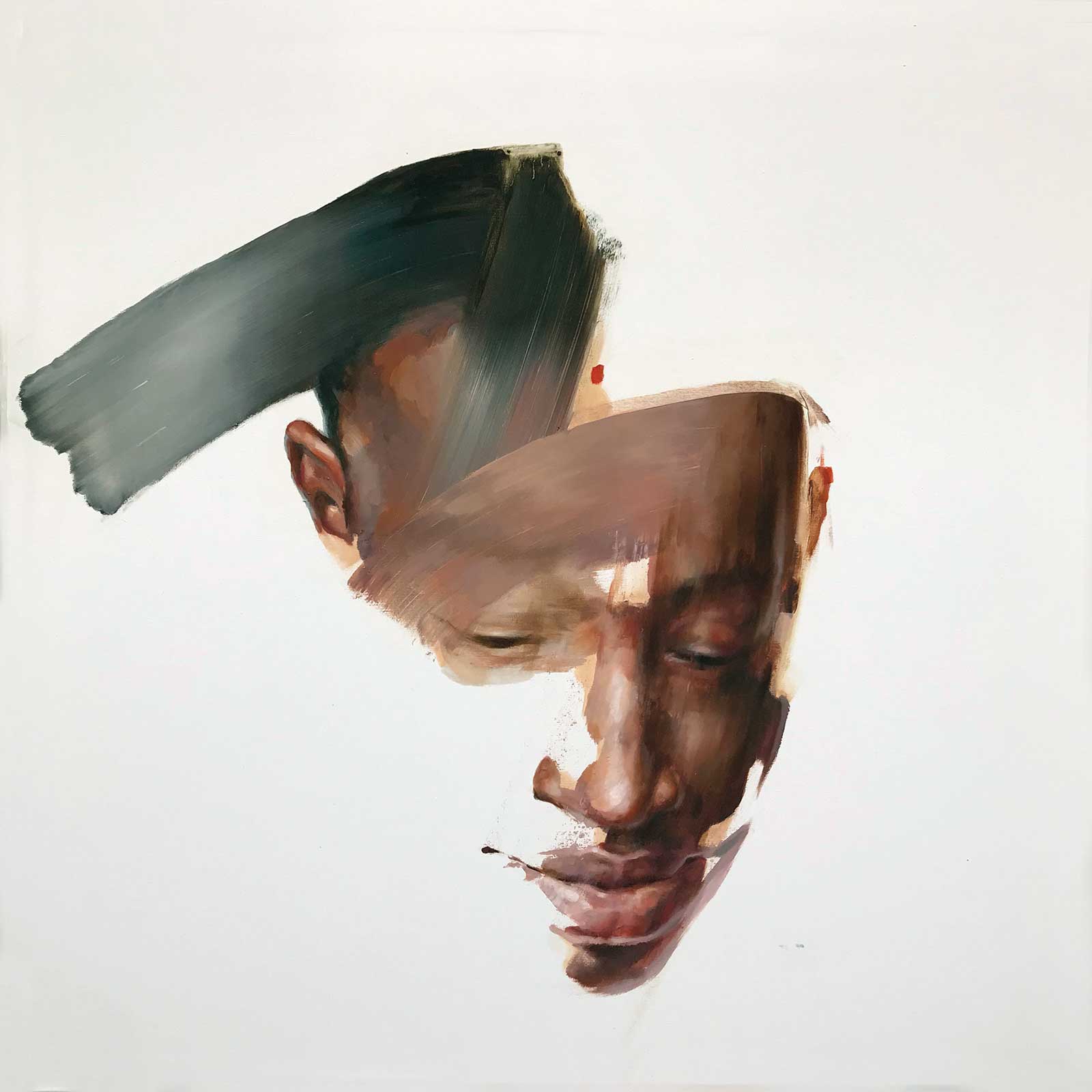
Abelomai 1, 2019, oil on canvas, 31½ x 31½"
Biojo is co-founder of Kaleido: Art Universe, “Where physical art and digital experiences collide,” an immersive platform on which artists display their art as well as audios and videos in which they can explain their creative process. Art Universe is a new application built specifically for the Apple Vision Pro, featuring Kaleido artists “in a magical, spatial environment.” —
César Biojo: New Works
Opens August 21, 2024
Galleria Ca d’Oro
690 Lincoln Road, Miami Beach, FL 33139
www.galleriacadoro.com
Powered by Froala Editor