Zienna Brunsted Stewart’s house in Santa Fe, New Mexico, has a curious quirk in the layout. The path to the living room and her studio leads through her and her boyfriend’s bedroom. Guests who visit are treated to all their business, whether it’s dirty cloths and an unmade bed, or all the bits of personal stuff that one might not leave out unguarded and on full exhibition.
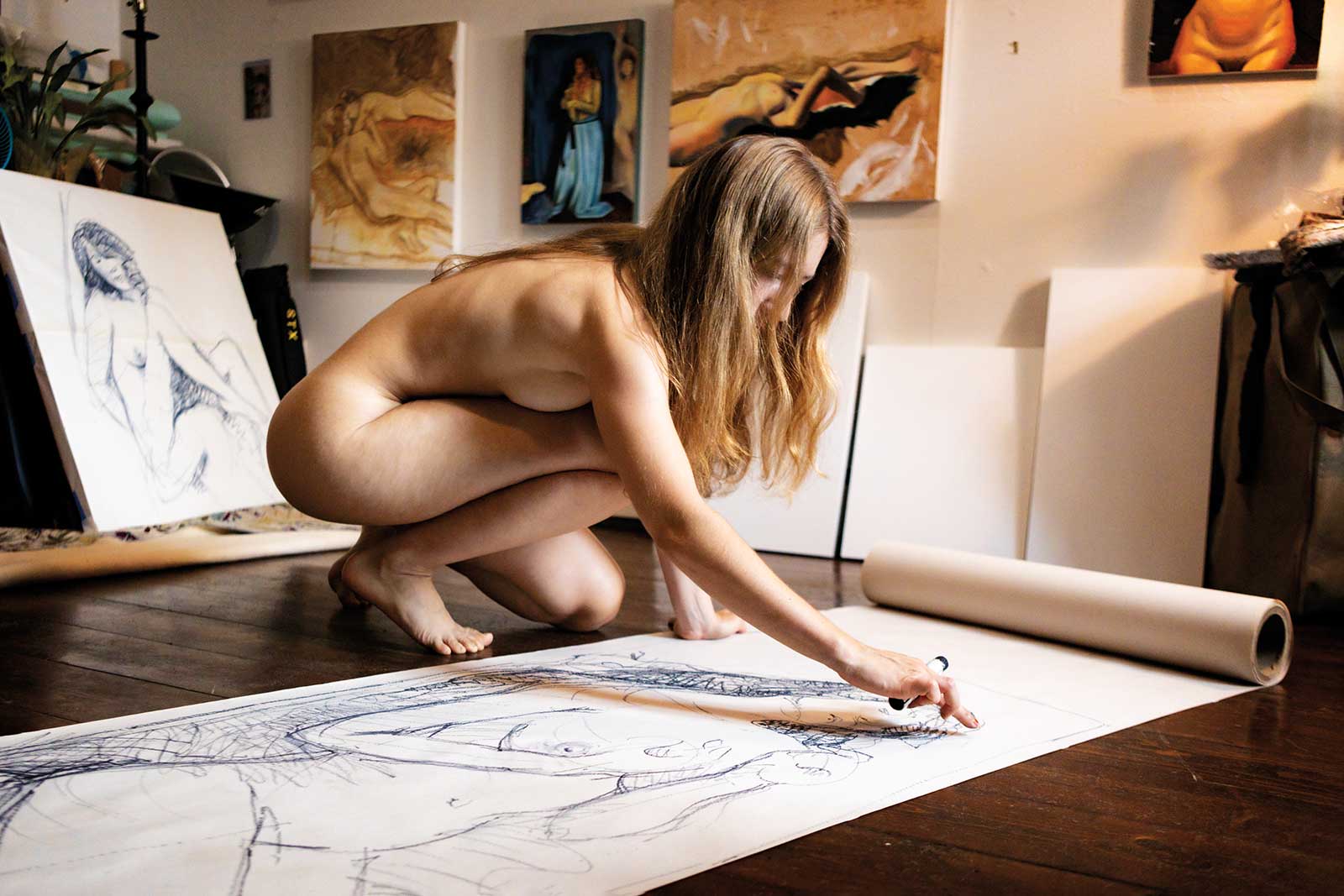
Blake Dieters, Untitled (Zienna Brunsted Stewart in her studio), photograph
A friend was over recently and was mortified for them. “All your intimacy is on display,” the friend said. Stewart was quick to defend her bedroom and what it revealed about her. “Some people would be uncomfortable with showing that portion of their lives,” she says. “But this is my life and it’s how I live.”
Although this is just a bedroom—which I’ve passed through on the short walk to her studio, and it is very tidy and organized—it serves as a larger and more poignant metaphor for Stewart’s burgeoning career as a painter of the nude form. Her paintings, her models, and even the artist herself, are often on full display—no masks, no inhibitions, no shame and no clothes. And her refreshing honesty about her body, her subjects, her artwork and all of our weird hangups about the nude form are an invitation for viewers to re-think the genre and its polarizing popularity.
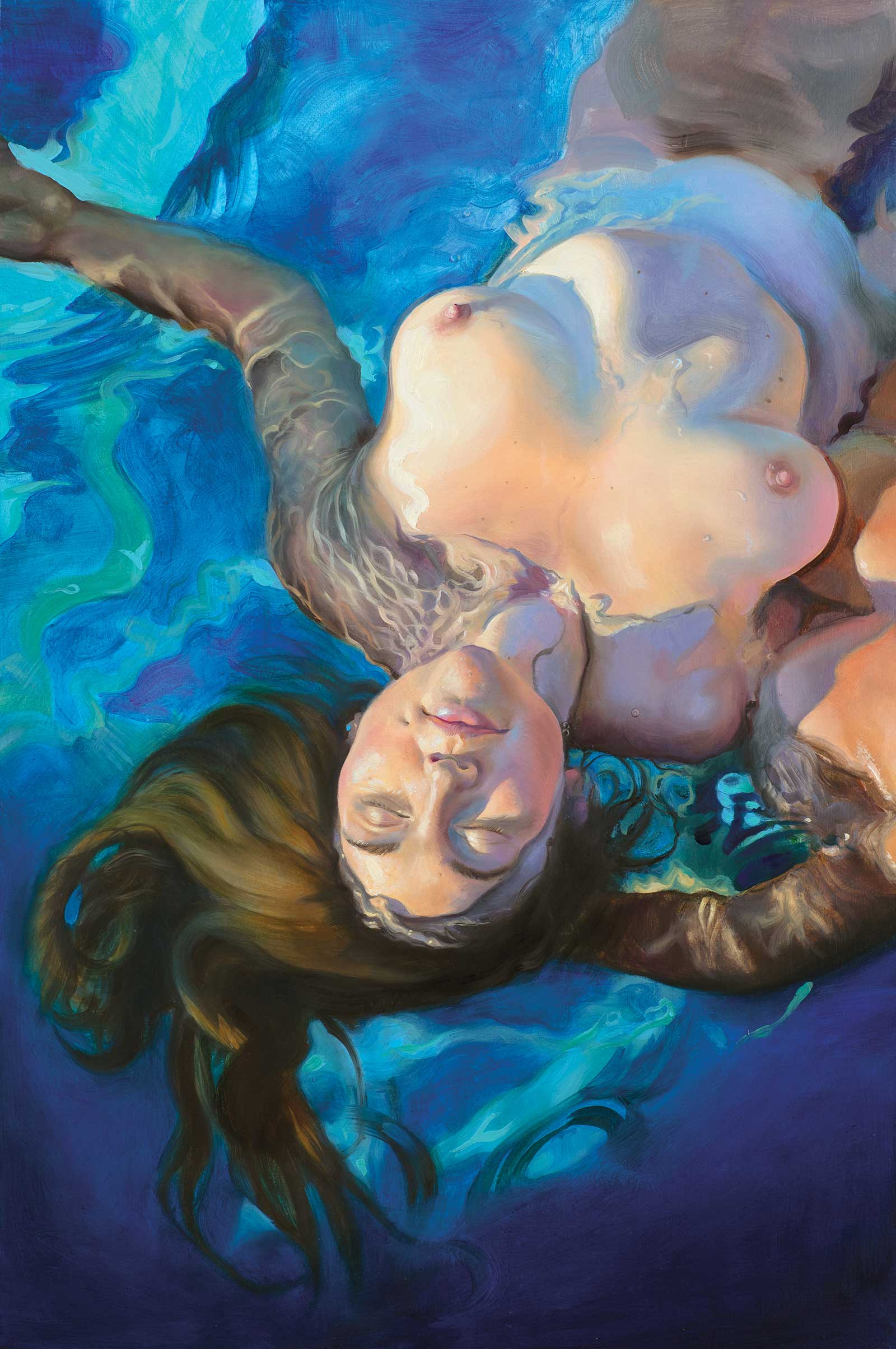
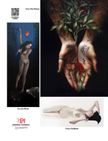
Zienna Brunsted Stewart, Octopus Hair, 2024, oil on cradled panel, 24 x 16”
Stewart dabbles here in there in other genres, but her studio sits squarely in the genre of figurative nudes. “I tried to do still life. I’ve tried landscape. For me, I was bored. I hate saying that because I have seen so many beautiful landscapes and still lifes and they have so much soul in them. But there was nothing there for me when I was doing it,” she says. “I just kept coming back to this idea of the nude. And it’s so hard to explain. Why do people like the things they like? Sometimes they just do. And that is me. I just know where I’m supposed to be.”
Pushed on the subject further, Stewart boils it down to three points: First, the nude form inspires her and still offers a limitless supply of compositional ideas. Second, naked bodies are more interesting to paint. “When you break it all down to its most basic parts, it’s just geometric forms: cylinders, spheres, cones,” she adds. Finally, her own upbringing in a Hindu ashram also played a major role on her views about her body.
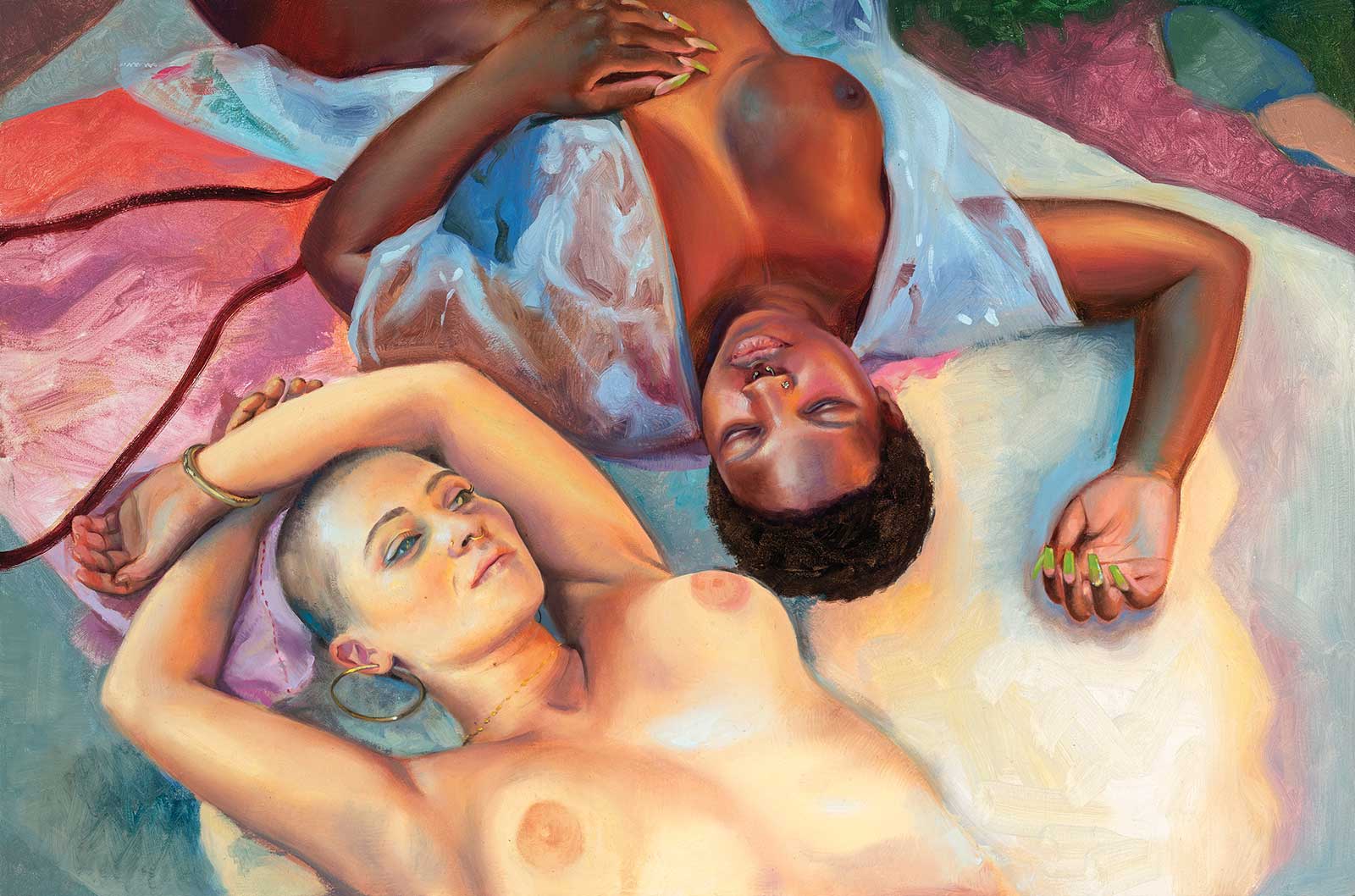
Zienna Brunsted Stewart, Two is Company, 2022, oil on cradled panel, 16 x 24”. Courtesy of Keep Contemporary.
Stewart, who was born in Florida, grew up mostly in Colorado. It was there, her mother tells her, that she was drawing objects around her long before she could even articulate them through speech. Art and culture found their way into the house regularly, including in W magazine, with its giant pages and fashion spreads with the occasional exposed breast or bare behind. Her family was from Denmark, so they had a European sensibility about art and nudity. Occasionally, the family hosted their Danish friend, Julie Nord, an artist from Copenhagen, whose works on paper would inspire the younger artist. When Stewart and her mother were living in the ashram, she felt there was a backward sensibility about the body and its beauty. “There was so much emphasis on transcending the physical and honoring the things that are natural about your body, but there were also things that were shameful, like a woman’s period, which was considered dirty,” she says. “I just didn’t agree with that and felt that our bodies should be embraced.”
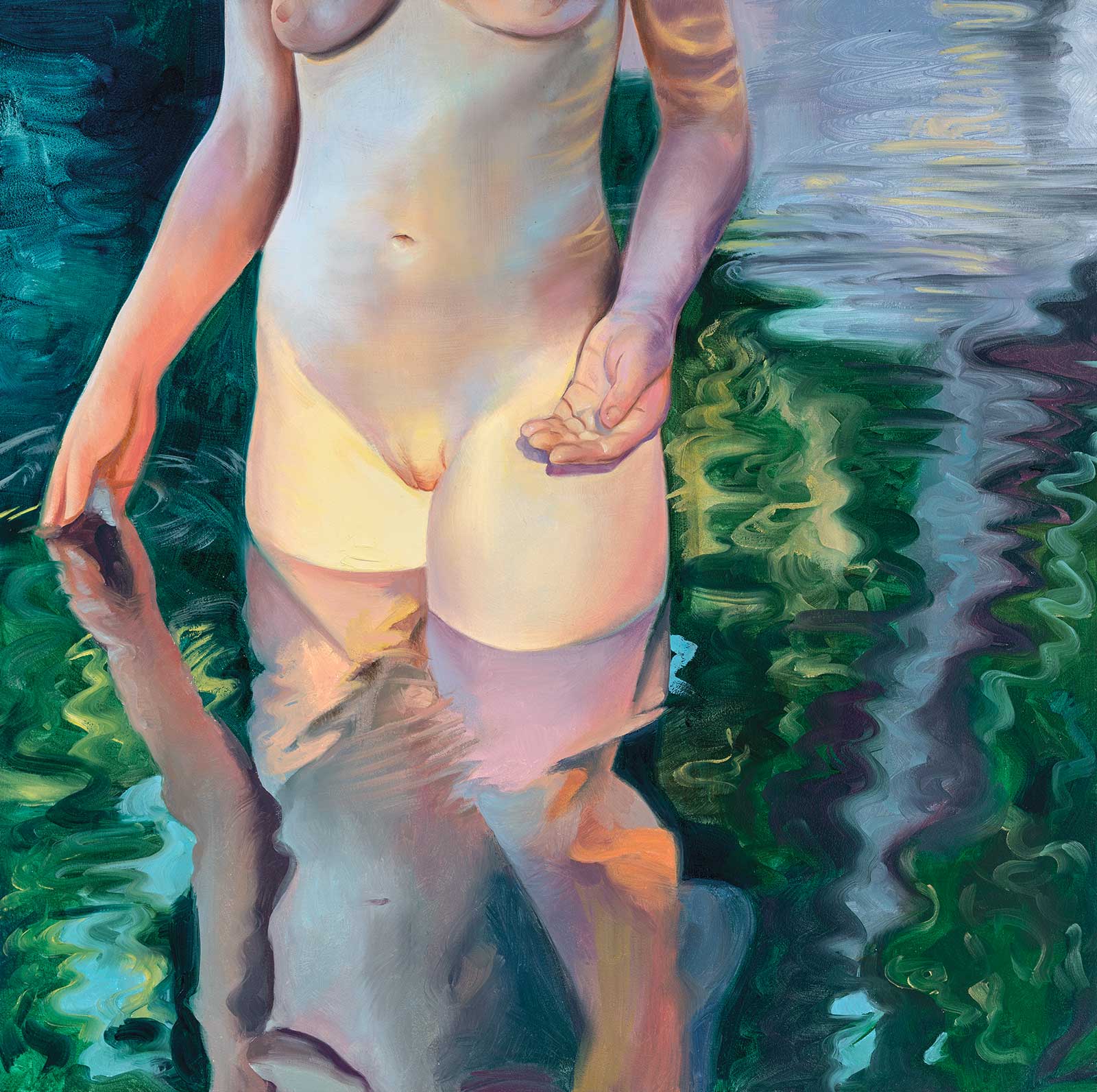
Zienna Brunsted Stewart, Reflections II, 2023, oil on cradled panel, 20 x 20”. Courtesy of Keep Contemporary.
She adds that she holds no animosity and carries no grudges from that part of her life; after all, those ideas about the human form did help set her on her path, as did her family, which always promoted individuality and expressing yourself. As a teen, she went to what she describes as a “super alternative” high school where students were encouraged to explore who they wanted to be in a free-flowing curriculum. Later, once she started serious art instruction, a great amount of time was spent in life drawing classes with live figure models—the ABCs of art. Stewart also studied with Odd Nerdrum, the eccentric Norwegian painter who invented the Kitsch Movement, which unified the Old Masters and classic romanticism within a philosophical construct. Nerdrum, who teaches classes wearing a large white tunic, also helped Stewart establish a profane sense of humor about the human body and its many grotesqueries. [I will let you, dear reader, Google this and see for yourself.]
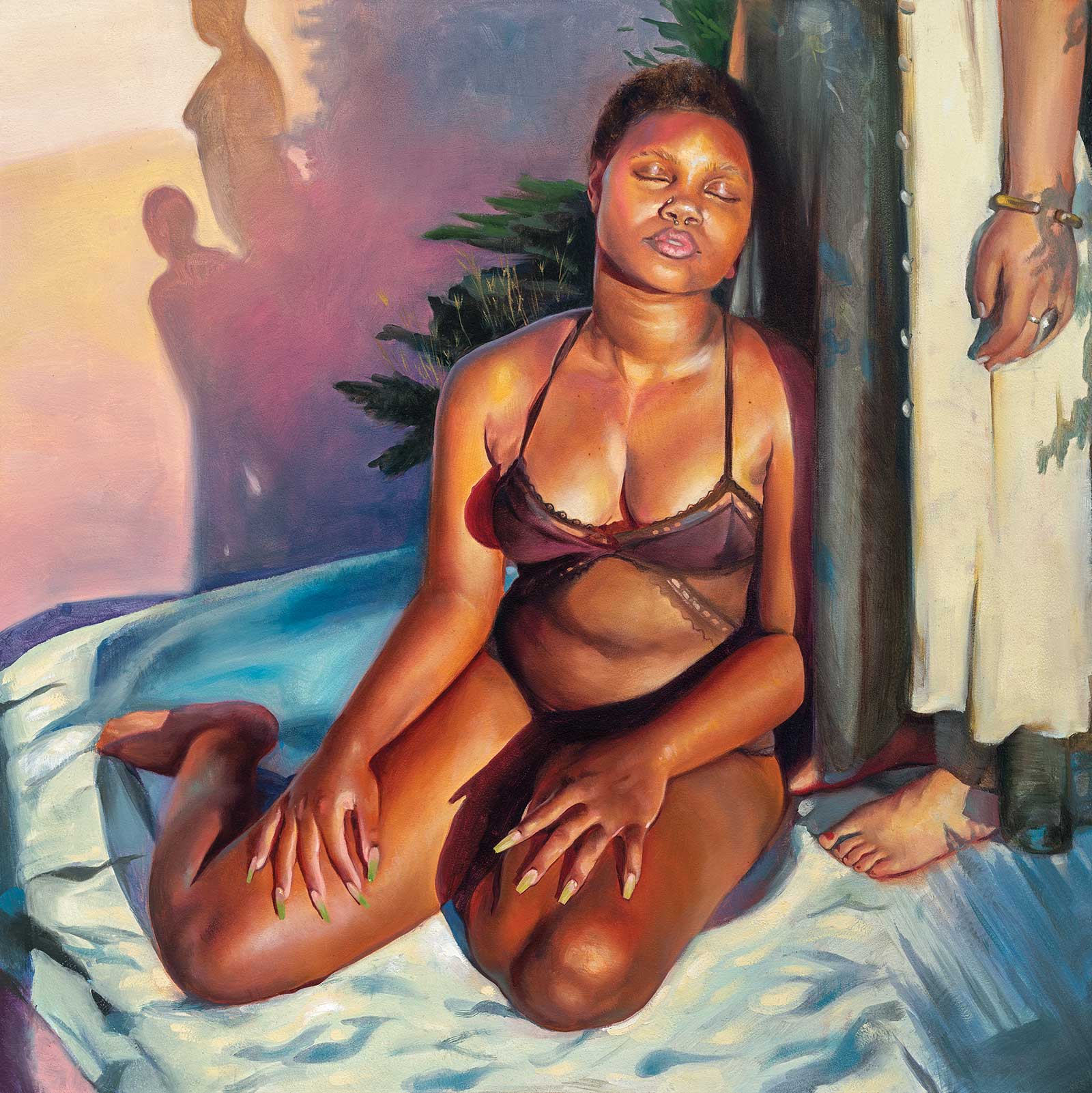
Zienna Brunsted Stewart, Three is a Party, 2022, oil on cradled panel, 20 x 20”
It’s easy to see how and why Stewart painted herself into the genre she has. The path seems clear based on her own narrative of it. But then there is another dimension to it that may be surprising: not only does she paint the nude, she also models as one. She has posed for art photographers as well as her painting friends, including Santa Fe resident Michael Bergt, who calls Stewart “a bright painter with a unique perspective on the figure.”
“I started modeling for my own paintings because I was a cheap model I could afford,” she says with a laugh. Asked if there is a risk showing a more intimate side of herself, she ponders one of the words quietly. “If ‘intimate’ means genuine, or not pretending, or not putting on masks for a persona, then I guess that’s the right word. If ‘intimate’ means me being myself, then no, there is no risk in me oversharing.”
As comfortable in her own skin as she is, Stewart finds it odd that Americans seem to be getting even more prudish. She’s noticed fewer galleries showing figurative nudes, and even some collectors who just outright turn away from the genre. She currently shows at Keep Contemporary in Santa Fe, and is presently looking for wider representation with a gallery that will trust her to keep painting what she wants without reservations.
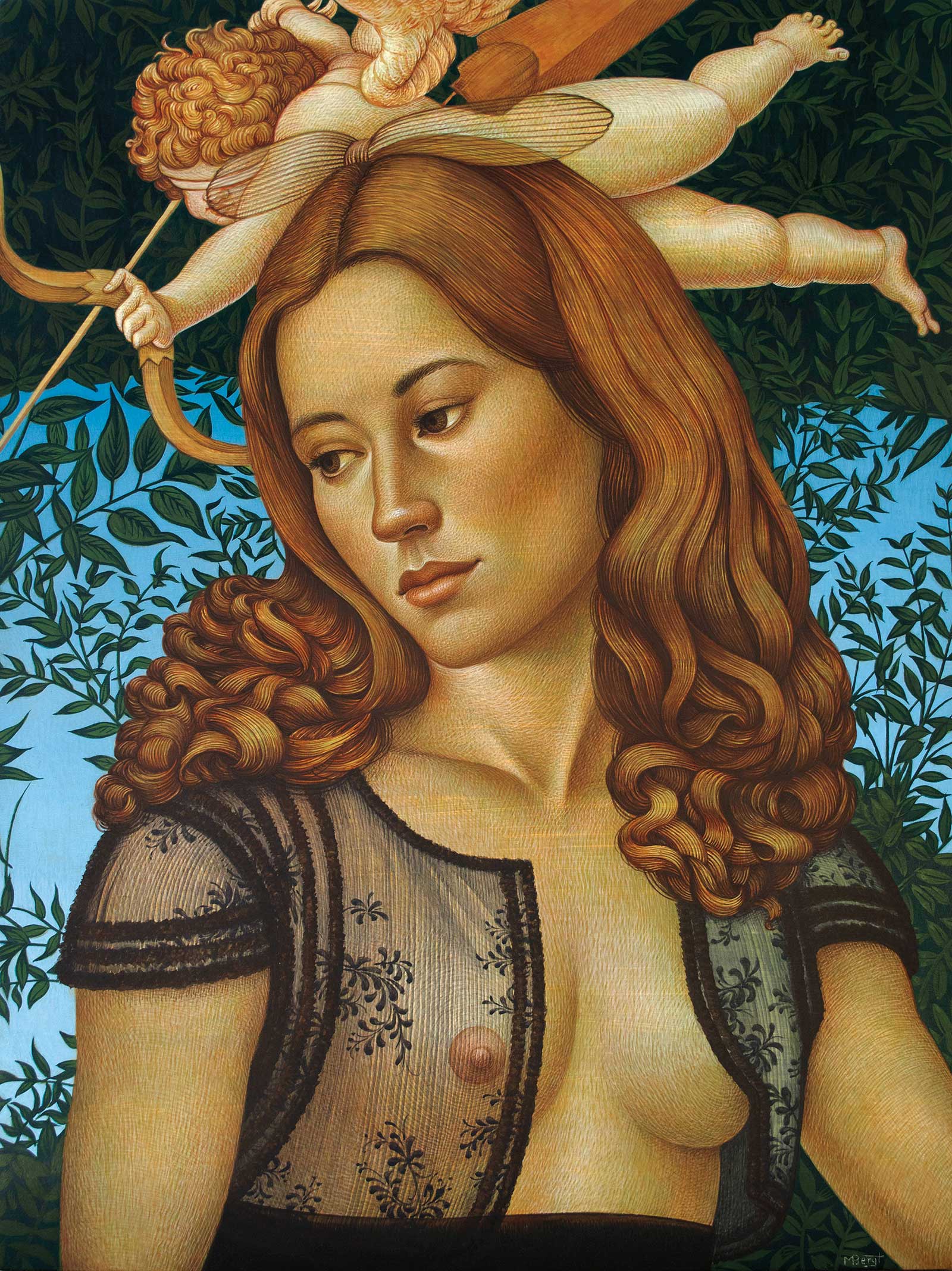
Michael Bergt, Throwback, 2021, egg tempera, 24 x 18 in. Zienna Brunsted Stewart modeled for this painting.
The elephant in the room, especially when it comes to nude women in paintings, is the idea of the male gaze, which Stewart admits she has difficulty articulating. “It’s so complicated. I’ve been reading a lot of John Berger, who attempted to look at some of these ideas and it’s really fascinating,” she says. “I’ve been told in the past my models should be covering up because of the male gaze, but then that hardly seems right. An artist should be allowed to paint what they want.” Stewart falls back on this line of thinking frequently. After all, she asks, doesn’t she have a voice within her own work?
She points to the vulnerability of a nude, the intimacy of their pose and the beauty of their form. If these qualities are admired in the spirit in which they were created, then what is the harm in that for artists, models or collectors? None, Stewart would argue. Or, in other words, don’t be a creep. Be respectful of the subjects. And consider the perspective of the artist. “Anyone can own and appreciate these works,” she adds. “It’s not for the few.”
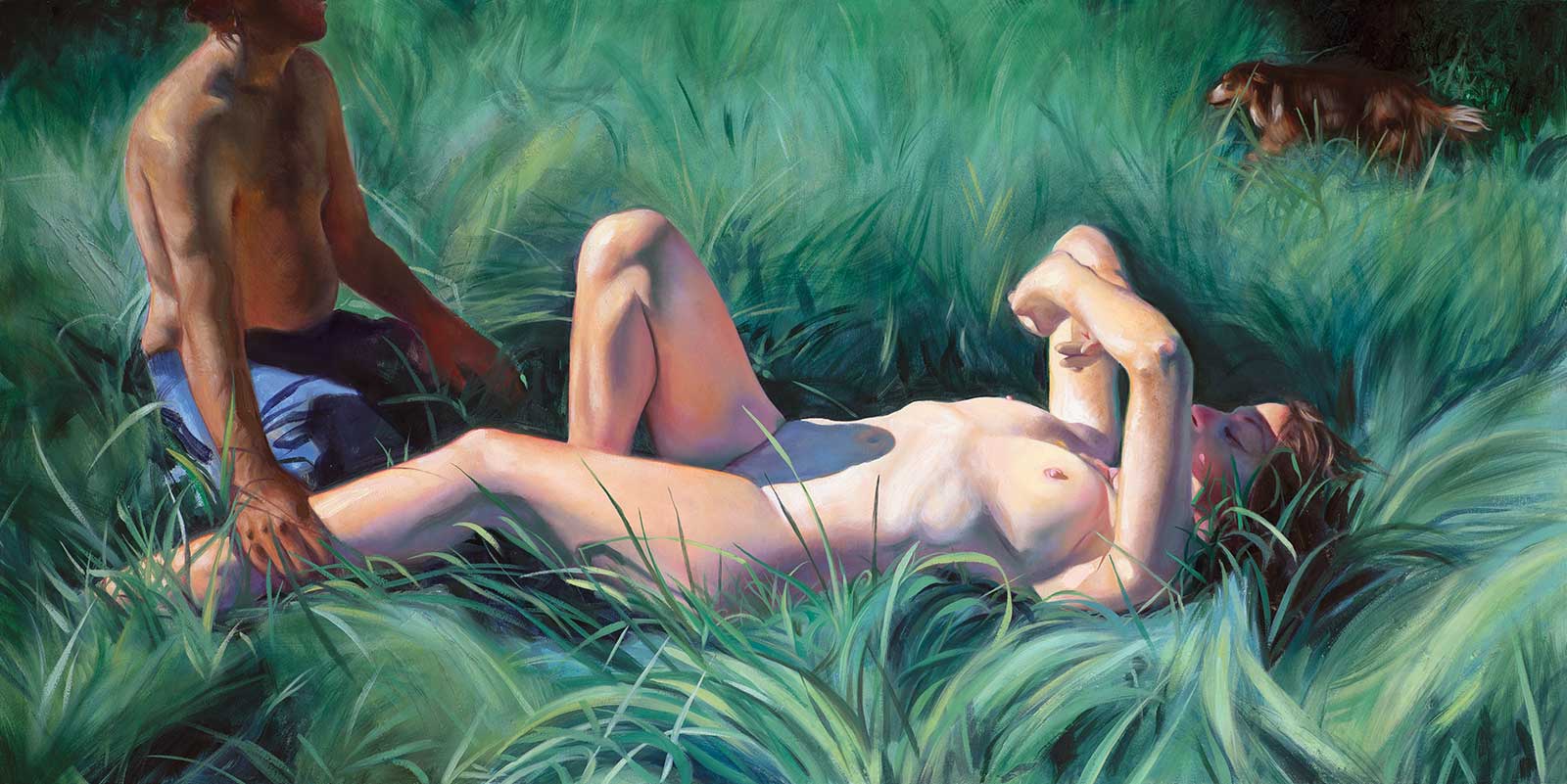
Zienna Brunsted Stewart, Summer’s Sun, 2024, oil on cradled panel, 20 x 40”
Stewart’s most recent paintings are reflections on where she’s at as an artist right now. The work can be happy and playful, such as Octopus Hair with its vivid blues and top-down view of her subject floating in a pool, and also more intimately charged scenes that suggest passion and romance. A new batch of works shows a woman lying in loosely painted grass, her fair skin glowing in the hot sunlight. The works seem to call out to Andrew Wyeth’s Helga pictures, including those classic images of Helga lying nude in direct sunlight or in moody interior shadows. Like many of Wyeth’s images, Stewart focuses almost solely on the quality of the subject’s skin, which falls somewhere between paper and porcelain. Stewart has also been praised for painting different kinds of women, which can be seen in Three is a Party and Eclipsed, both of which show a Black figure during the last moments of a sunset. “I like to paint all different kinds of people,” Stewart says. “The human body is meant to be celebrated.”
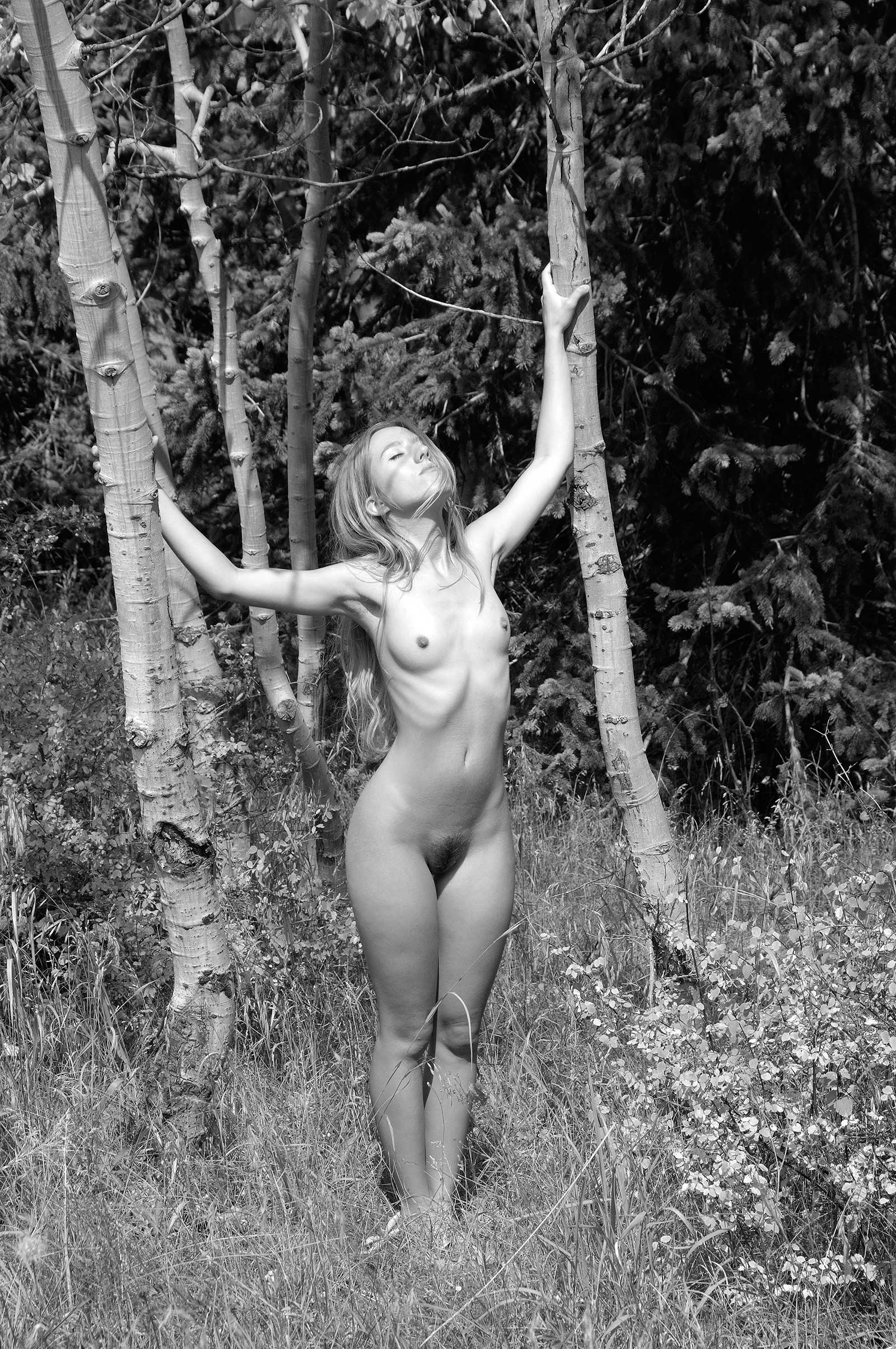
Bill Heckel, Aspen Grove, photograph. Zienna Brunsted Stewart modeled for this image.
The celebrated human form is what the artist has devoted her career to, for better or for worse. She could, after all, reluctantly start painting still lifes and landscapes. Nudes are harder to market, harder to promote and share on social media, and harder to sell to the general public. And yet, they captivate Stewart. They allow her to be herself—to pull that mask off and show people who she is. They allow her to lead people through her bedroom to her studio, no matter what they see along the way. —
See More: www.ziennabstewart.com
Instagram: @zienna_zienna
Powered by Froala Editor