When gallerist George Billis learned that the Fairfield Museum and History Center was hosting an exhibition of WPA-era muralist Robert Lambdin’s (1886-1987) paintings of the factories and workers of Bridgeport, Connecticut, he proposed a complementary show of urban-inspired pieces by contemporary artists represented by his New York City and Connecticut galleries.
The result is Industrial Beauty,an exhibition featuring seven artists with distinct proclivities, approaches and styles when it comes to rendering urban environments and the interface with their natural surroundings.
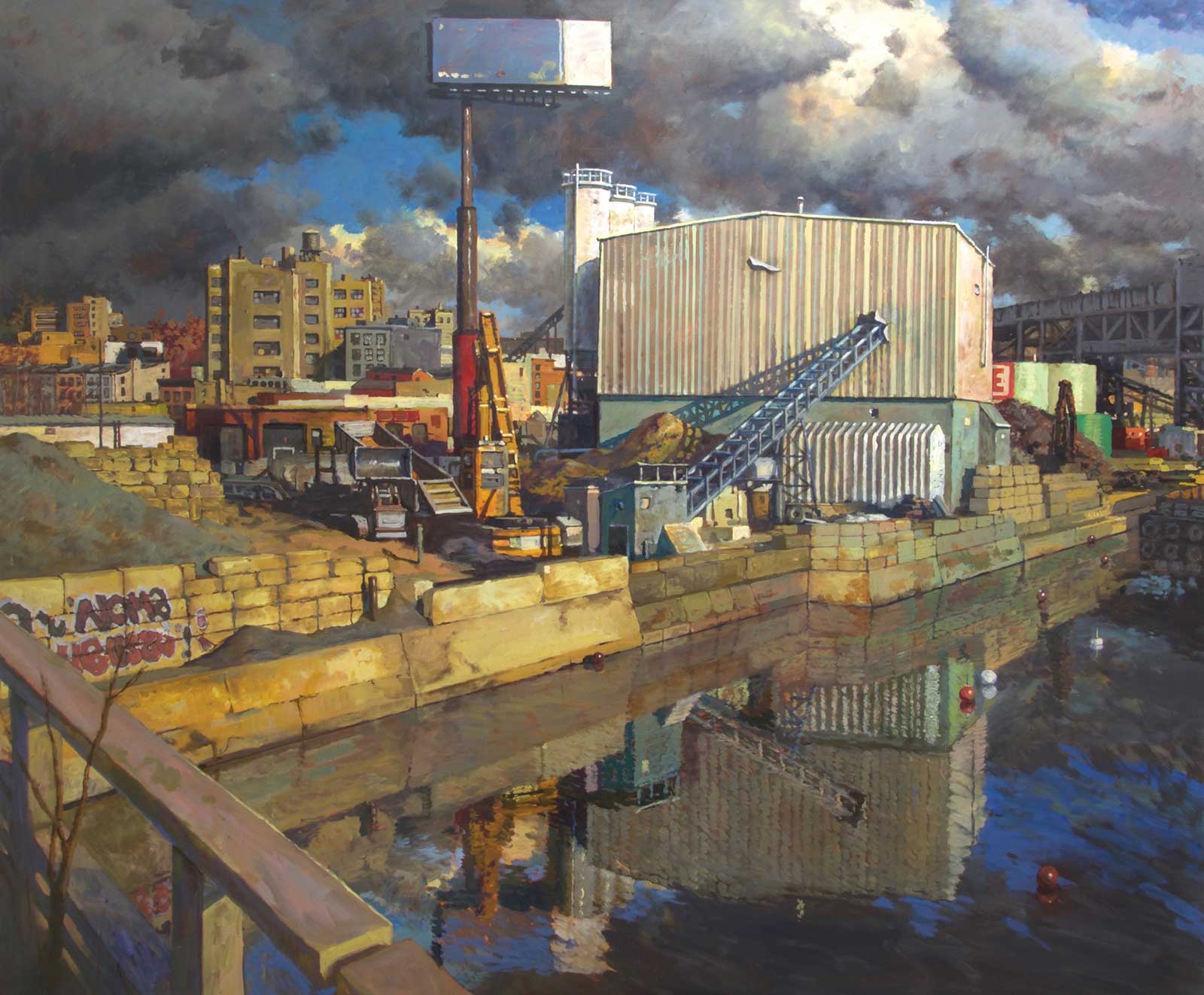
Derek Buckner, Scrap Metal Yard, Gowanus Canal, 60 x 72"
Of all the artists in the show, Nicholas Cato-Evans’ work has the strongest connection to the Lambdin exhibition. In addition to New York scenes, works from his series Painting Bridgeport will be on view, a project he says “has been like leaving Plato’s cave. Over 20 years of regular commuting between New York City and Providence, it has appeared as a mere shadow on the train or bus wall. From the elevated perspectives of the rail trestle and highway viaduct, I’ve often felt as if I’m scrutinizing a scaled model of the city more than passing through its living communities. Exploring Bridgeport’s actual streets closes a circle; the diorama becomes real. And finding a place to physically stand brings previously virtual shadow and light to visual life.”
Cato-Evans was uninterested in depicting Bridgeport’s tourist sites or structural landmarks, deciding to focus instead on what he sees as the city’s standouts, “architectural volumes whose almost Platonic spareness becomes buoyant in a turbulent ocean of industrial vernacular.
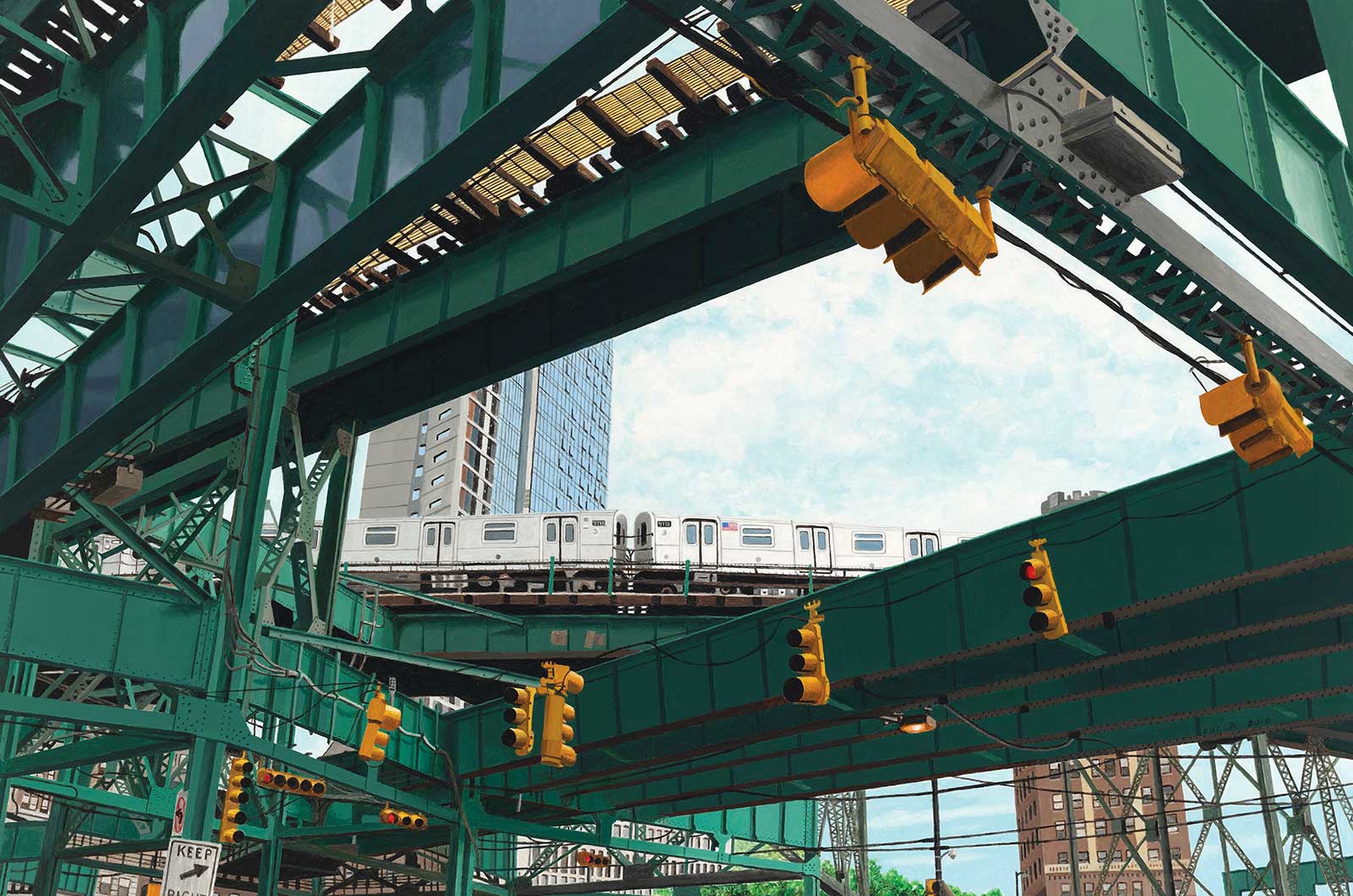
Roland Kulla, Queens Plaza, acrylic on canvas, 40 x 60"
“In [my piece] Vault, a utilitarian salt tent is a refulgent, somehow expectant orphan seated among broken masonry and cracked floor plates,” he explains. “A Euclidian oasis in a glistening and unmapped desert. It is both real and virtual. I see my paintings as documenting a new type of community. Hidden in plain sight, it gives me hope. And I feel at home.”
David Leonard’s paintings are inspired and informed by the grids, patterns and rhythms of the city streets. “I’m drawn to the deliberateness of the skyscrapers and townhouses as if these architectural forms are my bottles, boxes and vases like in a Giorgio Morandi still life painting,” says Leonard.
Leonard pays close attention to the elements in the atmosphere, like ash, cinder and soot, and their effect on the quality of the light and how it illuminates surfaces in a way that is unique to that particular place. “To leave this out would not be true to the people who live and have lived there, who may find their particular climate reassuring,” he says.
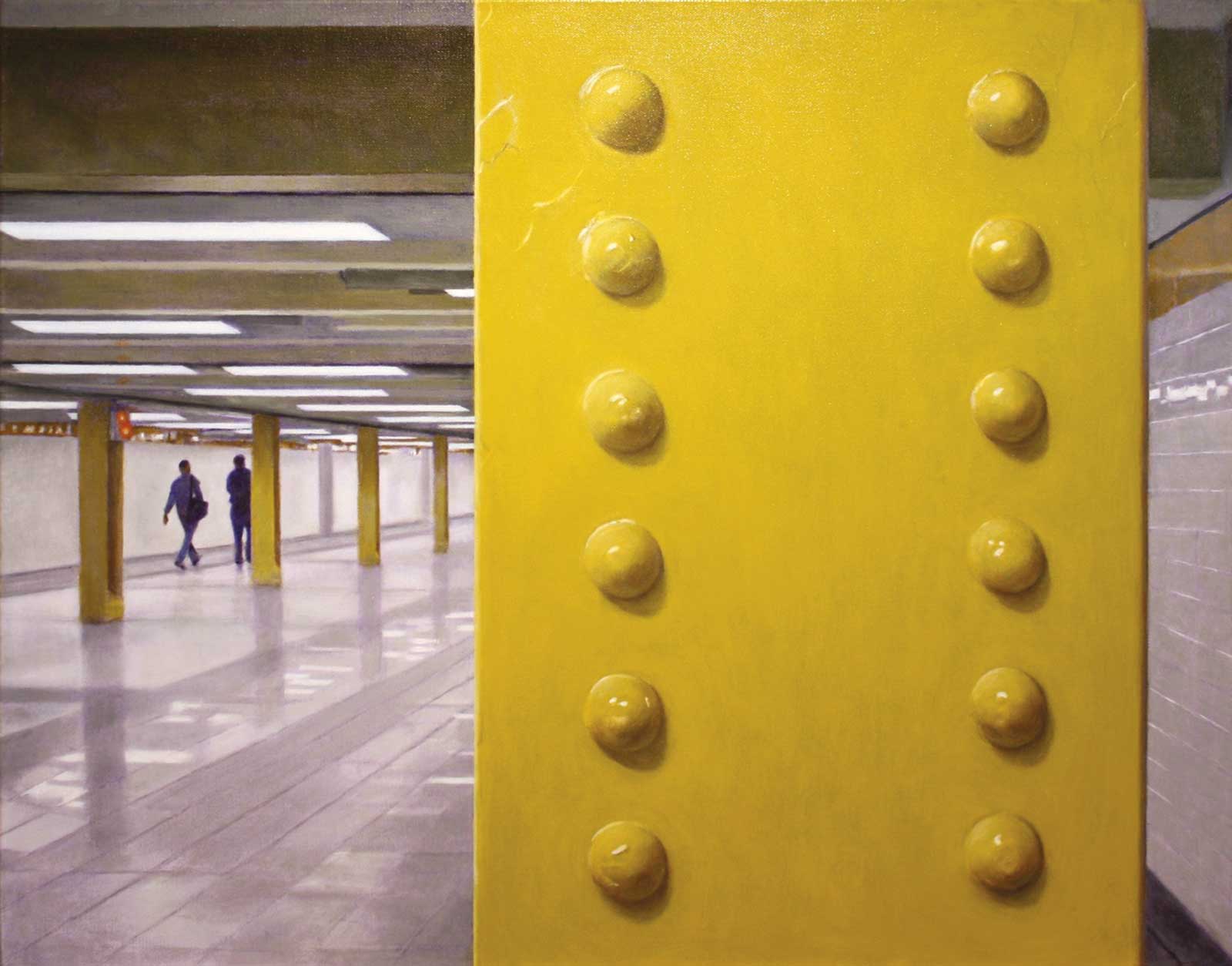
Kevin Frank, Patterns III, oil on canvas, 22 x 28"
Urban Bourbon, a painting of the intersection at Lexington Avenue and 60th Street in New York City, captures in tight detail the exciting visual complexity of Manhattan that so many people find captivating. “It’s like a collage of reflections off buildings and windows with the street and cars,” Leonard says. “All this going on in the painting reminds me of Robert Rauschenberg’s silkscreens he did in the early 1960s where he collaged together his photos and found images on canvas. As I walk along the streets, I find intricate elements everywhere in the urban landscape.
“I find that the essence of our way of life can be seen in our never-ending attempt to subdue our environment,” he continues. “That being said, I paint with lush vibrant strokes so when a viewer sees my paintings, they will sense that I love this world and all its problems.”
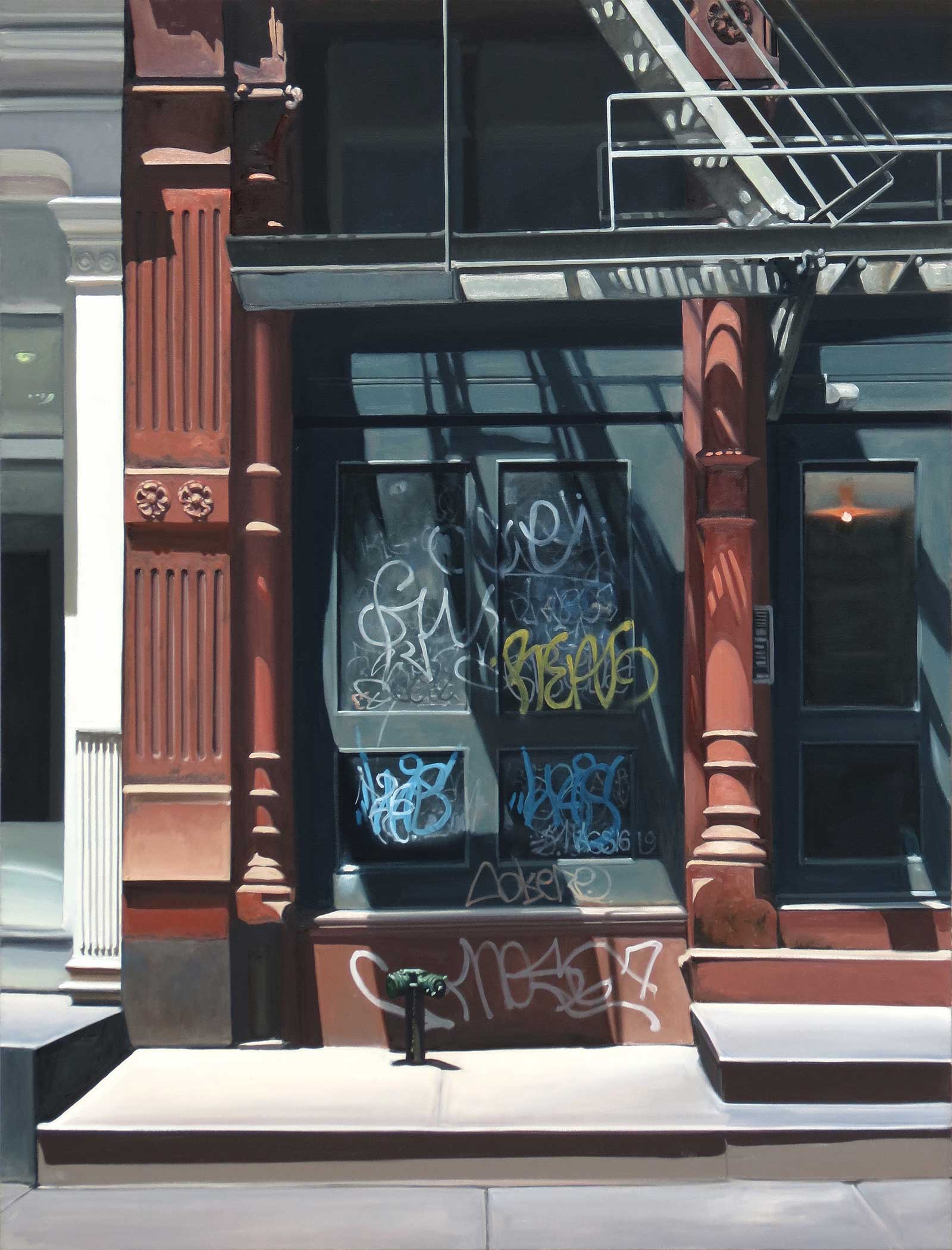
Stephen Magsig, Shadow Tags, oil on canvas, 62 x 48"
Roland Kulla began studying bridge structures more than 20 years ago, and has since completed more than 300 paintings of them. He started in Chicago, where he lives, and then branched out to bridges in Boston, New York, Pittsburgh and Berlin. He is currently working on a series of Portland, Oregon, bridge paintings. He zooms in on a portion of a bridge and focuses on the patterns of the bolts, elements of rust, graffiti, and then paints that segment as realistically as possible. “I like to find beauty in things others may take for granted,” says Kulla. “Presenting them in a way that people normally don’t ‘see.’ I find perspectives that make the composition dynamic, implying motion for something that is essentially static and captured in two dimensions.”
Kulla sees bridges as the physical embodiment of human problem solving—their complex forms and structures serving to “bridge” the void between here and there.
His paintings in Industrial Beauty come from two bodies of work—one of New York’s East River bridges; and the other of the city’s transit system. In Manhattan III, the eponymous bridge stretches across the river, slicing diagonally across the canvas, from a perspective that emphasizes its impressive leap across the river. Queen’s Landing captures the intersection of many lines at the east end of the Queensboro Bridge while a train passes overhead.
Kevin Frank, like most of the artists in the show, wasn’t aware of Lambdin prior, but he can see similarities between the late artist's work and his own urban landscapes and underground subway scenes. Frank also counts two of Lambdin’s contemporaries—Charles Sheeler and Charles Demuth—among his influences, both of whom focused on industrial facades and geometrical forms to enhance the stateliness and grandeur of the structures.
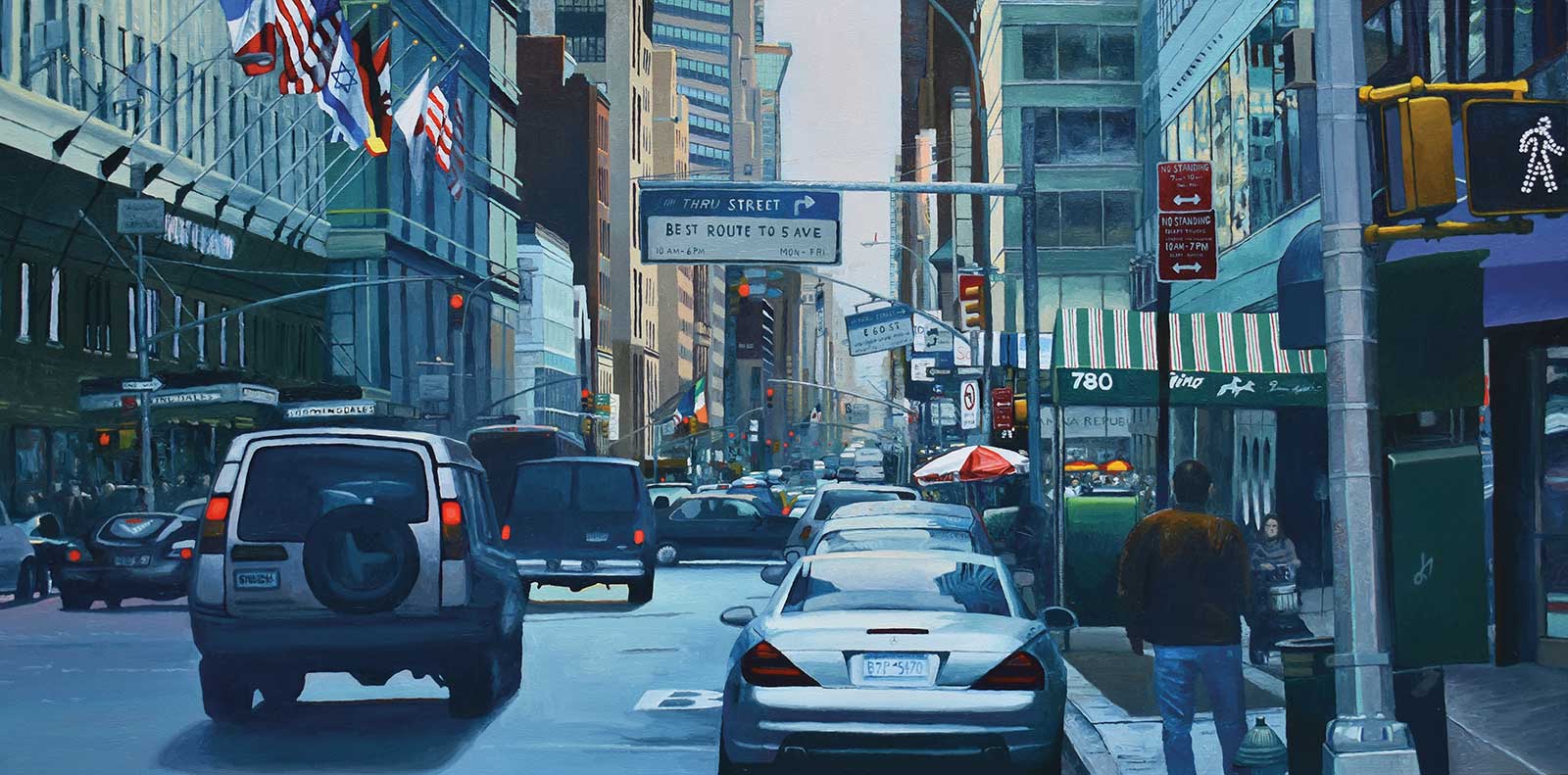
David Leonard, Urban Bourbon, oil on canvas, 30 x 60"
Frank started this vein of work in the aftermath of 9/11 with a piece called Atlas, which depicted a red steel subway beam that supported the ceiling. “I was inspired to paint it as a symbol of resilience and strength,” he says. “Further exploration yielded similar images with variations of color and composition. I tend to focus on the beauty and structure of the environment while generally ignoring the grime and otherwise distracting features of urban detritus. [I’m more interested in] composing an unexpected, meditative image, and the use of color and geometry found in a particular view.”
In Patterns III, in which a bright yellow, bolted subway beam stubbornly blocks the view down the platform, Frank is highlighting its intrusive yet necessary placement, while focusing on the patterns in its construction and the figures that walk along the row of beams in the distance.
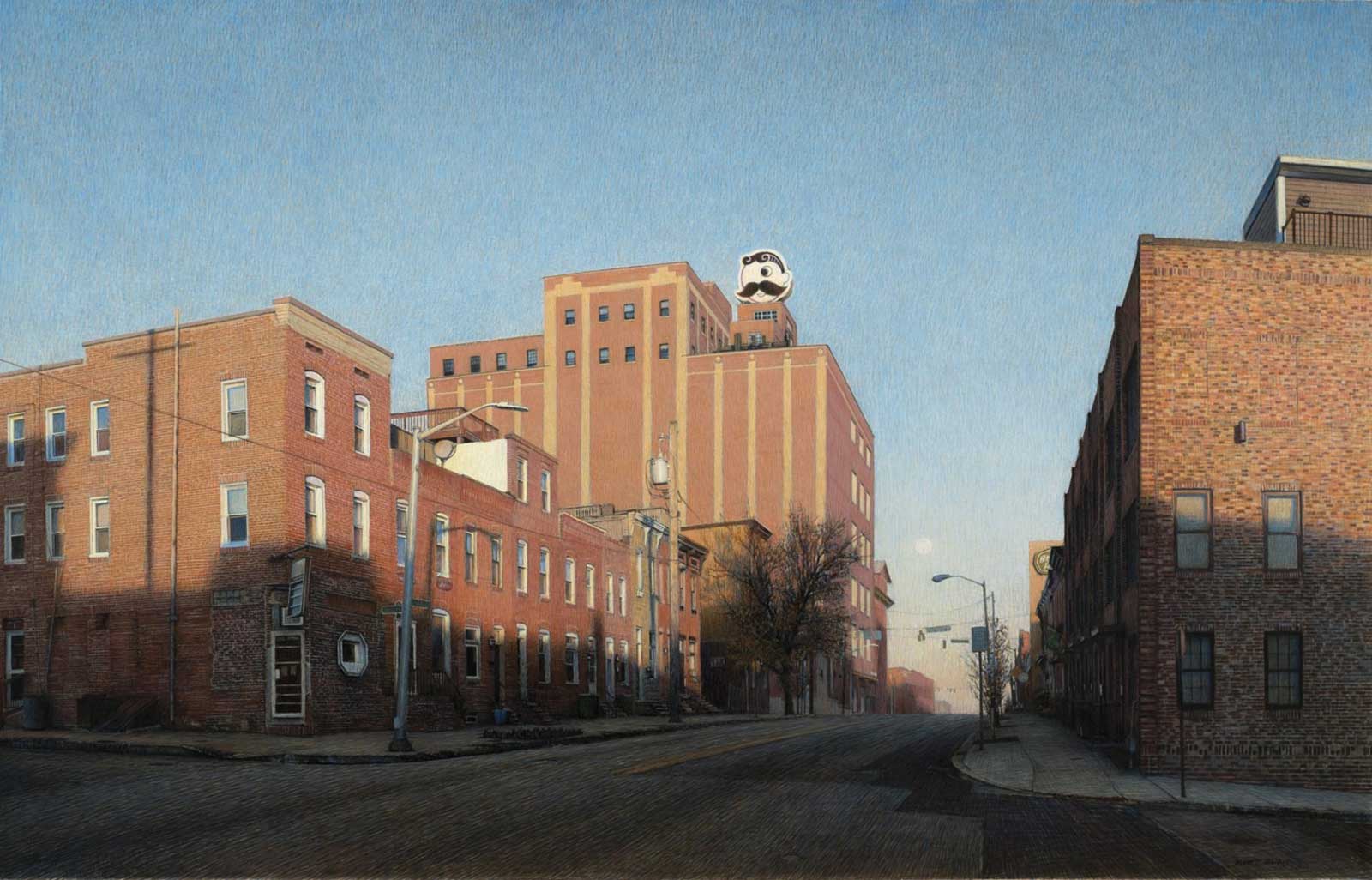
Bennett Vadnais, Brewers Hill, acrylic on panel, 15 x 23½”
Detroit-based artist Stephen Magsig relies on direct observation and photographic reference for his realist industrial landscapes of Detroit and cityscapes of New York. Shadow Tags is an example of the latter and depicts a cast iron building on Greene Street in SOHO, highlighting the interplay of light and shadow. “I fell in love with these cast iron buildings on our first trip to New York and started painting them in the mid-90s,” he shares. “There is something universal about their presence, history and the life they have lived, and I try to convey this in my paintings.”
Bennett Vadnais’ Brewers Hill, has the washed out, somewhat fuzzy quality of a photograph from the late 70s. It is a painting of Baltimore’s Natty Boh Tower, built in 1872 and once home to the National Brewing Company, which produced the city’s favorite hometown beer, before it was bought out in 1975. “The Natty Boh factory is an iconic building in Baltimore, which used to be, and still is to some extent, an important industrial city in the U.S.,” says Vadnais. “Besides the well-known Natty Boh symbol, I was drawn to the dramatic warm light against the rising moon.”
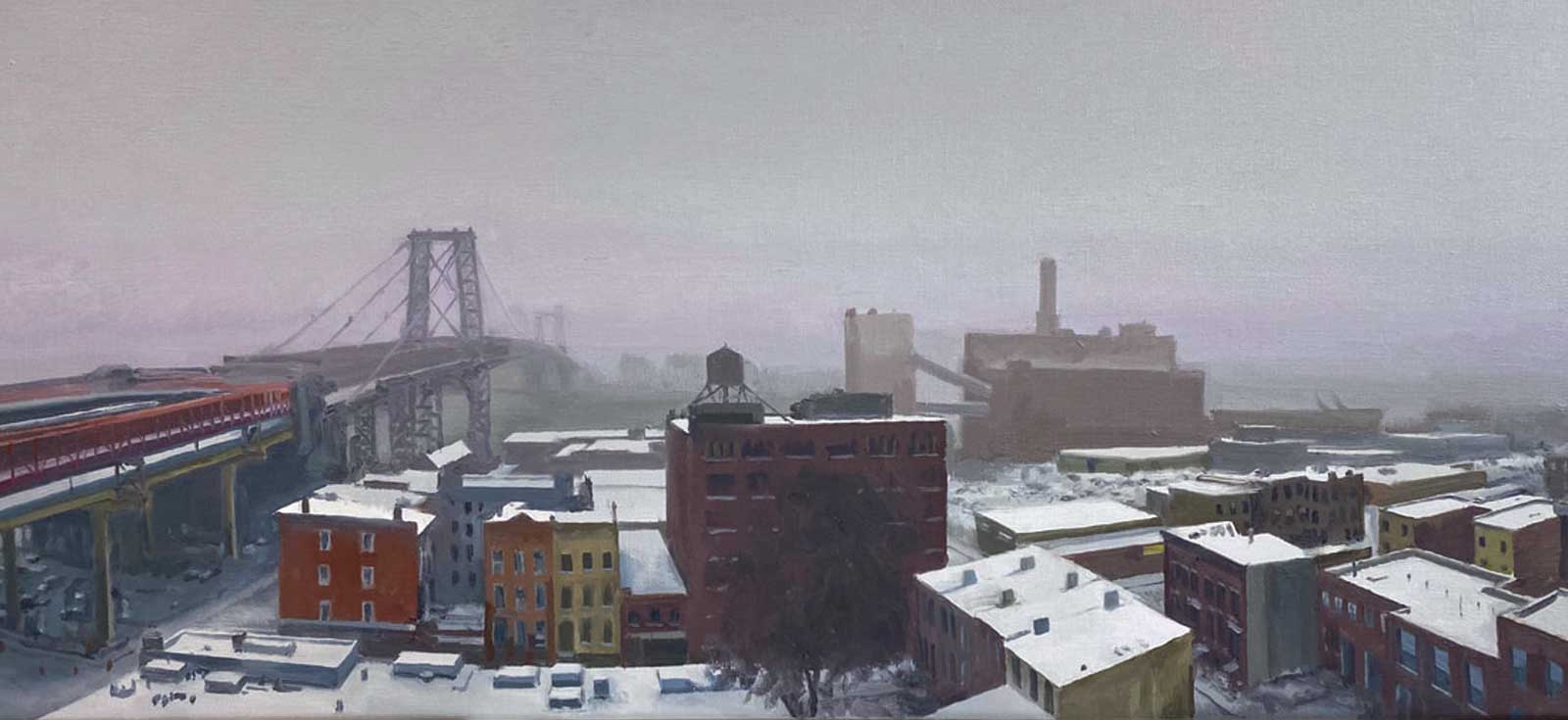
Nicholas Evans-Cato, Icebergs, oil on canvas, 10 x 26”
Vadnais is drawn to urban scenes because he enjoys painting clear, well-defined light and simple, functional structures. “I think a lot of existing industrial architecture represents a bygone era of ambition and optimism that seems to be lacking more recently,” he says. While he prefers rusted metal and aging brick over shiny chrome and glass, and finds industrial scenes quite beautiful, his work has a note of melancholy. They are suggestive of the passage of time and the loss that goes with it, evoking the soft ache of nostalgia—just like one of those old photographs can.
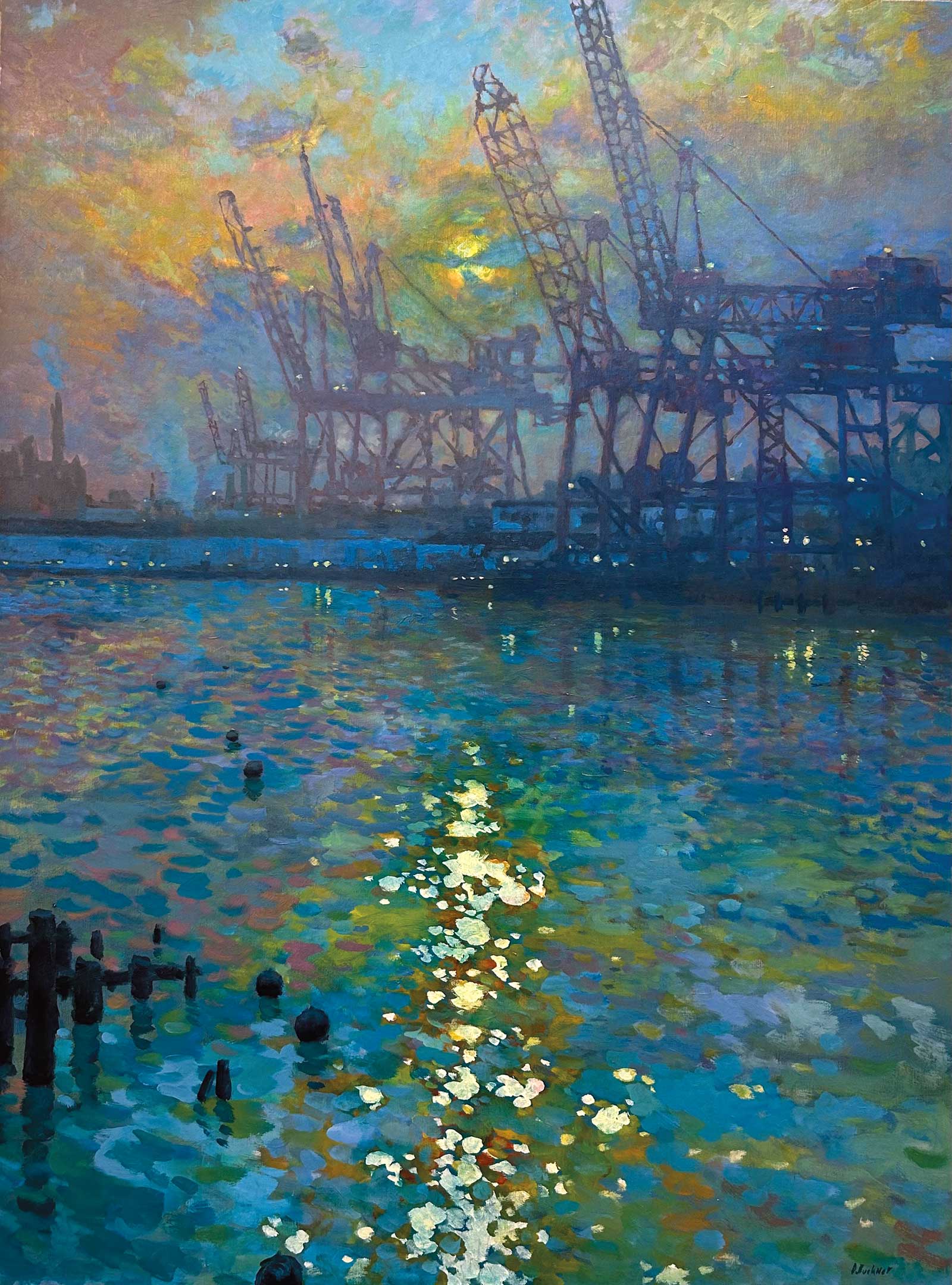
Derek Buckner, Port Cranes, Sunlight on Water, oil on canvas, 40 x 30”
Cranes, barges, scrap yards and warehouses populate Derek Buckner’s paintings of the gritty, industrial landscape around New York’s Gowanus Canal, an area he knows intimately. While he wasn’t familiar with Lambdin’s work, he is a fan of the Ashcan artists, especially George Bellows, who also focused on the industrial urban environment in the early 20th century, and issues of social justice facing the working class.
“Visually, the industrial cityscape is exciting because it often is haphazard,” says Buckner. “The buildings aren’t built for aesthetic reasons, but rather for utilitarian purposes. This allows unexpected juxtapositions of shape, color, etc. to occur. On an emotional level, I find so much beauty in the industrial environment. The combination of the dramatic, gritty industrial landscape is exhilarating.”
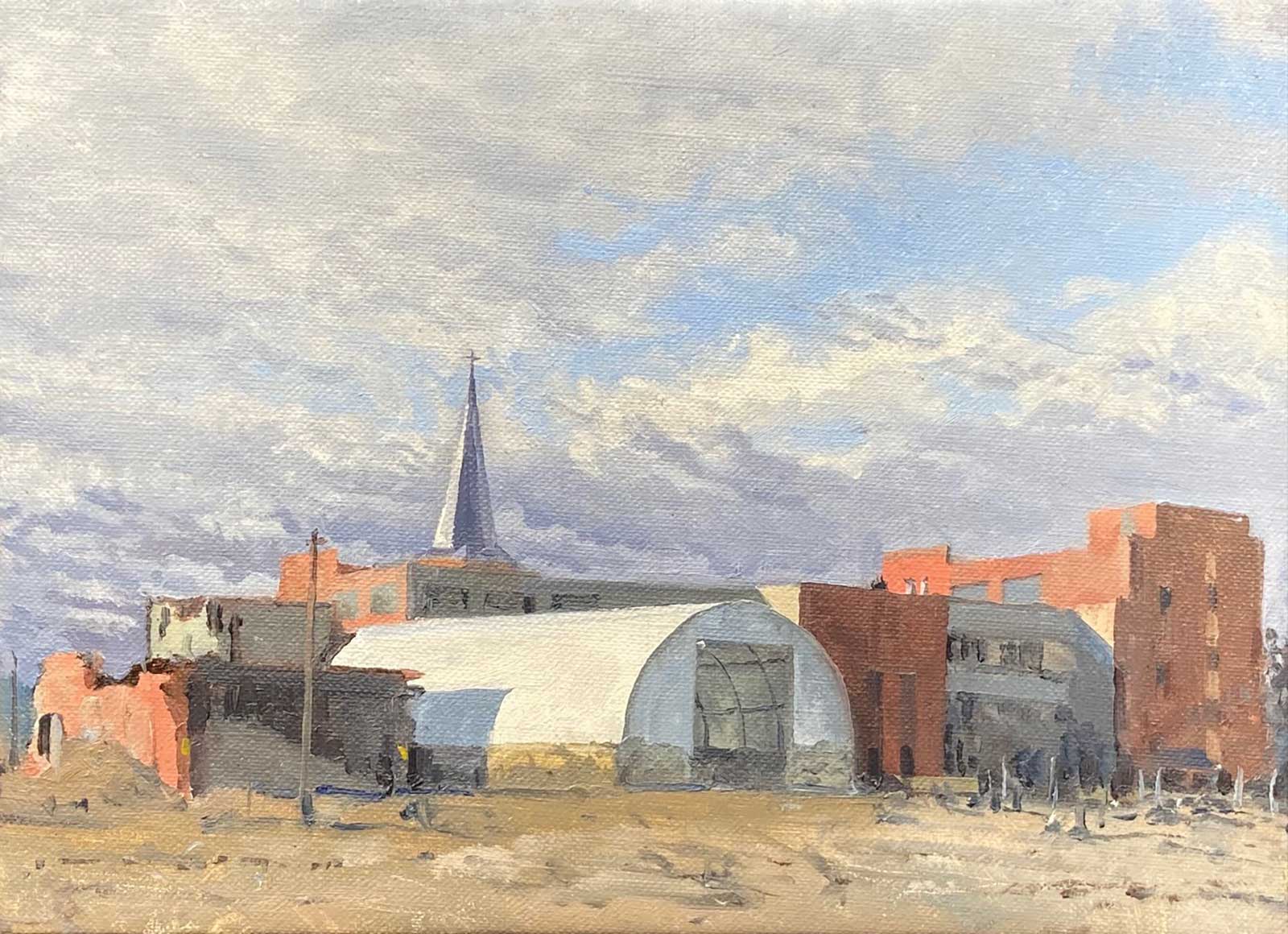
Nicholas Evans-Cato, Vault, oil on linen, 8 x 11”
His painting Scrap Metal Yard is of a specific location on the Gowanus in Brooklyn. “It’s one of the few places in Brooklyn where you have open skies—often very dramatic—in contrast to the large industrial structures the still waters of the canal below,” he says. His other show piece is part of a larger series of paintings based on sketches of port cranes in New Jersey, which were reworked and composed in the studio.
“Landscape painting, like the world it depicts, emerges from the individual’s discovery of the beauty, corrosion and decay of our natural and manmade surroundings,” says Billis, adding that, while thematically linked, the exhibit’s strength lies in the diversity of work. “It isn’t all New York cityscapes. I also tried to vary the styles. Each artists is unique in the way they portray industry and the city. With ingenuity, each melds scenes of nature and industry in ways that preserve views of the past and present, and suggest timelessness, for viewers now and for the future of landscape representation.”
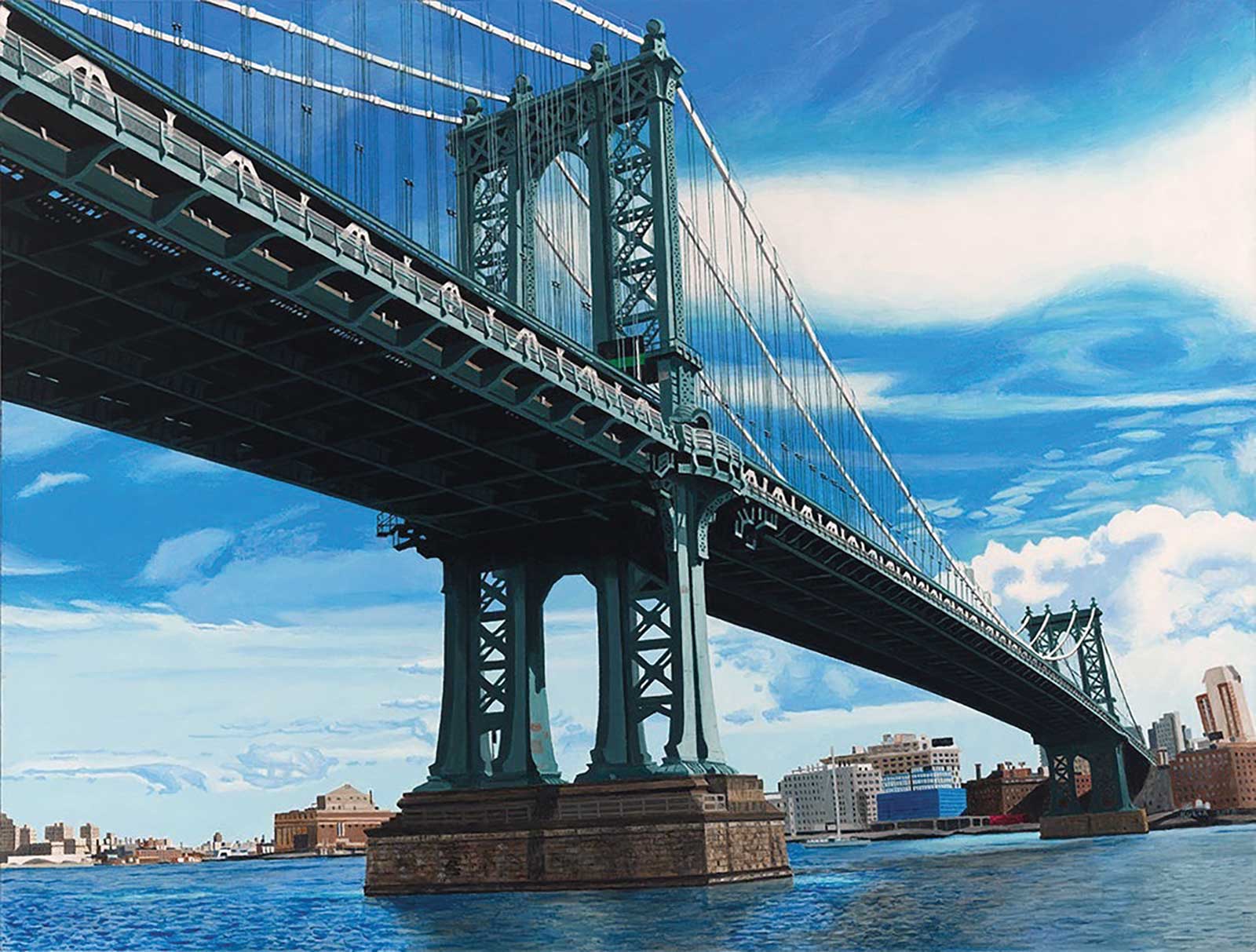
Roland Kulla, Manhattan III, acrylic on canvas, 45 x 60”
Industrial Beauty opens on June 12 and runs through July 26, with an opening reception on Friday, June 28 from 6 to 8 p.m. All paintings will be available for sale. —
Industrial Beauty
June 12-July 26, 2024
Fairfield Museum and History Center, 370 Beach Road, Fairfield, CT 06824
(203) 259-1598, www.fairfieldhistory.org
Powered by Froala Editor