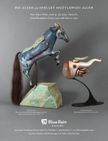
In Carl Dobsky’s magnificent Blind Leading the Blind,six citizens flounder in a concrete drainage trough, thrashing sightlessly through the toxic and filthy effluvium of capitalist life, while behind them a great phallic thruster shoots space-tourists into orbit aboard Jeff Bezos’ Blue Origin rocket with an onanistic jet of indulgent flame and smoke spilling over the upstream source of the ditch.
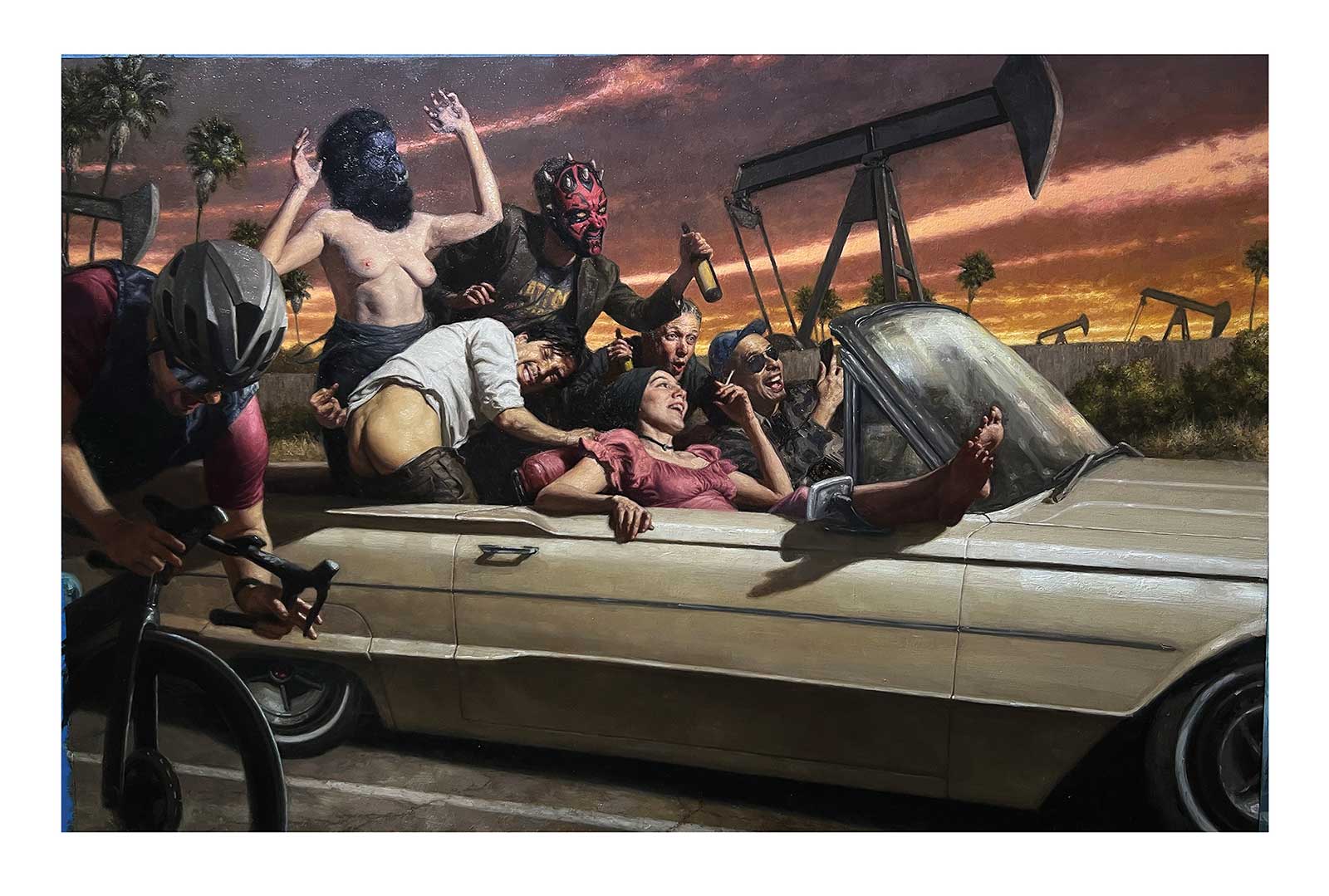
Carl Dobsky, Chariot of Fire, 2024, oil on linen, 24 x 37"
The blind are an ethnic breakdown of Los Angeles’ population, all suffering from the grinding economic reality of surviving beneath the impossible weight of the cost of living in California, where the hot-tub elite appear to enjoy the abundance, luxury and extravagance of bourgeois comfort, cheering the egotism and frabjous excess of the famous four Silicon Valley gazillionaires while everyone else struggles. These are not indigents—they have keys and water bottles—these are hydrated and driving, working and middle-class people struggling to get out of the mire. The contrast is intense. The ever-increasing golden gap between the mud-bound and the space-bound could not be broader. With manic and mannered fear, the blind fight through the filth, gripping each other for guidance as much as dragging each other down in the habit of relentless competition—and we watchers of the wretched scene are in the soup and slime with the actors. The painting is a superb indictment of folly in the fantasy city of the angels.
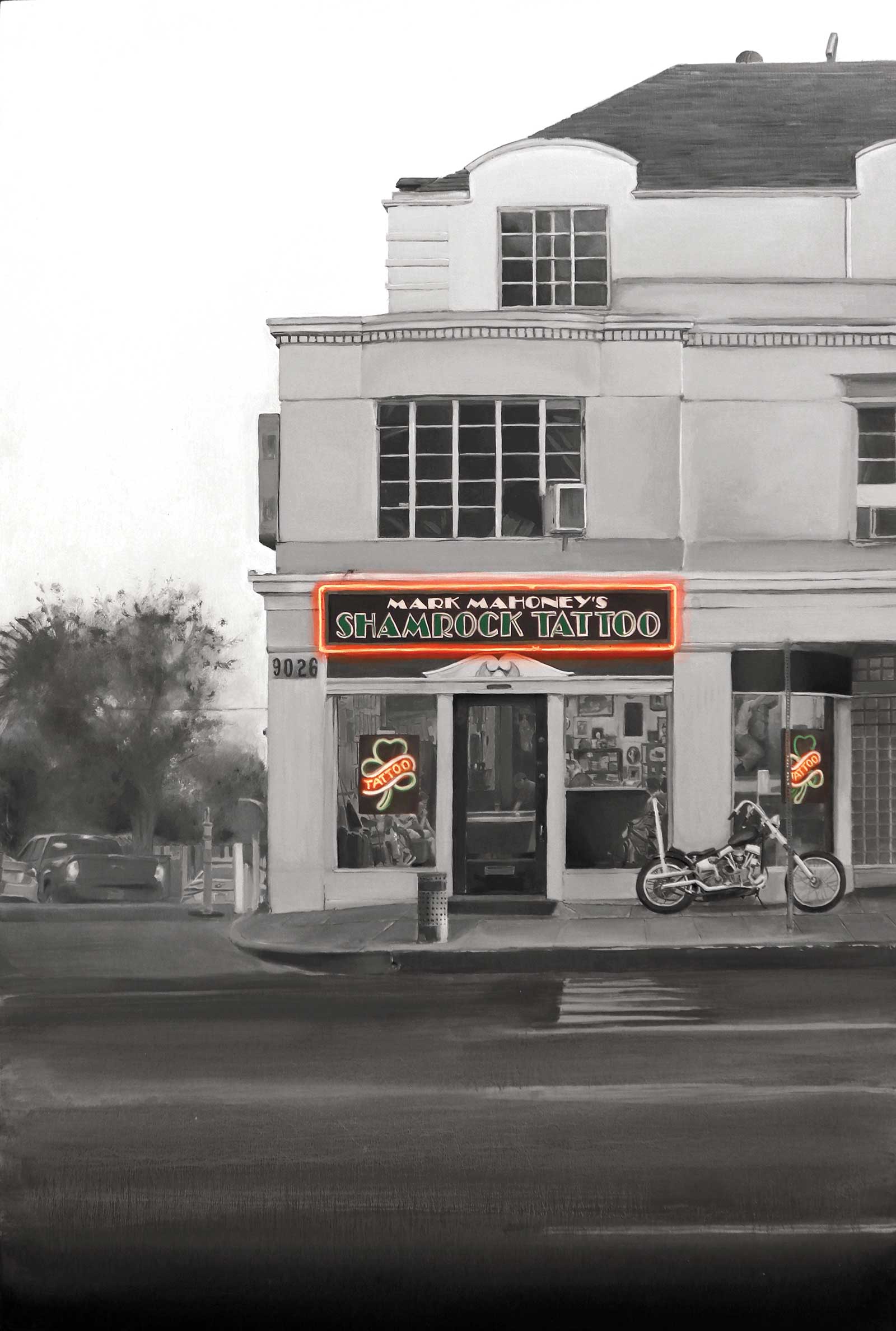
Shawn Barber, Shamrock on Sunset, 2023, oil on panel, 36 x 24"
While he was preparing to paint the canvas, Dobsky studied the afflictions of blindness, as Bruegel had done with his great parable, and searched through medical images, finding the study intensely difficult as a witness to suffering. He realized the eyes would have to be the focal point of his models’ faces. He says, “It was weirdly ironic that I had to keep saying, ‘I need your eyes wider open, really wide, really wide!’ knowing that they were not going to be seeing anything.” Dobsky frequently exaggerates the body language of his figures, deliberately introducing a histrionic drama to his tableaus illustrating Los Angeles life, but never reaching the extravagance of the mannerists who deliberately overextended their models’ physicality into impossible contortions. Dobsky’s figures are always positioned in gestures within the reach of human possibility, but his stylistic choice to emphasize pose and posture sets his work outside the conventional bounds of social realism, which constrains artists within the dull boundaries of nature, and into the realm of the theatrical comedies of antiquity, which allows for the unreality of extravagance to emphasize the vulnerability of his characters.
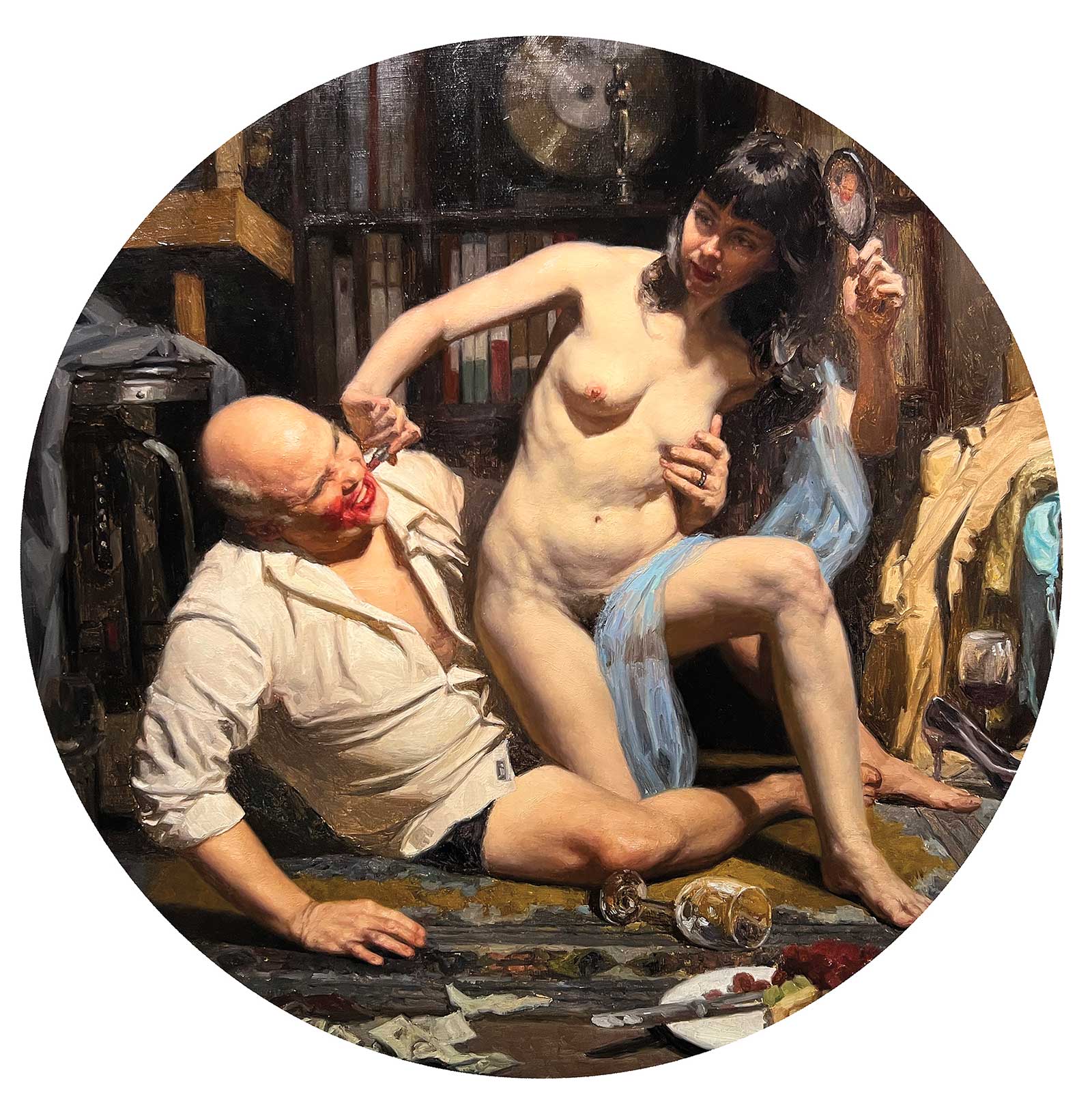
Carl Dobsky, Luxuria and the Fool (Lipstick on a Pig), 2024, oil on panel, 20"
To Aristotle, comedy represented the most ridiculous errors and ugliness of foolish mankind and—as a species of drama—offered the possibility of a painless release of tension to its audience, and that is the role of these cathartic paintings. Comedy gives us the staged space to laugh at people enacting the worst aspects of humanity so we don’t have to feel as terrible about them in reality. The ancient thinker transformed Dobsky’s approach to his painting. “When I read Aristotle’s Poetics it literally changed my way of thinking about art,” says Dobsky. “It was the thing that made me understand how to put images together in a way that made sense to people.” Intrigued by the excellent advice, he learned from Horace, too. Famous aphorisms from the writer’s Poetic Arts supported Aristotle’s guidance, as it had guided the hearts and hands of the artists of the Renaissance. “As is painting, so is poetry,” was a particular pleasure, and “into the middle of things” was an excellent reminder to throw the viewer directly into the heart of the action.
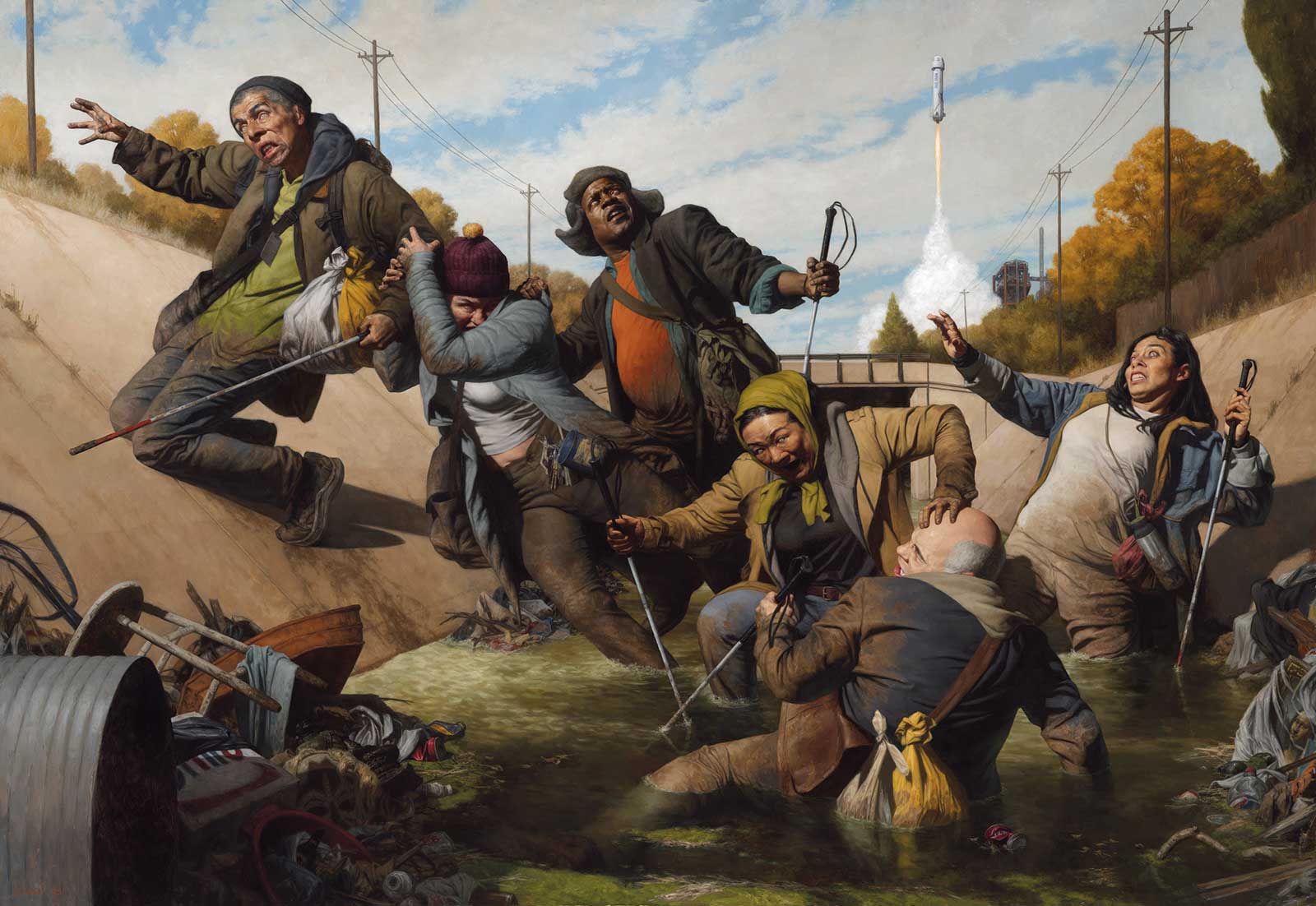
Carl Dobsky, Blind Leading the Blind (You Can’t Stop Progress), 2023, oil on linen, 72 x 104"
And like a clever playwright, Dobsky hides his wit in plain sight. Nothing occupies space on his canvases by accident. Amusingly, one of Andy Warhol’s Brillo Boxes floats among the branded trash stagnating among the muddy debris, alongside Marcel Duchamp’s readymade Bicycle Wheel and its stool, and these insults might tickle titters from the enemies of conceptual art and the crass commercialization of Pop Art. “I was doing sketches to figure out what the debris in the canal was going to be,” explains Dobsky. “I wanted garbage and cultural consumption, and I thought maybe someone threw a bicycle in there. And when I drew the bicycle wheel it looked like a Marcel Duchamp readymade. And I started laughing to myself, and thought I should put the Brillo box in there too. I thought it was funny, because people read it as garbage and don’t see it as artwork, and it reminded me of Danto’s argument about indiscernibles.” Ingeniously, Dobsky upped the ante of irony by including Leonardo Da Vinci’s Mona Lisa among the plastic and organic rubbish floating in the garbage of Western civilization, highlighting that precisely the same forces of capitalist exploitation are at play in the iconographic imagery of classical representation. A Buddha and an African mask are also hidden in the rubbish, cultural symbols endlessly consumed and cheapened by their commercialized use and abuse in the Western context.
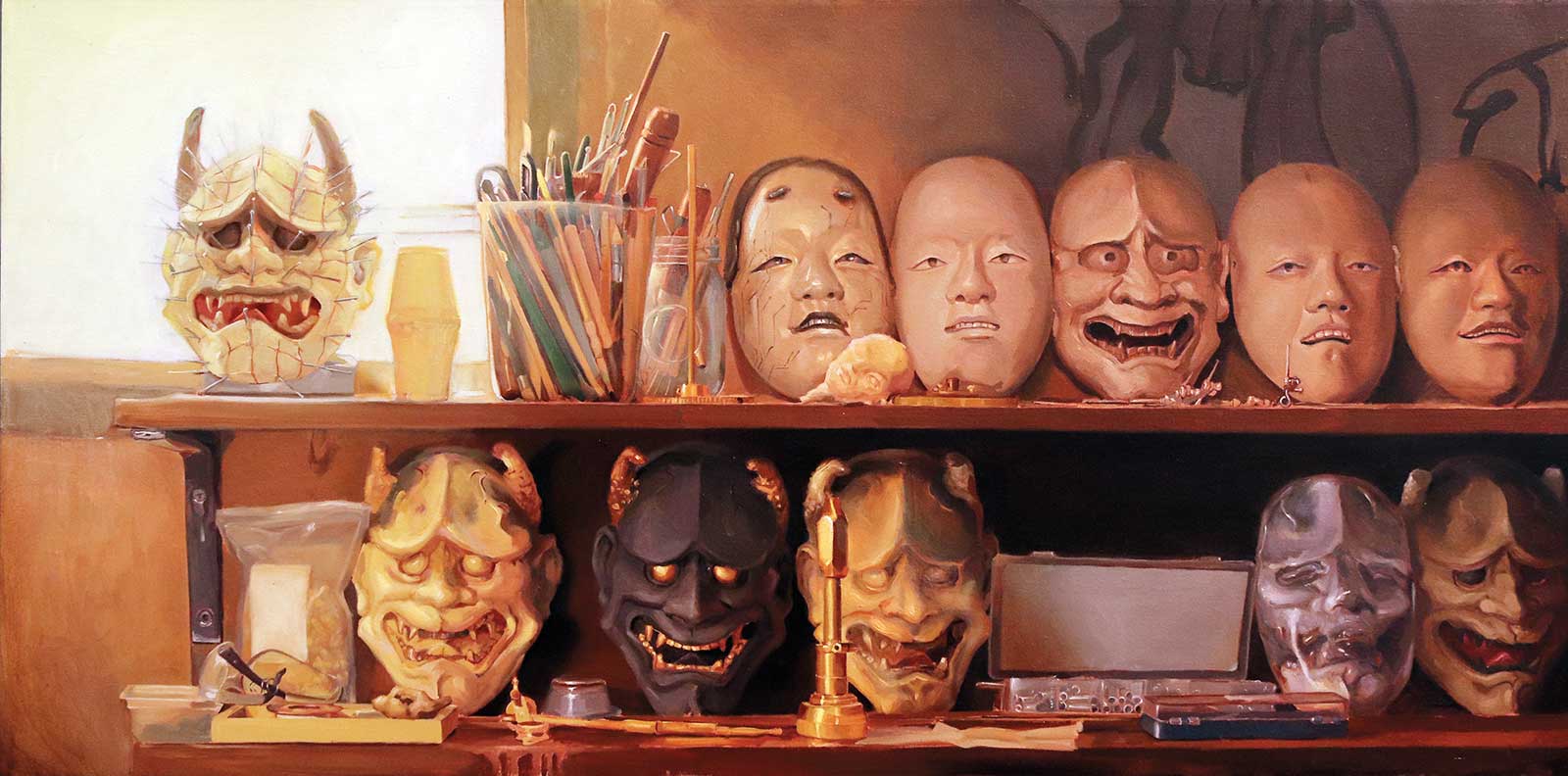
Shawn Barber, Mike Dorsey’s Masks, 2023, oil on linen, 24 x 48"
Danto’s indiscernibles led Dobsky into further reflection about the layered meanings of the painting. He explains, “I thought it tied into being blind, because you couldn’t discern what the things were, how would you know, if you’d just fallen into a ditch and couldn’t see anything?” This kind of witty insight is what sets Dobsky above other artists working with political commentary and traditional painting—while the well-meant efforts of other social realists may be sincere, they lack Dobsky’s humor and the ambiguous cleverness of his insights. He is unequaled as a painter and satirist. Yet he is conflicted about condemning the faults of capitalist society wholesale, explaining, “I feel that one of the most common experiences for most of us these days is that people don’t know which way to go. They don’t have a deep-seated world view, and they get lost…People put their hopes in this idea of progress. I’m conflicted…I’m not a very religious person and I’m almost jealous of people that are, because I envy the sense of community and the peace that must come from that, but at the same time we’re supposed to believe that science is going to save us? Then I look at people using science to send dildos into space for tourism. We have all this mass-consumption and we’re buried in shit…But what am I going to say—let’s not have progress? That’s not right.”
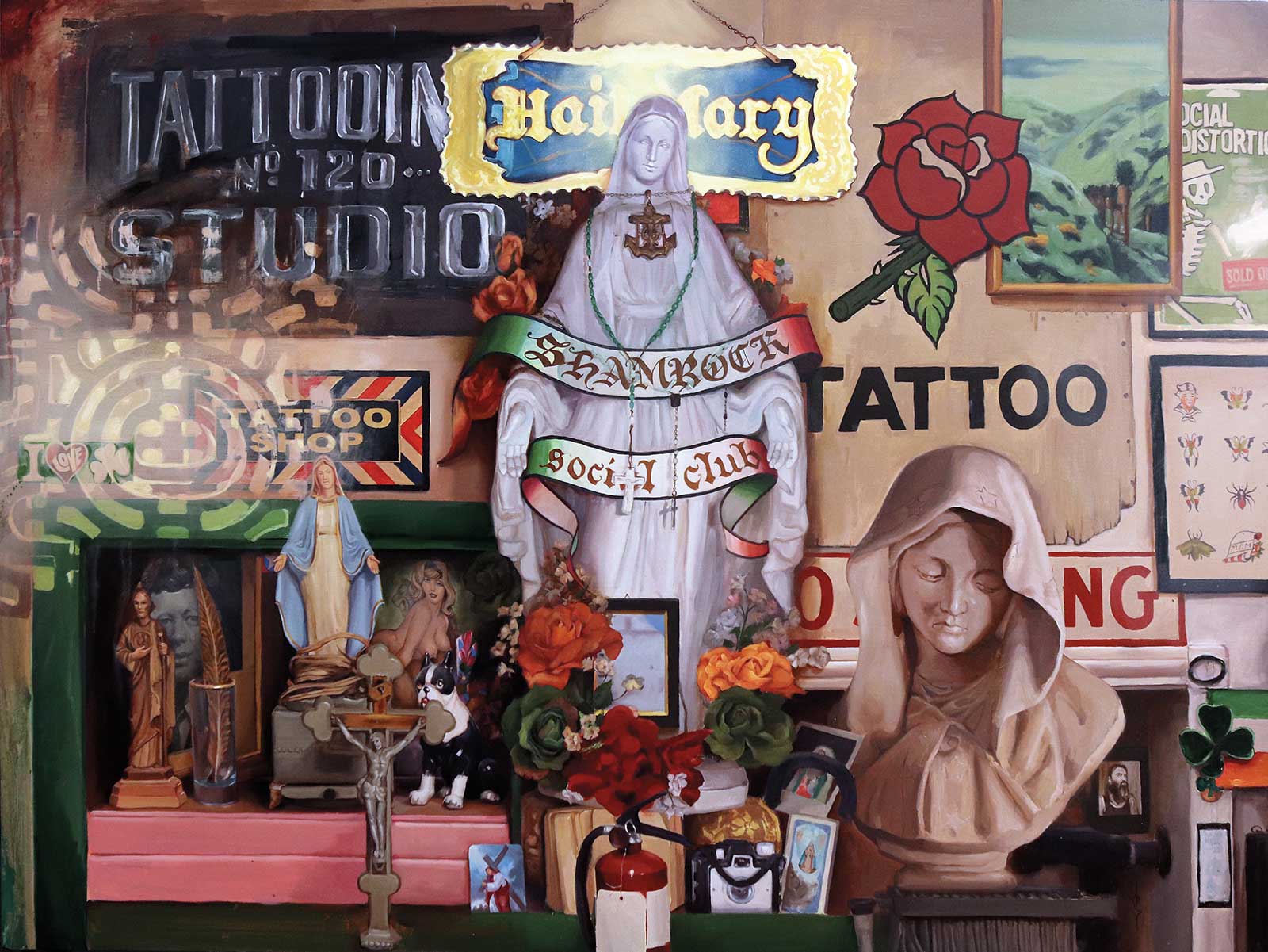
Shawn Barber, Shamrock Social Club, Disassembled Still Life, 2024, Oil on wood panel, 36 x 48"
Dobsky doubles down on his relentless skewering of pretention in his new Chariot of Fire, which continues the examination of recklessness and affectation he has previously examined in his magnificent Birds of Paradise. Chariot of Fire is equally as direct in its criticism—four men and two women ride in a gas-guzzling classic convertible loosely based on a Ford Thunderbird, cruising a broad California boulevard—burning rubber on the cracked macadam, passing palms and pumps sucking oil from the sun-kissed land. The reckless driver poses for a selfie with his passengers, an iconic and topless Gorilla Girl balancing on the back seat with a masked Darth Maul and a drinking friend (co-exhibitor Shawn Barber modeled for the role). They each brandish slender beer bottles as they sweep past a toppling cyclist, clutching his brakes and about to tumble as the sixth passenger moons and flips the bird at the unfortunate rider. The passengers have fallen far from the status of the prophet Elijah, who was assumed into heaven on a chariot of fire sent by God. Dobsky’s chariot carries its oblivious passengers through the frantic momentum of this fragile city deeper into ignorant excess.
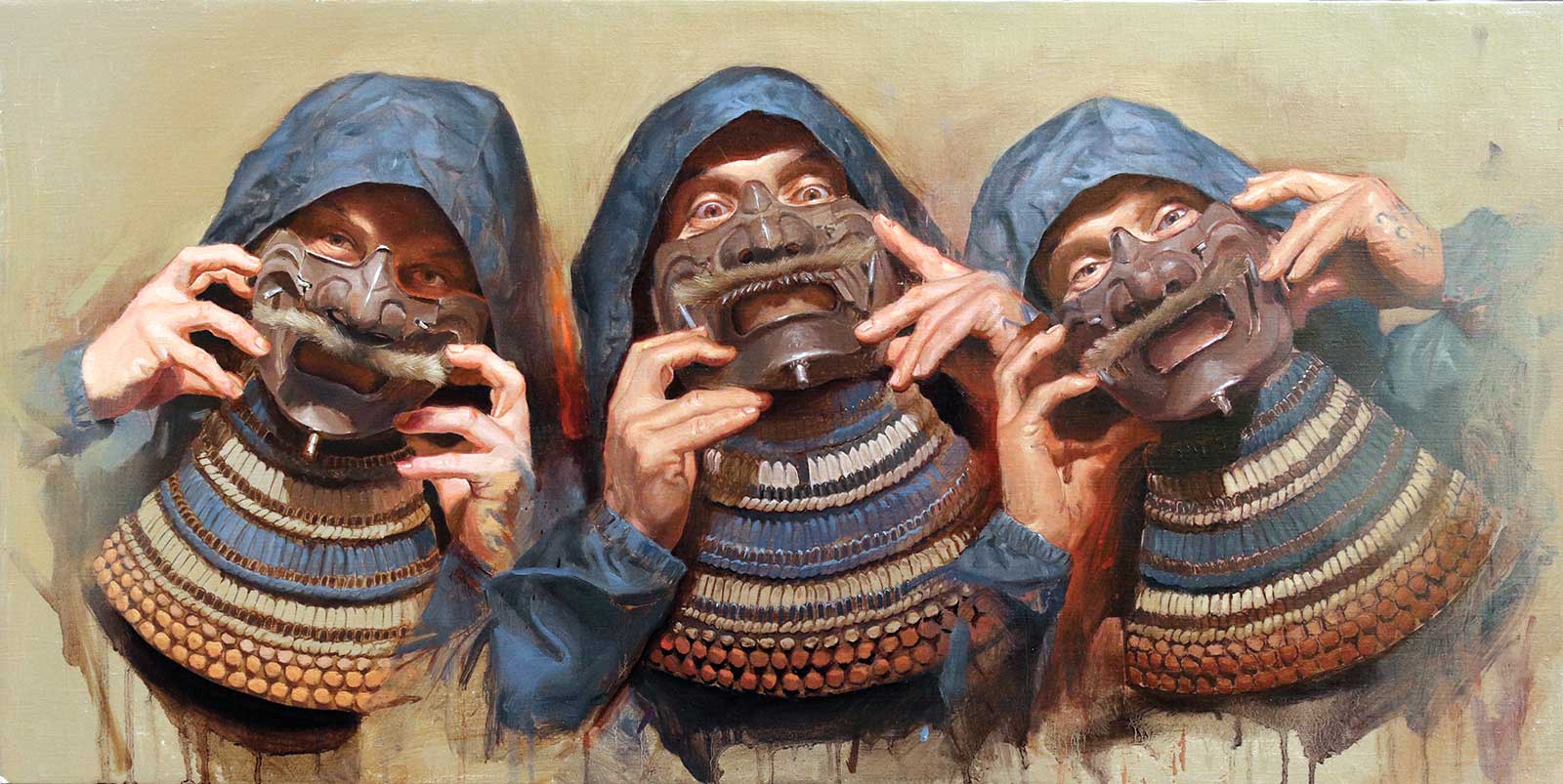
Shawn Barber, Portrait of the Artist, Carlos Torres, 3 views, oil on linen, 2023, 16 x 32"
Dobsky shares the walls with Shawn Barber’s most recent paintings, extending his series of Tattooed Portraits. Since 2005, he has painted over 490 works as documentation of this taboo slice of the lives of people whose creative choices and individualism find fulfillment outside the limited expectations and unimaginative confines of mainstream aesthetics. Still controversial, still subversive, despite their surge in popularity since the 1990s, tattoos bear the edgy aura of the underground, a rebel reputation as the preferred art of bikers and punks, an art of liminal life led on the fringes of respectable society.
The tattooed skin is a living canvas, and the art is often deeply personal—a tattoo is a profound statement of ownership of the image and its meaning. Barber says, “Different cultures have different perspectives on what’s okay to do to your body. Humans have been marking their bodies since the beginning of time, for all sorts of reasons. I get tattooed because I like the art of it. Some of it is storytelling. Our friend Lyle Tuttle coined the phrase ‘stickers on your luggage’—your tattoos are telling the story of the history of your life—are you doing it to celebrate something, is it a marker for somebody passing, is it an achievement? I think it’s therapeutic, there are some mental breakthroughs that come through by having a tattoo. It does a lot for people.”
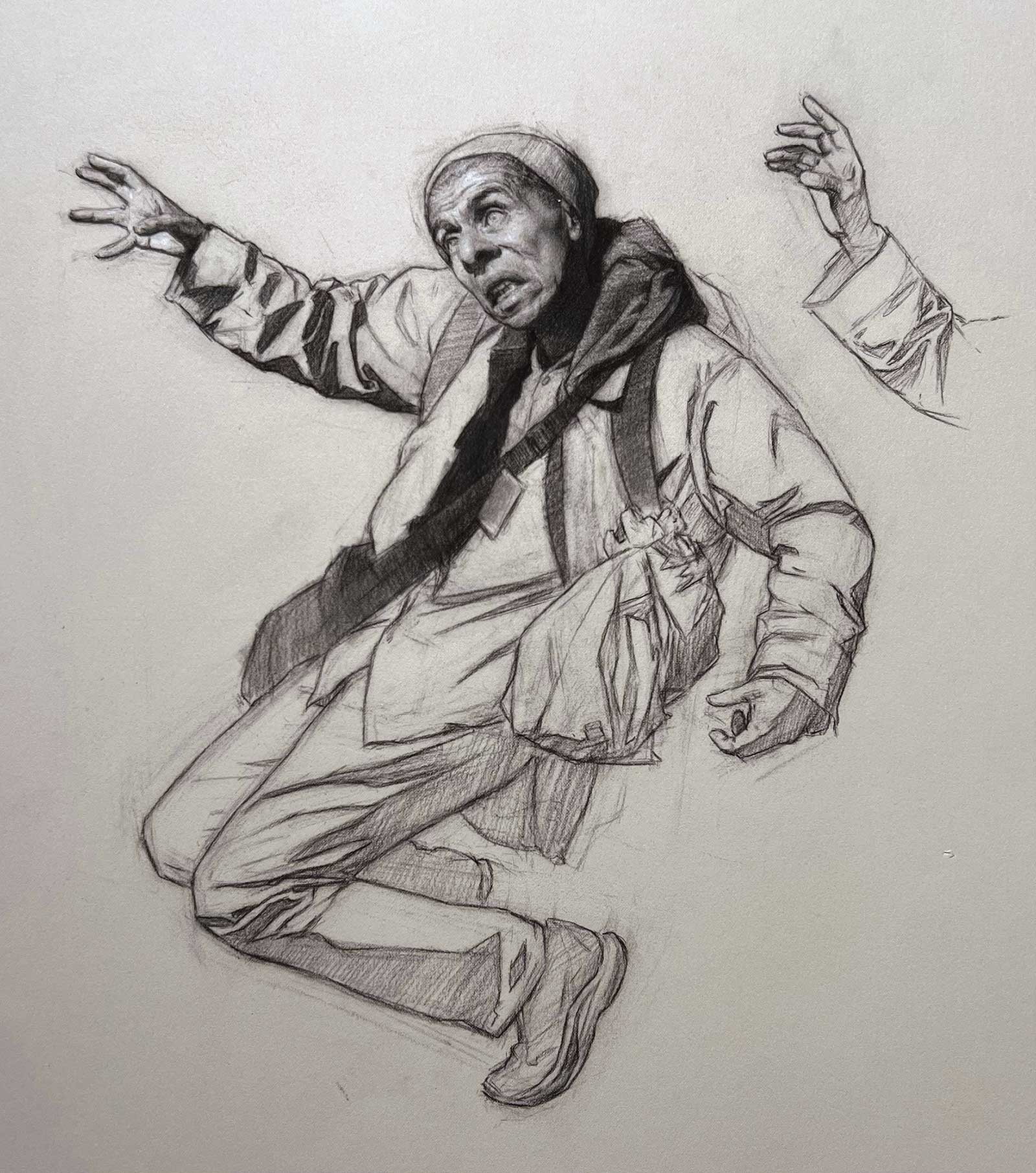
Carl Dobsky, Study of a Blind Man (Reaching), 2023, charcoal on toned paper, 17¾ x 19¾"
A tattoo concentrates the role of art as a means of sharing an idea into the body of its wearer, who becomes both the viewer and the viewed. A tattoo is also a statement of accepting a degree of alienation from society—once inked, forevermore an outsider, an initiated member of a private and magical fraternity of men and women who share secret art. Mike Dorsey’s Masks and Portrait of the Artist, Carlos Torres, 3 Views both deal with tattoo artists who collect masks, revealing another aspect of tattooing as a barrier separating the spectator from the person wearing the art. Simultaneously alienating and protective, tattoos are a kind of mask, concealing and covering the skin.
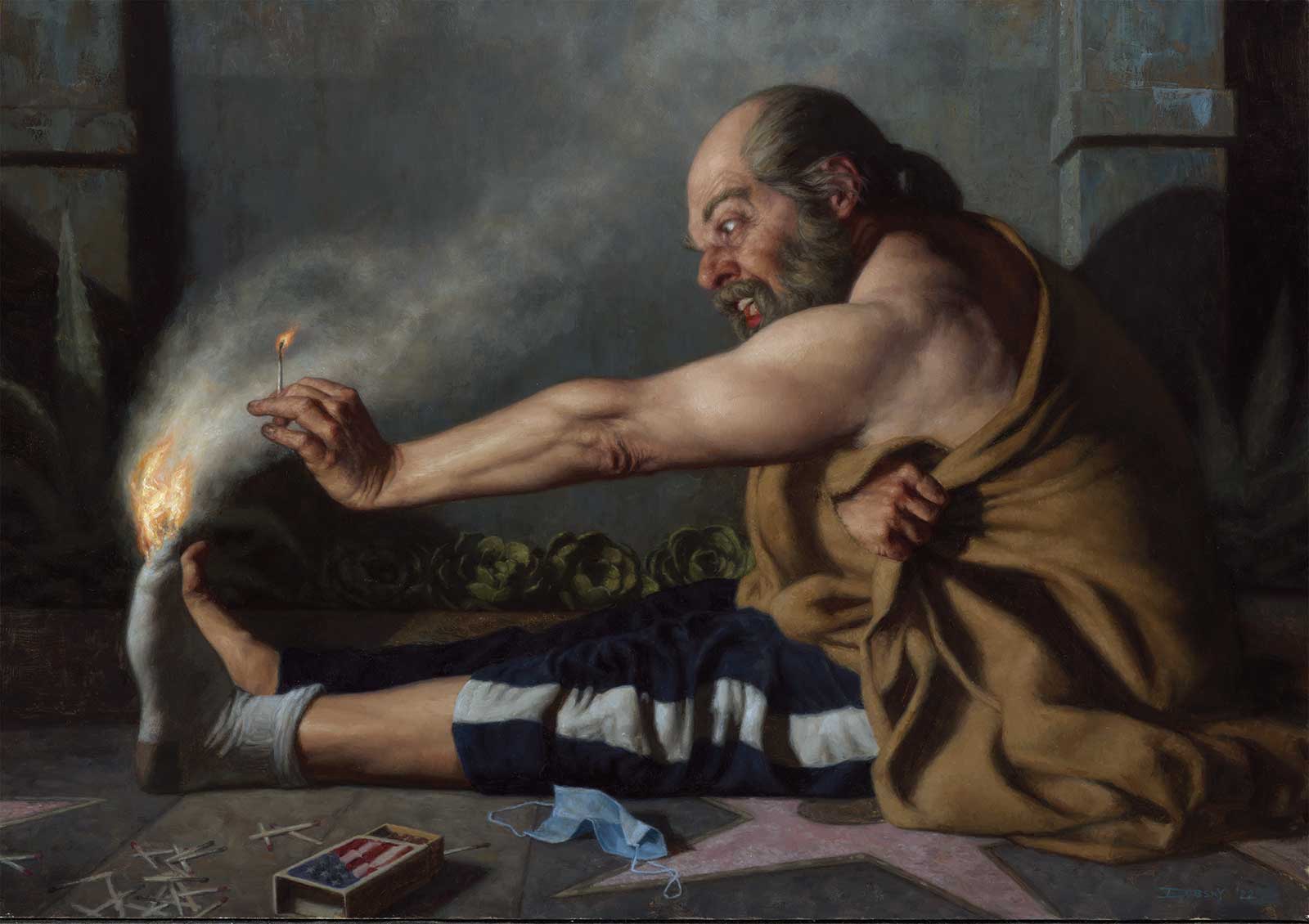
Carl Dobsky, Keeping Warm, (Man Setting Himself on Fire), 2022, oil on linen, 21 x 30"
Like the tattooed bodies he documents, many of Barber’s paintings present a multiplicity of images, overlaid upon each other. His Shamrock Social Club, Disassembled Still Life is a portrait of a tattoo shop on Sunset Boulevard, opposite the famous Rainbow club, which recently had to find a new location. Barber wanted to document the store, and created a compilation of fragments of the interesting objects which gave the place its character. “This is a commentary on them having to move. All these objects were in different rooms and different places, on different shelves, and different areas.”
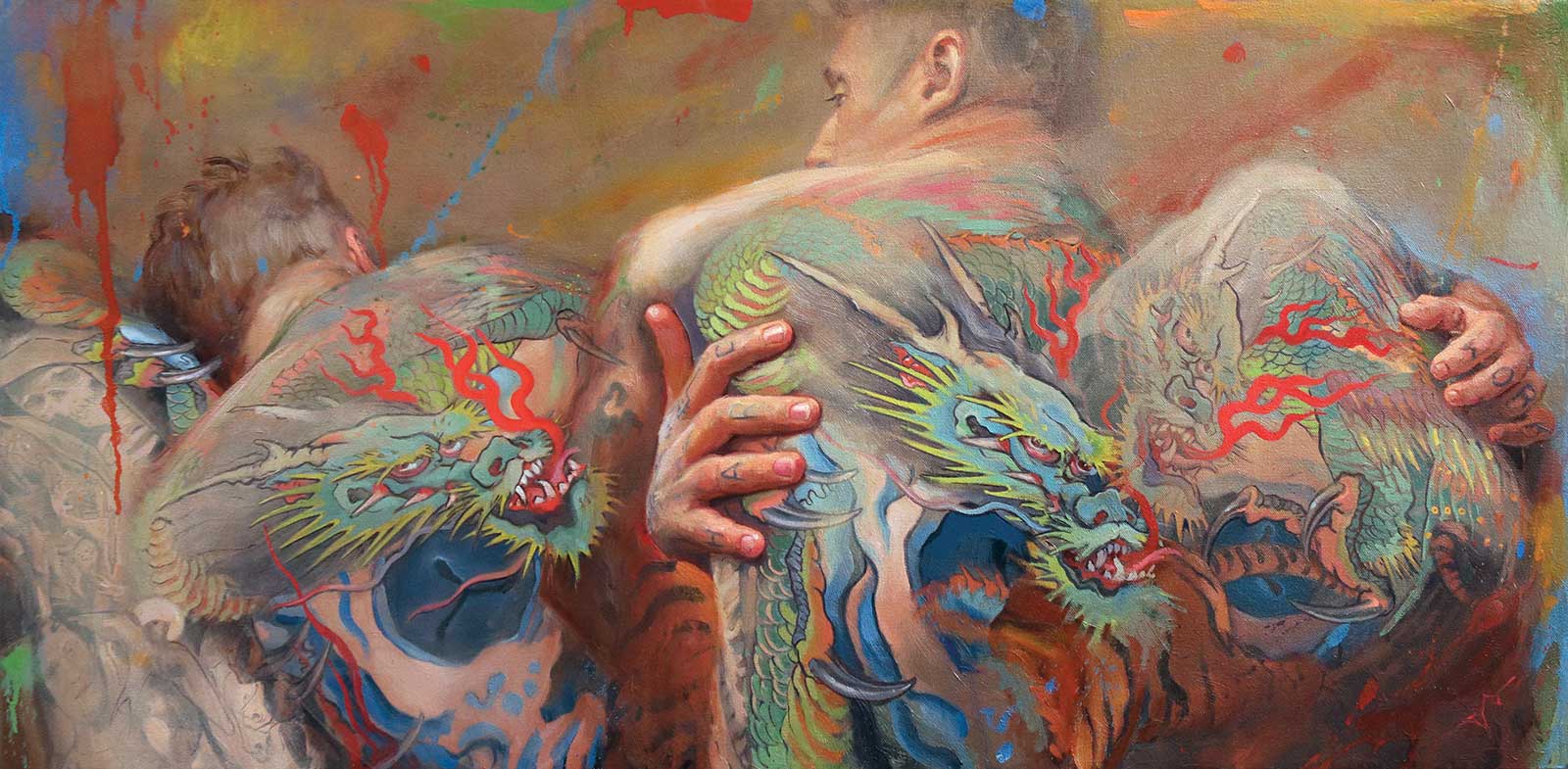
Shawn Barber, Tattooed Self Portrait, Dragon Back Study (Tattoo by Jason Kundell), 2024, oil on canvas, 18 x 36"
His Tattooed Self Portrait, Dragon Back Study (Tattoo by Jason Kundell) is an unusual triple self-portrait which puts the Japanese dragon that decorates his back into motion. His hands reach around his body, embracing himself and the mythical beast—the dragon’s claws appear to extend from his own fingers. “For a lot of us the dragon means power and energy,” says Barber. “A lot of the tattoos I get are classic themes. My back is a dragon fighting a tiger, they call it a battle royale.” Words are written into his fingers—but where convention inks “love” and “hate”, Barber’s message is positive and productive. “From my vantage point it says ‘work hard.’ It’s a reminder to stay on course, to stay on task, to be productive. I’m a hyper-productive person. It’s a statement.”
Michael Pearce is a dynamic writer, curator, and critic, and a champion of art that emerges from popular culture and shapes the spirit of the age. He has published dozens of articles about art and artists, and is author of Kitsch, Propaganda, and the American Avant-Garde. He is Professor of Art at California Lutheran University. —
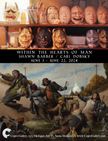
Within the Hearts of Man
June 1-22, 2024
Copro Gallery 2525 Michigan Avenue #T5, Santa Monica, CA 90404
(310) 829-2156, www.copronason.com
Powered by Froala Editor