Rose Freymuth-Frazier paints with the dexterity of a highly trained artist, and she is an outstanding member of the new generation of figurative painters that emerged during the great revival of representational art in the first decades of the 21st century. If studio wisdom is passed down like the laying on of hands practiced by the ancient hierophants, then she is an exceptional priestess of the bohemian church of paint, for she studied with two of the great characters of the turning millennium, painters who carried the torch through the dark decades of the 20th century. The evidence of their influence is apparent in her work, and her paintings emulate them, without imitation. She has her own voice, and it is a serious voice of strength and sensuality.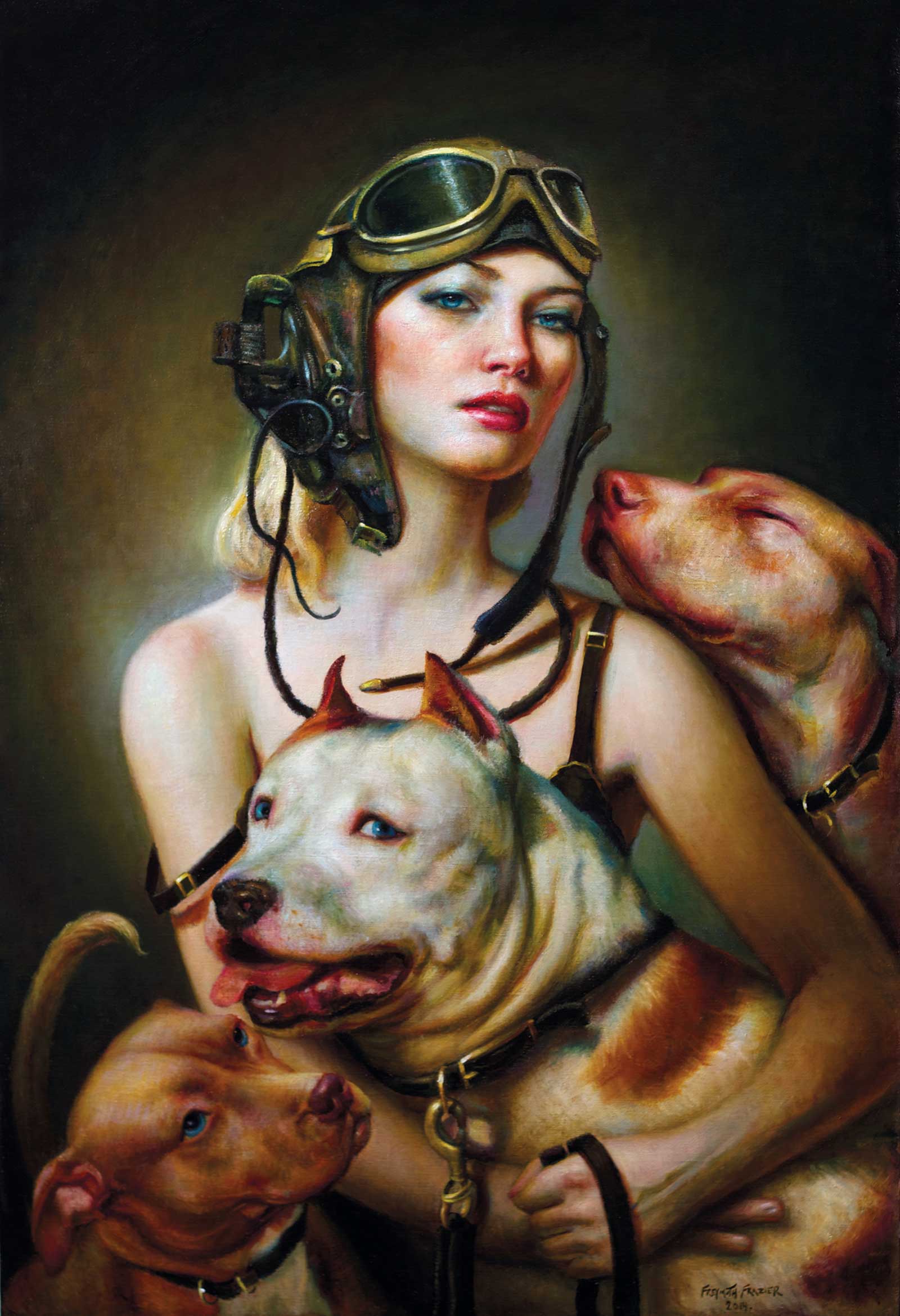 Fight Or Flight, 2013, oil on linen, 30 x 24”. Collection of Anne FinkelmanShe found the first of her mentors, Steven Assael, at the Art Students League of New York, when she slipped into a demonstration class. In the 1990s Assael painted an extraordinary series of beautiful portraits of punks and strip-club dancers, showing, like Nerdrum, how traditional techniques could be used to express contemporary ideas, refuting the ridiculous doctrines of the so-called avant-garde. When she saw them, Freymuth-Frazier saw paintings of her peers. “I had a lot of stripper, counterculture, performer friends,” she says.
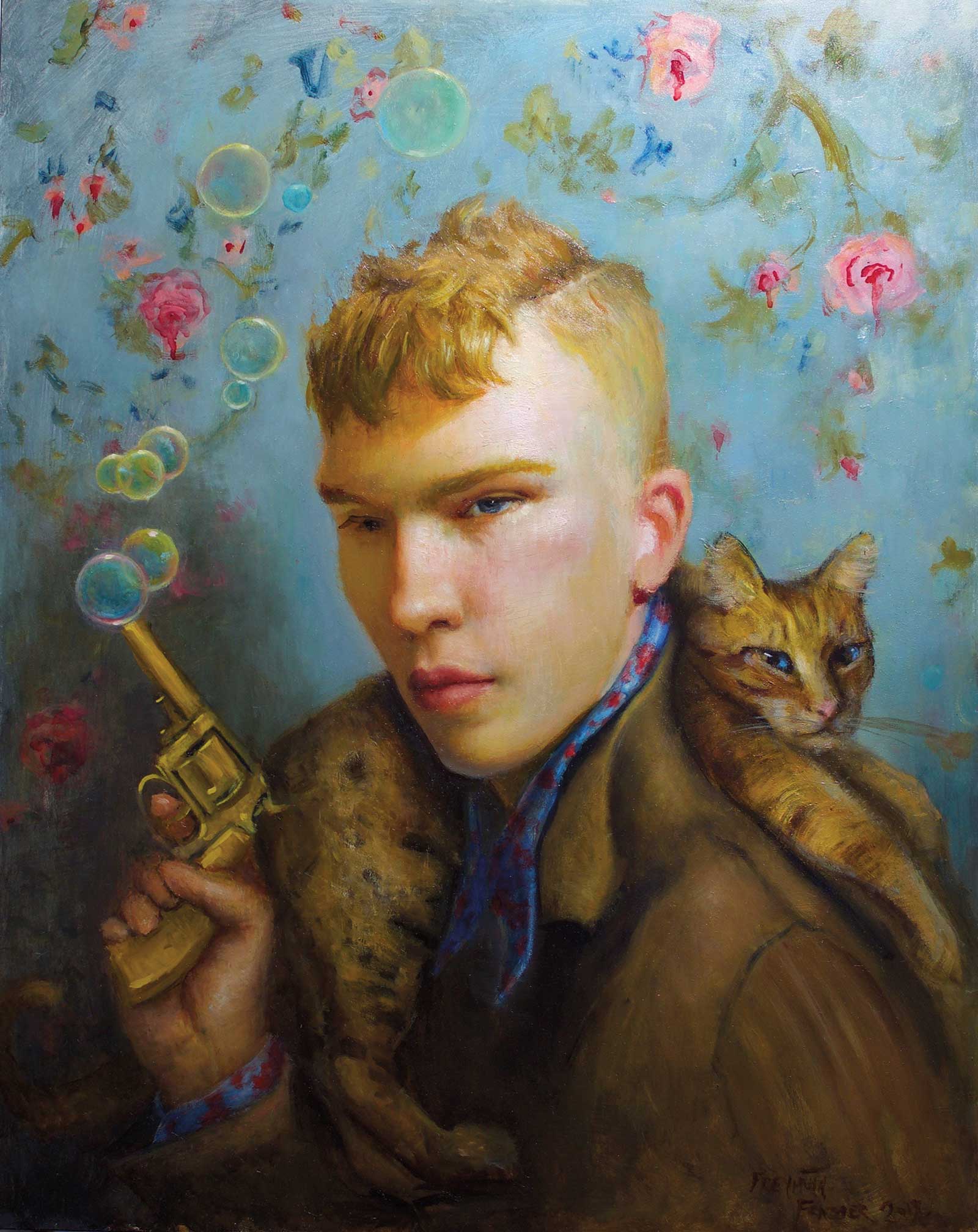 Small Game Hunter, 2018, oil on panel, 20 x 16". Collection of Sasha and Lance Grover
“I was taken with the way he presented them and the way he painted flesh, more than anything.” Later, she learned that Assael was to teach a workshop at the New York Academy of Art, so she joined the class, then became his apprentice and assistant in his New York City studio, running his private classes and studying with him for two years. Freymuth-Frazier continues, “Steven is a kind task master and an excellent teacher and mentor. I would never have become as technically adept as I did if it weren’t for his high, and ultimately unattainable, standards. He opened my eyes to the world of vibrant color that can be found in so many places, once you learn to see it. I think I’ve taken this love of bold color further into my work than almost anything else I’ve learned from him. It spoke to my slightly bubblegum, raised-in-California in the ’90s aesthetic, and I ran with it.”
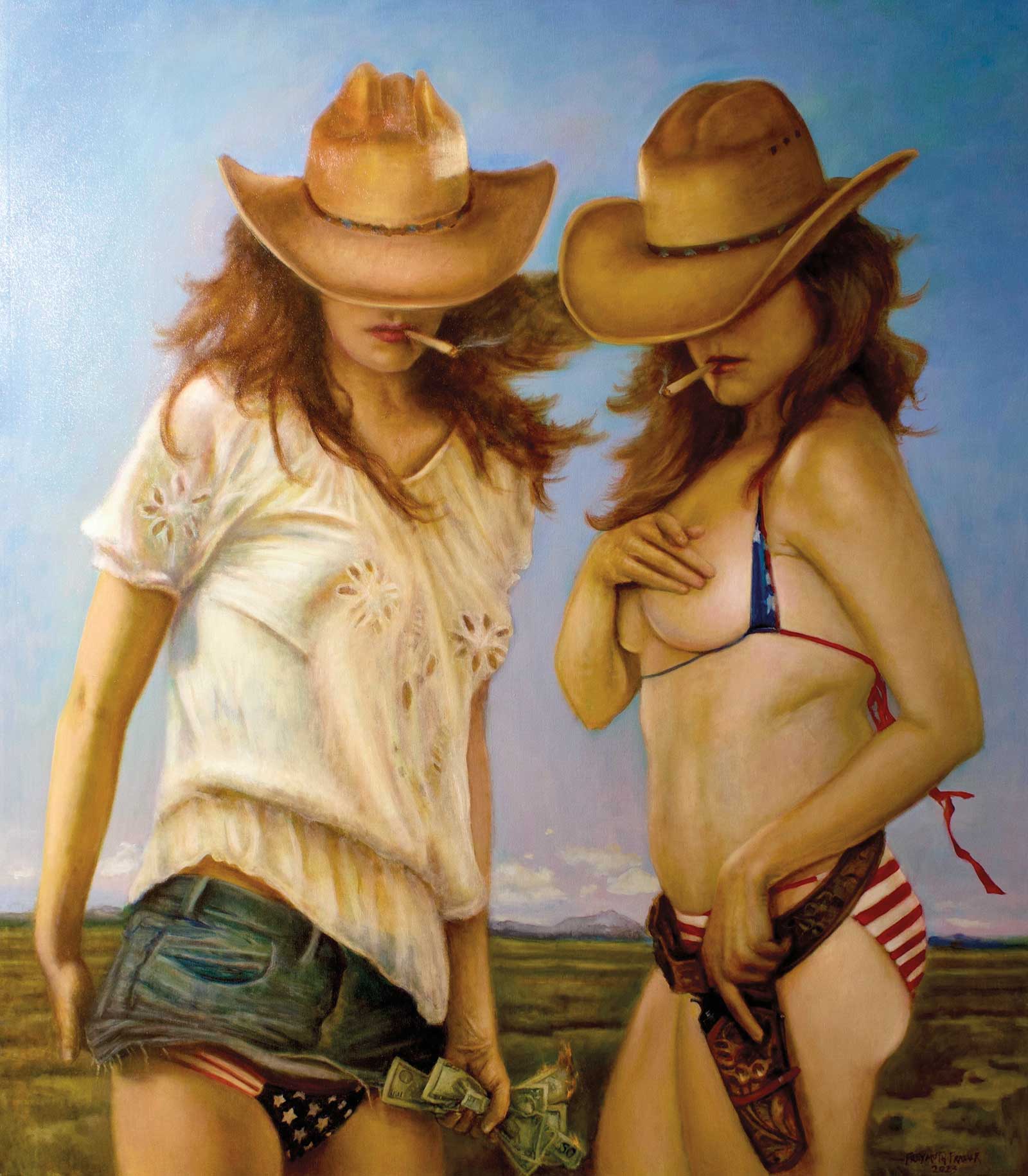 Bang For Your Buck, 2023, oil on linen, 52 x 46”
The second of her mentors was the extraordinary kitsch-painter Odd Nerdrum, whose controversial paintings exploded into the American art world with apocalyptic intensity in the 1990s. Freymuth-Frazier knew about Nerdrum’s work before she began studying painting with intention and rigor. In the summer of 2005, she was accepted to the Nerdrum School, which invites selected students to come and apprentice with the master. In the weird and austere beauty of Nerdrum’s farm on the edge of the southern tip of Norway, in the summer land where the sun never sets, she watched and learned. Nerdrum’s ochre house and barn arose from a long meadow sloping gently toward the sea, where curving rocks sculpted by ancient glaciers ascended calmly from the waves. It was an idyllic experience. Freymuth-Frazier recalled, “We painted or modeled for most of the day and often fished in the North Sea, turned hay, or walked the strange smooth rocks that hugged the coast.” Nerdrum has welcomed hundreds of students to his studio during the past 25 years, and all seem to remember the experience positively, many with warm fondness for the austerity of the barn’s bare pine planks and the bohemian spell that seems to linger around the farm, protecting it from the slings and arrows of reality. Freymuth-Frazier continues, “Odd is a magical creature and the world he created in Norway was like a dream, or a living surrealist masterpiece. He didn’t directly teach much technique but one could learn a lot just from observing him paint, which he did most days, all day long. The experience was soaking up what one could from watching him work on a large canvas outside amongst miniature ponies being shod or sheep wagging their dirty tails in the meadow. He has a huge collection of art he would excitedly bring out for students to view. Once, he had his entire collection of Käthe Kollwitz brought out and hung because I told him what her work meant to me. I found him to be very warm and generous, and I’m grateful to have experienced that summer in Norway right as I was finishing my training and embarking on a professional career. I will never forget it.”
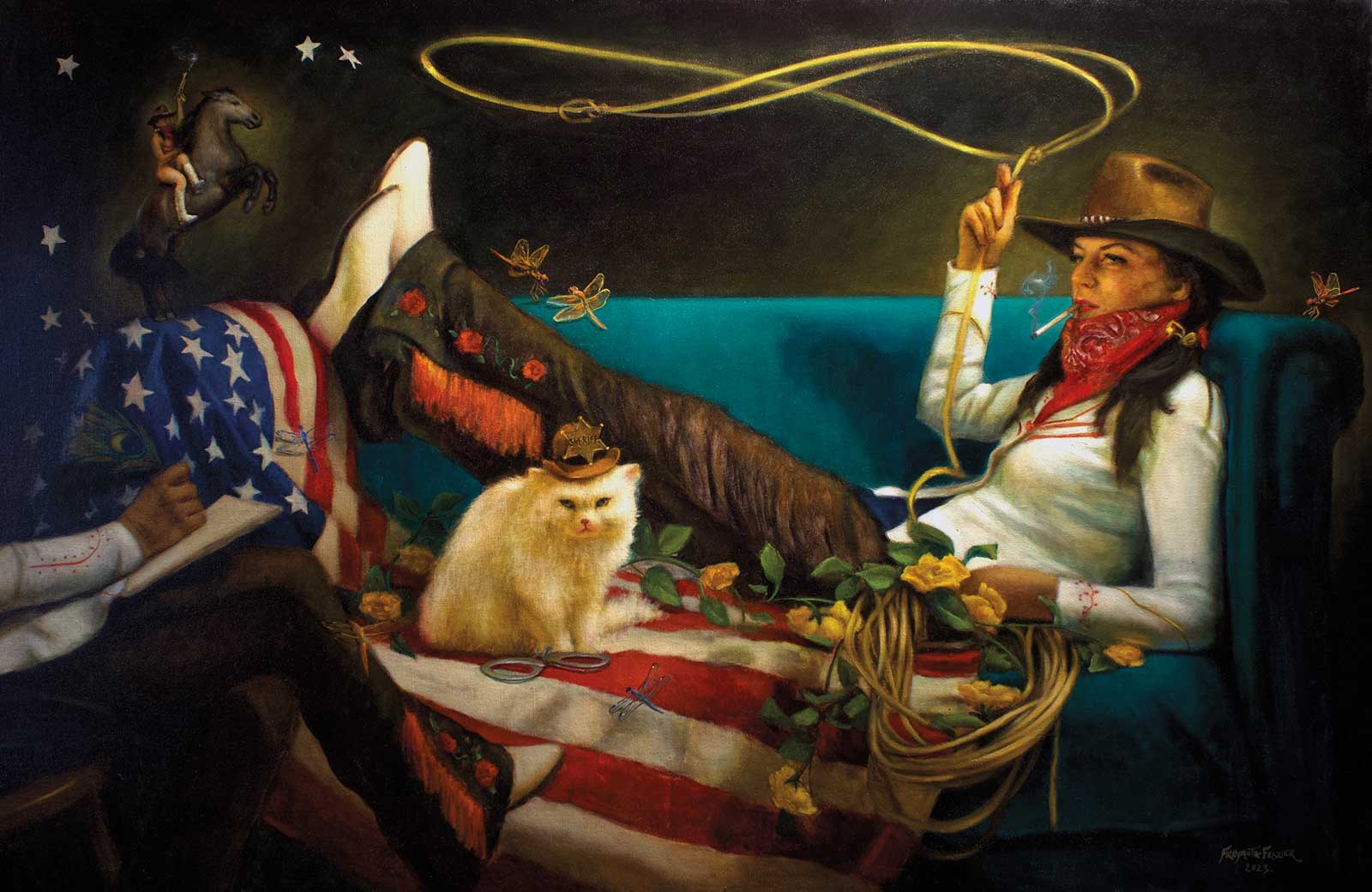 Gone Wild, 2023, oil on linen, 38 x 58”
Cheerfully emulating Assael’s contemporary portraits of colorful characters, Freymuth-Frazier began creating memorable portraits of fashionable and transitional people, denizens of the hidden burlesque world of New York, who imagined their lives and lived them as they chose. Her crew-cut Small Game Hunter was high-cheeked and androgynous and blew bubbles from a gilded pistol, the quintessential American symbol of macho, a tabby cat sprawled across their shoulders and the collar of a blue silk shirt both belying brute bravado. Fight or Flight put a naked and beautiful blonde model into a pilot’s leather skullcap, as an Amelia Earheart of the oily air, protected by three crop-eared pit bulls, ready for action. Both paintings took the sting from conventional stereotypes. Manly? Not much, but beautifully bohemian and alluring, sure. Sexy? Yes, but defended and intrepid, too.
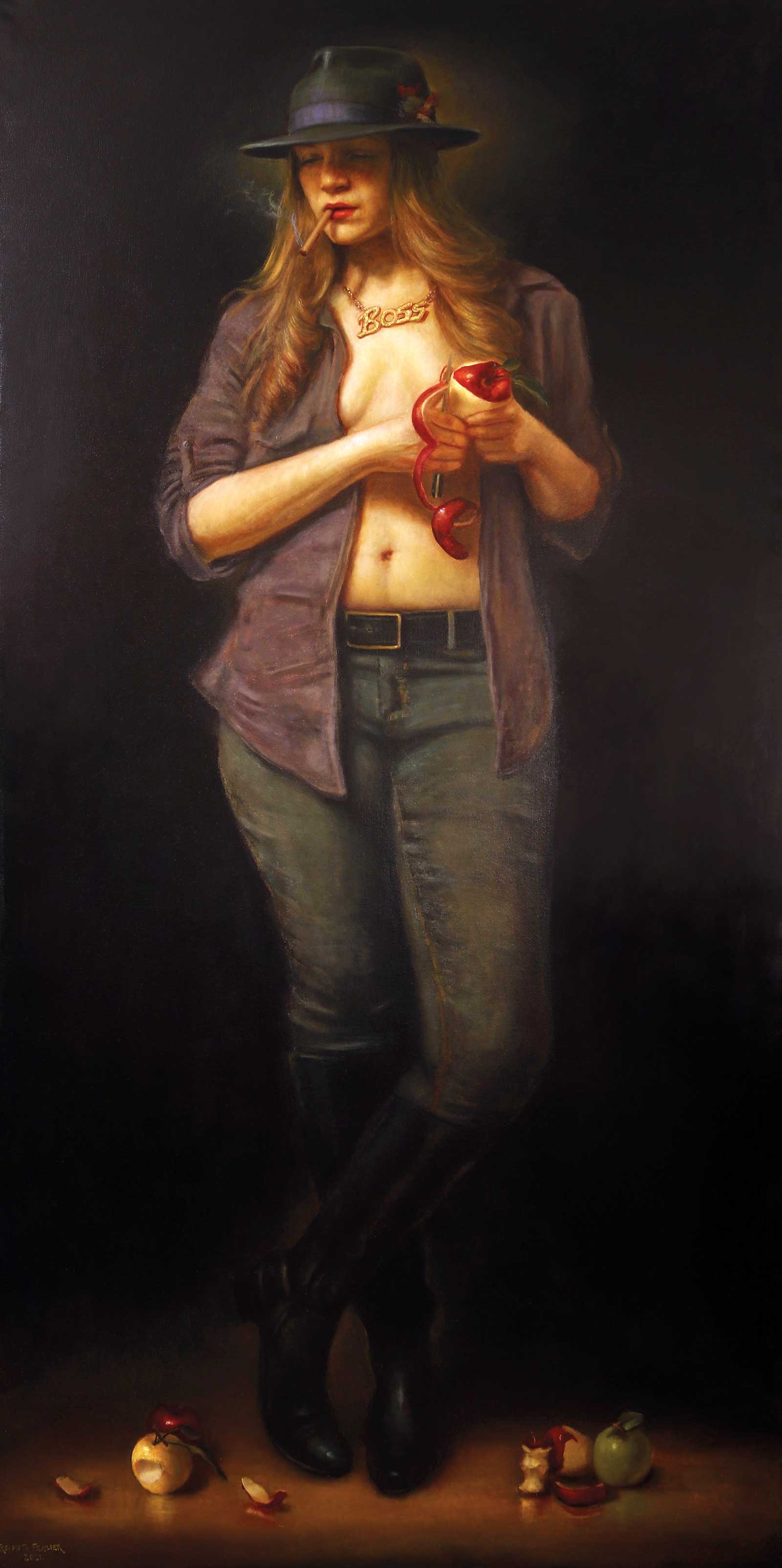
Boss, 2021, oil on linen, 78 x 40”. Collection of Michele Peterson.
Her recent work Bang For Your Buck portrays archetypal stripper cowgirls, presenting a pair of the Daisy Dukes of North America’s erotic Western culture, which is barely hidden beneath the thin veneer of bourgeois respectability. A cheerful and honest sexuality is a consistent theme in her work. “When I first began painting,” she says, “I was seeking a sort of ownership of that early experience of being a young woman who, like most of my peers, felt objectified and overly sexualized by the world we were living in. As I’ve gotten older, my work continues to be influenced by my experiences and those of my female friends as we pass through different stages of our lives.” A feminist theme underlies eros. In Boss Apple Peeler, Freymuth-Frazier paints herself as an archetypal Eve, reimagining the biblical character as a contemporary woman, shaded under Marlowe’s fedora and customary cigarette. This gumshoe Eve peels the fruit, unwinding the skin as if uncovering preconceptions about her role, deciphering the puzzle of women’s identity—did Eve know what she was doing when she gave Adam the primordial apple? Or was hers a thoughtful act, deliberately preferring the challenges of individuality and freedom of choice brought by knowledge of good and evil to the ignorance and bliss of living life in subordinate obedience? A few centuries ago, these ideas would have led to a heresy trial—now, amid the chaos of post-modernity they seem like a reasonable investigation. What are Western women’s roles in the new era?
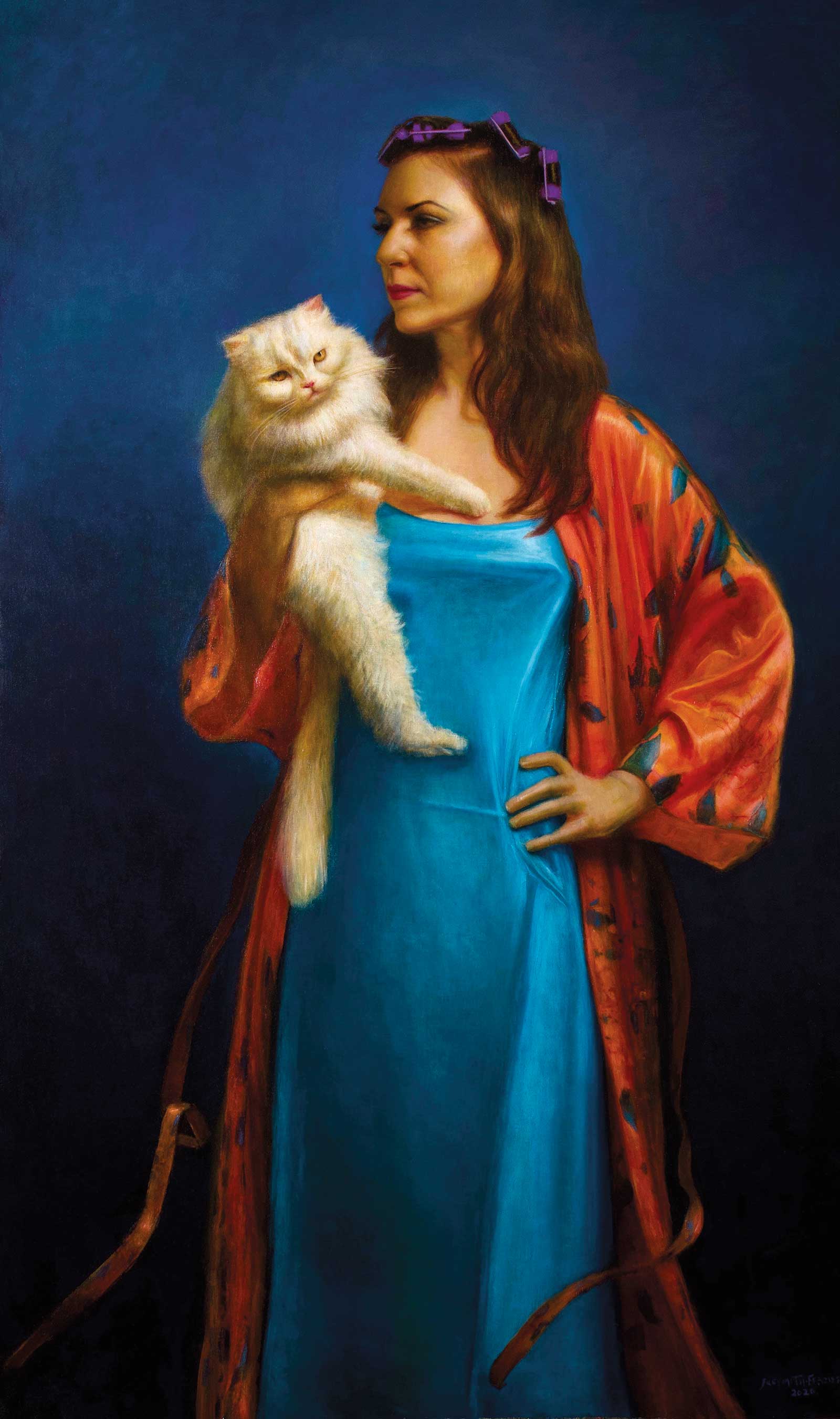
Midlife Madonna, 2020, oil on linen, 56 x 34”
Recently, Freymuth-Frazier has enjoyed further role playing in a series of pictures of a woman reclining on a psychoanalyst’s couch. Although the weight and interpretation of the paintings is deeply embedded in the maze of the modern mind, the paintings are lighthearted and charming, and thoroughly collectible. In Gone Wild she presents herself as a cowgirl. The couch is draped with an American flag, and another cowgirl takes the notes of a psychoanalyst, while stars fly and a diminutive pistolera, side-saddle on a rearing stallion, fires a six-shooter on the arm of the archetypal couch, naked, but for boots and neckerchief and 20-gallon hat. In others she is an intrepid spacewoman, a lounge-lizard. They are amusing, and they remind us of children playing dress-up and Halloween parties and performance. But there also are serious themes tucked into the paintings, which are allegories questioning personality, whose roots are far from the superficialities of cosplay. We are unperfect actors on the stage. How do we present selfhood? The figures on the psychoanalyst’s couch are all different versions of the same person, presenting the idea that an individual may be perceived in many different roles. Freymuth-Frazier explains, “The couch paintings are cheekily inspired by psychoanalysis and loosely based on Freud’s theory of personality: Id, Ego and Superego. I base each of the three figures on myself, so in that sense they can be called self-portraits. The central figure (Ego) reclines on the couch which represents the conscious mind. She is having a conversation with the therapist (Superego) and a third little figure (Id), who both reside on the periphery of the couch, in the domain of the subconscious mind.”
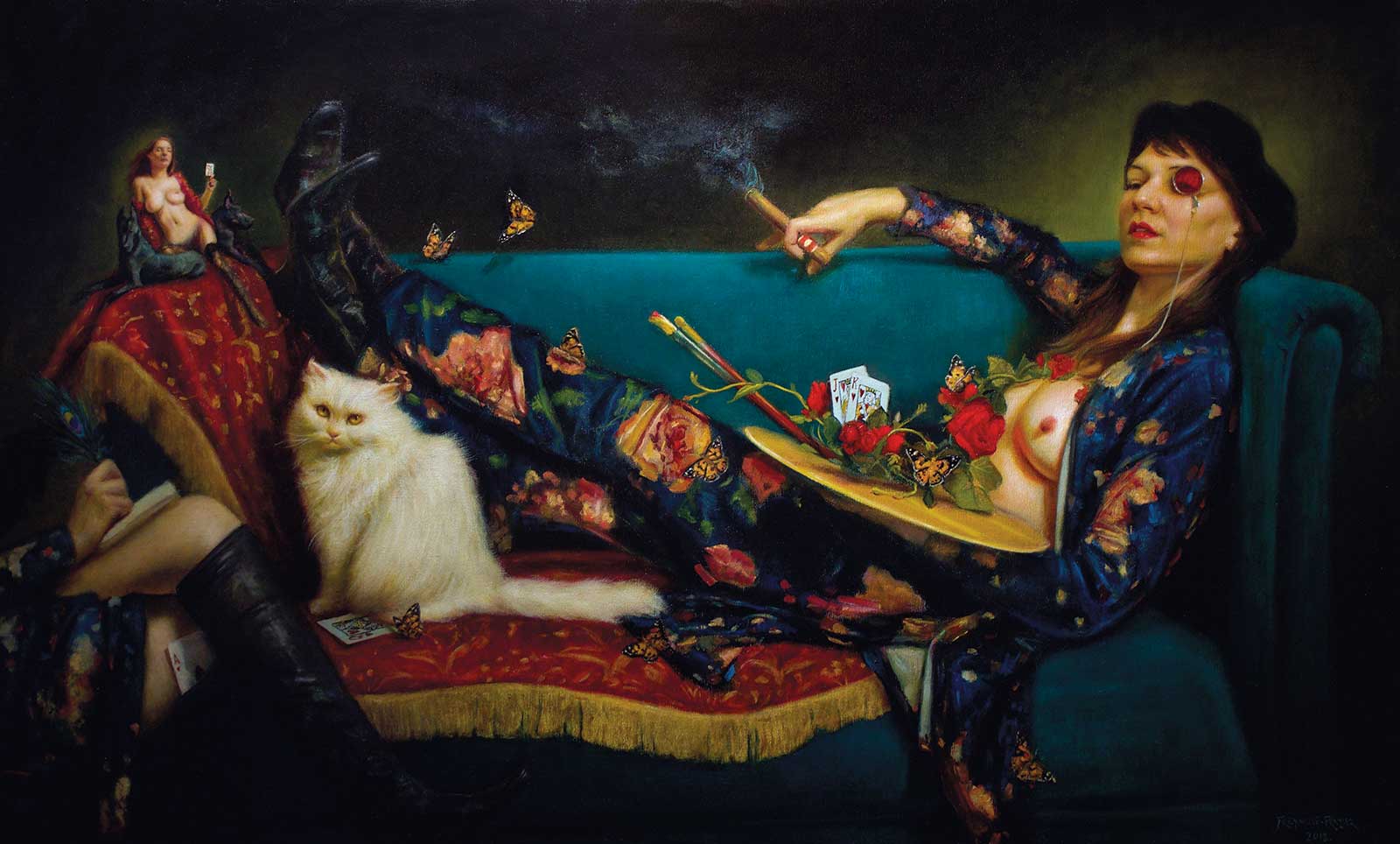
Painted Ladies, 2018, oil on linen, 34 x 54”. Bennett Collection of Women Realists.
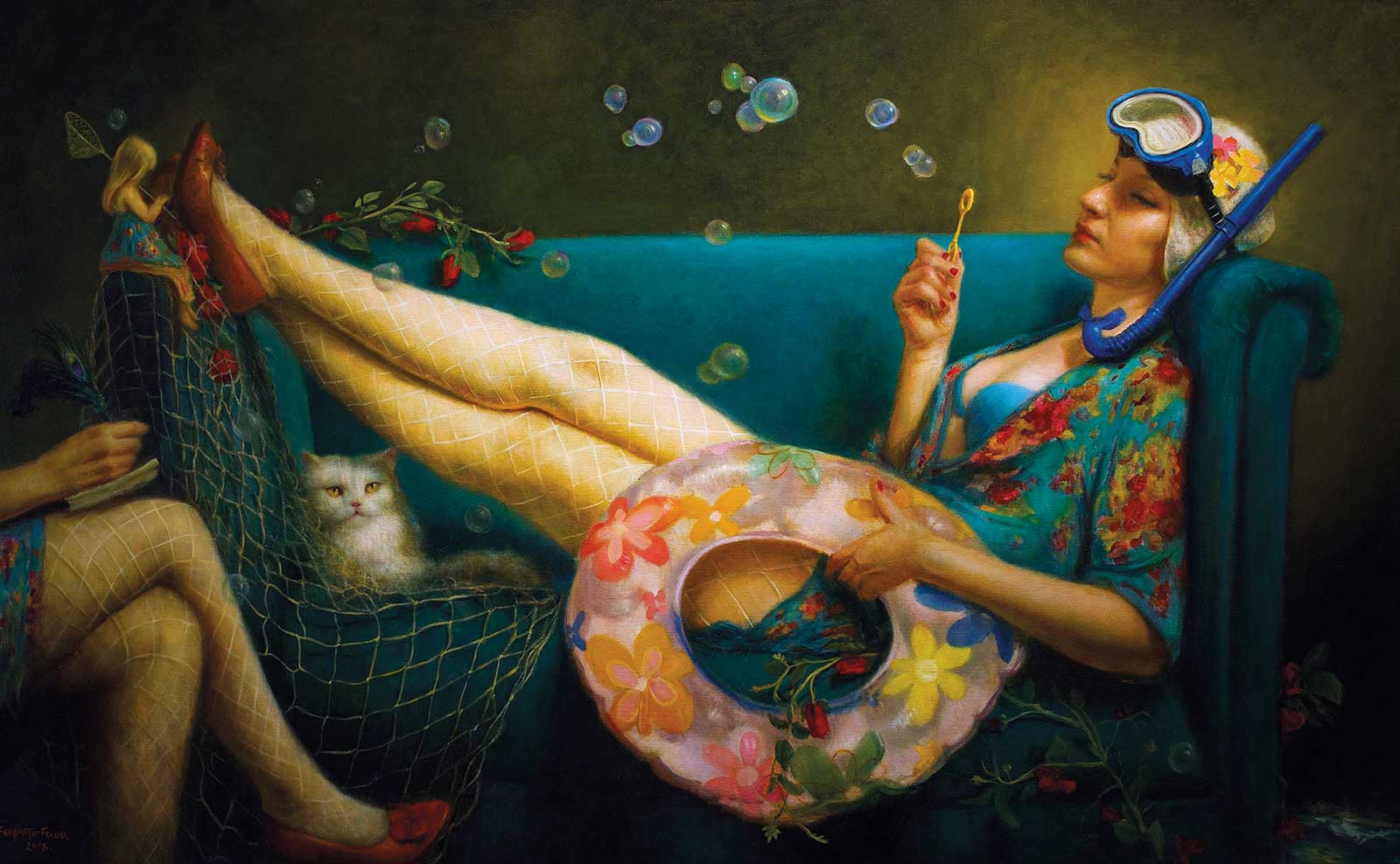
Gone Fishing, 2018, oil on linen, 34 x 54”. Collection of Ira and Carol Goldstein.
And there is a cat—an inscrutable Egyptian cat, a sacred and divine cat, who is intertwined through the paintings of the many lives of Freymuth-Frazier, who introduces her. “Bun Ra is a pure white, soft as silk, longhair Persian rescued from the mean streets of Giza, Egypt. She is the prettiest, sassiest, most unforgiving little thing. She knows who she is and isn’t pretending to be anything else. I admire her otherworldly elegance and grace mixed with unapologetic self-confidence, strength and indifference.”
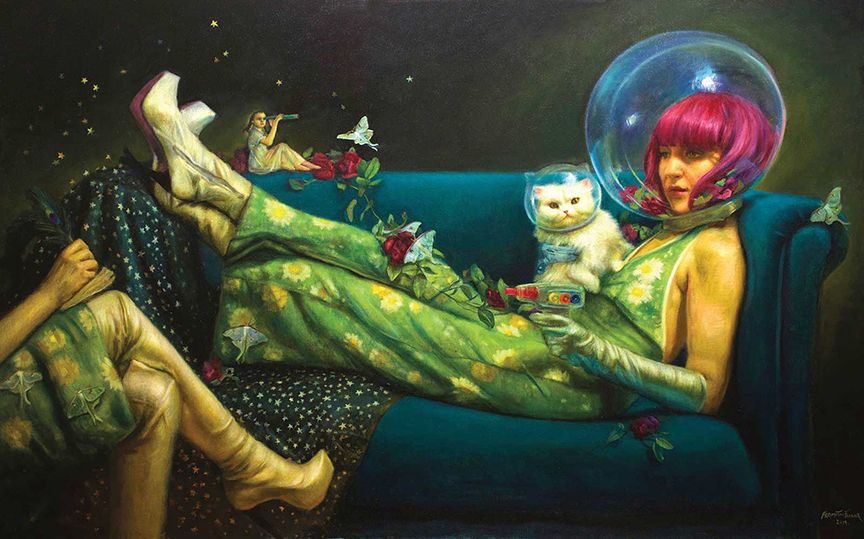
Inner Space, oil on linen, 2019, 34 x 54”. Collection of Milane Duncan Frantz.
This familiar companion and alter ego travels with her into the liminal world of her paintings. The cowgirl spins a lariat, and Bun Ra looks singularly unimpressed beneath the brim of her little cowboy hat, her yellow eyes gazing at us impassively. When her crimson bobbed mistress becomes a disco astronaut dressed in ’60s go-go boots and a fishbowl space helmet, and brandishing a Buck Rogers water-pistol ray gun, Bun Ra wears her own little helmet and looks thoroughly discontented under glass—but she seems more gruntled in Painted Ladies,even coquettish, for now the scene is properly set in silk-clad bohemia, and Freymuth-Frazier dons to-die-for spike-heeled boots and a Walter White hat, and the props are a palette and brushes, blood-red blooms, a Cabaret monocle and a cigar. Bun Ra is where she belongs. The title is a pun, and the transitory butterflies flutter through the scene reminding us of the brief illusions of this life, and of the fragile matters of love and lovers. With them, Freymuth-Frazier reminds us to read her paintings as allegories.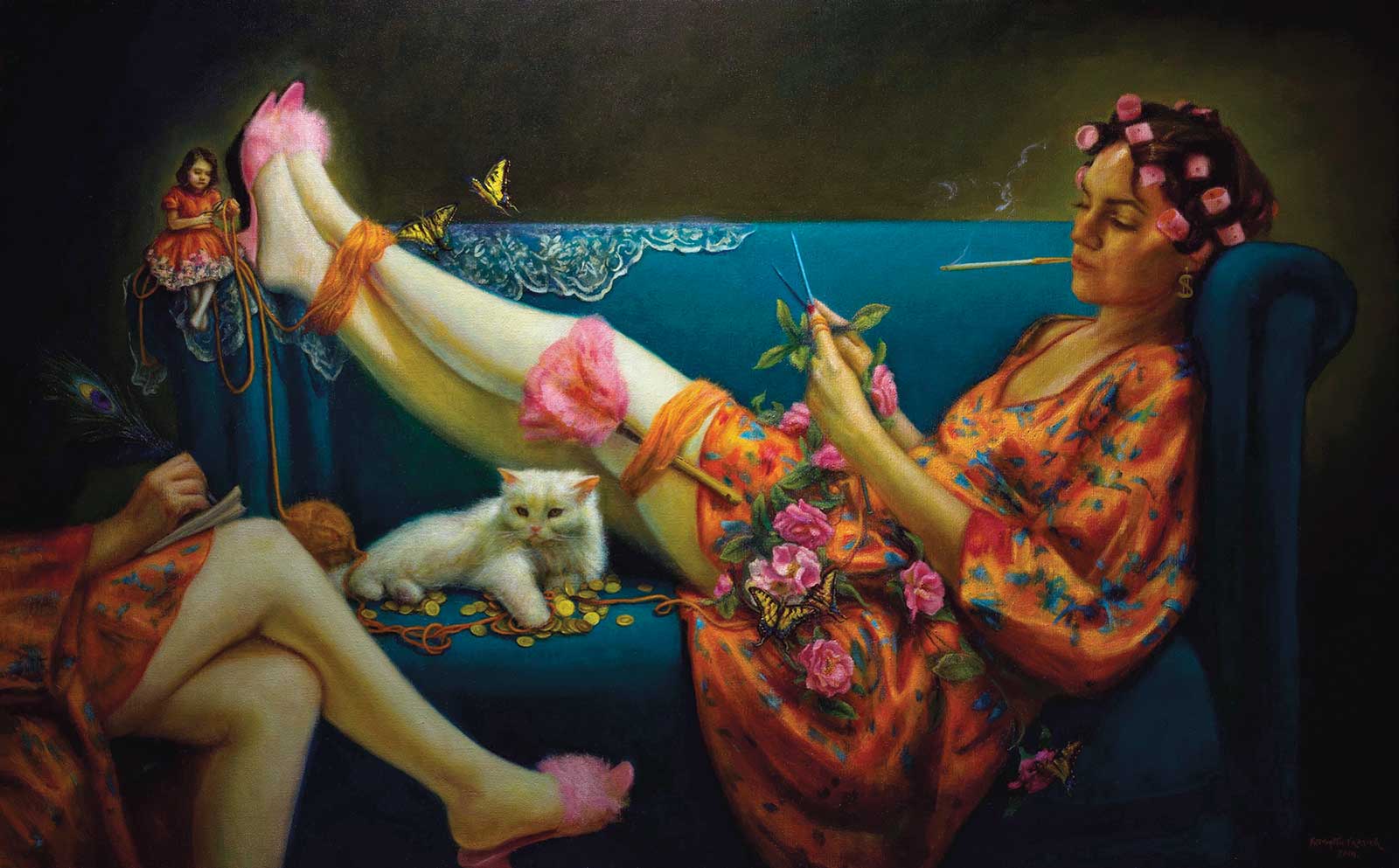
Self-Made, 2019, oil on linen, 34 x 54”. Collection of Sarah and Mike Cohen.
Everything means something, as Shakespeare said, “O, learn to read what silent love hath writ: to hear with eyes belongs to love’s fine wit.” The scattered cards are a royal flush of hearts—the tricky ego has the hidden ace, ready to slip it into the game at any moment, the id is a “ten” but she comes in the company of two formidable Great Danes, the big black dogs of mental darkness. Costumed Freymuth-Frazier holds the king and the jack in her hand and she has her bouquet of brushes and flowers—so Rose is a rose of love, but Bun Ra is the queen of hearts. —
Michael Pearce is a dynamic writer, curator, and critic, and a champion of art that emerges from popular culture and shapes the spirit of the age. He has published dozens of articles about art and artists, and is author of Kitsch, Propaganda, and the American Avant-Garde. He is Professor of Art at California Lutheran University.
Powered by Froala Editor