The art colonies in Santa Fe and Taos, New Mexico, began over 100 years ago. The tradition of loose associations of artists and individuals continues today.
Zienna Brunsted Stewart grew up in Crestone, Colorado, came to Santa Fe with her boyfriend and, essentially, never left. The area’s history, its contemporary artists and meeting her mentor, Michael Bergt, have encouraged her to flourish. She not only paints the female figure, but she’s also a model. One artist introduced her to the work of Odd Nerdrum and suggested that she should study with him. “I was looking through one of his books,” she says, “and thought ‘this is really cool.’ I didn’t even know who he was but I wrote him a letter and many months later his wife sent me an email asking me if I wanted to go to Norway. I had the feeling that this was what I needed to do.”
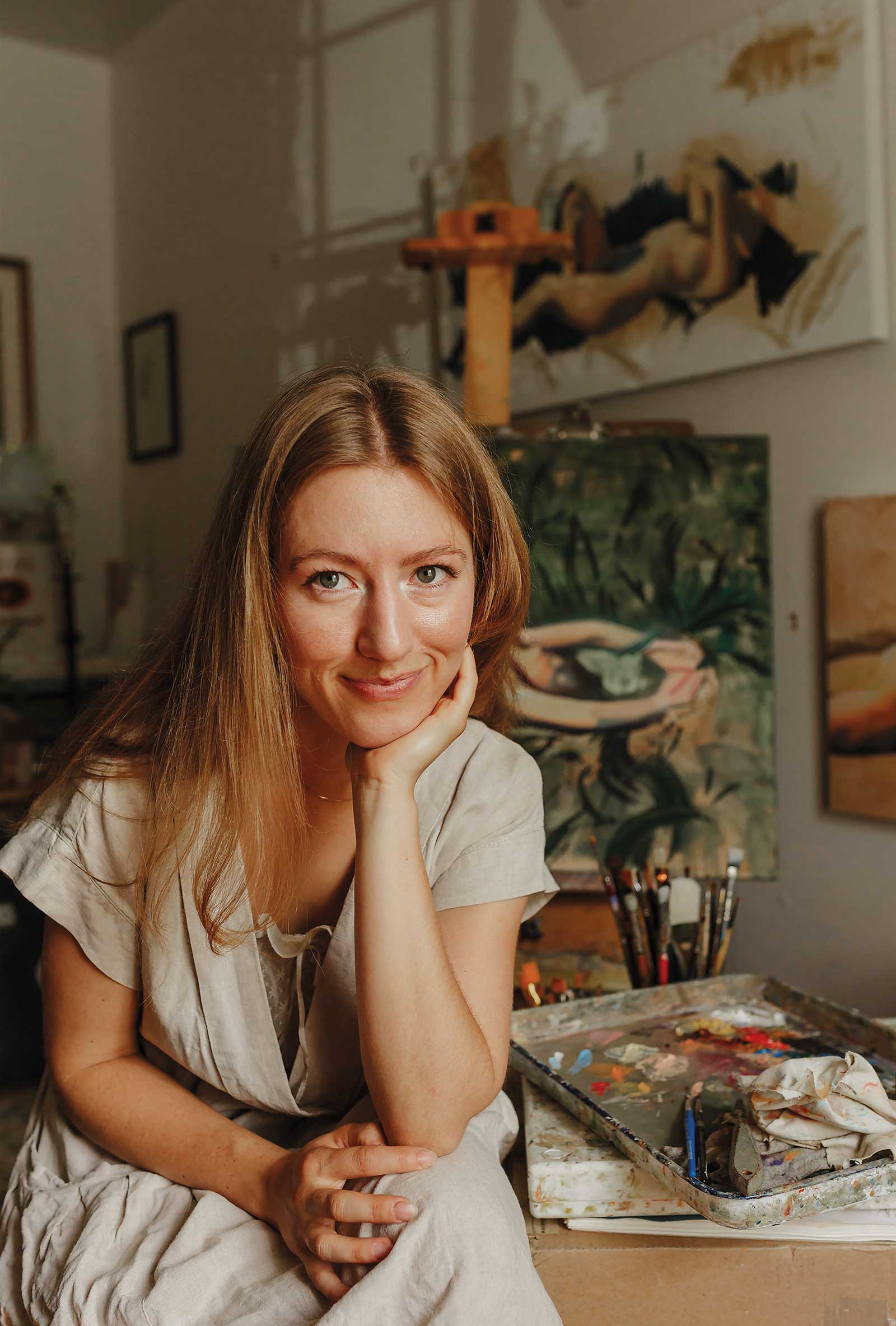
Zienna Brunsted Stewart in her studio. Photo by Lyndsey Groth.
Wise for her age, she studied with Nerdrum for seven weeks. “That was intentional,” she explains. “I knew that if I stayed for six months I was going to come out painting just like him. So I wanted to go and absorb as much as possible and be able to walk away with my own point of view intact.”
Stewart paints the female body as it is in nature, not as in the idealized, porcelain-skinned paintings of the past. Although initially drawn to classical painting, she began painting figures in water to encourage herself to paint more expressively and abstractly while staying representational. “I want to leave some space for your brain to fill in,” she explains. Her tiny, four-by-four inch Girl, Smiling (study) demonstrates her freeing up. The painting Adobe, incorporates her representational prowess in the figure against a painterly rendition of a weathered and textured Santa Fe adobe wall.
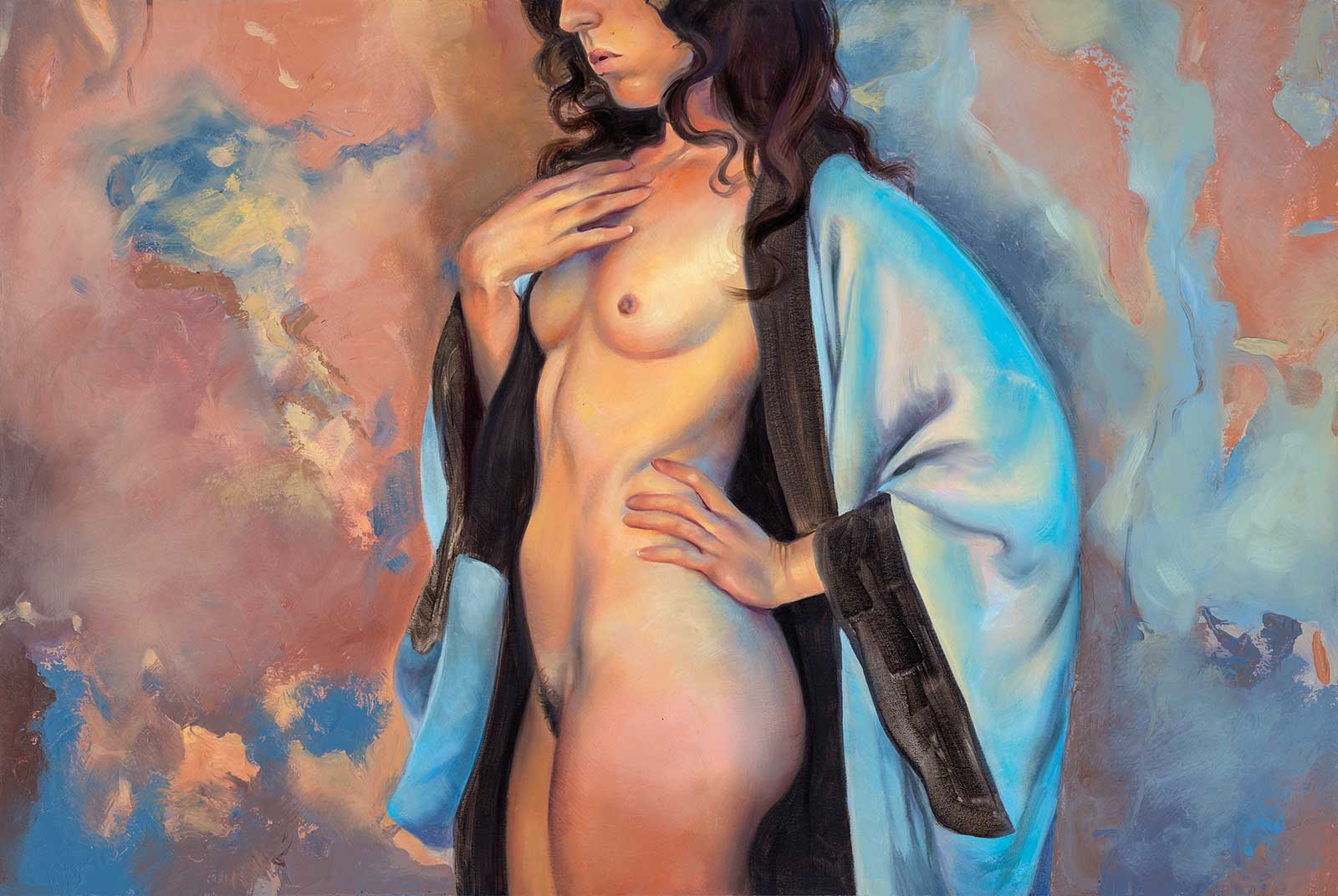
Zienna Brunsted Stewart, Adobe, oil on cradled panel, 16 x 24”. Courtesy Keep Contemporary, Santa Fe, NM
Speaking of being a woman painting women, she refers to a quote from the critic John Berger in his book Ways of Seeing: “Men act and women appear. Men look at women. Women watch themselves being looked at. This determines not only most relations between men and women but also the relation of women to themselves. The surveyor of woman in herself is male: the surveyed is female. Thus she turns herself into an object of vision: a sight.”
Stewart sometimes hears viewers of her paintings say things like, “Well, if you’re a woman who’s painting women nude, well, you’re just pandering to the male gaze. You have the male gaze inside of you.” And she thinks, “Okay. Eye roll.”
“When I’m together with other women,” she continues, “No one looks at us and thinks, ‘she’s looking sexy’ or ‘she’s not looking sexy.’ It doesn’t matter. We can just be ourselves—completely ourselves.”
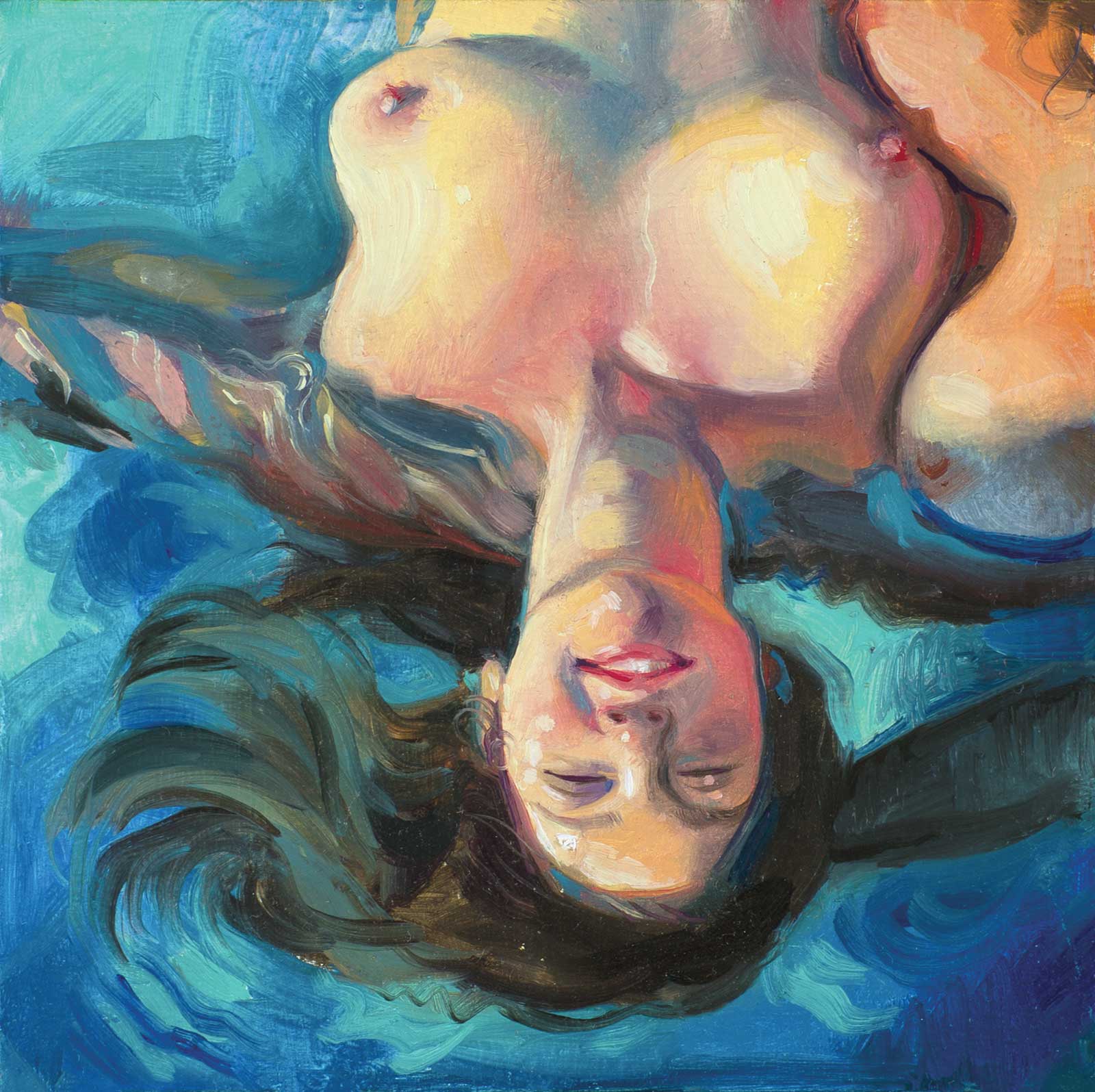
Zienna Brunsted Stewart, Girl, Smiling (study), oil on panel, 4 x 4”
Jesus Miguel Avena is a Mexican-American student at the Institute of American Indian Arts in Santa Fe. His recent work combines oil paintings with red earthenware frames which he describes as “melancholic paintings of people and fantastical characters in desert scenes to understand and represent these aspects of cultural, sexual and racial identity as a Mexican-American.”
In De otros colores, seya la media naranja (Of Other Colors, be the Better Half) he and his partner embrace in the arid desert. Their closeness and energy provides the shade to nurture the growth of tropical plants. His partner had remarked that he was going to come back as a blue bird so that whenever Avena saw the bird, he would see him. The two birds flying above them represent their subconscious.
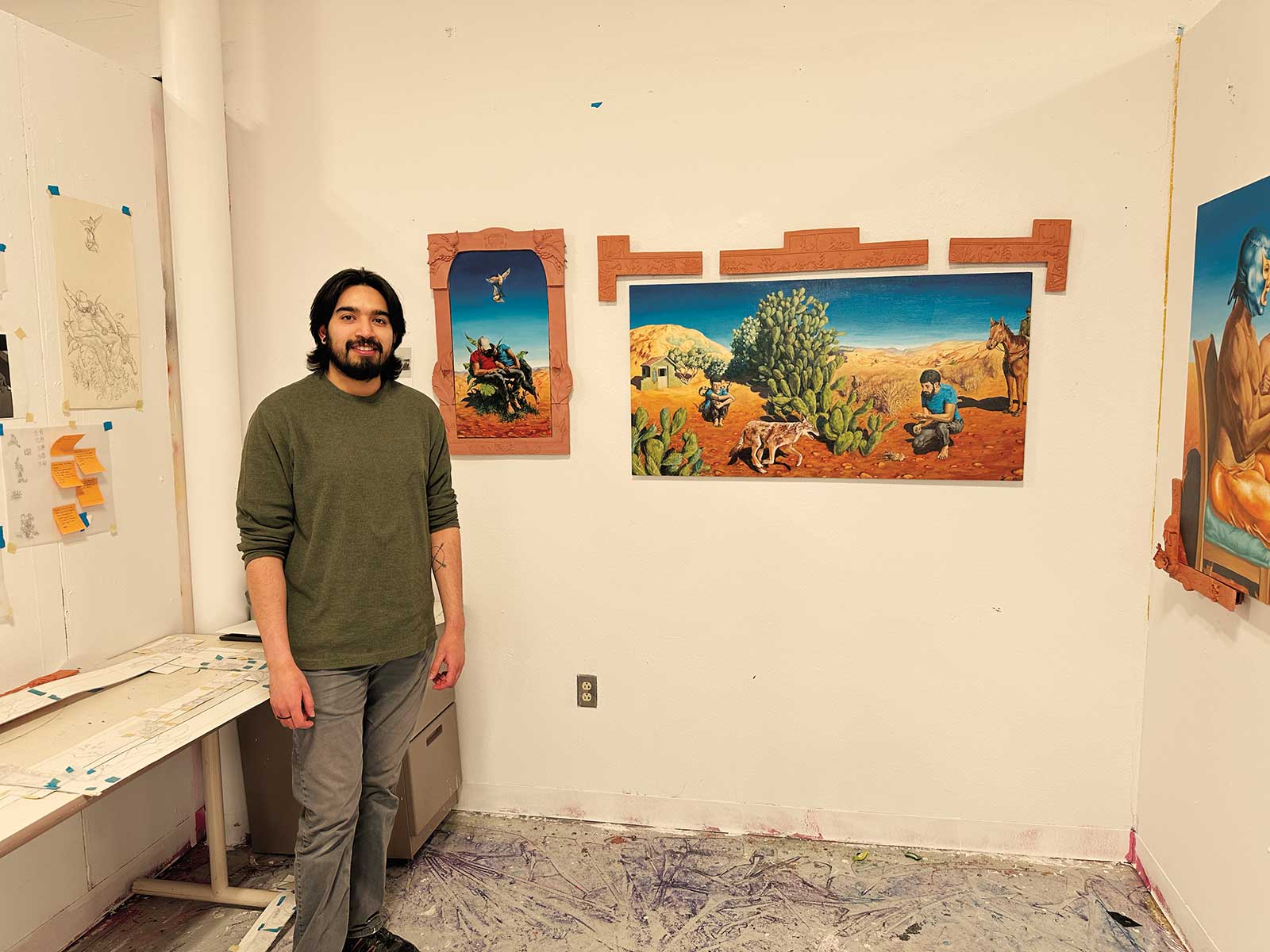
Jesus Miguel Avena in his studio.
Referring to his own duality of being both Mexican and American, he brings in aspects of Mesoamerican duality/dichotomy. The Aztec words for fire and water, for instance, when combined, become the word for war, the two words representing a life force but when combined, it represents destruction.
On the ceramic frame is a representation of the Aztec Earth Lady, Tlaltecuhtli. In the Aztec creation story, the gods Quetzalcoatl and Tezcatlipoca, who took the form of snakes, battle with Tlaltecuhtli, tearing her in half—her lower body becoming the earth and her upper body, the sky.
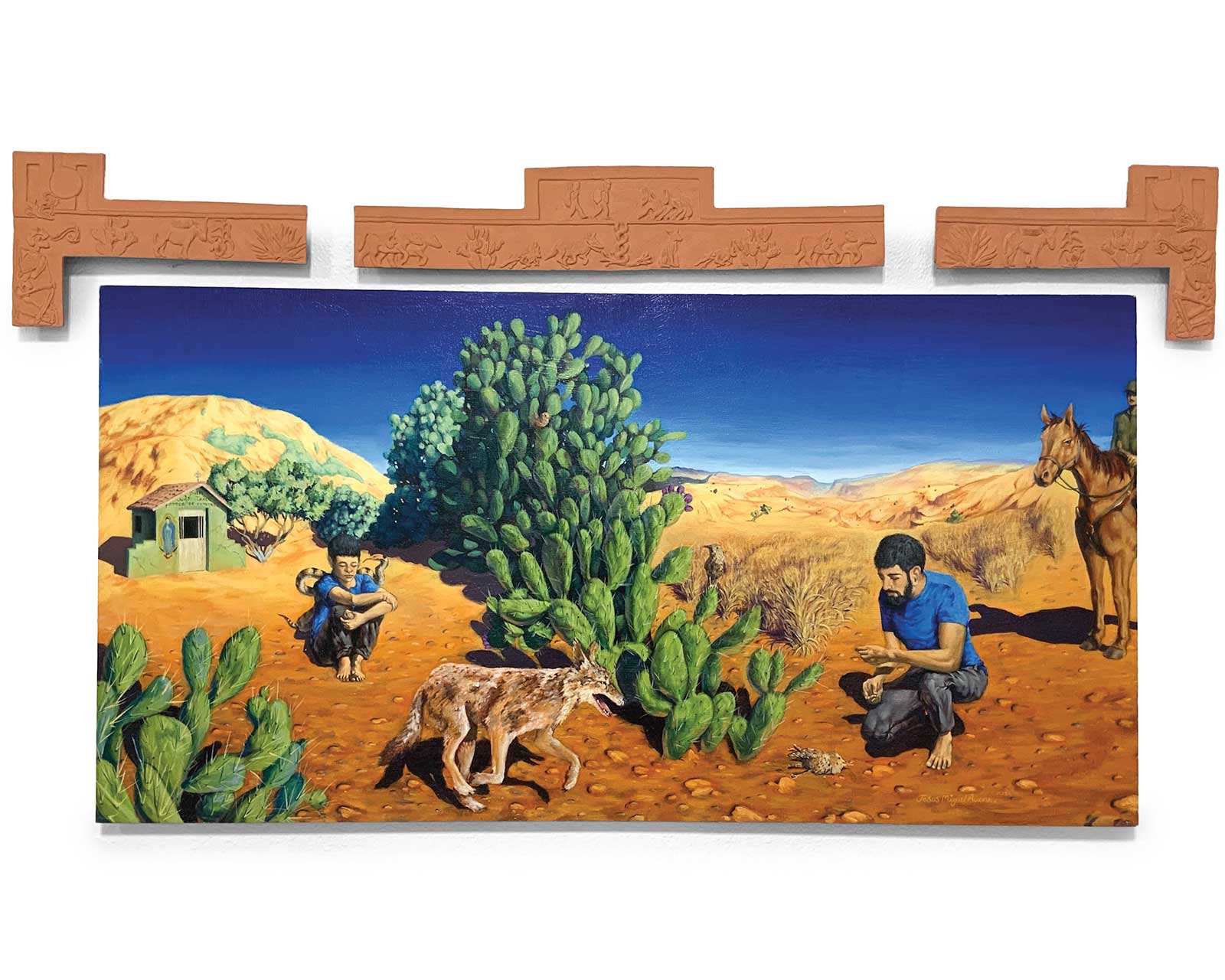
Jesus Miguel Avena, Tu puedes ser un coyote, mi hijo (You Can be a Coyote, my Son), 2023, oil on panel with ceramic red earthenware frame, 31¼ x 55”
A snake also figures in his painting Tu puedes ser un coyote, mi hijo (You can be a Coyote, my Son) in which Avena appears as a young man and as his older self. Borrowing from Mediterranean mythology, he has the serpent recall Cassandra whose was able to hear the future after a serpent licked her ear. Cursed by Apollo, her fate was that her prophecies would not be believed.
The older self advises his younger self in the title of the painting and in the presence of a coyote—a term used for those who smuggle people across the border. Young Avena sees that “the border situation is like a hopeless cause. It’s like you’re screaming out into the wind.” Behind him is an ubiquitous Mexican rural chapel dedicated to St. Jude, the patron of hopeless causes.
In the center, a large cactus is in the shape of Mexico before it ceded lands to the United States. In the distance, the cactus becomes the border wall.
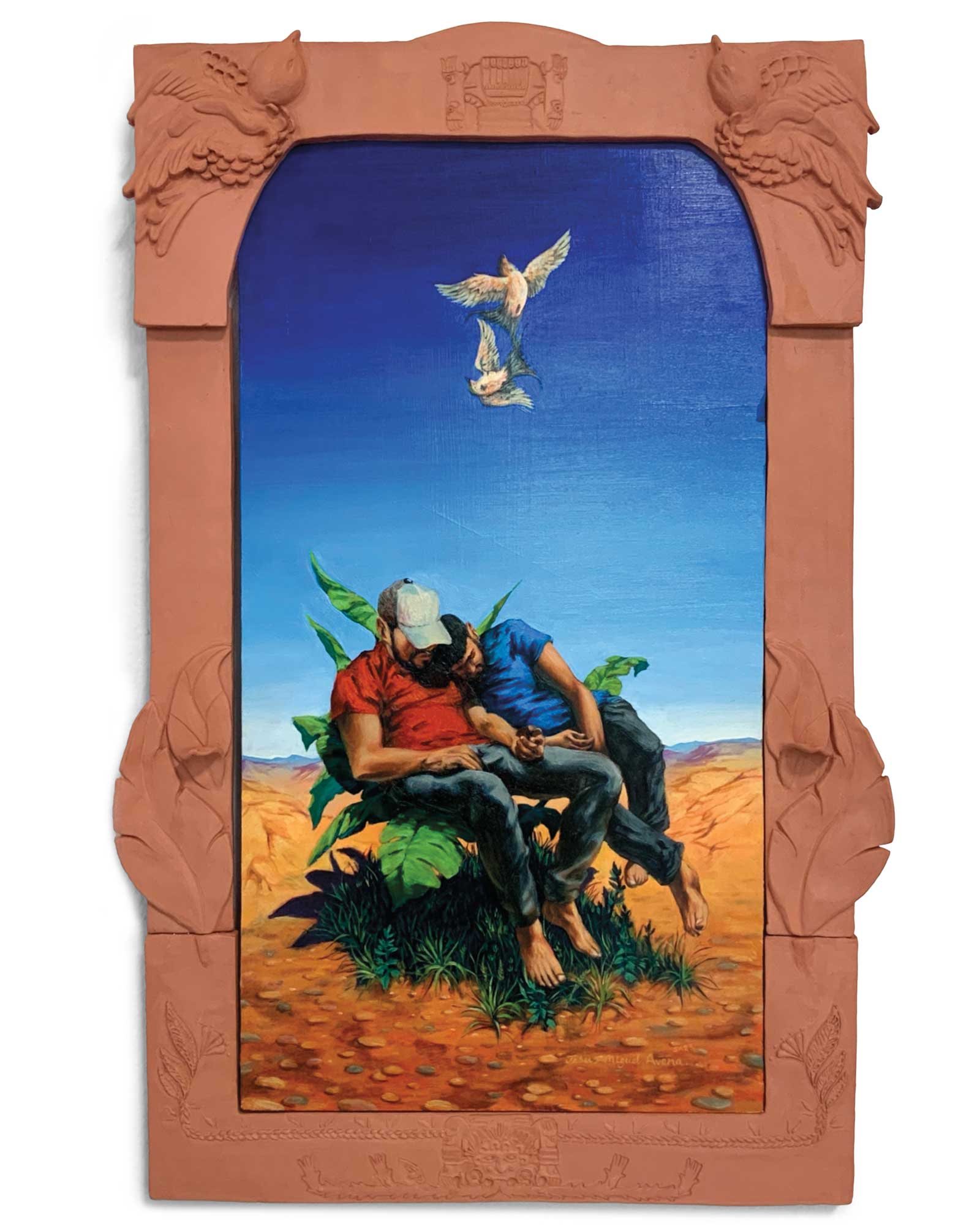
Jesus Miquel Avena, De otros colores, seya la media naranja (Of Other Colors, be the Better Half), 2023, oil on panel with ceramic red earthenware frame, 29 x 191/8”
He says, “My portrait and figurative paintings explore human embodiment, contrary to the human condition in personifying the internal dialogues on race, culture and sexuality. Ceramic components amplify thematic ideas of historical and cultural aspects of the Chicano/a/x life and aesthetics. Amalgamating earthenware material with figurative paintings represents my mixed cultural lineage and animates my psychological landscape. My consciousness incorporates the transformative concept of Nepantla as a space of ‘in-betweenness.’”
Nathan Mellot is a peripatetic artist dipping into cultures around the world. He says, “I paint to express what I haven’t seen elsewhere. There has been a lot of experimentation but through it runs an intention to share beauty as opposed to nihilism.”
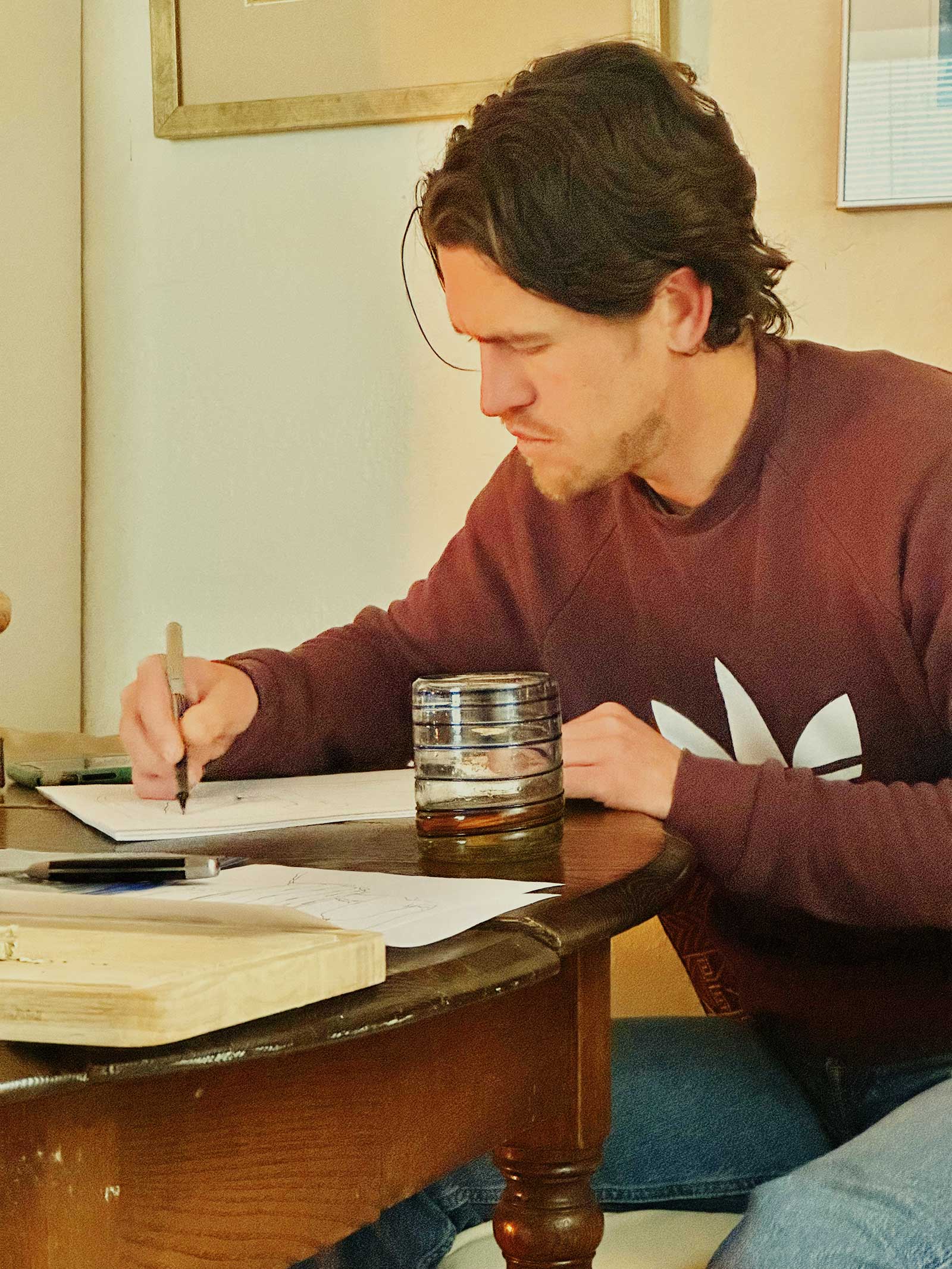
Nathan Mellott sketches ideas for future paintings.
He explains, “My painting Sunset Blvd is a portrait of a place. The people are invented as representative of its moods. This was the tenants’ pool for the hotel where I lived in West Hollywood. It was luxurious, libertine and listless. It was somewhat alien but sun-soaked and beautiful.
“Northern New Mexico has influenced my figures and the space they inhabit, both interiors and exteriors, inventions and paintings from life,” he continues. “With Sunset Blvd, the standing figure is monolithic, the other relaxed, both inhabiting deep-time. This is a tie to New Mexico.
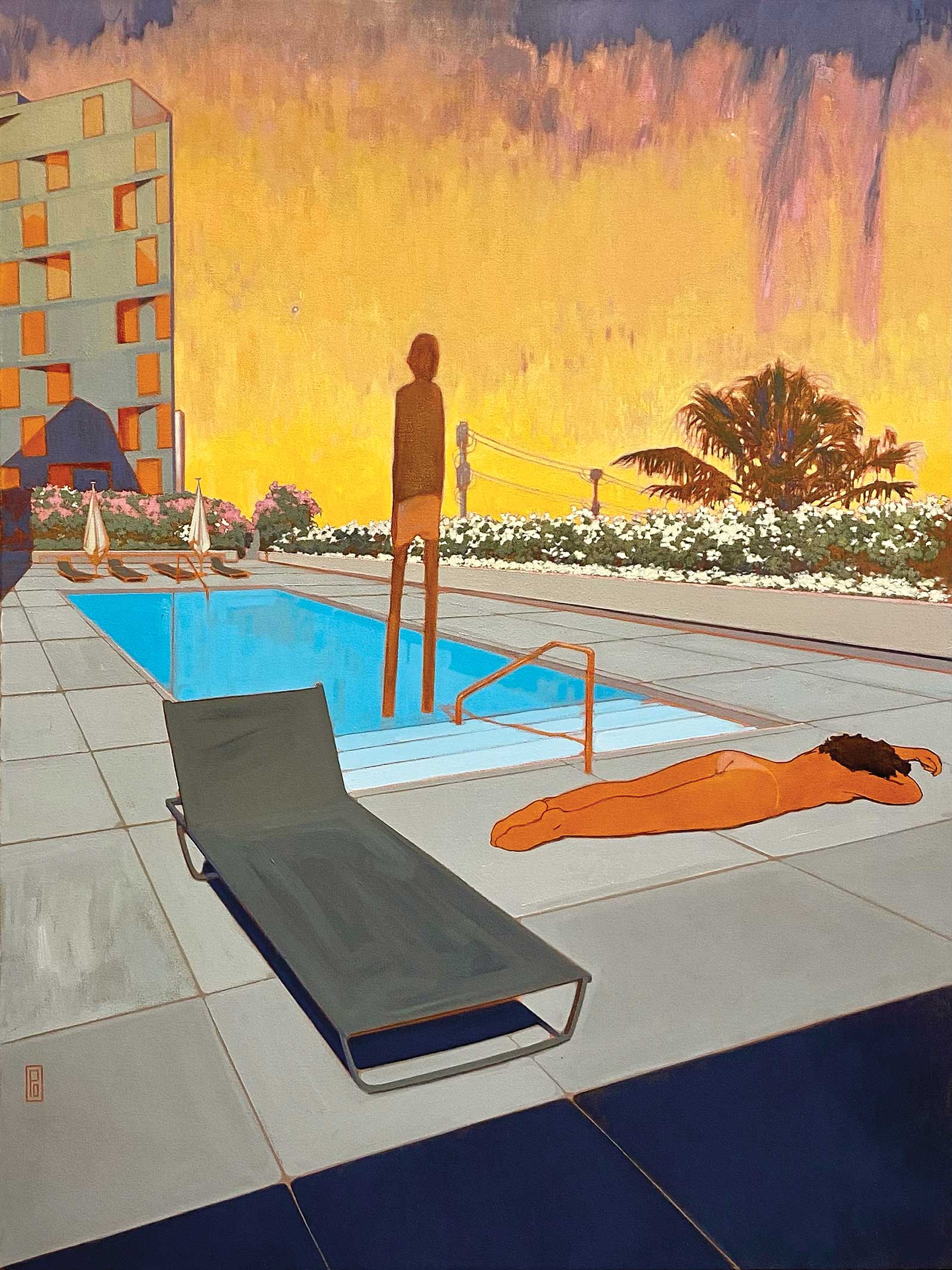
Nathan Mellott, Sunset Blvd, oil on canvas, 48 x 36”
Some consider New Mexico the center of the world. Here there is a conjunction of ancient and modern themes: nuclear power and pre-Columbian nations; godlike scientific ambitions in our labs and institutions, the country’s oldest “living” cultures, and petroglyphs by those forgotten; militancy, shamanism, poverty, and luxury abound - humble humans and their celestial aims.
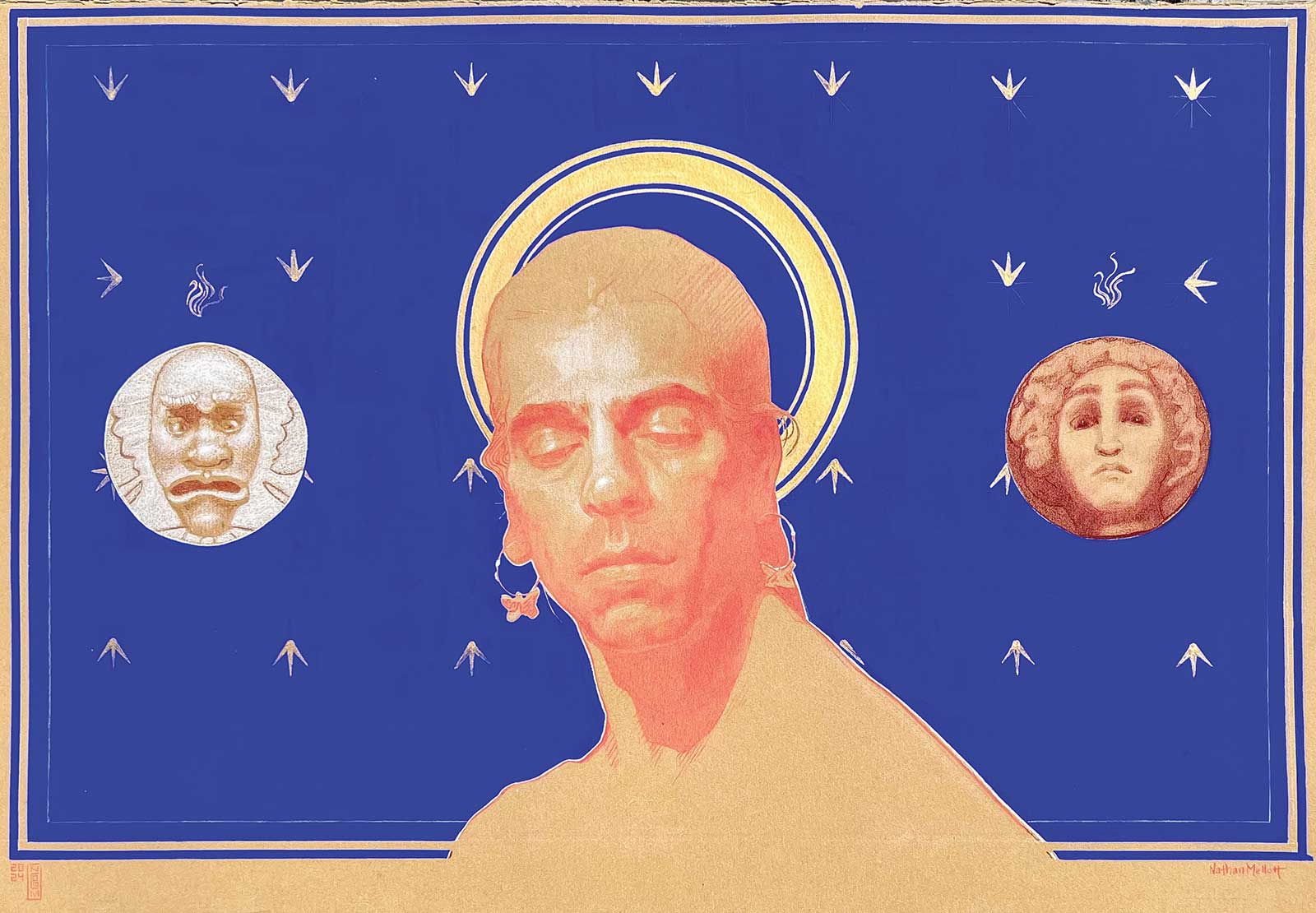
Nathan Mellott, Raven (Chiricahua Apache) with two Theatre Masks, 2024, pastel and watercolor on paper, 15 x 21”
Mellot has known Raven over the years and recently produced a new portrait. “Raven’s portrait began to take shape after capturing his expression, it conveyed strength and humility well,” he says. “I wanted to present this nobility of character as mythic or as an honor to his inner god. Raven (Chiricahua Apache) is a popular model in Santa Fe with a strong personality. For artists, he welcomes their plurality of observations—and he is reliable. His portraits, like New Mexico, are a crossroads of ideas. In mine, the halo and comets elevate his standing while the theatre masks represent complexity of the inner life. These motifs I carried away from another timeless place—Italy. They were inspired by a fresco in Bari, a marble letterbox in Carrara, a statue in Rome and a painting in Florence.”
John Hayduk hails from Connecticut where he developed an early interest in painting the figure. “I knew I loved realism,” he says, “The human body has always fascinated me, especially since I was a personal trainer. I knew I wanted to do figurative work.” He discovered the Academy of Realist Art Boston which introduced him to the 19th-century atelier system of the French academies. While at the academy he heard of Tony Ryder and the Ryder Studio in Santa Fe and one of its instructors, M. Tobias (Toby) Hall.
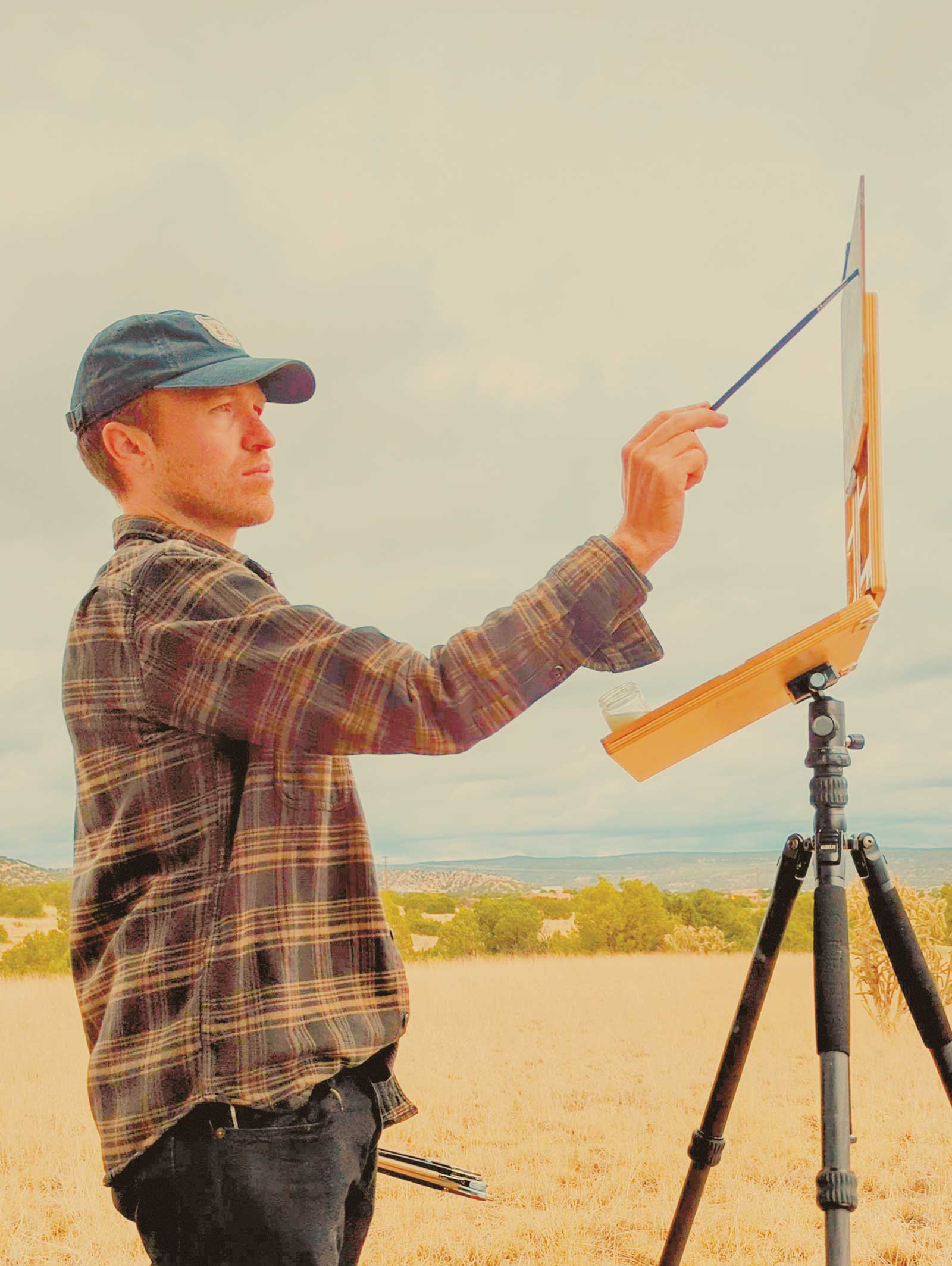
John Hayduk paints en plen air.
Six years ago he packed up his car and drove to Santa Fe, thinking he’d stay for a few months. “I was very lucky with the people I met and just instantly had this art community that’s been a huge part of me staying out here,” he says “He studied at The Ryder Studio for two years and then attended part time. Recently he has been painting with Toby Hall, transitioning gradually into plein air landscape paintings.
Ten years, ago, however, he was diagnosed with a non-specific motor neuron disease which brought the possibility of his being in a wheelchair and living only for a few more years. The experts he consults, notably at Duke University, now say more simply that “something’s wrong with your muscles” and the disease is progressing very slowly.
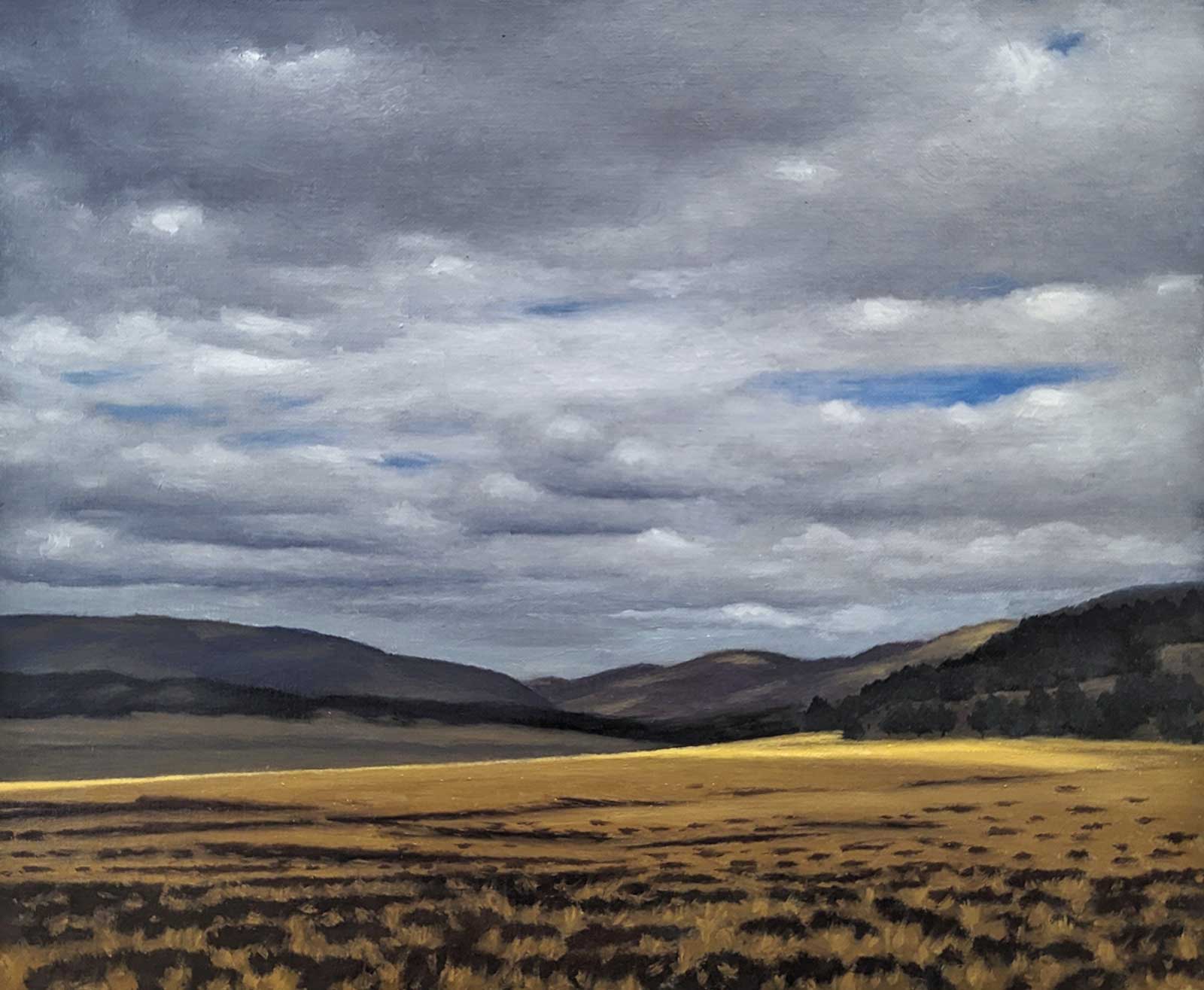
John Hayduk, Valles Caldera 2, 2024, oil on panel, 10 x 12”
He does have periodic tremors in his hands but he has learned to use the tools of his trade to continue to paint. Painters use a mahl stick with a padded end to support their hand and brush. Hayduk has brought it to further use by grasping it to have more control when he’s experiencing tremors.
He has begun a series of memento mori drawings, from the Latin “remember, you must die,” with healthy figures standing with their arms crossed as if laid in a coffin. “The aspect of the healthy body comes from an outside perspective,” he explains. “Throughout the day, nobody would think that anything was happening to me or that I was facing and thinking about this sort of thing.
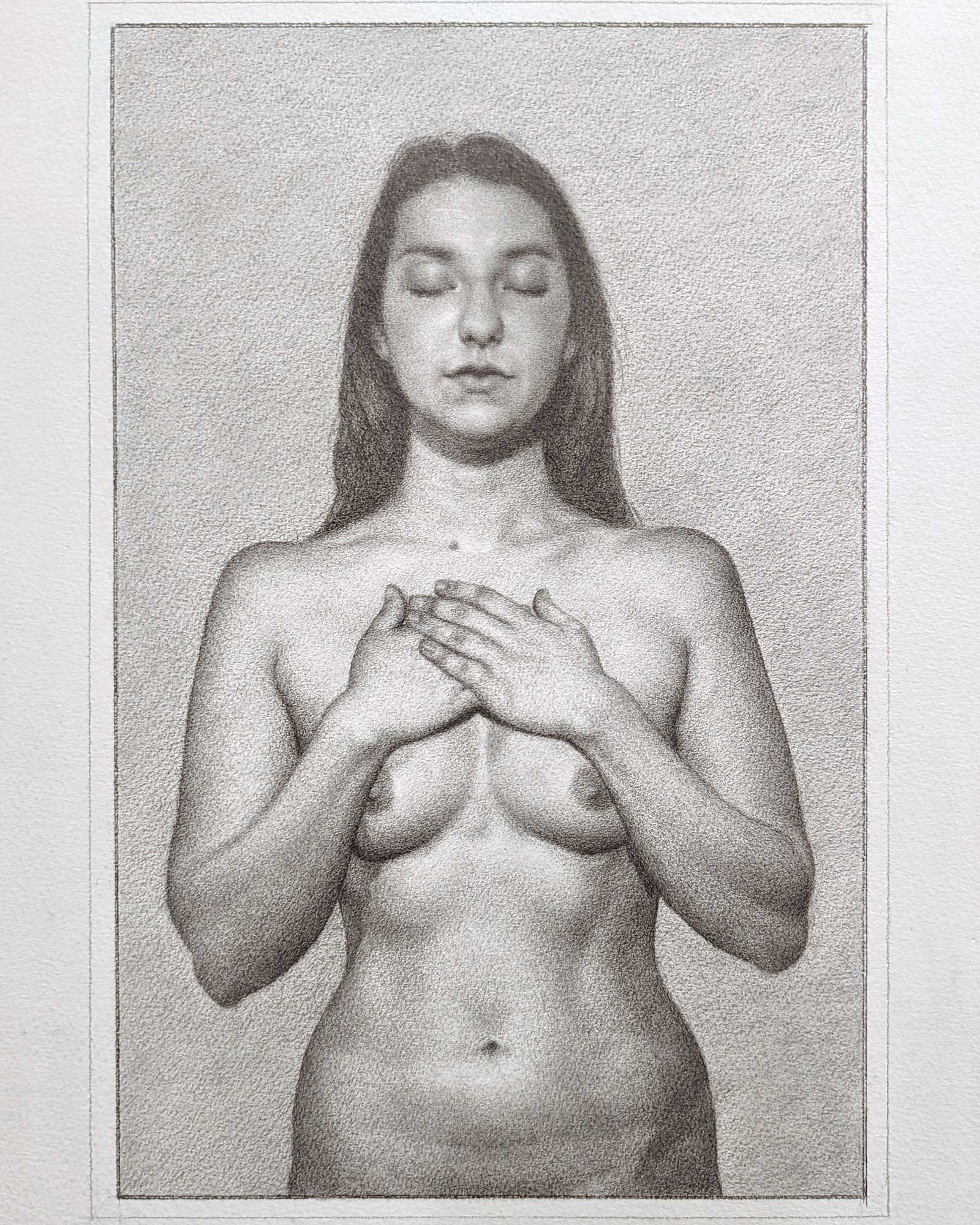
John Hayduck, Memento Mori 2, pencil on paper, 12 x 10”
“My Memento Mori series focuses on the idea of facing one’s mortality but I have been thinking about why I have become so drawn in by landscape painting and what the connection is there. Life and death is constantly surrounding us; death seems to come slowly from the human viewpoint until it is standing right in front of us. Being immersed in a landscape and the changing seasons allows us to see the coming and going of life and death at different rates. I can paint in one spot all year and see life, death and rebirth. Spring brings fresh buds and new life while winter sees the last leaves fall and the color drain from the plant life. Both are uniquely beautiful but there is something special in the darkness of winter to me. There is hope in knowing that new life is to come and the lack of color in the landscape brings the focus to the beautifully cool light of the winter sun. Landscape painting for me isn’t as simple as capturing nature’s beauty, it’s a meditation on life and death and seeing the beauty in both.
His recent painting Valles Caldera 2 depicts a meadow and mountains in the Jemez mountains formed by a cataclysmic volcanic eruption. A slash of sunlight shines through the overcast, bringing life and hope. —
Powered by Froala Editor