

Esteemed American painter and sculptor, Audrey Flack, ushered in her 90s not by sitting poolside, but by making vibrant new paintings and sculptures responding to the world. Hollis Taggart hosts a spellbinding exhibition of Flack’s recent work, beginning March 23 and running throughout April. The exhibition coincides with the publication of an illustrated memoir by the artist.
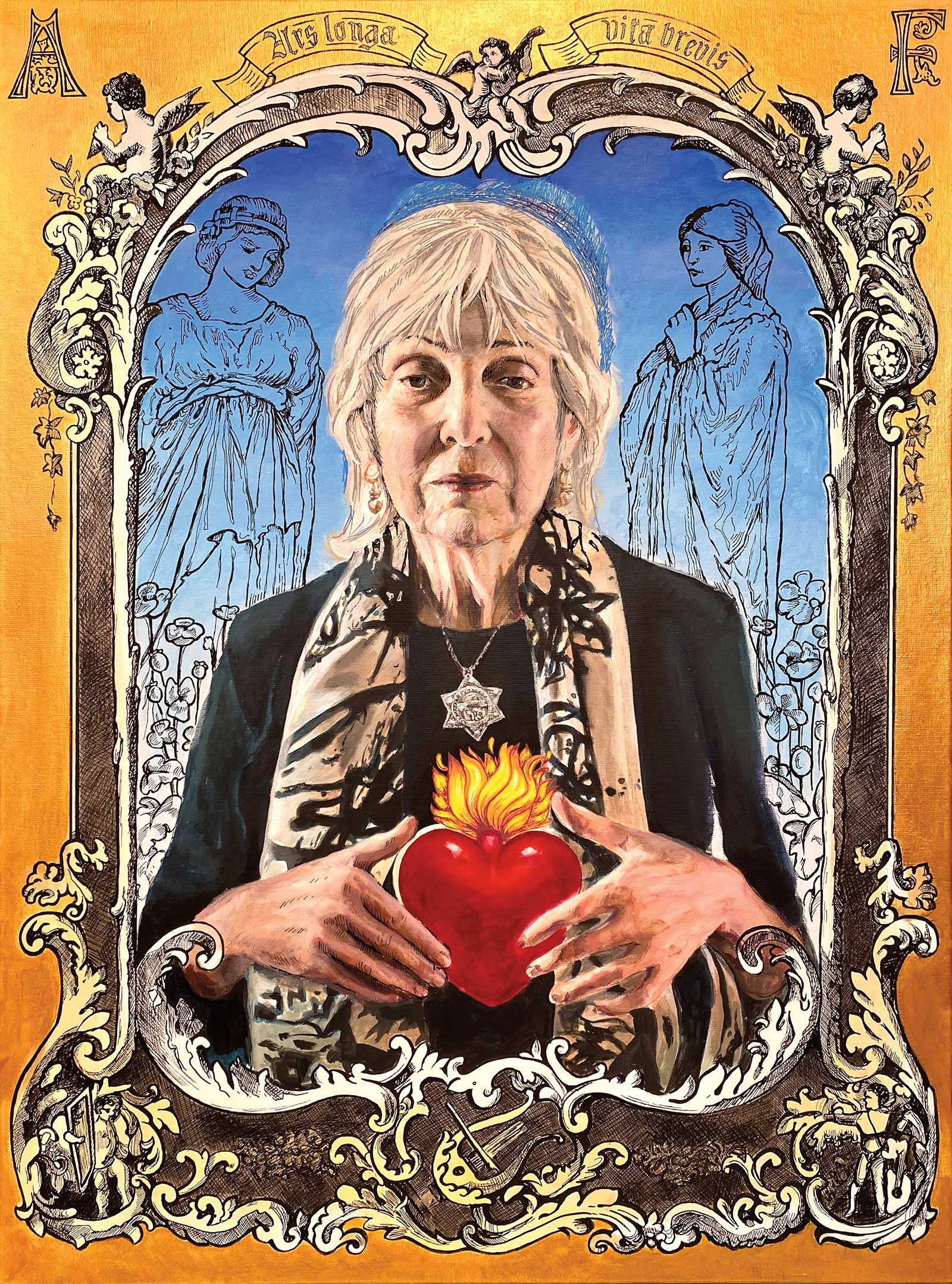
Untitled (Self Portrait as Mary with Flaming Heart), 2022, acrylic and mixed media on canvas, 40 x 30”
For more than 60 years, Flack has been constantly curious, mastering new forms and media, and pushing herself to innovate and respond to the current moment. She does all of this while maintaining her own voice and offering hope, delight and inspiration.
Her gallerist, Hollis Taggart, notes that “Audrey not only continues to perform at a high level of technical proficiency in her 90s, but also her creative juices are remarkable as well.”
Taggart continues, “Her newest body of work shows her virtuosity and technical skills as a draftsman and figurative painter, skills that harken back to the 1970s when she became famous as one of the original photorealists. For her to paint at this high level, at her advanced age, and to cook up this new imagery filled with wonder and symbolism, is unprecedented.”
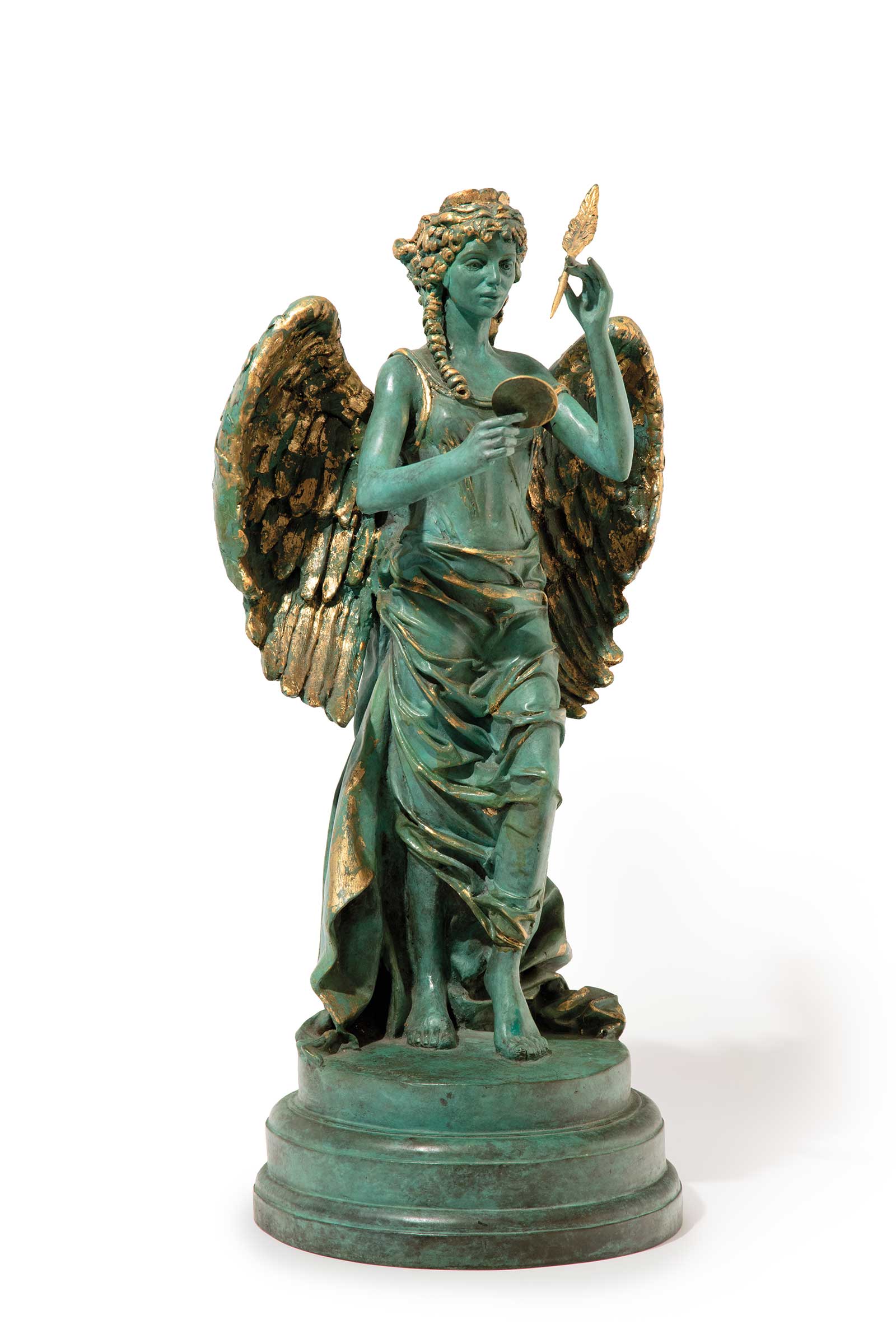
Recording Angel: Handmade Reduction, 2006, polychromed bronze, 20”
Flack first became known in the art world in the 1950s with her abstract expressionist paintings. She rubbed shoulders with important abstract expressionists like Franz Kline, Jackson Pollock and Willem de Kooning, as well as key female painters such as Grace Hartigan, Elaine de Kooning, Joan Mitchell and Lee Krasner.
Flack’s passion soon turned to photorealism and that is where she gained tremendous prominence. She was heralded alongside Richard Estes, Chuck Close, Ralph Goings and John Baeder, as one of the preeminent American photorealists of the 1960s and 1970s. The Museum of Modern Art notes that Flack’s photorealistic paintings were the first such paintings to be purchased for its permanent collection. Her work is also in the permanent collections of the Metropolitan Museum of Art, Solomon R. Guggenheim Museum, Whitney Museum of American Art, National Museum of Women in the Arts and others. Flack is an honorary vice president of the National Association of Women Artists and holds an honorary doctor of fine arts degree from Clark University.
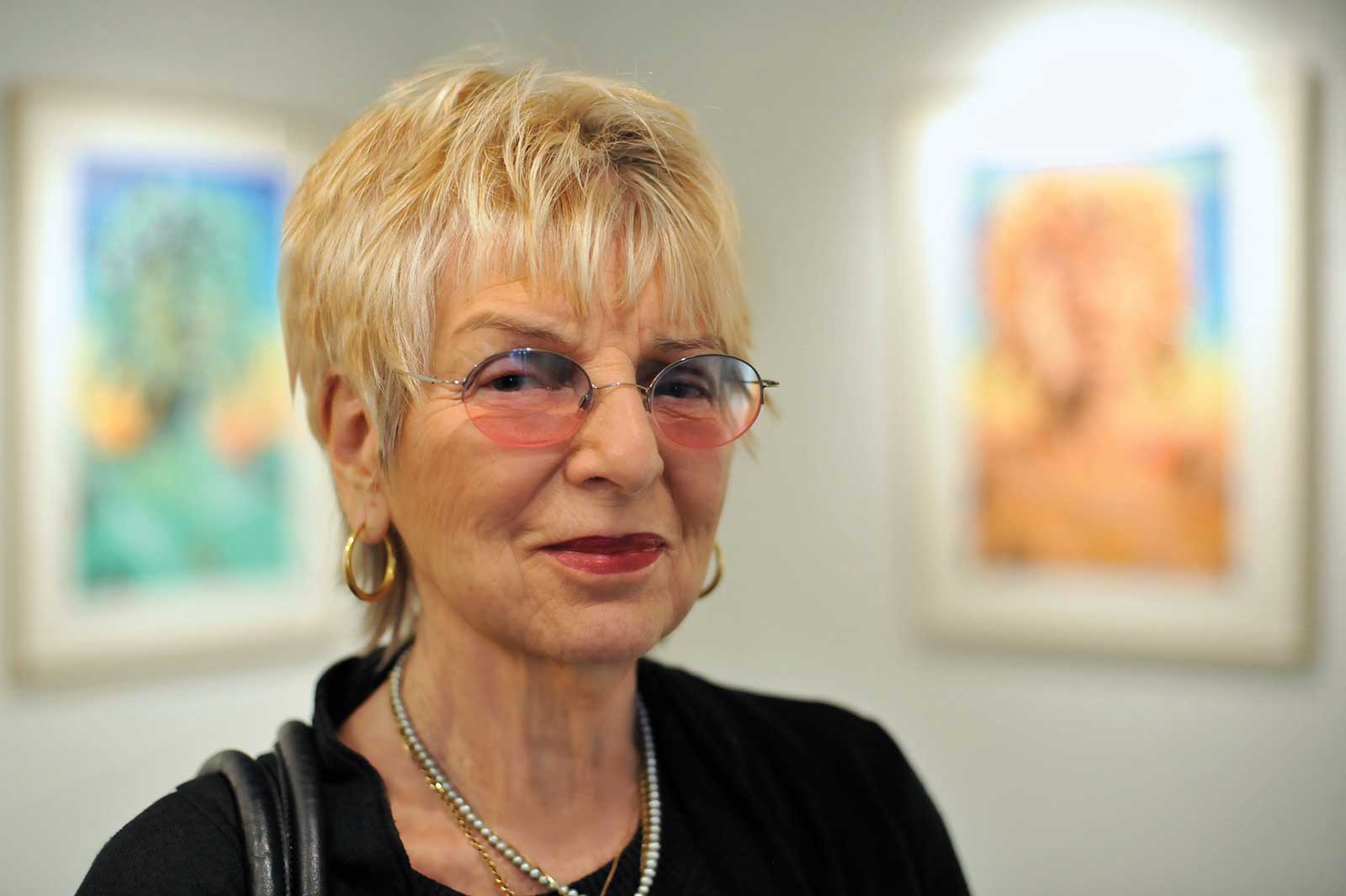
Arist Audrey Flack. Photo credit: Nancy Bundt.
All art images courtesy of Hollis Taggart and the artist
Flack’s photorealism was distinctly feminine: vanity tables overflowing with lipsticks, pearls, perfume bottles. Or trays of teas, luscious cakes and candies. Her choice of what to paint put her out of step with some of her feminist peers at the time. “A large part of the group [of feminist artists] felt that works that had elements of ‘femininity’ such as perfume bottles, lipsticks, etcetera, were verboten,” Flack says. “So I did not fit into an officially feminist art category, as it was in those days.”
However, she did and does share the revolutionary spirit of feminist artists. “I was involved in the very first stages of the feminist art movement,” she says. “Many of my colleagues exclusively created work on the subjects of feminism. A lot of this art tended to express the anger, hurt feelings and frustration of male dominance of the times. While I share many of these feelings, my work was not exclusively about that.”
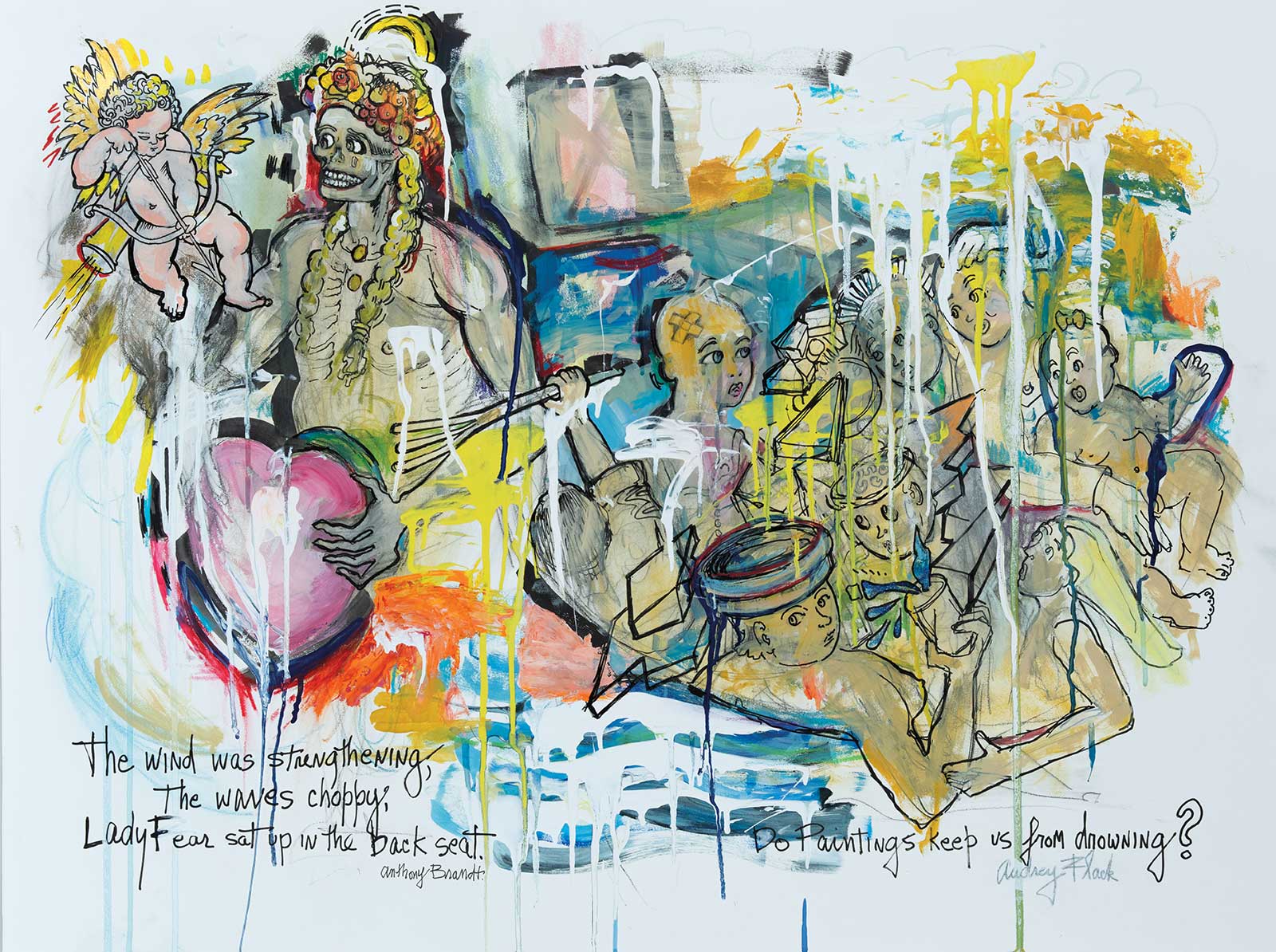
Untitled, 2020, acrylic and mixed media on paper, 40 x 30”
In recent videos and interviews, Flack proudly dons a fuchsia sweatshirt emblazoned with “Feminist AF.” The play on words with her initials and the contemporary expletive exemplifies her playful yet defiant attitude. She says she hopes her work “has been in support of feminism and feminist art through the decades, and has helped expand the definition.”
By choosing items associated with domesticity to paint, Flack was, in fact, injecting a kind of feminist thread into the male-dominated art world, where cars and buildings and billboards were favored subjects of male photorealists. But her talent lies as much in her technical skills as her composition. As art historian Robert C. Morgan noted in a 2010 article in the Brooklyn Rail, “[Flack] is less interested in confusing truth with illusion than in capturing the integral truth of seeing. The surface of a painting is a place of hyper-visual indulgence for the viewer to penetrate and optically swim through. The miraculous truth of seeing exists not apart from painterliness but within the very depths of its structure.”
Flack moved away from photorealism in the 1990s and began making sculptures, a medium she still works with today. Notable public commissions include four 24-foot-tall bronze figures that comprise the Monumental Gateway to the City of Rock Hill in South Carolina; the 15-foot Veritas et Justitia figure of Justice for the Thirteenth Judicial Courthouse in Tampa, Florida; and Islandia, a 9-foot bronze for the New York City Technical College in Brooklyn, New York.
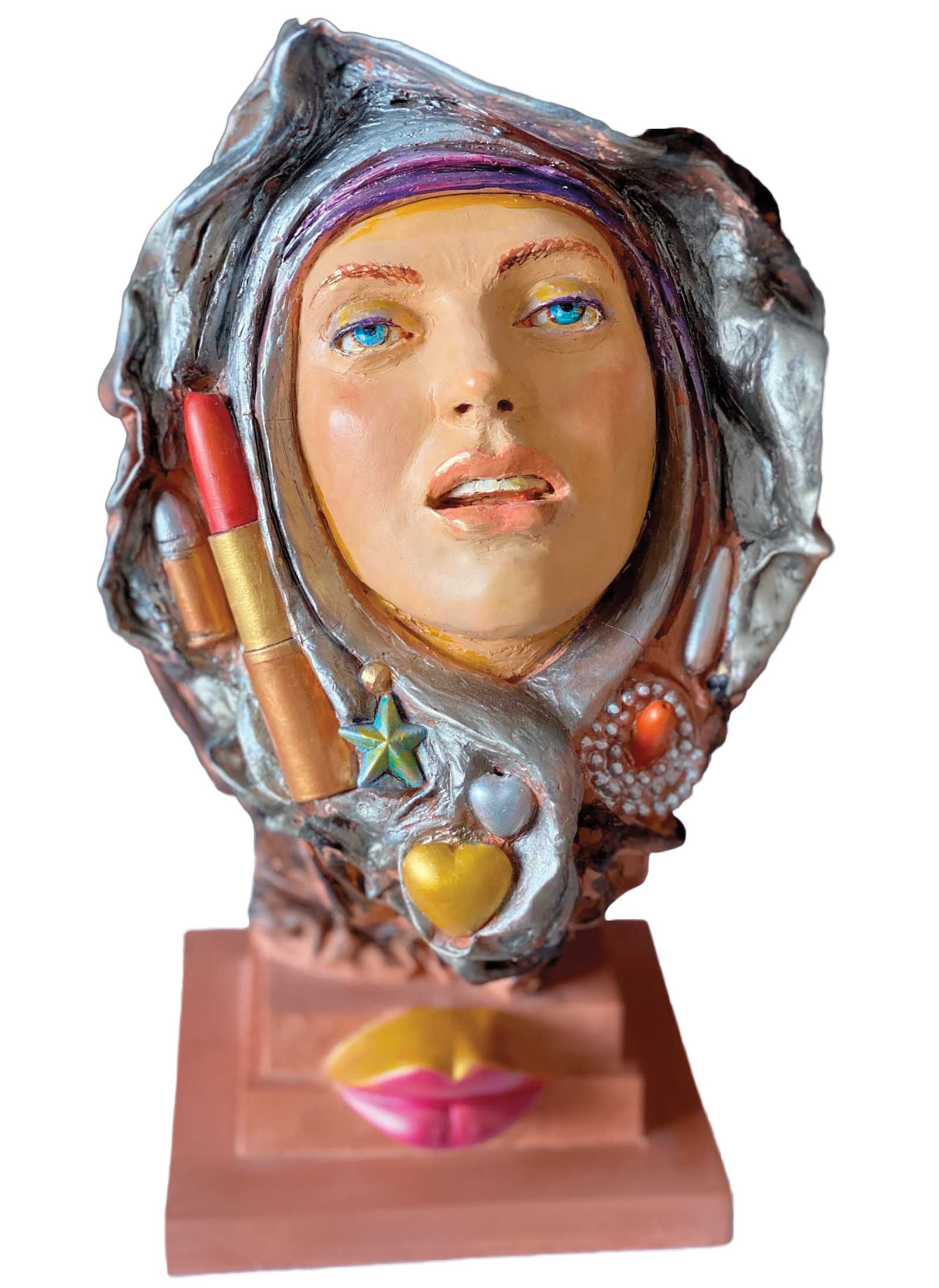
Head of Saint Theresa, 2010, polychromed Forton, 12”
The exhibition at Hollis Taggart features a number of Flack’s smaller-scale sculptures. Head of Saint Theresa, 2010, echoes the motifs of Flack’s photorealist work. Here, the saint is presented as a lustful woman adorned with lipstick and baubles. Also, beware the bullet cleverly installed alongside a lipstick tube—this seductress may be dangerous. Flack is commenting on the famous 16th-century sculptural tableau by Gian Lorenzo Bernini, Ecstasy of Saint Teresa, which has sparked controversy through the ages for its depiction of a saint’s religious ecstasy that looks a lot like physical orgasm.
Many of Flack’s sculptures are of female goddesses and saints. In the diminutive Victory (Gaia, Earthmother) with Bullet-moon, 1990, Flack uses some of her recurrent motifs such as a bullet and baubles and jewels. Close observation reveals a naked baby doll, toy soldiers, an open-mouthed shark. The sculpture is a puzzle. Is it meant to reference the ancient sculpture, Winged Victory of Samothrace, featuring the Greek goddess Nike? The title suggests the figure is Mother Earth, but elements of the sea are also present. Is there a hint of Venus here? Is that a crystal ball in the goddess’s hands?
Flack has an abiding interest in Renaissance and Baroque art. Her newest paintings pair figures from antiquity with contemporary superheroes and cartoon figures. Taggart says Flack’s superheroes are symbols. “They represent the highest aspirations of humanity,” he says. “They are not literally Superman or Superwoman. They represent the ideals and reflect the highest potential that we all possess as human beings.”

Untitled (Jesus), 2022, acrylic and mixed media on canvas, 42½ x 35”
Flack even casts herself as a saint in the painting (Untitled) Self Portrait as Mary with Flaming Heart. Dressed simply and wearing a Star of David pendant, the figure holds a glowing heart in front of her chest, symbolizing the powerful Christian image of “The Immaculate Heart of Mary” and reminding viewers that the mother of Jesus was a Jew.
Flack’s recent paintings have been described, fittingly, as “Post-Pop Baroque.” However, Flack’s friend, art historian Art Jones, cautions against reductive definitions. “There is no easy way to fully describe her recent paintings,” he says. “They draw from earlier stylistic eras—beyond just Pop Art and the 17th-century Baroque period—while also presenting something new and unrelated to the past.”
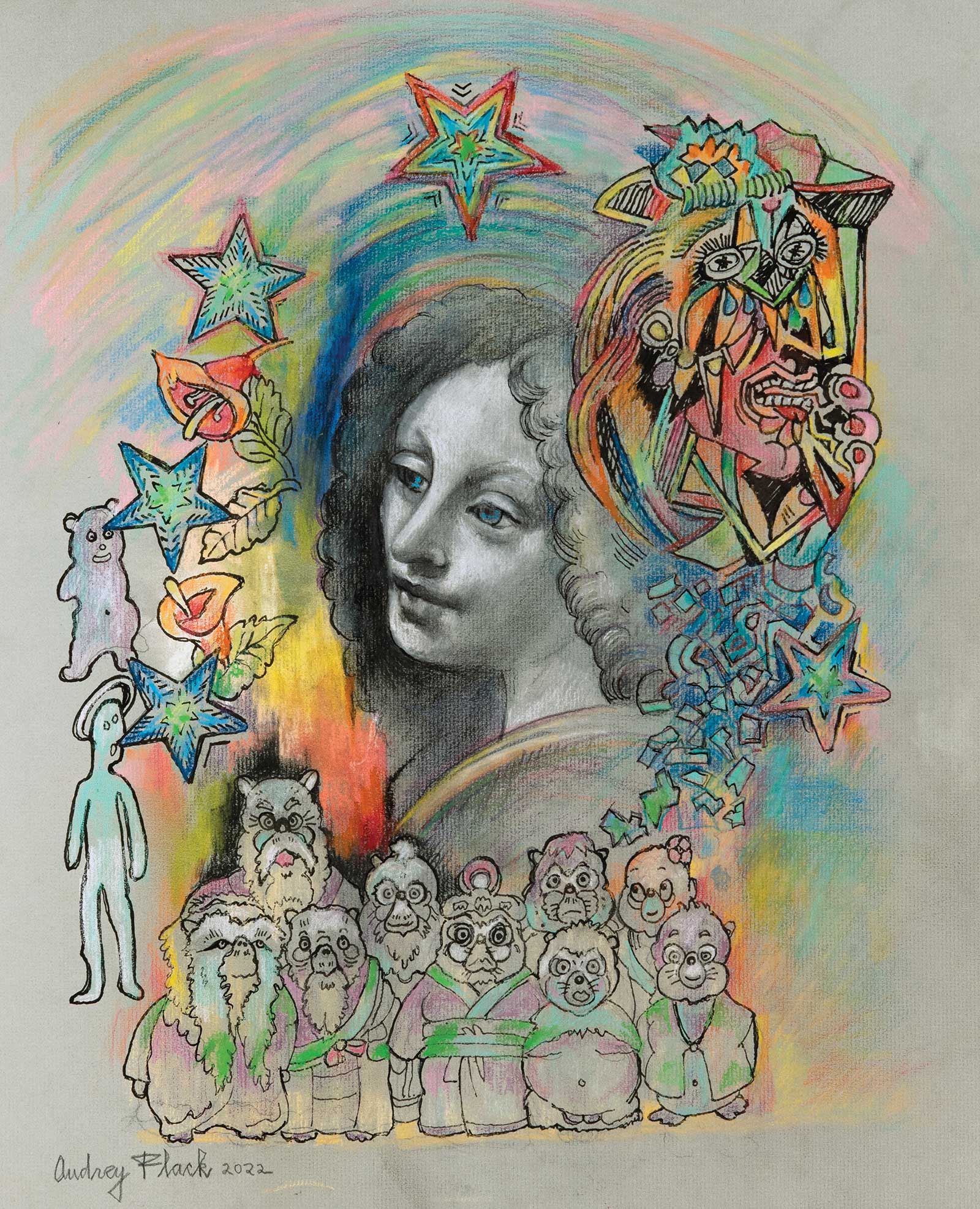
Untitled, 2022, mixed media on paper, 24 x 18”
Jones notes that in With Darkness Comes Stars: Melancholia, Flack uses the device of exploding fragments of rocks to break the picture frame and project illusionistically out of the painting toward the viewer. Flack’s reference to Albrecht Dürer’s 1514 engraving Melencolia I is overt. Instead of symbols of carpentry, however, Flack’s melancholic angel is surrounded by creatures from Disney cartoons. There’s a fire in the eyes of this solemn female figure, and her technicolor hair and surroundings suggest a less depressing outlook than Dürer’s. Indeed the painting’s title says it all. It’s out of the gloom that lights shine bright.
Taggart says that the essence of Flack’s work is spiritual. “Her desire is to aim for a higher calling of mankind, and rise above the pettiness and superficiality of our current times. She is stirring the pot, using her comic book characters as symbols for a more transcendent meaning.”
Jones agrees. “Flack’s Post-Pop heroes attempt to take a stand in regard to such issues and appear as healers of today’s social ills,” he says.
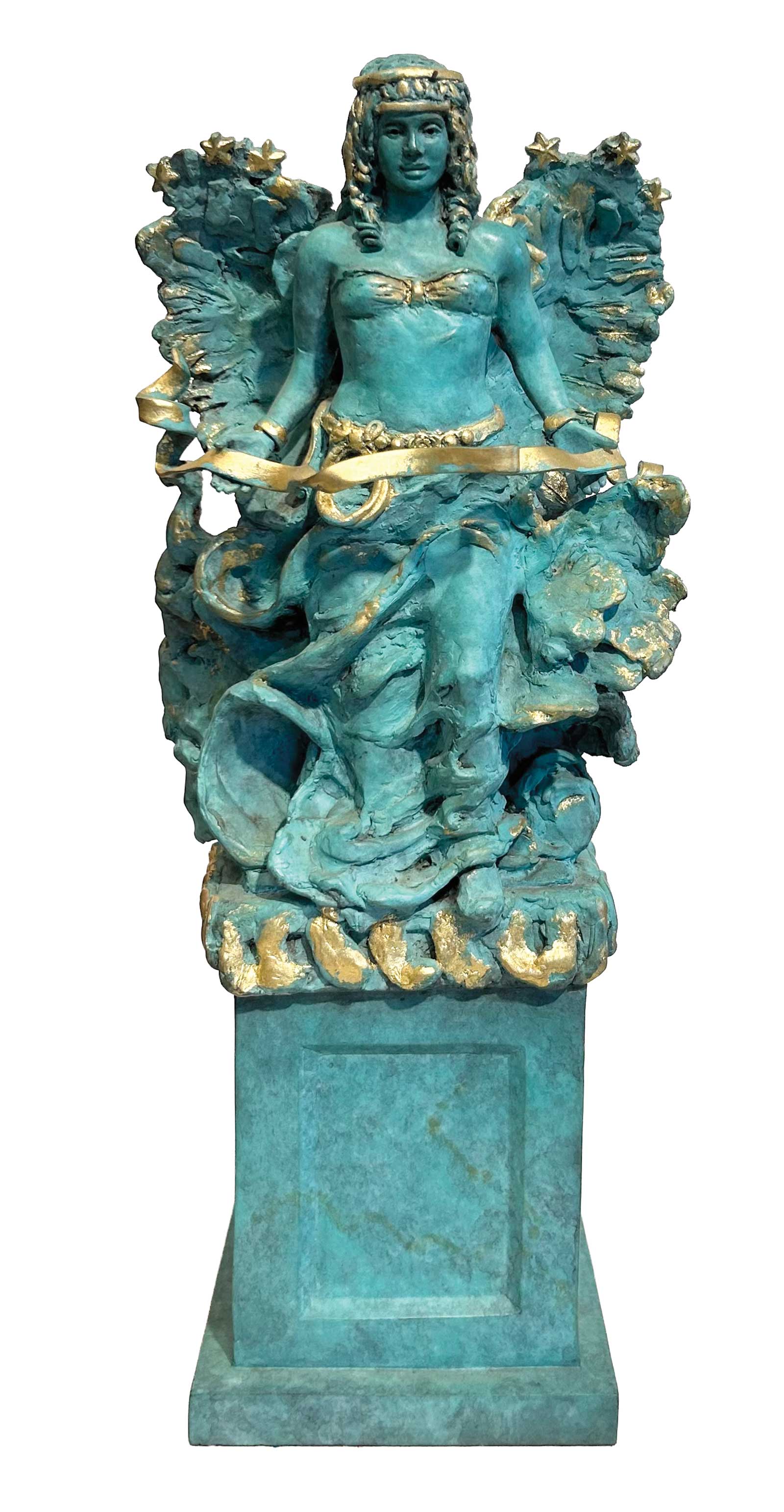
Wonder Woman Angel, 1995, bronze and accouterment, 17”
Not only are her heroes and heroines swooping in to try to save the day. Flack seems to suggest that art itself is a life preserver. A compelling untitled work on paper asks the question, “Do paintings keep us from drowning?” The cartoon-like figures in the painting appear to be on a sea voyage. Another quote states, “The wind was strengthening, the waves choppy, Lady Fear sat up in the back seat.” A figure of death holds a pink heart in front of him, while an avenging cherub aims its arrow. The painting’s potent symbolism seems up for interpretation, but the message seems to invoke fortitude in a storm.
Taggart stresses the timeliness of Flack’s newest work. “The world in chaos needs a new way out of its mess,” he says. “There is so much struggle and suffering in the world and everyone longs for a savior.”
By responding to this longing with images of saints and heroes, Taggart says Flack hopes to inspire. “There is a common thread running through these new works, and this same common thread runs through Audrey’s entire career of over seven decades,” he says. “She wants the viewer to reflect and look inside, to uplift, to improve the human condition. In the end, she is painting to create a better world.”
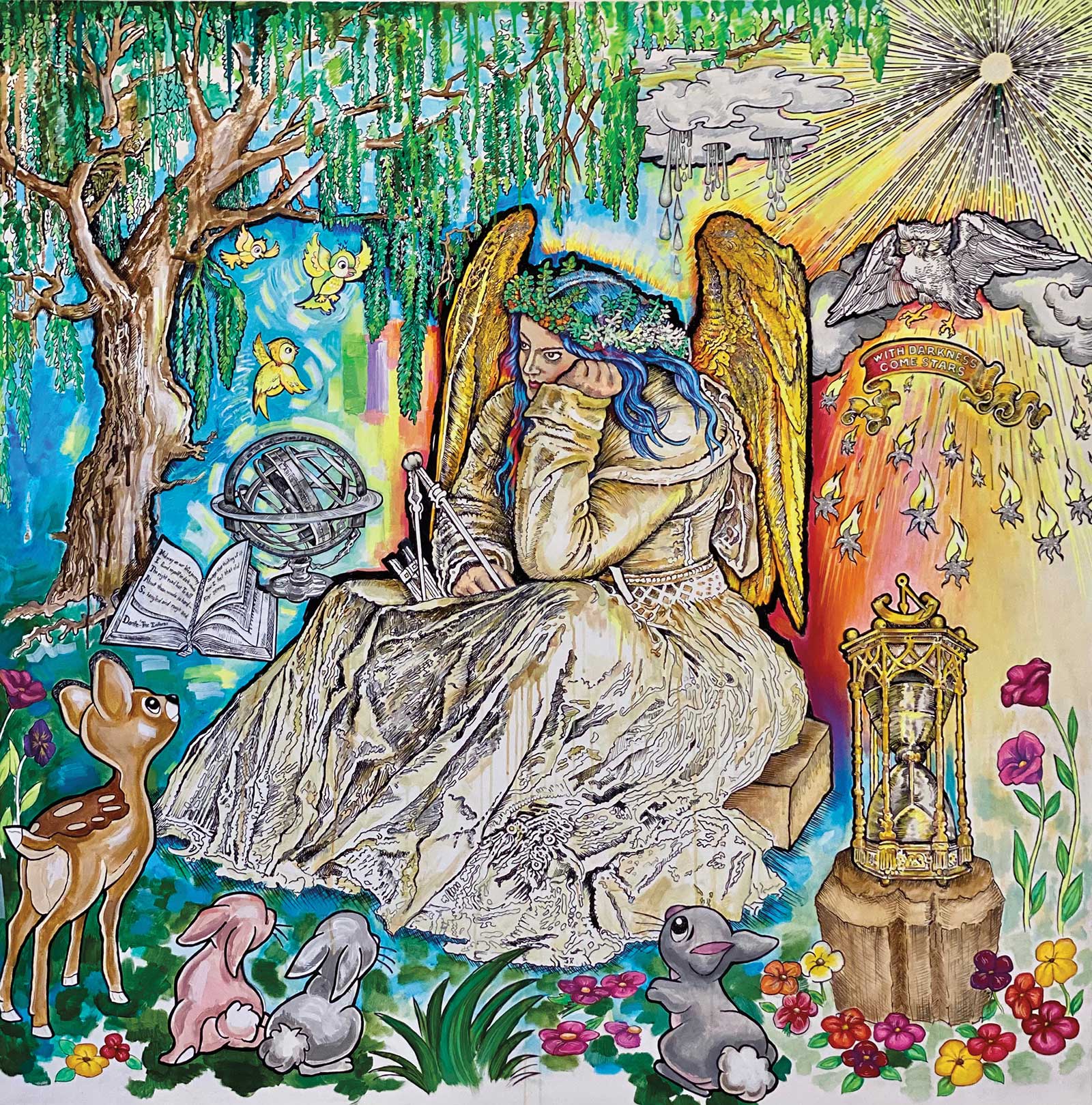
With Darkness Comes Stars: Melancholia, 2021, acrylic and mixed media on canvas, 72 x 72”
The exhibition at Hollis Taggart coincides with the publication of Flack’s new memoir, With Darkness Came Stars. Published by Pennsylvania State University Press, the illustrated memoir vividly traces the artist’s early beginnings, mid-century success, and mature staying power. It also includes plenty of juicy gossip. In an epilogue on “Facing Death at Ninety-Two,” the artist muses poetically on life’s inevitable suffering as well as the abiding possibility of bliss—especially in the face of great art. —
With Darkness Came Stars
March 23-May 1, 2024
Hollis Taggart, 521 W. 26th Street, New York, NY 10001
(212) 628-4000, www.hollistaggart.com
Powered by Froala Editor