
Jamie Adams’ paintings are full of the sensual and androgynous sexuality of the gorgeous movie actress Jean Seberg, bohemian and star of the new wave of French film-making of the 1960s. Seberg’s first film experience was as the lead in an adaptation of George Bernard Shaw’s play about the life of Joan of Arc, who led the French in war against the English. The press loathed the film, and Seberg said the pain she endured from critical reviews caused her more suffering than being burned at the stake.
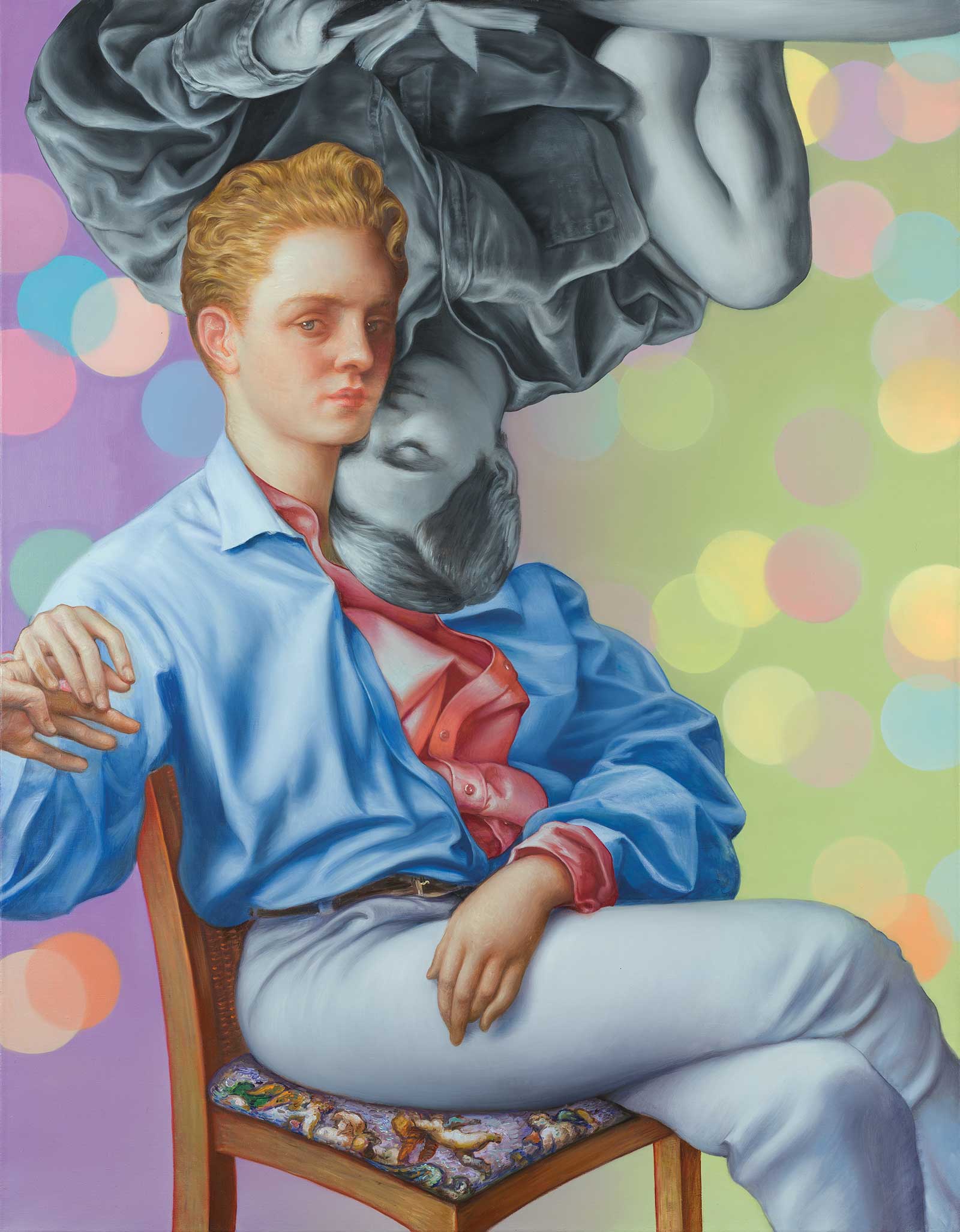
Bubba and Jeannie, 2022, oil on linen, 54 x 42”. Private collection.
Nevertheless, the Catholic martyr’s cropped pixie haircut had framed her beautiful high-boned face in the matte of fame, and the contrast between her natural and erotic sensuality, and the religious austerity of the role, established her as representative of a new kind of movie heroine whose sexual liberation brought independence from patriarchal oppression. Seberg’s first movies were critical failures, but she became an enduring alternative cult figure when she starred in Jean-Luc Godard’s radically experimental and nihilist movie Breathless. Seberg was a legend and icon of 60s free love.
Adams recalled the impact Breathless had upon him at the turn of the millennium, “…it was the car that passed in front of me…I was really struck by the light and the character of Jean Seberg’s apartment. It was ambient, very soft, enveloping kind of light. I thought, ‘this is north-facing light, this is a space I could live in, I could spend some time here.’ I was struck by the subtle greys on Jean-Paul Belmondo’s coat, and the white of the bed linen, the subtle shifts in value.” But at the same moment, he was living in Florence with his wife and daughters, soon after completing a Master’s degree at Pennsylvania Academy of the Fine Arts in Philadelphia, and overwhelmed by the glorious paintings and sculptures surrounding him in the renaissance city. He continues, “I’m struck by the delicacy, the precision, the hard edge of what I was seeing at the Uffizi and other places as Florentine style. I was struck by Michelangelo’s ceiling at the Bargello, in particular Bacchus.”
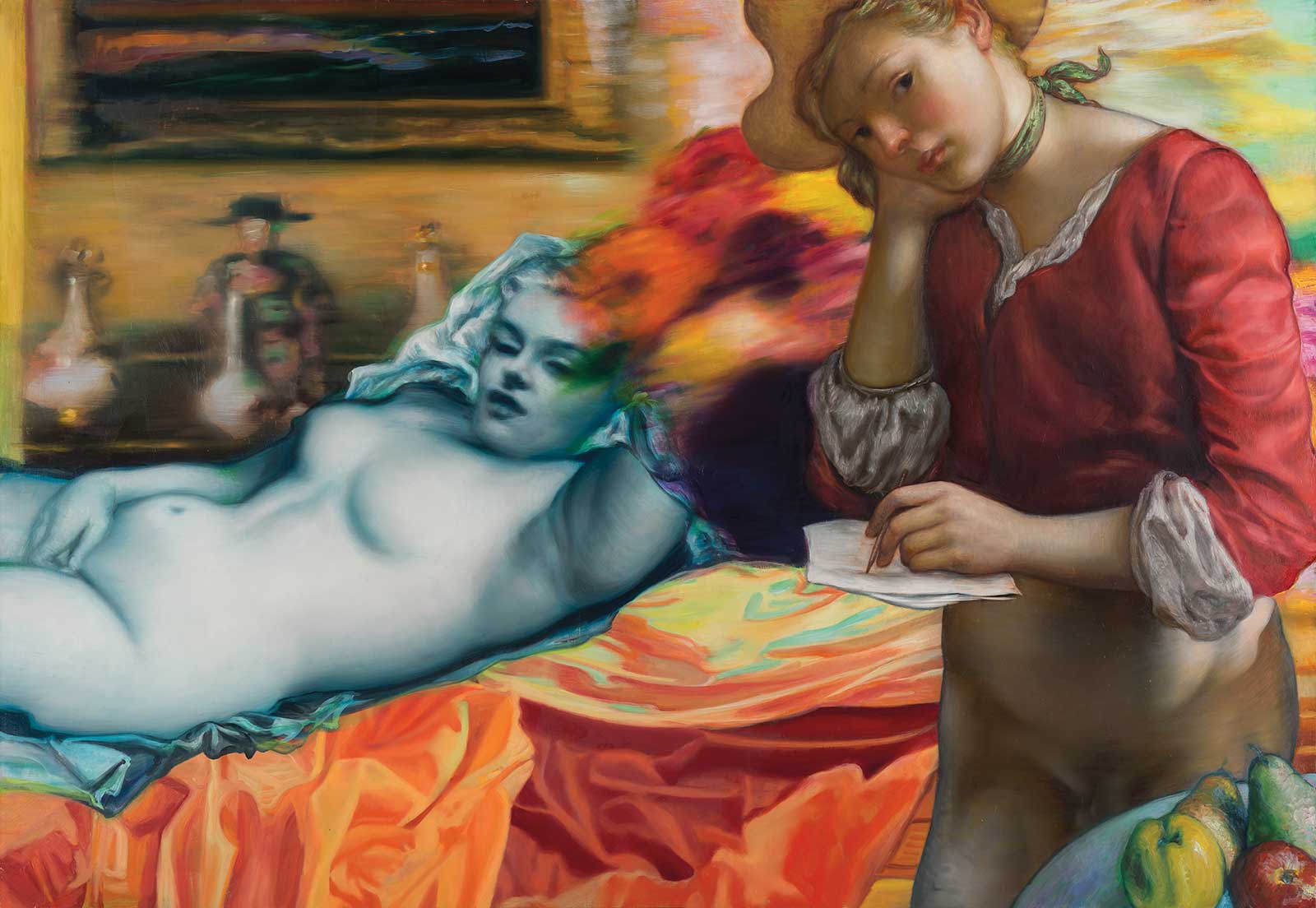
Blue Marilyn, 2016, oil on linen, 47 x 68”. Courtesy the artist and Philip Slein Gallery, St. Louis, Missouri.
Seberg cut a tragic figure in the political American psychodrama of the 1960s, when J. Edgar Hoover ordered a COINTELPRO campaign of disinformation to discredit her reputation after she donated to the Black Panther party, which he feared a subversive danger to the stability of the United States. Hoover put Seberg under the relentless surveillance of his agents, who also planted slander and racism into stories about her sex life crafted for the fertile imaginations of gossip columnists. The constant pressure of such persecution threw Seberg under a dark and oppressive shadow of paranoia which factored into the premature birth and death of her baby, and eventually led to her tragic suicide at 40, when her body was discovered under a blanket in the back seat of a car, an empty bottle of pills beside her. Working from Andrea Mantegna’s dramatically foreshortened The Lamentation over the Dead Christ, Adams painted Seberg as a martyr, deftly combining the religious trope of dead Jesus with intense Hollywood iconography.
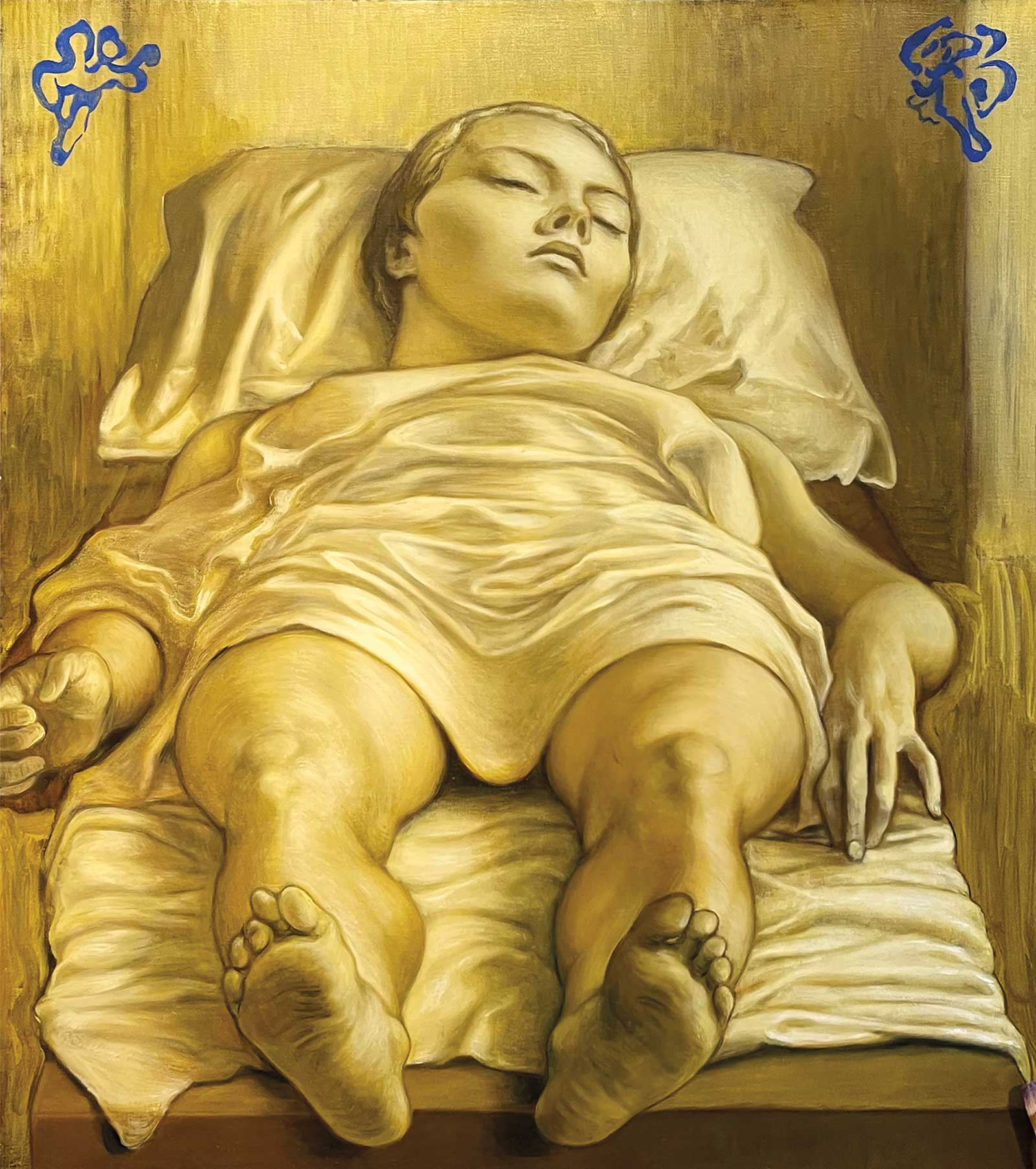
Jeannie Lamentation (Yellow), 2023, oil on linen, 36 x 32”. Courtesy the artist.
Adams repeatedly painted Seberg as an open and erotic figure, and under the blend and brush of his study she became a representative of the artificiality and synthesis of sex symbol imagery, a capitalist symbol of alternative American subculture. He managed an effortless balance of seduction and sideways cynicism, shaping the ambiguously androgynous image of his heroine in slippery and unstable compositions, altering the bodies of his models into a new form of celluloid mannerism. His virtuosity with the figure was enhanced, not diminished, by his deliberate twisting and manipulation of the anatomy, following the traditions of the 15th century he saw in Florence. His bodies seemed to transcend themselves, emerging from the flat dimensions of the picture into sculpted relief. In Niagara Lounge, Seberg wears the blue and red glasses of the three-dimensional screen as if suggesting that our experience of her sensual presence is incomplete.
Adams says, “I wanted to insert myself into that film. It was a way for me to insert myself into a history. It was probably something to do with photographs of my parents in their early days, and combing through my immediate family history and hoping to find something there for myself. The Jean Seberg character reminded me of myself. I felt like I recognized myself there. I used to be a lot thinner and had a lot more hair and there was some sort of familial resemblance. She reminded me of my mother, of a number of personages from my past, so I felt like I wanted to work with that persona…I slipped into a bit of an erotic dream, but what I was really trying to do was to go into that territory…but then try to subvert it in some way, so I would mix the gender. It was as if I was taking my own body, my own sense of self as a younger man, and infusing it into that figure in such a way that it wasn’t just this object of desire. There was a more complicated kind of longing that I was interested in.”
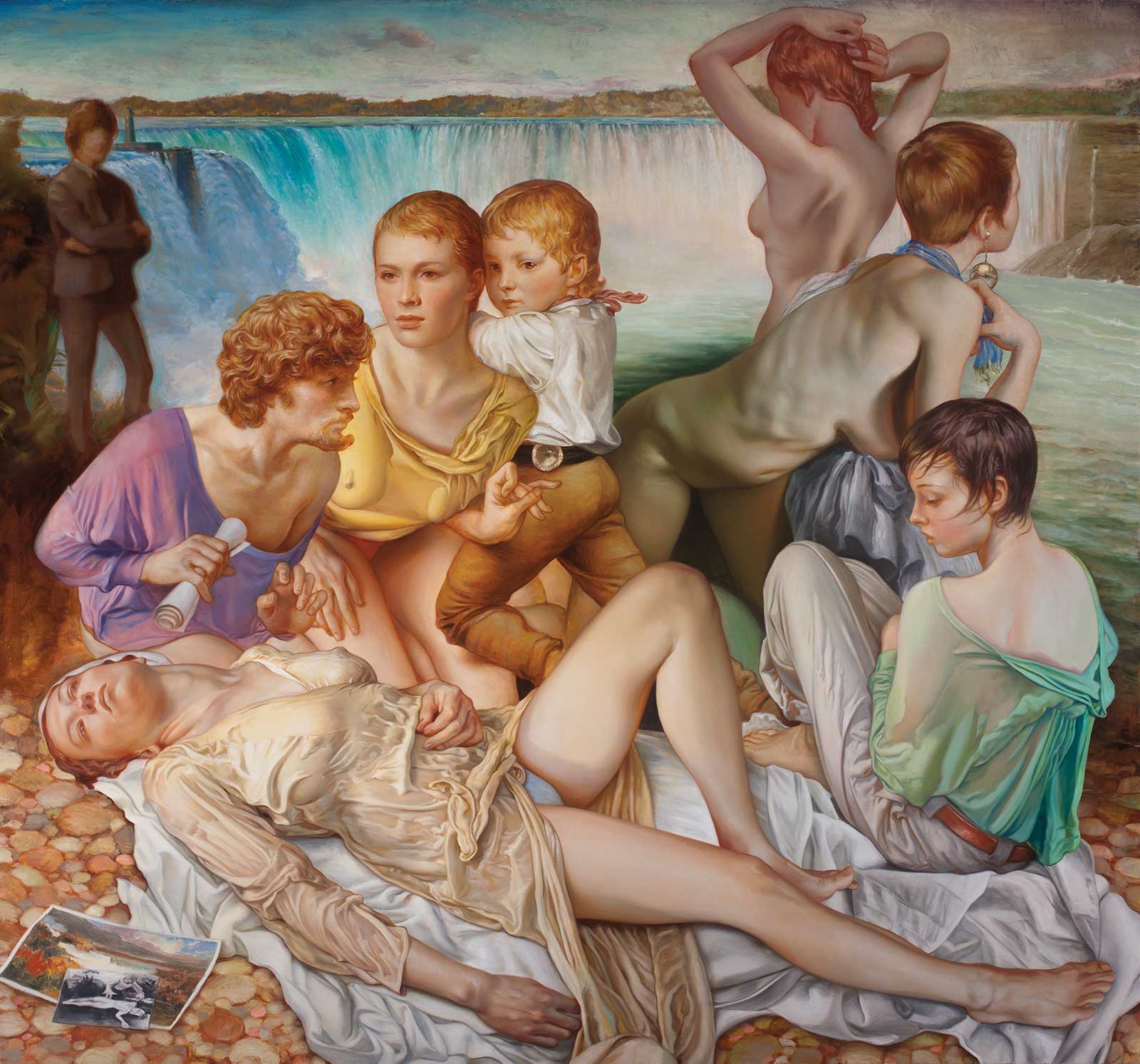
Niagaradown, 2013, oil on linen, 84 x 96”. Collection Crystal Bridges Museum of American Art, Bentonville, Arkansas.
Seberg was not the solitary subject of Adams’ sensual study. He mixed reality and fantasy in layered mood and media. While he was in graduate school, he realized he had to interrupt his expectations of what a painting could be. He had already spent years crafting portraits of politicians and other prominent people, and was ready to rebel. “I was really trying…to work against the grain of working as a commission painter,” says Adams. “By the time I was at grad school I had made 25 portrait paintings for the state of Pennsylvania and I thought to myself, ‘What would be the absolute worst persona to work with?’” Marilyn Monroe seemed ideal. “Coming from Pittsburgh, with the Warholian specter of his Marilyn Monroe prints, I thought maybe it’s a way to get deeper,” he says. “Not just the superficial, but can I make paintings of Monroe that somehow access a sense of self behind the celluloid, beyond the veneer of the screen that Warhol was about.” In Blue Marilyn, nude Monroe appears in a cameo of eros and art and history. She is simultaneously the tragic and sainted sex symbol of popular culture, and the objectified subject of Titian’s pornographic Venus of Urbino. His dalliance with Monroe in his Niagara series was born of rebellion against his career, but he soon bored of her, for the blonde bombshell lacked depth and was too simply a sex symbol.
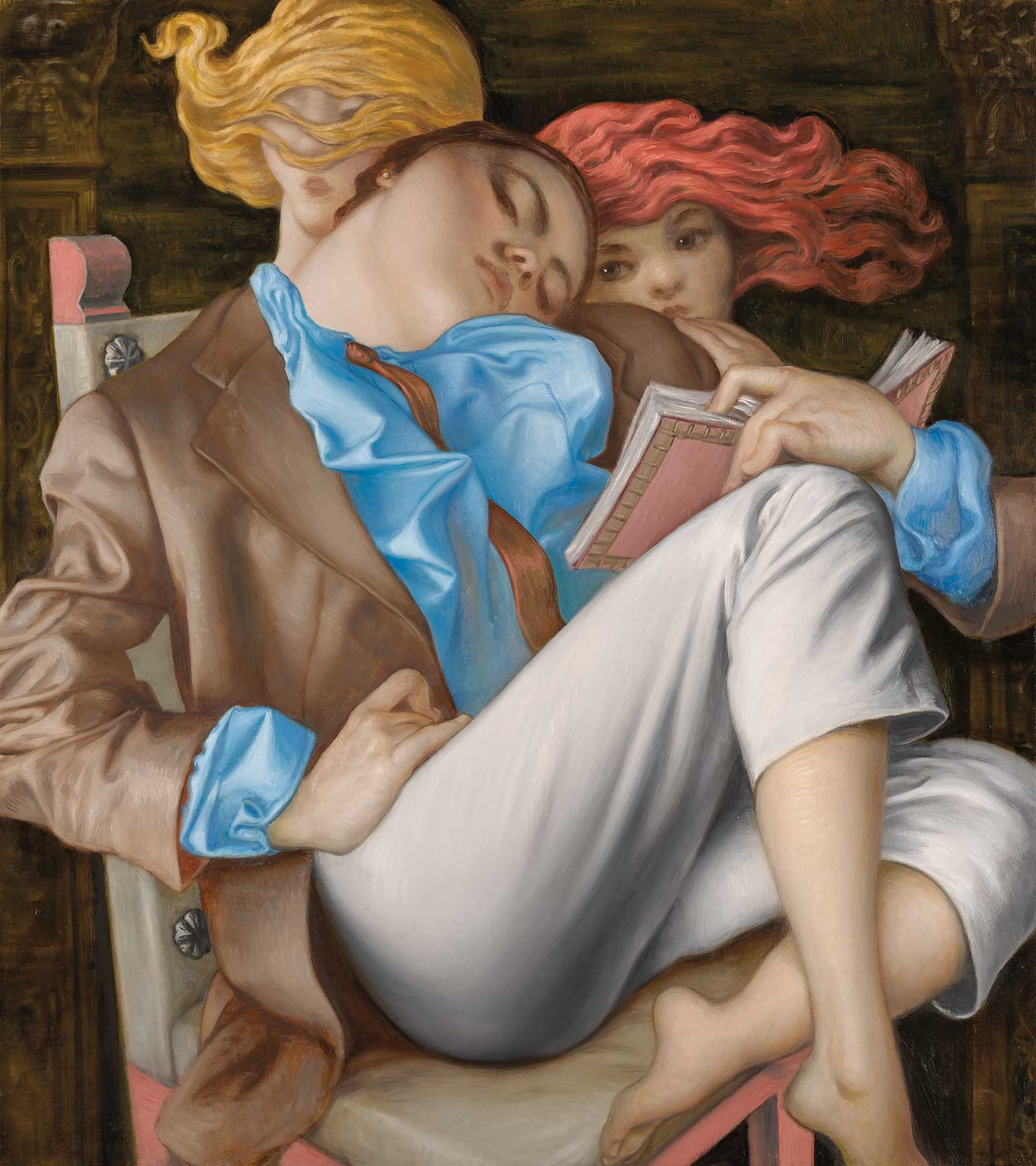
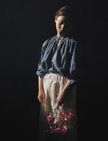
Jeannie Blue Shirt, 2022, oil on linen, 36 x 32”
Nevertheless, delighted to reach back into the scenography of his parents’ youth in a 50s fantasy of a bygone era, he inserted Seberg into a series of paintings in a parallel universe of Henry Hathaway’s film Niagara, staging erotic tableaus in honeymoon suites set before backdrops of the iconic falls and dancing on the exciting edges of erotica.
Adams applied the same androgyny which fascinated him in Seberg’s persona to a male character, who he named Blondie Bubba, and created a series of paintings about his dalliances and misadventures in a fantasy film world, deliberately tying personalities together in Bubba and Jeannie,where the bright and pretty boy rests in the luxurious folds of an oversized boyfriend shirt and tightly tailored lounge pants cling to his thighs. The cushion of his chair is embroidered with a mannerist ceiling painting, and he caresses the ambiguous and anonymous hand of an off-edge neighbor. While Bubba is set among light pastel spheres of lush technicolor lens diffraction, inverted Seberg is intimately suspended above him in the monochrome grisaille of Godard’s low-light black and white. She is studious with eyes cast at her open book while he is forthright, gazing directly at his audience. Ecce homo, behold the provisional person.
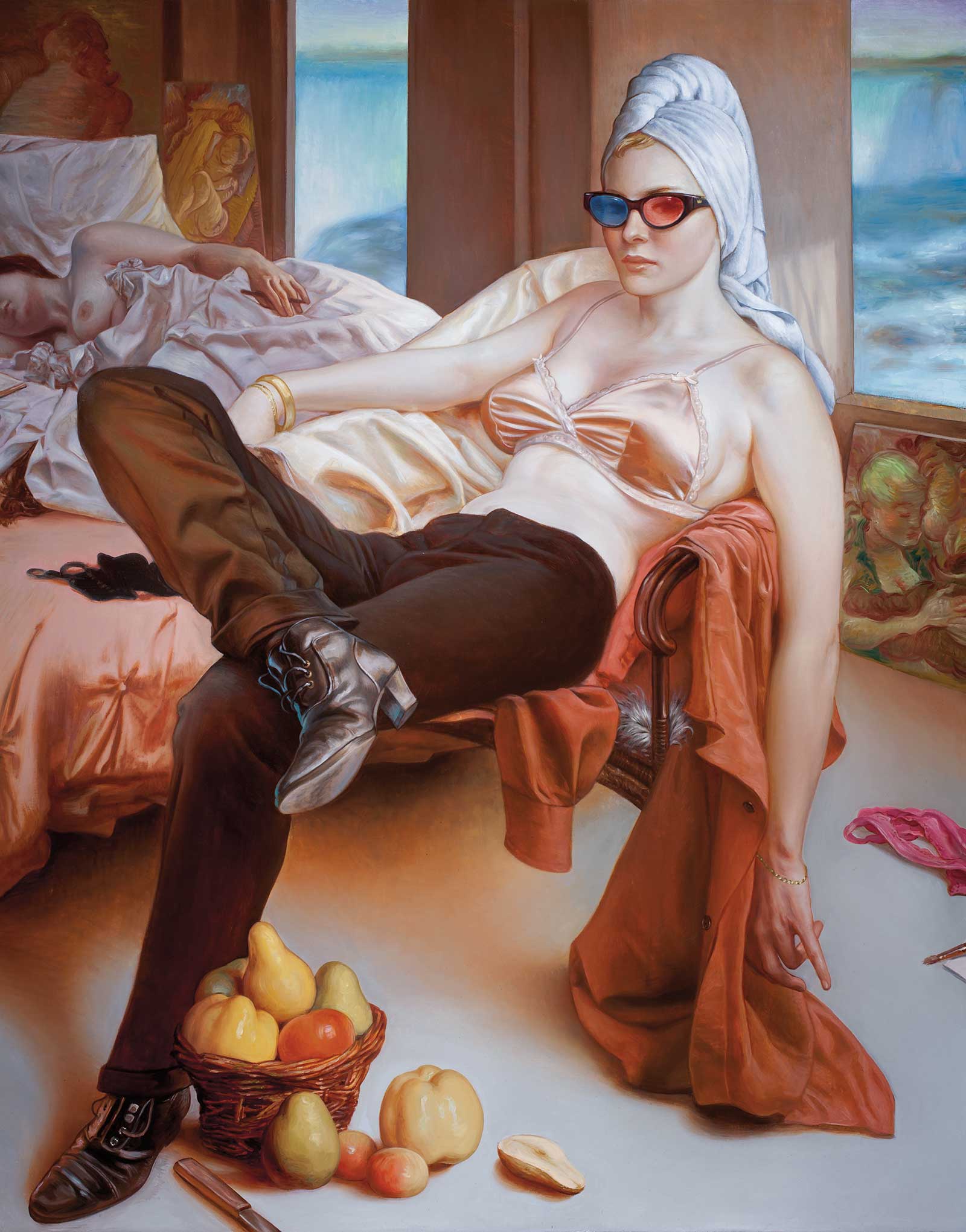
Niagara Lounge, 2013, oil on linen, 60 x 48”. Private collection.
In Drive-in Dancers, Bubba is dressed in a soft and smooth cowboy couture costume of tailored scarlet and gold, delicate and embroidered. He plays barefoot with a ribboned girl in freshly laundered shirt and skirt, holding Dionysian grapes between her toes. Their languid dance is a private show of decadent delight. Bubba’s head is tipped back in ecstatic self-indulgence as the girl fingers his sleeve, and a topless but ambiguous figure sashaying in flared satin lounge pants caresses his feminine waist. Her head has been replaced by a carved bust of a bearded man. Gender fluidity and iconography are the subjects of Adams’ scrutiny of this starlet stage. The threesome frolics among the conventional objects of bourgeois still life, apples, grapes, baskets, and flowers, but the space is equivocal—their intimacy is public—a panel behind them is the silver screen of a drive-in theater, where a fragment of the serif letters of a credit-crawl lingers briefly over the violet and orange clouds of a candy sky.
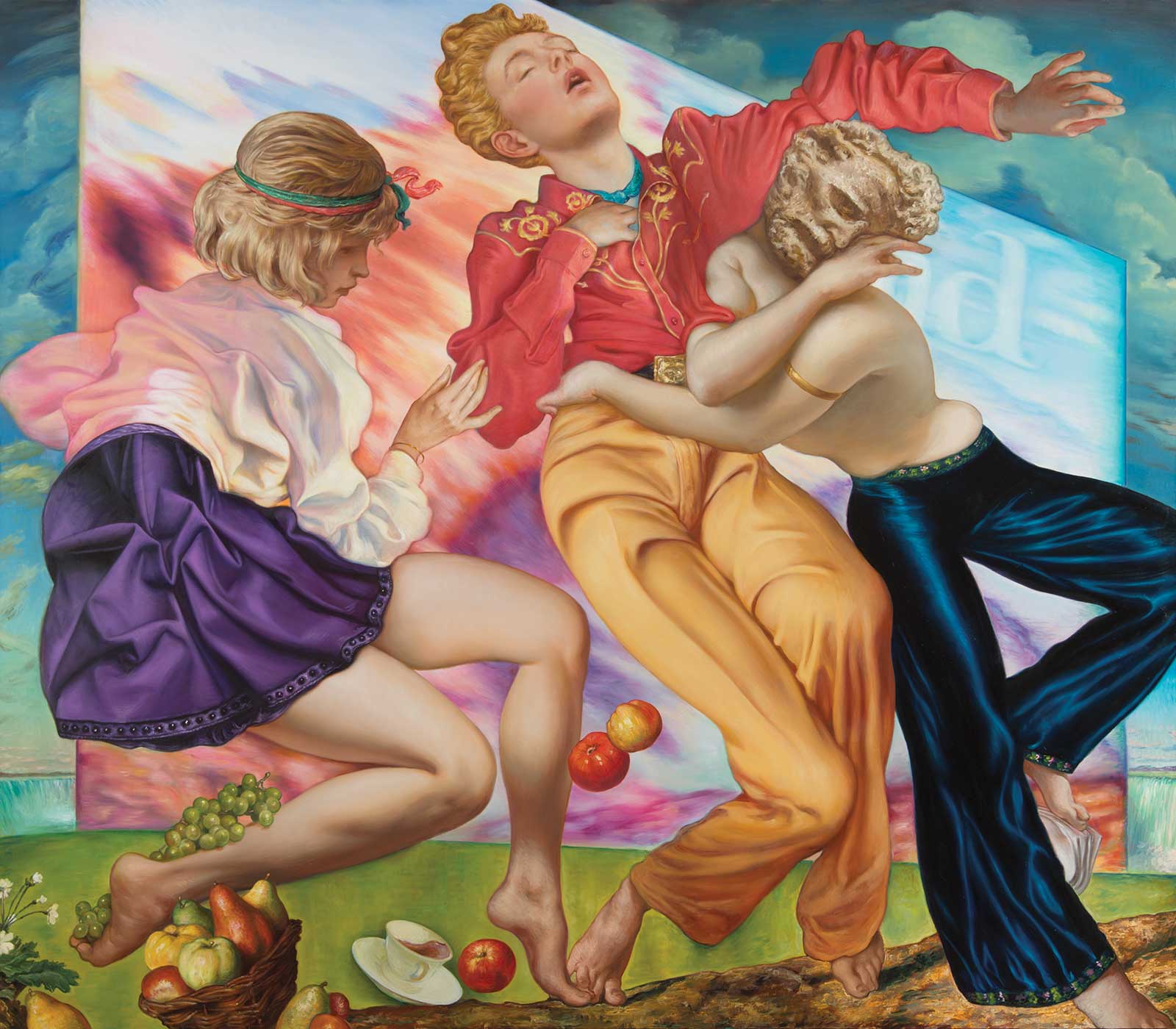
Drive-in Dancers, 2016, oil on linen, 84 x 96”. Courtesy the artist and Philip Slein Gallery, St. Louis, Missouri.
But Adams’ mannerism, his fascination with the plasticity of the body, was not merely a shallow or affected stylistic reference to the glib veneer of slick Hollywood’s image factory, or to contemporary transgenderism, for it originated from a deeply personal source. He explains, “…We had a horrible experience of our oldest daughter pulling a pot of boiling water onto herself, checking out what was on the stove. She was two years old. That precipitated her having to have multiple surgeries. They would put balloons under the good skin, expand it. All this reconstructive surgery. That had a profound effect on me, and from that point on, my figures began to morph and take on something more than a strict, classical, uniform, centered kind of representation.” Adams’ perception of the body changed. The human form was malleable.
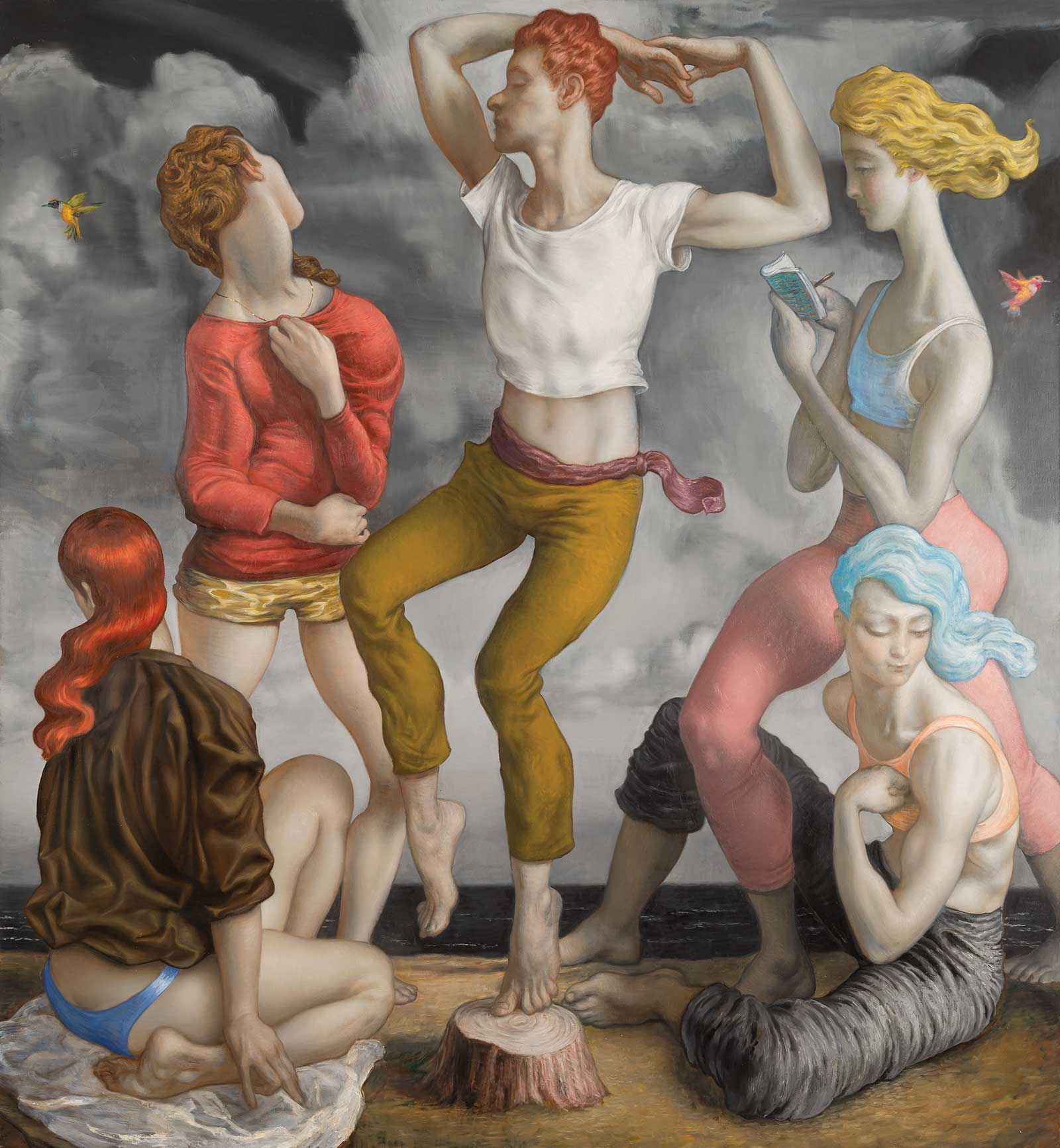
Bubba Bebop, 2022, oil on linen, 78 x 72”. Courtesy the artist and Zolla Lieberman Gallery, Chicago.
He began looking at the possibilities of the painted body as a continuum, rather than as a frozen moment in time. “It suggests movement, maybe even transition or transformation,” continues Adams. “Donatello’s David, where you look in the front and you see power, virility, boyhood; you move around the back and it looks feminine, it looks other and that’s happening amazingly in Michelangelo’s David. They’re playing with proportions, the width of the hips and so forth to suggest, I would say, transitional age. I’ve seen it with my daughters, at the age of 14 they become adult and it’s not a figure which is sustainable; it’s a figure that’s in the midst of transitioning from childhood to adulthood. And, of course, fashion is all over that.”
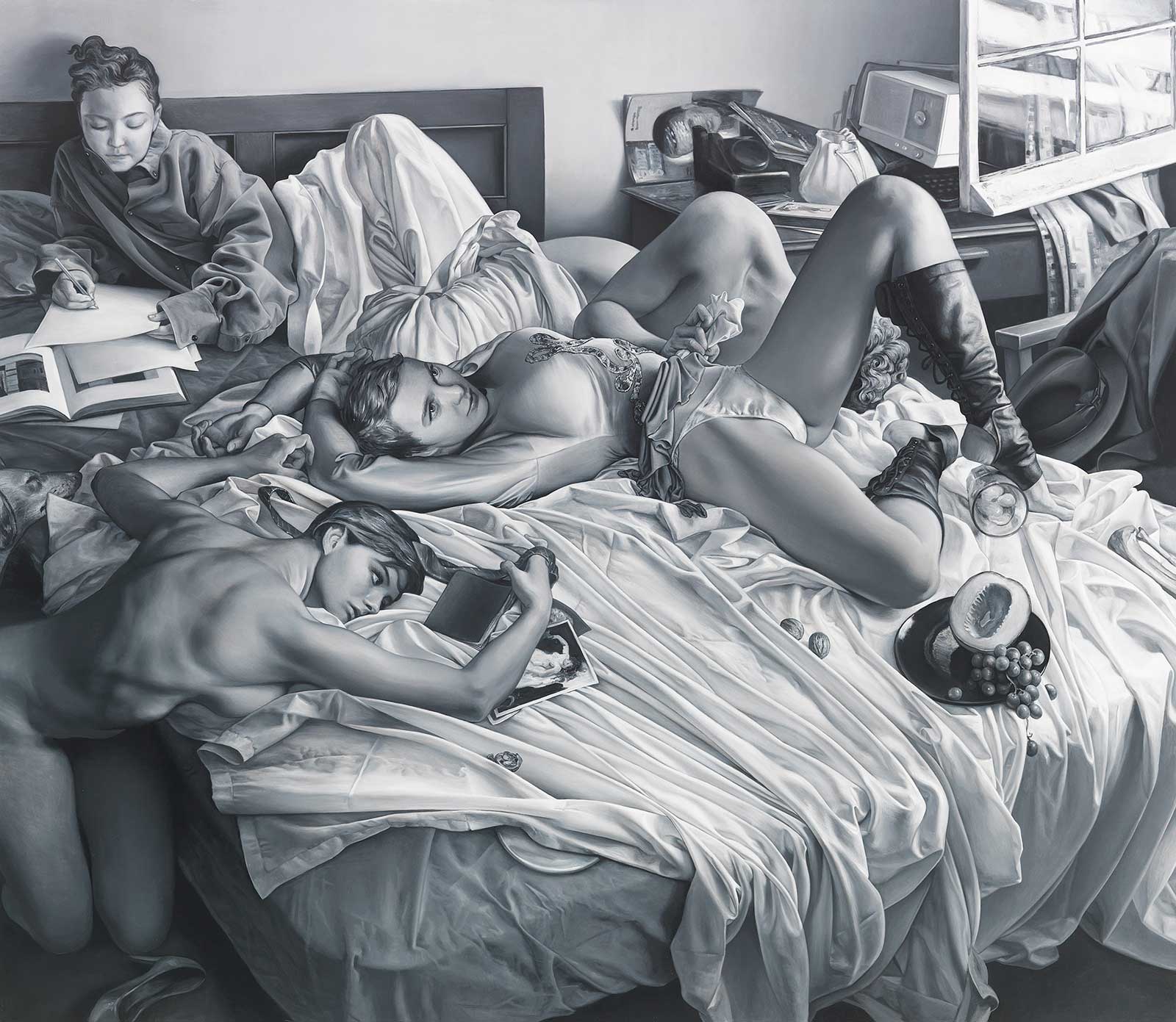
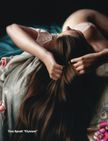
Jeannie Big Bed (#2), 2010, oil on linen, 84 x 96”. Private collection Detroit, Michigan.
Adams paintings seem to hint at extrasensory self-indulgence and the presentation of an existence shaped by media, by popular culture and by pleasure, where individuality is seduced—and reduced—by a brave new world of synthetic selfhood. Adams’ marvelous and mannered bodies are new bottles for a new wine. —
Michael Pearce is a dynamic writer, curator, and critic, and a champion of art that emerges from popular culture and shapes the spirit of the age. He has published dozens of articles about art and artists, and is author of Kitsch, Propaganda, and the American Avant-Garde. He is Professor of Art at California Lutheran University.
Powered by Froala Editor