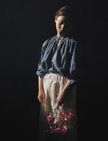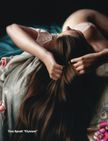
Lorraine Shemesh - On Balance,an exhibition of recent work in paint, paper and clay at Gerald Peters Gallery in New York, will be accompanied by a book of the same title that documents 30 years of her work.
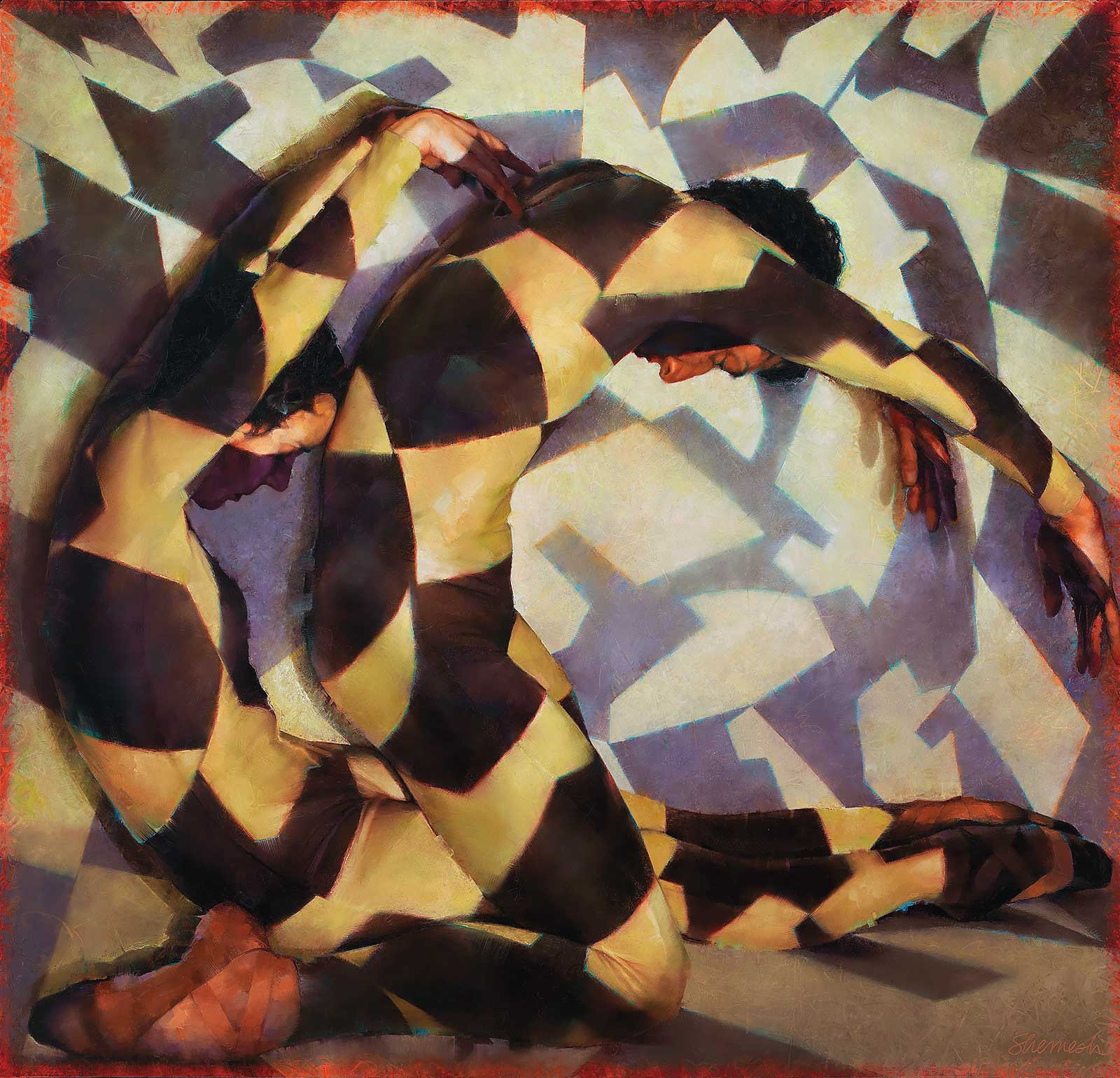 Slide, 2020, oil on canvas, 58 x 60½”Twenty-nine years ago, I exhibited her work in an exhibition at the Arnot Art Museum in Elmira, New York. At the time, she was painting figures in water. She explains, “When the figures were paired together in the water I tried to arrange them in simple geometric shapes like circles and ovals in order to unify them, and stabilize the composition. The models were shown linear drawings of the desired shape before getting into the water to help arrive at these configurations. No mean feat in the doing.”
In her pool paintings, the figure remains corporeal but dissolves and becomes one with the refractions in the water. In multiple paintings, the figures merge in an understanding of each other’s movements and physical closeness, but maintain a space between them which is both a form and a separation—all the while, creating complex patterns.
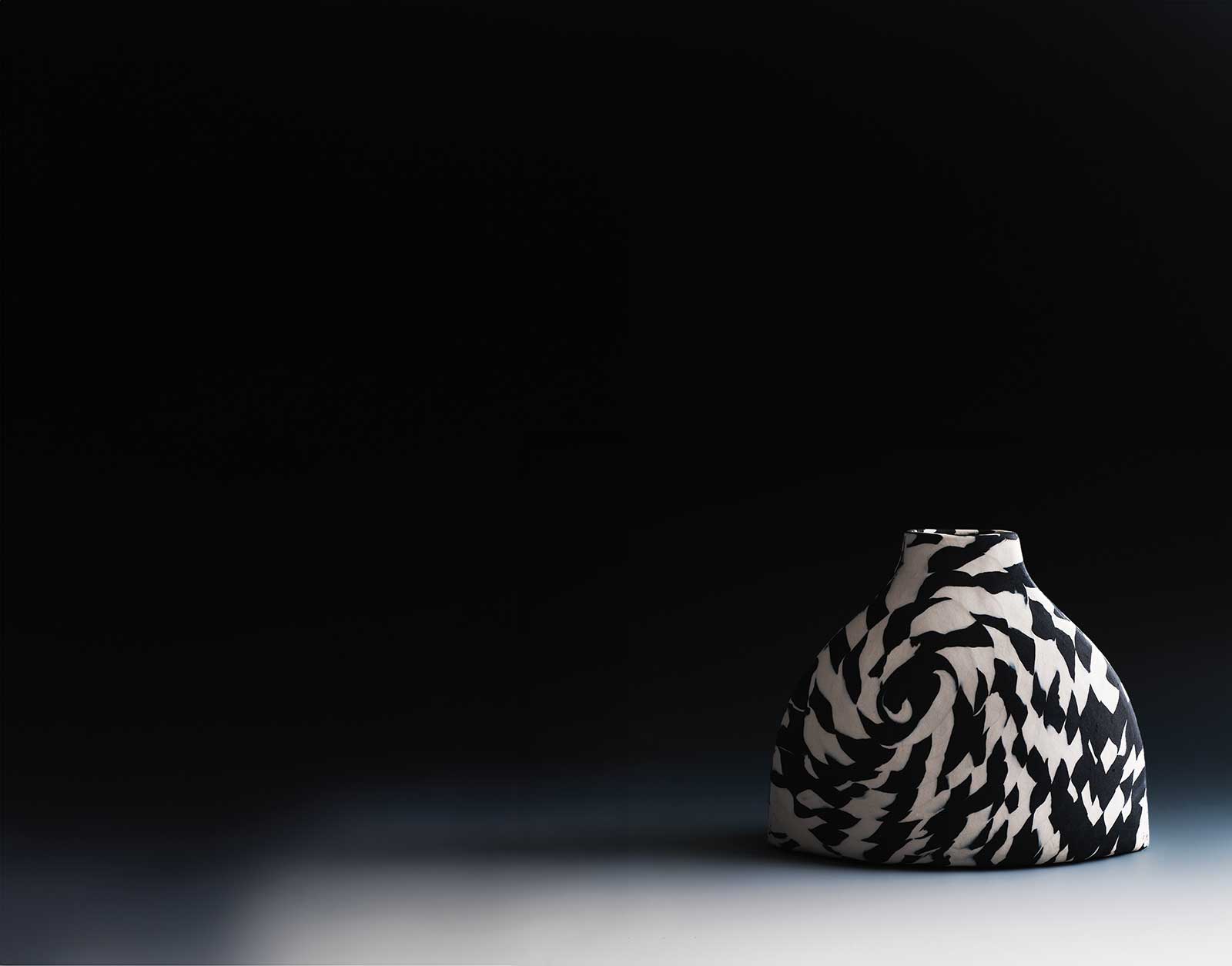 Black & White Twist Wide Nerikomi Bottle II, 2021, porcelain, 8½ x 10¼ x 3¼”“Pattern has played an integral role in the development of my work over time; whether it is planned or improvised, it is memorable because it has the capacity to transform things,” she says. “Developing various repeated patterns in order to create movement, rhythm and harmony presents the possibility of a visual metamorphosis in the work at hand. Initially, I was attracted to surface patterns on fabric, patterns that occur in nature, striated light patterns, and both geometric and organic shapes. Early on, I was drawn to water as a subject because of its myriad of patterns in constant flux. I have also employed pattern as a form of camouflage to hide and reveal different aspects of the human form as it moves.”
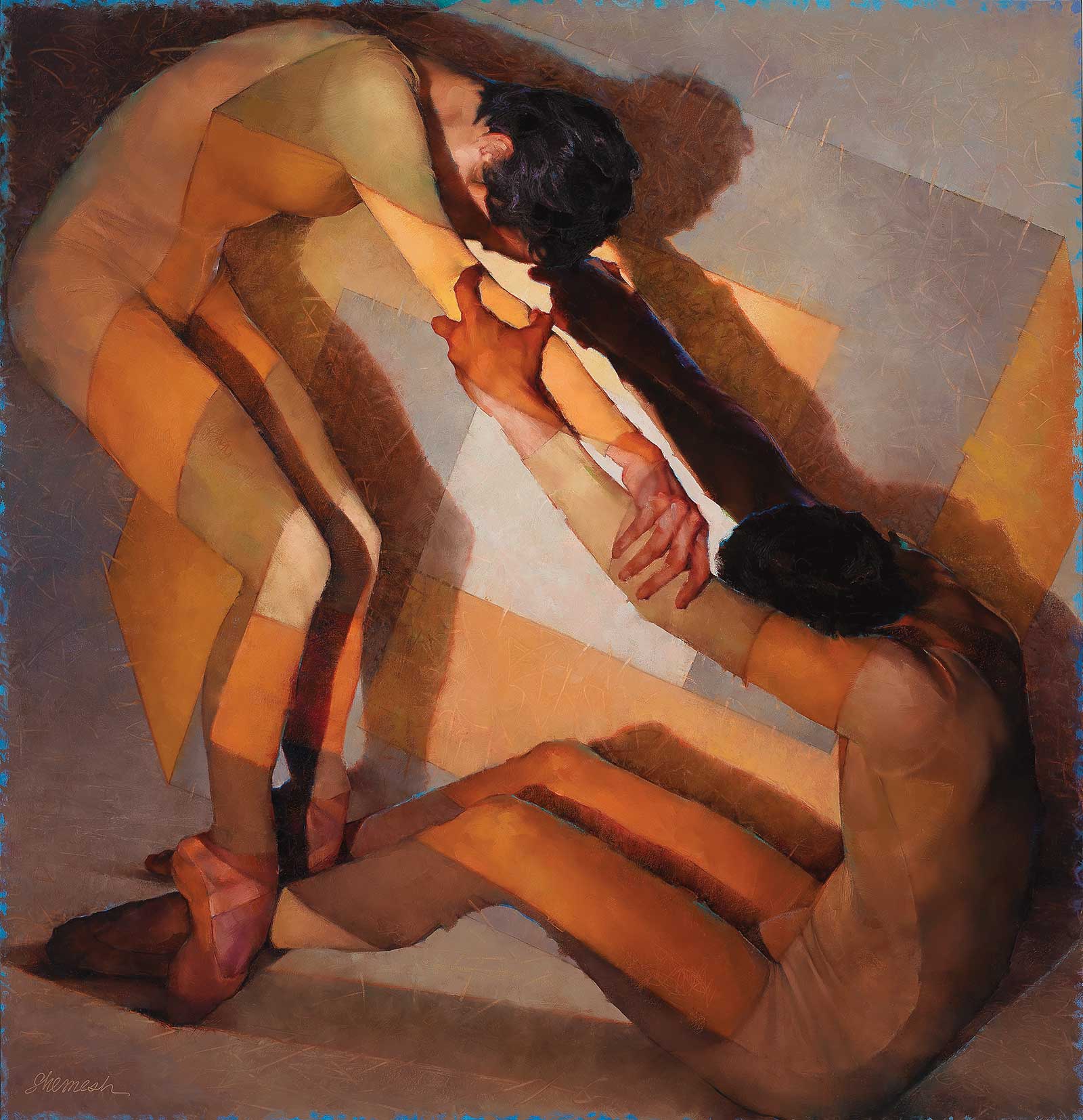 Clasp, 2022, oil on canvas, 55 11/16 x 53 5⁄8”She continues, “Visual magic for me lies in the combination of figuration and abstraction. I am drawn to the spontaneous quality of a certain kind of mark-making and the challenge of marrying that to the figure. Paint has a strong physical presence, whether it is rough, smooth, pushed or splattered. Developing the form with various paint viscosities makes one see differently, as thickly painted areas sit next to more transparent passages on the canvas. During the process, the figure is altered, so I think of it as a kind of synthesis.
“Variety in paint quality and handling gives the work juice. The development of thick and transparent passages when painting is arrived at through scraping and sanding, as well as laying down the paint with a brush, knife or stick. Variation in kinds of mark-making when painting results in greater visual interest.”
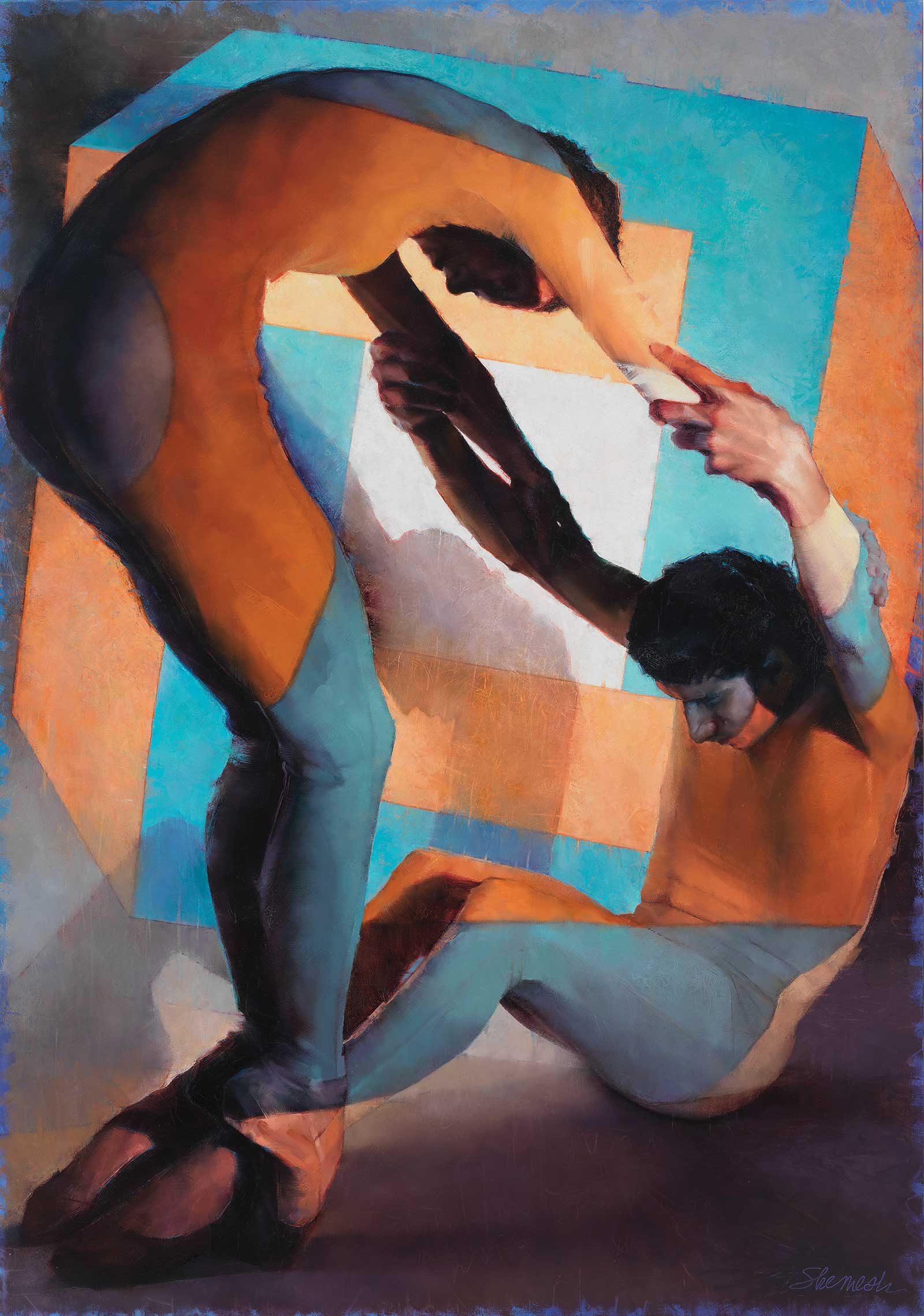 Around the Bend, 2022, oil on canvas, 60¼ x 52”The gallery notes, “Using intertwined figures and shapes in motion, Shemesh addresses ideas of disjuncture and harmony. The relationship between tension and tranquility is made visible as an expression of the human condition through her tactile and luminous handling of materials.”
A more tactile material than paint is clay. “In order to keep the paintings fresh over the protracted period of time it takes to do them, I alternately work with other media,” Shemesh says. “The tactile experience of holding unfamiliar materials in one’s hands is energizing on many fronts. My experience working with clay shifted the way I was thinking and painting. The physical process of pushing and pulling the clay around fed my interest in the more abstract shapes that figures form when joined together.”
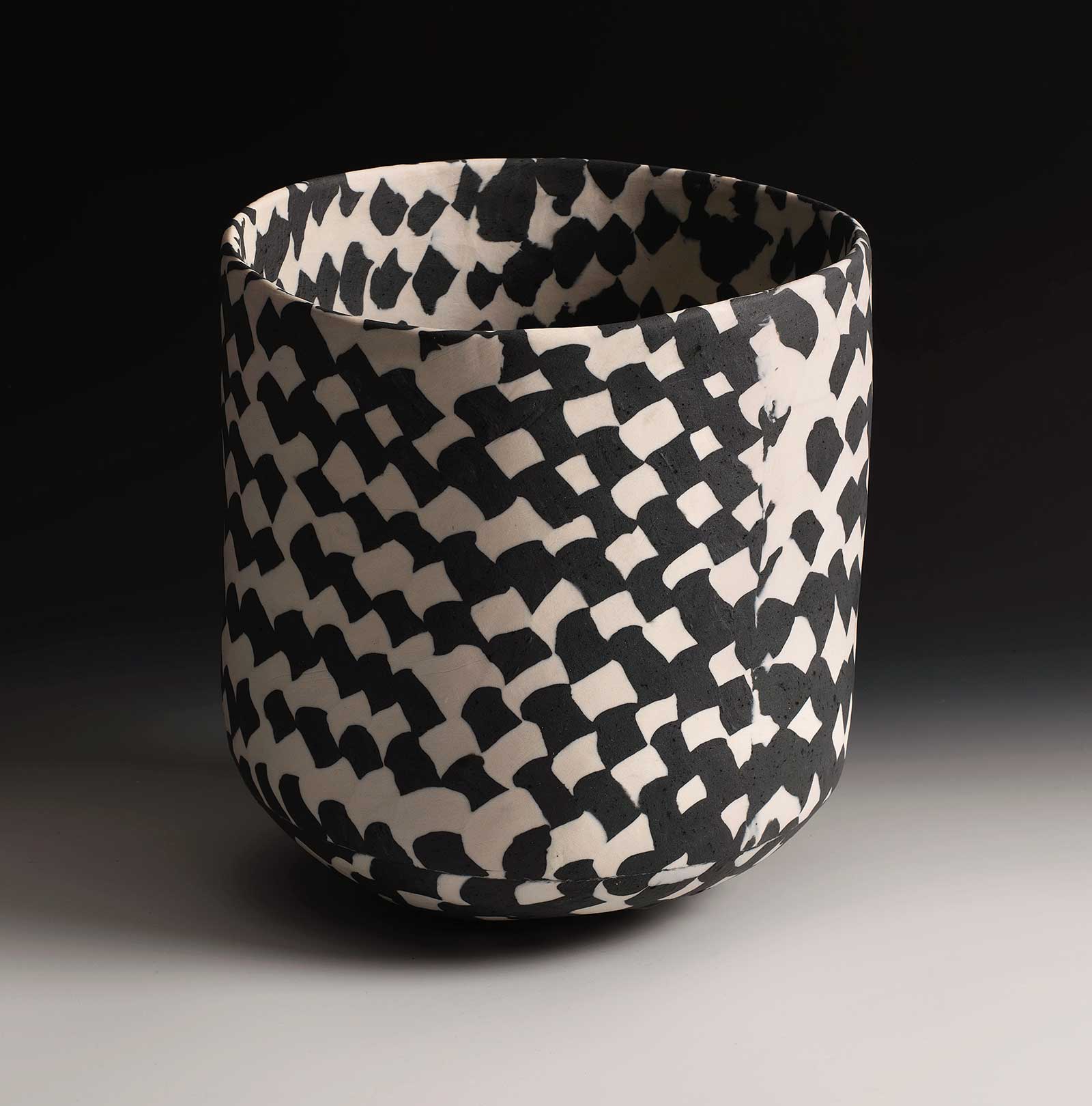 Black & White Checked Nerikomi Vessel, 2021, porcelain, 10¾ x 95⁄8 x 9”
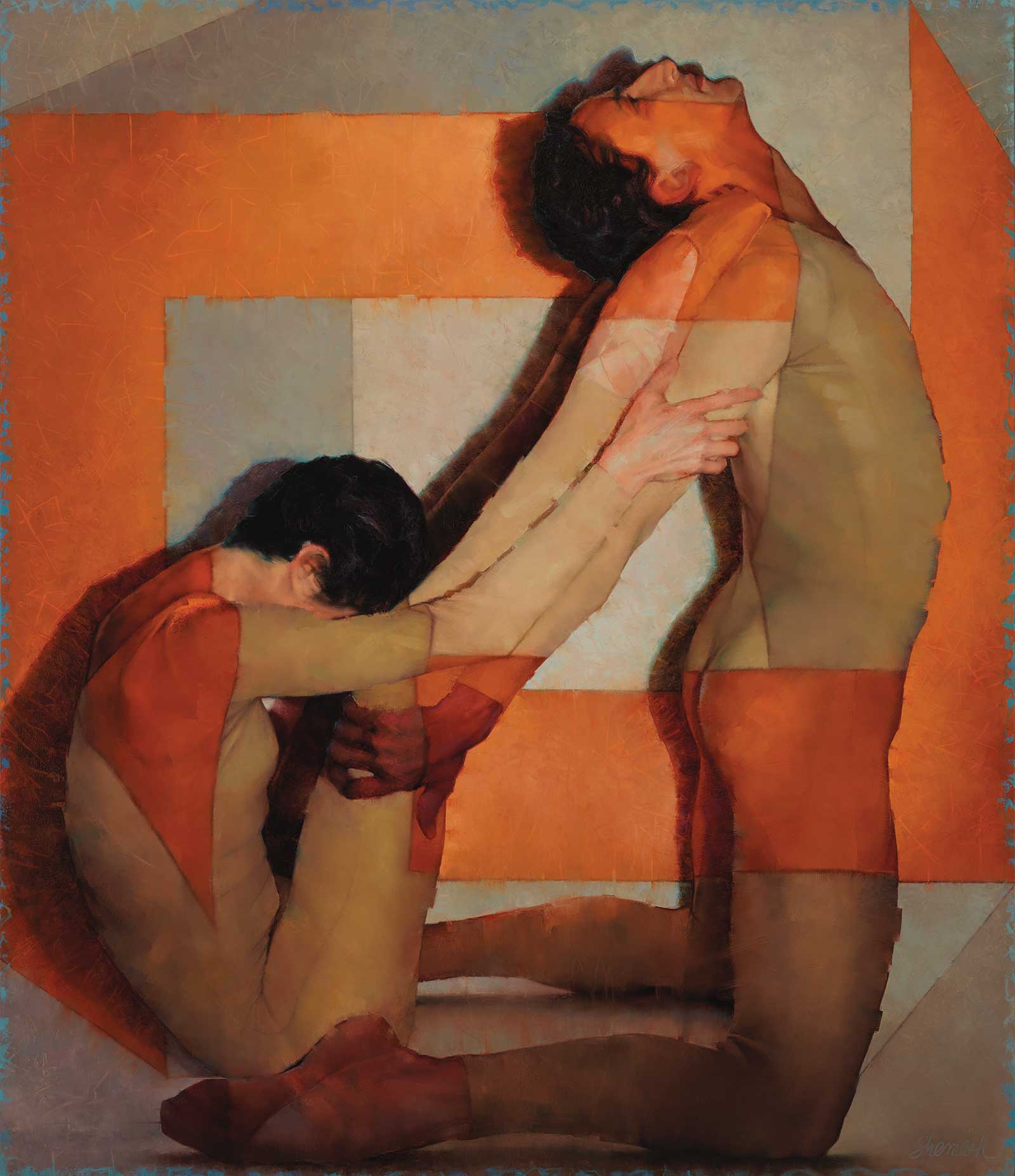
Backbend, 2022, oil on canvas, 60¼ x 52”
Shemesh uses the 400-year-old Japanese process of wedging powdered pigment into various clay bodies to color them. The colored clays are stacked and cut and reassembled in hand-built vessels called Nerikomi. When the pieces are wheel-thrown, they are called Neriage. In her Black and White Checked Nerikomi Vessel,2021, the black and white clays are combined and modeled. The squares distort in the process but always remain black and white, separate, yet one as a vessel.
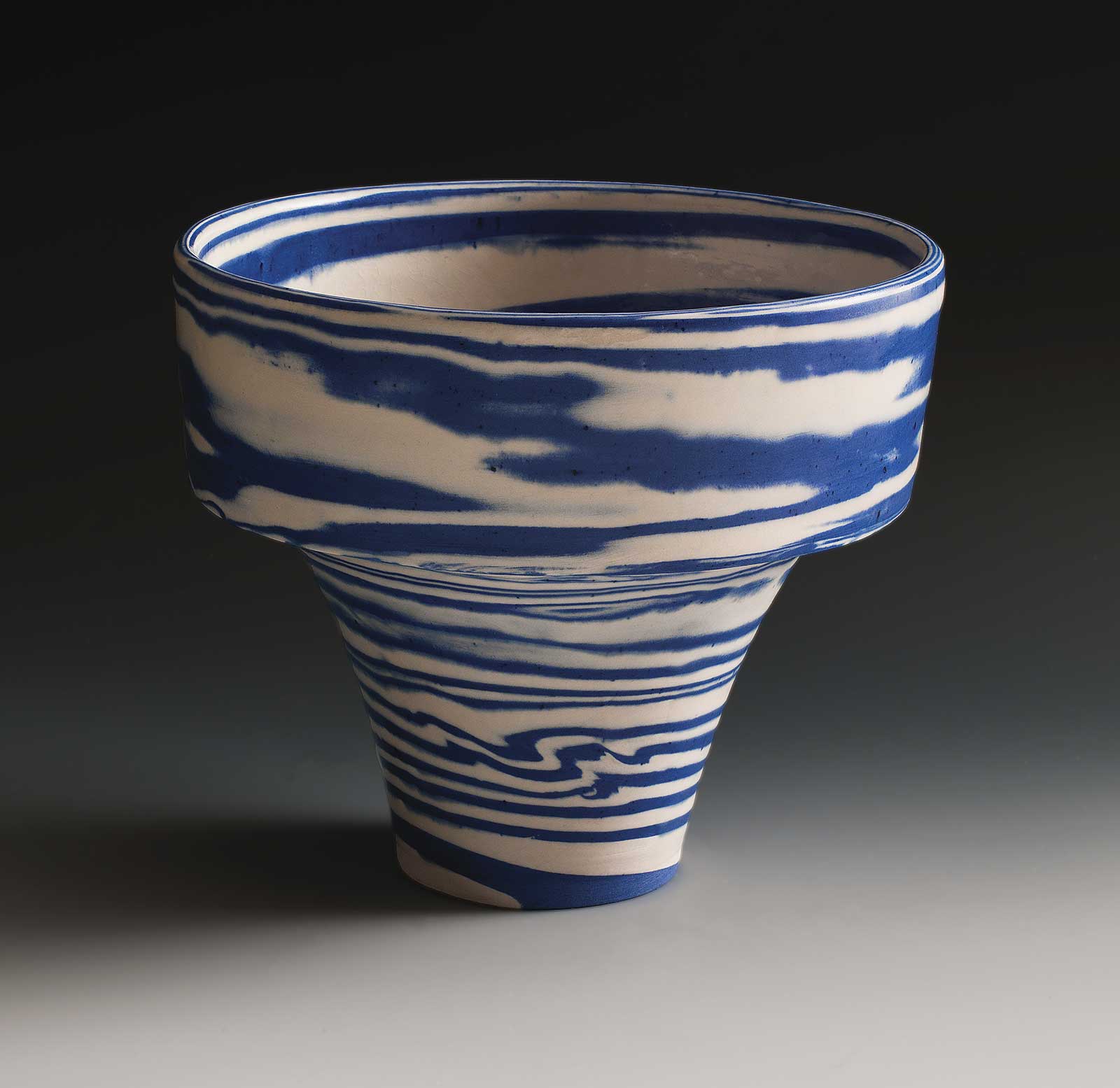 Blue & White Ledge Neriage Vessel, porcelain, 7½ x 8¼ x 8½"
The artist relates, “There is an emotional component to the weaving together of the light and dark of the human experience. Clay has a memory, is easily broken, sensitive to touch and temperature, capable of fragility and strength, and greatly affected by the atmosphere in which it finds itself. Much the same thing can be said for the human body and the ephemeral nature of life itself.”
Her recent paintings are similar to her earlier pool paintings in that she creates linear drawings of forms for her models to emulate, creating complex patterns. In these paintings she has employed professional dancers who have performed together and are intimately familiar with the way the other moves.
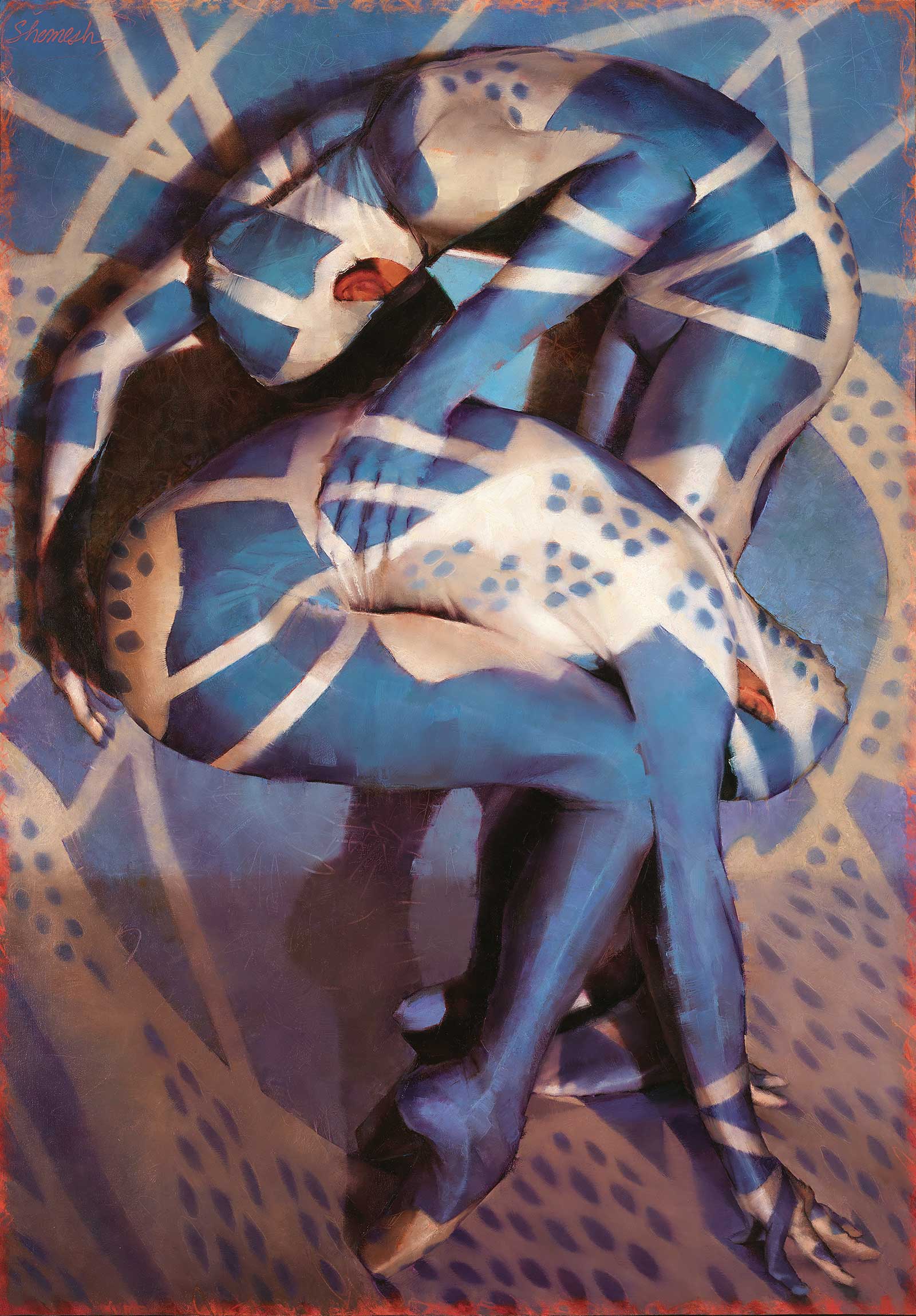 Chrysalis, 2023, oil on canvas, 60 x 42"
The warm palette of these paintings is influenced by the colors of the landscape in New Mexico, as shown in Around the Bend, 2022. Here the figures are on dry land, within a hypercube box structure, continuing to assume shapes, blending into and separate from one another. Shemesh describes the box as “imagined and used to visually contain and unify the two joined figures. There is an emotional component to the feeling of containment as well. The figures can be read as separate forms that also come together to become a larger, more visually forceful unit. The tension between the forms and how closely they are placed to the perimeter edge of the canvas frame is very important to me. This results in ‘edge tension’.”
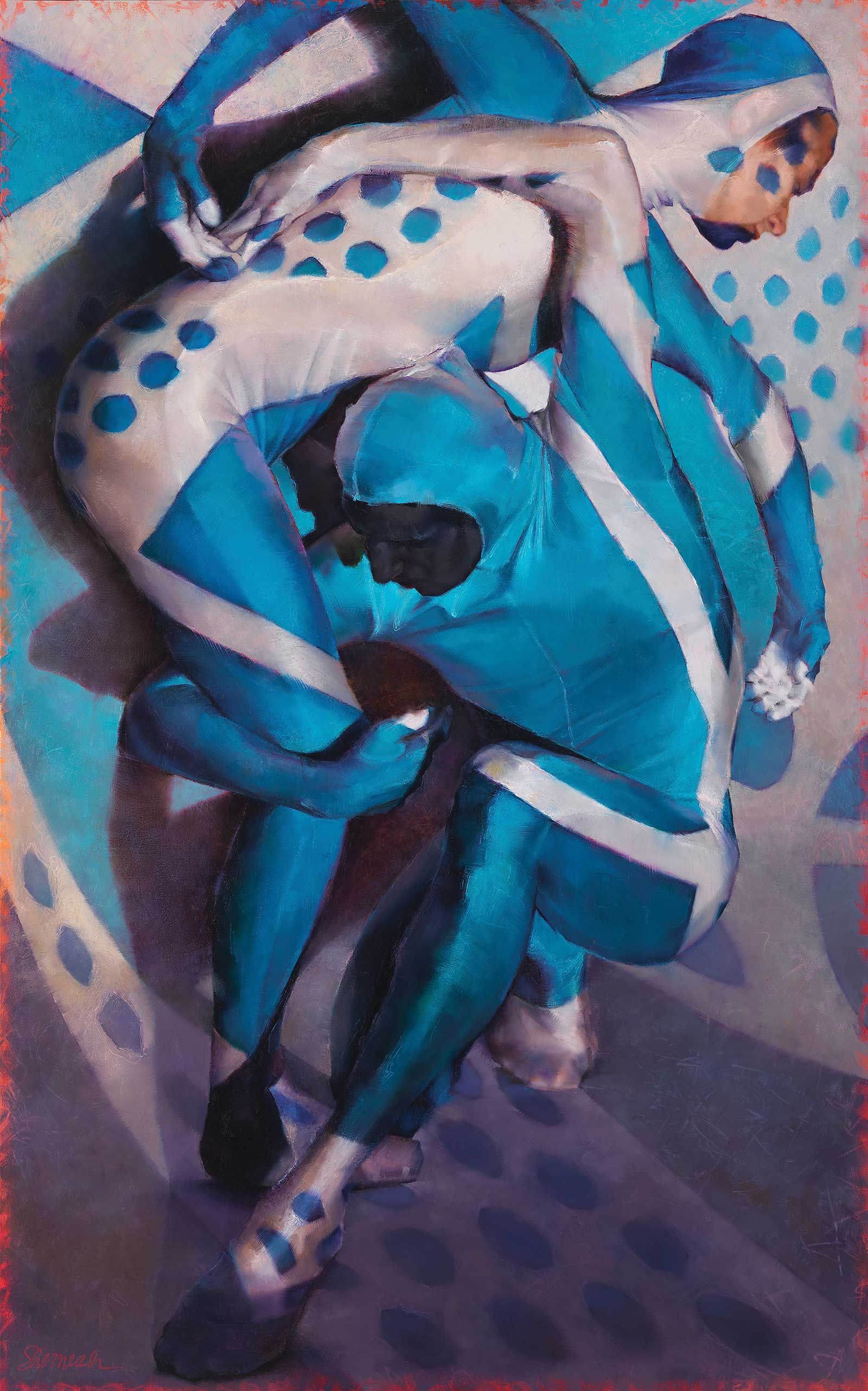 Torque, 2023, oil on canvas, 64 x 40"
“Edge” figures as well in her handling of paint as she defines her figures. She says, “There is fluctuating movement in the paint handling of the edges of the figures to account for the fact that the models move as they breathe. They are not still life objects. The human ‘quiver’ that occurs gives life to the form and allows for a more open-ended way of working, responsible for keeping the painting alive over a long period of time." The nuanced paintings of human forms merging into abstraction allow viewers to respond from their own unique experience, eliciting a form of discovery. Shemesh writes, “Art witnesses our lives and the times and culture in which we are immersed. Current events seep into our bones and are reflected in the action of our bodies. Art reminds us to look…and then to look again. The more we look, the more we see about ourselves and the world in which we find ourselves.” —
Lorraine Shemesh - On Balance
February 29-April 3, 2024
Gerald Peters Gallery 24 E. 78th Street, New York, NY 10075
(212) 628-9760, www.gpgallery.com
Powered by Froala Editor