When looking at the new body of work by Bennett Vadnais, for a moment I questioned if it was by the same artist best known for his acrylic-based urban landscapes. But as I studied the small-scale still lifes, it quickly became evident they were created by the same hand. Both share the muted, earth tones Vadnais favors, his affinity for stark designs and abstract shapes, and exhibit his finely attuned eye for contrast and meticulous attention to detail.
Vadnais’ shift to still lifes is more of an exploratory offshoot than a departure—he continues to paint street and architectural scenes, and still life is not a new genre for the artist, rather one he is revisiting.
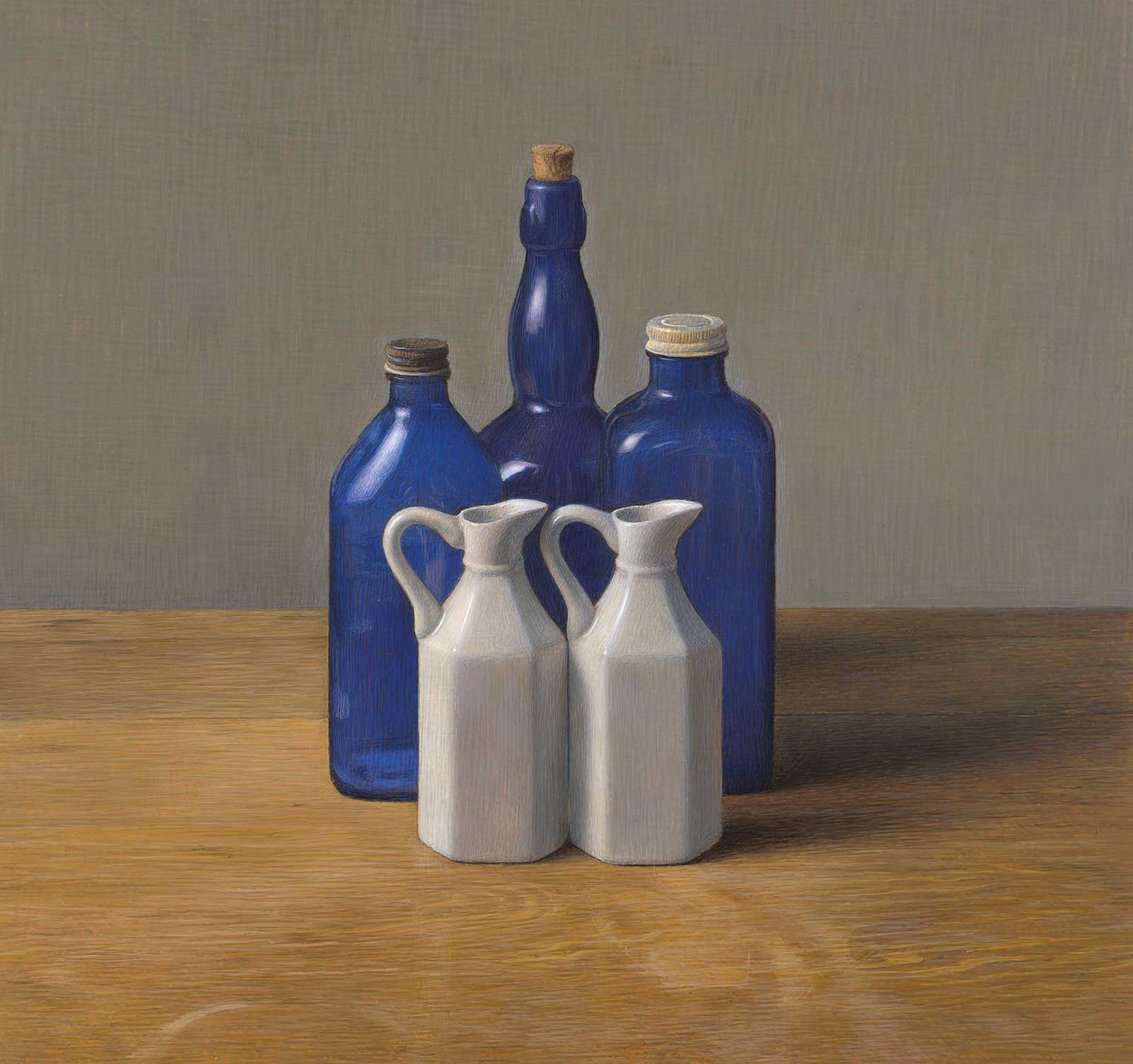
Blue Bottles, egg tempera on ACM panel, 13¾ x 13"
As with many artists, this shift in direction was fostered by the pandemic, when daily routines were turned upside down, creating unforeseen constraints as well as opportunities.
With his children out of school, Vadnais could not spend as much time in plein air creating the studies that his urban scenes are more heavily reliant upon. “I took to still lifes because, unlike my landscapes, I can do the entire piece by observation,” says Vadnais. “I can focus on the way the light works on the subtle textures…I’m always responding to what I’m observing. It’s much more controlled so I can be more precise.”
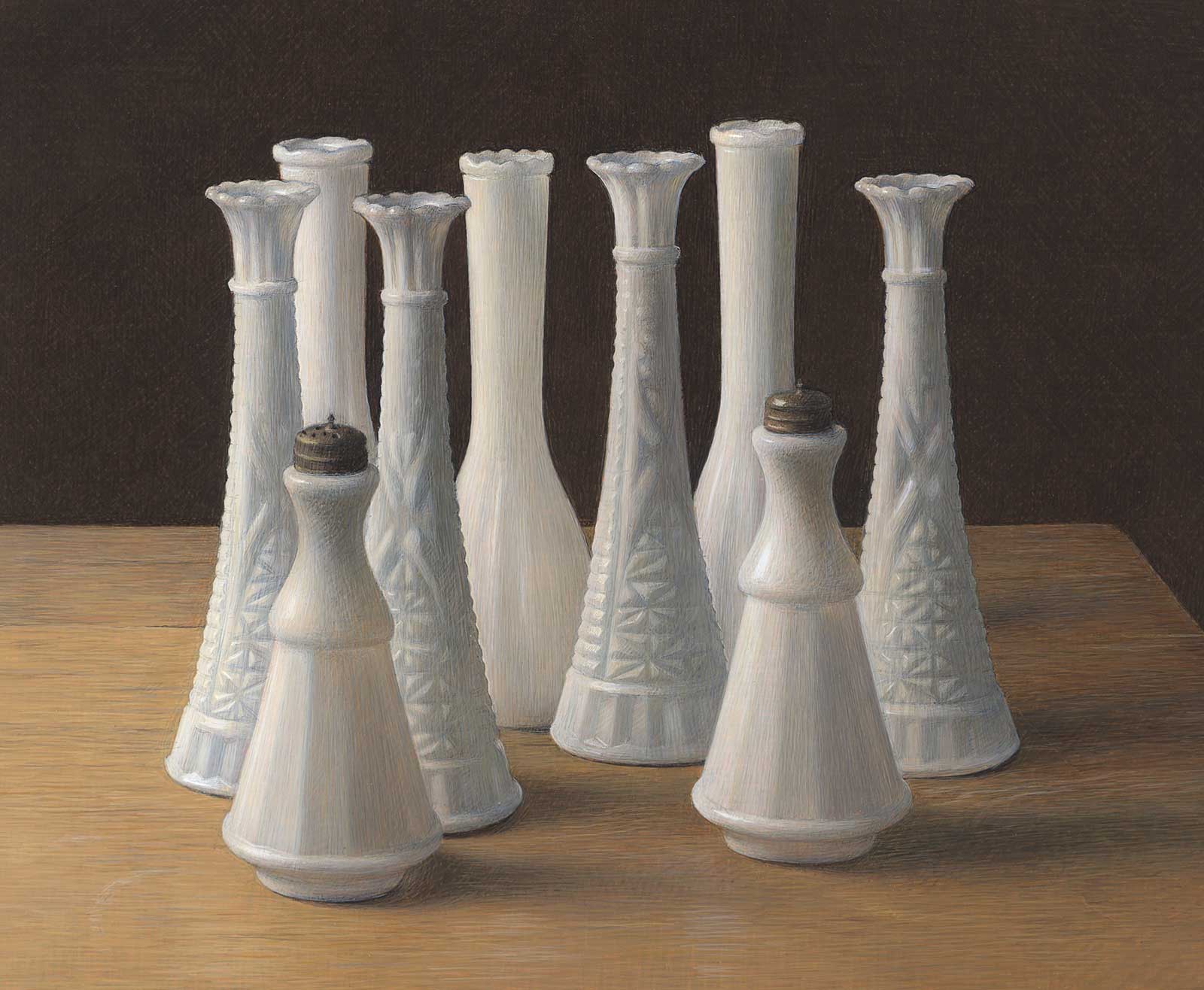
Milk Glass Vases, egg tempera on ACM panel, 11 x 14"
The reprieve from the pressure of producing for shows afforded Vadnais the freedom to further hone his skills painting in egg tempera, an ancient medium employed by many of his favorite artists, and whose techniques he has long applied to working in acrylic.
At home with a variety of water-based media, working with egg tempera was a natural transition. An organic mixture of egg yolk, dry pigments and water, Vadnais describes the medium as “somewhere between watercolor and gouache, a thin and translucent paint film with a subtly of color difficult to achieve with other mediums.”
Unlike oils, water-based paints are not very forgiving—once a mark is made, there is no taking it back. For this reason, Vadnais also produces preliminary sketches and studies of his still lifes because seeing the composition on a two-dimensional plane helps him better anticipate the problems he might run into while working on the final piece.
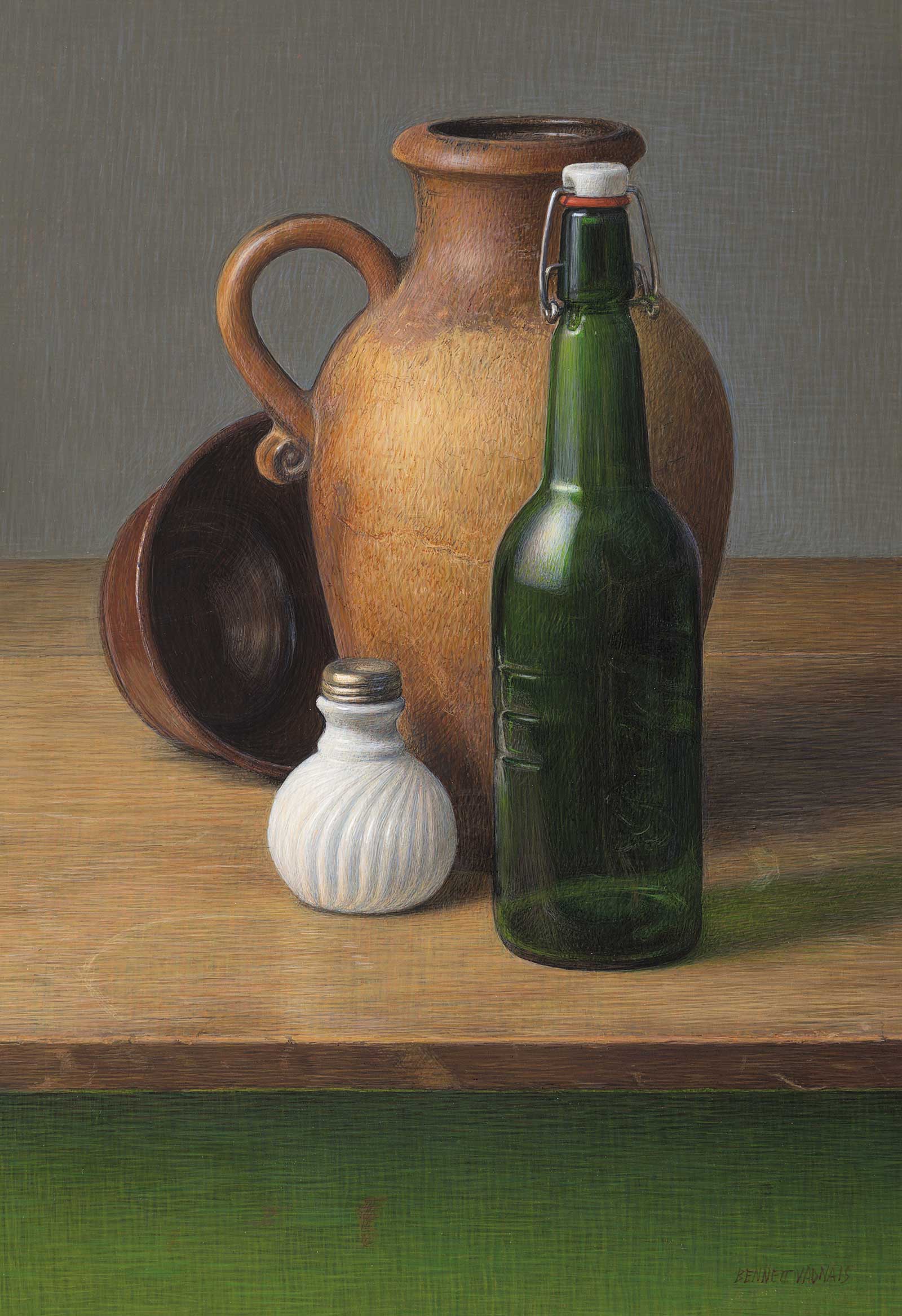
Still Life with Green Bottle, egg tempera on ACM panel, 10 x 15"
Vadnais has chosen various bottles, jugs and functional antiques in “milk glass,” an opaque to slightly translucent material with decorative embellishments that immediately transported me to my grandmother's house. These objects do not have sentimental value for Vadnais—they were chosen for their reflective qualities, textural properties, the technical challenges they pose and the contrast they provide with the other pieces in the composition.
“When the objects are all white it’s hard to paint the way light interacts with the surface,” says Vadnais, who considers himself more of a value painter than a colorist. “It’s an interesting study in how to balance your paint values when something is almost out of the range of what paint can imitate.”
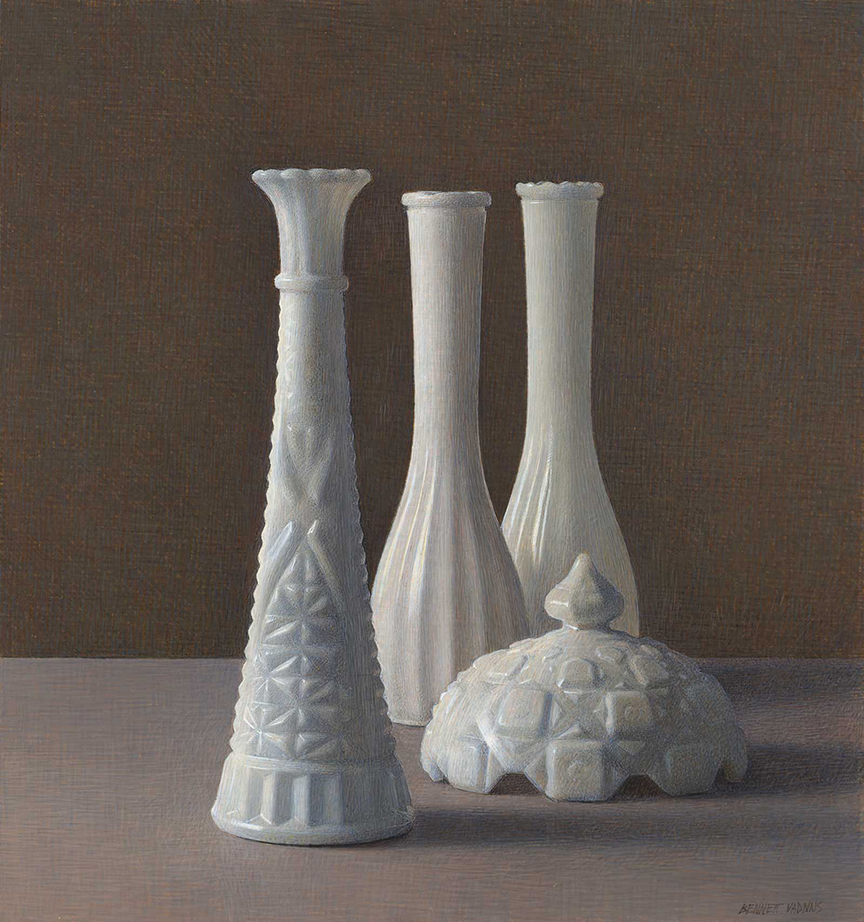
Three Vases and a Lid, egg tempera on ACM panel, 10½ x 11¼"
Despite the differences in scale, medium and genre, for Vadnais his still lifes and urban landscapes share more similarities than not.
“The main thing that I focus on is how light behaves,” says Vadnais. “With the still lifes it’s more controlled, and I can study it more precisely; but I also love the deep space and three-dimensionality I can get in landscapes to a higher degree. But really, I kind of feel like I’m in the same mode either way—I’m just painting light on objects.” —
George Billis Gallery 527 W. 23rd Street • New York, NY 10011 • (917) 273-8621 • www.georgebillis.com
Powered by Froala Editor