Leonard Koscianski begins his day at 6 a.m. with a 5-mile run through the streets of Annapolis, Maryland, with a group of fellow runners. “It’s dark,” he recounts, “the stars are out, there’s the moon. When we finish, the sun’s up and it’s daylight. We’re running in the transition of night into day.”
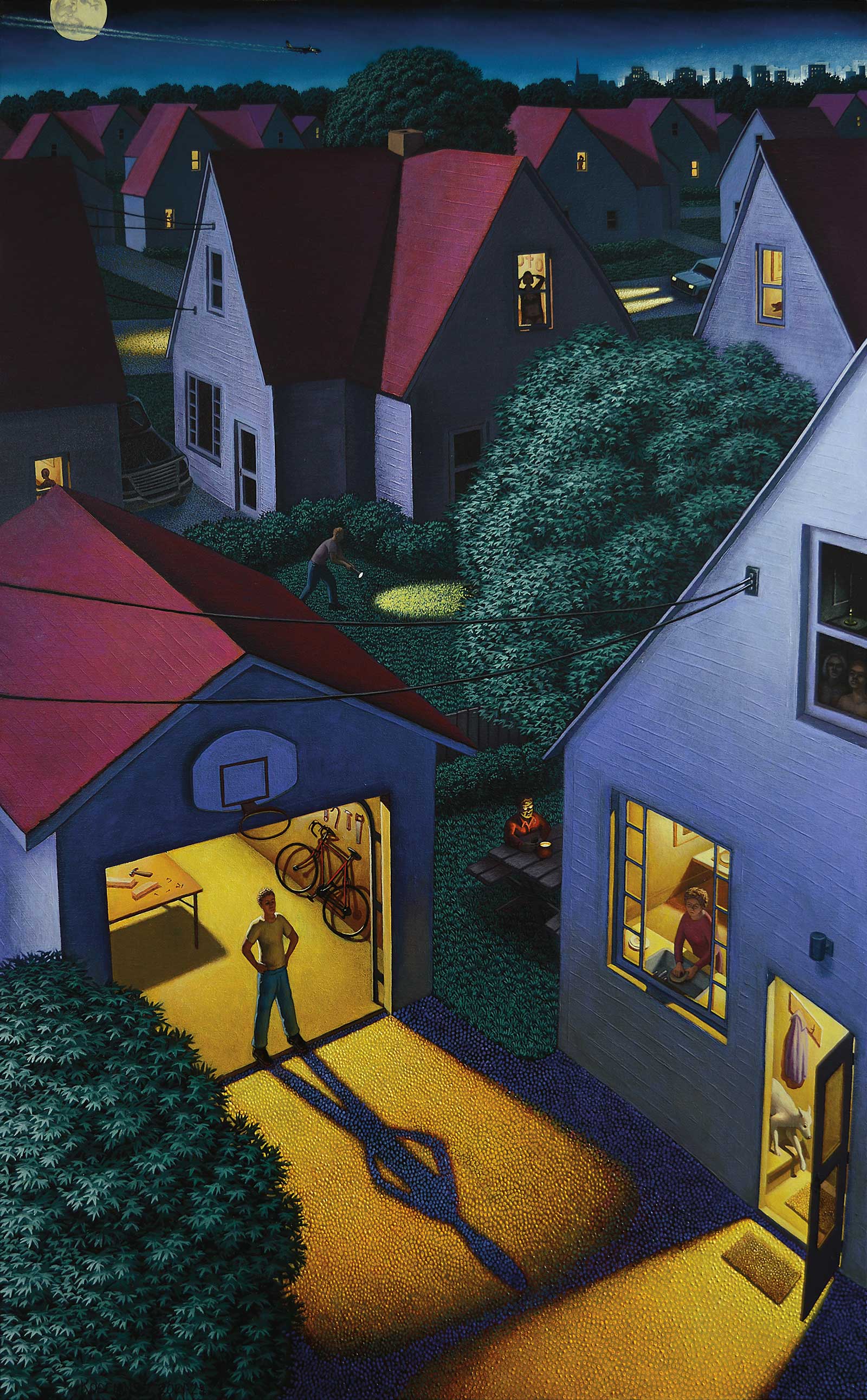
The Man Cave II, oil on canvas, 42 x 26". Courtesy J. Willott Gallery, Palm Desert, CA.
Light in its infinite variety illuminates his paintings, from cool moonlight to the warmth of incandescent light streaming out of buildings, relieving the dark. The phenomenon of the blueness of moonlight is caused by the light sensitivity of the eyes shifting to the blue end of the spectrum in low-light conditions. In Man Cave II, the blue moonlight is punctuated by the warm light of a garage, an open door and the light in windows revealing the house’s inhabitants.
Man Cave II follows Man Cave,a painting Koscianski finished and sent off to his gallery but kept questioning. He brought it back to his studio to rework it. It’s a painting of life in suburbia modeled after his brother’s house and his man cave in the garage. “When I was growing up in suburban Cleveland,” he recalls, “I would walk around at night and guys would be out in their garages working on their cars or something.”
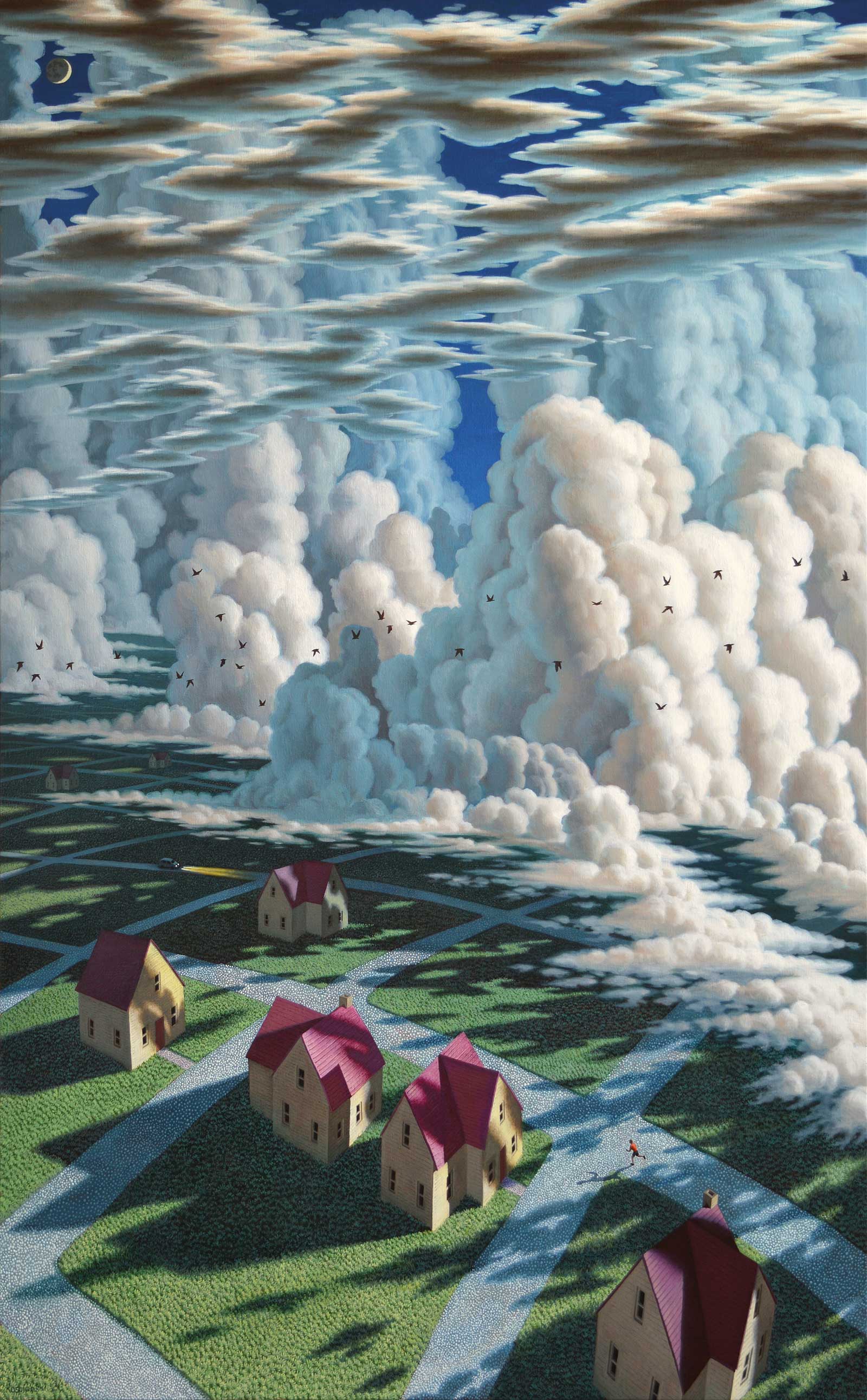
2 Stormy Weather, oil on canvas, 42 x 26". Private collection, courtesy J. Willott Gallery, Palm Desert, CA.
Originally the young man in the garage held a beer in his hand with a six-pack sat on the work bench behind him. “I wanted to make the symbols more healthy and removed the beer references and put tools on the workbench. He’s projecting his shadow outward into the world onto the driveway, which we do in our man caves. We sort of regroup and then go out and project ourselves into the world. I also realized I’d missed an opportunity to bring life to the other houses which I had painted with empty windows.” There is now an abundance of stories partly visible in the windows.
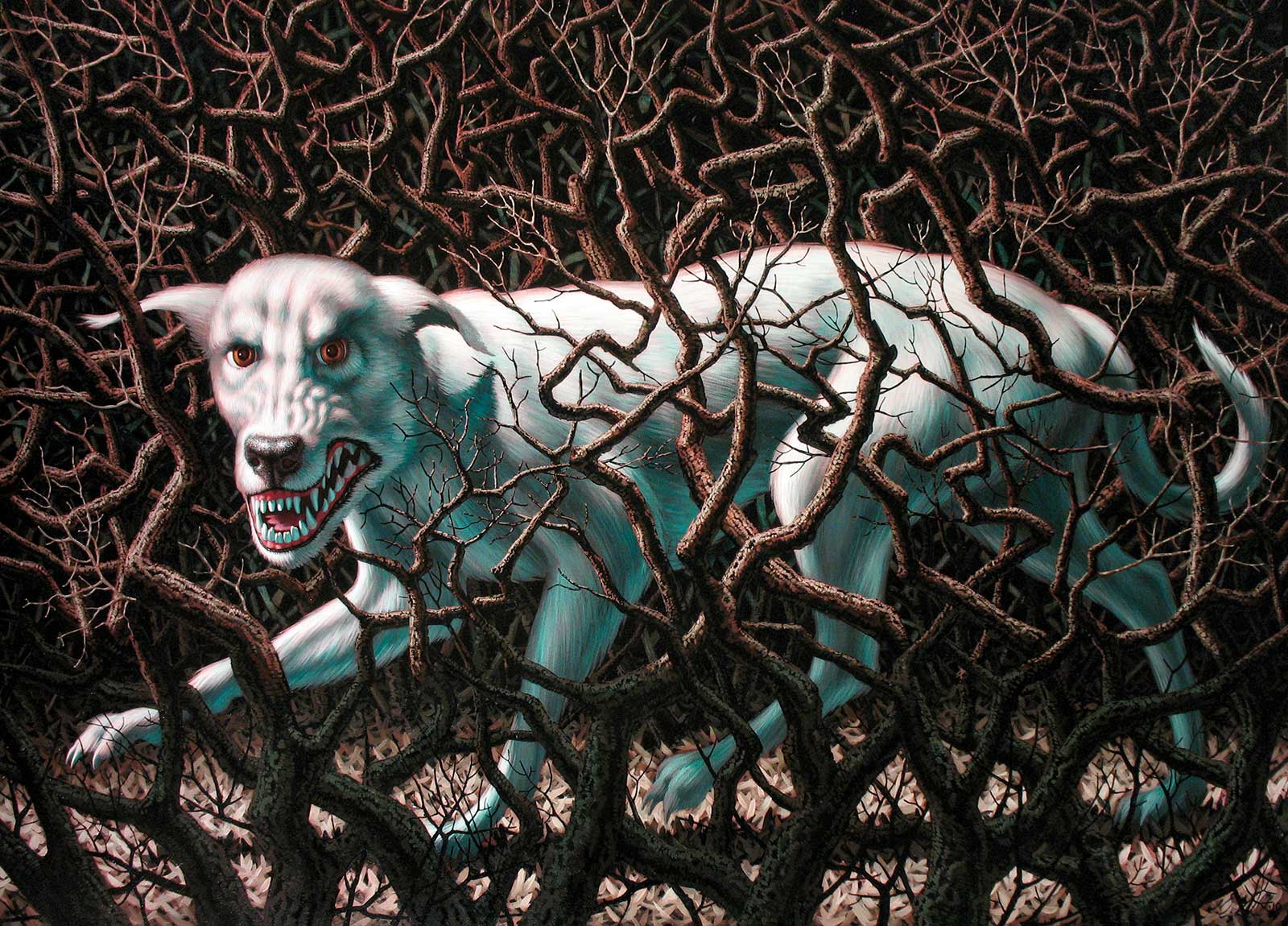
The Thick of It, oil on canvas, 26 x 42”. Courtesy J. Willott Gallery, Palm Desert, CA.
He reveals that his recent paintings are about personal experiences. Stormy Weather “is a metaphor for what was happening in my own life which was going through some stormy weather of its own. It’s so mysterious. Why do we create these things? Why do they relate to who we are?”
A storm gathers above the peaceful suburb. A lone runner heads, perhaps, for shelter. A car proceeds with its headlights on as the clouds obscure the sun. The tumultuous vertical clouds are balanced by the solidity of the sturdy houses and the characteristically rectilinear grid of the suburban streets.
The painting began with a sketch. “I was sitting in my studio with my sketchbook and my pen,” Koscianski explains. “I started drawing and it just sort of happened. I didn’t need to edit. It was there.
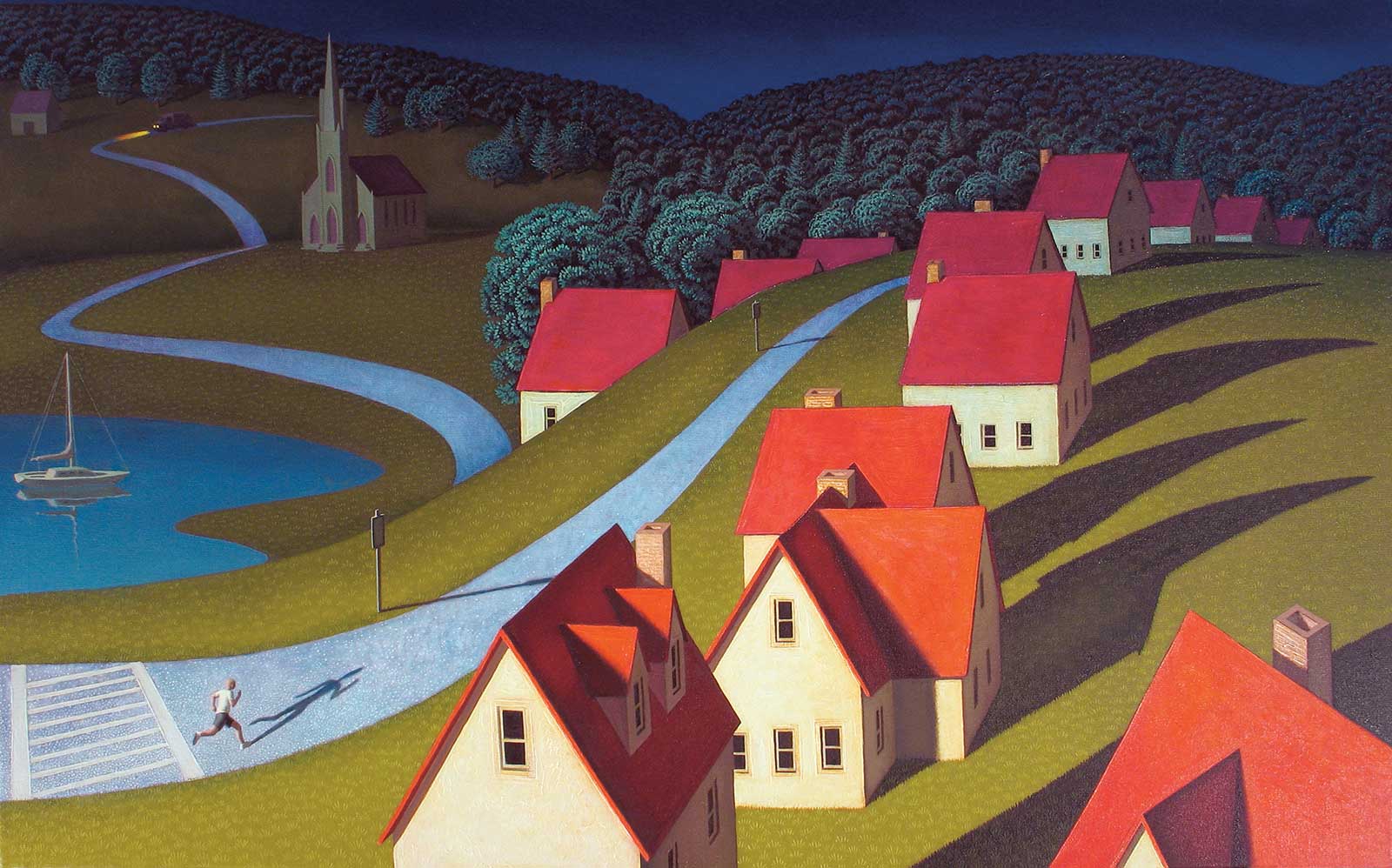
The Runner, 5 a.m., oil on canvas, 26 x 42”. Private collection, courtesy J. Willott Gallery, Palm Desert, CA.
“As a child I drew pictures and my father and I built model airplanes. I learned patience and meticulous craftsmanship from him. He was an attorney and I was looking forward to being an attorney or a doctor. One day I walked into the library of Saint Ignatius High School and found a huge textbook on modern art on the top shelf. I pulled it down and it was like ‘Wow!’ There was Dalí and the expressionists and Demuth’s I Saw the 5 in Gold. Suddenly history made sense. I could see evolution through art. My mother took me to the Cleveland Museum [of Art]. When I looked at the paintings, I could tell how they did it. I had learned about the physical properties of paint by painting a room at home and when I saw the paintings, I could see how they physically layered the paint. Later, when I attended the Cleveland Institute of Art, it was like coming home to a place I had never been.”
In art school, he says, “you had to justify what you did. You had to explain it. Why am I making this? How do I justify this? We were always thinking about the technical side of things—how to layer paint, what kind of brushes to use.”
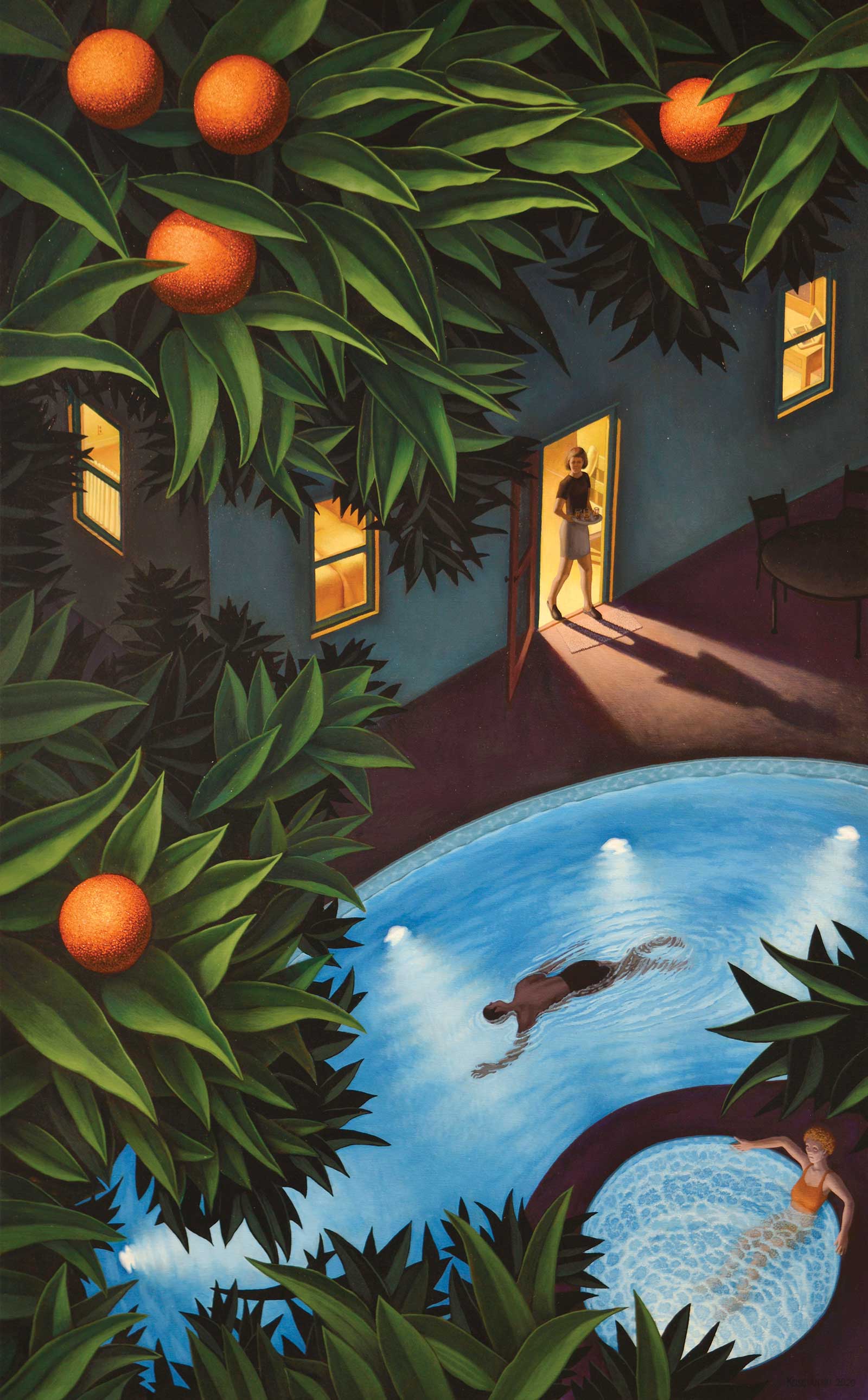
The Witching Hour, oil on canvas, 42 x 26”. Private collection, courtesy J. Willott Gallery, Palm Desert, CA.
Later, when he was teaching at the University of Tennessee he “put all the academic stuff away” intellectually and used it intuitively. In school he had been forced to create an artwork for a purpose. “I began to just paint pictures and then paint another picture. I don’t think of myself as an artist. I’m a kid from Cleveland who painted a picture and was compelled to paint another. I’ve been doing that for 45 years.”
Koscianski recalls conversations with gallery owners about painting intuitively. “I brought paintings up to Frank Bernarducci’s gallery in New York and began talking about them—I think this about this and that about that. Frank said, ‘Don’t think. Just paint.’ I have that posted in my studio. When I was showing with Phyllis Kind, she said that artists’ intentions in general are meaningless. She said, ‘You artists don’t know what you’re doing. Just do it!’”
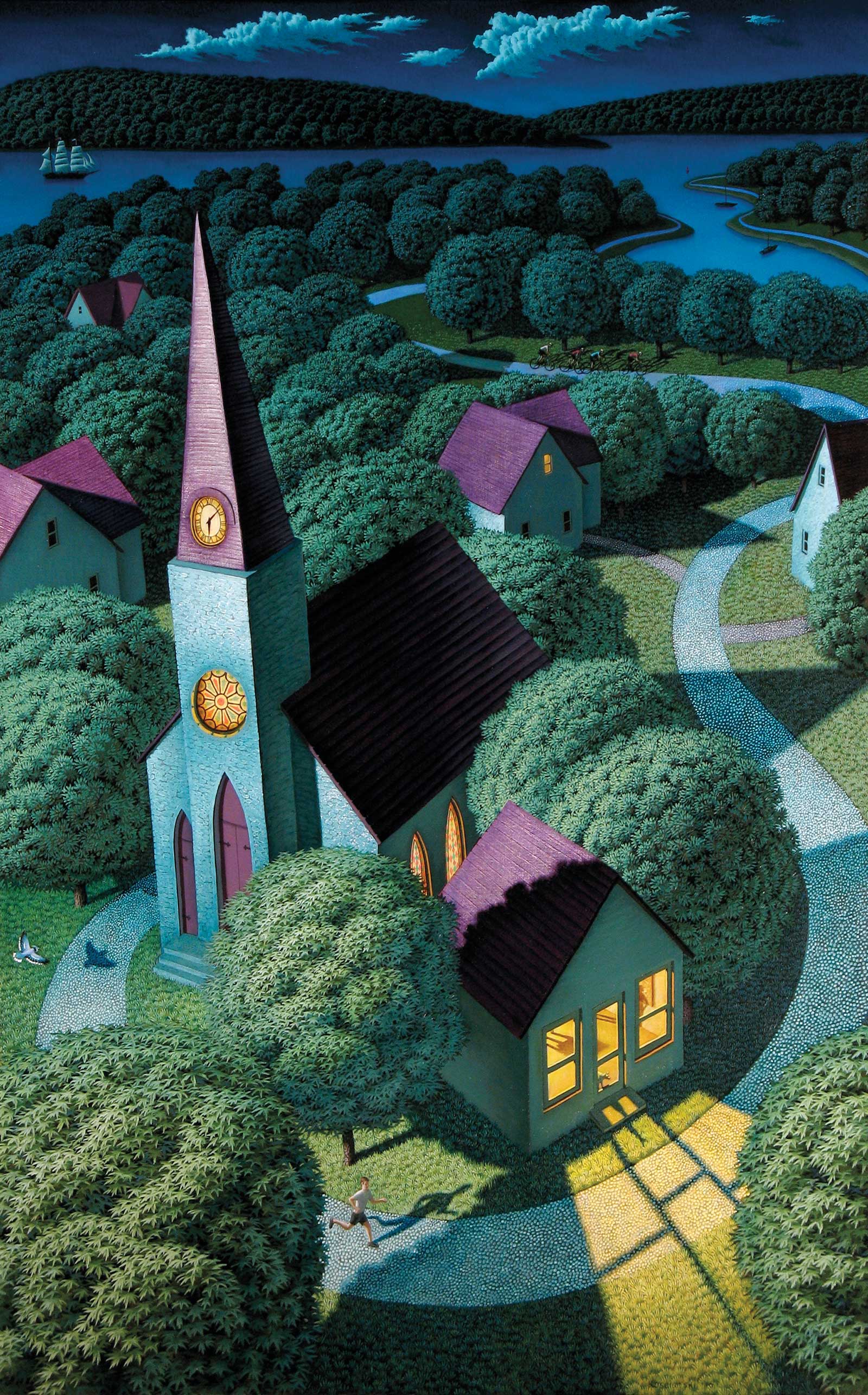
Summer Morning, oil on canvas, 42 x 26”. Private collection, courtesy J. Willott Gallery, Palm Desert, CA.
Painting the oranges in The Witching Hour, he wanted to make them glow and recalled his study of the Dutch masters. He painted them white with raised dots of paint to emulate their texture and then glazed with color—a technique he learned from the 17th-century Dutch painter Willem Kalf. He also points out Vermeer’s use of raised dots of paint that create a physical rather than an illusionistic highlight, reflecting the light shining on the painting.
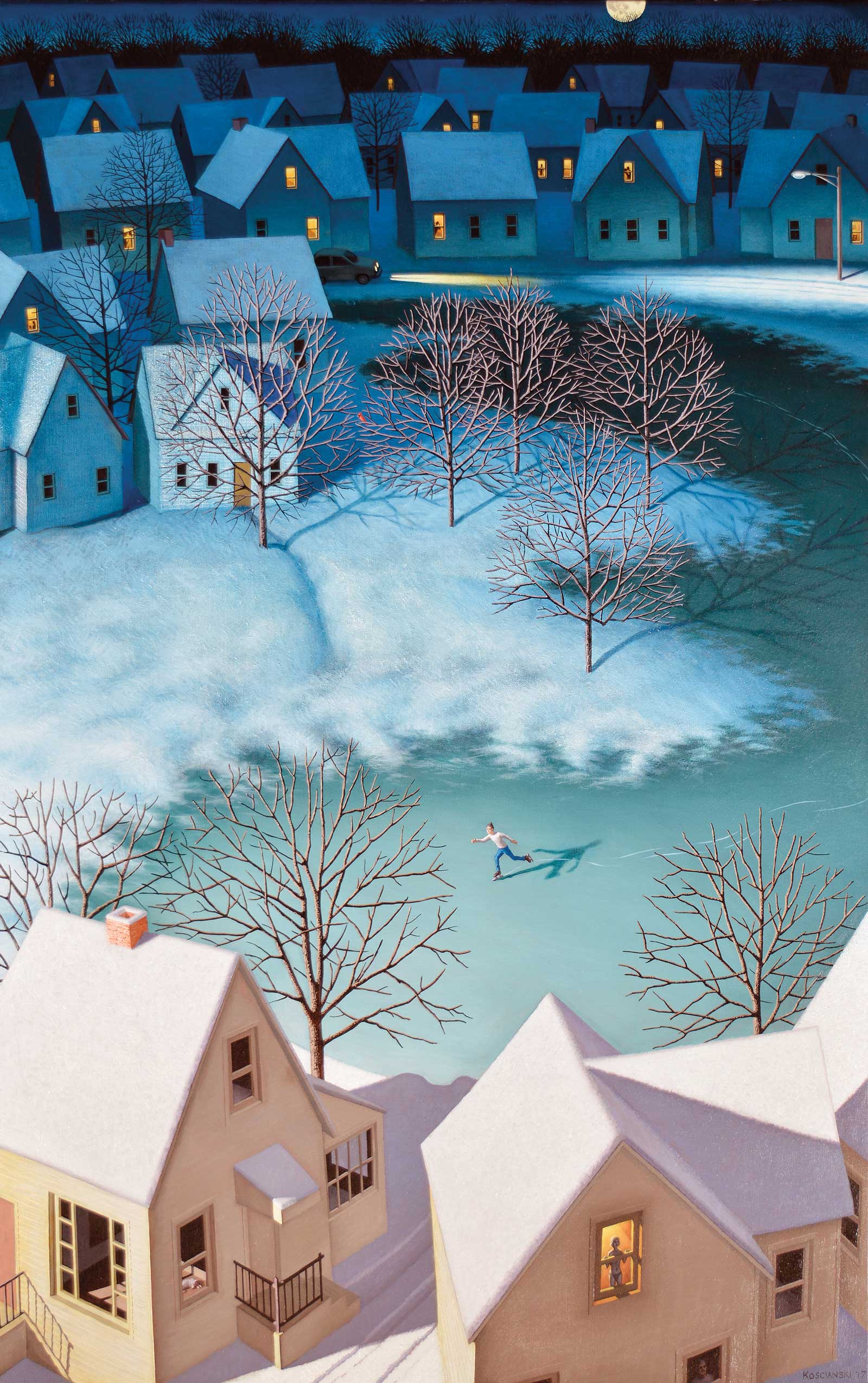
The Skater, oil on canvas, 42 x 26". Private collection, courtesy Stremmel Gallery, Reno, NV
His mastery of technique allows him to create paintings he calls “a surrealist blending of the conscious and the unconscious—the seen and the felt. Our perceptions are based on what we see but also on our memories and our language. For the child, so much of what they see is very chaotic. Until they master language, they can’t identify the things in the environment. When I teach about light and shadow I put an egg and a ping pong ball on the stand and shine a spotlight on them. I can then point out the parts of the shadow, the cast shadow, reflective light. The students then can identify and see what to them had been, simply, ‘shadow’.”
“Shadow” brings to mind his paintings of wild dogs, snarling and flying through the landscape. The image for his first painting of wild dogs came to him from out of the ether as his subjects sometimes do. After painting it, he was embarrassed by it but decided to send it out into the world. It was purchased from a New York gallery…by the Metropolitan Museum of Art, exhibited at the museum and featured in a number of museum publications. His initial reticence about sharing the painting gave way to a determination to always put himself out there, through and in his work.
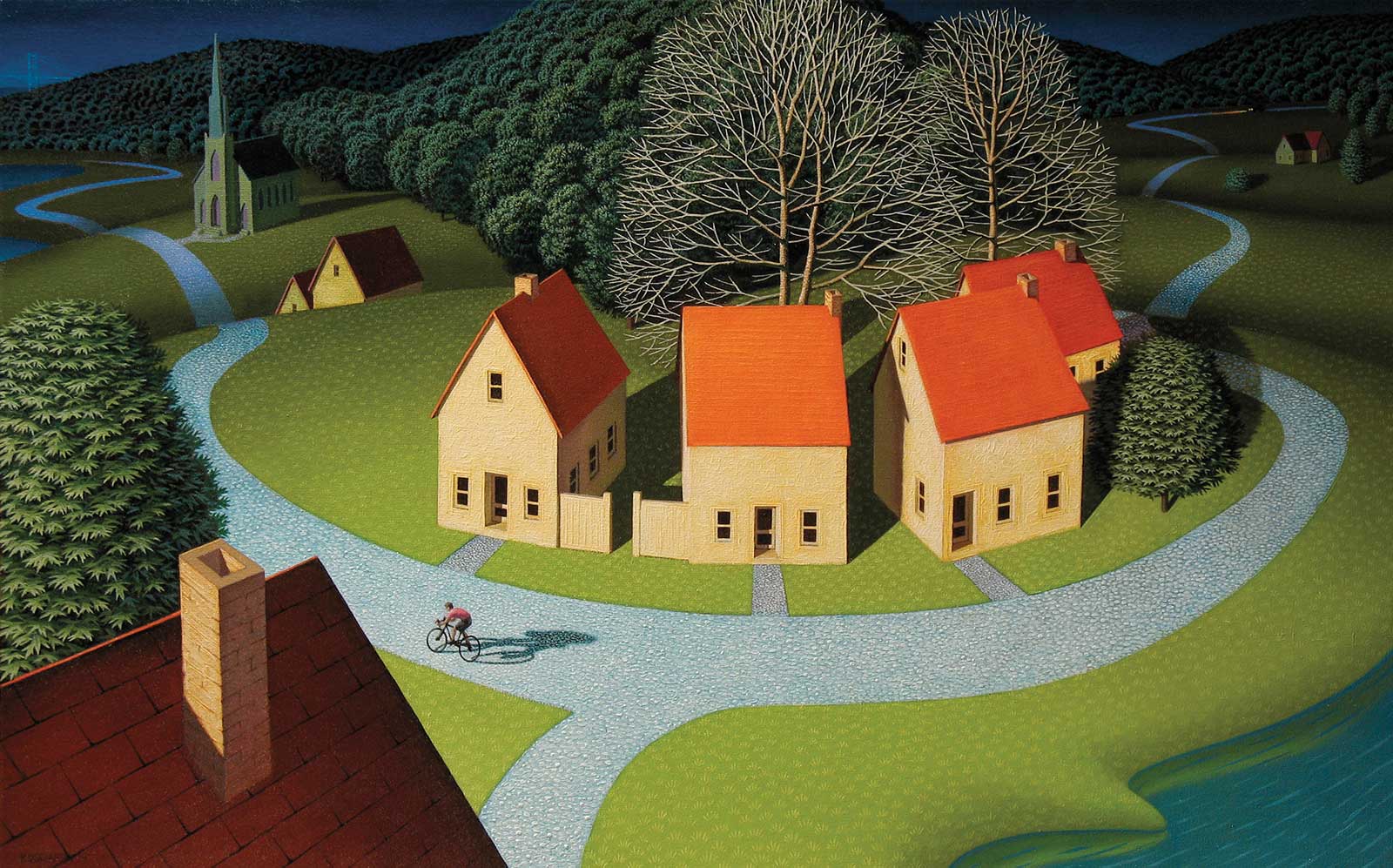
The Cyclist, 6 a.m., oil on canvas, 26 x 42". Private collection, courtesy J. Willott Gallery, Palm Desert, CA
In The Thick of It, a snarling dog glares out from within the confines of a thicket, angered perhaps by its predicament. The energy of anger “can be seen as threatening,” he observes, “but also as valuable. It’s the same energy we use to protect our families and our children.” When the Arnot Art Museum was given one of his wild dog paintings, Between Heaven and Hell, the educators and docents were reticent to show it to children—but the children loved it!
There is dark and there is light in Leonard Koscianski’s paintings, both visually and figuratively. They reflect the complexities of the visual world and the psychological world, the painter’s complexities and our own. —
Powered by Froala Editor