Once in a blue moon a new genre of art will arise, but more often than not, there will simply be exciting new trends and styles that appear within an existing genre. Back in 2016, we noticed a significant shift when many realist artists were bravely starting to introduce abstract elements in their representational figures, a style I coined as “Hybrid” in an article written that year. Today, in 2024, they are taking it a step further by maintaining a refined, tight realism, and combining it directly with bold abstract shapes and color.
The effect of this juxtaposition is exciting on many visual levels. The refined technical skill of high realism achieved in these works can be marveled at, while the loose color and shapes evoke feelings, the decorative arts and movement. Perhaps not a new genre of art, but certainly an exciting and noteworthy new trend currently being employed by some of the most highly recognized contemporary realist artists today. It may also be a necessary evolution for artists working in the relatively narrow market of realism in order to cross genre boundaries and have their work included in exhibitions, galleries and collections that lean more modern and abstract.
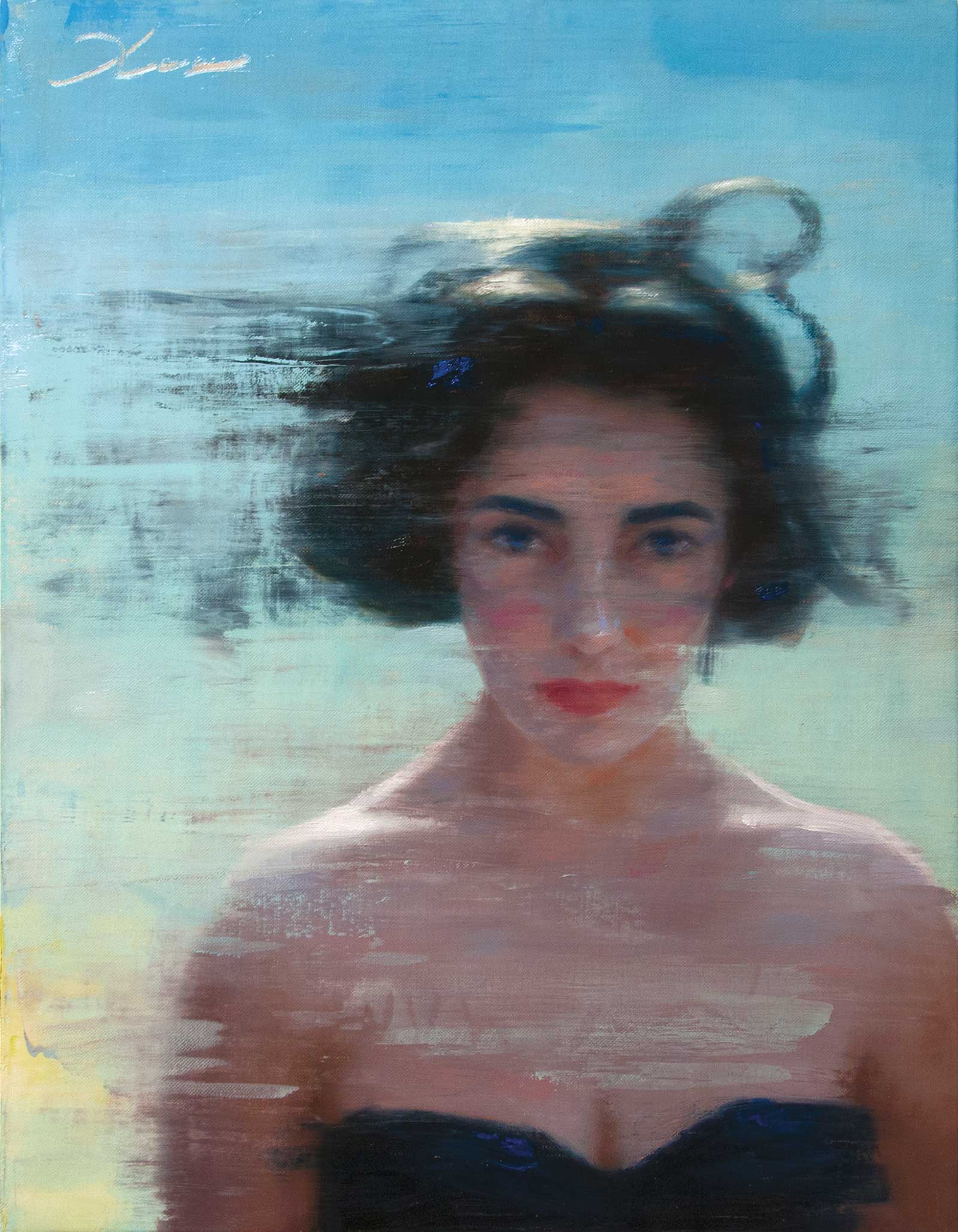 Vincent Xeus, Elizabeth in Tadema Sky, 2018, oil on linen, 18 x 14”. Private collection.
It’s important to note that these works are combining realism and abstraction, two styles that are usually quite at odds. Realism is defined as “the accurate, detailed, unembellished depiction of nature or contemporary life.” Realism does not typically incorporate imagination, but is based on close observation of life. It is also known as “representational” or “objective” art, meaning that it depicts real objects or scenes that are easily recognized. Within realism there are also many subcategories such as neoclassicalism, impressionism and cubism, to name a few, but all are grounded in the representational.
On the other hand, non-representational or abstract art does not attempt to portray an accurate rendition of visual reality, but instead uses shapes, colors and gestural marks to convey a feeling or moral dimension. It is also sometimes called “non-objective” which means separated from reality and not representative of an immediately identifyable person, place or thing. This genre emerged out of a post-war response to all things traditional and classical. A sense of freedom accompanied the artwork and was “felt” by the artists who wanted to express themselves in an expressive, open form. For Kazimir Malevich, an influential figure in the development of abstract art, shapes and colors had an emotional force comprised of pure feeling.
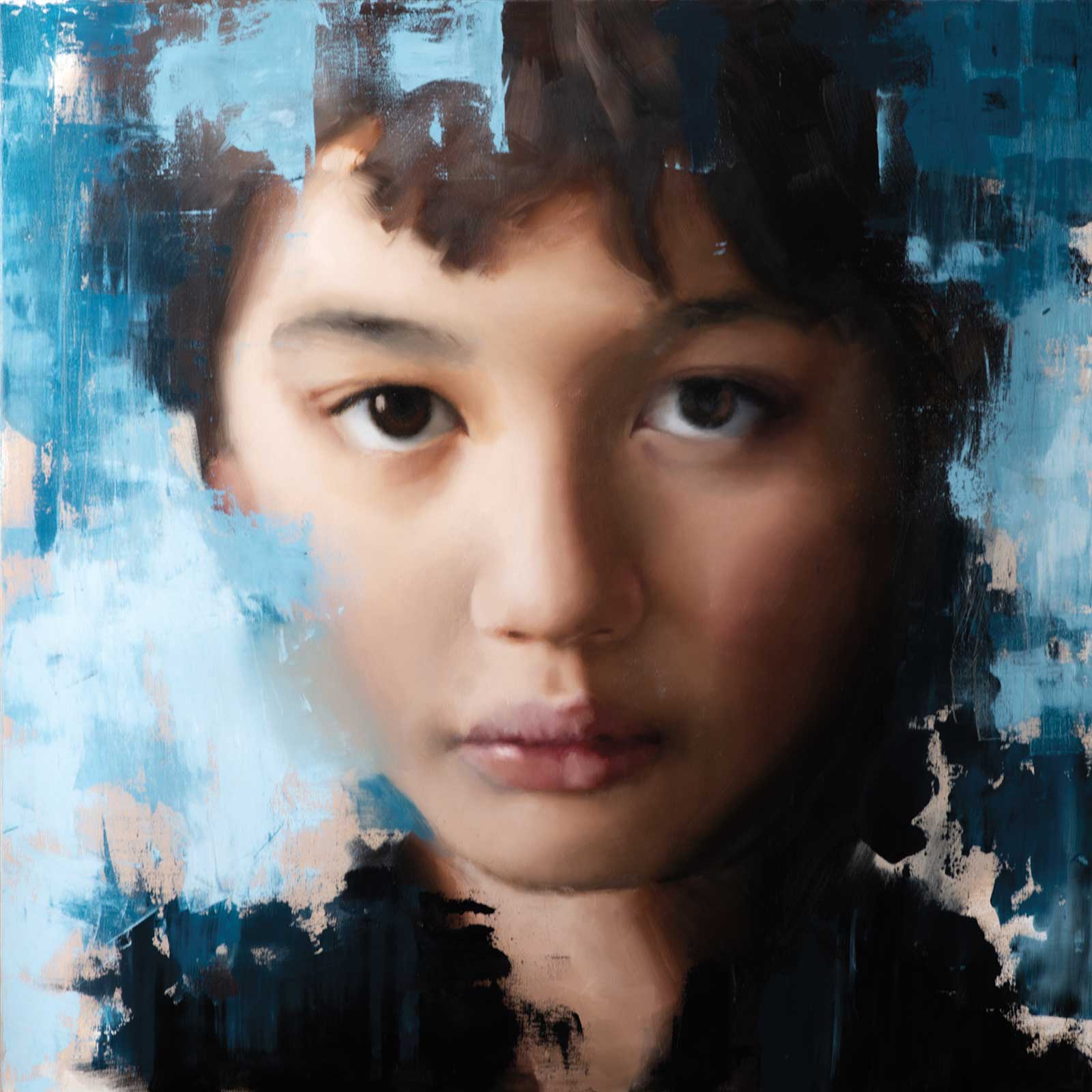
Bertrand Martin, Octave aux yeux Bruns, 2020, oil on linen, 47 x 47”. Courtesy Galerie Frederic Got, Paris.
Appreciating these opposing genres is fundamental in understanding what the realists of today are achieving within their work. Realism has been with us through the ages and reigns in the annals of art history. This can be seen in the horse drawings in the caves of Lascaux, the figures on Egyptian tombs, Roman statues, the works of Giotto, Michelangelo’s Sistine Chapel frescos and Leonardo’s Mona Lisa to the detail-oriented Dutch painters such as Rembrandt and Vermeer, Goya and Millet. Even the impressionists depicted subjects and scenes we recognize. We have always been awed by the incredible skill of these artists and the way they capture reality with brushes and pigments of color. Abstraction arrived on the art scene as early as Cézanne and Picasso, but its purest expression is often associated with works by artists like Wassily Kandinsky, Jackson Pollock and Mark Rothko, who used geometric shapes, bold color and splatters to convey their thoughts and feelings on canvas. It was a revolt against tradition and the constraints of control—even control of the brush. The movement brought a new level of creativity and aesthetic to the world of art.
Today, contemporary realist artists have been applying abstraction to all aspects of their paintings, the subjects as well as their backgrounds, while remaining true to their realism roots, resulting in striking, noteworthy works.
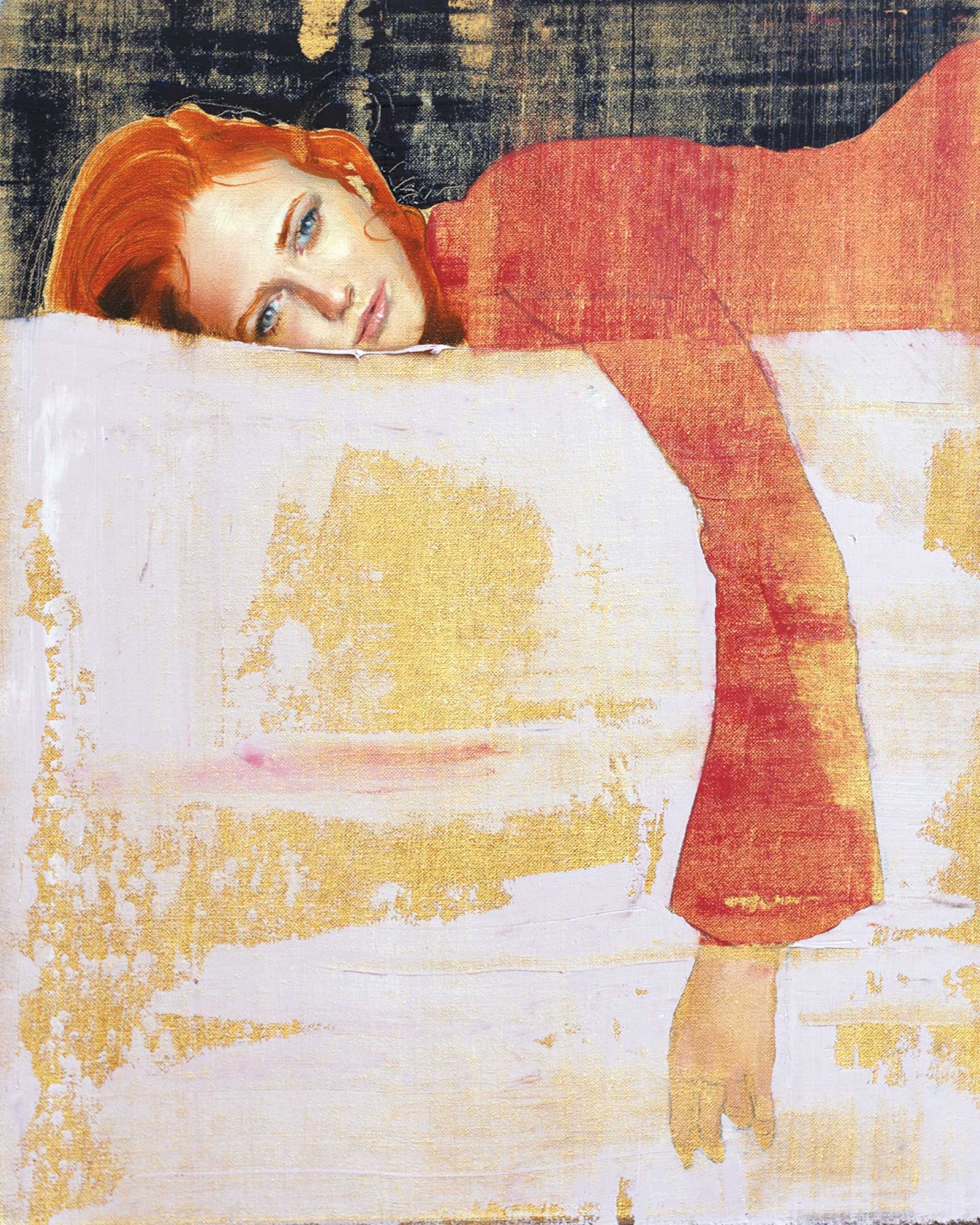 J Louis, Somewhere, 2023, oil on linen, 20 x 16”. Private collection.
In Octave aux yeux Bruns,a recent work by French artist Bertrand Martin, the artist employs his rare technical skill to depict a realistic figure. Sublime skin tones and gradual value transitions bestow a three-dimensional effect to the portrait set against a quickly painted background full of movement, bold blue strokes and blurred abstract shapes. Martin explains the two states of minds he inhabits when creating these new works. “In the first layers I create the background using acrylic and larger painting materials or knives to boldly spread the paint around the canvas and scratch the surface to add interesting texture. This part of the work is fairly fast as are my hand movements. I imagine how the realist figure will sit within the abstract shapes and how they can add to the feeling I am trying to convey. Once that is dry,” he continues, “I start in with classical realism techniques painting the figure with smaller brushes to add realistic details which is the time consuming and mainly technical part.”
The juxtaposition of the flat, bold shapes next to the highly realistic face with a frontal gaze makes it even more poignant and striking, taking the viewer through a gamut of feelings and layers of enjoyment when experiencing the work. By employing the two opposing styles and techniques, Martin has succeeding in creating a visually exciting yet subtle and calm work of art.
In the work Isla by J Louis, we see a similar combination of a tightly-rendered face and a graphic, stylized background. Here the realistic figure is draped over a vague, unidentifiable shape. Her clothes are recognizable but the traditional depiction of folds in the fabric is absent and replaced by thick “flat” paint applied with a palette knife. As with many of his paintings, the work contains aesthetically pleasing color harmonies.
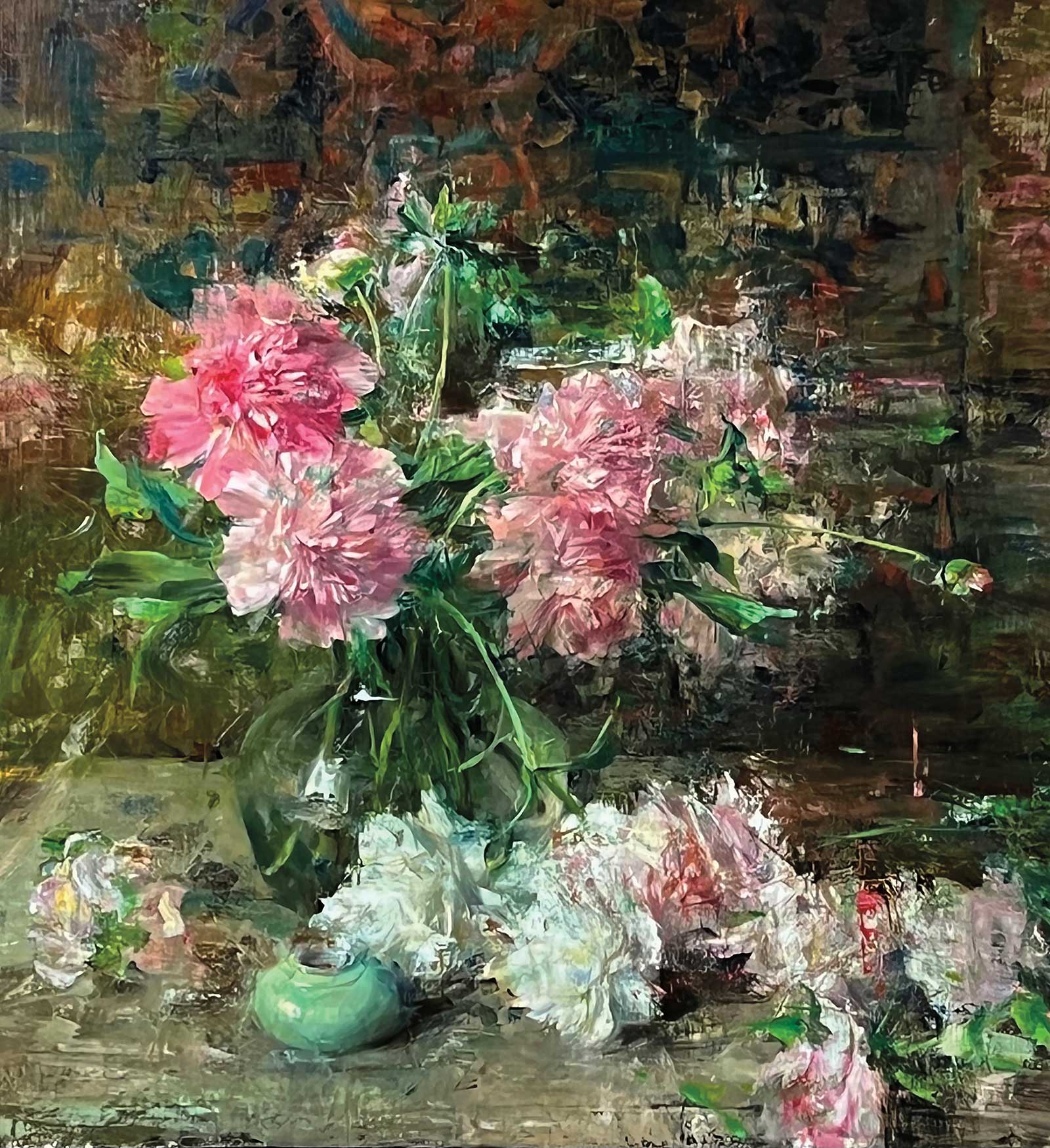 Quang Ho, Arrangement with Peonies, oil on linen, 30 x 30”. Private collection.
Timothy Rees has been exploring merging realism and abstraction for about five years and his paintings are increasingly leaning to opposing poles. “Teaching in the atelier, we always painted models in classical settings,” he shares. “Eventually the traditional idea of copying my observations, while great for refining my ability to see and render, left me uninterested. I wanted to test the boundaries of realism. I wanted to explore the dynamic ways paint can be applied. I wanted to use brilliant colors and compositions against realism and understand how to connect our everyday world to one of design. This exploration of reality versus fantasy, of observed humanity versus pure design, is a pure form of art that drives me to the easel.” An example of Rees’ style can be seen in Birth of Venus,in which the model’s shirt is not rendered in the tight realism of his earlier classical work, but rather simplified in an illustrative manner that bleeds into the background.
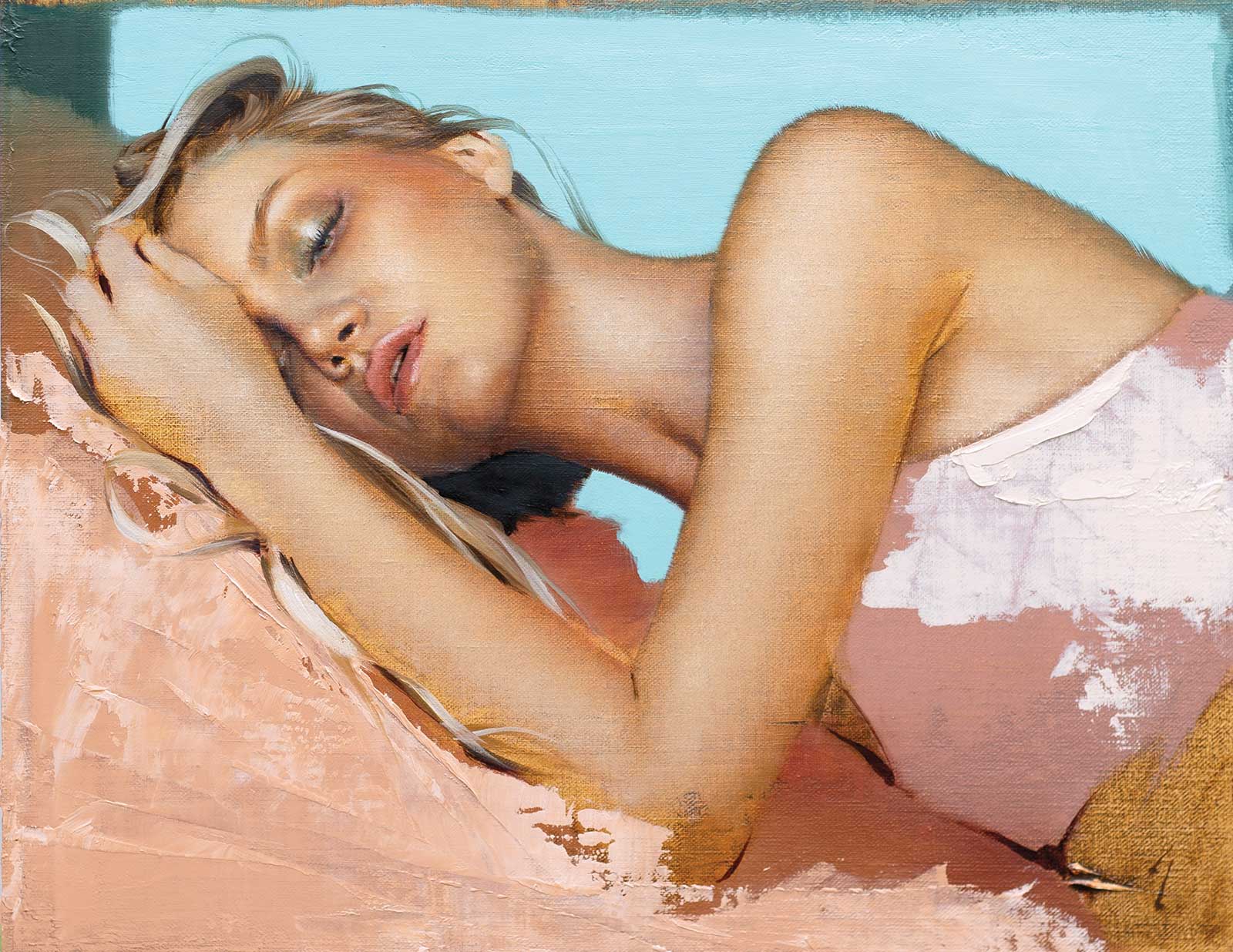
J Louis, Isla, 2022, oil on cradled linen panel, 14 x 18". Private collection.
Vincent Xeus, an artist celebrated for his ability to match Vermeer’s refined realism, is also one of the first contemporary realists to break with this tradition. In his painting Elizabeth in Tadema Sky, Xeus creates a visually interesting work by placing the iconic figure in an abstracted field with blurred strokes to create the sense of movement, and give the impression that the subject is fading away into the background. The soft edges add a delicacy to the portrait, enhanced by the abstract flat paint over-top. The background is a simple gradation of shapes and color which brings the focus back to the realist form of the face, allowing this work to cross over into the realm of modern art.
This combination of opposing styles does not just apply to figurative works. It also appears in works like Quang Ho’s recent Arrangement with Peonies,where the soft, lost edges of his beautifully rendered flowers meet the background. The detailed green pot highlights his technical skill at realism while the overall movement created in the work through blurred effects, speaks perhaps to the ethereal and fleeting beauty of the flowers themselves.
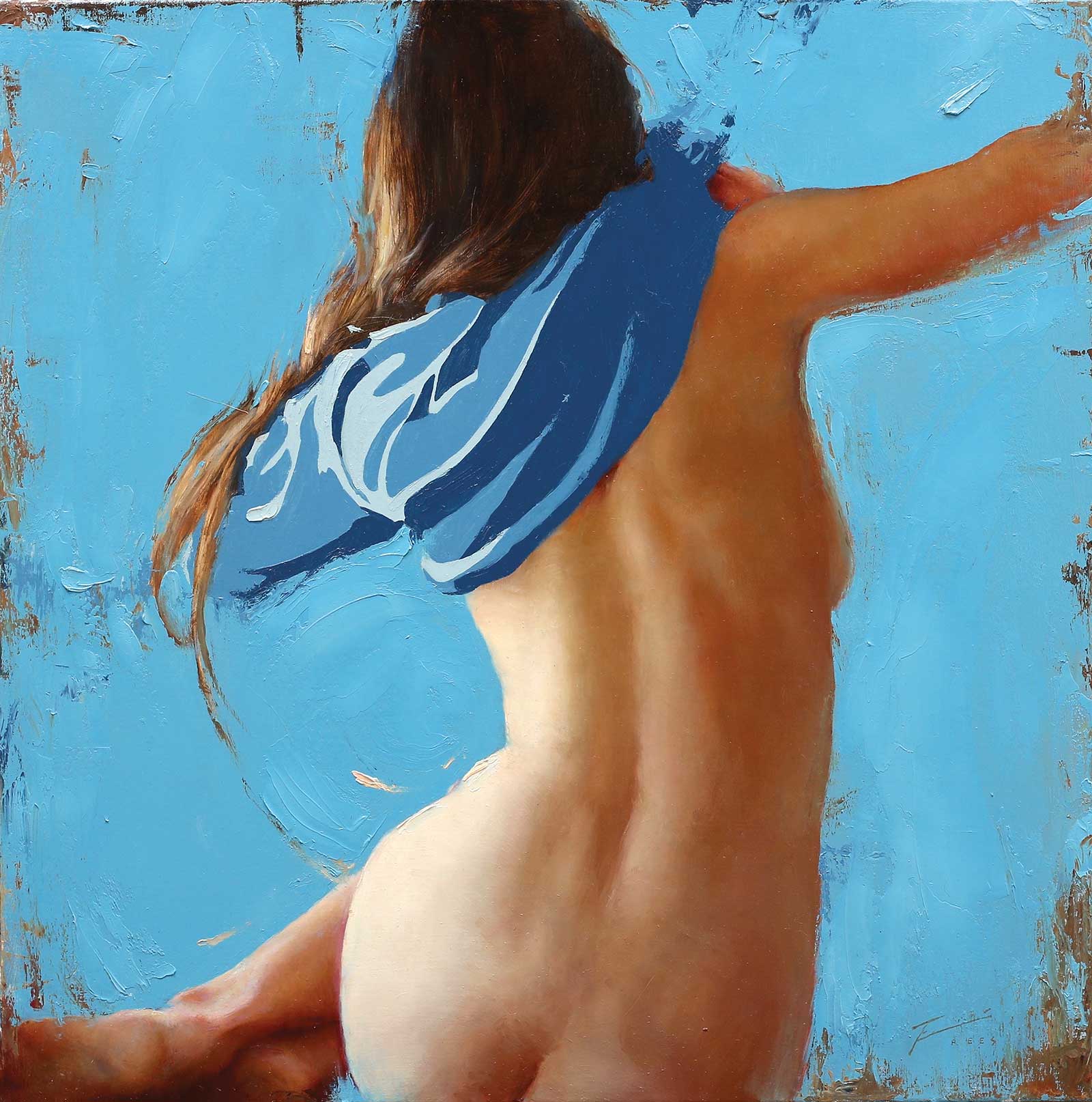
Timothy Rees, Birth of Venus, 2019, oil on linen, 24 x 24". Courtesy Bonner David Galleries, Scottsdale, Arizona.
Although these genres have crossed paths before in fine art, the current trend among top contemporary artists is a subject of conversation among art students, patrons and collectors. Will we be seeing more realist artists introducing abstraction to their works? Will the most classical contemporary realists such as Jeremy Lipking and Adrian Gottlieb remain loyal to their traditional representational style, roots and inspiration? We will watch closely as the genre of contemporary realism continues to evolve. —
+++
Vanessa Françoise Rothe is a curator, editor/writer, art dealer and fine artist. In addition to curating over forty exhibitions, she has had dozens of articles published in various art magazines over the last 20 years. She has served as chairman, art director, educational director and on the PR Committee for numerous fine art organizations, and is the proud founder of the Americans in Paris fine art project.
Powered by Froala Editor