Sade’s iconic song of unrequited love carries layers of meaning as the title of Salman Toor’s latest exhibition. Sensual yet devastating like Sade’s music, Toor’s paintings inhabit a world where love falls outside the bounds of ordinariness. Furtive, tender, vilified, Toor’s queer men of South Asian descent carve out spaces where they can find each other and be themselves.
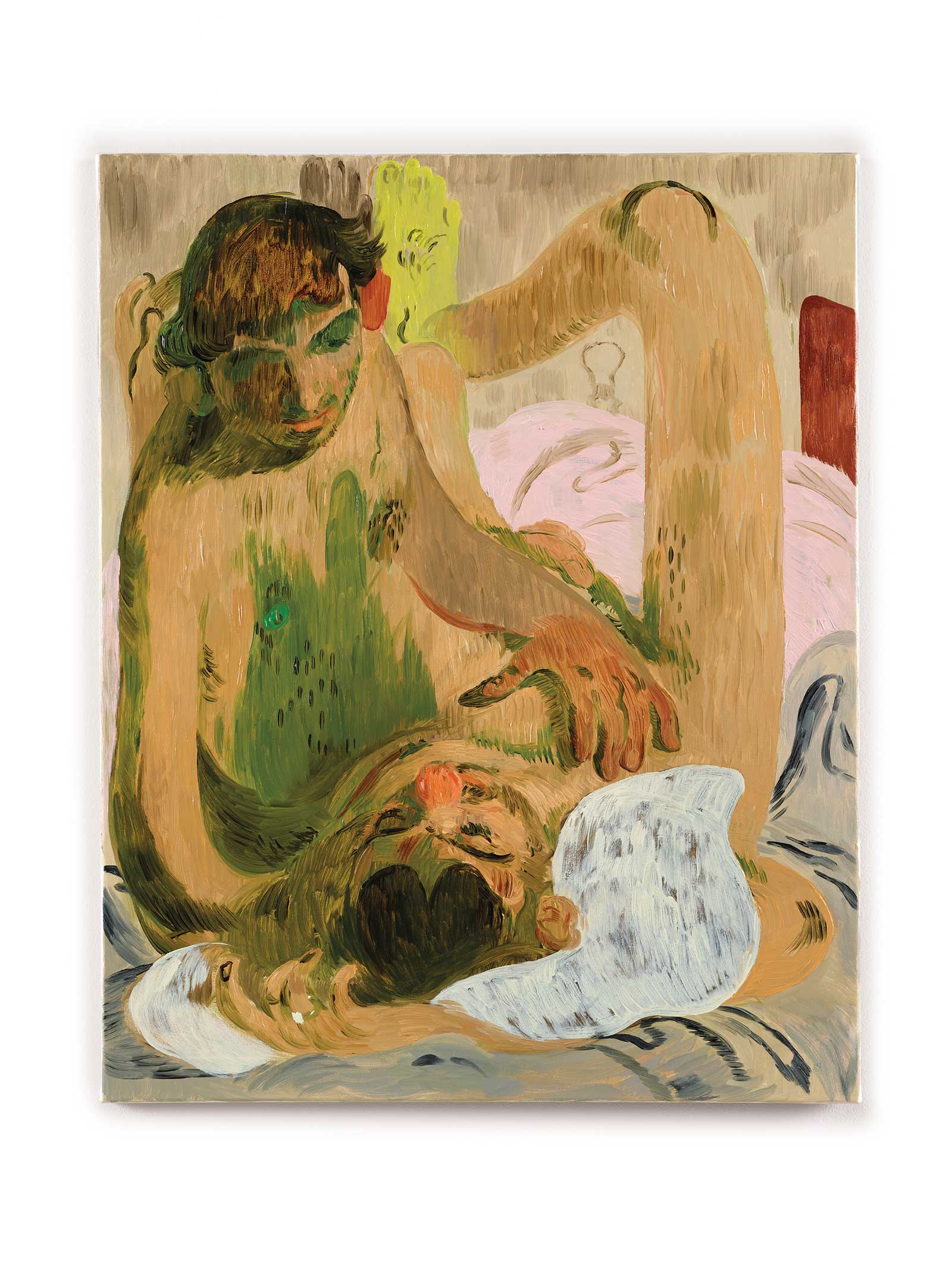
Boys in Bed, 2021, oil on panel, 30 x 24”. Rose Art Museum, Brandeis University. Gift of Adam and Rachel Green, 2023.9. © Salman Toor; Courtesy of the artist and Lurhing Augustine, New York.
Salman Toor: No Ordinary Love opens November 16 at the Rose Art Museum at Brandeis University, and runs through February 11, 2024.
Toor’s paintings defy easy description. New York Times art critic Roberta Smith described Toor’s 2020 show, How Will I Know, at the Whitney Museum of American Art as “an aesthetic territory bordered by painting, illustration and cartooning” that “almost forms an unusually sumptuous graphic novel.”
The same could be said of No Ordinary Love.Each painting and work on paper tells a story. Young men in love, or lust. Tender yet charged moments in bars or on the street. Illicit lovemaking in a tent on the grounds of an estate. Dinner tables, bedrooms, museums. The figures in these scenes often have exaggerated features—clown noses, or protruding noses like Pinnochio. Rubbery arms and legs, hair like helmets, bulbous fingers like Mickey Mouse.
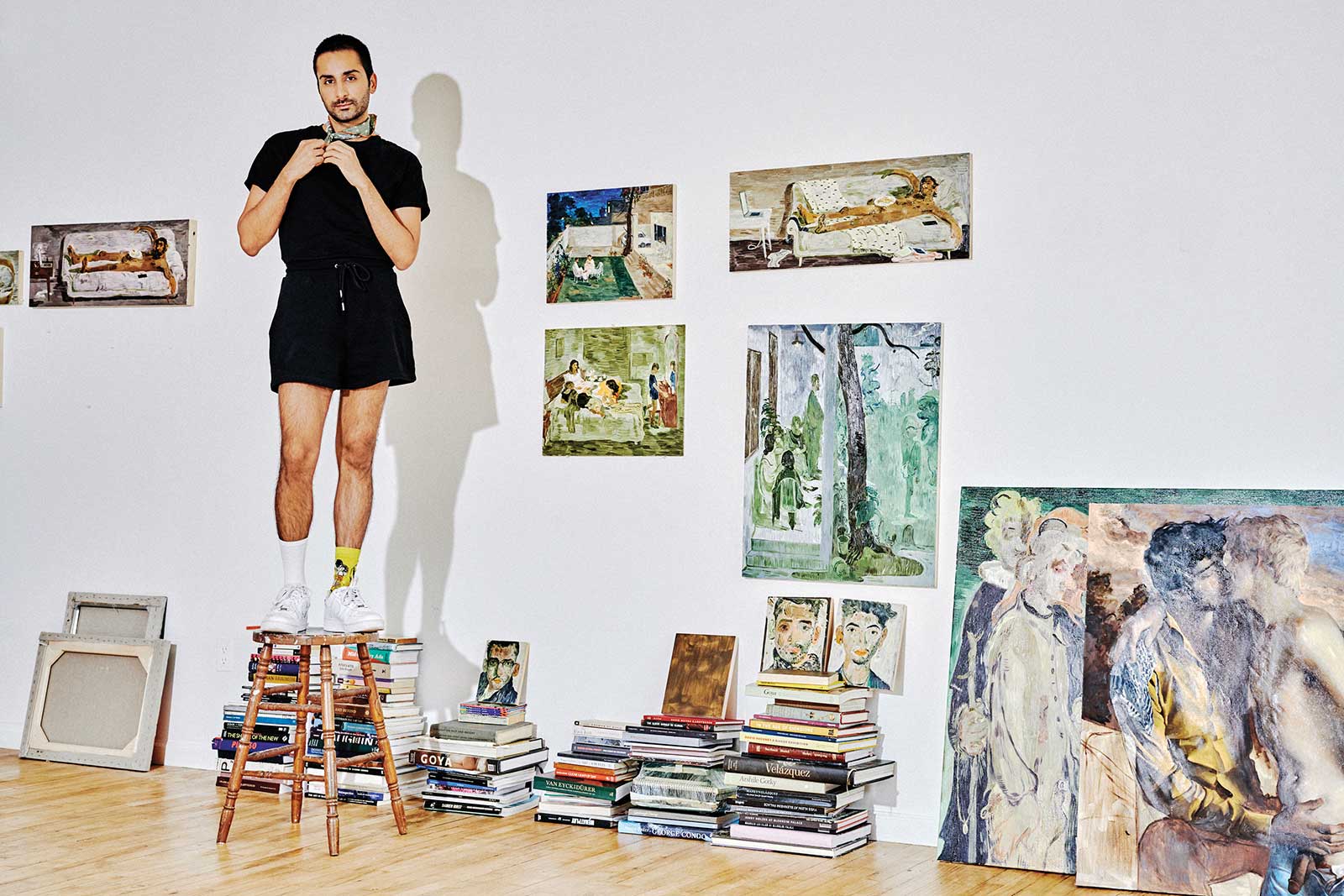
Salman Toor, 2022. Photo by Bryan Derballa.
The cartoonish elements in Toor’s work open the door to deeper looking, according to Dr. Gannit Ankori, chief curator at the Rose Art Museum. “Salman Toor’s paintings and drawings address multiple themes, many of them quite difficult,” Ankori says. She says by blending formal beauty with humor, Toor allows his viewers “to access the unbearable weight of the traumas embedded within the paintings.”
“The use of humor and grotesque renditions camouflage profound pain and are coping mechanisms that have been employed by artists from Goya to Toor to deal with trauma,” Ankori says.
Born in Pakistan in 1983 and now based in New York, Toor began his career painting virtuosic contemporary versions of Old Masters portraits and landscapes. He fulfilled his ambition to be as good as the Renaissance painters he had long admired. But in the last decade, Toor began to explore other styles and subject matter closer to his lived experience. He began inserting himself and his friends into his paintings, and it is that work that propelled him to art-world fame.
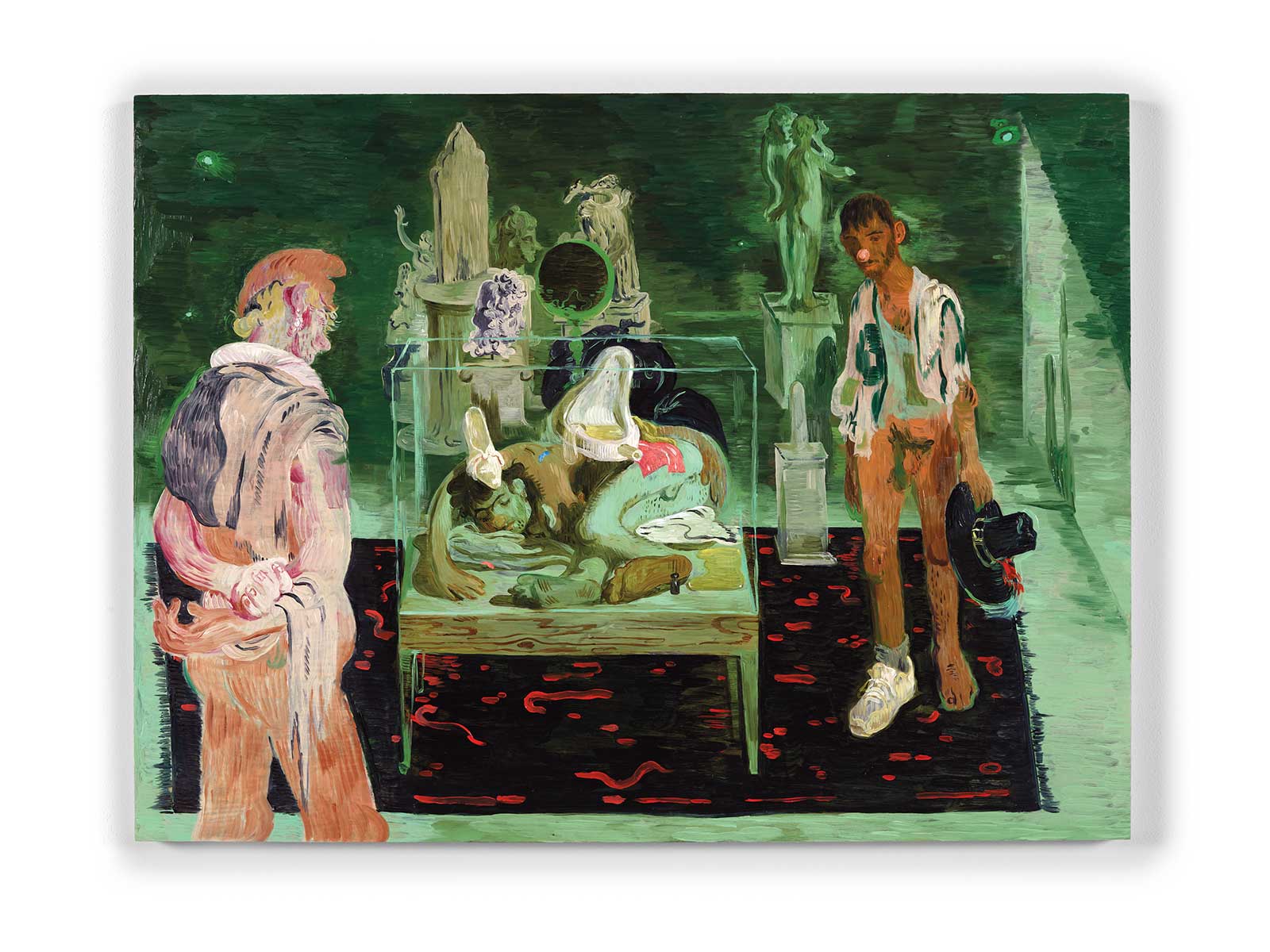
Museum Boys, oil on panel, 2021, 30 x 40”. Collection of Scott Mueller. © Salman Toor; Courtesy of the artist and Lurhing Augustine, New York.
No Ordinary Love is Toor’s second institutional exhibition. It was organized by and debuted at the Baltimore Museum of Art and curated by Dr. Asma Naeem. The Rose Art Museum is the final venue for the exhibition. Previous venues included the Honolulu Museum of Art and Florida’s Tampa Museum of Art.
The Rose Art Museum acquired one of the works in the exhibition, Boys in Bed.The painting shows two men in a tender moment, perhaps during or after lovemaking. One lover is propped on an arm gazing at his companion who is stretched out and relaxed on a pillow. No code-switching here. Gay lust and desire drips from the painting along with all of Toor’s languid limbs. Phalluses can be found everywhere, from the prone lover’s actual penis, to his reddened nose, to the bedspread tangled around the lovers. The figures’ queerness and alternative culture is conveyed through a green nipple, black nail polish, hip hairstyles, a chunky wedding ring.
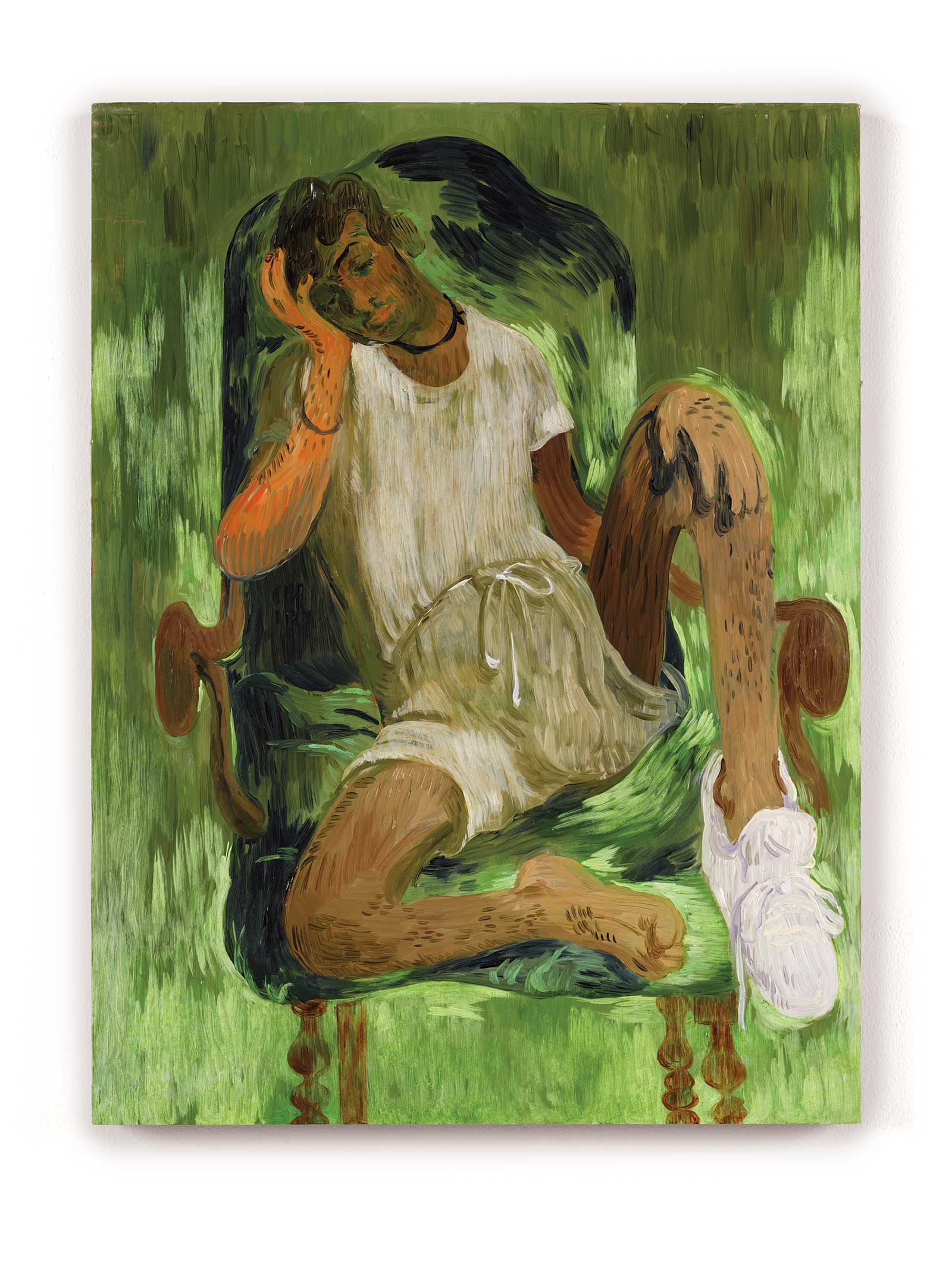
Seated Boy with Sneaker, 2021, oil on panel, 24 x18”. Collection of Charlotte and Herbert S. Wagner III. © Salman Toor; Courtesy of the artist and Lurhing Augustine, New York.
Ankori notes that works like Boys in Bed are “imbued with sensuality and vulnerability, showcasing the artist’s deep art historical knowledge, spanning European, American and South Asian traditions.”
One of Toor’s trademarks is his lavish use of greens. He told the New Yorkerthat he had a moment in his studio in 2018 when he decided to take the green he had only used in shadows and make whole paintings in green. “One of the things I like about green is that it can be very hot and very cold,” Toor said in the article. “With green, there’s a flickering light that’s nocturnal, and poisonous (think of absinthe), and also jewel-like—emeralds and jade.”
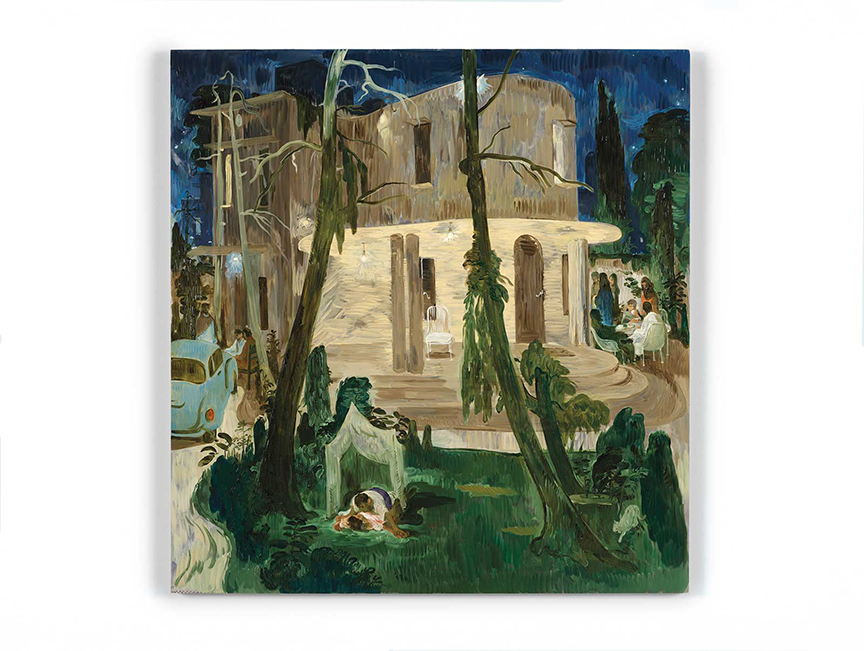
Back Lawn, 2021, oil on panel, 50 x 48”. © Salman Toor; Courtesy of the artist and Lurhing Augustine, New York.
A great example of the many shades and possibilities of green can be found in The Latecomer. A man dressed all in white, including very white shoes, enters a sultry bar and lounge. A syrupy green atmosphere surrounds clusters of presumably queer people engaged in chatting or kissing. One figure appears to have a kind of Picasso-esque cubist head, while another flings an arm up and back reminiscent of a Matisse dancer or a Henri Moore sculpture. In another grouping, one person takes a cell phone picture of two others; the flash of the camera makes a phosphorescent gleam. Meanwhile the main figure’s face is blurry. His body language seems apprehensive and yet not threatened. He’s not a newcomer to this convivial queer scene, merely late to arrive.
A review of Toor’s 2020 show at the Whitney in the New York Review of Books noted, “The spirit and appearance of Jesus Christ and of Pinocchio, two figures who are rarely found in the same sentence, both can be felt in Salman Toor’s paintings.” Similarly, The Latecomerseems to reference Jesus, maybe suggesting the transgressive idea that the Second Coming might occur in a gay bar in New York City.
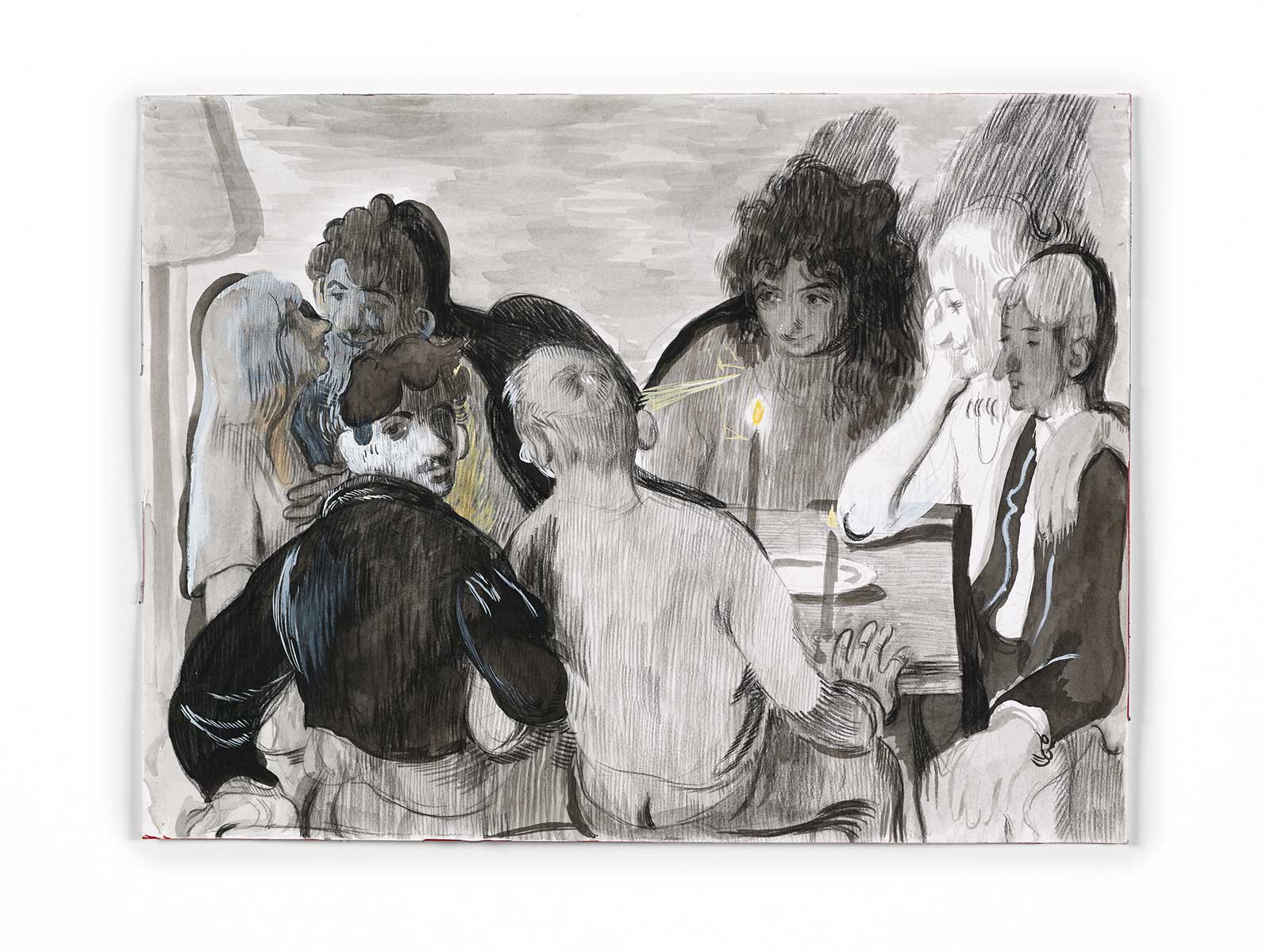
Among Friends, 2022, charcoal and ink on paper, 121/8 x 16”. © Salman Toor; Courtesy of the artist and Lurhing Augustine, New York.
Ankori says Toor is one of his generation’s most influential painters. “His paintings and drawings are brilliantly executed, with unparalleled color palettes and brushstrokes,” she says. “Toor is also incredibly sophisticated. Well-versed in art histories from different epochs and cultures, he positions his art in dialogue with conventional genres and tropes, even as he undermines and reinvents them.”
One overt example of Toor’s mashup of queer culture and art history can be observed in Museum Boys. In this painting, Toor uses one of his favorite devices, what he calls “fag puddles.” In this scene, two naked men sleep inside a display case at a museum. Their bodies are tumbled together with an 18th-century dress shoe and a urinal (a nod to Duchamp). Two half-clothed men observe the readymade tableau vivant. The figure who faces the viewer is missing a shoe. Forbes Magazine noted that the painting “borrows from Johannes Vermeer, evoking a contemporary reimagining of the Dutch Baroque period painter’s specialization in domestic interior scenes of middle-class life.”
Shoelessness is a Toor motif. The painting Seated Boy with Sneakershows a young man seated on a formal armchair, dressed only in a white T-shirt and shorts with his legs drawn up. One white sneaker on his left foot, the other foot naked. The figure rests his head in one hand. He looks depressed and defeated. Has he given all he had to give to someone who took his love?
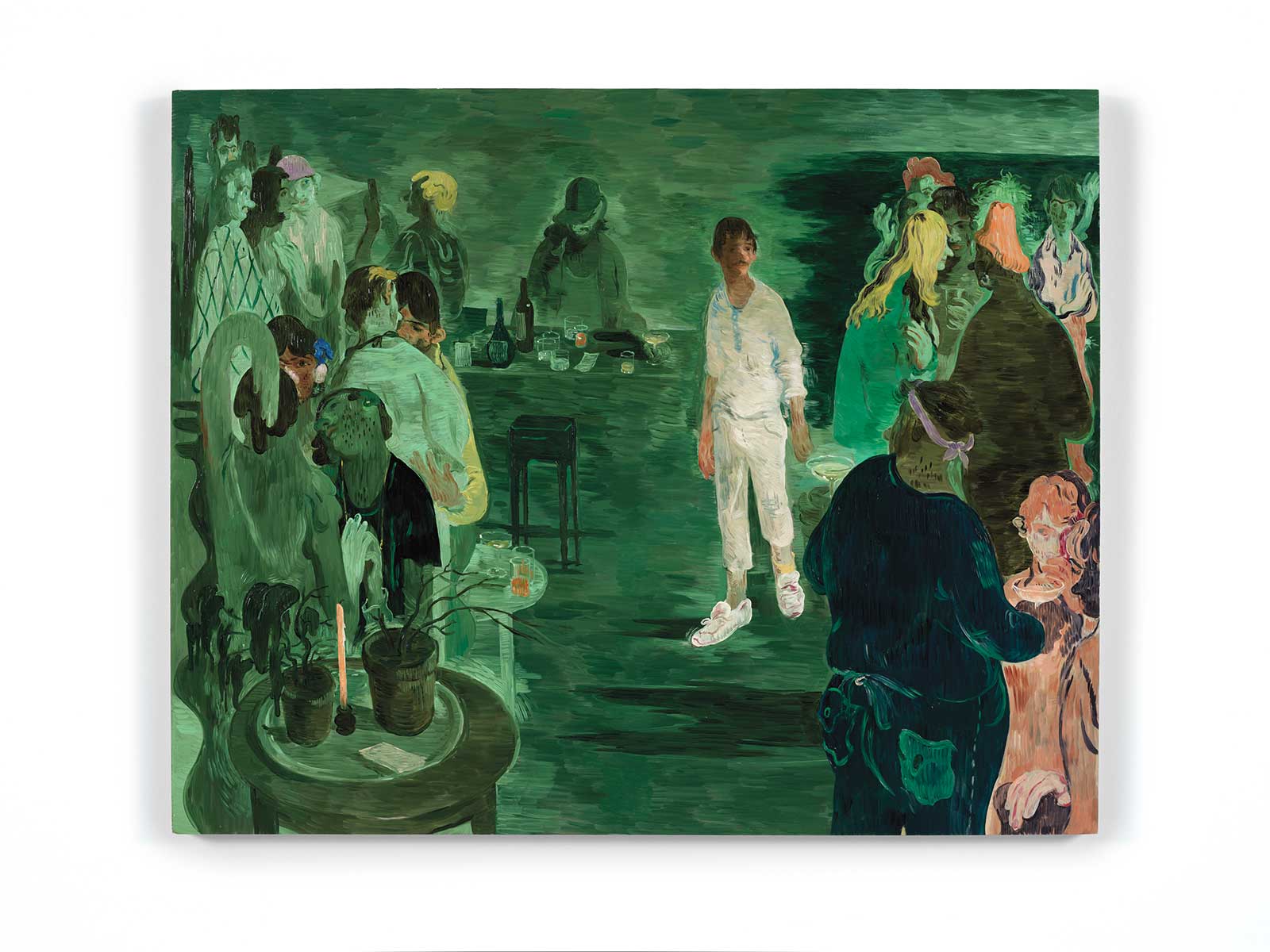
The Latecomer, 2021, oil on panel, 48 x 60”. Collection of John Auerbach and Ed Tang. © Salman Toor; Courtesy of the artist and Lurhing Augustine, New York.
Toor creates interior views, even when presenting outdoor scenes. His figures appear in enclosed spaces—from a lover’s arms to a bed to a clearing in a forest. Some of these are safe spaces, where gay men can embrace and socialize or make love. But in Night Capture, the enclosed space is one of danger. A parked car’s headlights illuminate a scene of a man on his back in distress. His feet are bare and a few yards away lies an effeminate boot. Two men stand nearby while another tends to the fallen man—or is that his assailant? The men all appear to be South Asian. This is a scene of violence, and we might infer a homophobic assault. But Toor leaves the story open to interpretation, leaving the viewer with the uneasy sense of voyeurism.
Ankori says the exhibition fits into the Rose’s overall programming. Salman Toor’s Pakistani childhood; immigration to the United States, and current life amid the South Asian Queer diaspora in New York resonates with members of our community,” she says.
Known for its excellent collection of modern art, the Rose will contextualize Toor’s work by also displaying works from the museum’s permanent collection. Ankori says those works will range “from Goya’s etchings, a Cézanne painting of a nude man, Philip Guston’s piles, and Nicole Eisenman’s grotesque drawings.”
The Rose also presents the work of contemporary artists from across the globe. Toor’s exhibition follows a show devoted to a young Iranian artist, Arghavan Khosravi, and will be followed by an installation created by an indigenous Mexican artist, Noé Martínez.
The Rose will host a public reception on Thursday, November 16, at 6 p.m. Acclaimed writers Evan Moffitt and Hanya Yanagihara contributed essays to the exhibition’s accompanying illustrated catalog. —
Salman Toor: No Ordinary Love
When: November 16, 2023–February 11, 2024
Where: Rose Art Museum, Brandeis University 415 South Street, Waltham, MA 02453
Information: (718) 736-3434, www.brandeis.edu/rose
Powered by Froala Editor